Within Distance
Why the Same UFO Angle Can Mean Any Size
A small nearby object and a large distant one can occupy the same angle in the sky, making physical size unknowable without range.
On this page
- How angular size differs from physical width
- Small angle examples at different distances
- What witnesses can measure defensibly
Page outline Jump by section
Introduction
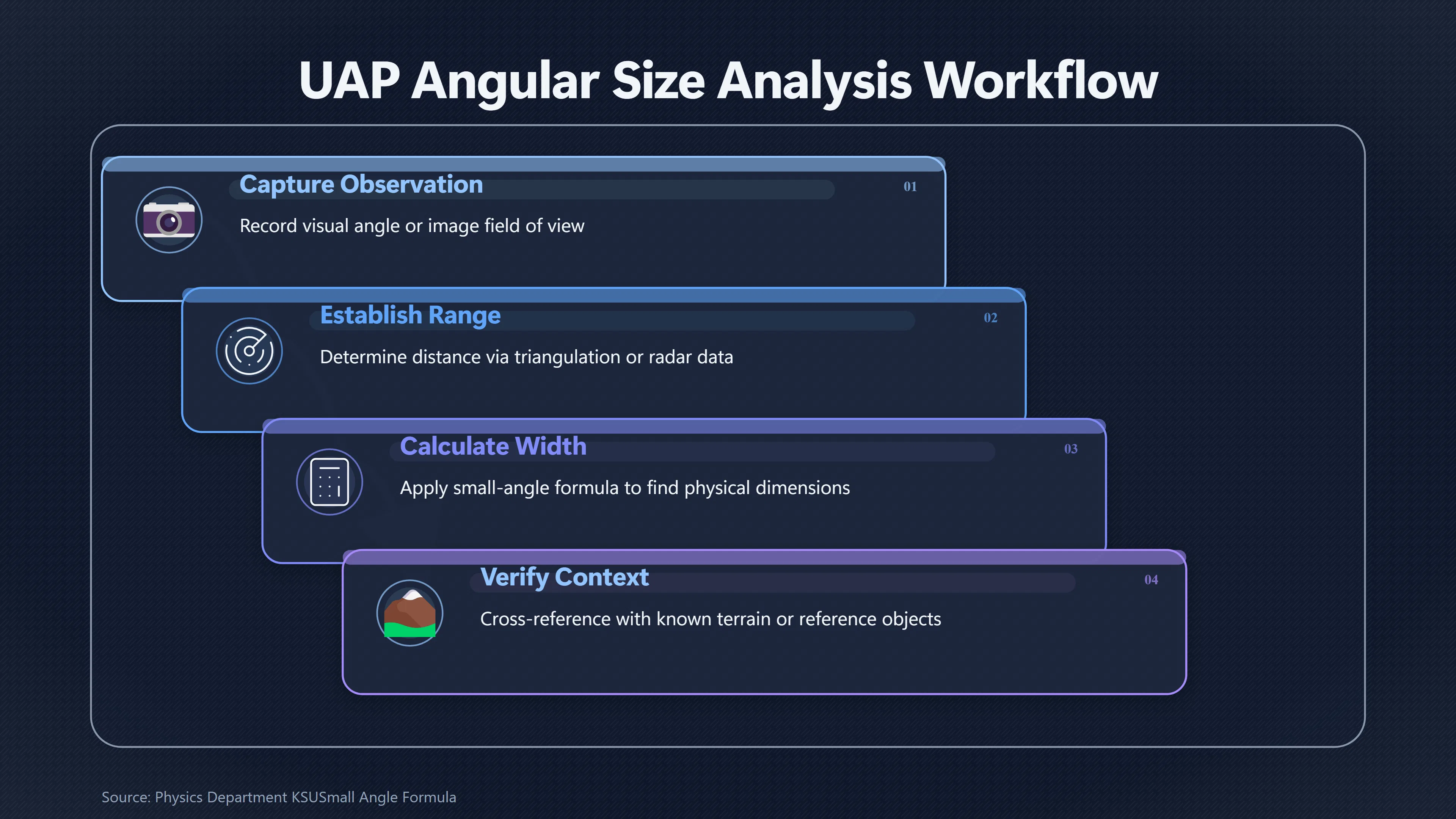
A UFO or UAP that looks extremely large is not necessarily a large object. What an eyewitness or an ordinary camera can usually establish directly is its angular size: the angle that the object, light or image occupies in the observer’s field of view. A small nearby object and a much larger distant object can subtend exactly the same angle. Without an independent measurement of distance, there is no unique conversion from that angle into metres. This is ordinary geometry, expressed by the small-angle relationship between angular width, physical width and range.[Imaging the Universe]itu.physics.uiowa.eduImaging the Universe Small Angle Formula | Imaging the UniverseImaging the UniverseSmall Angle Formula | Imaging the Universe - Physics and Astronomy | The University of Iowa…
That distinction matters particularly in UFO reports because witnesses commonly describe an object’s apparent dimensions by comparing it with an aircraft, building or football pitch. Such descriptions may express a genuine impression, but they implicitly contain a distance judgement. If that range estimate is wrong by a factor of ten, the inferred physical size will also be wrong by roughly a factor of ten. The All-domain Anomaly Resolution Office (AARO) specifically warns that forced perspective can produce reports of excessively large UAP, while recent UAP research recommendations favour recording angular size rather than asking witnesses to presume exact dimensions.[AARO]aaro.milUAP RecordsUAP Records/Information Papers8 Jul 2026 — Effect of Forced Perspective… forced perspective and parallax can frequently explain ex…
How angular size differs from physical width
Angular size describes how much of the sky an object covers, not how many metres wide it is. For an object whose width is small compared with its distance, the relationship is approximately:
physical width ≈ distance × angular width in radians
Equivalently:
angular width ≈ physical width ÷ distance[aaro.mil]aaro.milSource details in endnotes.
The University of Iowa’s astronomy material gives this as the small-angle formula and notes that it is appropriate when the angle is small or the object’s distance is much greater than its physical dimensions. Crucially, the formula can determine physical size only when distance is already known, or determine distance when physical size is independently known.[Imaging the Universe]itu.physics.uiowa.eduImaging the Universe Small Angle Formula | Imaging the UniverseImaging the UniverseSmall Angle Formula | Imaging the Universe - Physics and Astronomy | The University of Iowa…
That produces an important degeneracy in UFO observations. Imagine that an object spans about 0.57°, or 0.01 radians. All of these approximate combinations produce the same apparent width:
Physical widthDistanceAngular width10 cm10 m0.57°1 m100 m0.57°10 m1 km0.57°100 m10 km0.57°
From angular width alone, there is no geometrical way to choose between them. Multiplying both the object’s width and its distance by the same factor leaves essentially the same angular size. This is why an observation cannot normally progress from “it covered this much of my view” to “therefore it was 100 metres across” without supplying additional range evidence.[Physics Department KSU]phys.ksu.eduPhysics Department KSUSmall Angle FormulaPhysics Department KSUSmall Angle Formula
A useful familiar benchmark is the full Moon. NASA gives its angular diameter as approximately half a degree.[NASA Science]science.nasa.govScience XDF Moon ComparisonNASA ScienceXDF Moon ComparisonSeptember 25, 2012 — This image compares the angular size of the XDF field to the angular size of the full… A UFO reported as “about the apparent width of the Moon” therefore provides potentially useful angular information: it was reported as spanning roughly 0.5°. But that statement says nothing by itself about the object’s physical dimensions. At 100 metres, 0.5° corresponds to a width of about 0.87 metres; at 1 kilometre, about 8.7 metres; at 10 kilometres, about 87 metres.
The Moon itself demonstrates why intuition can be misleading. A finger or thumb held close to the eye can conceal an astronomical body hundreds of thousands of kilometres away because apparent size depends on the ratio of width to distance, not physical width alone. NASA notes that the Moon’s half-degree diameter is only about half the width of a finger held at arm’s length.[NASA Science]science.nasa.govScience XDF Moon ComparisonNASA ScienceXDF Moon ComparisonSeptember 25, 2012 — This image compares the angular size of the XDF field to the angular size of the full…
The same UFO angle can imply radically different sizes
The ambiguity becomes more striking when a witness’s initial range assumption changes. Suppose a light or silhouette subtends 1°.
If it really is 100 metres away, its corresponding width is approximately 1.75 metres. At 500 metres, it is about 8.7 metres. At 5 kilometres, it becomes roughly 87 metres. At 20 kilometres, it would be about 350 metres.
Nothing about the 1° angular measurement itself distinguishes those possibilities. The dramatic change in physical dimensions comes entirely from changing the assumed range. Conversely, if investigators can independently establish the object’s distance, the same angular measurement suddenly becomes powerful evidence: once range is known, physical size can be calculated.
This distinction explains why “larger than an airliner” can be much less secure than it sounds in a sighting report. If an unfamiliar object is assumed to be several kilometres away, the brain may interpret its observed angle as belonging to something physically enormous. If the same angular stimulus actually comes from a small object much closer to the observer, the resulting linear-size estimate can be grossly inflated.
AARO now explicitly treats this geometry as relevant to UAP analysis. Its information material states that forced perspective and parallax can frequently account for excessively large sizes or high speeds described in reports, although it also cautions that no single explanation accounts for every UAP case.[AARO]aaro.milUAP RecordsUAP Records/Information Papers8 Jul 2026 — Effect of Forced Perspective… forced perspective and parallax can frequently explain ex… The useful point is therefore not that every large-UFO report is a nearby small object. It is that large apparent physical size cannot be established from angular appearance when range remains uncertain.
Why eyewitness intuition does not solve the distance problem
In ordinary life, people rarely notice this ambiguity because vision uses more than angular size. The visual system combines information about perspective, familiar objects, relative movement and other cues when judging distance and scale. Experimental research has repeatedly found interactions between perceived size, perceived distance and visual angle rather than a simple one-to-one translation from retinal image to physical dimensions.[PubMed]pubmed.ncbi.nlm.nih.govPub Med Perceptual distance and the constancy of size and stereoscopic depthPerceptual distance and the constancy of size and stereoscopic depth - PubMed…
Familiar size is especially useful. A car that occupies a particular angle can be assigned a plausible range partly because the observer already knows approximately how large cars are. Experiments have shown that familiarity influences judgements of both size and distance.[DOI]doi.orgThe Effect of Object Familiarity on the Perception of Size and DistanceThe Effect of Object Familiarity on the Perception of Size and Distance An unidentified object creates the opposite problem: if its real dimensions are unknown, familiar size cannot supply an independent scale.
Other depth information can also disappear in the circumstances associated with many aerial observations. The US Federal Aviation Administration lists comparative size and shape of known objects, relative retinal motion and interposition among visual references used to perceive distance, speed and depth.[Federal Aviation Administration]faa.govFederal Aviation Administration Spatial Disorientation: Visual IllusionsFederal Aviation Administration Spatial Disorientation: Visual Illusions An isolated light against an otherwise poorly referenced sky can therefore remove exactly the contextual information that would normally help an observer decide whether something is small and close or large and distant.
Aviation provides practical evidence that such errors are not merely theoretical. FAA guidance warns that at night, bright runway or approach lights surrounded by relatively few terrain lights can produce an illusion that the runway is closer than it actually is. Its flying handbook likewise describes night-time difficulty in judging distance and visual illusions created by lighting.[Federal Aviation Administration]faa.govOpen source on faa.gov. Pilots are trained to recognise these effects precisely because expertise does not abolish the underlying limitations of visual geometry.
For UFO analysis, the implication is narrow but important. A witness can be entirely sincere and accurately describe the angle, brightness or movement that was perceived while still being wrong about physical size. The weak link can be the inferred range rather than the observation itself.
Cameras do not automatically provide metres
A photograph or video can improve angular measurement because the image can sometimes be calibrated against the camera’s field of view, focal length or known objects in the scene. It does not, however, automatically reveal range. A 20-pixel-wide object can represent something small nearby or something much larger farther away, just as with naked-eye observation.
NASA’s independent UAP study therefore emphasised systematic calibration, multiple measurements and sensor metadata rather than treating imagery alone as sufficient. The study noted that near-simultaneous observations from multiple smartphones could potentially be combined with metadata to triangulate an object’s location, after which its velocity and size could be estimated.[NASA]nasa.govupdate nasa shares uap independent study report names directorupdate nasa shares uap independent study report names director The sequence matters: establish location or range, then turn angular measurements into physical dimensions.
AARO’s published UAP material illustrates the same distinction. In one official imagery description, AARO noted that an area of contrast increased in apparent size while the observing platform was closing its distance to the source; the sensor also changed to a narrower field of view. An enlarging image therefore did not, by itself, imply that the object itself was growing.[AARO]aaro.milNext UAP Report DocumentsNext UAP Report Documents
There is an additional complication when the UFO is merely a bright or poorly resolved light. Optical systems represent point-like sources through a point-spread function, meaning that the recorded patch of light has dimensions determined partly by the optics, atmosphere, detector and processing rather than by the source’s physical boundary. Point-spread-function modelling is consequently essential in astronomy when accurate object properties are required.[arXiv]arxiv.orgOpen source on arxiv.org. A fuzzy disc around an unresolved light should not therefore be casually converted from pixels into the diameter of a solid craft.
What witnesses can measure defensibly
The strongest eyewitness account separates what was actually seen from quantities inferred afterwards. Instead of beginning with “the craft was 50 metres across”, a more useful report records how much of the observer’s view it occupied and explains the comparison used.
A practical description might be: “Its apparent width was roughly the diameter of the full Moon”, or “about twice the Moon’s apparent width”. Because the Moon is approximately 0.5° across, these descriptions preserve an approximate angular measurement without pretending that distance is known.[NASA Science]science.nasa.govScience XDF Moon ComparisonNASA ScienceXDF Moon ComparisonSeptember 25, 2012 — This image compares the angular size of the XDF field to the angular size of the full…
This approach is increasingly reflected in UAP data practice. AARO’s 2025 UAP workshop paper recommends framing witness questions around what was perceived — including angular size, shape and movement — rather than presumed properties such as exact distance or solid-object dimensions. It also recommends allowing an “unknown” response instead of encouraging witnesses to manufacture information they do not possess.[AARO]aaro.mil2025 UAP Workshop: Narrative Data, Infrastructures, and…Frame questions around what was perceived (angular size, shape, movement…
For an angular-size report to be useful, the witness should ideally preserve several distinctions:
- Angular width: how much of the visual field the object occupied, preferably using a repeatable comparison.
- Range evidence: whether distance was measured, constrained by landmarks, inferred from apparent position, or merely felt intuitively.
- Resolved shape versus light: whether genuine edges and structure were visible or the object was essentially an unresolved luminous source.
- Reference conditions: whether stars, buildings, terrain, clouds or other objects supplied meaningful scale or depth cues.
- Imaging information: for photographs or videos, the original file, zoom state, field of view and other available sensor metadata.
The crucial discipline is to keep angular size and physical size separate until there is evidence connecting them. Historical UFO material sometimes did this explicitly: archived UFO accounts record angular estimates such as an object appearing about one degree across, or comparisons with the apparent diameter of the full Moon.[CIA]cia.govOpen source on cia.gov. Whatever one concludes about those individual reports, expressing the observation in angular terms preserves information that can later be tested without building an assumed distance into the measurement.
When a large-size estimate becomes credible
Unknown range does not mean physical size can never be determined. It means that another measurement has to break the size-distance ambiguity.
Two separated, synchronised observing positions can potentially triangulate a target. Radar or another calibrated ranging system can supply distance directly under suitable conditions. A well-constrained trajectory relative to known terrain may establish useful limits. In imagery, a genuinely co-located reference object of known dimensions can sometimes provide scale. AARO’s Puerto Rico case analysis, for example, describes using pixel analysis and comparisons with objects of known dimensions to estimate that the objects under study were smaller than one metre.[AARO]aaro.milPuerto Rico UAP Case ResolutionPuerto Rico UAP Case Resolution
NASA’s UAP study similarly highlighted the value of multiple near-simultaneous observations because triangulation can estimate an object’s location and thereby permit estimates of size and velocity.[NASA Science]science.nasa.govOpen source on nasa.gov. This is fundamentally different from simply asking a lone witness how many metres across something “looked”.
That distinction provides a straightforward credibility test for spectacular size claims. When a UFO is described as 30, 100 or 300 metres wide, the immediate question is not whether the witness seemed trustworthy. It is how the range was established. If the answer is radar, triangulation or another independently calibrated measurement, the linear dimensions may be testable. If the answer is essentially “it looked that far away”, the numerical size remains dependent on an unverified assumption.
Angular size itself can still be valuable evidence. It records something much closer to the observation that actually reached the eye or sensor. What it cannot do alone is tell investigators whether they are dealing with a small object nearby or a much larger one farther away. That missing distance is exactly how an ordinary object can acquire extraordinary dimensions in a UFO report.
Amazon book picks
Further Reading
Books and field guides related to Why the Same UFO Angle Can Mean Any Size. Use these as the next step if you want deeper reading beyond the article.
The UFO Experience: A Scientific Inquiry
Cited by the New York Review of Books as "the best brief for visitation," this classic study presents an analysis of UFO reports and conc...
Optics
For courses in Optics A Contemporary Approach to Optics with Practical Applications and New Focused Pedagogy Hecht Optics balances theory...
Sensation and Perception
. Bruce Goldstein's SENSATION AND PERCEPTION, the best-seller which has helped over 150,000 students understand the ties between how we s...
Fundamentals of Astrodynamics
Rating: 4.5/5 from 12 Google Books ratings
Teaching text developed by U.S. Air Force Academy and designed as a first course emphasizes the universal variable formulation. Develops...
eBay marketplace picks
Marketplace Samples
Live-tested eBay searches with available results related to this page.
Selected fromUFO model oneBay.co.uk.
Endnotes
1.
Source: phys.ksu.edu
Title: Physics Department KSUSmall Angle Formula
Link:https://www.phys.ksu.edu/personal/wysin/astro/small_angle.html
2.
Source: aaro.mil
Title: UAP Records
Link:https://www.aaro.mil/UAP-Records/
Source snippet
UAP Records/Information Papers8 Jul 2026 — Effect of Forced Perspective... forced perspective and parallax can frequently explain ex...
3.
Source: aaro.mil
Link:https://www.aaro.mil/Portals/136/PDFs/Information%20Papers/2025_UAP_Workshop_Paper.pdf
Source snippet
2025 UAP Workshop: Narrative Data, Infrastructures, and...Frame questions around what was perceived (angular size, shape, movement...
4.
Source: science.nasa.gov
Title: Science XDF Moon Comparison
Link:https://science.nasa.gov/asset/hubble/xdf-moon-comparison/
Source snippet
NASA ScienceXDF Moon ComparisonSeptember 25, 2012 — This image compares the angular size of the XDF field to the angular size of the full...
Published: September 25, 2012
5.
Source: doi.org
Title: The Effect of Object Familiarity on the Perception of Size and Distance
Link:https://doi.org/10.1080/14640746908400218
6.
Source: faa.gov
Title: Federal Aviation Administration Spatial Disorientation: Visual Illusions
Link:https://www.faa.gov/pilots/safety/pilotsafetybrochures/media/spatiald_visillus.pdf
7.
Source: faa.gov
Link:https://www.faa.gov/air_traffic/publications/atpubs/aim_html/chap8_section_1.html
8.
Source: faa.gov
Link:https://www.faa.gov/sites/faa.gov/files/regulations_policies/handbooks_manuals/aviation/airplane_handbook/12_afh_ch11.pdf
9.
Source: nasa.gov
Title: update nasa shares uap independent study report names director
Link:https://www.nasa.gov/news-release/update-nasa-shares-uap-independent-study-report-names-director/
10.
Source: science.nasa.gov
Link:https://science.nasa.gov/wp-content/uploads/2023/09/uap-independent-study-team-final-report.pdf?emrc=80696d
11.
Source: aaro.mil
Title: Next UAP Report Documents
Link:https://www.aaro.mil/Next-AARO-Home-redesign/Next-Parent/Next-UAP-Report-Documents/
12.
Source: arxiv.org
Link:https://arxiv.org/abs/2306.07996
13.
Source: cia.gov
Link:https://www.cia.gov/readingroom/document/cia-rdp81r00560r000100010001-0
14.
Source: aaro.mil
Title: Puerto Rico UAP Case Resolution
Link:https://www.aaro.mil/Portals/136/PDFs/case_resolution_reports/AARO_Puerto_Rico_UAP_Case_Resolution.pdf
15.
Source: science.nasa.gov
Title: hubble glossary
Link:https://science.nasa.gov/mission/hubble/multimedia/hubble-glossary/
16.
Source: nasa.gov
Title: Small Steps, Giant Leaps: Episode 176: Calibrating Satellite Image Data
Link:https://www.nasa.gov/podcasts/small-steps-giant-leaps/small-steps-giant-leaps-episode-176-calibrating-satellite-image-data/
17.
Source: science.nasa.gov
Title: spectrometer characteristics
Link:https://science.nasa.gov/mission/portable-remote-imaging-spectrometer-prism/spectrometer-characteristics/
18.
Source: aaro.mil
Link:https://www.aaro.mil/Next-AARO-Home-redesign/Next-Parent/Next-AARO-UAP-Imagery-Acc-Table/
19.
Source: aaro.mil
Link:https://www.aaro.mil/Next-AARO-Home-redesign/Next-Parent/Next-UAP-Report-Documents/poster/dividLink/
20.
Source: science.nasa.gov
Link:https://science.nasa.gov/uap/
21.
Source: science.nasa.gov
Title: daily moon guide
Link:https://science.nasa.gov/moon/daily-moon-guide/
22.
Source: aaro.mil
Link:https://www.aaro.mil/Next-AARO-Home-redesign/Next-Parent/Presidential-UAP-Transparency-Initiative/dvpmoduleid/77396/
23.
Source: svs.gsfc.nasa.gov
Link:https://svs.gsfc.nasa.gov/5588
24.
Source: nasa.gov
Title: Antenna Range Technical Data
Link:https://www.nasa.gov/jpl/mesa/antenna-range/
25.
Source: science.nasa.gov
Title: photographing the moon illusion
Link:https://science.nasa.gov/resource/photographing-the-moon-illusion/
26.
Source: giss.nasa.gov
Link:https://www.giss.nasa.gov/pubs/abs/mc01300f.html
27.
Source: aaro.mil
Link:https://www.aaro.mil/Next-AARO-Home-redesign/Next-Parent/Presidential-UAP-Transparency-Initiative/videoid/1014097/dvpcc/false/
28.
Source: aaro.mil
Link:https://www.aaro.mil/Next-AARO-Home-redesign/Next-Parent/Presidential-UAP-Transparency-Initiative/videoid/1006106/dvpcc/false/
29.
Source: doi.org
Link:https://doi.org/10.5281/Zenodo.10287332
30.
Source: science.nasa.gov
Title: five things to know about the moon
Link:https://science.nasa.gov/solar-system/moon/five-things-to-know-about-the-moon/
31.
Source: aaro.mil
Link:https://www.aaro.mil/Next-AARO-Home-redesign/Next-Parent/Presidential-UAP-Transparency-Initiative/videoid/1006105/dvpmoduleid/77396/
32.
Source: moon.nasa.gov
Title: phases of the moon
Link:https://moon.nasa.gov/resources/54/phases-of-the-moon/
33.
Source: nasa.gov
Title: Dimensional Calibration
Link:https://www.nasa.gov/centers-and-facilities/white-sands/dimensional-calibration/
34.
Source: faa.gov
Title: Chapter 8. Medical Facts for Pilots
Link:https://www.faa.gov/air_traffic/publications/atpubs/aim/aim0801.html
35.
Source: faa.gov
Link:https://www.faa.gov/air_traffic/publications/atpubs/aim/aim0705.html
36.
Source: uavsar.jpl.nasa.gov
Link:https://uavsar.jpl.nasa.gov/science/documents/calibration.html
37.
Source: faa.gov
Title: Bell 206B-3 Jet Ranger III | Federal Aviation Administration
Link:https://www.faa.gov/lessons_learned/rotorcraft/accidents/N828AC
38.
Source: apod.nasa.gov
Link:https://apod.nasa.gov/apod/ap080801.html
39.
Source: pwg.gsfc.nasa.gov
Link:https://pwg.gsfc.nasa.gov/stargaze/Sshadow.htm
40.
Source: heasarc.gsfc.nasa.gov
Title: pspc psf faq1
Link:https://heasarc.gsfc.nasa.gov/docs/rosat/faqs/pspc_psf_faq1.html
41.
Source: ntrs.nasa.gov
Link:https://ntrs.nasa.gov/search.jsp?R=19930016547
42.
Source: ntrs.nasa.gov
Link:https://ntrs.nasa.gov/citations/19930000203
43.
Source: faa.gov
Title: Office of Aerospace Medicine Technical Reports | Federal Aviation Administration
Link:https://www.faa.gov/data_research/research/med_humanfacs/oamtechreports/1970s/1978/197815
44.
Source: ntrs.nasa.gov
Link:https://ntrs.nasa.gov/citations/19750052232
45.
Source: arxiv.org
Link:https://arxiv.org/html/2411.02401v1
46.
Source: eclipse2017.nasa.gov
Title: exploring angular diameter
Link:https://eclipse2017.nasa.gov/exploring-angular-diameter
47.
Source: impact.earthdata.nasa.gov
Link:https://impact.earthdata.nasa.gov/casei/instrument/APU/
48.
Source: eclipse2017.nasa.gov
Title: last total solar eclipse earth
Link:https://eclipse2017.nasa.gov/last-total-solar-eclipse-earth
49.
Source: eclipse2017.nasa.gov
Title: what’s many moons
Link:https://eclipse2017.nasa.gov/what%27s-many-moons
50.
Source: www1.grc.nasa.gov
Link:https://www1.grc.nasa.gov/beginners-guide-to-aeronautics/moon/
51.
Source: esdpubs.nasa.gov
Title: Advanced Microwave Precipitation Radiometer
Link:https://esdpubs.nasa.gov/instrument/Advanced_Microwave_Precipitation_Radiometer
52.
Source: science.nasa.gov
Title: xdf moon comparison 2
Link:https://science.nasa.gov/asset/hubble/xdf-moon-comparison-2/
53.
Source: ntrs.nasa.gov
Link:https://ntrs.nasa.gov/api/citations/19780020077/downloads/19780020077.pdf
54.
Source: science.nasa.gov
Title: hubble astronomers assemble wide view of the evolving universe
Link:https://science.nasa.gov/missions/hubble/hubble-astronomers-assemble-wide-view-of-the-evolving-universe/
55.
Source: apod.nasa.gov
Link:https://apod.nasa.gov/apod/ap171115.html
56.
Source: science.nasa.gov
Title: hubble legacy field relative size on the sky
Link:https://science.nasa.gov/asset/hubble/hubble-legacy-field-relative-size-on-the-sky/
57.
Source: solarsystem.nasa.gov
Title: govht Ma ansit r T
Link:https://solarsystem.nasa.gov/rails/active_storage/disk/eyJfcmFpbHMiOnsibWVzc2FnZSI6IkJBaDdDVG9JYTJWNVNTSXBNVEExWXpOaE16Z3RZekUxTXkwME9UZzFMVGd4T0dFdE1HWXpNMlJoWlRoaU5qWXhCam9HUlZRNkVHUnBjM0J2YzJsMGFXOXVTU0pQWVhSMFlXTm9iV1Z1ZERzZ1ptbHNaVzVoYldVOUlsUnlZVzV6YVhSZlRXRjBhQzV3WkdZaU95Qm1hV3hsYm1GdFpTbzlWVlJHTFRnbkoxUnlZVzV6YVhSZlRXRjBhQzV3WkdZR093WlVPaEZqYjI1MFpXNTBYM1I1Y0dWSkloUmhjSEJzYVdOaGRHbHZiaTl3WkdZR093WlVPaEZ6WlhKMmFXTmxYMjVoYldVNkNteHZZMkZzIiwiZXhwIjpudWxsLCJwdXIiOiJibG9iX2tleSJ9fQ%3D%3D–33d968070f47d1a408c661da72d504583ff25ef9/Transit_Math.pdf
58.
Source: science.nasa.gov
Title: messier 31
Link:https://science.nasa.gov/mission/hubble/science/explore-the-night-sky/hubble-messier-catalog/messier-31/
59.
Source: science.nasa.gov
Title: apod 2024 july 6 ngc 7789 caroline s rose
Link:https://science.nasa.gov/image-article/apod-2024-july-6-ngc-7789-caroline-s-rose/
60.
Source: nasa.gov
Link:https://www.nasa.gov/wp-content/uploads/2025/08/2022-agency-foia-log.xlsx?emrc=93a4ff
61.
Source: ntrs.nasa.gov
Link:https://ntrs.nasa.gov/api/citations/20110002751/downloads/20110002751.pdf
62.
Source: ntrs.nasa.gov
Link:https://ntrs.nasa.gov/api/citations/20050202011/downloads/20050202011.pdf?attachment=true
63.
Source: faa.gov
Link:https://www.faa.gov/data_research/research/med_humanfacs/oamtechreports/1960s/1966/196624
64.
Source: faa.gov
Link:https://www.faa.gov/data_research/research/med_humanfacs/oamtechreports/1960s/1962/196215
65.
Source: faa.gov
Link:https://www.faa.gov/data_research/research/med_humanfacs/oamtechreports/1960s/1966/196638
66.
Source: faa.gov
Link:https://www.faa.gov/data_research/research/med_humanfacs/oamtechreports/1960s/1967/196718
67.
Source: faa.gov
Link:https://www.faa.gov/air_traffic/publications/atpubs/aip_html/part2_enr_section_5.3.html
68.
Source: faa.gov
Link:https://www.faa.gov/sites/faa.gov/files/about/office_org/headquarters_offices/avs/SD_UAV-EV1.pdf
69.
Source: faa.gov
Title: 20220622 ARAC ACSWG CtA Final Recommendation Report
Link:https://www.faa.gov/regulations_policies/rulemaking/committees/documents/media/20220622%20ARAC%20ACSWG%20CtA%20Final%20Recommendation%20Report.pdf
70.
Source: faa.gov
Link:https://www.faa.gov/sites/faa.gov/files/data_research/research/med_humanfacs/oamtechreports/AM81-06.pdf
71.
Source: faa.gov
Link:https://www.faa.gov/sites/faa.gov/files/data_research/research/med_humanfacs/oamtechreports/AM78-15.pdf
72.
Source: faa.gov
Link:https://www.faa.gov/sites/faa.gov/files/data_research/research/med_humanfacs/oamtechreports/AM82-06.pdf
73.
Source: faa.gov
Title: pilot vision
Link:https://www.faa.gov/pilots/safety/pilotsafetybrochures/media/pilot_vision.pdf
74.
Source: faa.gov
Link:https://www.faa.gov/sites/faa.gov/files/data_research/research/med_humanfacs/oamtechreports/AM77-12.pdf
75.
Source: faa.gov
Link:https://www.faa.gov/air_traffic/publications/atpubs/aip_html/chap7_section_6.html
76.
Source: aaro.mil
Link:https://www.aaro.mil/UAP-Cases/Official-UAP-Imagery/4/
77.
Source: aaro.mil
Link:https://www.aaro.mil/FAQ/
78.
Source: aaro.mil
Link:https://www.aaro.mil/Next-AARO-Home-redesign/Next-Parent/Next-AARO-UAP-Imagery-Fixed-Table/
79.
Source: aaro.mil
Link:https://www.aaro.mil/UAP-Cases/Official-UAP-Imagery/ftag/MSF0951a18/
80.
Source: aaro.mil
Link:https://www.aaro.mil/UAP-Records/-1/
81.
Source: aaro.mil
Title: AAR O UAP Trends All-domain Anomaly Resolution Office UAP REPORTING TRENDS
Link:https://www.aaro.mil/UAP-Cases/UAP-Reporting-Trends/
82.
Source: aaro.mil
Link:https://www.aaro.mil/Next-AARO-Home-redesign/Inactive-Parent/Next-UAP-Imagery-dup/
83.
Source: aaro.mil
Link:https://www.aaro.mil/Next-AARO-Home-redesign/Next-Parent/Next-AARO-UAP-Trends/
84.
Source: aaro.mil
Link:https://www.aaro.mil/Next-AARO-Home-redesign/Bruce-working/Next-AARO-UAP-Trends-Charts/
85.
Source: aaro.mil
Link:https://www.aaro.mil/UAP-Cases/Official-UAP-Imagery/
86.
Source: aaro.mil
Link:https://www.aaro.mil/Portals/136/PDFs/FOIA/2023%20FOIAs/23-F-0010.pdf
87.
Source: aaro.mil
Title: AARO Historical Record Report Vol 1 2024
Link:https://www.aaro.mil/Portals/136/PDFs/AARO_Historical_Record_Report_Vol_1_2024.pdf
88.
Source: doi.org
Link:https://doi.org/10.1167/jov.21.10.21
89.
Source: cia.gov
Title: CIA RDP81R00560R000100010001 0
Link:https://www.cia.gov/readingroom/docs/CIA-RDP81R00560R000100010001-0.pdf
90.
Source: faa.gov
Title: Aerospace Medicine Technical Reports | Federal Aviation Administration
Link:https://www.faa.gov/data_research/research/med_humanfacs/oamtechreports/1960s/1967/196720
91.
Source: faa.gov
Title: Aerospace Medicine Technical Reports | Federal Aviation Administration
Link:https://www.faa.gov/data_research/research/med_humanfacs/oamtechreports/1960s/1966/196622
92.
Source: itu.physics.uiowa.edu
Title: Imaging the Universe Small Angle Formula | Imaging the Universe
Link:https://itu.physics.uiowa.edu/glossary/small-angle-formula
Source snippet
Imaging the UniverseSmall Angle Formula | Imaging the Universe - Physics and Astronomy | The University of Iowa...
93.
Source: pubmed.ncbi.nlm.nih.gov
Title: Pub Med Perceptual distance and the constancy of size and stereoscopic depth
Link:https://pubmed.ncbi.nlm.nih.gov/17131650/
Source snippet
Perceptual distance and the constancy of size and stereoscopic depth - PubMed...
94.
Source: pubmed.ncbi.nlm.nih.gov
Link:https://pubmed.ncbi.nlm.nih.gov/17076062/
Source snippet
Effects of motion parallax and perspective cues on perceived size and distance - PubMed...
95.
Source: pmc.ncbi.nlm.nih.gov
Link:https://pmc.ncbi.nlm.nih.gov/articles/PMC5723144/
Source snippet
PubMed Central (PMC)A Binocular Information Source for Size Perception - PMCby NG Kim · 2017 · Cited by 7 — For too long, size perception...
96.
Source: datasciencecampus.ons.gov.uk
Link:https://datasciencecampus.ons.gov.uk/projects/technical-report-project-mertz-novel-use-of-historical-raf-flight-safety-records/
97.
Source: pmc.ncbi.nlm.nih.gov
Link:https://pmc.ncbi.nlm.nih.gov/articles/PMC8479574/
98.
Source: media.nationalarchives.gov.uk
Title: nationalarchives.gov.uk The Cold War and UFOs | The National Archives
Link:https://media.nationalarchives.gov.uk/index.php/cold-war-ufos/
99.
Source: pmc.ncbi.nlm.nih.gov
Link:https://pmc.ncbi.nlm.nih.gov/articles/PMC6026807/
100.
Source: media.nationalarchives.gov.uk
Link:https://media.nationalarchives.gov.uk/index.php/ufo-files-national-archives/
101.
Source: pubmed.ncbi.nlm.nih.gov
Link:https://pubmed.ncbi.nlm.nih.gov/29225765/
102.
Source: pmc.ncbi.nlm.nih.gov
Link:https://pmc.ncbi.nlm.nih.gov/articles/PMC4938592/
103.
Source: pmc.ncbi.nlm.nih.gov
Link:https://pmc.ncbi.nlm.nih.gov/articles/PMC2929966/
104.
Source: media.nationalarchives.gov.uk
Title: ufo file release march 2009
Link:https://media.nationalarchives.gov.uk/index.php/ufo-file-release-march-2009/
Published: march 2009
105.
Source: pmc.ncbi.nlm.nih.gov
Link:https://pmc.ncbi.nlm.nih.gov/articles/PMC6670320/
106.
Source: pubmed.ncbi.nlm.nih.gov
Link:https://pubmed.ncbi.nlm.nih.gov/8361840/
107.
Source: pubmed.ncbi.nlm.nih.gov
Link:https://pubmed.ncbi.nlm.nih.gov/2972800/
108.
Source: pubmed.ncbi.nlm.nih.gov
Link:https://pubmed.ncbi.nlm.nih.gov/9259645/
109.
Source: pubmed.ncbi.nlm.nih.gov
Link:https://pubmed.ncbi.nlm.nih.gov/7304227/
110.
Source: pmc.ncbi.nlm.nih.gov
Link:https://pmc.ncbi.nlm.nih.gov/articles/PMC12066382/
111.
Source: pmc.ncbi.nlm.nih.gov
Link:https://pmc.ncbi.nlm.nih.gov/articles/PMC2832682/
112.
Source: skybrary.aero
Link:https://skybrary.aero/index.php/articles/visual-illusions
113.
Source: itu.physics.uiowa.edu
Title: part 1 small angle formula
Link:https://itu.physics.uiowa.edu/labs/foundational/parallax/part-1-small-angle-formula
114.
Source: itu.physics.uiowa.edu
Title: part 1 equations angular size
Link:https://itu.physics.uiowa.edu/labs/foundational/angular-size/part-1-equations-angular-size
115.
Source: itu.physics.uiowa.edu
Title: angular size
Link:https://itu.physics.uiowa.edu/labs/foundational/angular-size
116.
Source: coe.edu
Title: Angular Size | Coe College ANGULAR SIZE
Link:https://www.coe.edu/faculty-staff/james-wetzel/astronomy/angular-size
117.
Source: users.physics.unc.edu
Link:https://users.physics.unc.edu/~gcsloan/science/ufo.html
118.
Source: home.ifa.hawaii.edu
Link:https://home.ifa.hawaii.edu/users/meech/a281/oldlectures/UFO.pdf
119.
Source: sciencedirect.com
Title: Angular Size
Link:https://www.sciencedirect.com/topics/engineering/angular-size
120.
Source: mymaps2.oxfordshire.gov.uk
Link:https://mymaps2.oxfordshire.gov.uk/server/rest/services/Third_Party/Landuse/MapServer/3
121.
Source: mymaps2.oxfordshire.gov.uk
Link:https://mymaps2.oxfordshire.gov.uk/maps/rest/services/Basemaps/Basemap_OS_ZSMM_BW/MapServer/layers
122.
Source: maidstone.gov.uk
Title: Animal welfare
Link:https://maidstone.gov.uk/home/other-services/environmental-health/animals-and-pests/welfare-concerns
123.
Source: maidstone.gov.uk
Title: Dangerous dogs
Link:https://maidstone.gov.uk/home/other-services/environmental-health/animals-and-pests/dangerous-dogs
124.
Source: maidstone.gov.uk
Link:https://maidstone.gov.uk/home/primary-services/planning-and-building/heritage-and-landscape/hedges
125.
Source: maidstone.gov.uk
Title: Procedure for investigating the complaint
Link:https://maidstone.gov.uk/home/primary-services/find-and-contact-us/additional-areas/complain-about-a-councillor/code-complaints/procedure-for-investigating-the-complaint
126.
Source: maidstone.gov.uk
Title: Houses of multiple occupation standards
Link:https://maidstone.gov.uk/home/primary-services/housing/housing-for-business/hmo-standards
127.
Source: brent.gov.uk
Link:https://www.brent.gov.uk/education-schools-and-learning/brent-council-accident-incident-recording-system-for-council-community-schools
Additional References
128.
Source: youtube.com
Link:https://www.youtube.com/watch?v=fh3znHctOkA
Source snippet
Quantum physicists analyze pentagon US navy UFO video footage...
129.
Source: youtube.com
Title: Quantum physicists analyze pentagon US navy UFO video footage
Link:https://www.youtube.com/watch?v=cwACSrLEPeM
Source snippet
Breaking Down UAP Footage with the Head of The Pentagon's UAP Taskforce, Dr. Jon Kosloski...
130.
Source: youtube.com
Title: Breakdown of the Pentagon UFO videos with Mick West
Link:https://www.youtube.com/watch?v=Le7Fqbsrrm8
Source snippet
Pentagon claims to debunk famous 'GOFAST' UFO radar video, but still has not ID'd mysterious object...
131.
Source: youtube.com
Title: The SHOCKING Math Error Behind Viral UFO Videos | Mick West
Link:https://www.youtube.com/watch?v=ypfbhfEXnBo
Source snippet
Breakdown of the Pentagon UFO videos with Mick West...
132.
Source: researchgate.net
Link:https://www.researchgate.net/publication/19574158_Familiar_size_and_the_theory_of_off-sized_perceptions
133.
Source: academia.edu
Link:https://www.academia.edu/168974714/Trumps_UFO_Declassification_Release_01
134.
Source: researchgate.net
Link:https://www.researchgate.net/publication/383948173_Unidentified_Aerial_Phenomena_I_Observations_and_Characterizations_of_Events?_tp=eyJjb250ZXh0Ijp7InBhZ2UiOiJzY2llbnRpZmljQ29udHJpYnV0aW9ucyIsInByZXZpb3VzUGFnZSI6bnVsbCwic3ViUGFnZSI6bnVsbH19
135.
Source: researchgate.net
Link:https://www.researchgate.net/publication/253814462_Spherical_Unidentified_Anomalous_Phenomena_Scientific_Observations_and_Physical_Hypotheses_Danger_Evaluation_For_Aviation_and_Future_Observational_Plans
136.
Source: researchgate.net
Link:https://www.researchgate.net/publication/51199410_The_importance_of_a_visual_horizon_for_distance_judgments_under_severely_degraded_vision
137.
Source: skybrary.aero
Link:https://skybrary.aero/sites/default/files/bookshelf/6021.pdf