Within Field of View
When Tracking Makes the Background Look Faster
A tracking sensor can hold a UFO near frame center while the moving background creates a false impression of extreme target speed.
On this page
- How target tracking keeps an object centered
- Why moving scenery becomes the dominant visual cue
- What screen motion can and cannot reveal about speed
Page outline Jump by section
Introduction
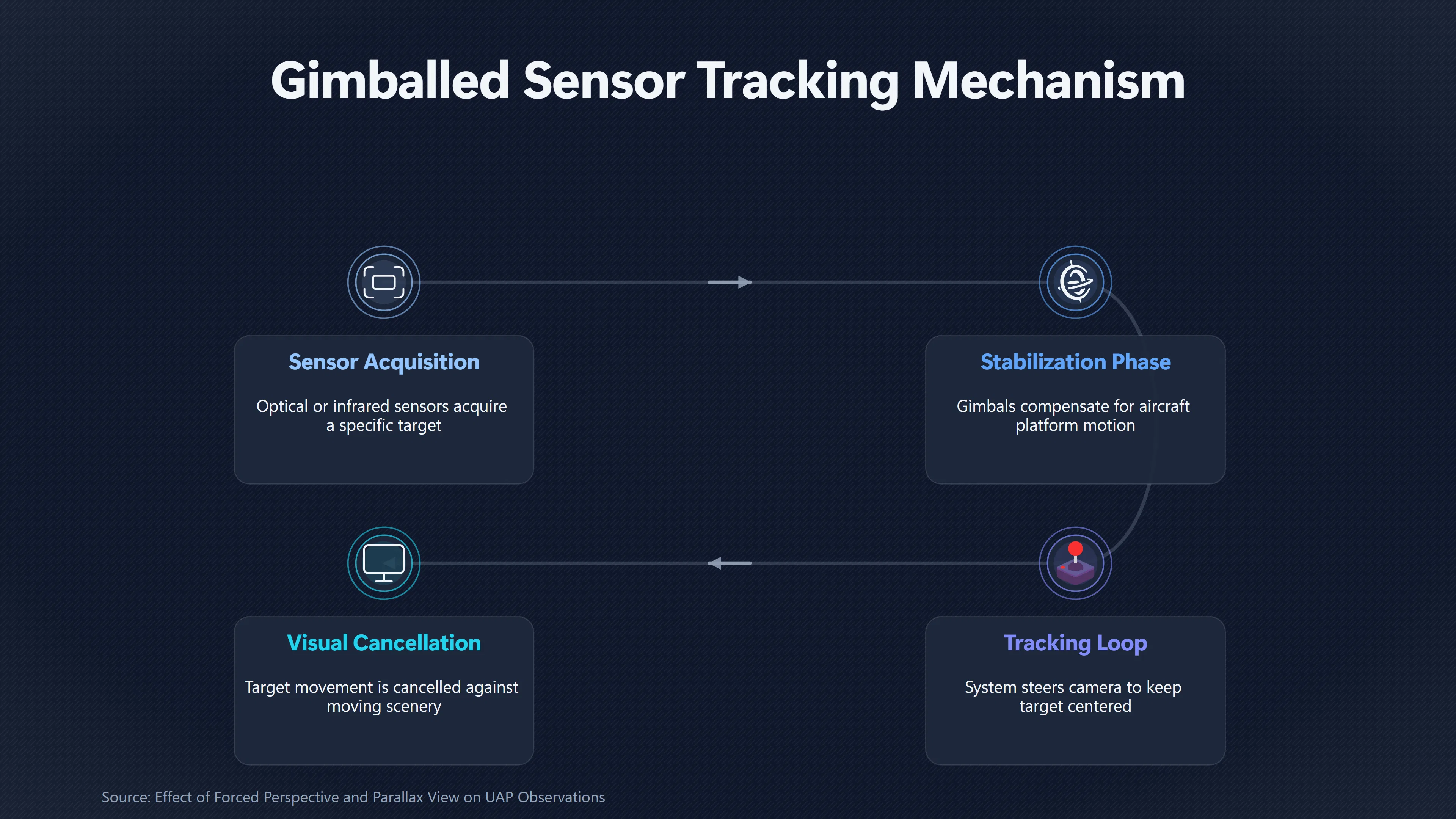
A tracking camera can make a UFO or UAP look almost stationary while the world appears to race behind it. That is not a contradiction: it is often exactly what the tracking system is designed to do. Once an electro-optical or infrared sensor acquires a target, its gimbal can continually change its pointing direction so that the target stays near the centre of the display. The object’s movement across the screen is therefore being actively cancelled, while terrain, clouds or ocean remain free to sweep through the frame. Technical literature on electro-optical tracking explicitly describes systems that keep tracked targets centred in the camera’s field of view.[ScienceDirect]sciencedirect.comTarget location of unmanned aerial vehicles based on the electro-optical stabilization and tracking platform - ScienceDirect…
For UFO footage, this matters because the eye naturally treats a stable centre-frame object as the reference point and the moving scenery as evidence of the object’s speed. In reality, that screen motion combines aircraft movement, camera steering, viewing geometry, range and the target’s own motion. AARO specifically warns that observer speed and a small field of view can make the background appear to move rapidly behind a slow or stationary object.[AARO]aaro.milAARO FAQ…
How tracking keeps the object centred
An airborne tracking sensor is not necessarily pointed rigidly in the same direction as the aircraft. Its camera is commonly mounted on a stabilised gimbal that can rotate independently of the platform. Stabilisation compensates for unwanted aircraft motion, while a tracking loop can deliberately steer the camera as the line of sight to the selected target changes. Research on gimballed electro-optical systems describes both functions: stabilising the line of sight and controlling the tracker so that the target remains within, or near the centre of, the field of view.[TÜBİTAK Academic Journals]journals.tubitak.gov.trOpen source on tubitak.gov.tr.
Imagine a fast aircraft passing a much slower airborne object. With an ordinary forward-facing camera, the object might enter one side of the image, cross it and leave the other. A tracking system instead turns its optical axis towards the object throughout the encounter. If tracking is accurate, the target’s image can remain within a small central area even though the line of sight is continually rotating.
The important distinction is therefore between movement in the image and movement of the camera’s line of sight. The first can be small precisely because the second is being adjusted to compensate for it. Line-of-sight rate is itself a significant quantity in stabilised tracking systems; engineering work models it from gimbal motion and servo behaviour rather than assuming that a target’s position within the displayed frame tells the whole story.[Sage Journals]journals.sagepub.comSage JournalsLine-of-sight rate modeling and error analysis of inertial stabilized platforms by coordinate transformation - Qingjia Gao…
Recent official UAP releases provide unusually clear demonstrations of the principle. In its description of the 2026 PR-049 military infrared footage, AARO says the sensor pans while narrowing its field of view in order to maintain two areas of contrast generally near the centre. It subsequently zooms out while continuing to keep them centred. In other released imagery, AARO likewise describes tracked areas of contrast remaining generally in the centre of the sensor’s field of view. These descriptions do not resolve what every depicted object is, but they show directly that centre-frame persistence can be a property of sensor operation rather than evidence that an object is stationary relative to the aircraft or Earth.[AARO]aaro.milNext - AARO UAP Imagery Acc TableMay 8, 2026…
Why the scenery can look extraordinarily fast
Once the tracker makes the target the stable point in the image, the background can become the dominant motion cue. If the sensor platform is moving rapidly and the line of sight is rotating to follow the target, each successive frame looks towards a slightly different part of the landscape or ocean. The target stays near the reticle; the scenery does not.
That creates a visual reversal. Instead of seeing a camera move past an object, the viewer sees an apparently fixed object with the Earth streaming underneath it. The effect can be particularly persuasive when three conditions coincide:
- The aircraft is fast. Its changing position produces substantial changes in viewing geometry.
- The camera is zoomed in. A narrow field of view removes much of the wider scene that would reveal how the sensor is turning.
- The target is actively tracked. Keeping it near the centre deprives the viewer of one of the simplest visual cues to its angular movement.
AARO describes this combination in its guidance on parallax. A stationary or slow-moving object can appear to move rapidly relative to a fast observer because it is the observer’s movement and field of view that generate much of the apparent background motion. AARO says the effect is enhanced in a small sensor field of view and cautions that forced perspective and parallax can produce inaccurate estimates of UAP speed and direction.[AARO]aaro.milAARO FAQ…
This does not mean the scenery is somehow artificial or that the target is necessarily stationary. Both may genuinely be moving. The error comes from assigning all of the relative motion visible in the image to the target.
GoFast shows the trap particularly clearly
The US Navy’s well-known GoFast recording is a useful example because the sensor has locked onto a small object near the centre while the ocean appears to rush underneath it. At first viewing, the combination strongly suggests an object travelling at extreme speed just above the sea. NASA’s UAP independent study used the case to demonstrate why that visual interpretation cannot safely be made from appearance alone, stating that the apparent anomalous behaviour in GoFast could be explained by the motion of the sensor platform.[NASA Science]science.nasa.govScience Independent Study Team ReportScience Independent Study Team Report
AARO later carried out a more extensive geospatial reconstruction. It assessed the object as being at roughly 13,000 feet rather than skimming the ocean and concluded with high confidence that it did not display anomalous or exceptional performance. Its published case material gives a wind-compensated speed range of roughly 5–92 mph, depending on assumptions about heading, rather than the extraordinary velocity suggested by casually watching the background.[AARO]aaro.milGo Fast Case Resolution Card Methodology FinalGo Fast Case Resolution Card Methodology Final
The important lesson here is not the unresolved identity of the GoFast object. AARO’s analysis did not identify it conclusively. The more relevant result for interpreting tracking footage is that the dramatic visual impression of speed was not itself a reliable measurement of speed. AARO’s modelling found scenarios in which the object’s movement was broadly compatible with ordinary motion while parallax made its apparent performance far more striking.[AARO]aaro.milGo Fast Case Resolution Card Methodology FinalGo Fast Case Resolution Card Methodology Final
GoFast also illustrates why tracking is perceptually powerful. Once the infrared sensor has the object locked near the centre, the eye has an obvious stationary reference point: the target. The ocean therefore seems to be the thing sliding rapidly relative to it. But the correct reference frame is not the video rectangle. The camera is aboard a moving F/A-18 and is changing its viewing direction as it tracks.
Puerto Rico provides a second real-world example
The 2013 infrared footage recorded from a US Customs and Border Protection aircraft near Aguadilla, Puerto Rico, produced another striking impression of rapid UAP movement. AARO’s later reconstruction concluded that two objects were drifting in a straight line at about 3.6 metres per second, or 8 mph, broadly consistent with the recorded wind, while the aircraft and sensor geometry made them appear much faster.[AARO]aaro.milPuerto Rico UAP Case ResolutionPuerto Rico UAP Case Resolution
AARO explicitly attributed the apparent high speed to motion parallax and identified three contributing ingredients: the aircraft’s flight speed, the sensor’s zoom and the changing relative positions of aircraft and objects. Its reconstruction incorporated aircraft position and sensor parameters such as elevation, azimuth and slant angle rather than attempting to estimate velocity simply by watching how quickly the scenery crossed the screen.[AARO]aaro.milPuerto Rico UAP Case ResolutionPuerto Rico UAP Case Resolution
The case is useful because it demonstrates the same mechanism outside GoFast. A tracked infrared object can look dynamically impressive while reconstruction in an Earth-referenced coordinate system yields much slower motion. That does not establish that every similar UAP video has the same explanation; it establishes that the visual pattern itself — centre-frame object plus fast-moving background — is insufficient evidence for exceptional speed.
What screen motion can actually tell us
Tracking footage still contains valuable information, but it has to be interpreted in the correct coordinate system. A target staying in the same few pixels mainly tells us that the tracker is succeeding at keeping its image there. It does not, by itself, tell us that the physical object is hovering.
Likewise, background pixels crossing the screen rapidly demonstrate angular change between the camera’s line of sight and the background. They do not directly state how many metres per second the target is travelling through the atmosphere. Converting image motion into physical velocity requires additional geometry.
Useful quantities can include the aircraft’s position, altitude, speed and heading; the sensor’s azimuth and elevation angles; field of view or zoom state; target range; gimbal orientation; timing information; and, where available, independent radar or other observations. Range is especially consequential because the same angular movement can correspond to very different linear speeds at different distances.
NASA has highlighted precisely this problem in UAP research. Many observations are incidental rather than collected with instruments designed and calibrated to constrain an unknown object’s movement. Missing metadata about the sensor, acquisition conditions and observing geometry can therefore prevent a rigorous determination of distance or motion even when video exists.[NASA Science]smd-cms.nasa.govScience NASAUNIDENTIFIED ANOMALOUS PHENOMENA Independent…
The difference is fundamental:
What the display directly shows: how target and background images move relative to the camera’s changing line of sight.
What viewers usually want to know: how fast the physical target moves relative to the Earth or surrounding air.
Getting from the first to the second requires measurement and reconstruction, not simply watching the apparent speed of the background.
A centred UFO is therefore not a stationary UFO
The most useful way to read tracking footage is to stop treating the edges of the video as a fixed window onto the world. In tracking mode, the window itself is turning.
That changes the meaning of one of the most visually compelling patterns in military UAP videos. A target that hangs almost motionless under a reticle while ocean, clouds or terrain stream rapidly behind it may indeed be moving quickly. But the footage alone does not establish that conclusion, because the same visual arrangement can be deliberately produced by a gimballed tracker following an ordinary slow-moving object from a fast-moving aircraft. Engineering literature describes target centring as a normal tracking objective, while AARO’s GoFast and Puerto Rico analyses demonstrate how platform motion and parallax can then dominate the apparent speed seen on screen.[sciencedirect.com]sciencedirect.comTarget location of unmanned aerial vehicles based on the electro-optical stabilization and tracking platform - ScienceDirect…
For UFO and UAP analysis, the practical rule is simple: a stationary image position is not a stationary physical position, and a racing background is not a target speedometer. Until sensor pointing, platform motion, range and viewing geometry are accounted for, apparent speed in a tightly tracked video should be treated as an observation to explain, not as a measured performance characteristic.
Amazon book picks
Further Reading
Books and field guides related to When Tracking Makes the Background Look Faster. Use these as the next step if you want deeper reading beyond the article.
Computer Vision: Algorithms and Applications
Computer Vision: Algorithms and Applications explores the variety of techniques used to analyze and interpret images. It also describes c...
Multiple View Geometry in Computer Vision
A basic problem in computer vision is to understand the structure of a real world scene given several images of it. Techniques for solvin...
Modern Control Engineering
Rating: 4.0/5 from 8 Google Books ratings
Mathematical modeling of control systems. Mathematical modeling of mechanical systems and electrical systems. Mathematical modeling of fl...
Feedback Control of Dynamic Systems
Emphasizing modern topics and techniques, this text blends theory and real world practice, mixes design and analysis, introduces design e...
eBay marketplace picks
Marketplace Samples
Live-tested eBay searches with available results related to this page.
Selected fromUFO poster oneBay.co.uk.

Current eBay listing
I Want To Believe UFO Poster Giclée Fine Art Heavyweight Print

Current eBay listing
VINTAGE UFO FLYING SAUCERS COMIC ADVERTISING A2 POSTER PRINT


Endnotes
1.
Source: sciencedirect.com
Link:https://www.sciencedirect.com/science/article/pii/S0263224119307055
Source snippet
Target location of unmanned aerial vehicles based on the electro-optical stabilization and tracking platform - ScienceDirect...
2.
Source: aaro.mil
Link:https://www.aaro.mil/FAQ/
Source snippet
AARO FAQ...
3.
Source: aaro.mil
Title: Effect of Forced Perspective and Parallax View on UAP Observations
Link:https://www.aaro.mil/Portals/136/PDFs/Information%20Papers/AARO_Effect_of_Forced_Perspective_and_Parallax_View_on_UAP_Observations_2024.pdf?ver=WTwJtQaCvC3BkRlBJCGLzg%3D%3D
Source snippet
Effect of Forced Perspective and Parallax View on UAP Observations...
4.
Source: aaro.mil
Link:https://www.aaro.mil/Next-AARO-Home-redesign/Next-Parent/Next-AARO-UAP-Imagery-Acc-Table/
Source snippet
Next - AARO UAP Imagery Acc TableMay 8, 2026...
Published: May 8, 2026
5.
Source: aaro.mil
Link:https://www.aaro.mil/Next-AARO-Home-redesign/Next-Parent/Presidential-UAP-Transparency-Initiative/
Source snippet
Next - AARO Presidential UAP Transparency Initiative...
6.
Source: aaro.mil
Link:https://www.aaro.mil/Next-AARO-Home-redesign/Next-Parent/Next-UAP-Report-Documents/poster/dividLink/
7.
Source: science.nasa.gov
Title: Science Independent Study Team Report
Link:https://science.nasa.gov/wp-content/uploads/2023/09/uap-independent-study-team-final-report.pdf?emrc=80696d
8.
Source: smd-cms.nasa.gov
Title: Science NASA
Link:https://smd-cms.nasa.gov/wp-content/uploads/2023/09/uap-independent-study-team-final-report.pdf
Source snippet
UNIDENTIFIED ANOMALOUS PHENOMENA Independent...
9.
Source: aaro.mil
Title: [Go Fast]({{ ‘go-fast/’ | relative_url }}) Case Resolution Card Methodology Final
Link:https://www.aaro.mil/Portals/136/PDFs/case_resolution_reports/AARO_GoFast_Case_Resolution_Card_Methodology_Final.pdf?ver=qXvjrruO_0MgtnTsfYnCEQ%3D%3D
10.
Source: aaro.mil
Title: Puerto Rico UAP Case Resolution
Link:https://www.aaro.mil/Portals/136/PDFs/case_resolution_reports/AARO_Puerto_Rico_UAP_Case_Resolution.pdf
11.
Source: aaro.mil
Link:https://www.aaro.mil/Portals/136/PDFs/SASC_AARO_Open_Hearing_Case_Slides_19Nov2024.pdf?ver=Hec1SwKwP-4zSRJwIEIlJw%3D%3D
12.
Source: sideshow.jpl.nasa.gov
Title: meta File Format
Link:https://sideshow.jpl.nasa.gov/pub/JPL_GNSS_Products/README/metaFileFormat.html
13.
Source: nasa.gov
Title: Photophoretic tracers
Link:https://www.nasa.gov/directorates/stmd/photophoretic-tracers-for-near-space-remote-sensing-at-30-100-km-altitudes/
14.
Source: science.nasa.gov
Link:https://science.nasa.gov/uap/
15.
Source: aaro.mil
Link:https://www.aaro.mil/Next-AARO-Home-redesign/Next-Parent/Presidential-UAP-Transparency-Initiative/dvpmoduleid/77396/
16.
Source: sciencedirect.com
Title: Visual circuitry for distance estimation in Drosophila
Link:https://www.sciencedirect.com/science/article/pii/S0960982225011789
17.
Source: nasa.gov
Title: NAS A Tests Scalable Satellite Tech to Launch Sensors Quicker
Link:https://www.nasa.gov/centers-and-facilities/langley/nasa-tests-scalable-satellite-tech-to-launch-sensors-quicker/
18.
Source: doncio.navy.mil
Link:https://www.doncio.navy.mil/chips/ArticleDetails.aspx?ID=18139
19.
Source: navy.mil
Link:https://www.navy.mil/Press-Office/News-Stories/Article/4064895/nps-develops-ai-solution-to-automate-drone-defense-with-high-energy-lasers/
20.
Source: navy.mil
Title: NP S Develops AI Solution to Automate Drone Defense with High Energy Lasers
Link:https://www.navy.mil/DesktopModules/ArticleCS/Print.aspx?Article=4064895&ModuleId=523&PortalId=1
21.
Source: ntrs.nasa.gov
Link:https://ntrs.nasa.gov/citations/20250000989
22.
Source: ntrs.nasa.gov
Link:https://ntrs.nasa.gov/citations/20260000829
23.
Source: aaro.mil
Link:https://www.aaro.mil/Next-AARO-Home-redesign/Next-Parent/Presidential-UAP-Transparency-Initiative/videoid/1006074/dvpcc/false/
24.
Source: ntrs.nasa.gov
Link:https://ntrs.nasa.gov/citations/20240000168
25.
Source: aaro.mil
Link:https://www.aaro.mil/Next-AARO-Home-redesign/Next-Parent/Presidential-UAP-Transparency-Initiative/videoid/1006080/dvpcc/false/
26.
Source: nasa.gov
Title: NAS A to Release, Discuss Unidentified Anomalous Phenomena Report
Link:https://www.nasa.gov/news-release/nasa-to-release-discuss-unidentified-anomalous-phenomena-report/
27.
Source: aaro.mil
Link:https://www.aaro.mil/Next-AARO-Home-redesign/Next-Parent/Presidential-UAP-Transparency-Initiative/videoid/1007791/dvpmoduleid/77396/
28.
Source: navy.mil
Title: A N/SPS-49(V) Radar Set > United States Navy > Display-Fact Files
Link:https://www.navy.mil/Resources/Fact-Files/Display-FactFiles/Article/2167967/ansps-49v-radar-set/
29.
Source: uavsar.jpl.nasa.gov
Link:https://uavsar.jpl.nasa.gov/science/documents.html
30.
Source: ntrs.nasa.gov
Link:https://ntrs.nasa.gov/citations/20210024080
31.
Source: aaro.mil
Link:https://www.aaro.mil/Next-AARO-Home-redesign/Next-Parent/Presidential-UAP-Transparency-Initiative/videoid/1007707/dvpcc/false/
32.
Source: history.navy.mil
Title: lookout manual 1943
Link:https://www.history.navy.mil/research/library/online-reading-room/title-list-alphabetically/l/lookout-manual-1943.html
33.
Source: history.navy.mil
Title: mil CI C [Combat Information Center] Manual (RADSIX)
Link:https://www.history.navy.mil/research/library/online-reading-room/title-list-alphabetically/c/cic–combat-information-center-manual-radsix.html
34.
Source: planetarydata.jpl.nasa.gov
Title: MDIS CDR RDRSIS
Link:https://planetarydata.jpl.nasa.gov/img/data/messenger/msgrmds_7001/DOCUMENT/MDIS_CDR_RDRSIS.HTM
35.
Source: planetarydata.jpl.nasa.gov
Title: MDIS CDR RDRSIS
Link:https://planetarydata.jpl.nasa.gov/img/data/messenger/MSGRMDS_2001/DOCUMENT/MDIS_CDR_RDRSIS.HTM
36.
Source: uavsar.jpl.nasa.gov
Title: rpi format
Link:https://uavsar.jpl.nasa.gov/science/documents/rpi-format.html
37.
Source: uavsar.jpl.nasa.gov
Link:https://uavsar.jpl.nasa.gov/science/documents/calibration.html
38.
Source: navair.navy.mil
Link:https://www.navair.navy.mil/node/10591
39.
Source: navair.navy.mil
Link:https://www.navair.navy.mil/node/10226
40.
Source: ntrs.nasa.gov
Link:https://ntrs.nasa.gov/citations/20110014686
41.
Source: navair.navy.mil
Link:https://www.navair.navy.mil/node/7331
42.
Source: navair.navy.mil
Link:https://www.navair.navy.mil/node/7701
43.
Source: ntrs.nasa.gov
Link:https://ntrs.nasa.gov/search.jsp?R=20000013442
44.
Source: navair.navy.mil
Link:https://www.navair.navy.mil/node/3091
45.
Source: ntrs.nasa.gov
Link:https://ntrs.nasa.gov/citations/19870031782
46.
Source: ntrs.nasa.gov
Link:https://ntrs.nasa.gov/citations/19810061439
47.
Source: aaro.mil
Link:https://www.aaro.mil/UAP-Cases/Official-UAP-Imagery/ftag/MSF0951a18/
48.
Source: aaro.mil
Link:https://www.aaro.mil/Next-AARO-Home-redesign/Next-Parent/AARO-UAP-Case-DT/
49.
Source: aaro.mil
Link:https://www.aaro.mil/Next-AARO-Home-redesign/Inactive-Parent/FAQ-Datatable/
50.
Source: aaro.mil
Title: UAP Imagery* “Go Fast” Object NAVAIR
Link:https://www.aaro.mil/Next-AARO-Home-redesign/Inactive-Parent/Next-UAP-Imagery-dup/
51.
Source: aaro.mil
Link:https://www.aaro.mil/Next-AARO-Home-redesign/Next-Parent/AARO-UAP-Case-Resolution-DT/
52.
Source: aaro.mil
Link:https://www.aaro.mil/Next-AARO-Home-redesign/Next-Parent/Next-AARO-UAP-Imagery-Fixed-Table/
53.
Source: aaro.mil
Link:https://www.aaro.mil/Next-AARO-Home-redesign/Next-Parent/Next-UAP-Case-RR-Data-Table/
54.
Source: aaro.mil
Link:https://www.aaro.mil/UAP-Records/-1/
55.
Source: aaro.mil
Link:https://www.aaro.mil/Resources/Historical-Record-Reports/Volume-II/
56.
Source: aaro.mil
Link:https://www.aaro.mil/Next-AARO-Home-redesign/Inactive-Parent/AARO-Records-Tabs/
57.
Source: aaro.mil
Link:https://www.aaro.mil/UAP-Cases/Official-UAP-Imagery/
58.
Source: aaro.mil
Link:https://www.aaro.mil/
59.
Source: aaro.mil
Link:https://www.aaro.mil/UAP-Cases/Official-UAP-Imagery/4/
60.
Source: aaro.mil
Title: AARO FY2025 Consolidated Annual Report on UAP
Link:https://www.aaro.mil/Portals/136/PDFs/FY25%20UAP%20Annual%20Report/AARO_FY2025_Consolidated_Annual_Report_on_UAP.pdf
61.
Source: sciencedirect.com
Title: Motion Parallax
Link:https://www.sciencedirect.com/topics/computer-science/motion-parallax
62.
Source: sciencedirect.com
Title: A line-of-sight rate estimation method for roll-pitch gimballed infrared seeker
Link:https://www.sciencedirect.com/science/article/pii/S0030402619308125
63.
Source: sciencedirect.com
Title: Motion-guided small MAV detection in complex and non-planar scenes
Link:https://www.sciencedirect.com/science/article/abs/pii/S0167865524002757
64.
Source: nasa.gov
Link:https://www.nasa.gov/wp-content/uploads/2017/12/2021_agency_foia_log_0.xlsx
65.
Source: nasa.gov
Title: 2024 agency foia log.xlsx
Link:https://www.nasa.gov/wp-content/uploads/2025/08/2024-agency-foia-log.xlsx?emrc=646ac0
66.
Source: pds.nasa.gov
Link:https://pds.nasa.gov/services/search/search?f.facet_instrument.facet.prefix=2%2Cplasma+analyzer%2C&f.facet_investigation.facet.prefix=2%2Cmars_global_surveyor%2C&f.facet_target.facet.prefix=3%2Ccalibration%2Ccalibration%2C&f.facet_type.facet.prefix=2%2Cdata_set%2C&fq=facet_instrument%3A%221%2Cplasma+analyzer%22&fq=facet_target%3A%222%2Ccalibration%2Ccalibration%22&fq=facet_type%3A%221%2Cdata_set%22&q=
67.
Source: apps.jpl.nasa.gov
Link:https://apps.jpl.nasa.gov/static/doc/manual/library/commands/upload.html
68.
Source: uavsar.jpl.nasa.gov
Link:https://uavsar.jpl.nasa.gov/cgi-bin/calibration.pl
69.
Source: pds.nasa.gov
Link:https://pds.nasa.gov/services/search/search?f.facet_primary_result_purpose.facet.prefix=2%2Cscience%2C&fq=facet_primary_result_purpose%3A%221%2Cscience%22&q=fc+coins+xbox+free+Visit+Buyfc26coins.com+Tan%C3%BAs%C3%ADtott+biztons%C3%A1gi+tan%C3%BAs%C3%ADtv%C3%A1nyok+a+weboldalhoz..i0Z6
70.
Source: pds.nasa.gov
Link:https://pds.nasa.gov/services/search/search?f.facet_pds_model_version.facet.prefix=2%2Cpds4%2C&fq=facet_pds_model_version%3A%221%2Cpds4%22&q=fc+coins+safe+Visit+Buyfc26coins.com+for+latest+FC+coins+news..5B1X&start=100
71.
Source: navair.navy.mil
Link:https://www.navair.navy.mil/product/UAS-Payloads
72.
Source: ntrs.nasa.gov
Link:https://ntrs.nasa.gov/citations/19650020752
73.
Source: journals.tubitak.gov.tr
Link:https://journals.tubitak.gov.tr/elektrik/vol29/iss5/16/
74.
Source: journals.sagepub.com
Link:https://journals.sagepub.com/doi/abs/10.3233/JIFS-191735
Source snippet
Sage JournalsDynamic modeling, control and experimental validation of gimballed sensor system for precision pointing applications - Ravin...
75.
Source: journals.sagepub.com
Link:https://journals.sagepub.com/doi/abs/10.1177/0954405417716955
Source snippet
Sage JournalsLine-of-sight rate modeling and error analysis of inertial stabilized platforms by coordinate transformation - Qingjia Gao...
76.
Source: journals.sagepub.com
Link:https://journals.sagepub.com/doi/pdf/10.1177/0954405417716955
Source snippet
Sage JournalsLine-of-sight rate modeling and error analysis of inertial stabilized platforms by coordinate transformation - Qingjia Gao...
77.
Source: search.trdizin.gov.tr
Link:https://search.trdizin.gov.tr/en/yayin/detay/524517
78.
Source: search.trdizin.gov.tr
Link:https://search.trdizin.gov.tr/tr/yayin/detay/524517/line-of-sight-rate-construction-for-a-roll-pitch-gimbal-via-a-virtual-pitch-yaw-gimbal
Additional References
79.
Source: youtube.com
Title: Explained: New Navy UFO Videos
Link:https://www.youtube.com/watch?v=Q7jcBGLIpus
Source snippet
Mick West GoFast parallax Explained: "Go Fast" UFO Video - Not Low and Not Fast - Like a Balloon...
80.
Source: metabunk.org
Link:https://www.metabunk.org/threads/go-fast-footage-from-tom-delonges-to-the-stars-academy-bird-balloon.9569/page-10
81.
Source: metabunk.org
Link:https://www.metabunk.org/threads/go-fast-footage-from-tom-delonges-to-the-stars-academy-bird-balloon.9569/page-14
82.
Source: researchgate.net
Link:https://www.researchgate.net/publication/2985896_Aerial_video_surveillance_and_exploitation
83.
Source: mdpi.com
Link:https://www.mdpi.com/1424-8220/18/12/4350
84.
Source: facebook.com
Link:https://www.facebook.com/NewsNationNow/posts/a-new-us-government-data-release-on-uaps-sheds-light-on-reported-encounters-worl/1025530889853928/
85.
Source: ufotransparency.com
Link:https://ufotransparency.com/topics/aaro-case-resolutions
86.
Source: scribd.com
Link:https://www.scribd.com/document/990030540/Anomalous-Aero-Signature-Analysis-A-Comprehensive-Examination-of-UAPs-and-UFOs
87.
Source: ascelibrary.org
Link:https://ascelibrary.org/doi/abs/10.1061/JAEEEZ.ASENG-6912
88.
Source: facebook.com
Link:https://www.facebook.com/newshour/posts/boston-university-space-physicist-joshua-semeter-was-part-of-an-independent-pane/1143879570940621/