Within Distance
Why Night UFOs Are So Hard to Size
Darkness removes terrain, texture, horizon and familiar-size references that normally help people judge how far away an object is.
On this page
- Which distance cues disappear after dark
- Why pilots can still misjudge range
- How sparse backgrounds amplify size uncertainty
Page outline Jump by section
Introduction
Night UFO sightings are unusually hard to size because darkness removes much of the visual information people normally use to judge distance. A light against a black sky may have a clear apparent brightness and position, yet provide almost no reliable indication of whether it is a small object hundreds of metres away or a much larger object kilometres away. Because physical size depends on distance, uncertainty in range becomes uncertainty in size.
This is not merely a problem for inexperienced observers. Aviation research and official pilot guidance document substantial errors in judging height, distance and orientation when terrain, horizons and surrounding lights disappear after dark. Laboratory research likewise shows that human estimates of size and distance depend on contextual cues, including familiar objects and the structure of the surrounding scene.[faa.gov]faa.govFederal Aviation Administration Chapter 8. Medical Facts for PilotsFederal Aviation Administration Chapter 8. Medical Facts for Pilots
For UFO and UAP reports, the practical lesson is narrow but important: a confident night-time description of an object’s physical size can greatly exceed what the visual evidence actually establishes.
Which distance cues disappear after dark?
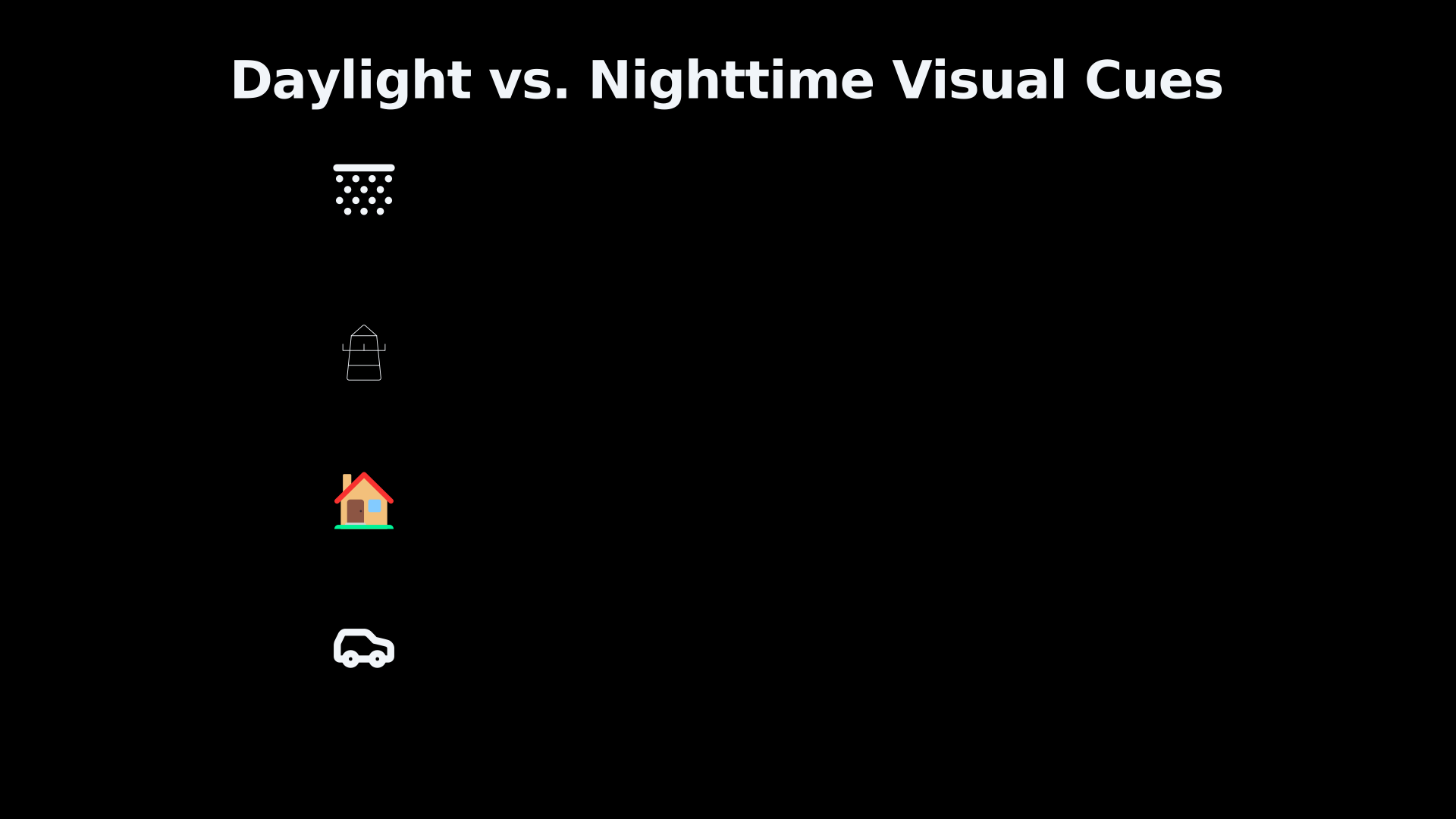
In daylight, observers rarely estimate distance from a single cue. The visual system combines several imperfect signals into a coherent three-dimensional scene. Ground texture changes with distance; roads and other parallel features converge in perspective; familiar objects provide scale; nearer features can obscure farther ones; and movement of the observer produces motion parallax, in which nearby scenery shifts across the visual field faster than distant scenery.
Night can remove several of these signals simultaneously. An unlit field, sea or hillside may cease to function visually as a textured surface and become almost indistinguishable from the sky. The horizon may disappear. Buildings, trees and other familiar-size references may vanish. An airborne light can consequently become an isolated stimulus without an obvious position within a visible three-dimensional scene.
The importance of those missing references is demonstrated particularly clearly by aviation. The US Federal Aviation Administration (FAA) warns pilots that featureless terrain, including darkened areas, can create false impressions of altitude. It also notes that bright runway lights surrounded by few other lights can produce an illusion of reduced distance, while terrain with few lights supplies inadequate height cues.[Federal Aviation Administration]faa.govFederal Aviation Administration Chapter 8. Medical Facts for PilotsFederal Aviation AdministrationChapter 8. Medical Facts for PilotsJanuary 8, 2015…
This matters for UFO size estimates because angular size alone does not tell the observer how large an object physically is. If two objects subtend the same angle at the eye, a ten-times-more-distant object can also be ten times larger. Darkness does not change that geometry; it removes information that might otherwise help the observer choose between those possibilities.
Familiar size no longer rescues the estimate
Recognising an ordinary object can itself provide a useful distance cue. If something is unmistakably a car, for example, prior knowledge of typical car dimensions helps the brain interpret its retinal image. Experimental work has shown that familiar size can influence both perceived physical size and perceived distance, even when binocular information is available.[DOI]doi.orgFamiliar size affects the perceived size and distance of real objects even with binocular vision | JOV | ARVO Journals…
An unidentified light lacks precisely that advantage. If the observer does not know whether it belongs to an airliner, drone, balloon, helicopter or something else, there is no trustworthy physical dimension to insert into the perceptual calculation. A seemingly structured arrangement of several lights may help establish angular relationships between them, but unless their distance or real separation is known, it still does not establish the overall dimensions of the source.
Research under reduced visual conditions illustrates the wider problem. Experiments in darkness have found systematic biases in perceived location and size when visual information is minimal, while older experimental work found that introducing additional size cues reduced errors in distance judgements.[PubMed Central (PMC)]pmc.ncbi.nlm.nih.govPubMed Central (PMC)The visual system's intrinsic bias and knowledge of size mediate perceived size and location in the dark - PMCJune 10…
The night sky therefore creates a particularly difficult combination: an unfamiliar target, an uncertain physical scale and an impoverished background.
Why pilots can still misjudge range
Experienced pilots are a useful test of the claim that expertise alone solves night-time visual ambiguity. Pilots routinely make spatial judgements and receive specialised training, yet aviation authorities still teach them to anticipate visual illusions caused by darkness and missing references.
The most striking example is the black-hole approach. It occurs during a night approach when a runway is visible but the surrounding terrain provides few or no useful visual cues. The Australian Transport Safety Bureau describes the resulting condition as capable of creating a false sense of altitude or attitude; the absence of peripheral cues can lead pilots to fly below the normal approach path.[ATSB]atsb.gov.auEngine nacelle strike and continued operation involving Boeing 737-8FE, VH-YIW, Faleolo Airport, Apia, Samoa on 23 April 2016 | ATSBJ…
This is significant because a runway is far less ambiguous than a UFO. Its shape is known, its dimensions can often be known, it sits at a known location and it presents an organised pattern of lights. Yet pilots can still misperceive their geometry relative to it when the surrounding visual scene disappears.
NASA research on the black-hole problem likewise concluded that important perspective information available during daylight can become unavailable under black-hole conditions, forcing the visual system to rely on poorer remaining information.[NASA Technical Reports Server]ntrs.nasa.govNASA Technical Reports ServerVisual slant misperception and the Black-Hole landing situation - NASA Technical Reports Server (NTRS)Decemb… FAA experiments involving simulated night landings found that changing visible runway length and approach lighting affected pilots’ perception of approach angle, demonstrating that alterations in the sparse visual scene can materially change spatial judgements.[Federal Aviation Administration]faa.govOpen source on faa.gov.
More recent simulator work with active airline pilots has continued to reproduce the black-hole illusion, although individual pilots did not experience it to the same degree.[UWL Repository]repository.uwl.ac.ukOpen source on uwl.ac.uk. The evidence therefore does not support a simple division between unreliable novices and reliable experts. Training helps observers recognise dangerous conditions and use instruments or other independent references, but expertise does not create visual information that the environment fails to provide.
That distinction is important when evaluating UFO testimony from pilots. Professional experience can make observations valuable, especially descriptions of aircraft operations, relative bearings and instrument indications. It does not mean that an unaided night-time estimate of the range to an unfamiliar light automatically becomes a measurement.
Sparse backgrounds amplify size uncertainty
A sparse night scene can feel visually simple while being geometrically ambiguous. Imagine a witness seeing a compact cluster of three lights above an unlit landscape. The witness may accurately remember their triangular arrangement and even make a reasonable estimate of the angle between them. What remains unknown is the scale of that triangle.
If the lights are close, their physical separation must be small to produce the observed angular pattern. If they are much farther away, the same pattern requires proportionally greater separation. Without another source of range information, both interpretations can fit the naked-eye observation.
This is why reports such as “it looked 30 metres across” deserve careful separation into two questions:
- How large did it appear in the visual field? This is an angular-size question and may sometimes be reconstructed from a careful report.
- How far away was it? This requires independent range evidence or useful environmental constraints.
- What physical size follows from those two quantities? Only once both are adequately constrained can a linear dimension be calculated with confidence.
Research on familiar-size perception reinforces the point. In controlled experiments, objects arranged to subtend the same retinal angle could nevertheless produce different judgements of size and distance because observers brought prior knowledge about the objects into their interpretation. The effect became stronger for perceived size under a more restricted viewing condition.[PubMed Central (PMC)]pmc.ncbi.nlm.nih.govPubMed Central (PMC)Familiar size affects the perceived size and distance of real objects even with binocular vision - PMC… An unidentified night light provides even less semantic information about its true dimensions.
Darkness can also make the remaining lights themselves misleading. FAA guidance describes autokinesis, in which a stationary light viewed against darkness can appear to move after prolonged fixation. The same guidance warns that roads or moving trains can be mistaken for runway lighting and that dark scenes containing ground lights and stars can contribute to false-horizon illusions.[Federal Aviation Administration]faa.govFederal Aviation Administration Chapter 8. Medical Facts for PilotsFederal Aviation AdministrationChapter 8. Medical Facts for PilotsJanuary 8, 2015… These phenomena do not explain every night UFO sighting, but they show why isolated lights should not be treated as precise spatial reference points merely because they look clear.
Apparent detail does not necessarily restore scale
A common intuition is that seeing a definite outline, formation or set of lights should make a size estimate reliable. It may improve the description of the object’s apparent geometry without solving its distance.
Suppose a witness can confidently say that a luminous object covered roughly the same angle as a thumbnail held at arm’s length. That is much more useful than simply calling it “huge”, because it attempts to record angular extent. But the observation still permits a wide range of physical sizes at different distances.
The same limitation applies to photographs and video. Night imaging introduces additional difficulties because bright points can spread across pixels through defocus, glare, saturation and other optical effects. Research on machine vision encounters an analogous problem: modern depth-estimation systems perform worse in night scenes because low illumination, glare, saturated regions and missing scene information degrade the visual structure used to infer depth.[arXiv]arxiv.orgOpen source on arxiv.org. A camera recording therefore does not automatically convert an ambiguous night sighting into a known-distance object.
The All-domain Anomaly Resolution Office (AARO) makes a closely related point in its technical discussion of UAP perspective. It warns that forced perspective and parallax can lead to inaccurate estimates of UAP size, speed and direction, particularly when observations depend on a single moving sensor. AARO explicitly treats supplementary sensor information as important for developing a more complete estimate of an object’s characteristics.[AARO]aaro.milEffect of Forced Perspective and Parallax View on UAP ObservationsEffect of Forced Perspective and Parallax View on UAP Observations
The key issue is therefore not whether a witness saw something clearly. Clarity of detection and accuracy of range are different questions.
Darkness can create confidence without calibration
One reason night UFO size reports can sound compelling is that the uncertainty is not necessarily obvious to the observer. A bright isolated object can be visually striking. Its direction may seem definite, its motion dramatic and its shape memorable. None of those qualities guarantees that its distance is equally well perceived.
Human vision normally solves scale through combinations of cues rather than through a conscious calculation. When some cues disappear, the brain does not simply present a warning saying “range unknown”. Perception still produces an apparently coherent scene, drawing on whatever information remains. Experiments on perception in darkness show that when visual information becomes minimal, systematic perceptual biases and prior knowledge can influence perceived size and location.[PubMed Central (PMC)]pmc.ncbi.nlm.nih.govPubMed Central (PMC)The visual system's intrinsic bias and knowledge of size mediate perceived size and location in the dark - PMCJune 10…
Aviation provides a practical demonstration of the gap between subjective confidence and objective geometry. Black-hole approaches can occur even though the pilot genuinely sees the runway. The danger arises because the visible information is insufficient or misleading for the spatial judgement being attempted. Research continues to debate the exact perceptual mechanisms behind the illusion, and no single proposed mechanism explains every observed effect.[Purdue University Graduate School]hammer.purdue.eduOpen source on purdue.edu. But the operational fact is well established enough for aviation authorities to train pilots to compensate for it.
The parallel with night UFO reports should therefore be drawn carefully. A black-hole approach does not prove that a particular UFO witness misjudged distance. It demonstrates something more limited and better supported: even skilled observers can make consequential spatial errors when darkness removes environmental reference cues.
What makes a night-time size estimate stronger?
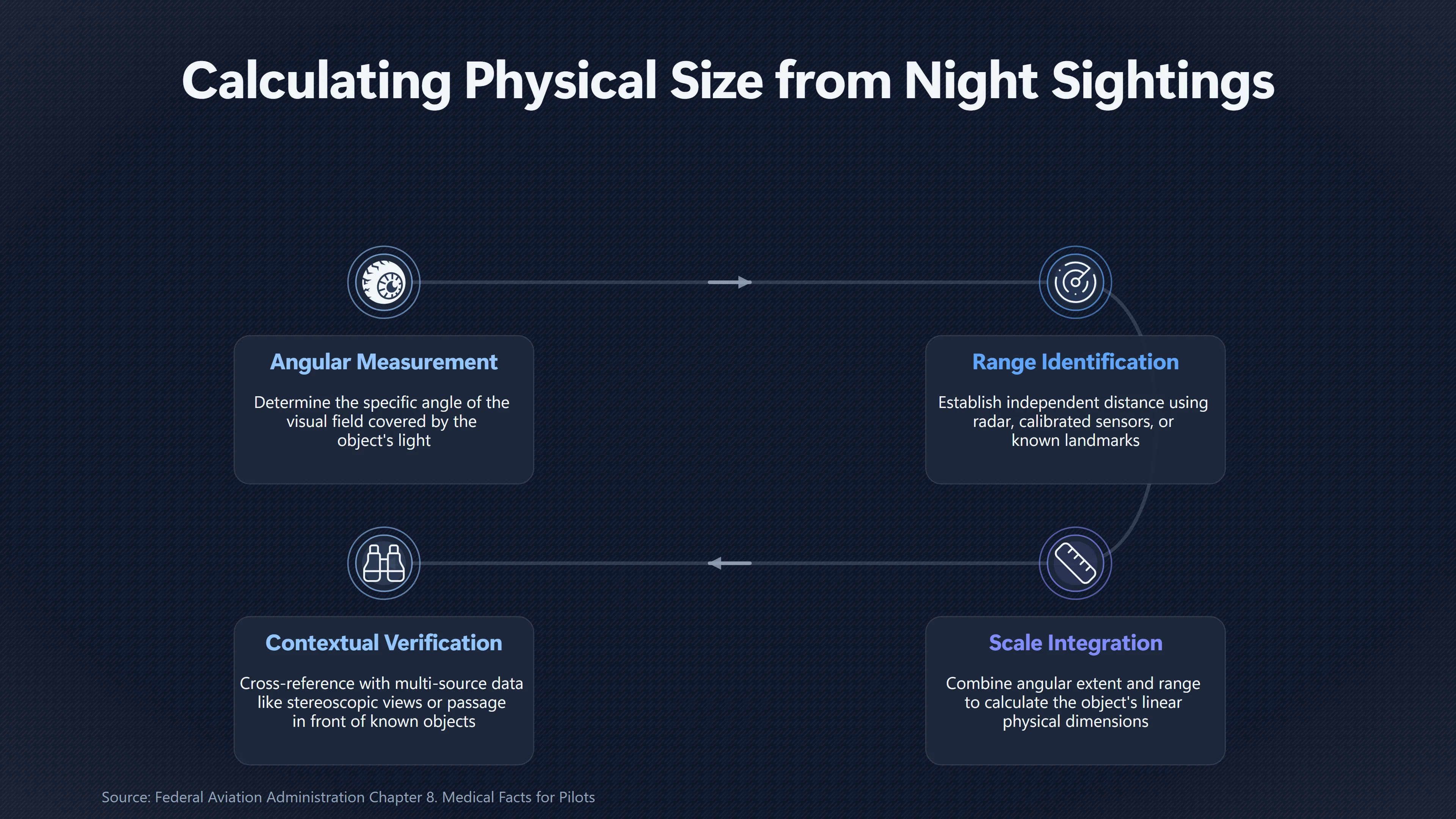
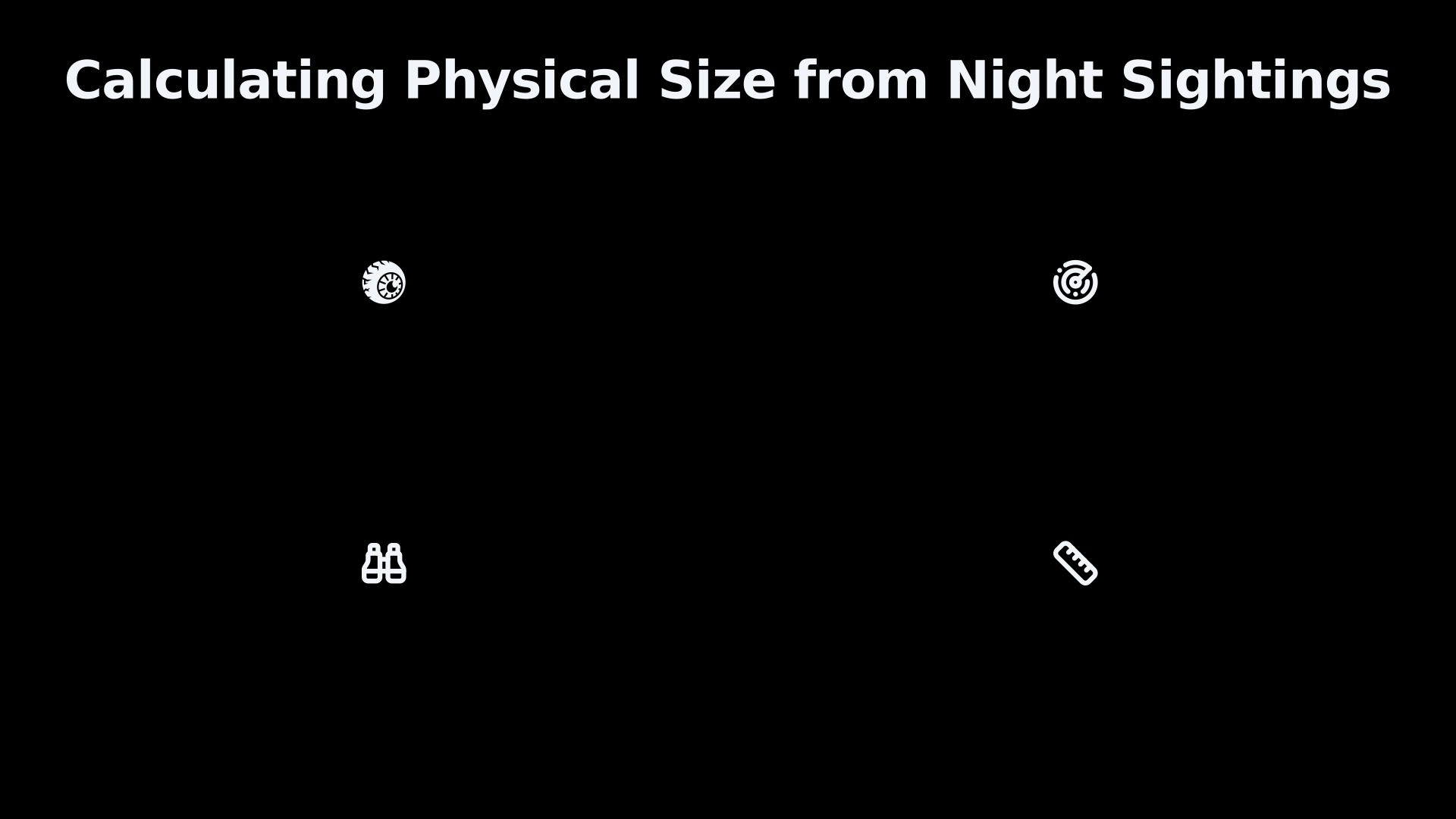
A credible physical-size estimate needs information that breaks the size–distance ambiguity. The strongest evidence therefore comes from observations in which range is established independently rather than inferred solely from how large or close the object looked.
Useful constraints can include calibrated sensor ranging, reliable radar information tied to the same target, stereoscopic observations from separated known positions, well-established passage in front of or behind objects at known distances, or sufficiently characterised imagery from multiple viewpoints. Even then, investigators must establish that the different sensors or witnesses were actually observing the same object.
This emphasis on calibrated, multi-source data is consistent with NASA’s approach to UAP research. Its independent study concluded that the existing body of high-quality observations was too limited for firm scientific conclusions and emphasised systematic calibration, multiple measurements and thorough sensor metadata as requirements for better analysis.[NASA Science]science.nasa.govScience UAPScience UAP
For an ordinary witness report, useful documentation can still narrow uncertainty. Recording the exact observing position, direction, elevation angle, time, duration, weather, visible stars or landmarks and the object’s angular size is considerably more informative than estimating metres or feet from appearance alone. Those details may later permit investigators to reconstruct lines of sight or identify known objects.
What they should not do is quietly transform an assumed distance into a measured one.
The safest reading of “it was enormous”
Descriptions of enormous night-time UFOs should neither be dismissed automatically nor accepted literally as measurements. The correct question is what observation supports the claimed scale.
If independent evidence establishes that an object was nearby, a large angular extent can indeed imply a large physical object. If reliable ranging places it far away, the implied dimensions may be larger still. But when a sighting consists primarily of lights against a dark or featureless sky, the range may be poorly constrained, making any physical-size estimate correspondingly fragile.
That is the specific risk created by night skies: darkness removes terrain, texture, horizon information and familiar-size references at exactly the moment those cues are needed to convert apparent size into physical scale. Aviation research shows how strongly impoverished night scenes can distort spatial judgement even for trained pilots, while vision research shows that size and distance perception draw on contextual and learned information rather than retinal angle alone.[atsb.gov.au]atsb.gov.auEngine nacelle strike and continued operation involving Boeing 737-8FE, VH-YIW, Faleolo Airport, Apia, Samoa on 23 April 2016 | ATSBJ…
A witness can therefore be entirely sincere and observant about the presence, brightness or apparent shape of a UFO while still being substantially wrong about how many metres across it was. In a sparse night sky, “large-looking” is an observation; “physically enormous” is a conclusion that requires distance evidence.
Amazon book picks
Further Reading
Books and field guides related to Why Night UFOs Are So Hard to Size. Use these as the next step if you want deeper reading beyond the article.
The UFO Experience: A Scientific Inquiry
Cited by the New York Review of Books as "the best brief for visitation," this classic study presents an analysis of UFO reports and conc...
Sensation and Perception
. Bruce Goldstein's SENSATION AND PERCEPTION, the best-seller which has helped over 150,000 students understand the ties between how we s...
Human Factors in Aviation
Fully updated and expanded, the second edition of Human Factors in Aviation serves the needs of the widespread aviation community - stude...
eBay marketplace picks
Marketplace Samples
Live-tested eBay searches with available results related to this page.
Selected fromUFO poster oneBay.co.uk.
Current eBay listing
I Want To Believe UFO Poster Giclée Fine Art Heavyweight Print


Current eBay listing
VINTAGE UFO FLYING SAUCERS COMIC ADVERTISING A2 POSTER PRINT
Endnotes
1.
Source: faa.gov
Title: Federal Aviation Administration Chapter 8. Medical Facts for Pilots
Link:https://www.faa.gov/Air_traffic/publications/atpubs/aim_html/chap8_section_1.html
2.
Source: faa.gov
Title: Federal Aviation Administration Chapter 8. Medical Facts for Pilots
Link:https://www.faa.gov/air_traffic/publications/atpubs/aim/aim0801.html
Source snippet
Federal Aviation AdministrationChapter 8. Medical Facts for PilotsJanuary 8, 2015...
Published: January 8, 2015
3.
Source: doi.org
Link:https://doi.org/10.1167/jov.21.10.21
Source snippet
Familiar size affects the perceived size and distance of real objects even with binocular vision | JOV | ARVO Journals...
4.
Source: atsb.gov.au
Link:https://www.atsb.gov.au/investigations/ao
Source snippet
Engine nacelle strike and continued operation involving Boeing 737-8FE, VH-YIW, Faleolo Airport, Apia, Samoa on 23 April 2016 | ATSBJ...
Published: April 2016
5.
Source: ntrs.nasa.gov
Link:https://ntrs.nasa.gov/citations/19840008727
Source snippet
NASA Technical Reports ServerVisual slant misperception and the Black-Hole landing situation - NASA Technical Reports Server (NTRS)Decemb...
6.
Source: faa.gov
Link:https://www.faa.gov/data_research/research/med_humanfacs/oamtechreports/1980s/1982/198206
7.
Source: arxiv.org
Link:https://arxiv.org/abs/1909.13701
8.
Source: arxiv.org
Title: arXiv LED: Light Enhanced Depth Estimation at Night
Link:https://arxiv.org/abs/2409.08031
9.
Source: aaro.mil
Title: Effect of Forced Perspective and Parallax View on UAP Observations
Link:https://www.aaro.mil/Portals/136/PDFs/Information%20Papers/AARO_Effect_of_Forced_Perspective_and_Parallax_View_on_UAP_Observations_2024.pdf?ver=WTwJtQaCvC3BkRlBJCGLzg%3D%3D
10.
Source: hammer.purdue.edu
Link:https://hammer.purdue.edu/articles/thesis/QUANTITATIVE_ANALYSES_AND_EMPIRICAL_TESTS_OF_PERCEPTUAL_THEORIES_OF_THE_BLACK_HOLE_ILLUSION/24582891/1
11.
Source: docs.lib.purdue.edu
Link:https://docs.lib.purdue.edu/dissertations/AAI30504599/
12.
Source: science.nasa.gov
Title: Science UAP
Link:https://science.nasa.gov/uap/
13.
Source: nasa.gov
Title: UPDATE: NASA Shares UAP Independent Study Report; Names Director
Link:https://www.nasa.gov/news-release/update-nasa-shares-uap-independent-study-report-names-director/
14.
Source: science.nasa.gov
Title: satellite data evaluation
Link:https://science.nasa.gov/earth-science/csda/satellite-data-evaluation/
15.
Source: science.nasa.gov
Link:https://science.nasa.gov/uap/faqs/
16.
Source: aaro.mil
Link:https://www.aaro.mil/Next-AARO-Home-redesign/Next-Parent/Next-AARO-UAP-Imagery-Acc-Table/
17.
Source: aaro.mil
Link:https://www.aaro.mil/Next-AARO-Home-redesign/Next-Parent/Next-UAP-Report-Documents/poster/dividLink/
18.
Source: aaro.mil
Link:https://www.aaro.mil/Next-AARO-Home-redesign/Next-Parent/Presidential-UAP-Transparency-Initiative/
19.
Source: aaro.mil
Link:https://www.aaro.mil/Next-AARO-Home-redesign/Next-Parent/Presidential-UAP-Transparency-Initiative/dvpmoduleid/77396/
20.
Source: data.nasa.gov
Link:https://data.nasa.gov/dataset/viirs-npp-gap-filled-lunar-brdf-adjusted-nighttime-lights-daily-l3-global-500m-linear-lat–b60ad
21.
Source: faa.gov
Title: Airman Education Programs | Federal Aviation Administration
Link:https://www.faa.gov/pilots/training/airman_education/topics_of_interest/spatial_disorientation
22.
Source: faa.gov
Title: Pilot’s Handbook of Aeronautical Knowledge | Federal Aviation Administration
Link:https://www.faa.gov/regulations_policies/handbooks_manuals/aviation/phak
23.
Source: nasa.gov
Title: NAS A to Release, Discuss Unidentified Anomalous Phenomena Report
Link:https://www.nasa.gov/news-release/nasa-to-release-discuss-unidentified-anomalous-phenomena-report/
24.
Source: nasa.gov
Title: NAS A Provides Coverage of Unidentified Anomalous Phenomena Meeting
Link:https://www.nasa.gov/news-release/nasa-provides-coverage-of-unidentified-anomalous-phenomena-meeting/
25.
Source: nasa.gov
Title: NAS A Announces Unidentified Aerial Phenomena Study Team Members
Link:https://www.nasa.gov/general/nasa-announces-unidentified-aerial-phenomena-study-team-members/
26.
Source: faa.gov
Title: Helicopter Flying Handbook | Federal Aviation Administration
Link:https://www.faa.gov/regulations_policies/handbooks_manuals/aviation/helicopter_flying_handbook
27.
Source: faa.gov
Title: Airplane Flying Handbook | Federal Aviation Administration
Link:https://www.faa.gov/regulations_policies/handbooks_manuals/aviation/airplane_handbook
28.
Source: hammer.purdue.edu
Title: The Black Hole Illusion Theoretical and Empirical Implications
Link:https://hammer.purdue.edu/articles/thesis/The_Black_Hole_Illusion_Theoretical_and_Empirical_Implications/14477718
29.
Source: aaro.mil
Link:https://www.aaro.mil/Next-AARO-Home-redesign/Next-Parent/Presidential-UAP-Transparency-Initiative/videoid/1007740/dvpcc/false/
30.
Source: aaro.mil
Link:https://www.aaro.mil/Next-AARO-Home-redesign/Next-Parent/Presidential-UAP-Transparency-Initiative/videoid/1007707/dvpcc/false/
31.
Source: ntrs.nasa.gov
Link:https://ntrs.nasa.gov/citations/20180003019
32.
Source: doi.org
Title: Perspective Space as a Model for Distance and Size Perception
Link:https://doi.org/10.1177/2041669517735541
33.
Source: faa.gov
Link:https://www.faa.gov/air_traffic/publications/atpubs/aim/aim0705.html
34.
Source: science.nasa.gov
Title: identifying ufos and uaps
Link:https://science.nasa.gov/solar-system/skywatching/night-sky-network/identifying-ufos-and-uaps/
35.
Source: faa.gov
Title: Bell 206B-3 Jet Ranger III | Federal Aviation Administration
Link:https://www.faa.gov/lessons_learned/rotorcraft/accidents/N828AC
36.
Source: ntrs.nasa.gov
Link:https://ntrs.nasa.gov/citations/20250005806
37.
Source: ntrs.nasa.gov
Link:https://ntrs.nasa.gov/citations/19900013614
38.
Source: ntrs.nasa.gov
Link:https://ntrs.nasa.gov/search.jsp?R=19860047082
39.
Source: ntrs.nasa.gov
Link:https://ntrs.nasa.gov/citations/19850031465
40.
Source: ntrs.nasa.gov
Link:https://ntrs.nasa.gov/citations/19820008186
41.
Source: ntrs.nasa.gov
Link:https://ntrs.nasa.gov/citations/19810009188
42.
Source: ntrs.nasa.gov
Link:https://ntrs.nasa.gov/citations/19800025591
43.
Source: ntrs.nasa.gov
Link:https://ntrs.nasa.gov/citations/19800022534
44.
Source: ntrs.nasa.gov
Link:https://ntrs.nasa.gov/citations/19800017541
45.
Source: ntrs.nasa.gov
Link:https://ntrs.nasa.gov/citations/19800034854
46.
Source: faa.gov
Title: Office of Aerospace Medicine Technical Reports | Federal Aviation Administration
Link:https://www.faa.gov/data_research/research/med_humanfacs/oamtechreports/1970s/1978/197815
47.
Source: ntrs.nasa.gov
Link:https://ntrs.nasa.gov/citations/19720025374
48.
Source: ladsweb.modaps.eosdis.nasa.gov
Title: nighttime lights
Link:https://ladsweb.modaps.eosdis.nasa.gov/missions-and-measurements/science-domain/nighttime-lights/
49.
Source: ladsweb.modaps.eosdis.nasa.gov
Link:https://ladsweb.modaps.eosdis.nasa.gov/missions-and-measurements/products/VNP46A1/
50.
Source: ladsweb.modaps.eosdis.nasa.gov
Link:https://ladsweb.modaps.eosdis.nasa.gov/missions-and-measurements/products/VNP46A2/
51.
Source: aaro.mil
Link:https://www.aaro.mil/FAQ/
52.
Source: aaro.mil
Link:https://www.aaro.mil/UAP-Cases/Official-UAP-Imagery/4/
53.
Source: aaro.mil
Link:https://www.aaro.mil/Next-AARO-Home-redesign/Next-Parent/Next-AARO-UAP-Imagery-Fixed-Table/
54.
Source: aaro.mil
Title: AAR O UAP Trends All-domain Anomaly Resolution Office UAP REPORTING TRENDS
Link:https://www.aaro.mil/UAP-Cases/UAP-Reporting-Trends/
55.
Source: aaro.mil
Link:https://www.aaro.mil/Next-AARO-Home-redesign/Next-Parent/Next-AARO-UAP-Trends/
56.
Source: aaro.mil
Link:https://www.aaro.mil/
57.
Source: aaro.mil
Link:https://www.aaro.mil/UAP-Records/-1/
58.
Source: aaro.mil
Link:https://www.aaro.mil/Next-AARO-Home-redesign/Inactive-Parent/AARO-Records-Tabs/
59.
Source: aaro.mil
Link:https://www.aaro.mil/Resources/Historical-Record-Reports/Volume-II/
60.
Source: aaro.mil
Link:https://www.aaro.mil/Next-AARO-Home-redesign/Next-Parent/Next-UAP-Case-RR-Data-Table/
61.
Source: aaro.mil
Link:https://www.aaro.mil/Next-AARO-Home-redesign/Next-Parent/AARO-UAP-Case-Resolution-DT/
62.
Source: aaro.mil
Link:https://www.aaro.mil/Next-AARO-Home-redesign/Bruce-working/Next-AARO-UAP-Trends-Charts/
63.
Source: aaro.mil
Title: AAR O UAP Trends All-domain Anomaly Resolution Office UAP REPORTING TRENDS
Link:https://www.aaro.mil/UAP-Cases/UAP-Reporting-Trends/quot/
64.
Source: aaro.mil
Title: UAP Imagery* “[Go Fast]({{ ‘go-fast/’ | relative_url }})” Object NAVAIR
Link:https://www.aaro.mil/Next-AARO-Home-redesign/Inactive-Parent/Next-UAP-Imagery-dup/
65.
Source: faa.gov
Link:https://www.faa.gov/air_traffic/publications/atpubs/aim_html/chap7_section_6.html
66.
Source: faa.gov
Link:https://www.faa.gov/air_traffic/publications/atpubs/aip_html/chap7_section_6.html
67.
Source: faa.gov
Link:https://www.faa.gov/data_research/research/med_humanfacs/oamtechreports/1970s/1977/197712
68.
Source: faa.gov
Link:https://www.faa.gov/air_traffic/publications/atpubs/fs_html/chap9_section_1.html
69.
Source: faa.gov
Title: EN R 1.15: Medical Facts for Pilots7.. JUDGMENT ASPECTS OF COLLISION AVOIDANCE 1
Link:https://www.faa.gov/air_traffic/publications/atpubs/aip_html/part2_enr_section_1.15.html
70.
Source: faa.gov
Title: Chapter 3. Airport Traffic Control
Link:https://www.faa.gov/air_traffic/publications/atpubs/atc_html/chap3_section_4.html
71.
Source: faa.gov
Link:https://www.faa.gov/air_traffic/publications/atpubs/aip_html/part2_enr_section_5.3.html
72.
Source: doi.org
Title: The Effect of Object Familiarity on the Perception of Size and Distance
Link:https://doi.org/10.1080/14640746908400218
73.
Source: doi.org
Link:https://doi.org/10.1167/8.16.3
74.
Source: pmc.ncbi.nlm.nih.gov
Link:https://pmc.ncbi.nlm.nih.gov/articles/PMC8479574/
Source snippet
PubMed Central (PMC)Familiar size affects the perceived size and distance of real objects even with binocular vision - PMC...
75.
Source: asu.elsevierpure.com
Link:https://asu.elsevierpure.com/en/publications/visual-misperception-in-aviation-glide-path-performance-in-a-blac/
Source snippet
Arizona State UniversityVisual misperception in aviation: Glide path performance in a black hole environment - Arizona State University...
76.
Source: pmc.ncbi.nlm.nih.gov
Link:https://pmc.ncbi.nlm.nih.gov/articles/PMC3876294/
Source snippet
PubMed Central (PMC)The visual system's intrinsic bias and knowledge of size mediate perceived size and location in the dark - PMCJune 10...
77.
Source: pubmed.ncbi.nlm.nih.gov
Title: Pub Med DISTANCE PRECEPTION IN DARKNESS
Link:https://pubmed.ncbi.nlm.nih.gov/14171578/
Source snippet
DISTANCE PRECEPTION IN DARKNESS - PubMed...
78.
Source: repository.uwl.ac.uk
Link:https://repository.uwl.ac.uk/id/eprint/10237/
79.
Source: pmc.ncbi.nlm.nih.gov
Link:https://pmc.ncbi.nlm.nih.gov/articles/PMC13099787/
80.
Source: nelincs.gov.uk
Title: armed forces weekend behind the scenes bringing the air display to life
Link:https://www.nelincs.gov.uk/armed-forces-weekend-behind-the-scenes-bringing-the-air-display-to-life/
81.
Source: pubmed.ncbi.nlm.nih.gov
Link:https://pubmed.ncbi.nlm.nih.gov/40146598/
82.
Source: pmc.ncbi.nlm.nih.gov
Link:https://pmc.ncbi.nlm.nih.gov/articles/PMC11893116/
83.
Source: GOV.UK
Title: www.gov.uk AAI B investigation to AW109SP, G-RAYN
Link:https://www.gov.uk/aaib-reports/aaib-investigation-to-aw109sp-g-rayn
84.
Source: publications.drdo.gov.in
Link:https://publications.drdo.gov.in/ojs/index.php/dsj/article/view/19080
85.
Source: pubmed.ncbi.nlm.nih.gov
Link:https://pubmed.ncbi.nlm.nih.gov/36511414/
86.
Source: pmc.ncbi.nlm.nih.gov
Link:https://pmc.ncbi.nlm.nih.gov/articles/PMC9745869/
87.
Source: pmc.ncbi.nlm.nih.gov
Link:https://pmc.ncbi.nlm.nih.gov/articles/PMC9745885/
88.
Source: pmc.ncbi.nlm.nih.gov
Link:https://pmc.ncbi.nlm.nih.gov/articles/PMC9561717/
89.
Source: pmc.ncbi.nlm.nih.gov
Link:https://pmc.ncbi.nlm.nih.gov/articles/PMC9445487/
90.
Source: pmc.ncbi.nlm.nih.gov
Link:https://pmc.ncbi.nlm.nih.gov/articles/PMC9149917/
91.
Source: pmc.ncbi.nlm.nih.gov
Link:https://pmc.ncbi.nlm.nih.gov/articles/PMC8955019/
92.
Source: pmc.ncbi.nlm.nih.gov
Link:https://pmc.ncbi.nlm.nih.gov/articles/PMC7381460/
93.
Source: pmc.ncbi.nlm.nih.gov
Link:https://pmc.ncbi.nlm.nih.gov/articles/PMC7355477/
94.
Source: pmc.ncbi.nlm.nih.gov
Link:https://pmc.ncbi.nlm.nih.gov/articles/PMC6867642/
95.
Source: GOV.UK
Title: www.gov.uk[Withdrawn] Aviation safety if there’s no Brexit deal
Link:https://www.gov.uk/government/publications/aviation-safety-if-theres-no-brexit-deal/aviation-safety-if-theres-no-brexit-deal
96.
Source: pmc.ncbi.nlm.nih.gov
Link:https://pmc.ncbi.nlm.nih.gov/articles/PMC6026807/
97.
Source: flyingmag.com
Title: Black-Hole Approach
Link:https://www.flyingmag.com/features/black-hole-approach/
98.
Source: pmc.ncbi.nlm.nih.gov
Link:https://pmc.ncbi.nlm.nih.gov/articles/PMC5723144/
99.
Source: pmc.ncbi.nlm.nih.gov
Link:https://pmc.ncbi.nlm.nih.gov/articles/PMC5714114/
100.
Source: pmc.ncbi.nlm.nih.gov
Link:https://pmc.ncbi.nlm.nih.gov/articles/PMC5543138/
101.
Source: GOV.UK
Title: www.gov.uk AAI B investigation to Piper PA-32R-300 Cherokee Lance, G-BDWP
Link:https://www.gov.uk/aaib-reports/aaib-investigation-to-piper-pa-32r-300-cherokee-lance-g-bdwp
102.
Source: GOV.UK
Title: aircraft accident report aar 1 2016 g wnsb 23 august 2013
Link:https://www.gov.uk/aaib-reports/aircraft-accident-report-aar-1-2016-g-wnsb-23-august-2013
Published: august 2013
103.
Source: GOV.UK
Link:https://www.gov.uk/aaib-reports/report-on-the-accident-to-eurocopter-ec225-lp-super-puma-g-redu-near-the-eastern-trough-area-project-etap-central-production-facility-platform-in-the-north-sea-on-18-february-2009
104.
Source: GOV.UK
Title: cessna 172c g aryk 4 november 2004
Link:https://www.gov.uk/aaib-reports/cessna-172c-g-aryk-4-november-2004
Published: november 2004
105.
Source: pmc.ncbi.nlm.nih.gov
Link:https://pmc.ncbi.nlm.nih.gov/articles/PMC4139461/
106.
Source: media.nationalarchives.gov.uk
Link:https://media.nationalarchives.gov.uk/index.php/untold-story-raf-black-second-world-war-fliers-europe/
107.
Source: pubmed.ncbi.nlm.nih.gov
Link:https://pubmed.ncbi.nlm.nih.gov/24453346/
108.
Source: pmc.ncbi.nlm.nih.gov
Link:https://pmc.ncbi.nlm.nih.gov/articles/PMC6618443/
109.
Source: pubmed.ncbi.nlm.nih.gov
Link:https://pubmed.ncbi.nlm.nih.gov/24155297/
110.
Source: pmc.ncbi.nlm.nih.gov
Link:https://pmc.ncbi.nlm.nih.gov/articles/PMC4140626/
111.
Source: pmc.ncbi.nlm.nih.gov
Link:https://pmc.ncbi.nlm.nih.gov/articles/PMC3536915/
112.
Source: GOV.UK
Link:https://www.gov.uk/government/news/leave-the-landing-light-on–2
113.
Source: pmc.ncbi.nlm.nih.gov
Link:https://pmc.ncbi.nlm.nih.gov/articles/PMC3205207/
114.
Source: pmc.ncbi.nlm.nih.gov
Link:https://pmc.ncbi.nlm.nih.gov/articles/PMC3408867/
115.
Source: pmc.ncbi.nlm.nih.gov
Link:https://pmc.ncbi.nlm.nih.gov/articles/PMC3088122/
116.
Source: pubmed.ncbi.nlm.nih.gov
Link:https://pubmed.ncbi.nlm.nih.gov/9090147/
117.
Source: pubmed.ncbi.nlm.nih.gov
Link:https://pubmed.ncbi.nlm.nih.gov/17760289/
118.
Source: pubmed.ncbi.nlm.nih.gov
Link:https://pubmed.ncbi.nlm.nih.gov/17131650/
119.
Source: pubmed.ncbi.nlm.nih.gov
Link:https://pubmed.ncbi.nlm.nih.gov/26288899/
120.
Source: pubmed.ncbi.nlm.nih.gov
Link:https://pubmed.ncbi.nlm.nih.gov/7971108/
121.
Source: pubmed.ncbi.nlm.nih.gov
Link:https://pubmed.ncbi.nlm.nih.gov/2751588/
122.
Source: pubmed.ncbi.nlm.nih.gov
Link:https://pubmed.ncbi.nlm.nih.gov/10505177/
123.
Source: pubmed.ncbi.nlm.nih.gov
Link:https://pubmed.ncbi.nlm.nih.gov/18672513/
124.
Source: pubmed.ncbi.nlm.nih.gov
Link:https://pubmed.ncbi.nlm.nih.gov/11866199/
125.
Source: pubmed.ncbi.nlm.nih.gov
Link:https://pubmed.ncbi.nlm.nih.gov/492892/
126.
Source: pubmed.ncbi.nlm.nih.gov
Link:https://pubmed.ncbi.nlm.nih.gov/12207951/
127.
Source: pubmed.ncbi.nlm.nih.gov
Link:https://pubmed.ncbi.nlm.nih.gov/7497071/
128.
Source: pubmed.ncbi.nlm.nih.gov
Link:https://pubmed.ncbi.nlm.nih.gov/12892431/
129.
Source: pubmed.ncbi.nlm.nih.gov
Link:https://pubmed.ncbi.nlm.nih.gov/1771071/
130.
Source: pubmed.ncbi.nlm.nih.gov
Link:https://pubmed.ncbi.nlm.nih.gov/7971124/
131.
Source: pubmed.ncbi.nlm.nih.gov
Link:https://pubmed.ncbi.nlm.nih.gov/17076062/
132.
Source: pubmed.ncbi.nlm.nih.gov
Link:https://pubmed.ncbi.nlm.nih.gov/17929690/
133.
Source: pubmed.ncbi.nlm.nih.gov
Link:https://pubmed.ncbi.nlm.nih.gov/15035328/
134.
Source: pubmed.ncbi.nlm.nih.gov
Link:https://pubmed.ncbi.nlm.nih.gov/26868887/
135.
Source: pubmed.ncbi.nlm.nih.gov
Link:https://pubmed.ncbi.nlm.nih.gov/16836053/
136.
Source: pubmed.ncbi.nlm.nih.gov
Link:https://pubmed.ncbi.nlm.nih.gov/8361840/
137.
Source: pubmed.ncbi.nlm.nih.gov
Link:https://pubmed.ncbi.nlm.nih.gov/42044896/
138.
Source: sciencedirect.com
Title: Distance Perception
Link:https://www.sciencedirect.com/topics/medicine-and-dentistry/distance-perception
139.
Source: skybrary.aero
Link:https://skybrary.aero/index.php/articles/visual-illusions
140.
Source: GOV.UK
Title: www.gov.uk Working for AAIB
Link:https://www.gov.uk/government/organisations/air-accidents-investigation-branch/about/recruitment
141.
Source: rollofhonour.nottinghamshire.gov.uk
Link:https://rollofhonour.nottinghamshire.gov.uk/Person/Details/42474
142.
Source: eppingforestdc.gov.uk
Title: Essential information for pilots
Link:https://www.eppingforestdc.gov.uk/leisure/northweald/information-for-pilots/
Additional References
143.
Source: nature.com
Link:https://www.nature.com/articles/s41598-017-06495-3
144.
Source: defense.gov
Link:https://www.defense.gov/News/News-Stories/Article/article/3368109/dod-working-to-better-understand-resolve-anomalous-phenomena/
145.
Source: rosap.ntl.bts.gov
Link:https://rosap.ntl.bts.gov/view/dot/21207
146.
Source: youtube.com
Title: The SHOCKING Math Error Behind Viral UFO Videos | Mick West
Link:https://www.youtube.com/watch?v=ypfbhfEXnBo
Source snippet
Pentagon UFO Footage Looks Impossible. Here's the Catch...
147.
Source: youtube.com
Title: What Pilots See at Night That Passengers Never Notice
Link:https://www.youtube.com/watch?v=H3jtXItenTQ
Source snippet
Black Hole Illusion Recognition and Avoidance...
148.
Source: researchgate.net
Link:https://www.researchgate.net/publication/225162367_A_two-process_theory_of_the_response_to_size_and_distance
149.
Source: researchgate.net
Link:https://www.researchgate.net/publication/372284105Black_Hole_Illusion_In_Aviation-_A_Simulator_Experiment_to_examine_Predominant_Criteria_in_a_Real-Life_Environment
150.
Source: researchgate.net
Link:https://www.researchgate.net/publication/225763577_Instruction_effects_on_size_and_distance_judgments
151.
Source: researchgate.net
Link:https://www.researchgate.net/publication/23233342_Visual_Misperception_in_Aviation_Glide_Path_Performance_in_a_Black_Hole_Environment
152.
Source: researchgate.net
Link:https://www.researchgate.net/publication/44069372Effects_of[Field-of-View