Within Flares
How a Satellite Flash Can Last Less Than a Second
Astronomical surveys have recorded satellite glints lasting fractions of a second, sometimes with no visible object between flashes.
On this page
- What high speed surveys found about sub second satellite flashes
- Why the satellite may vanish completely between glints
- How instant flashes complicate UFO and transient identification
Page outline Jump by section
Introduction
A satellite does not have to leave a visible streak to reveal itself. High-speed astronomical surveys have shown that reflected sunlight from an orbiting object can produce a flash lasting only a few tenths of a second — and, in some survey data, inferred durations reach the millisecond range. If the satellite is otherwise too faint to detect, an observer or camera records something much stranger-looking: a star-like point appears in an apparently empty patch of sky and is gone almost immediately.[OUP Academic]academic.oup.comOUP Academichigh-rate foreground of sub-second flares from geosynchronous satellites | Monthly Notices of the Royal Astronomical Society…
This is a particularly important form of satellite flare for UFO/UAP and astronomical-transient identification because the usual clue — a continuously moving object — can disappear. Research using the Weizmann Fast Astronomical Survey Telescope (W-FAST) and the Zwicky Transient Facility (ZTF) demonstrates that such flashes are not merely theoretical. They form a substantial foreground of artificial events, including isolated detections that can resemble genuine, unexplained sky transients.[arXiv]arxiv.orgarXiv A high-rate foreground of sub-second flares from geosynchronous satellitesA high-rate foreground of sub-second flares from geosynchronous satellitesNovember 6, 2020…
What high-speed surveys actually found
One of the clearest demonstrations came from W-FAST, a 55-centimetre telescope designed to explore very rapid optical phenomena. Unlike conventional astronomical imaging with exposures lasting many seconds, W-FAST can operate at high frame rates; the satellite-glint study used observations at 25 frames per second. That cadence allowed researchers to resolve flashes that a slower camera would compress into a single detection.[OUP Academic]academic.oup.comOUP Academichigh-rate foreground of sub-second flares from geosynchronous satellites | Monthly Notices of the Royal Astronomical Society…
Guy Nir and colleagues reported numerous flashes lasting roughly 0.1–0.3 seconds. They typically reached apparent magnitudes of about 9–11. Their analysis indicated that most, and possibly all, were sunlight glints from artificial objects in geosynchronous or graveyard orbits rather than previously unknown astronomical explosions. The estimated occurrence rate was striking: roughly 30–40 events per day per square degree brighter than about magnitude 11 in the declination range they studied, with potentially higher rates around the geostationary belt.[OUP Academic]academic.oup.comOUP Academichigh-rate foreground of sub-second flares from geosynchronous satellites | Monthly Notices of the Royal Astronomical Society…
The high frame rate was crucial. Several flashes could sometimes be seen from the same otherwise inconspicuous object. The intervals between them were often irregular, suggesting that a rotating spacecraft or piece of debris could carry several reflective surfaces pointing in different directions. Each surface could send a brief specular reflection towards the telescope as the object turned.[OUP Academic]academic.oup.comOUP Academichigh-rate foreground of sub-second flares from geosynchronous satellites | Monthly Notices of the Royal Astronomical Society…
ZTF subsequently provided evidence on a much larger scale. Sergey Karpov and Julien Peloton developed a method for finding repeated flashes lying along the trajectory of an otherwise invisible satellite. Applied to ZTF alerts between November 2019 and December 2021, it identified about 73,000 individual glint events, associated with more than 300 satellites on orbits ranging from low Earth orbit to geostationary distances. Such events occurred in about 3.6% of ZTF science images examined in that analysis.[arXiv]arxiv.orgarXiv Impact of satellite glints on the transient science on ZTF scalearXiv Impact of satellite glints on the transient science on ZTF scale
Most importantly for the idea of an apparently instantaneous UFO or unexplained transient, Karpov and Peloton inferred individual flash timescales ranging from about 0.1 seconds down to 10−3 seconds — one millisecond. Instantaneous brightnesses were estimated at roughly magnitude 4–14, with brightness increases of at least 2–4 magnitudes.[arXiv]arxiv.orgarXiv Impact of satellite glints on the transient science on ZTF scalearXiv Impact of satellite glints on the transient science on ZTF scale
A later analysis of more than three years of ZTF observations concentrated specifically on isolated, single-frame events. Using three methods, the researchers estimated that at least 20% of these apparently isolated detections were associated with artificial satellites. Their inferred mean all-sky glint rate reached as high as about 80,000 events per hour, depending on the assumptions used.[arXiv]arxiv.orgarXiv The rate of satellite glints in ZTF and LSST sky surveysarXiv The rate of satellite glints in ZTF and LSST sky surveys
These numbers should not be interpreted as saying that 20% of every unexplained light in the sky is a satellite. They refer to a particular astronomical dataset and selection of transient candidates. What they establish is narrower but important: even professional survey data contain a large population of fleeting, point-like events whose artificial origin may not be obvious from the individual detection.
Why the satellite disappears between flashes
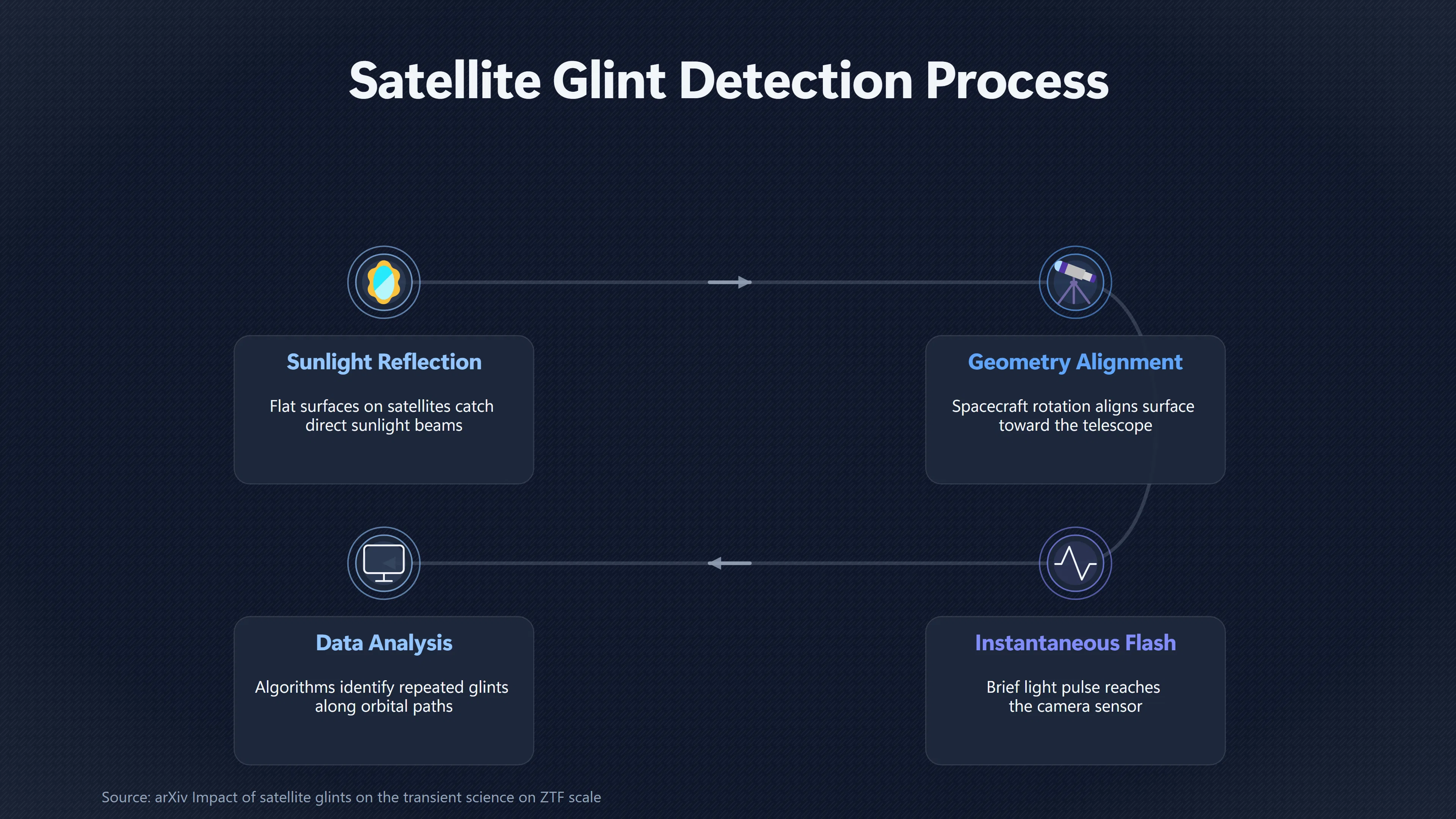
The counter-intuitive feature of these observations is that the telescope can detect the reflection while failing to detect the object producing it. That happens because a specular glint and the satellite’s ordinary brightness are very different measurements.
A satellite may normally reflect too little light towards the observer to rise above the camera’s detection threshold. As the spacecraft rotates, however, a flat or partly mirror-like surface can momentarily satisfy the Sun–surface–observer geometry required for a much stronger reflection. The telescope therefore sees the brief beam of reflected sunlight without seeing the dim satellite before or afterwards. Karpov and Peloton found brightness amplitudes of at least several magnitudes in their ZTF sample, illustrating how large that contrast can be.[arXiv]arxiv.orgarXiv Impact of satellite glints on the transient science on ZTF scalearXiv Impact of satellite glints on the transient science on ZTF scale
W-FAST observations show why the phenomenon can become almost point-like. Nir and colleagues calculated that if a high-altitude satellite rotates quickly enough, a glint can last less than about 0.05 seconds. During such a short illumination interval, its apparent movement may be smaller than roughly 0.75 arcseconds. Under ordinary atmospheric seeing, the resulting image can therefore resemble a stationary point source rather than a satellite trail.[OUP Academic]academic.oup.comOUP Academichigh-rate foreground of sub-second flares from geosynchronous satellites | Monthly Notices of the Royal Astronomical Society…
That creates three very different observational appearances from essentially the same physical mechanism. A continuously bright satellite makes a line; a rotating satellite producing repeated glints can make a dotted or dashed line; and a satellite that happens to reflect towards the observer only once during an exposure can leave a single star-like point.
The last case is the most deceptive. There may be no detectable line connecting the flash to anything else, and another image seconds or minutes later may show an entirely empty location. For an eyewitness, the equivalent experience would simply be a pinpoint of light that switches on and off too quickly to establish a trajectory.
Long astronomical exposures can make the event still harder to interpret. W-FAST researchers noted that a magnitude 9–11 flash lasting only 0.1–0.3 seconds would be diluted to roughly magnitude 14–16 if its light were averaged across a 30-second exposure. A conventional survey therefore does not necessarily measure the flash’s true instantaneous brightness or duration.[OUP Academic]academic.oup.comOUP Academichigh-rate foreground of sub-second flares from geosynchronous satellites | Monthly Notices of the Royal Astronomical Society…
A flash can survive without a visible trail
It is tempting to assume that orbital motion should automatically identify a satellite: anything moving rapidly enough ought to draw a streak across a photograph. The sub-second observations show why that test can fail.
A trail records the portion of the trajectory during which enough light reaches the detector. If the satellite remains below the detection limit for almost its entire passage and becomes bright for only milliseconds, the recorded trail corresponds only to that tiny illuminated segment. At sufficiently high orbital altitude, where angular motion is slower, that segment can be comparable to or smaller than the image of an ordinary star.[OUP Academic]academic.oup.comOUP Academichigh-rate foreground of sub-second flares from geosynchronous satellites | Monthly Notices of the Royal Astronomical Society…
This also explains why a sequence of flashes is diagnostically valuable. Karpov and Peloton’s ZTF algorithm looked for multiple detections aligned along a straight trajectory inside a single exposure. Individually those detections could look like unrelated transient points; collectively, their alignment exposes the otherwise invisible path of a rotating satellite.[arXiv]arxiv.orgarXiv Impact of satellite glints on the transient science on ZTF scalearXiv Impact of satellite glints on the transient science on ZTF scale
An isolated flash removes that advantage. If only one reflective surface happens to align with the observer, or only one glint exceeds the telescope’s sensitivity threshold, there is no dotted trajectory to reconstruct. The artificial object can therefore enter a transient catalogue as what initially looks like a new point source.
Rubin Observatory now explicitly treats both streaks and glints as forms of satellite contamination. Its guidance notes that mirror-like small debris can generate bright glints or trains of glints when tumbling, and its data products include flags intended to warn scientists that detections may have been affected by these signatures.[Rubin Observatory]rubinobservatory.orgRubin ObservatoryImpacts from artificial satellites and debris | Rubin ObservatoryMarch 31, 2026…
The strongest clue is often what happens around the flash
A single image contains surprisingly little information about a millisecond glint. Stronger discrimination comes from looking for evidence that should accompany an artificial object.
Repeated points on a line are particularly useful. Several flashes occurring along a plausible orbital trajectory strongly favour a rotating reflector over an astronomical source. This is the principle behind the ZTF glint-identification method.[arXiv]arxiv.orgarXiv Impact of satellite glints on the transient science on ZTF scalearXiv Impact of satellite glints on the transient science on ZTF scale
Very high cadence can expose the event’s real timescale. A flash occupying several 40-millisecond W-FAST frames is recognisably different from an object that remains steadily luminous. Conversely, an ordinary long exposure may erase precisely that timing information.[OUP Academic]academic.oup.comOUP Academichigh-rate foreground of sub-second flares from geosynchronous satellites | Monthly Notices of the Royal Astronomical Society…
Parallax from separated observatories can also distinguish nearby orbital objects from distant astronomical sources. Nir and colleagues proposed that a fast auxiliary telescope located kilometres away from a main survey telescope could flag glints through their differing apparent positions. A true stellar or extragalactic transient would effectively have no measurable parallax over such a baseline, whereas an Earth-orbiting reflector can.[OUP Academic]academic.oup.comOUP Academichigh-rate foreground of sub-second flares from geosynchronous satellites | Monthly Notices of the Royal Astronomical Society…
Earth’s shadow provides another powerful test. A conventional satellite glint requires direct sunlight. W-FAST therefore observed towards Earth’s shadow, where sufficiently distant lines of sight remove or greatly suppress sunlit artificial objects. That allowed the researchers to place a 95% confidence upper limit of 0.052 fast astrophysical transients per square degree per day brighter than magnitude 11 in their search. The contrast between abundant glints outside the shadow and the lack of corresponding fast events inside it helped establish the artificial foreground.[OUP Academic]academic.oup.comOUP Academichigh-rate foreground of sub-second flares from geosynchronous satellites | Monthly Notices of the Royal Astronomical Society…
Finally, orbital catalogues can sometimes identify the culprit directly. Rubin Observatory points scientists towards tools such as SatChecker, which compare observations with public satellite catalogues, although uncatalogued debris and uncertainties in orbital information mean that absence of a match cannot by itself prove that an event is non-artificial.[Rubin Observatory]rubinobservatory.orgRubin ObservatoryImpacts from artificial satellites and debris | Rubin ObservatoryMarch 31, 2026…
When an extraordinary transient was actually space hardware
The danger is not confined to hypothetical classification errors. A well-known astronomical dispute showed how convincing an isolated artificial flash can be.
In 2020, astronomers reported a bright near-infrared transient detected during observations of GN-z11, an extremely distant galaxy. The flash was initially discussed as potentially associated with a gamma-ray burst at a redshift of about 11 — which would have made it an extraordinary event from the early Universe. The original researchers considered artificial objects but argued against known satellites and Solar System bodies on the available observational information.[Nature]nature.comA possible bright ultraviolet flash from a galaxy at redshift z ≈ 11 | Nature AstronomyDecember 14, 2020…
Other astronomers challenged that interpretation. Nir, Ofek and Avishay Gal-Yam pointed out that the measured rate of point-like satellite reflections made a high-orbit satellite or piece of debris a plausible alternative. Separate work examining similar signals in archival observations likewise argued that nearby moving objects were considerably more probable than the exotic interpretation.[arXiv]arxiv.orgarXiv The GN-z11-Flash Event Can be a Satellite GlintThe GN-z11-Flash Event Can be a Satellite GlintFebruary 8, 2021…
The case was ultimately tied to a specific artificial object. Michałowski and colleagues reconstructed the observation and identified the Breeze-M upper stage of a Russian Proton rocket, travelling in a highly elliptical Earth orbit, as the source of the flash. The association ruled out the event as the proposed record-distance gamma-ray burst.[Nature]nature.comOpen source on nature.com.
GN-z11-flash was not itself a demonstration that every mysterious millisecond flash is a satellite, and its observing configuration differed from a conventional naked-eye UFO sighting. Its importance here is methodological: even professional observations aimed at one of the most distant known galaxies can acquire a transient signal from Earth-orbiting hardware, and the artificial origin may only emerge after detailed reconstruction.
Why instant flashes complicate UFO and transient identification
For UFO/UAP analysis, millisecond and sub-second glints undermine several intuitive assumptions about what a satellite ought to look like.
A satellite need not remain visible before and after its brightest moment. It need not produce an obvious continuous path. It need not brighten gradually enough for an observer to perceive motion. And the absence of a satellite in the next photograph does not mean that the source itself disappeared. The reflective geometry may simply have disappeared.
The same lesson applies in professional transient astronomy. Karpov and Peloton’s later ZTF analysis estimated that artificial satellites account for at least 20% of the isolated single-frame events in the sample they examined. Because the flashes can extend down to millisecond timescales, ordinary survey exposures may record them as unresolved points rather than recognisable moving objects.[arXiv]arxiv.orgarXiv The rate of satellite glints in ZTF and LSST sky surveysarXiv The rate of satellite glints in ZTF and LSST sky surveys
This does not make “satellite glint” a universal explanation for every brief unexplained light. Geometry still matters: the object must be sunlit, an appropriate reflective surface must direct light towards the observer, and the apparent position and timing should be compatible with an orbital source. Multiple observers, simultaneous cameras, accurate timestamps and orbital checks can therefore strengthen or weaken the hypothesis.
But the high-speed survey evidence changes the baseline expectation. An isolated point of light that appears for a fraction of a second in an otherwise empty sky is not, by that fact alone, evidence of an object suddenly materialising, emitting its own light or performing an unusual manoeuvre. Modern astronomical datasets have directly demonstrated a mundane mechanism capable of producing almost exactly that observational signature: an invisible orbiting object can send a narrow pulse of sunlight towards the observer for tenths, hundredths or even thousandths of a second, then disappear completely from view.[OUP Academic]academic.oup.comOUP Academichigh-rate foreground of sub-second flares from geosynchronous satellites | Monthly Notices of the Royal Astronomical Society…
Amazon book picks
Further Reading
Books and field guides related to How a Satellite Flash Can Last Less Than a Second. Use these as the next step if you want deeper reading beyond the article.
NightWatch: A Practical Guide to Viewing the Universe
A practical guide to viewing the universe.
Fundamentals of Astrodynamics
Rating: 4.5/5 from 12 Google Books ratings
Teaching text developed by U.S. Air Force Academy and designed as a first course emphasizes the universal variable formulation. Develops...
Satellite Orbits: Models, Methods, and Applications
This modern presentation guides readers through the theory and practice of satellite orbit prediction and determination. Starting from th...
eBay marketplace picks
Marketplace Samples
Live-tested eBay searches with available results related to this page.
Selected fromsatellite model oneBay.co.uk.


Endnotes
1.
Source: academic.oup.com
Link:https://academic.oup.com/mnras/article/505/2/2477/6279685
Source snippet
OUP Academichigh-rate foreground of sub-second flares from geosynchronous satellites | Monthly Notices of the Royal Astronomical Society...
2.
Source: arxiv.org
Title: arXiv Impact of satellite glints on the transient science on ZTF scale
Link:https://arxiv.org/abs/2202.05719
3.
Source: arxiv.org
Title: arXiv A high-rate foreground of sub-second flares from geosynchronous satellites
Link:https://arxiv.org/abs/2011.03497
Source snippet
A high-rate foreground of sub-second flares from geosynchronous satellitesNovember 6, 2020...
Published: November 6, 2020
4.
Source: arxiv.org
Title: arXiv The rate of satellite glints in ZTF and LSST sky surveys
Link:https://arxiv.org/abs/2310.17322
5.
Source: nature.com
Link:https://www.nature.com/articles/s41550-020-01266-z
Source snippet
A possible bright ultraviolet flash from a galaxy at redshift z ≈ 11 | Nature AstronomyDecember 14, 2020...
Published: December 14, 2020
6.
Source: arxiv.org
Title: arXiv The GN-z11-Flash Event Can be a Satellite Glint
Link:https://arxiv.org/abs/2102.04466
Source snippet
The GN-z11-Flash Event Can be a Satellite GlintFebruary 8, 2021...
Published: February 8, 2021
7.
Source: nature.com
Link:https://www.nature.com/articles/s41550-021-01473-2
Source snippet
A more probable explanation for a continuum flash towards a redshift ≈ 11 galaxy | Nature Astronomy...
8.
Source: nature.com
Link:https://www.nature.com/articles/s41550-021-01472-3
9.
Source: academic.oup.com
Link:https://academic.oup.com/pasj/article/78/2/781/8502082
10.
Source: academic.oup.com
Link:https://academic.oup.com/mnras/article/543/4/3915/8257487
11.
Source: academic.oup.com
Link:https://academic.oup.com/mnras/article/546/2/staf1158/8221885
12.
Source: nature.com
Link:https://www.nature.com/articles/s41550-023-01904-2
13.
Source: nature.com
Title: L. Jiang et al. reply | Nature Astronomy
Link:https://www.nature.com/articles/s41550-021-01474-1
14.
Source: nature.com
Link:https://www.nature.com/articles/s41598-021-92162-7
15.
Source: nature.com
Title: Evidence for GN-z11 as a luminous galaxy at redshift 10.957 | Nature Astronomy
Link:https://www.nature.com/articles/s41550-020-01275-y
16.
Source: academic.oup.com
Link:https://academic.oup.com/mnras/article/501/3/3272/5992334
17.
Source: academic.oup.com
Link:https://academic.oup.com/mnras/article/491/4/5852/5652208
18.
Source: academic.oup.com
Link:https://academic.oup.com/mnras/article/486/2/2422/5449035
19.
Source: academic.oup.com
Link:https://academic.oup.com/mnras/article/484/4/4507/5303752
20.
Source: academic.oup.com
Link:https://academic.oup.com/mnras/article/402/2/855/1101814
21.
Source: nature.com
Title: research articles
Link:https://www.nature.com/natastron/research-articles?type=matters-arising&year=2021
22.
Source: nature.com
Title: research articles
Link:https://www.nature.com/natastron/research-articles?type=matters-arising
23.
Source: academic.oup.com
Link:https://academic.oup.com/mnras/article-pdf/505/2/2477/38576797/stab1437.pdf
24.
Source: academic.oup.com
Link:https://academic.oup.com/mnras/article-abstract/505/2/2477/6279685
25.
Source: arxiv.org
Link:https://arxiv.org/pdf/2011.03497
26.
Source: arxiv.org
Link:https://arxiv.org/pdf/2202.05719
27.
Source: arxiv.org
Link:https://arxiv.org/html/2509.25947v1
28.
Source: arxiv.org
Link:https://arxiv.org/pdf/2310.17322
29.
Source: youtube.com
Title: Mysterious Flash
Link:https://www.youtube.com/watch?v=Jrwd0MKesBw
Source snippet
Satellite Flare...
30.
Source: youtube.com
Title: Satellite Flare
Link:https://www.youtube.com/watch?v=lGpB_mFQiAA
Source snippet
Geosynchronous Satellite Flare caught in Star Time Lapse...
31.
Source: rubinobservatory.org
Link:https://rubinobservatory.org/for-scientists/frequently-asked-questions/leo-sats
Source snippet
Rubin ObservatoryImpacts from artificial satellites and debris | Rubin ObservatoryMarch 31, 2026...
Published: March 31, 2026
32.
Source: rubinobservatory.org
Link:https://rubinobservatory.org/news/action-rubin-lsst-begins
33.
Source: rubinobservatory.org
Title: Key numbers | Rubin Observatory
Link:https://rubinobservatory.org/for-scientists/rubin-101/key-numbers
34.
Source: rubinobservatory.org
Title: Alerts and brokers | Rubin Observatory
Link:https://rubinobservatory.org/for-scientists/data-products/alerts-and-brokers
35.
Source: rubinobservatory.org
Link:https://rubinobservatory.org/news/first-alerts
36.
Source: rubinobservatory.org
Title: Data products, pipelines, and services | Rubin Observatory
Link:https://rubinobservatory.org/for-scientists/data-products
37.
Source: rubinobservatory.org
Link:https://rubinobservatory.org/news/lsst-camera-installed
38.
Source: rubinobservatory.org
Link:https://rubinobservatory.org/news/rubin-detect-brown-dwarfs
39.
Source: indico.in2p3.fr
Link:https://indico.in2p3.fr/event/26707/?view=standard_numbered
40.
Source: indico.in2p3.fr
Link:https://indico.in2p3.fr/event/26707/
41.
Source: rubinobservatory.org
Link:https://rubinobservatory.org/explore/rubin-basics/active-galactic-nuclei
42.
Source: rubinobservatory.org
Link:https://rubinobservatory.org/explore/staff/adam-snyder
43.
Source: rubinobservatory.org
Title: Tour de Galaxias Exóticas
Link:https://rubinobservatory.org/es/education/first-look-lasting-impact-resources-for-educators/skyviewer-education-tours/exotic-galaxies-tour-teacher-guide
44.
Source: rubinobservatory.org
Link:https://rubinobservatory.org/about/history
45.
Source: cosmosage.online
Link:https://cosmosage.online/arxiv/?pid=2509.25428&rank=pid
46.
Source: astro-arxiv-sanity.com
Link:https://www.astro-arxiv-sanity.com/?pid=1612.05243&rank=pid
Additional References
47.
Source: youtube.com
Title: Geosynchronous Satellite Flare caught in Star Time Lapse
Link:https://www.youtube.com/watch?v=KFTFywzVI_E
Source snippet
Satellite glints astronomical transients optical flashes Searching for Fast Astronomical Transients in Archival Photographic Plates...
48.
Source: usgs.gov
Link:https://www.usgs.gov/publications/across-track-tilt-concept-sun-glint-mitigation-future-earth-observing-missions
49.
Source: usgs.gov
Link:https://www.usgs.gov/publications/across-track-tilt-concept-sun-glint-mitigation-uture-earth-observing-missions
50.
Source: scijinks.gov
Link:https://scijinks.gov/news/flashes-the-sky-how-the-lightning-sensor-weather-satellite-can-also-track-meteoroids
51.
Source: science.gov
Link:https://www.science.gov/topicpages/l/large%2Btelescope%2Binterferometer
52.
Source: researchgate.net
Link:https://www.researchgate.net/publication/355152832_A_glint_in_the_eye_photographic_plate_archive_searches_for_non-terrestrial_artifacts
53.
Source: researchgate.net
Link:https://www.researchgate.net/publication/380585594_BRDF-Based_Photometric_Modeling_of_LEO_Constellation_Satellite_from_Massive_Observations
54.
Source: researchgate.net
Link:https://www.researchgate.net/publication/345878983_Orbital_Foregrounds_for_Ultra-short_Duration_Transients
55.
Source: researchgate.net
Link:https://www.researchgate.net/publication/357069920_Reply_to_Three_papers_regarding_the_origin_of_GN-z11-flash
56.
Source: researchgate.net
Link:https://www.researchgate.net/publication/370031018_The_Evryscope_Fast_Transient_Engine_Real-time_Detection_for_Rapidly_Evolving_Transients