Within UFO Identifications
When the Horizon Itself Creates a UFO Illusion
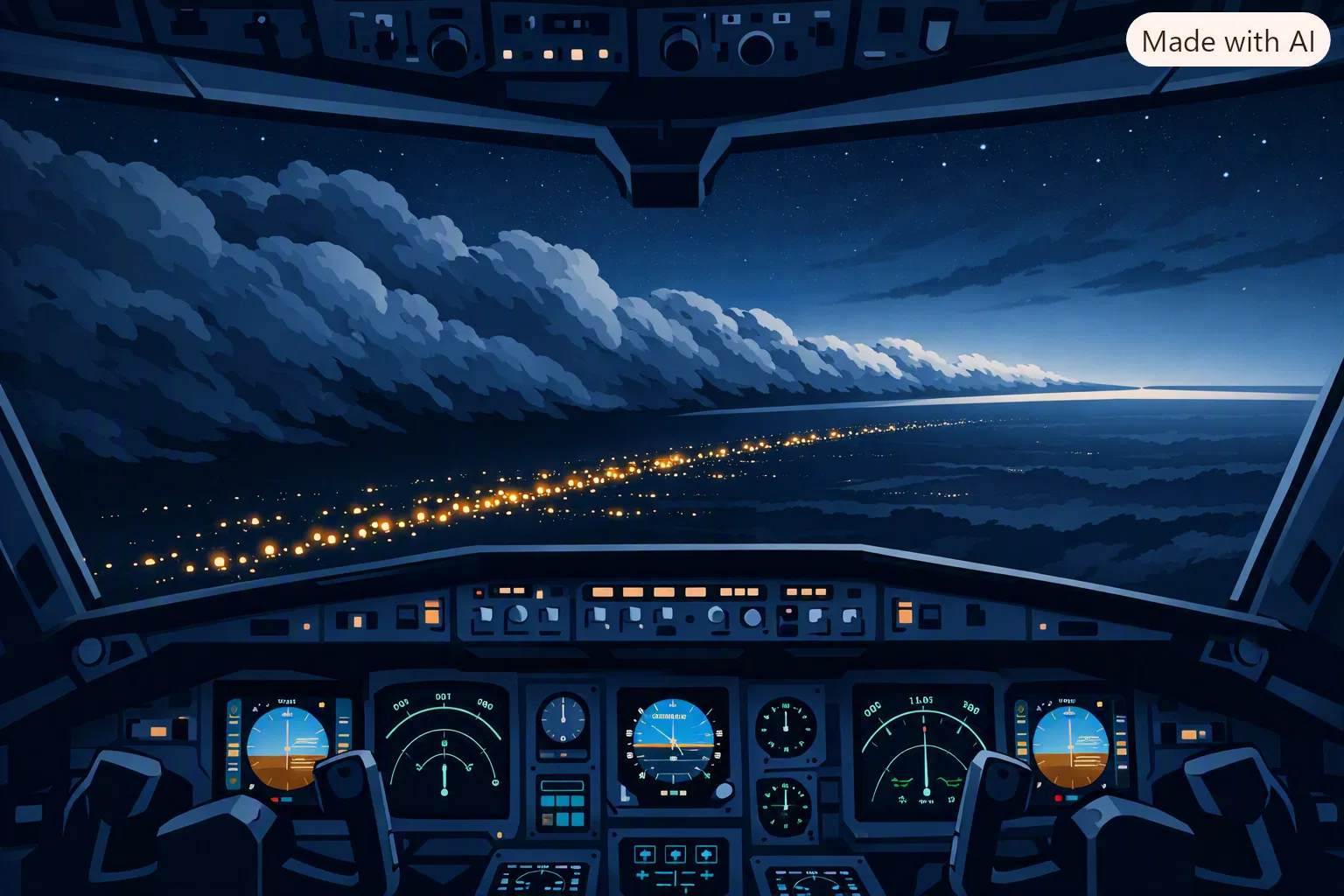
Cloud banks, dark terrain and misleading lines of lights can create a false horizon that alters perceived orientation and movement.
On this page
- How pilots acquire false visual horizons
- Why tilt changes apparent object motion
- Night and weather conditions that increase risk
Page outline Jump by section
Introduction
A false horizon occurs when a pilot or airborne observer unconsciously treats the wrong visual feature as the level reference for the world. A sloping cloud deck, a shoreline, a band of town lights, or the boundary between dark terrain and sky can all substitute for the true horizon when the real one is weak or invisible. The result is more than a mistaken sense of which way is “up”: the apparent height, direction and movement of another light or object can also be distorted because its motion is being judged against a tilted reference frame. FAA guidance specifically warns that sloping clouds, obscured horizons and geometric patterns of ground lights can produce this error.[Federal Aviation Administration]faa.govOpen source on faa.gov.
For UFO/UAP reports made from aircraft, this matters because an otherwise ordinary light can appear to climb, descend or manoeuvre unexpectedly when the observer’s visual frame is itself wrong or moving.
How pilots acquire a false visual horizon
Human visual orientation depends heavily on large, stable features that define horizontal and vertical. In normal daylight the real earth–sky boundary usually provides a strong reference. At night, above cloud or over featureless terrain, that reference may disappear while other long, conspicuous lines remain. The visual system can then adopt one of those lines as “level” without the observer consciously deciding to do so.
The FAA lists several characteristic situations. Ground lights may become difficult to distinguish from stars; particular geometric arrangements of lights can suggest a horizon that is not horizontal; a visible sloping cloud formation can become the dominant reference; and over large bodies of water atmospheric and surface conditions may leave no discernible true horizon at all.[Federal Aviation Administration]faa.govOpen source on faa.gov. Its separate guidance on visual illusions adds banked cloud layers and featureless terrain where ground lights merge perceptually with the night sky.[Federal Aviation Administration]faa.govOpen source on faa.gov.
This is not simply a theoretical weakness inferred from laboratory demonstrations. Aviation researchers have induced false-horizon effects in simulators and observed inappropriate control responses. In one study of pilots exposed to spatial-disorientation scenarios, a false horizon had a measurable effect on roll control, and the authors concluded more generally that spatial disorientation could produce inappropriate control inputs even when the pilot did not recognise that disorientation was occurring.[Aeolus]aeolus-hpi.orgOpen source on aeolus-hpi.org. A wider review of orientation in flight notes that a pilot who follows a false horizon may enter a gentle bank yet still feel as though the aircraft is level.[Springer]springer.comOpen source on springer.com.
That last point is important for interpreting aerial observations. The observer does not necessarily experience the scene as obviously tilted or confused. The false horizon can feel normal.
A particularly persuasive visual line can be produced by:
- Sloping cloud tops. A broad cloud deck extending across peripheral vision may be treated as level even when it rises substantially from one side of the view to the other. Aviation safety guidance specifically identifies this configuration as a false-horizon hazard.[AOPA]aopa.orgOpen source on aopa.org.
- Ground-light patterns. Roads, coastal settlements, towns on sloping terrain or aligned lights can form an apparent straight boundary. Against a dark sky, that line may carry more visual weight than the poorly visible real horizon.[Federal Aviation Administration]faa.govOpen source on faa.gov.
- Dark terrain or water. An unlit surface can merge with a dark sky, removing the normal boundary altogether. The remaining illuminated structures then become disproportionately influential as orientation cues. FAA and Australian aviation guidance both emphasise the heightened disorientation risk created by reduced visual references at night.[Federal Aviation Administration]faa.govOpen source on faa.gov.
- Weather that selectively obscures the horizon. Haze, rain, cloud and uneven illumination can conceal the true earth–sky line while leaving some nearer edge or illuminated layer visible enough to take its place.[Flight Safety Foundation]flightsafety.orgOpen source on flightsafety.org.
The underlying problem is therefore not poor eyesight. It is that the visual system has been supplied with a plausible but incorrect reference.
Why a tilted horizon changes apparent object motion
For an airborne observer, judging another object’s movement is inherently relational. A distant light is not perceived merely as a changing point on the retina; its location is interpreted relative to the horizon, nearby clouds, stars, terrain and the aircraft’s own attitude. If the chosen horizon is tilted, the coordinate system used to describe the object’s motion is tilted too.
Imagine a distant aircraft maintaining approximately level flight while the observer adopts a cloud deck rising from left to right as the horizon. Against that false reference, the target can appear higher on one side of the scene and lower on the other even though its true altitude has changed little. If the observer’s own aircraft then banks in an unconscious attempt to align itself with the false horizon, the apparent motion becomes more complicated: the entire visual field rotates while the target shifts relative to the cockpit.
This mechanism provides a straightforward route from an orientation error to reports of anomalous motion. A target may seem to:
- climb or descend unusually relative to the perceived horizon;
- cross the observer’s field of view on a steeper or flatter track than its real flight path;
- change its apparent direction as the observer banks;
- appear unexpectedly close to the observer’s own altitude;
- trace an arc or diagonal path produced partly by rotation of the observer’s frame rather than by an equivalent manoeuvre by the target.
Those effects are a geometric consequence of judging relative position from a mistaken reference frame. They should not be interpreted as evidence that every reported rapid UAP manoeuvre is a false-horizon effect. A false horizon by itself does not generate arbitrary accelerations or prove the identity of a target. Rather, it can corrupt the observer’s estimate of orientation, after which normal own-aircraft movement and ordinary target movement may be described in misleading terms. Experimental evidence that false horizons induce actual roll corrections makes this more significant than a purely static visual error.[Aeolus]aeolus-hpi.orgOpen source on aeolus-hpi.org.
A historical accident demonstrates just how large the resulting error can be. On 4 December 1965, Eastern Air Lines Flight 853 and TWA Flight 42 approached each other near Carmel, New York, with about 1,000 feet of assigned vertical separation. The Eastern crew saw the TWA Boeing 707 shortly after emerging near cloud tops and believed it to be at or near their altitude. Investigators concluded that cloud tops rising towards the north formed a false apparent horizon behind the other aircraft. The Eastern pilots pulled up to avoid what they believed was a collision threat; that climb eliminated the real vertical separation, and the two aircraft collided.[Wikisource]wikisource.orgOpen source on wikisource.org.
The Civil Aeronautics Board’s analysis is unusually relevant to UFO/UAP interpretation because the object itself was neither exotic nor especially difficult to recognise: it was another airliner. What was misperceived was its spatial relationship to the observer. The cloud background made a conventional aircraft appear to occupy a threatening, incorrect position.[Wikisource]wikisource.orgOpen source on wikisource.org.
That distinction is essential. Some aerial reports may correctly describe the existence and general appearance of a light or object while being much less reliable about its altitude, trajectory or rate of movement.
Night and weather conditions that increase risk
False horizons become most persuasive when reliable visual references are weak and misleading ones remain strong. Darkness is therefore especially important. The FAA’s Airplane Flying Handbook states that darkness and low visibility increase susceptibility to visual error and notes that night scenes containing both stars and ground lights can make the true horizon difficult to establish.[Federal Aviation Administration]faa.govOpen source on faa.gov. SKYbrary similarly identifies the absence of a visible horizon on dark nights or in instrument meteorological conditions as a major setting for spatial disorientation.[Skybrary]skybrary.aeroOpen source on skybrary.aero.
The risk is not limited to completely overcast weather. Clear nights can be deceptive precisely because visibility of individual lights may remain excellent while orientation cues are poor. A pilot may see stars, settlements or another aircraft sharply but still have little reliable information about where the actual horizontal plane lies. FAA guidance describes this potentially confusing mixture of stars and ground illumination explicitly.[Federal Aviation Administration]faa.govOpen source on faa.gov.
Cloud decks are another high-value warning sign in an aerial anomaly report. A smooth cloud top can provide a broad, visually dominant surface, while gradual changes in its height may be difficult to recognise from the cockpit. The Carmel accident showed that an upslope in cloud tops could alter perceived vertical separation from another aircraft severely enough to trigger an unnecessary evasive manoeuvre.[Wikisource]wikisource.orgOpen source on wikisource.org. Experimental and operational literature likewise treats sloping cloud as a repeatable source of false orientation rather than an exceptional curiosity.[PubMed]nih.govOpen source on nih.gov.
Dark terrain creates the opposite-looking but related problem: instead of supplying the wrong horizon, it may remove the true one. Australia’s Transport Safety Bureau has repeatedly highlighted the loss of external visual cues during night flying as a spatial-disorientation hazard, including accidents in sparsely illuminated areas and over water.[NTSB Data]ntsb.govOpen source on ntsb.gov. When only a few bright features remain, those lights can dominate the observer’s interpretation of the scene.
Workload can make these conditions harder to recognise. An aircrew watching an unexpected light may divide attention between the object, instruments, radio traffic and normal flight duties. Research on spatial disorientation has found that misleading visual cues can affect both control inputs and visual scanning without necessarily being consciously identified by the pilot.[PubMed]nih.govOpen source on nih.gov. This is one reason pilot experience alone cannot rule out a false-horizon explanation: aviation training treats such illusions seriously precisely because competent, trained observers remain susceptible to them.
What this means for UFO/UAP assessment
False horizons are best treated as a risk factor for erroneous motion and position estimates, not as a universal explanation for unfamiliar aerial objects. The Pentagon’s All-domain Anomaly Resolution Office has stressed more generally that UAP reports encompass conventional aircraft, balloons, satellites, lights, sensor artefacts and optical effects such as parallax; being unidentified at first observation does not establish that a target behaved anomalously in physical space.[AARO]aaro.milOpen source on aaro.mil. A false horizon adds another way in which the observer’s reference geometry can be wrong before investigators attempt to infer speed or manoeuvrability.
In practice, a report deserves particular scrutiny for false-horizon distortion when several features occur together: the observation was made at night or in poor visibility; the true earth–sky boundary was absent or weak; a sloping cloud bank, coastline or conspicuous line of lights was present; the reported anomaly concerns dramatic climbing, descending or banking relative to the visible scene; and the observing aircraft itself was turning or changing attitude.
The strongest test is independent attitude and position data. If cockpit instruments, flight-recorder information, inertial data or a reliable video horizon establish the observer’s roll and pitch, investigators can reconstruct the sightline without relying solely on what looked horizontal at the time. The FAA’s basic countermeasure for spatial disorientation is exactly this shift from unreliable visual impressions to reliable fixed references or flight instruments.[Federal Aviation Administration]faa.govOpen source on faa.gov.
A useful UFO/UAP analysis should therefore separate three questions that witnesses understandably experience as one: What was the object? Where was it relative to the aircraft? How did it actually move? A witness can be right about the first and wrong about the latter two. The Carmel collision is a stark demonstration that even another large aircraft can be placed at the wrong apparent altitude when the horizon is misleading.[Wikisource]wikisource.orgOpen source on wikisource.org.
That is the distinctive importance of false horizons within IFO explanations. They do not have to manufacture a strange object. They can make an ordinary object occupy a strange geometry — and once the observer or aircraft responds to that geometry, the resulting apparent motion can become stranger still.
Amazon book picks
Further Reading
Books and field guides related to When the Horizon Itself Creates a UFO Illusion. Use these as the next step if you want deeper reading beyond the article.
Human Factors in Flight
The late Captain Frank H Hawkins FRAes, M Phil, was Human Factors Consultant to KLM, for whom he had flown for over 30 years as line capt...
The Pilot's Manual: Flight School
Time is money in an airplane and with an instructor. Effective for both preflight learning and post-flight briefings, Flight School will...

Stick and Rudder
First published 1972. Subjects: Aerodynamics, Flight, Piloting, Airplanes, Airplanes, piloting.
eBay marketplace picks
Marketplace Samples
Live-tested eBay searches with available results related to this page.
Selected fromaviation poster oneBay.co.uk.
Endnotes
1.
Source: aaro.mil
Link:https://www.aaro.mil/UAP-Cases/Official-UAP-Imagery/4/
Additional References
2.
Source: youtube.com
Title: How ‘Spatial Disorientation’ Can Be Fatal To Pilots In Flight
Link:https://www.youtube.com/watch?v=Vi9Oaon_7d4
Source snippet
This selection of videos details how false horizons, banked clouds, and nighttime visual reference errors induce spatial disorientation a...
3.
Source: youtube.com
Title: How to Recognize and Overcome Spatial Disorientation
Link:https://www.youtube.com/watch?v=YatlPrTZUNs
Source snippet
How 'Spatial Disorientation' Can Be Fatal To Pilots In Flight...
4.
Source: cia.gov
Link:https://www.cia.gov/stories/story/how-to-investigate-a-flying-saucer/
5.
Source: youtube.com
Title: PPGS Lesson 14.2 | Aeromedical: Illusions
Link:https://www.youtube.com/watch?v=ZBPmFaqECdM
Source snippet
ICEFLAGS: Unmasking the In-Flight Illusions...
6.
Source: youtube.com
Title: Aviation visual illusions
Link:https://www.youtube.com/watch?v=zZOhH07h4Iw
Source snippet
How to Recognize and Overcome Spatial Disorientation...
7.
Source: media.defense.gov
Title: FY24 CONSOLIDATED ANNUAL REPORT ON UAP 508
Link:https://media.defense.gov/2024/Nov/14/2003583603/-1/-1/0/FY24-CONSOLIDATED-ANNUAL-REPORT-ON-UAP-508.PDF
8.
Source: youtube.com
Title: ICEFLAGS: Unmasking the In-Flight Illusions
Link:https://www.youtube.com/watch?v=uRZO1LRLQ4I
Source snippet
Aviation visual illusions...