Within UFO Identifications
Why a Stationary Light Can Seem to Move
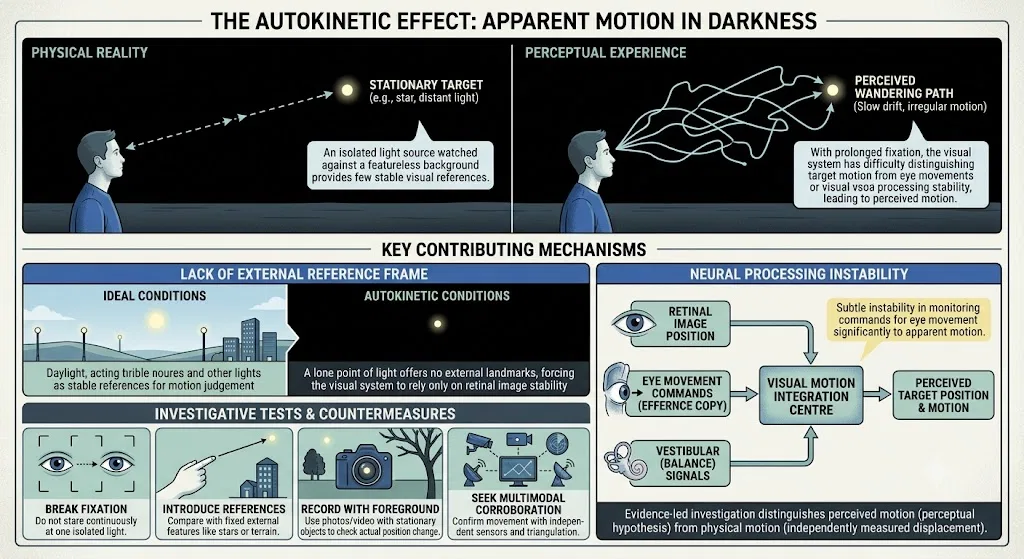
A fixed light viewed against a dark featureless background can appear to wander because the eye lacks stable visual references.
On this page
- What the autokinetic effect is
- Why darkness removes reliable motion references
- How pilots and investigators reduce the illusion
Page outline Jump by section
Introduction
Autokinesis is a visual illusion in which a stationary point of light appears to wander when it is watched against a dark, featureless background. The light itself need not move at all. With few surrounding landmarks to act as a reference frame, the visual system has difficulty deciding whether small changes in the image arise from the target, the observer’s eyes or the observer’s own movement. Modern experiments confirm that apparent motion can emerge even when the stimulus is physically stationary.[PubMed Central (PMC)]nih.govOpen source on nih.gov.
This matters to UFO and UAP investigation because many night-time reports begin with exactly the conditions in which autokinesis is strongest: a distant, unresolved light seen against open sky, dark countryside or water. A star, planet, tower light or other fixed source may therefore be sincerely reported as drifting, changing direction or apparently manoeuvring. Aviation authorities treat the effect as a genuine operational hazard rather than a matter of carelessness or imagination.[Federal Aviation Administration]faa.govOpen source on faa.gov.
What the autokinetic effect is
The basic demonstration is remarkably simple. Place a small stationary light in an otherwise dark visual field and stare at it. After several seconds, many observers begin to perceive motion even though no physical displacement has occurred. The apparent path can look like a slow drift, wavering or irregular wandering rather than the steady track expected from an objectively moving object.[PubMed Central (PMC)]nih.govOpen source on nih.gov.
The Federal Aviation Administration describes the practical version succinctly: in darkness, a stationary light can appear to move after it has been stared at for many seconds. The FAA places autokinesis among night-time visual illusions because a pilot who treats the apparent motion as real may make unnecessary control inputs.[Federal Aviation Administration]faa.govOpen source on faa.gov. Aviation-safety guidance similarly describes a distant fixed light becoming apparently mobile during prolonged fixation.[Skybrary]skybrary.aeroOpen source on skybrary.aero.
That makes autokinesis particularly relevant to reports phrased in terms such as the light started moving, it drifted sideways, it changed course or it seemed to approach. Such descriptions establish what the witness perceived; by themselves, they do not establish that the source underwent equivalent physical motion.
A useful distinction is that autokinesis concerns apparent positional motion, not every strange feature that a night-time light may display. Changes of colour or rapid twinkling, for example, can involve atmospheric scintillation and belong to a different explanatory mechanism.[Skeptical Inquirer]skepticalinquirer.orgOpen source on skepticalinquirer.org. Investigators should therefore avoid treating every unusual property of a luminous report as one single illusion.
Why darkness removes reliable motion references
Human vision normally judges movement through relationships. A car passing houses, an aircraft crossing cloud or a light moving relative to the horizon supplies external reference points against which displacement can be measured. An isolated light in darkness removes much of that geometrical information.
The problem is especially severe for a tiny, distant source. Its image provides little or no information about physical size, range or surroundings. Without a visible horizon, terrain, neighbouring stars or other stable structure, the observer cannot easily separate motion of the target from tiny changes associated with gaze and visual processing. This is why autokinesis is associated with featureless darkness rather than ordinary well-lit scenes.[Skybrary]skybrary.aeroOpen source on skybrary.aero.
The mechanism is more subtle than the popular explanation that “your eyeballs twitch, so the light moves”. Human eyes never remain perfectly motionless during fixation, but research does not support a simple one-for-one relationship in which each involuntary eye movement produces a matching perceived excursion of the target. Gregory and Zangwill’s classic work instead argued that instability in the neural system monitoring commands for eye movement contributes importantly to the effect. Later research has likewise noted that measured eye movements and perceived autokinetic motion do not simply correlate.[Sage Journals]sagepub.comOpen source on sagepub.com.
A 2024 experimental study adds an important modern result. Researchers compared genuinely slow target motion with autokinetic perception and found that, at sufficiently low physical speeds, judgements became increasingly aligned with the illusory motion rather than with the target’s real direction. The authors interpreted this as evidence for a perceptual threshold below which reliable discrimination of motion becomes difficult.[PubMed Central (PMC)]nih.govOpen source on nih.gov.
For UFO/UAP assessment, that finding is useful because distant lights often offer precisely the kind of weak motion signal that human vision handles poorly. A witness may therefore experience movement with considerable subjective clarity even though the available visual information is inadequate to determine whether the source actually changed position.
Why an ordinary light can acquire extraordinary-looking motion
Autokinesis can make an otherwise unremarkable source difficult to recognise because apparent motion changes the entire interpretation of the scene. A bright point regarded as stationary might readily be considered a star, planet or distant ground light. Once it seems to drift or manoeuvre, the observer naturally starts considering mobile objects instead.
Several conditions make this transformation more plausible:
- The target is point-like. If no body, wings, outline or surface detail can be resolved, there is little visual information beyond brightness and apparent direction.
- The background is nearly empty. Open sea, remote countryside and dark sky remove stable positional references.
- The observer fixates on the light. Aviation guidance repeatedly warns against prolonged staring because the effect develops during sustained observation of an isolated source.[Federal Aviation Administration]faa.govOpen source on faa.gov.
- Distance is uncertain. With no known size or range, a tiny apparent angular displacement can be mentally translated into very different imagined trajectories.
- The observer is actively trying to interpret a possible hazard or aircraft. Once apparent motion is noticed, attention may become even more concentrated on the same ambiguous target.
These conditions explain why trained observers are not automatically immune. The FAA teaches autokinesis precisely because professional pilots can encounter it. The operational lesson is not that the observer has poor vision, but that human visual perception has predictable limitations when its normal reference structure disappears.[Federal Aviation Administration]faa.govOpen source on faa.gov.
Nor does apparent complexity necessarily prove complex real motion. A light that seems first to drift one way and then another may be especially striking to the observer, yet the absence of an external angular reference makes such perceived changes difficult to convert into reliable kinematics. Autokinesis should consequently remain a candidate explanation when a report describes impressive motion but provides no independent measure of that motion.

How pilots reduce the illusion
Aviation practice offers the clearest model for controlling autokinesis because the consequences of acting on false motion can be immediate. The basic principle is to stop relying on the isolated light as its own reference frame.
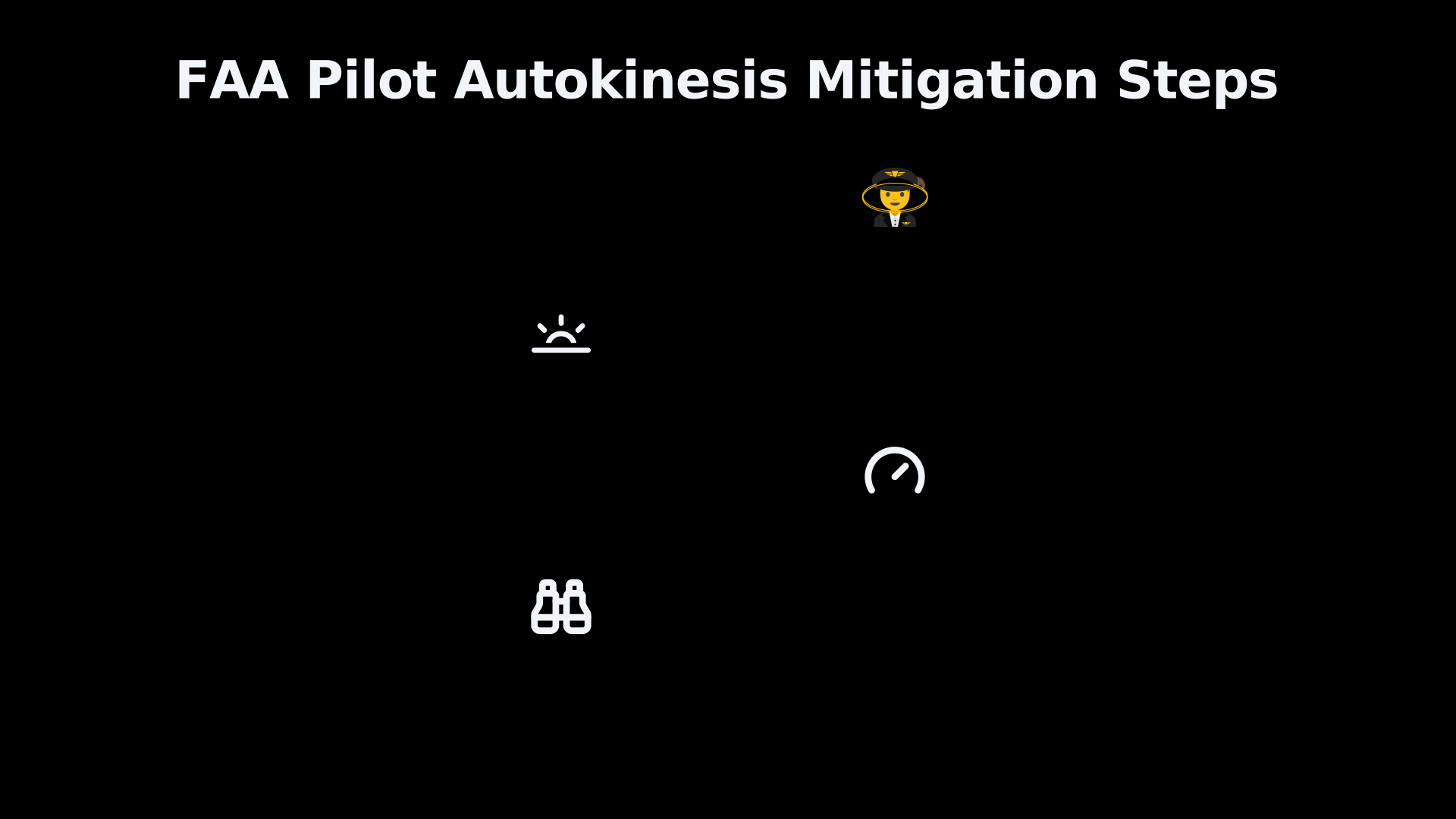
FAA guidance warns that attempting to align an aircraft with the apparent movements of a stationary light can lead to loss of control.[Federal Aviation Administration]faa.govOpen source on faa.gov. Aviation-safety material therefore recommends breaking fixation and bringing independent references back into the judgement.[Skybrary]skybrary.aeroOpen source on skybrary.aero.
In practice, that means:
- Do not stare continuously at one isolated light. A normal visual scan interrupts the fixation conditions that encourage autokinesis.
- Compare the light with fixed external features where possible. A horizon, stars, terrain, buildings or other known reference points can reveal whether its angular position is genuinely changing.
- Cross-check instruments rather than steering in response to apparent motion alone. For a pilot, heading, attitude and navigation information provide measurements independent of the visual illusion.
- Reassess after changing gaze. If the apparent wandering weakens, disappears or changes when fixation is broken, that is evidence that perception rather than target motion may be contributing.
These safeguards embody a broader investigative rule: a single observer’s impression of motion is evidence of perceived motion, not yet a measurement of physical motion.
How UAP investigators can test a “moving” light
The same principle can be applied to UFO/UAP reports without dismissing the witness account. Instead of asking whether the witness was “fooled”, investigators can ask what independent data establish that the reported angular movement occurred outside the observer’s visual system.
The strongest checks are those that create stable references or independent measurements. A photograph or video that includes fixed foreground objects can potentially show whether the source changes angular position relative to them. Multiple cameras at known locations can provide triangulation. Radar or other ranging systems can independently establish motion in three dimensions. Modern proposals for systematic UAP observation emphasise precisely this kind of multimodal collection: wide-field cameras for tracking, multiple observing stations for triangulation and independent radar-derived measurements of range and kinematics.[arXiv]arxiv.orgOpen source on arxiv.org.
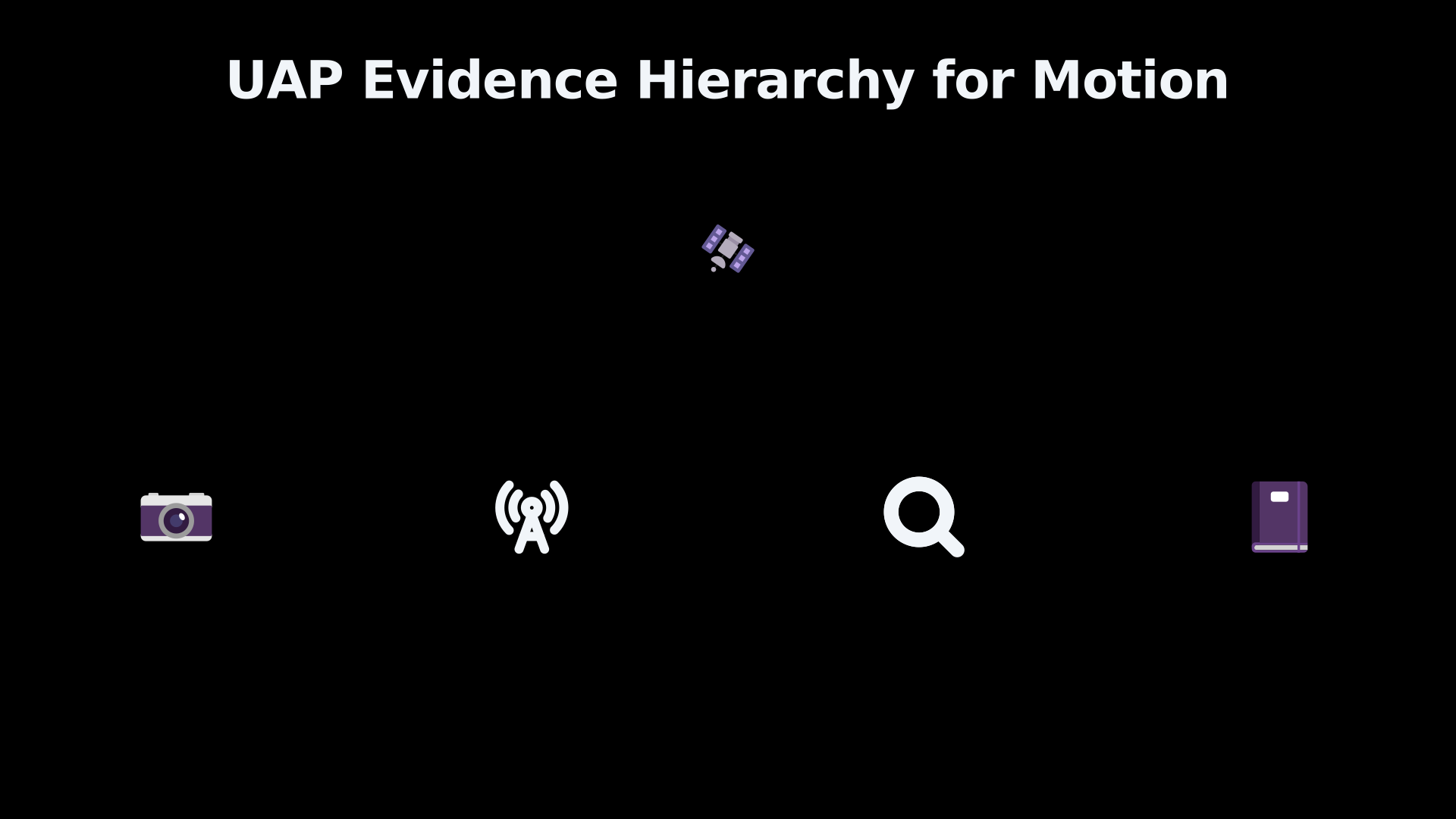
For a witness report involving a lone night-time light, investigators should therefore distinguish several levels of evidence:
- Apparent movement only: the witness saw the light wander, but there is no stable visual reference or recording.
- Angular movement against a reference: the light demonstrably changed position relative to a landmark or recorded star field.
- Corroborated movement: independent cameras or sensors recorded a compatible trajectory.
- Measured range and kinematics: instrumentation establishes that an object physically changed position rather than merely changing apparent direction.
Autokinesis is most relevant to the first category. It becomes progressively less satisfactory as independent evidence of real displacement accumulates. This is why it should be treated as a testable perceptual hypothesis, not a universal explanation for luminous UAP reports.
What autokinesis can — and cannot — explain
Autokinesis has a narrow but important explanatory role. It is well suited to reports involving an isolated light, darkness, prolonged observation, few reference points and motion reported mainly as wandering or drifting. The FAA’s continuing inclusion of the effect in pilot guidance, together with laboratory evidence that physically stationary targets can produce perceived motion, establishes that the underlying phenomenon is real and operationally significant.[Federal Aviation Administration]faa.govOpen source on faa.gov.
It is not, however, sufficient merely to label any unexplained night-time light “autokinesis”. A report backed by independently recorded displacement, reliable triangulation or matching sensor tracks requires a different analysis. Nor does autokinesis by itself explain unusual brightness changes, colour effects, disappearance behind obstacles or other observations that may have separate physical or perceptual causes.
Its real value in UFO/UAP investigation is methodological. It shows why motion that feels obvious to an observer need not be objectively present, particularly when the visual scene contains no trustworthy frame of reference. The appropriate response is neither automatic belief nor automatic dismissal, but measurement: break fixation, introduce stationary references, compare observations and seek independent sensor confirmation. Under dark, featureless viewing conditions, that distinction can be the difference between a light that merely seems to manoeuvre and one that demonstrably does.
Amazon book picks
Further Reading
Books and field guides related to Why a Stationary Light Can Seem to Move. Use these as the next step if you want deeper reading beyond the article.
Sensation and Perception
. Bruce Goldstein's SENSATION AND PERCEPTION, the best-seller which has helped over 150,000 students understand the ties between how we s...
Visual Perception: Physiology, Psychology, and Ecology
This edition contains over 460 additional references and the treatment of visual psychology in the early chapters has been extensively re...
Vision Science: Photons to Phenomenology
This textbook on vision reflects the integrated computational approach of modern research scientists, combining psychological, computatio...
The Invisible Gorilla
NEW YORK TIMES BESTSELLER • Our minds don’t work the way we think they do. Two renowned psychologists explain how and why our intuitions...
eBay marketplace picks
Marketplace Samples
Live-tested eBay searches with available results related to this page.
Selected fromUFO poster oneBay.co.uk.

Current eBay listing
I Want To Believe UFO Poster Giclée Fine Art Heavyweight Print

Current eBay listing
VINTAGE UFO FLYING SAUCERS COMIC ADVERTISING A2 POSTER PRINT

Endnotes
1.
Source: media.defense.gov
Title: FY24 CONSOLIDATED ANNUAL REPORT ON UAP 508
Link:https://media.defense.gov/2024/Nov/14/2003583603/-1/-1/0/FY24-CONSOLIDATED-ANNUAL-REPORT-ON-UAP-508.PDF
2.
Source: cia.gov
Link:https://www.cia.gov/stories/story/how-to-investigate-a-flying-saucer/
3.
Source: aaro.mil
Link:https://www.aaro.mil/UAP-Cases/Official-UAP-Imagery/4/
4.
Source: youtube.com
Title: PPGS Lesson 14.2 | Aeromedical: Illusions
Link:https://www.youtube.com/watch?v=ZBPmFaqECdM
Source snippet
FAA TEST-AIR TRANSPORTATION PILOT-FLIGHT EMERGENCY & HAZARDS Q9109,Q9110,Q9110-1,Q9108,Q9114...
5.
Source: youtube.com
Link:https://www.youtube.com/watch?v=y3NZhjTQwgE
Source snippet
Sherif's Autokinetic Effect Study - AQA A-Level Psychology...
6.
Source: youtube.com
Title: Sherif’s Autokinetic Effect Study
Link:https://www.youtube.com/watch?v=CTb4Rs9ZcsM
Source snippet
Conformity Research: Sherif's Autokinetic Effect Experiment...
7.
Source: youtube.com
Title: Conformity Research: Sherif’s Autokinetic Effect Experiment
Link:https://www.youtube.com/watch?v=1-pbW6kc7q0
Source snippet
Muzafer Sherif Conformity and the autokinetic effect...
8.
Source: youtube.com
Title: Muzafer Sherif Conformity and the autokinetic effect
Link:https://www.youtube.com/watch?v=2E2jib4d_cw