Within UFO Identifications
Why a Helicopter at Night Can Become a UFO
Hovering helicopters can resemble fixed or slowly moving lights when darkness conceals the fuselage and rotor.
On this page
- Hovering flight and deceptive bearing
- How lighting overwhelms the airframe
- Sound, flight tracking and location clues
Page outline Jump by section
Introduction
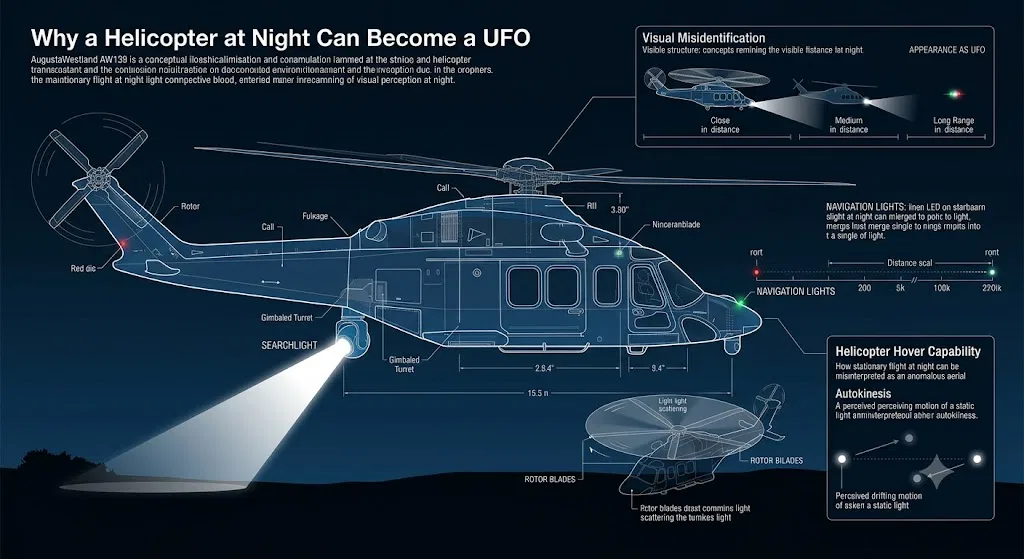
A helicopter at night can stop looking like a helicopter surprisingly quickly. Its fuselage and rotor may disappear against a dark sky while its navigation, anti-collision, landing or search lights remain conspicuous. If the aircraft is hovering, moving nearly towards or away from the observer, or operating at enough distance that its angular motion is small, the result may be a bright point or cluster of lights that appears fixed in the sky. That combination closely matches a common UFO/UAP description: a luminous object that hovers, drifts slowly and has no obvious wings or conventional outline.
This is not merely a hypothetical possibility. Aviation authorities explicitly recognise that night viewing strips away distance, shape and motion cues, while isolated lights can produce perceptual illusions of their own. Helicopters add the unusual ability to remain genuinely stationary relative to the ground. In a reported sighting, therefore, “it hovered” can sometimes be evidence for, rather than against, a helicopter explanation.[Federal Aviation Administration]faa.govFederal Aviation AdministrationRotorcraft Flying HandbookThe approved aircraft lights for night operations are a green light on the right…
Hovering flight can make an aircraft look fixed in the sky
A conventional aeroplane normally has to keep moving through the air, whereas a helicopter can maintain a stabilised hover. The Federal Aviation Administration (FAA) describes a normal hover as flight in which the helicopter remains stationary while its rotor accelerates a large mass of air downwards. Helicopters can also hover-taxi at very low speeds.[Federal Aviation Administration]faa.govFederal Aviation AdministrationRotorcraft Flying HandbookThe approved aircraft lights for night operations are a green light on the right…
That capability creates an unusually convincing night-time misidentification. A person looking towards a helicopter conducting police observation, an approach, a survey, a search or another low-speed operation may see little more than its lights. Because the aircraft really can stay over roughly the same patch of ground, waiting for it to “fly like a normal aircraft” may not resolve the mystery.
Even a helicopter that is travelling can appear almost stationary under the right geometry. Motion across the observer’s field of view is easiest to notice when an object moves sideways. An aircraft coming broadly towards the observer or receding from them may change its range substantially while changing its bearing only slightly. Night removes many of the foreground references that would otherwise reveal that change. FAA pilot guidance notes that distance is deceptive at night because intervening references are scarce and familiar objects cannot readily be compared for size and position; estimates of altitude and speed suffer for the same reason.[Federal Aviation Administration]faa.govFederal Aviation Administration
This is especially important when assessing statements such as “the light stayed in exactly the same place for several minutes”. Such testimony is compatible with a true hover, but it can also result from small angular movement being difficult to perceive. A sighting therefore becomes more diagnostic if the witness records the light’s bearing relative to fixed landmarks at intervals rather than relying on a general impression of immobility.
There is another complication. In darkness, an isolated stationary light can itself appear to wander. Aviation medicine calls this autokinesis or the autokinetic effect. FAA guidance describes a static light as capable of appearing to move when stared at in darkness, while aviation-safety material identifies the problem particularly with small lights against backgrounds lacking other visual cues.[Federal Aviation Administration]faa.govFederal Aviation Administration Chapter 8Medical Facts for PilotsFalse horizon. Sloping cloud formations, an obscured horizon, a dark scene spread with ground lights and stars, c…
A distant hovering helicopter can therefore produce apparently contradictory descriptions without doing anything extraordinary: one observer may call it motionless, while another sees small darts or excursions. Those perceived motions should not automatically be treated as measured changes in the aircraft’s trajectory.

Bright lights can erase the helicopter around them
Aircraft lighting is designed to make an aircraft conspicuous, not necessarily to make its entire shape easy for an observer on the ground to recognise. At night, aircraft in flight display navigation lights and anti-collision lighting under normal operating rules. UK rules specify anti-collision lights intended to attract attention and navigation lights intended to indicate the aircraft’s relative path. FAA guidance likewise notes that anti-collision systems can use rotating beacons or strobes, in red or white, with intensities that can exceed the regulatory minimum.[Regulatory Library]regulatorylibrary.caa.co.uk00880 SERA3215 Lights to be displayed by aircraftRegulatory LibrarySERA.3215 Lights to be displayed by aircraft…
FAA helicopter guidance specifies the familiar navigation arrangement of green on the right side, red on the left and white towards the rear. Depending on the aircraft and operation, landing lights, taxi lights or searchlights may add much brighter white illumination.[Federal Aviation Administration]faa.govFederal Aviation AdministrationRotorcraft Flying HandbookThe approved aircraft lights for night operations are a green light on the right…
At useful identification distances, these lights can be visible when the airframe is not. The observer then receives a highly incomplete picture:
- A frontal view can collapse the aircraft into one or several bright lights. The dark fuselage contributes little visible contrast.
- A landing or searchlight can dominate everything else. If a high-intensity white light points roughly towards the observer, weaker navigation lights and structural detail may be difficult to notice.
- Strobes change the perceived form from moment to moment. A flashing anti-collision light may seem to appear and disappear independently of steadier lights.
- Changes in heading change the visible pattern. A helicopter rotating in a hover can expose or conceal different navigation lights without translating appreciably across the sky.
- Haze, thin cloud or mist can enlarge the apparent luminous area. Light scattered around the source may make a compact lamp look like a larger glowing object while further suppressing the outline behind it.
The navigation colours can still provide useful clues. Red and green lights are deliberately positioned on opposite sides so that the orientation of an aircraft can be inferred. Yet recognition requires both lights to be visible and separable. At long range, through haze, or with a bright white light overpowering them, the observer may instead report a single white, red or multicoloured object.[Federal Aviation Administration]faa.govFederal Aviation Administration
Night vision itself compounds the problem. The FAA warns that darkness and low visibility make visual errors more likely, while ground lights, stars and the absence of a clear horizon can degrade judgements of position. This matters because recognising “a helicopter” normally depends on seeing a collection of familiar cues at once: body, tail boom, rotor disc, scale, direction and motion. At night, several of those cues can vanish simultaneously.[Federal Aviation Administration]faa.govFederal Aviation Administration
A mundane example shows how complete the misidentification can be. In Melbourne in 2017, Australian police said a man apparently mistook a police helicopter for a UFO before directing a laser at it. The incident is useful not because every luminous UFO report is comparable, but because the object in that case was unquestionably a helicopter and was nevertheless interpreted as something anomalous by an observer on the ground.[ABC News]abc.net.auman allegedly mistakes police helicopter for ufoman allegedly mistakes police helicopter for ufo
Sound helps, but “I heard nothing” is not decisive
Rotor and engine noise is one of the best clues distinguishing a helicopter from many other lights in the sky. A close helicopter operating in ordinary conditions is difficult to describe as genuinely silent. If a witness observes an object at short range for a sustained period, has a clear acoustic path to it and hears nothing at all, that fact should count against a helicopter identification.
It should not, however, be treated as an automatic exclusion. Aircraft audibility varies with range, background noise, terrain, buildings, vegetation and atmospheric conditions. Noise-modelling guidance used by US agencies explicitly accounts for landscape and atmospheric effects, while National Park Service guidance notes that wind and other environmental sounds can mask aircraft and that hills or buildings can reduce the noise reaching an observer.[National Park Service]nps.govNational Park Service Impact AssessmentNational Park Service Impact Assessment
The visual and acoustic evidence also behave differently. A bright lamp viewed against a black sky can remain conspicuous at a range where the helicopter’s sound is weak, masked or difficult to locate. That discrepancy can make the sighting feel stranger: a brilliant light is obvious to the eye, so the observer intuitively expects an equally obvious noise source.
Descriptions of silence therefore need context. “I could not hear a helicopter” is much more useful when the report also gives an estimated distance, local traffic or wind noise, whether the observer was indoors, whether windows were open, whether terrain intervened, and how long the object remained visible.
Flight tracking and location can turn a guess into a test
A helicopter hypothesis becomes substantially stronger when the sighting’s time and position can be compared with aviation activity. Useful location clues include nearby airports, hospitals with helipads, police or coastguard bases, military installations, power lines, offshore facilities and known air-tour or training areas. Helicopters routinely operate lower and more locally than airline traffic, so a witness who instinctively searches only for airport approaches may miss the most relevant possibilities.
Public flight-tracking services are valuable because Automatic Dependent Surveillance–Broadcast (ADS-B) can transmit an aircraft’s identity, position, altitude, heading and speed. Services such as Flightradar24 combine ADS-B with other surveillance methods to plot much of this traffic.[Flightradar24]flightradar24.comOpen source on flightradar24.com.
A missing track is not, by itself, proof that no helicopter was present. ADS-B carriage requirements depend on the airspace and aircraft, reception coverage is not universal, and public services may have incomplete data. Flightradar24 itself notes that an aircraft may be absent because it lacks compatible ADS-B equipment, is outside receiver or multilateration coverage, or has been blocked from display.[Federal Aviation Administration]faa.govOpen source on faa.gov.
Government aircraft deserve particular caution. US rules permit authorised ADS-B transmission exceptions for sensitive national-defence, homeland-security, intelligence or law-enforcement missions where transmission could compromise operational security or safety. FAA procedures also restrict public release of flight-track data for certain sensitive government operations. Thus, “nothing was on the app” is a useful observation but not a conclusive one, especially where police or military helicopters are plausible.[Federal Aviation Administration]faa.govOpen source on faa.gov.
For a UFO/UAP investigation, the best clues work in combination. A helicopter explanation becomes progressively more persuasive when several of the following line up: the object spends long periods hovering or moving slowly; its bearing changes little; red, green, white or flashing lights appear as its orientation changes; it is located near a plausible helicopter operating area; rotor noise becomes audible as it approaches or local conditions change; and a flight track, dispatch record or other independent source matches the sighting.
Conversely, the hypothesis weakens if reliable observations demonstrate behaviour outside helicopter performance, establish a close range at which a substantial airframe should have been visible, show no appropriate aircraft activity despite unusually complete tracking evidence, or provide multiple independent measurements inconsistent with rotorcraft motion. The important distinction is between testing those details and simply deciding that an unusual-looking light “must have been a helicopter”.
Why this particular IFO mechanism is so persuasive
Helicopters occupy an awkward middle ground in night-time UFO reports. They are familiar machines, yet their most distinctive visual features — rotor, tail boom and fuselage — can all disappear before their lights do. They can then perform the one manoeuvre that makes many witnesses reject an aircraft explanation: hovering.
The result is a characteristic transformation. By daylight, the viewer sees a helicopter carrying lights. At night, the same scene can become lights apparently carrying no visible aircraft at all. Darkness removes shape and scale; hover or near-end-on travel removes obvious lateral motion; bright aviation lighting becomes the dominant visual stimulus; and the absence or masking of rotor noise may remove the final familiar cue. Aviation research into night vision, autokinesis and deceptive distance shows why these failures of identification can occur without any unusual behaviour by the aircraft itself.[skybrary.aero]skybrary.aeroOpen source on skybrary.aero.
For that reason, a slowly moving or hovering night light deserves a helicopter check early in an IFO investigation. The useful question is not simply whether the witness recognised a helicopter, but whether darkness had removed the very features by which a helicopter would normally be recognised.

Amazon book picks
Further Reading
Books and field guides related to Why a Helicopter at Night Can Become a UFO. Use these as the next step if you want deeper reading beyond the article.
Helicopter Flying Handbook
Compiled by the Federal Aviation Administration, this handbook is the ultimate technical manual for anyone who flies or wants to learn to...
Pilot's Handbook of Aeronautical Knowledge
Pilot's Handbook of Aeronautical Knowledge, created by the Federal Aviation Administration, is the official reference manual for pilots a...
Principles of Helicopter Aerodynamics
An internationally recognized expert explains the aerodynamic principles of helicopters and other rotating-wing vertical lift aircraft. B...
Human Factors in Flight
The late Captain Frank H Hawkins FRAes, M Phil, was Human Factors Consultant to KLM, for whom he had flown for over 30 years as line capt...
eBay marketplace picks
Marketplace Samples
Live-tested eBay searches with available results related to this page.
Selected fromhelicopter model oneBay.co.uk.
Endnotes
1.
Source: faa.gov
Link:https://www.faa.gov/sites/faa.gov/files/regulations_policies/handbooks_manuals/aviation/faa-h-8083-21.pdf
Source snippet
Federal Aviation AdministrationRotorcraft Flying HandbookThe approved aircraft lights for night operations are a green light on the right...
2.
Source: faa.gov
Title: Federal Aviation Administration Chapter 8
Link:https://www.faa.gov/air_traffic/publications/atpubs/aim_html/chap8_section_1.html
Source snippet
Medical Facts for PilotsFalse horizon. Sloping cloud [formations]({{ 'formations/' | relative_url }}), an obscured horizon, a dark scene spread with ground lights and stars, c...
3.
Source: faa.gov
Link:https://www.faa.gov/air_traffic/publications/media/pcg_10-12-17.pdf
Source snippet
Federal Aviation AdministrationPilot/Controller Glossary12 Oct 2017 — HOVER CHECK− Used to describe when a helicopter/VTOL aircraft requi...
4.
Source: faa.gov
Title: Federal Aviation Administration
Link:https://www.faa.gov/sites/faa.gov/files/regulations_policies/handbooks_manuals/aviation/airplane_handbook/12_afh_ch11.pdf
5.
Source: skybrary.aero
Link:https://skybrary.aero/articles/autokinetic-effect
Source snippet
Autokinetic Effect | SKYbrary Aviation SafetyThe autokinetic effect (also referred to as autokinesis) is a phenomenon of visual p...
6.
Source: faa.gov
Title: Federal Aviation Administration Chapter 4
Link:https://www.faa.gov/air_traffic/publications/atpubs/aim_html/chap4_section_3.html
Source snippet
Air Traffic ControlAn aircraft anti-collision light system can use one or more rotating beacons and/or strobe lights, be colored either r...
7.
Source: faa.gov
Link:https://www.faa.gov/sites/faa.gov/files/aircraft/air_cert/design_approvals/rotorcraft/ROT_NVISCklistFlightEvaluationi_r1.pdf
Source snippet
Federal Aviation AdministrationNVIS Flight Evaluation○If NVIS compatible lights were installed, check to see that light color is preserve...
8.
Source: flightradar24.com
Link:https://www.flightradar24.com/how-it-works
9.
Source: flightradar24.com
Title: Automatic Dependent Surveillance
Link:https://www.flightradar24.com/how-it-works/ads-b
10.
Source: faa.gov
Link:https://www.faa.gov/air_traffic/technology/equipadsb/resources/faq
11.
Source: flightradar24.com
Link:https://www.flightradar24.com/about_android.php
12.
Source: faa.gov
Link:https://www.faa.gov/air_traffic/publications/atpubs/foa_html/chap5_section_4.html
13.
Source: faa.gov
Link:https://www.faa.gov/air_traffic/publications/atpubs/foa_html/chap2_section_1.html
14.
Source: skybrary.aero
Link:https://skybrary.aero/articles/visual-illusions
15.
Source: faa.gov
Link:https://www.faa.gov/sites/faa.gov/files/regulations_policies/handbooks_manuals/aviation/helicopter_flying_handbook/hfh_ch12.pdf
16.
Source: faa.gov
Link:https://www.faa.gov/media/13821
17.
Source: faa.gov
Link:https://www.faa.gov/sites/faa.gov/files/2022-01/NovDec2008.pdf
18.
Source: faa.gov
Title: Letts 2017 Legal Interpretation
Link:https://www.faa.gov/about/office_org/headquarters_offices/agc/practice_areas/regulations/interpretations/Data/interps/2017/Letts_2017_Legal_Interpretation.pdf
19.
Source: faa.gov
Link:https://www.faa.gov/sites/faa.gov/files/uas/resources/policy_library/section_352_responses/107_29_for_section_352.pdf
20.
Source: faa.gov
Title: A C 20-74
Link:https://www.faa.gov/regulations_policies/advisory_circulars/index.cfm/go/document.information/documentID/22032
21.
Source: faa.gov
Title: FA A Safety Briefing
Link:https://www.faa.gov/sites/faa.gov/files/JanFeb2025.pdf
22.
Source: faa.gov
Link:https://www.faa.gov/air_traffic/publications/atpubs/aip_html/part2_enr_section_1.1.html
23.
Source: faa.gov
Link:https://www.faa.gov/faq/what-are-requirements-aircraft-warning-lights-tall-structures
24.
Source: faa.gov
Link:https://www.faa.gov/air_traffic/publications/atpubs/aim_html/chap2_section_1.html
25.
Source: faa.gov
Link:https://www.faa.gov/air_traffic/publications/atpubs/aip_html/part1_gen_section_1.7.html
26.
Source: faa.gov
Link:https://www.faa.gov/newsroom/small-unmanned-aircraft-systems-uas-regulations-part-107
27.
Source: faa.gov
Title: pilot handbook 1
Link:https://www.faa.gov/sites/faa.gov/files/pilot_handbook_1.pdf
28.
Source: faa.gov
Link:https://www.faa.gov/about/office_org/headquarters_offices/avs/offices/afx/afs/afs200/afs280/act_arc/act_arc_reco/ACT_ARC_Rec_23-1_Simulation_Training
29.
Source: faa.gov
Link:https://www.faa.gov/Air_traffic/publications/atpubs/aim_html/chap7_section_6.html
30.
Source: faa.gov
Title: Robinson R44
Link:https://www.faa.gov/lessons_learned/rotorcraft/accidents/N474FA
31.
Source: faa.gov
Link:https://www.faa.gov/data_research/research/med_humanfacs/oamtechreports/media/AM63-30pt04.pdf
32.
Source: faa.gov
Link:https://www.faa.gov/sites/faa.gov/files/training_testing/testing/supplements/FAA-CT-8080-8D.pdf
33.
Source: faa.gov
Link:https://www.faa.gov/air_traffic/publications/media/aim.pdf
34.
Source: faa.gov
Link:https://www.faa.gov/air_traffic/publications/atpubs/aim/aim0403.html
35.
Source: faa.gov
Title: AIM Chg 1 dtd 10 5 23
Link:https://www.faa.gov/air_traffic/publications/media/AIM_Chg_1_dtd_10-5-23.pdf
36.
Source: faa.gov
Title: AIM Chg 3 dtd 7 9 26
Link:https://www.faa.gov/AIR_TRAFFIC/PUBLICATIONS/media/AIM_Chg_3_dtd_7-9-26.pdf
37.
Source: faa.gov
Title: FA A Safety Briefing
Link:https://www.faa.gov/sites/faa.gov/files/2022-01/SepOct2015.pdf
38.
Source: faa.gov
Link:https://www.faa.gov/air_traffic/publications/atpubs/pcg_html/glossary-a.html
39.
Source: faa.gov
Title: AM70 09
Link:https://www.faa.gov/sites/faa.gov/files/data_research/research/med_humanfacs/oamtechreports/AM70-09.pdf
40.
Source: faa.gov
Link:https://www.faa.gov/air_traffic/publications/atpubs/atc_html/chap9_section_2.html
41.
Source: faa.gov
Title: aip amd 2 8 15 19
Link:https://www.faa.gov/air_traffic/publications/media/aip_amd_2_8-15-19.pdf
42.
Source: faa.gov
Link:https://www.faa.gov/air_traffic/publications/atpubs/aip_html/chap4_section_5.html
43.
Source: faa.gov
Link:https://www.faa.gov/sites/faa.gov/files/data_research/research/med_humanfacs/oamtechreports/202006.pdf
44.
Source: faa.gov
Link:https://www.faa.gov/sites/faa.gov/files/aircraft/air_cert/design_approvals/air_software/TC-15-62.pdf
45.
Source: faa.gov
Title: pcg change 2 dtd 05 19 22
Link:https://www.faa.gov/air_traffic/publications/media/pcg_change_2_dtd_05-19-22.pdf
46.
Source: faa.gov
Title: LN OJF
Link:https://www.faa.gov/lessonslearned/rotorcraft/accidents/LN-OJF
47.
Source: faa.gov
Link:https://www.faa.gov/documentLibrary/media/Advisory_Circular/AC_120-96A.pdf
48.
Source: faa.gov
Title: AIM Chg2 dtd 1 22 26
Link:https://www.faa.gov/air_traffic/publications/media/AIM_Chg2_dtd_1-22-26.pdf
49.
Source: faa.gov
Link:https://www.faa.gov/sites/faa.gov/files/regulations_policies/handbooks_manuals/aviation/airplane_handbook/19_afh_ch18.pdf
50.
Source: faa.gov
Link:https://www.faa.gov/media/109216
51.
Source: faa.gov
Title: 2019 11 07 ACS WG Interim Recommendation Report Powered Lift Handbook
Link:https://www.faa.gov/regulations_policies/rulemaking/committees/documents/media/2019-11-07%20ACS%20WG%20Interim%20Recommendation%20Report%20-%20Powered-Lift%20Handbook.pdf
52.
Source: faa.gov
Link:https://www.faa.gov/documentLibrary/media/Advisory_Circular/AC%2020-151A.pdf
53.
Source: faa.gov
Link:https://www.faa.gov/media/44471
54.
Source: faa.gov
Title: aip amd 2 dtd 4 20 23
Link:https://www.faa.gov/sites/faa.gov/files/aip_amd_2_dtd_4-20-23.pdf
55.
Source: faa.gov
Link:https://www.faa.gov/documentLibrary/media/Advisory_Circular/43-204.pdf
56.
Source: faa.gov
Title: FA A Safety Briefing
Link:https://www.faa.gov/sites/faa.gov/files/2022-01/JanFeb2015.pdf
57.
Source: faa.gov
Link:https://www.faa.gov/documentlibrary/media/order/7110.65tbasic.pdf
58.
Source: faa.gov
Link:https://www.faa.gov/sites/faa.gov/files/2022-11/AAR87-07.pdf
59.
Source: faa.gov
Link:https://www.faa.gov/media/31341
60.
Source: faa.gov
Link:https://www.faa.gov/air_traffic/publications/atpubs/aim_html/chap5_section_4.html
61.
Source: faa.gov
Title: TAP Final EA Appendix F 1
Link:https://www.faa.gov/sites/faa.gov/files/TAP_Final_EA_Appendix_F_1.pdf
62.
Source: faa.gov
Link:https://www.faa.gov/sites/faa.gov/files/about/office_org/headquarters_offices/apl/NoiseRoadmap_2011_FINAL.pdf
63.
Source: faa.gov
Link:https://www.faa.gov/sites/faa.gov/files/reports_noise_analysis.pdf
64.
Source: faa.gov
Title: reports national parks
Link:https://www.faa.gov/sites/faa.gov/files/reports_national_parks.pdf
65.
Source: faa.gov
Link:https://www.faa.gov/noisepolicyreview/summary-of-comments
66.
Source: faa.gov
Link:https://www.faa.gov/sites/faa.gov/files/about/office_org/headquarters_offices/apl/Approval_for_APA_Equivalent_Methodology.pdf
67.
Source: faa.gov
Link:https://www.faa.gov/sites/faa.gov/files/Arches_ROD%20and%20Appendices_10-21-22%20%281%29.pdf
68.
Source: faa.gov
Title: Natural Bridges ROD and Appendices 10 21 22
Link:https://www.faa.gov/sites/faa.gov/files/Natural%20Bridges_ROD%20and%20Appendices_10-21-22.pdf
69.
Source: faa.gov
Title: Canyonlands ROD and Appendices 10 21 22
Link:https://www.faa.gov/sites/faa.gov/files/Canyonlands_ROD%20and%20Appendices_10-21-22.pdf
70.
Source: faa.gov
Title: AIP Basic dtd 1 22 26 FINAL
Link:https://www.faa.gov/air_traffic/publications/media/AIP_Basic_dtd_1-22-26_FINAL.pdf
71.
Source: drs.faa.gov
Title: CFR 20170830 0023 F 23 2530 0000.0001
Link:https://drs.faa.gov/browse/excelExternalWindow/CFR_20170830_0023_F_23-2530_0000.0001
72.
Source: faa.gov
Link:https://www.faa.gov/sites/faa.gov/files/regulations_policies/handbooks_manuals/aviation/airplane_handbook/20_afh_glossary.pdf
73.
Source: faa.gov
Link:https://www.faa.gov/sites/faa.gov/files/regulations_policies/handbooks_manuals/aviation/airplane_handbook/03_afh_ch2.pdf
74.
Source: faa.gov
Title: Chapter 8
Link:https://www.faa.gov/sites/faa.gov/files/regulations_policies/handbooks_manuals/aviation/helicopter_flying_handbook/hfh_ch08.pdf
75.
Source: faa.gov
Link:https://www.faa.gov/sites/faa.gov/files/regulations_policies/handbooks_manuals/aviation/seaplane_handbook/faa-h-8083-23-2.pdf
76.
Source: skybrary.aero
Link:https://skybrary.aero/sites/default/files/bookshelf/4078.pdf
77.
Source: skybrary.aero
Link:https://skybrary.aero/sites/default/files/bookshelf/1816.pdf
78.
Source: skybrary.aero
Link:https://skybrary.aero/sites/default/files/bookshelf/3445.pdf
79.
Source: skybrary.aero
Link:https://skybrary.aero/sites/default/files/bookshelf/611.pdf
80.
Source: skybrary.aero
Link:https://skybrary.aero/sites/default/files/bookshelf/2037.pdf
81.
Source: forum.flightradar24.com
Title: 178075 i saw an aircraft attempted to track it but it did not show up on the map
Link:https://forum.flightradar24.com/forum/other-forums/about-this-forum/178075-i-saw-an-aircraft-attempted-to-track-it-but-it-did-not-show-up-on-the-map
82.
Source: flightradar24.com
Title: gaps in the map where aircraft arent found on flightradar24
Link:https://www.flightradar24.com/blog/flight-tracking-news/gaps-in-the-map-where-aircraft-arent-found-on-flightradar24/
83.
Source: flightradar24.com
Link:https://www.flightradar24.com/how-it-works/mlat
84.
Source: forum.flightradar24.com
Title: 223579 ads b off but aircraft is still visible
Link:https://forum.flightradar24.com/forum/[radar
85.
Source: flightradar24.com
Title: common errors on flightradar24
Link:https://www.flightradar24.com/blog/inside-flightradar24/common-errors-on-flightradar24/
86.
Source: flightradar24.com
Link:https://www.flightradar24.com/glossary
87.
Source: forum.flightradar24.com
Link:https://forum.flightradar24.com/forum/radar-forums/flightradar24-web-page-and-apps/6039-fr24-boxes-priviledged-over-other-boxes-feeders/page4
88.
Source: anti.com
Link:https://www.anti.com/
89.
Source: anti.com
Link:https://www.anti.com/releases/
90.
Source: essex.police.uk
Title: ufo reports 2014 to 2024
Link:https://www.essex.police.uk/foi-ai/essex-police/other-information/previous-foi-requests/ufo-reports-2014-to-2024/
91.
Source: westmidlands.police.uk
Title: 1454a 24 attachment
Link:https://www.westmidlands.police.uk/SysSiteAssets/foi-media/west-midlands/disclosure_log_2024/october/1454a_24_attachment.pdf
92.
Source: regulatorylibrary.caa.co.uk
Title: 00880 SERA3215 Lights to be displayed by aircraft
Link:https://regulatorylibrary.caa.co.uk/923-2012/Content/Regs/00880_SERA3215_Lights_to_be_displayed_by_aircraft.htm
Source snippet
Regulatory LibrarySERA.3215 Lights to be displayed by aircraft...
93.
Source: abc.net.au
Title: man allegedly mistakes police helicopter for ufo
Link:https://www.abc.net.au/news/2017-02-09/man-allegedly-mistakes-police-helicopter-for-ufo/8254288
94.
Source: nps.gov
Title: National Park Service Impact Assessment
Link:https://www.nps.gov/subjects/sound/rm47-part-5-impact.htm
95.
Source: planning.nps.gov
Link:https://planning.nps.gov/showFile.cfm?projectID=103441&sfid=532400
96.
Source: Wikipedia
Link:https://en.wikipedia.org/wiki/Anti
97.
Source: nps.gov
Title: new study shows how to estimate aircraft noise from the ground up
Link:https://www.nps.gov/articles/000/new-study-shows-how-to-estimate-aircraft-noise-from-the-ground-up.htm
98.
Source: nps.gov
Title: grand canyon national park centennial briefings soundscapes
Link:https://www.nps.gov/articles/000/grand-canyon-national-park-centennial-briefings-soundscapes.htm
99.
Source: nps.gov
Title: Pilcher 2006 Report access
Link:https://www.nps.gov/grte/learn/historyculture/upload/Pilcher-2006-Report-access.pdf
100.
Source: nps.gov
Title: Accoustical Monitoring Report 2011
Link:https://www.nps.gov/mora/learn/nature/upload/Accoustical-Monitoring-Report_2011.pdf
101.
Source: visitorusemanagement.nps.gov
Title: 508 final Monitoring Guidebook Edition One IVUMC
Link:https://visitorusemanagement.nps.gov/Content/documents/508_final_Monitoring_Guidebook_Edition_One_IVUMC.pdf
102.
Source: home.nps.gov
Title: Climber Sound Report Final access
Link:https://home.nps.gov/grte/learn/historyculture/upload/NPSClimberSoundReport_Final-access.pdf
103.
Source: nps.gov
Link:https://www.nps.gov/subjects/policy/mp-8-use-of-parks.htm
104.
Source: nps.gov
Title: Meadow Run Watershed Restoration
Link:https://www.nps.gov/shen/meadow-run-watershed-restoration.htm
105.
Source: caa.co.uk
Link:https://www.caa.co.uk/[drones
106.
Source: caa.co.uk
Link:https://www.caa.co.uk/newsroom/news/new-study-on-electronic-conspicuity-published-by-aviation-regulator/
107.
Source: caa.co.uk
Link:https://www.caa.co.uk/commercial-industry/airspace/event-and-obstacle-notification/lighting-and-marking-of-obstacles/
108.
Source: regulatorylibrary.caa.co.uk
Title: caa.co.uk G M1 SPA.NV I S.140 Information and documentation
Link:https://regulatorylibrary.caa.co.uk/air-operations-pre-30-october-2025/Content/Document%20Amendment/Replace%20GM%20Decision%2047/GM1%20SPA%20NVIS%20140%20Information.htm
109.
Source: caa.co.uk
Link:https://www.caa.co.uk/data-and-publications/publications/publication-categories/general-aviation/
110.
Source: regulatorylibrary.caa.co.uk
Title: caa.co.uk G M2 Annex I Definitions
Link:https://regulatorylibrary.caa.co.uk/965-2012/Content/Document%20Structure/01%20Definitions/4%20GM/GM2%20Annex%20I%20Definitions.htm
111.
Source: caa.co.uk
Link:https://www.caa.co.uk/drones/open-category/getting-started-with-drones-and-model-aircraft/flying-at-night-in-the-open-category/
112.
Source: merriam-webster.com
Link:https://www.merriam-webster.com/dictionary/anti
113.
Source: dictionary.cambridge.org
Link:https://dictionary.cambridge.org/dictionary/english/anti
Additional References
114.
Source: youtube.com
Title: Metabunk Minute
Link:https://www.youtube.com/watch?v=2bFfuIidCK0
Source snippet
Helicopter night lights UFO misidentification Army Helicopter Pilot Describes How Strange Bright Light Took Control Of His Chopper | UFO...
115.
Source: youtube.com
Title: Drones, Airplanes, Or UAPs? How To Tell The Difference | Business Insider
Link:https://www.youtube.com/watch?v=lnIxGL_fP9E
Source snippet
Chilean Navy UFO sighting explained | This Is Why...
116.
Source: youtube.com
Title: Debunking a Trivial “UFO Takes Off! Video.”
Link:https://www.youtube.com/watch?v=4QFvqA79trg
Source snippet
Drones, Airplanes, Or UAPs? How To Tell The Difference | Business Insider...
117.
Source: facebook.com
Link:https://www.facebook.com/ExpressandStar/posts/i-look-to-disprove-them-why-west-midlands-police-inspector-believes-officers-mak/1485365300301323/
118.
Source: researchgate.net
Link:https://www.researchgate.net/publication/381405238_The_cryptoterrestrial_hypothesis_A_case_for_scientific_openness_to_a_concealed_earthly_explanation_for_Unidentified_Anomalous_Phenomena
119.
Source: facebook.com
Link:https://www.facebook.com/altasworldnews/posts/new-pentagon-ufo-files-reveal-near-miss-encounter-with-mysterious-super-heated-o/122127531213094319/
120.
Source: skyatnightmagazine.com
Link:https://www.skyatnightmagazine.com/space-science/things-mistaken-for-ufos
121.
Source: acousticalsociety.org
Link:https://acousticalsociety.org/wp-content/uploads/2022/11/PAS_152_4_pt2.pdf
122.
Source: instagram.com
Link:https://www.instagram.com/reel/DRxgAnPk4px/
123.
Source: reddit.com
Link:https://www.reddit.com/r/UFOs/comments/1hriqi4/a_spherical_ufo_filmed_by_the_police_helicopter/