Within Auroras
Why STEVE Can Be Mistaken for a Strange UFO
STEVE appears as a narrow purple or mauve ribbon, making it a strong example of a real sky phenomenon that can look unfamiliar and extraordinary.
On this page
- What the purple STEVE ribbon looks like
- How citizen observations helped identify the phenomenon
- Why unfamiliar luminous bands complicate UFO interpretation
Page outline Jump by section
Introduction
STEVE is a strong reminder that a genuinely natural sky phenomenon can look nothing like the aurora an observer expects. Instead of a broad green curtain, STEVE usually appears as a narrow purple, mauve or whitish ribbon stretching roughly east–west across the night sky, often on the equatorward side of the main auroral display. It can extend for enormous distances while remaining remarkably thin, and sometimes appears with separate green vertical streaks known as the “picket fence”.[PubMed Central (PMC)]pmc.ncbi.nlm.nih.govPub Med Central (PMCSTEVE is a strong reminder that a genuinely natural sky phenomenon can look nothing like the aurora an observer expects. Instead of a bro…

That combination makes STEVE particularly relevant to the interpretation of unusual-light and UFO/UAP reports. Its appearance can suggest a beam, luminous trail, elongated object or unexplained atmospheric structure rather than the familiar northern or southern lights. More importantly, scientists themselves initially had to establish that the purple ribbon was physically different from ordinary aurora. Satellite measurements, spectroscopy and carefully timed photographs eventually showed that STEVE is associated with an intense subauroral plasma flow and heating, while evidence indicates that its mauve ribbon is produced differently from conventional particle-precipitation aurora.[AGU Publications]agupubs.onlinelibrary.wiley.comAGU Publications
What the purple STEVE ribbon actually looks like
The defining visual feature is geometry. STEVE is a narrow luminous band that can run for thousands of kilometres east–west while being only tens of kilometres wide in the north–south direction. The original 2018 scientific description called it a narrow, visible structure in the subauroral region — meaning equatorward of the conventional auroral oval. Citizen photographs showed colours markedly different from common auroral forms and occasionally revealed finer structures aligned with Earth’s magnetic field.[PubMed]pubmed.ncbi.nlm.nih.govPub MedThe defining visual feature is geometry. STEVE is a narrow luminous band that can run for thousands of kilometres east–west while being o…
That distinction is important because a casual observer may use “aurora” as shorthand for almost any colourful glow during geomagnetic activity. Visually, however, STEVE breaks the stereotype. Aurora photographer Chris Ratzlaff described it as predominantly pink-mauve, relatively dim and extremely thin compared with the large mass of green aurora. It can stretch from one horizon towards the other and may be comparatively brief.[WIRED]wired.comsteve aurora alberta chasers aurorasaurusThat distinction is important because a casual observer may use “aurora” as shorthand for almost any colourful glow during geomagnetic ac…
Scientific triangulation has since put physical dimensions behind those impressions. For a well-photographed event on 16 September 2017, researchers used simultaneous images taken from widely separated locations in western Canada to estimate that STEVE’s visible emission extended roughly from 130 to 270 kilometres altitude. The accompanying green picket fence was lower, at roughly 95 to 150 kilometres.[AGU Publications]agupubs.onlinelibrary.wiley.comScientific triangulation has since put physical dimensions behind those impressions. For a well-photographed event on 16 September 2017…
The colour is not merely ordinary purple aurora arranged into an unusual shape. Spectroscopic observations on 10 April 2018 found an enhancement of atomic oxygen’s 630-nanometre red emission within STEVE, but also a broad continuum of light spanning visible wavelengths. Researchers concluded that this continuum accounts for STEVE’s characteristic mauve appearance. By contrast, the accompanying picket fence showed a strong 557.7-nanometre green oxygen emission much more reminiscent of conventional auroral light.[ResearchGate]researchgate.netResearch GateThe colour is not merely ordinary purple aurora arranged into an unusual shape. Spectroscopic observations on 10 April 2018 found an enha…
This creates an especially deceptive visual combination: a long mauve ribbon can coexist with green structures that look distinctly auroral. An eyewitness may therefore be looking at related upper-atmospheric phenomena produced through different processes within the same part of the sky.
Why STEVE is not simply a purple aurora
Ordinary auroral light is fundamentally associated with energetic particles precipitating into Earth’s upper atmosphere and exciting atmospheric atoms and molecules. STEVE occurs during the same broader family of magnetospheric disturbances, but the evidence for its purple ribbon does not fit that straightforward mechanism.
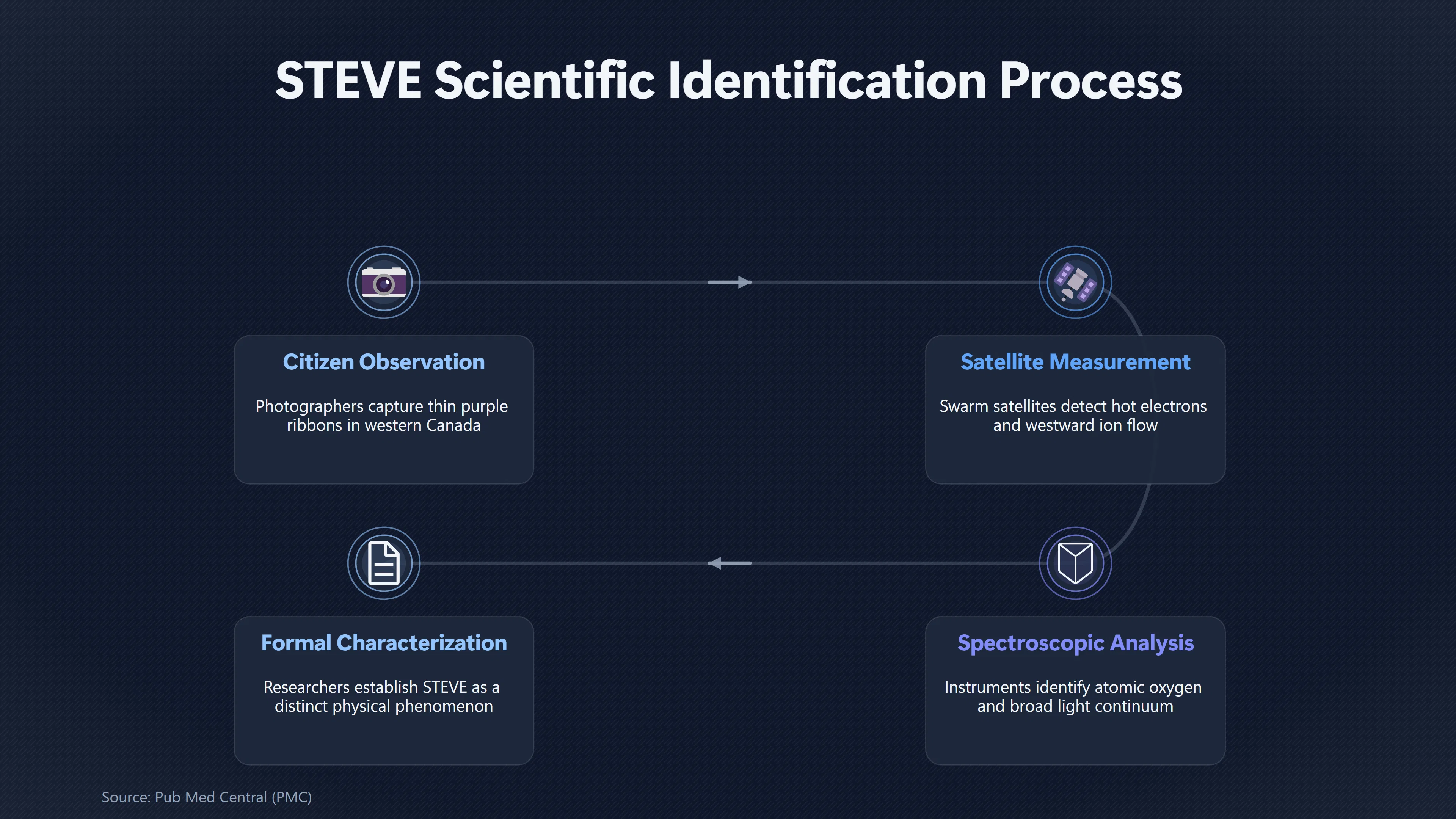
The decisive early clue came from combining ground observations with spacecraft measurements. ESA’s Swarm satellites found that the region associated with STEVE contained unusually hot electrons, depleted plasma density and a powerful westward ion flow. Those characteristics connected the visible ribbon with an intense subauroral ion drift, or SAID — a fast plasma flow occurring equatorward of the normal auroral zone.[PubMed]pubmed.ncbi.nlm.nih.govPub MedThe defining visual feature is geometry. STEVE is a narrow luminous band that can run for thousands of kilometres east–west while being o…
A separate analysis of a STEVE event on 28 March 2008 provided an important test. Researchers compared all-sky camera observations with measurements from a polar-orbiting satellite and found no corresponding energetic particle precipitation where STEVE occurred. They therefore concluded that this event was not conventional aurora and described the visible emission as ionospheric skyglow potentially generated by a fundamentally different process.[DOI]doi.orgA separate analysis of a STEVE event on 28 March 2008 provided an important test. Researchers compared all-sky camera observations with m…
Later observations refined rather than erased that distinction. A 2019 study examining three events found both the mauve STEVE arc and green picket-fence structures associated with strong subauroral ion drifts, electron heating and plasma waves. But an event containing only the mauve arc lacked the particle precipitation seen when a picket fence was present. The researchers proposed that plasma heating drives the mauve emission, whereas energetic electron precipitation can drive the green picket fence.[Wiley Online Library]onlinelibrary.wiley.comOnline LibraryLater observations refined rather than erased that distinction. A 2019 study examining three events found both the mauve STEVE arc and gr…
Some details of the emission physics remain active research questions, particularly for the associated green structures. That uncertainty should not be confused with uncertainty over whether STEVE exists. Its morphology, location and association with unusual plasma conditions are supported by independent photographic, satellite and spectroscopic observations. What continues to be refined is the detailed chain of processes that converts those conditions into the colours and structures seen from the ground.[DOI]doi.orgSome details of the emission physics remain active research questions, particularly for the associated green structures. That uncertainty…
Citizen photographs turned an odd light into a measurable phenomenon
STEVE is unusually relevant to the study of UFO reports because its modern scientific recognition began not with a satellite discovering something that nobody on the ground could see, but with ordinary people repeatedly photographing something they could see and did not initially understand.
Aurora photographers in western Canada had been recording the thin purple feature and discussing it online. Some observers were calling the structure a “proton arc”, but that identification was problematic. Collaboration between the Alberta Aurora Chasers, space physicist Eric Donovan and Elizabeth MacDonald’s NASA-supported Aurorasaurus citizen-science project turned the photographs into material that could be compared with scientific instruments.[NASA]nasa.govmystery of purple lights in sky solved with help from citizen scientistsAurora photographers in western Canada had been recording the thin purple feature and discussing it online. Some observers were calling t…
The temporary name “Steve” was deliberately useful precisely because it did not claim to know the mechanism. It came from the animated film Over the Hedge, in which characters confronted by something unfamiliar decide to call it Steve. After measurements revealed the unusual thermal conditions and rapid plasma flow associated with the phenomenon, researchers converted the nickname into the backronym Strong Thermal Emission Velocity Enhancement — STEVE.[European Space Agency]esa.intThe temporary name “Steve” was deliberately useful precisely because it did not claim to know the mechanism. It came from the animated fi…
The observational record was substantial enough to move beyond a single spectacular photograph. NASA reports that citizen scientists supplied 30 STEVE observations during 2015–16, providing the distributed ground observations needed to characterise the feature.[NASA]nasa.govaurora chasing citizen scientists help discover a new feature of steveThe observational record was substantial enough to move beyond a single spectacular photograph. NASA reports that citizen scientists supp…
The 2018 Science Advances paper that formally characterised STEVE accordingly included professional space scientists and members of the Alberta Aurora Chasers among its authors. Ground photography could establish when, where and what people saw; spacecraft could independently measure the plasma environment overhead. The combination linked an unfamiliar visible ribbon with a specific geophysical environment.[PubMed]pubmed.ncbi.nlm.nih.govPub MedThe defining visual feature is geometry. STEVE is a narrow luminous band that can run for thousands of kilometres east–west while being o…
The same approach subsequently produced unusually precise results from apparently informal observations. For the September 2017 event, researchers compared photographs from observers hundreds of kilometres apart and used identifiable stars as angular reference points. That allowed them to triangulate the altitude of the green pickets and constrain the much less structured purple ribbon.[AGU Publications]agupubs.onlinelibrary.wiley.comScientific triangulation has since put physical dimensions behind those impressions. For a well-photographed event on 16 September 2017…
There is also evidence that STEVE was never genuinely new to the sky. NASA reports that citizen researcher Michael Hunnekuhl recognised possible STEVE-like descriptions in the historical observations of early twentieth-century aurora researcher Carl Størmer. The implication is that modern collaboration and instrumentation identified a phenomenon that observers had probably encountered long before scientists gave it a distinct physical category.[NASA Science]science.nasa.govThere is also evidence that STEVE was never genuinely new to the sky. NASA reports that citizen researcher Michael Hunnekuhl recognised p…
Why STEVE can be mistaken for a strange UFO
STEVE demonstrates a recurring identification problem: an observer’s category can be wrong even when the observation itself is substantially accurate. Someone may genuinely see a narrow purple structure crossing a huge portion of the sky. The mistake comes later, when that unfamiliar appearance is interpreted as an object, beam, trail or unexplained technology because it does not resemble the observer’s mental picture of an aurora.
Several characteristics make that especially plausible.
- It can look object-like without being an object. A sharply bounded ribbon is visually easier to interpret as a coherent “thing” than a diffuse glow.
- Its colour violates familiar expectations. Purple or mauve is less immediately recognisable than the green curtains widely associated with aurora.
- It occurs outside the conventional auroral oval. STEVE is subauroral and can therefore appear at lower magnetic latitudes than observers associate with ordinary auroral displays.[PubMed]pubmed.ncbi.nlm.nih.govPub MedThe defining visual feature is geometry. STEVE is a narrow luminous band that can run for thousands of kilometres east–west while being o…
- Its dimensions are difficult to judge by eye. A ribbon hundreds of kilometres above the observer and extending over very large horizontal distances provides few everyday depth cues.
- It may coexist with apparently separate lights. Green picket-fence streaks can accompany the mauve ribbon, making a single geophysical episode look like several different structures or components.[AGU Publications]agupubs.onlinelibrary.wiley.comScientific triangulation has since put physical dimensions behind those impressions. For a well-photographed event on 16 September 2017…
- It can be transient. A comparatively short-lived appearance gives witnesses limited time to inspect it, find reference points or reconsider their first interpretation.
STEVE therefore cautions against a simplistic identification rule such as “aurora explains only green curtains”. An extended luminous UFO report may require comparison not merely with textbook aurora but with less familiar upper-atmospheric phenomena associated with geomagnetic activity.
At the same time, STEVE should not become a catch-all explanation. Its recognised signature is comparatively specific: a thin, extended mauve or purple subauroral arc, normally occurring in connection with geomagnetic activity and sometimes accompanied by green picket-fence structures. A compact point source, a clearly bounded solid-looking object crossing the sky on an independent trajectory, or a light showing behaviour incompatible with a large upper-atmospheric structure would require other explanations.

The strongest identification clues
For UFO/UAP case analysis, the value of STEVE lies less in matching the word “purple” than in matching several independent features at once. The most persuasive identification would combine an appropriate shape and colour with location, timing and evidence of the relevant space-weather conditions.
A photograph is particularly valuable because stars and landmarks can constrain the ribbon’s orientation and angular extent. Multiple photographs from separated sites are stronger still: as the 2017 triangulation work demonstrated, seemingly ordinary sky photographs can establish that the emission is located high in the atmosphere rather than behaving like a nearby flying object.[AGU Publications]agupubs.onlinelibrary.wiley.comScientific triangulation has since put physical dimensions behind those impressions. For a well-photographed event on 16 September 2017…
Contemporaneous auroral activity is another important clue, but it must be interpreted carefully. STEVE is associated with processes occurring equatorward of the main auroral oval, so the fact that an unusual purple ribbon sits apart from obvious green aurora is not evidence against the identification. Separation from the familiar display is part of what makes STEVE distinctive.[AGU Publications]agupubs.onlinelibrary.wiley.comAGU Publications
The best evidence can therefore produce an initially counter-intuitive result: a witness may correctly report that the strange purple ribbon did not look like the aurora nearby, while scientists can also correctly identify it as a natural phenomenon intimately connected with the same disturbed near-Earth space environment.
That is STEVE’s central lesson for UFO interpretation. Natural explanations are not restricted to familiar-looking natural phenomena. Sometimes the anomalous appearance is real, the photographs are real and the observer’s description is reasonable — but the apparent anomaly reflects an uncommon part of Earth’s upper-atmospheric physics rather than an unidentified craft.
Amazon book picks
Further Reading
Books and field guides related to Why STEVE Can Be Mistaken for a Strange UFO. Use these as the next step if you want deeper reading beyond the article.
Aurora: In Search of the Northern Lights
The beautiful aurorae, or northern lights, are the stuff of legends. The ancient stories of the Sami people warn that if you mock the lig...
Northern Lights: The definitive guide to auroras
The perfect gift for anyone looking to explore the wonder of the Northern Lights. Discover the incomparable beauty of nature's lightshow...
Aurora: Observing and Recording Nature's Spectacular Light Show
This new book addresses a gap in the literature, offering an explanation of the aurora's causes, how the occurrence of major events may n...
The Sun Kings: The Unexpected Tragedy of Richard Carrington a...
In September of 1859, the entire Earth was engulfed in a gigantic cloud of seething gas, and a blood-red aurora erupted across the planet...
eBay marketplace picks
Marketplace Samples
Live-tested eBay searches with available results related to this page.
Selected frompurple aurora art oneBay.co.uk.
Endnotes
1.
Source: pmc.ncbi.nlm.nih.gov
Title: Pub Med Central (PMC)
Link:https://pmc.ncbi.nlm.nih.gov/articles/PMC5851661/
Source snippet
STEVE is a strong reminder that a genuinely natural sky phenomenon can look nothing like the aurora an observer expects. Instead of a bro...
2.
Source: agupubs.onlinelibrary.wiley.com
Title: AGU Publications
Link:https://agupubs.onlinelibrary.wiley.com/doi/10.1029/2018GL078509
3.
Source: pubmed.ncbi.nlm.nih.gov
Title: Pub Med
Link:https://pubmed.ncbi.nlm.nih.gov/29546244/
Source snippet
The defining visual feature is geometry. STEVE is a narrow luminous band that can run for thousands of kilometres east–west while being o...
4.
Source: wired.com
Title: steve aurora alberta chasers aurorasaurus
Link:https://www.wired.com/story/steve-aurora-alberta-chasers-aurorasaurus
Source snippet
That distinction is important because a casual observer may use “aurora” as shorthand for almost any colourful glow during geomagnetic ac...
5.
Source: agupubs.onlinelibrary.wiley.com
Title: AGU Publications
Link:https://agupubs.onlinelibrary.wiley.com/doi/10.1029/2019GL084473
Source snippet
Scientific triangulation has since put physical dimensions behind those impressions. For a well-photographed event on 16 September 2017...
Published: September 2017
6.
Source: researchgate.net
Title: Research Gate
Link:https://www.researchgate.net/publication/334209583_First_observations_from_the_TREx_Spectrograph_the_Optical_Spectrum_of_STEVE_and_the_Picket_Fence_Phenomena
Source snippet
The colour is not merely ordinary purple aurora arranged into an unusual shape. Spectroscopic observations on 10 April 2018 found an enha...
Published: April 2018
7.
Source: doi.org
Link:https://doi.org/10.1002/grl.v45.16
Source snippet
A separate analysis of a STEVE event on 28 March 2008 provided an important test. Researchers compared all-sky camera observations with m...
Published: March 2008
8.
Source: onlinelibrary.wiley.com
Title: Online Library
Link:https://onlinelibrary.wiley.com/doi/abs/10.1029/2019GL082460
Source snippet
Later observations refined rather than erased that distinction. A 2019 study examining three events found both the mauve STEVE arc and gr...
9.
Source: doi.org
Link:https://doi.org/10.1029/2019gl084473
Source snippet
Some details of the emission physics remain active research questions, particularly for the associated green structures. That uncertainty...
10.
Source: nasa.gov
Title: mystery of purple lights in sky solved with help from citizen scientists
Link:https://www.nasa.gov/science-research/heliophysics/mystery-of-purple-lights-in-sky-solved-with-help-from-citizen-scientists/
Source snippet
Aurora photographers in western Canada had been recording the thin purple feature and discussing it online. Some observers were calling t...
11.
Source: esa.int
Title: European Space Agency
Link:https://www.esa.int/Applications/Observing_the_Earth/FutureEO/Swarm/Steve_over_the_picket_fence
Source snippet
The temporary name “Steve” was deliberately useful precisely because it did not claim to know the mechanism. It came from the animated fi...
12.
Source: nasa.gov
Title: aurora chasing citizen scientists help discover a new feature of steve
Link:https://www.nasa.gov/science-research/heliophysics/aurora-chasing-citizen-scientists-help-discover-a-new-feature-of-steve/
Source snippet
The observational record was substantial enough to move beyond a single spectacular photograph. NASA reports that citizen scientists supp...
13.
Source: science.nasa.gov
Link:https://science.nasa.gov/science-research/earth-science/short-history-of-steve/
Source snippet
There is also evidence that STEVE was never genuinely new to the sky. NASA reports that citizen researcher Michael Hunnekuhl recognised p...
Additional References
14.
Source: youtube.com
Link:https://www.youtube.com/watch?v=tbNaNwyBlwk
Source snippet
Aurorasaurus Citizen Science Database of Strong Thermal Emission Velocity Enhancement (STEVE)...
15.
Source: youtube.com
Title: There’s a new aurora in subpolar skies. Its name is Steve
Link:https://www.youtube.com/watch?v=nqF3AtEkFEU
Source snippet
Aurora Chasers Found Something NASA Can’t Explain | Chasing Steve | Full Documentary...
16.
Source: youtube.com
Title: New celestial phenomena named Steve
Link:https://www.youtube.com/watch?v=YfV5avWRsoI
Source snippet
STEVE atmospheric phenomenon purple ribbon NASA science There’s a new aurora in subpolar skies. Its name is Steve...
17.
Source: youtube.com
Link:https://www.youtube.com/watch?v=gqLgg4h3jPs
Source snippet
New celestial phenomena named Steve...
18.
Source: youtube.com
Title: The Aurora Named STEVE
Link:https://www.youtube.com/watch?v=wRHwGD-is9U
Source snippet
There’s a new aurora in subpolar skies. Its name is Steve...
19.
Source: youtu.be
Title: Science Tech TV
Link:https://youtu.be/IS-niVGzV8A
Source snippet
New science in plain sight: Citizen scientists lead to the discovery of optical structure in ScienceVio...