Within Flares
Starlink Horizon Gli
Starlink satellites can produce brief, exceptionally bright glints that look very different from the familiar “train” of dots crossing the sky. Under a particular Sun–satellite–observer geometry, an operational Starlink can remain too faint to notice, brighten abruptly into a conspicuous point of light near the horizon, and then fade again.
Page outline Jump by section
Introduction
Starlink satellites can produce brief, exceptionally bright glints that look very different from the familiar “train” of dots crossing the sky. Under a particular Sun–satellite–observer geometry, an operational Starlink can remain too faint to notice, brighten abruptly into a conspicuous point of light near the horizon, and then fade again. Because the bright phase occupies only a small part of its path, the observer may see little or no obvious track. The result can look like a light that has suddenly appeared, hovered briefly, and vanished.
This is not merely a theoretical explanation for unidentified anomalous phenomena (UAP). Photometric research has measured extreme Starlink flares, a 2024 study reconstructed a pilot-reported UAP as recently launched Starlink satellites, and the US All-domain Anomaly Resolution Office (AARO) has documented a predictable low-sky “flare window” in which multiple Starlinks can brighten in succession.[arXiv]arxiv.orgOpen source on arxiv.org.
The low-sky geometry behind extreme Starlink brightening
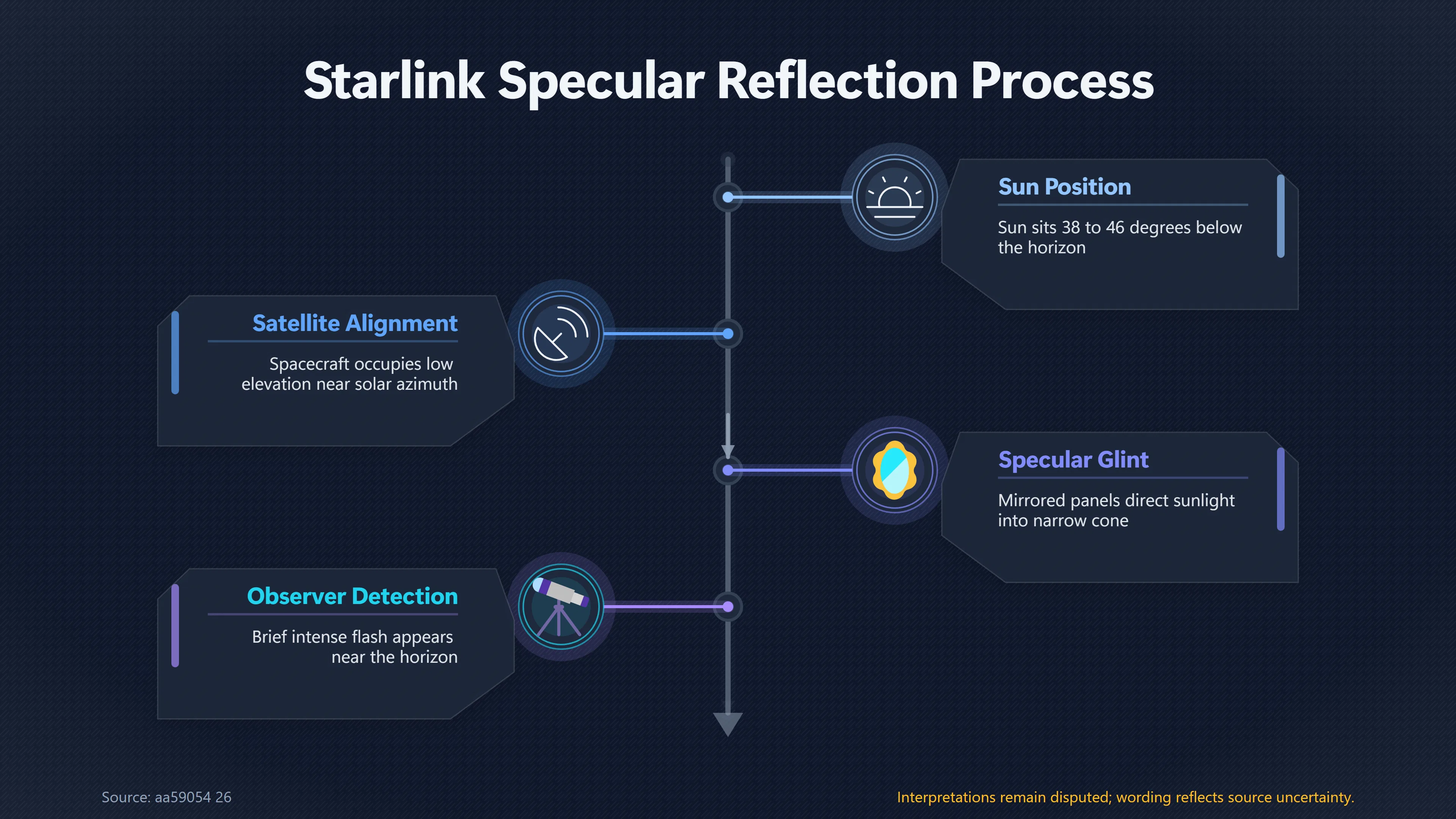
An operational Starlink does not shine like an aircraft lamp. What reaches the observer is reflected sunlight, and the intensity depends strongly on the spacecraft’s orientation and reflective properties. AARO describes the Starlink bus as having flat antenna arrays and mirrored panels on its Earth-facing side. Its report distinguishes ordinary diffuse reflection, which spreads light broadly, from specular reflection, or glint, in which a smooth surface directs sunlight into a much narrower cone. That concentration can increase apparent brightness by several orders of magnitude while shortening the time for which the reflection is visible.[AARO]aaro.milOpen source on aaro.mil.
The important geometry occurs when the satellite is low above the horizon and approximately towards the Sun’s azimuth, even though the Sun itself is far below the horizon. Anthony Mallama and Richard Cole’s study of extreme Starlink flaring found that the angle between the ideal specular reflection and the observer’s line of sight becomes very small in this configuration. Their measured brightness changes were consistent with the bidirectional reflectance distribution function, or BRDF, of the Starlink chassis — essentially a mathematical description of how strongly a surface reflects light in different directions.[arXiv]arxiv.orgOpen source on arxiv.org.
AARO independently modelled the geometry for Starlinks at roughly 550 kilometres altitude. For an idealised Earth-facing reflector, its calculation places the perfect specular condition at the horizon when the relevant Sun–satellite geometry is about 46°. Allowing the reflected beam to deviate by roughly two degrees, AARO estimates that favourable flares generally occur with the Sun about 38° to 46° below the horizon, while the satellite appears between the horizon and roughly 10° elevation. Those figures are guidelines rather than immutable limits: spacecraft generation, orbital altitude, attitude and surface scattering all affect the exact result.[AARO]aaro.milOpen source on aaro.mil.
This deep-night geometry helps explain a feature that can initially seem counter-intuitive. A Starlink flare need not occur only in obvious twilight. The observer’s ground can be thoroughly dark while a low-Earth-orbit satellite hundreds or thousands of kilometres away along the line of sight still occupies the right illuminated geometry to redirect sunlight towards them.
The effect has also been observed rather than merely calculated. In January 2023, satellite observer Robert McNaught recorded repeated low-elevation Starlink flares from Coonabarabran, Australia, on an all-sky camera. They occurred roughly every two to three minutes, at elevations of about 7°–8°, while the Sun was around 39° below the horizon. Most reached approximately magnitude 0 and one about magnitude –2. Richard Cole noted that the favourable specular region moves with the Sun, accounting for the flashes recurring in approximately the same celestial area.[Satellites Above]satobs.orgOpen source on satobs.org.
AARO performed its own observations near Sidney, Nebraska, in March 2024. Its predicted post-sunset flare window moved from about 10° elevation towards the horizon as the Sun descended from –38° to –46°. An observed flare at 10:38 pm was measured at azimuth 309.6° and elevation 3.2°, within the predicted region. Before sunrise the following morning, another measured position — azimuth 47.4°, elevation 3.7° — likewise fell inside the predicted window.[AARO]aaro.milOpen source on aaro.mil.
Why repeated flashes cluster near the solar azimuth
The most misleading feature is that the bright patch of sky can remain much more stable than the individual satellites passing through it.
A Starlink is travelling rapidly around Earth throughout the event. It does not stop. But the observer sees it clearly only while its reflection geometry is favourable. Imagine a stream of otherwise inconspicuous satellites crossing a narrow spotlight: each becomes conspicuous on entering the illuminated patch and disappears on leaving it. Without seeing their faint approach and departure tracks, the eye naturally pays attention to the patch rather than to the individual trajectories.
This is why a sequence can look something like:
nothing → bright point → fade → nothing → another bright point nearby → fade.
With enough satellites passing through the favourable geometry, the observer may therefore perceive repeated flashes in a relatively confined region rather than recognise several independent spacecraft travelling continuously through it. AARO calls this region the flare window. It notes that multiple satellites on different orbital paths can flare simultaneously there, producing apparent glowing orbs, disappearing and reappearing lights, crossing movements and even transient geometric arrangements.[AARO]aaro.milOpen source on aaro.mil.
That distinction is crucial when evaluating reports of apparently stationary UAP lights. “Stationary” may describe what was perceptible during the brightest few moments rather than the physical motion of the object. If a glint is brief, low on the horizon and seen without a nearby angular reference, the satellite’s displacement during the conspicuous part of the event can be difficult to judge. A succession of different satellites brightening in the same flare window can strengthen the illusion that one persistent object is repeatedly switching on, disappearing and returning.
This also explains why witnesses can accurately insist that what they saw did not resemble their previous sightings of Starlink. They may indeed be comparing two visually different Starlink phenomena.

These glints are not the familiar Starlink train
The familiar Starlink train occurs shortly after deployment, when many recently launched satellites remain relatively close together and appear as a procession of moving points. AARO describes this as a different orbital phase and optical configuration from the glints produced after satellites reach operational orbit.[AARO]aaro.milOpen source on aaro.mil.
An operational Starlink flare can therefore violate several expectations created by seeing a train:
- there may be no long string of continuously visible satellites;
- the light can be dramatically brighter than the satellite’s ordinary appearance;
- most of the spacecraft’s track may be invisible;
- flashes can recur in a restricted area of sky;
- different satellites can cross the flare window on different trajectories;
- several reflections can occur at once.
The difference matters because “I know what Starlink looks like” is not, by itself, sufficient to exclude Starlink. A train and a specular flare are different manifestations of the same constellation.
There is strong observational evidence for just how extreme the brightness can become. Mallama and Cole’s 2024 analysis examined an August 2022 incident in which five pilots aboard two commercial aircraft over the Pacific reported very luminous objects as UAP. Douglas Buettner and colleagues reconstructed the incident using aircraft ADS-B position data, satellite orbital elements and the pilots’ photographs and video, identifying a closely spaced Starlink group launched earlier that day.[arXiv]arxiv.orgOpen source on arxiv.org.
Photometry of the pilots’ imagery put the large luminous feature at approximately magnitude –4, comparable to Venus at its brightest, while the pilots’ preceding visual estimates suggested several point sources near magnitude –5. Mallama and Cole found that the spacecraft were low towards the horizon, close to the solar azimuth, with the Sun approximately 30° below the horizon. Their independent reflection model was consistent with the extreme observed brightness.[skyandtelescope.org]skyandtelescope.orgOpen source on skyandtelescope.org.
That case involved a recently launched group rather than the recurring operational flare-window effect alone, but it demonstrates the central point: Starlink reflections can become bright enough to defeat the everyday assumption that a satellite must be a faint, steadily travelling dot.
Why pilots can find the effect especially convincing
Aircraft crews are particularly well positioned to encounter the low-horizon geometry. At cruising altitude, the geometric horizon lies farther away than it does for a ground observer, increasing the region of low sky accessible to the crew. AARO notes that an aircraft travelling east-to-west after sunset towards the solar direction, or west-to-east before sunrise, can remain in favourable flare geometry for longer than a stationary observer.[AARO]aaro.milOpen source on aaro.mil.
That helps account for reports lasting much longer than a single satellite flare. A pilot can spend many minutes seeing different satellites enter the same favourable reflection region. The persistence belongs to the geometry and constellation population, not necessarily to one luminous object.
AARO examined one FAA report from 9 October 2022 in which an eastbound airline pilot near Gallup, New Mexico, reported multiple unidentified lights moving in different directions at about 35,000 feet. Reconstructing the airborne viewing geometry placed the Sun at an altitude of –38.5° and azimuth 65.6°, with the predicted Starlink flare region around 9° above the horizon. AARO estimated the reported lights at approximately azimuth 63.3° and elevation 5.7°. A satellite-sky reconstruction also showed Starlinks crossing the region in different directions. AARO consequently assessed the lights as very likely satellite flares.[AARO]aaro.milOpen source on aaro.mil.
This does not mean every pilot report of a distant light is Starlink. Some reports lack enough positional, timing or imagery data to establish any identification, and descriptions that materially conflict with satellite geometry require other explanations. The useful lesson is narrower: brief, recurring, extremely bright low-horizon lights near the solar azimuth now have a well-documented Starlink mechanism that should be checked before treating their apparent hovering or reappearance as physical manoeuvring.
The strongest clues that a sudden light is a Starlink glint
No single visual characteristic proves an identification. The strongest assessment comes from combining the observation time and position with satellite ephemerides and solar geometry. That is how the 2022 Pacific case was reconstructed, and it is essentially the approach recommended by AARO.[arXiv]arxiv.orgOpen source on arxiv.org.
Several features together make the Starlink explanation particularly strong: the lights are concentrated within roughly the lowest 10° of sky; they occur towards the Sun’s azimuth even though the Sun is well below the horizon; individual points brighten and fade rather than remaining continuously visible across a complete satellite pass; and new flashes repeatedly appear in approximately the same region. Multiple points may travel on crossing paths because separate orbital planes are contributing.
The solar geometry is especially discriminating. A random distant aircraft, planet or atmospheric light does not have a reason to cluster systematically in a narrow region tied to the position of the Sun tens of degrees below the horizon. A specular satellite reflection does. AARO’s Nebraska observations showed that the predicted flare region moved in azimuth and elevation as the Sun moved, while the measured Starlink flares followed that changing window.[AARO]aaro.milOpen source on aaro.mil.
Accurate records can therefore turn an extraordinary-looking observation into a testable orbital problem. Useful evidence includes the precise UTC time, observer coordinates, viewing azimuth and elevation, aircraft altitude and heading where relevant, an unedited video containing stars for angular reference, and the duration and direction of each visible track. Those details allow investigators to compare the observation against satellite positions rather than relying on resemblance alone.
AARO has explicitly incorporated this mechanism into UAP analysis. Its FY2024 annual report said the office was increasingly receiving cases it could resolve to Starlink, including a commercial-pilot report of white flashing lights that correlated with the orbital path of a Starlink launch. Its dedicated satellite-flaring paper concludes that both diffuse and specular satellite reflections can account for some UAP reports.[U.S. Department of War]defense.govOpen source on defense.gov.
For the particular report pattern of lights that suddenly appear near the horizon, seem briefly stationary or detached from any obvious track, vanish, and then recur nearby, Starlink glints are consequently more than a generic “could be a satellite” suggestion. They provide a specific optical mechanism, a predictable relationship with the Sun, documented examples, measured extreme brightness and a geometry that can be reconstructed after the event.

Amazon book picks
Further Reading
Books and field guides related to Starlink Horizon Gli. Use these as the next step if you want deeper reading beyond the article.
The Backyard Astronomer's Guide
Discusses the practical aspects of stargazing, including how to choose appropriate equipment, contending with light pollution, taking suc...
NightWatch: A Practical Guide to Viewing the Universe
A practical guide to viewing the universe.
Turn Left at Orion
With over 100,000 copies sold since first publication, this is one of the most popular astronomy books of all time. It is a unique guideb...
Satellite Orbits: Models, Methods and Applications
Satellite Orbits -Models, Methods, and Applications has been written as a compre hensive textbook that guides the reader through the theo...
eBay marketplace picks
Marketplace Samples
Live-tested eBay searches with available results related to this page.
Selected fromStarlink satellite model oneBay.co.uk.
Endnotes
1.
Source: aanda.org
Title: aa59054 26
Link:https://www.aanda.org/articles/aa/full_html/2026/05/aa59054-26/aa59054-26.html
2.
Source: celestrak.org
Link:https://celestrak.org/publications/Visual-Observing/Part2/Narrative2.pdf
3.
Source: youtube.com
Title: Why “Racetrack” UFOs are mostly Starlink Flares
Link:https://www.youtube.com/watch?v=_VmrRGln1XA
Source snippet
These UFOs are Starlink Flares, 100%...
4.
Source: youtube.com
Title: These UFOs are Starlink Flares, 100%
Link:https://www.youtube.com/watch?v=Ea8BCl2yVU0
Source snippet
Flaring Starlink satellites when Sun is 45º - 35º below horzion...
5.
Source: youtube.com
Title: Flaring Starlink satellites when Sun is 45º
Link:https://www.youtube.com/watch?v=wfx1TgDwAME
Source snippet
How to Solve Starlink UFOs with Sitrec...
6.
Source: youtube.com
Title: How to Solve Starlink UFOs with Sitrec
Link:https://www.youtube.com/watch?v=WkzRJQ3rWa0
Source snippet
The Problem with Starlink...
7.
Source: youtube.com
Title: The Problem with Starlink
Link:https://www.youtube.com/watch?v=4m38NgaQ_OU
Source snippet
Starlink flare pilot UAP Mick West Why "Racetrack" UFOs are mostly Starlink Flares...
8.
Source: youtube.com
Title: Mick West
Link:https://www.youtube.com/watch?v=e-WDx7byI0k
Source snippet
How to Solve Starlink UFOs with Sitrec Mick West...