Within Distance
Do Three UFO Lights Prove a Huge Triangle?
Several lights can define a large apparent shape without proving they share one distance or belong to a single physical object.
On this page
- Angular spacing versus physical separation
- Separate lights that can mimic one structure
- What evidence could establish a common range
Page outline Jump by section
Introduction
Three lights forming a triangle in the night sky do not, by themselves, prove that the observer is looking at one enormous triangular craft. What is directly established is much narrower: three luminous sources occupy three directions in the observer’s field of view. Their angular spacing can be measured, but their distances, physical separation and connection to one another remain unknown unless other evidence supplies that information.
This distinction is crucial in UFO and UAP reports because the assumption of a single structure can transform a simple pattern of lights into an apparently gigantic vehicle. Draw imaginary lines between three widely spaced lights, assume that all three are at the same distance, and the resulting triangle can acquire an impressive calculated wingspan. But if the lights are separate aircraft at different ranges, the supposed wingspan is not merely inaccurate — there is no physical wingspan to measure.
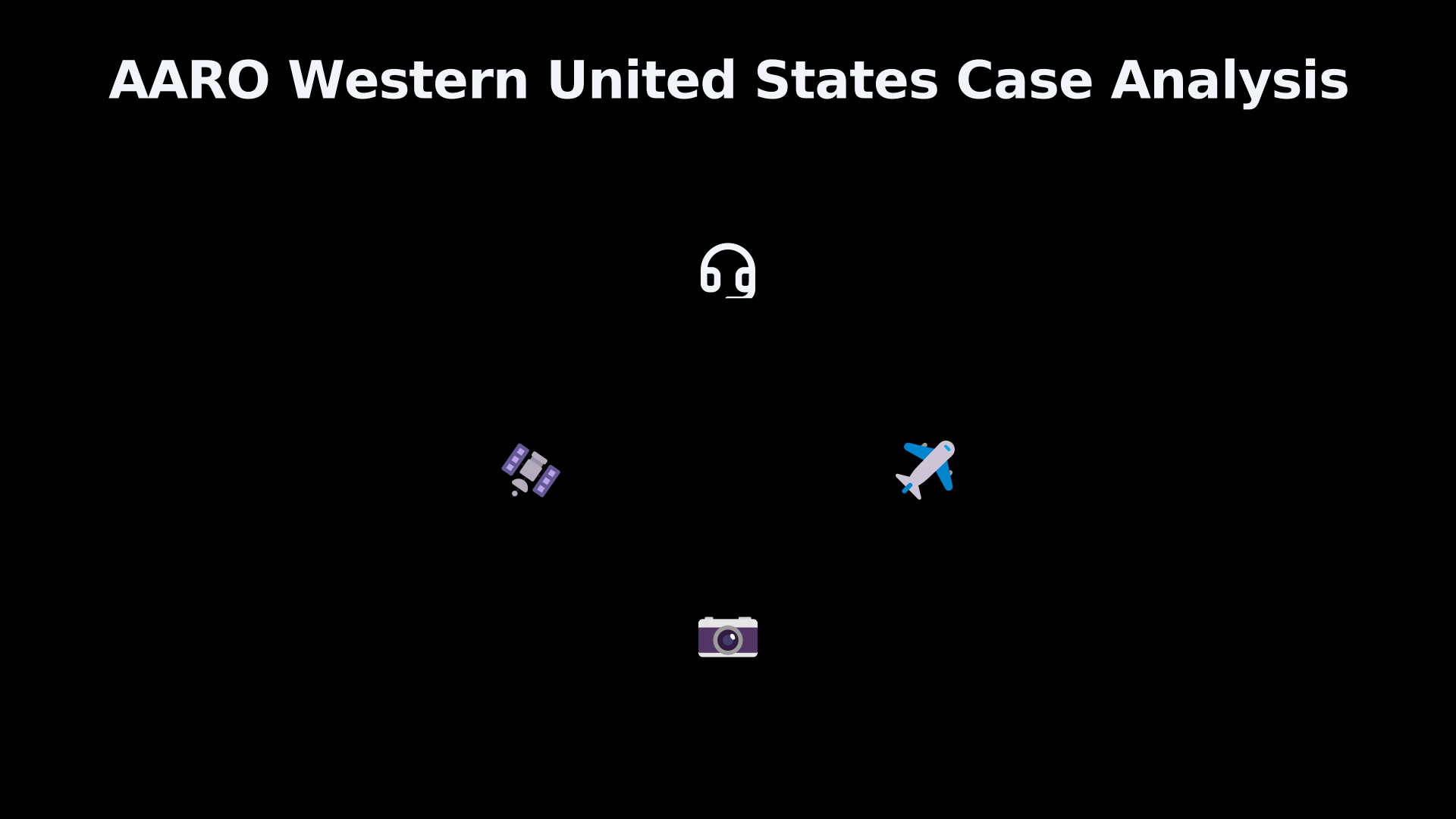
Official UAP investigations provide concrete examples of this problem. In one 2021 Western United States case, equidistant lights that observers treated as a potentially significant formation were ultimately correlated by the US All-domain Anomaly Resolution Office (AARO) with separate commercial aircraft, some as far as 300 nautical miles from the observing sensor.[AARO]aaro.milOpen source on aaro.mil.
Angular spacing is not physical separation
The underlying geometry is straightforward. An observer can measure the angular separation between two lights: the angle between the directions in which they appear. Turning that angle into metres requires knowing their distance.
The University of Iowa’s astronomy materials give the standard small-angle relationship: for sufficiently small angles, physical size or separation is approximately the distance multiplied by the angle in radians. Crucially, the same source notes that when the formula is used to determine the separation between two objects, the objects must be at roughly the same distance.[Imaging the Universe]uiowa.eduOpen source on uiowa.edu.
Consider three lights whose outer corners are separated by five degrees. Five degrees is about 0.087 radians. If the lights really are at a common range, the approximate transverse separation would therefore be:
- at 100 metres: about 8.7 metres;
- at 1 kilometre: about 87 metres;
- at 10 kilometres: about 870 metres;
- at 100 kilometres: about 8.7 kilometres.
Nothing about the observed five-degree angle chooses between those scales. Range information has to come from somewhere else.
For a triangular-light report, there is an additional complication. Even the calculation above assumes that the lights lie at approximately the same range. If light A is one kilometre away, light B is several kilometres away and light C is farther still, their apparent positions can nevertheless project onto the observer’s two-dimensional field of view as a triangle.
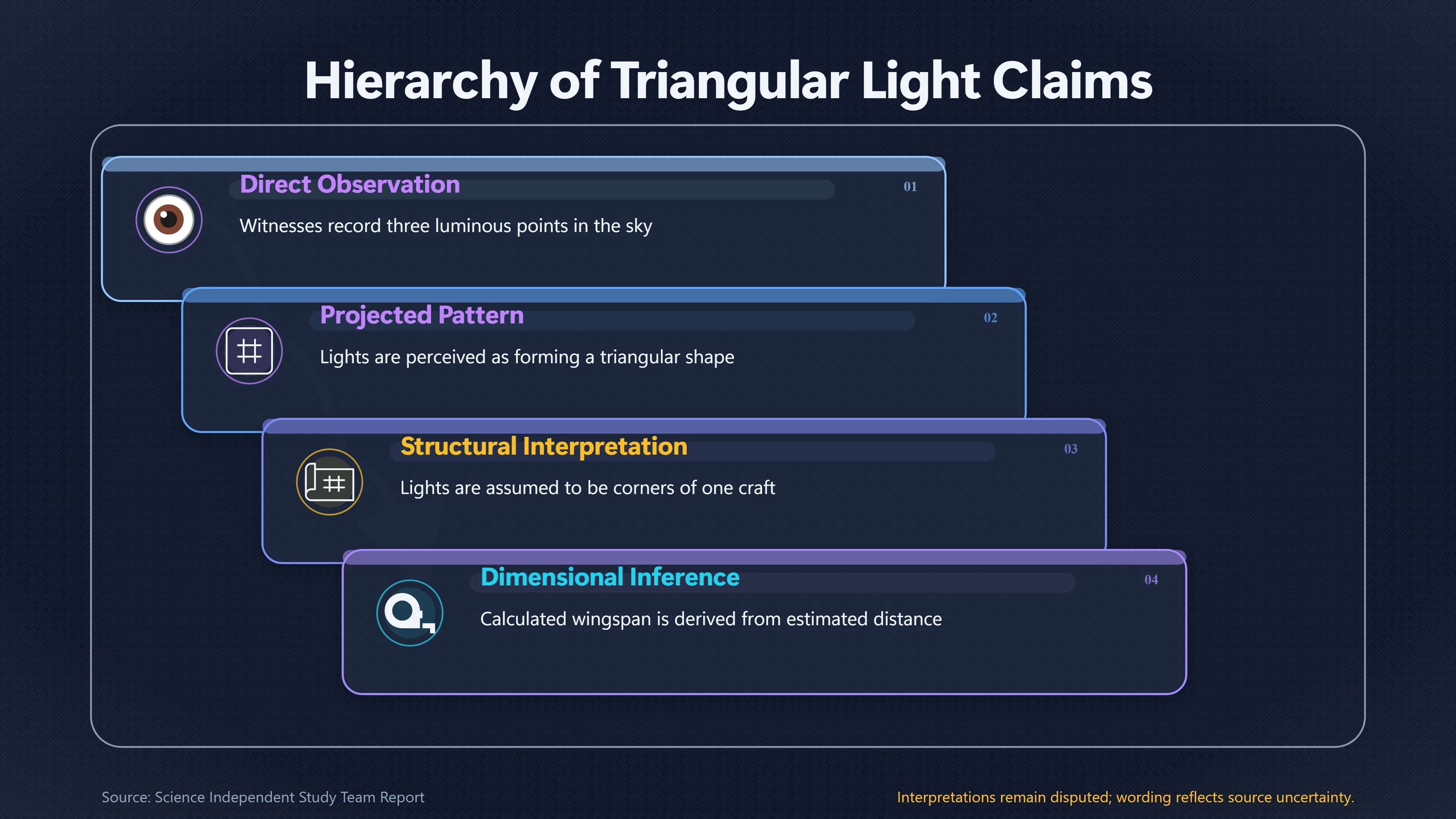
The result is an important hierarchy of claims. “Three lights were separated by several degrees” can be a direct observation. “Three lights formed a triangle” describes their projected pattern. “The three lights were the corners of one object” is an interpretation. “That object was 500 metres wide” adds another inference requiring a distance estimate.
Collapsing those four statements into one is precisely how uncertain range can produce extraordinary UFO size estimates.
Separate lights can look like one organised structure
A common argument for a single triangular craft is that its lights remained together while moving. That is relevant evidence, but it is not decisive. Separate objects can maintain an organised apparent pattern.
Aircraft can fly similar headings, follow parallel or intersecting air corridors, or deliberately maintain formations. More generally, distant objects can undergo substantial physical movement while producing comparatively small angular changes for an observer. A short observation with little parallax may consequently make a loose three-dimensional arrangement appear rigid.
AARO’s Western United States case provides an unusually clear demonstration because investigators had more than the visual impression available to them. Military personnel reported equidistant lights moving at a relatively constant pace and regarded them as a possible intrusion into restricted military airspace. AARO subsequently compared their positions with additional information and concluded that the objects were significantly farther away than the observers had originally estimated. Air-traffic-control data associated them with commercial aircraft using established corridors.[AARO]aaro.milOpen source on aaro.mil.
AARO’s published imagery summary is even more explicit: analysis of the full-motion video together with commercial flight data led the office to assess that the objects were three separate commercial aircraft at great distance. Radar tracks aligned with the observed points, which appeared only as small dots because of their range.[AARO]aaro.milUAP ImageryAARO UAP Imagery…
The case does not establish that every triangular UFO formation consists of aircraft. Nor was it a classic close-range report of a black triangular body. Its value here is methodological. It demonstrates with an investigated UAP case that apparently organised lights can be physically separate objects, and that an observer’s original range impression can be badly wrong.
AARO’s 2025 mission briefing returned to the same case. It states that post-event geospatial analysis placed the objects significantly farther from the observer than the pilot’s initial estimate and that apparent changes in morphology were visual artefacts associated with sensor autofocus.[AARO]aaro.milOpen source on aaro.mil.
That is exactly the danger when inferring one huge craft from several unresolved lights: apparent structure, apparent size and apparent range can reinforce one another even though none has yet been independently established.
A projected triangle does not require a triangular object
There is a simple geometrical reason triangles deserve particular caution. Any three non-collinear points define a triangle in projection. They do not need connecting edges, a shared surface or even a common distance.
Imagine three aircraft seen against a black sky. One is relatively close and dim; two are farther away and brighter. From a particular viewing position their directions happen to occupy the three corners of a broad triangle. If the aircraft move on sufficiently similar apparent tracks for several seconds, an observer may naturally experience the configuration as a single moving unit.
Change the observer’s viewpoint substantially and the apparent triangle may distort or collapse. That is the information a single viewpoint cannot provide.
This is not just an abstract problem in UFO analysis. AARO’s reconstruction of the 2013 Aguadilla, Puerto Rico infrared incident illustrates how deceptive projected proximity can be. The video appeared to show one object splitting into two. AARO reports that an Intelligence Community partner’s reconstruction of the sensor’s look angle and the objects’ flight path instead indicated two objects travelling near each other, rather than one object dividing. The reconstruction also changed other apparent properties of the event, including the impression that the objects entered the water.[AARO]aaro.milOpen source on aaro.mil.
Aguadilla was not a triangular-light sighting, so it should not be presented as an explanation for triangle reports. It demonstrates the narrower principle that matters here: a two-dimensional sensor image can make multiple objects appear to have a physical relationship that disappears when the viewing geometry is reconstructed.
Why the visual system strengthens the impression
Geometry is only part of the issue. Human perception is exceptionally good at organising separated visual elements into coherent figures.
Vision research has long studied illusory contours, in which properly arranged visual elements cause an observer to perceive boundaries that are not physically drawn. The Kanizsa triangle is the famous example: three appropriately arranged elements induce the percept of a triangle whose connecting edges are absent. R. L. Gregory’s classic discussion in Nature described how the configuration produces apparent contours even in areas without the corresponding physical luminance boundaries.[Nature]nature.comOpen source on nature.com.
Later experimental research confirms that perceptual grouping can organise separated elements through principles including closure and spatial proximity. Experiments using Kanizsa-type figures have found measurable effects of grouping even after controlling for simple proximity.[PubMed Central (PMC)]nih.govOpen source on nih.gov.
This does not mean that witnesses reporting triangular UFOs are hallucinating, nor that a triangle of three lights is literally equivalent to a laboratory Kanizsa figure. The lights can be entirely real. The relevant point is that seeing real, separated luminous points and perceiving them as parts of one organised configuration are not mutually exclusive. Human vision routinely performs that organisation.
Darkness can make the distinction harder because the surrounding information that might reveal the true geometry is reduced. FAA guidance on night operations describes the “black-hole approach”, in which flying over water or unlit terrain leaves runway lights as essentially the only visual reference. Without peripheral cues, pilots can experience serious errors of orientation and apparent position. The FAA also notes that sparse ground lighting can alter perceived distance.[Federal Aviation Administration]faa.govOpen source on faa.gov.
A triangular UFO sighting high in a dark sky is not the same task as landing an aeroplane, but the aviation evidence establishes the underlying point: even trained observers can make systematic spatial judgements incorrectly when the normal visual reference field is impoverished.
Does a dark area between the lights prove a solid body?
Some triangle reports go beyond three lights. Witnesses may describe darkness between them, an apparent silhouette, stars disappearing behind the shape or a surface darker than the surrounding sky. Those details deserve separate consideration because they could, if robustly established, provide evidence beyond the lights themselves.
But “the area between the lights looked black” is not automatically equivalent to “a solid black surface was present”.
Against a dark sky, the space between separated lights is already dark. Once those lights are perceptually grouped as corners of an object, the enclosed region can become the apparent body of that object. A genuine silhouette is a stronger claim and needs evidence capable of distinguishing a surface from ordinary night sky.
Reported stellar occultation — stars disappearing as the alleged object passes in front of them — would therefore be more informative than simple darkness. Yet even this needs careful documentation. Investigators would want to know which stars were visible immediately beforehand, whether atmospheric conditions or thin cloud changed, whether the observer’s gaze shifted, and whether a calibrated recording actually shows background sources being obscured along a moving boundary.
A resolved edge travelling consistently across multiple background stars would be much stronger evidence for a physical body than three corner lights surrounding a region perceived as black.
The distinction protects both sides of the analysis. It would be unjustified to dismiss good silhouette or occultation evidence merely because separate lights are possible. It is equally unjustified to infer a solid kilometre-wide triangle merely because no stars were noticed between three bright lights.
“They turned together” is stronger — but how much stronger?
A formation that maintains its geometry through a pronounced manoeuvre is more interesting than three lights simply travelling across the sky in approximately parallel directions. If three luminous corners repeatedly preserve fixed angular relationships while the whole configuration changes orientation, the hypothesis of a rigid structure gains support.
Even then, investigators need to distinguish angular rigidity from physical rigidity.
The observer usually measures only projected directions. Separate objects executing coordinated motion can preserve a formation. Perspective can also cause changing three-dimensional arrangements to produce deceptively orderly two-dimensional motion. Cameras introduce further complications through stabilisation, focus, vibration, zoom and changes in pointing direction.
The Western United States case again supplies a warning. AARO concluded that apparent shape changes were produced by sensor vibration and autofocus, while the underlying sources correlated with distant aircraft.[AARO]aaro.milOpen source on aaro.mil.
The useful question is therefore not simply “Did the triangle move as one?” but “What measurement demonstrates that the three sources maintained fixed physical separations?”
A short handheld video containing three bright unresolved pixels may demonstrate stable angular spacing. It normally cannot establish the range of each pixel. Without that third dimension, apparent rigidity remains suggestive rather than conclusive.

Even clearly triangular imagery can be misread without context
AARO’s “Southeast Asia Triangles” case reinforces a related lesson about shape inference, although it involved remote imagery rather than night-time aerial lights. Six dark triangular objects in a formation were initially flagged as potentially anomalous and as a possible navigation concern. Subsequent imagery and contextual analysis led AARO to assess that they were cone-shaped static fishing nets on the water.[AARO]aaro.milOpen source on aaro.mil.
The investigation compared their size, shape and location with clearer imagery from the same region. AARO reported that additional images from late 2022 and early 2023 showed similar triangular forms together with downstream turbidity, helping establish that the structures were on the water. Multiple science and technology partners agreed with the fishing-net identification.[AARO]aaro.milOpen source on aaro.mil.
That case should not be conflated with luminous triangular UFOs. Its relevance is narrower but useful: recognisable projected geometry is not sufficient to establish an object’s nature, location or scale. Contextual information can completely alter what a triangular image represents.
For three night-time lights, that contextual information is often exactly what is missing.
What evidence could establish a common range?
The crucial evidential step is to determine whether the lights occupy approximately the same region of three-dimensional space. Several kinds of data can do this much better than naked-eye impressions.
Independent ranging is particularly valuable. Suitable radar or other calibrated ranging sensors could establish distances to individual sources. If three lights repeatedly register at compatible ranges while moving together, the case for a common structure becomes stronger.
Observations from separated locations can supply parallax. If two calibrated cameras at known positions simultaneously record the lights, their lines of sight can potentially be triangulated. Instead of assuming that all three lights are ten kilometres away, investigators can estimate the position of each one independently.
This is the same geometrical principle that makes distance so important in ordinary angular-size calculations. The University of Iowa’s treatment explicitly notes that angular separation can be converted to physical separation when the relevant distance is known.[Imaging the Universe]uiowa.eduOpen source on uiowa.edu.
Correlated radar and air-traffic records can test the separate-aircraft hypothesis. In the Western United States case, this type of external information was decisive: AARO found that the lights strongly correlated with specific commercial aircraft travelling on different routes, at distances reaching roughly 300 nautical miles.[AARO]aaro.milOpen source on aaro.mil.
Resolved optical structure would also matter. High-quality imagery showing illuminated corners physically joined by edges or a consistently illuminated surface would carry much more information than three saturated points against black sky.
Reliable occultation measurements could provide evidence for a solid body between the lights, especially if recorded simultaneously from multiple viewpoints.
Finally, sensor metadata matters. NASA’s independent UAP study emphasised that scientific analysis is impeded by poor calibration, missing multiple measurements and inadequate sensor metadata. NASA’s response highlighted systematic calibration, multiple measurements and complete metadata as priorities for obtaining scientifically useful UAP observations.[NASA]nasa.govUPDAT E: NASA Shares UAP Independent Study Report; Names DirectorUPDAT E: NASA Shares UAP Independent Study Report; Names Director
Those recommendations are directly relevant to triangle reports. A timestamped video with known focal length, field of view, camera position and pointing direction is much more useful than a cropped clip whose zoom and orientation are unknown.
What can legitimately be concluded from three lights?
The most defensible description should stop where the measurements stop.
If a witness observes three lights maintaining an approximately triangular arrangement, then “three lights in a triangular formation” is a reasonable description. If radar independently places them together, or calibrated multi-site observations establish a shared range, more can be said. If imagery resolves a physical structure joining them, the description can advance further still.
But calling three unresolved points “a 300-metre triangular craft” normally requires at least two additional propositions: that the lights belong to one object and that the object’s range is known well enough to convert angular separation into physical dimensions. Neither proposition follows automatically from the triangle itself.
This is not an argument that triangular craft cannot exist, nor an explanation for every triangle UFO report. Some reports contain claims of visible surfaces, close-range structure or other evidence that must be evaluated on its own merits. The narrower conclusion is much firmer: three lights define a triangle in the observer’s field of view, not necessarily a triangle in physical space.
The distinction is especially important when discussing exceptionally large UFOs. If the three lights are mistakenly assumed to be corners of one vehicle, uncertain distance becomes uncertain wingspan. If they are actually separate sources, the calculated “size” ceases to describe any physical object at all.
AARO’s resolved cases show why investigators should resist making that leap. Equidistant lights have proved to be separate distant aircraft; apparently unified imagery has resolved into multiple neighbouring objects; and triangular-looking forms have acquired ordinary identities once location and contextual imagery were available.[AARO]aaro.milUAP ImageryAARO UAP Imagery…
The evidential threshold is therefore straightforward. A large apparent triangle is evidence for a large angular pattern. To establish one giant triangular craft, investigators need something more: common range, demonstrable physical connection, or independent measurements showing that the lights really are fixed parts of the same object.
Amazon book picks
Further Reading
Books and field guides related to Do Three UFO Lights Prove a Huge Triangle?. Use these as the next step if you want deeper reading beyond the article.
The UFO Experience: A Scientific Inquiry
Cited by the New York Review of Books as "the best brief for visitation," this classic study presents an analysis of UFO reports and conc...
UFOs: Generals, Pilots, and Government Officials Go on the Re...
NEW YORK TIMES BESTSELLER • Impeccably researched, this riveting journalistic investigation separates fact from fiction, and documents th...
Sensation and Perception
. Bruce Goldstein's SENSATION AND PERCEPTION, the best-seller which has helped over 150,000 students understand the ties between how we s...
Optics
For courses in Optics A Contemporary Approach to Optics with Practical Applications and New Focused Pedagogy Hecht Optics balances theory...
eBay marketplace picks
Marketplace Samples
Live-tested eBay searches with available results related to this page.
Selected fromUFO poster oneBay.co.uk.


Current eBay listing
VINTAGE UFO FLYING SAUCERS COMIC ADVERTISING A2 POSTER PRINT
Current eBay listing
I Want To Believe UFO Poster Giclée Fine Art Heavyweight Print

Endnotes
1.
Source: science.nasa.gov
Title: Science Independent Study Team Report
Link:https://science.nasa.gov/wp-content/uploads/2023/09/uap-independent-study-team-final-report.pdf?emrc=80696d
Source snippet
NASA ScienceIndependent Study Team ReportSeptember 13, 2023 — At present, analysis of UAP data is hampered by poor sensor calibration, th...
Published: September 13, 2023
2.
Source: aaro.mil
Title: UAP Imagery
Link:https://www.aaro.mil/UAP-Cases/Official-UAP-Imagery/4/
Source snippet
AARO UAP Imagery...
3.
Source: aaro.mil
Title: UAP Case Resolution Reports
Link:https://www.aaro.mil/UAP-Cases/UAP-Case-Resolution-Reports/
Source snippet
AARO UAP Case Resolution Reports...
4.
Source: faa.gov
Title: Federal Aviation Administration Spatial Disorientation: Visual Illusions
Link:https://www.faa.gov/pilots/safety/pilotsafetybrochures/media/spatiald_visillus.pdf
Source snippet
Federal Aviation AdministrationSpatial Disorientation: Visual IllusionsSeptember 15, 2016 — Illusions may cause you to orient your aircra...
Published: September 15, 2016
5.
Source: faa.gov
Title: pilot vision
Link:https://www.faa.gov/pilots/safety/pilotsafetybrochures/media/pilot_vision.pdf
6.
Source: aaro.mil
Link:https://www.aaro.mil/Next-AARO-Home-redesign/Next-Parent/Next-AARO-UAP-Imagery-Acc-Table/
7.
Source: science.nasa.gov
Link:https://science.nasa.gov/uap/
8.
Source: science.nasa.gov
Title: as nasa missions study interstellar comet hubble makes size estimate
Link:https://science.nasa.gov/missions/hubble/as-nasa-missions-study-interstellar-comet-hubble-makes-size-estimate/
9.
Source: nasa.gov
Title: How Big is Space? We Asked a NASA Expert: Episode: 61
Link:https://www.nasa.gov/science-research/astrophysics/how-big-is-space-we-asked-a-nasa-expert-episode-61/
10.
Source: nasa.gov
Title: UPDAT E: NASA Shares UAP Independent Study Report; Names Director
Link:https://www.nasa.gov/news-release/update-nasa-shares-uap-independent-study-report-names-director/
11.
Source: nasa.gov
Title: NAS A to Release, Discuss Unidentified Anomalous Phenomena Report
Link:https://www.nasa.gov/news-release/nasa-to-release-discuss-unidentified-anomalous-phenomena-report/
12.
Source: nasa.gov
Title: NAS A Provides Coverage of Unidentified Anomalous Phenomena Meeting
Link:https://www.nasa.gov/news-release/nasa-provides-coverage-of-unidentified-anomalous-phenomena-meeting/
13.
Source: nasa.gov
Title: NAS A Announces Unidentified Aerial Phenomena Study Team Members
Link:https://www.nasa.gov/general/nasa-announces-unidentified-aerial-phenomena-study-team-members/
14.
Source: jpl.nasa.gov
Title: learns more about interstellar visitor oumuamua
Link:https://www.jpl.nasa.gov/news/nasa-learns-more-about-interstellar-visitor-oumuamua/
15.
Source: nasa.gov
Title: Solar System’s First Interstellar Visitor Dazzles Scientists
Link:https://www.nasa.gov/missions/solar-systems-first-interstellar-visitor-dazzles-scientists/
16.
Source: faa.gov
Title: Chapter 8. Medical Facts for Pilots
Link:https://www.faa.gov/air_traffic/publications/atpubs/aim/aim0801.html
17.
Source: ntrs.nasa.gov
Link:https://ntrs.nasa.gov/search.jsp?R=19800011510
18.
Source: faa.gov
Title: Office of Aerospace Medicine Technical Reports | Federal Aviation Administration
Link:https://www.faa.gov/data_research/research/med_humanfacs/oamtechreports/1970s/1978/197815
19.
Source: aaro.mil
Link:https://www.aaro.mil/FAQ/
20.
Source: aaro.mil
Title: Next UAP Report Documents
Link:https://www.aaro.mil/Next-AARO-Home-redesign/Next-Parent/Next-UAP-Report-Documents/
21.
Source: aaro.mil
Title: AARO Historical Record Report Vol 1 2024
Link:https://www.aaro.mil/Portals/136/PDFs/AARO_Historical_Record_Report_Vol_1_2024.pdf
22.
Source: aaro.mil
Link:https://www.aaro.mil/Next-AARO-Home-redesign/Next-Parent/AARO-UAP-Case-Resolution-DT/
23.
Source: aaro.mil
Link:https://www.aaro.mil/Next-AARO-Home-redesign/Next-Parent/Next-UAP-Case-RR-Data-Table/
24.
Source: aaro.mil
Link:https://www.aaro.mil/Next-AARO-Home-redesign/Next-Parent/Next-AARO-UAP-Imagery-Fixed-Table/
25.
Source: aaro.mil
Title: UAP Imagery* “[Go Fast]({{ ‘go-fast/’ | relative_url }})” Object NAVAIR
Link:https://www.aaro.mil/Next-AARO-Home-redesign/Inactive-Parent/Next-UAP-Imagery-dup/
26.
Source: faa.gov
Link:https://www.faa.gov/air_traffic/publications/atpubs/aim_html/chap7_section_6.html
27.
Source: faa.gov
Link:https://www.faa.gov/data_research/research/med_humanfacs/oamtechreports/1980s/1982/198206
28.
Source: faa.gov
Link:https://www.faa.gov/data_research/research/med_humanfacs/oamtechreports/1970s/1977/197712
29.
Source: faa.gov
Link:https://www.faa.gov/Air_traffic/publications/atpubs/aim_html/chap8_section_1.html
30.
Source: faa.gov
Link:https://www.faa.gov/sites/faa.gov/files/regulations_policies/handbooks_manuals/aviation/airplane_handbook/12_afh_ch11.pdf
31.
Source: faa.gov
Title: PHA K Table of Contents Chapter 1
Link:https://www.faa.gov/sites/faa.gov/files/02_phak_toc.pdf
32.
Source: faa.gov
Link:https://www.faa.gov/air_traffic/publications/atpubs/aim/aim0705.html
33.
Source: faa.gov
Title: Intro Aviation Physiology
Link:https://www.faa.gov/sites/faa.gov/files/2022-11/Intro_Aviation_Physiology.pdf
34.
Source: faa.gov
Title: 2019 11 07 ACS WG Interim Recommendation Report Powered Lift Handbook
Link:https://www.faa.gov/regulations_policies/rulemaking/committees/documents/media/2019-11-07%20ACS%20WG%20Interim%20Recommendation%20Report%20-%20Powered-Lift%20Handbook.pdf
35.
Source: faa.gov
Title: pilot handbook 1
Link:https://www.faa.gov/sites/faa.gov/files/pilot_handbook_1.pdf
36.
Source: faa.gov
Link:https://www.faa.gov/about/office_org/headquarters_offices/avs/offices/afx/afs/afs200/afs280/act_arc/act_arc_reco/ACT_ARC_Rec_23-1_Simulation_Training
37.
Source: faa.gov
Title: AM70 09
Link:https://www.faa.gov/sites/faa.gov/files/data_research/research/med_humanfacs/oamtechreports/AM70-09.pdf
38.
Source: faa.gov
Link:https://www.faa.gov/sites/faa.gov/files/about/office_org/headquarters_offices/avs/SD_UAV-EV1.pdf
39.
Source: faa.gov
Link:https://www.faa.gov/media/31341
40.
Source: faa.gov
Link:https://www.faa.gov/sites/faa.gov/files/regulations_policies/handbooks_manuals/aviation/faa-h-8083-21.pdf
41.
Source: faa.gov
Link:https://www.faa.gov/about/office_org/headquarters_offices/avs/offices/aam/cami/library/online_libraries/aerospace_medicine/media/77013861.pdf
42.
Source: faa.gov
Link:https://www.faa.gov/data_research/research/med_humanfacs/oamtechreports/media/AM63-30pt04.pdf
43.
Source: orbitaldebris.jsc.nasa.gov
Link:https://orbitaldebris.jsc.nasa.gov/measurements/radar.html
44.
Source: ntrs.nasa.gov
Link:https://ntrs.nasa.gov/api/citations/19710023849/downloads/19710023849.pdf?attachment=true
45.
Source: ntrs.nasa.gov
Link:https://ntrs.nasa.gov/api/citations/19680022040/downloads/19680022040.pdf
46.
Source: science.gsfc.nasa.gov
Link:https://science.gsfc.nasa.gov/sci/bio/david.p.bennett
47.
Source: ntrs.nasa.gov
Link:https://ntrs.nasa.gov/api/citations/19860003369/downloads/19860003369.pdf
48.
Source: ntrs.nasa.gov
Link:https://ntrs.nasa.gov/api/citations/20050202011/downloads/20050202011.pdf?attachment=true
49.
Source: ntrs.nasa.gov
Link:https://ntrs.nasa.gov/api/citations/20030014839/downloads/20030014839.pdf
50.
Source: ntrs.nasa.gov
Link:https://ntrs.nasa.gov/api/citations/19830007525/downloads/19830007525.pdf?attachment=true
51.
Source: ntrs.nasa.gov
Link:https://ntrs.nasa.gov/api/citations/20030079993/downloads/20030079993.pdf?attachment=true
52.
Source: nuforc.org
Link:https://nuforc.org/sighting/?id=197690
53.
Source: oecs.mit.edu
Link:https://oecs.mit.edu/pub/vibtkyng/release/1
54.
Source: nuforc.org
Link:https://nuforc.org/sighting/?id=183844
55.
Source: nuforc.org
Link:https://nuforc.org/sighting/?id=173578
56.
Source: nuforc.org
Link:https://nuforc.org/sighting/?id=143905
57.
Source: nuforc.org
Link:https://nuforc.org/sighting/?id=141702
58.
Source: nuforc.org
Link:https://nuforc.org/sighting/?id=139421
59.
Source: nuforc.org
Link:https://nuforc.org/sighting/?id=138185
60.
Source: nuforc.org
Link:https://nuforc.org/sighting/?id=135385
61.
Source: nuforc.org
Link:https://nuforc.org/sighting/?id=128931
62.
Source: nuforc.org
Link:https://nuforc.org/sighting/?id=128112
63.
Source: nuforc.org
Link:https://nuforc.org/sighting/?id=119426
64.
Source: nuforc.org
Link:https://nuforc.org/sighting/?id=114570
65.
Source: nuforc.org
Link:https://nuforc.org/sighting/?id=56303
66.
Source: nuforc.org
Link:https://nuforc.org/sighting/?id=43375
67.
Source: nuforc.org
Link:https://nuforc.org/sighting/?id=39267
68.
Source: nuforc.org
Link:https://nuforc.org/sighting/?id=30427
69.
Source: nuforc.org
Link:https://nuforc.org/sighting/?id=20980
70.
Source: nuforc.org
Link:https://nuforc.org/sighting/?id=13794
71.
Source: nuforc.org
Link:https://nuforc.org/sighting/?id=12759
72.
Source: nuforc.org
Link:https://nuforc.org/sighting/?id=1244
73.
Source: nuforc.org
Link:https://nuforc.org/sighting/?id=10104
74.
Source: pubmed.ncbi.nlm.nih.gov
Link:https://pubmed.ncbi.nlm.nih.gov/9616473/
75.
Source: pubmed.ncbi.nlm.nih.gov
Link:https://pubmed.ncbi.nlm.nih.gov/652477/
76.
Source: pmc.ncbi.nlm.nih.gov
Link:https://pmc.ncbi.nlm.nih.gov/articles/PMC10422910/
Additional References
77.
Source: ufotransparency.com
Link:https://ufotransparency.com/files/2024-02-26-aaro-western-united-states-uap-case-resolution-aaro-western-us-case-resolution
78.
Source: illusionsindex.org
Link:https://www.illusionsindex.org/i/kanizsa-triangle
Source snippet
The Illusions IndexKanizsa TriangleIn the Kaniza triangle the triangle that one seems to see pointing upwards, in virtue of a difference...
79.
Source: arxiv.org
Title: arXiv Perceptual grouping explains constellations across cultures
Link:https://arxiv.org/abs/2010.06108
Source snippet
Perceptual grouping explains constellations across culturesOctober 13, 2020...
Published: October 13, 2020
80.
Source: youtube.com
Title: UFO FILES: FOIA VIDEO RELEASE of the ‘Aguadilla UAP’ in Puerto Rico
Link:https://www.youtube.com/watch?v=cuSZDrBDgb8
Source snippet
This video features expert analysis explaining how sensor artifacts, optical illusions, and multiple separate aircraft can easily be misi...
81.
Source: archives.gov
Link:https://www.archives.gov/files/federal-register/the-federal-register/2004-annual1.txt
82.
Source: archives.gov
Link:https://www.archives.gov/files/federal-register/the-federal-register/2003-annual2.txt
83.
Source: archives.gov
Link:https://www.archives.gov/files/federal-register/the-federal-register/1994-annual2.txt
84.
Source: youtube.com
Title: DECLASSIFIED VIDEO: UFO FILES
Link:https://www.youtube.com/watch?v=AdJvR5MmEAM
Source snippet
UFO FILES: FOIA VIDEO RELEASE of the 'Aguadilla UAP' in Puerto Rico...
85.
Source: youtube.com
Title: The SHOCKING Math Error Behind Viral UFO Videos | Mick West
Link:https://www.youtube.com/watch?v=ypfbhfEXnBo
Source snippet
DECLASSIFIED VIDEO: UFO FILES - South Asian Object 2...
86.
Source: journals.plos.org
Link:https://journals.plos.org/plosone/article?id=10.1371%2Fjournal.pone.0040106
Source snippet
Superiority of Kanizsa Triangle in Breaking Interocular...by L Wang · 2012 · Cited by 96 — this study showed that a Kanizsa triangle...