Within False Horizons
What Happens When the Real Horizon Disappears?
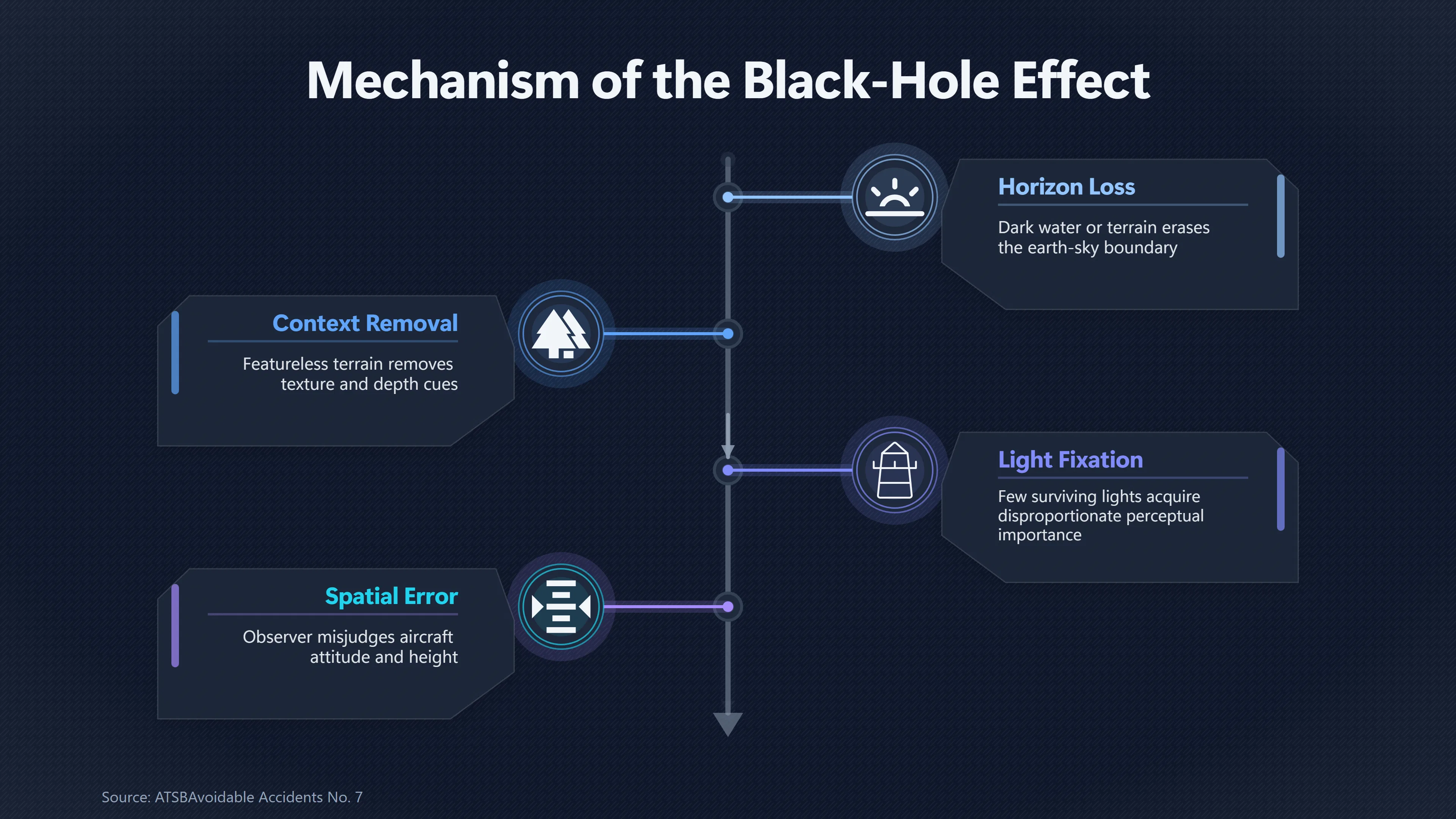
Over unlit water or featureless terrain, sky and surface can merge until isolated lights become misleading orientation cues.
On this page
- Why dark water and terrain can merge with the sky
- Which remaining lights become dominant orientation cues
- Why night and poor visibility increase false horizon risk
Page outline Jump by section
Introduction
Over dark water or unlit terrain, the real horizon can effectively disappear. Sea, forest, desert or sparsely populated ground may reflect so little light that the surface and night sky become one nearly continuous field. The aircraft can still be in legally clear weather, yet the outside scene no longer supplies the strong earth–sky boundary that normally tells an observer what is level. Australian investigators emphasise that even excellent visibility can coexist with no visible horizon or useful ground–sky contrast.[ATSB]atsb.gov.auATSBAvoidable Accidents No. 7Visual flight at night accidents: What you can't see can still hurt you | ATSBDecember 17, 2013…
That matters when assessing unusual lights seen from aircraft. Once the true horizon is missing, a few surviving lights — a shoreline, runway, isolated settlement, vessel, star or another aircraft — acquire disproportionate perceptual importance. They can supply a misleading reference for attitude, height or apparent motion. The result does not prove that any particular UFO/UAP report is an illusion, but it identifies a well-established circumstance in which observers can sincerely misjudge where a light lies and how it is moving.[Federal Aviation Administration]faa.govFederal Aviation Administration Chapter 8. Medical Facts for PilotsFederal Aviation Administration Chapter 8. Medical Facts for Pilots
Why dark water and terrain can merge with the sky
A useful visual horizon is more than a theoretical line where Earth meets sky. Transport Canada defines a discernible horizon as an identifiable division between terrain and sky accompanied by enough surrounding visual information to maintain coordinated flight by external reference. Its aviation guidance explicitly recognises a “black hole effect” when meteorological conditions combined with inadequate celestial, lunar or cultural illumination leave insufficient cues to see terrain and ground objects or establish such a horizon.[Transport Canada]tc.canada.caadvisory circular ac noTransport CanadaAdvisory Circular (AC) No. 603-001March 31, 2020…
Dark water is particularly effective at removing those cues. Away from moonlight, coastal development and illuminated vessels, there may be almost nothing visible between the aircraft and the stars. Featureless land can produce much the same result: forest, desert and remote countryside lose texture, contours and depth cues after dark. The Transportation Safety Board of Canada therefore describes night flight over bodies of water or forest as flight over “featureless terrain”, where few or no visual references can leave no discernible horizon.[tsb.gc.ca]tsb.gc.caAir transportation safety investigation report A21W0001 - Transportation Safety Board of CanadaMay 11, 2022…
This distinction is important because good meteorological visibility does not guarantee a good visual horizon. The atmosphere may be clear while the ground itself supplies too little reflected or artificial light to be seen. The Australian Transport Safety Bureau (ATSB) has documented accidents in fine or otherwise acceptable weather where darkness, a moonless sky and the absence of ground lighting eliminated the horizon. An older Australian study of 35 night take-off accidents found visual or sensory illusion or spatial disorientation to be a primary factor in 15; in those cases, the absence of ground lighting and a horizon was considered particularly important.[ATSB]atsb.gov.audark night take accidents australiaDark Night Take-off Accidents in Australia | ATSBApril 21, 1995…
Water can also erase the boundary in poor visibility rather than complete darkness. In an ATSB case involving an aircraft manoeuvring over water in foggy conditions, investigators concluded that turning away from land exposed the pilot to a featureless grey environment with no visible horizon, making attitude and height extremely difficult to judge. The mechanism is therefore broader than simply “a black night”: what matters is insufficient contrast between the surface and what lies above it.[ATSB]atsb.gov.auATSBFlying visually in poor weather | ATSBATSBFlying visually in poor weather | ATSB
When a few lights become the strongest reference
The disappearance of most of the landscape does not necessarily leave complete darkness. More often it produces something perceptually awkward: almost no structure, but a few conspicuous lights.
Those surviving points can carry much more visual weight than they would in daylight. FAA guidance specifically warns that an obscured horizon, a dark scene containing ground lights and stars, and geometric arrangements of ground lighting can make a pilot perceive an incorrect relationship to the real horizon. Surface references and the natural horizon are especially liable to disappear on overwater flights, at night and over extremely sparsely populated areas.[Federal Aviation Administration]faa.govFederal Aviation Administration Chapter 8. Medical Facts for PilotsFederal Aviation Administration Chapter 8. Medical Facts for Pilots
The problem can take several forms:
- Shoreline lights can blur the distinction between Earth and sky. When the water itself is invisible, lights along a distant coast may appear suspended in darkness rather than obviously attached to land. Aviation guidance notes that, when flying towards the shore of an ocean or large lake, shoreline lights can even be confused with stars because the water between observer and shore supplies so little visible structure.[Skybrary]skybrary.aeroGeneral Aviation Night Flying Guidance | SKYbrary Aviation SafetyGeneral Aviation Night Flying Guidance | SKYbrary Aviation Safety
- A small settlement can become an implicit reference line. If nothing else reveals the slope or shape of the ground, an arrangement of lights may look more horizontal than it really is. FAA guidance treats geometric patterns of ground lights as a recognised source of false-horizon illusions.[Federal Aviation Administration]faa.govFederal Aviation Administration Chapter 8. Medical Facts for PilotsFederal Aviation Administration Chapter 8. Medical Facts for Pilots
- Runway or landing-zone lights can dominate an otherwise empty scene. Transport Canada warns that the black-hole effect can be intensified when the only visual stimuli are lights on or near an aerodrome. In one Canadian helicopter investigation, the surrounding area had almost no cultural illumination; after the autopilot was disconnected, the available outside cues were essentially an illuminated windsock and 12 temporary helipad lights, which at greater distance would have appeared largely as a single source.[Transport Canada]tc.canada.caadvisory circular ac noTransport CanadaAdvisory Circular (AC) No. 603-001March 31, 2020…
- A solitary light can seem to move. This is the related phenomenon of autokinesis: a stationary point viewed against a dark, featureless background can appear to wander because there is no stable reference against which the visual system can judge its position. FAA guidance recognises autokinesis as a night-flight illusion, while SKYbrary describes the absence of reference points as central to the effect.[Skybrary]skybrary.aeroAutokinetic Effect | SKYbrary Aviation SafetyAutokinetic Effect | SKYbrary Aviation Safety
That final mechanism is especially relevant when interpreting reports of isolated aerial lights. Loss of the horizon and autokinesis are not identical illusions, but dark, reference-poor conditions favour both. An observer can therefore face two uncertainties simultaneously: the orientation of the surrounding visual field is poorly constrained, and the light within that field may itself appear to shift.
The black-hole effect shows how powerful missing context can be
The aviation “black-hole” or featureless-terrain illusion provides experimental and operational evidence for how strongly sparse night scenes can distort visual judgement. The classic configuration is a night approach towards an illuminated runway with little or no lighting in the intervening terrain. FAA guidance states that an absence of ground features — including approaches over water or darkened areas — can make the aircraft appear higher than it really is, encouraging an unintentionally low approach.[Federal Aviation Administration]faa.govFederal Aviation Administration Chapter 8. Medical Facts for PilotsFederal Aviation Administration Chapter 8. Medical Facts for Pilots
Research has investigated the effect for decades. An FAA study published in 1982 examined how runway dimensions and approach lighting affected pilots’ perceived approach angles in simulated night landings. More recent work continues to find the basic black-hole illusion while debating precisely which perceptual model best explains it. A 2024 experimental analysis found evidence of the illusion but reported that its data did not support either of two specific quantitative theories being tested.[Federal Aviation Administration]faa.govOpen source on faa.gov.
One proposed mechanism is particularly relevant to the missing-horizon problem. Researchers have tested whether, when the real horizon is absent, observers infer an implicit one from the converging edges of a runway. Experiments reported by Robinson, Williams and Biggs found systematic errors consistent with such a “line bias” account. But the authors also noted that there is no settled single explanation for the black-hole illusion.[Uniformed Services University]scholar.usuhs.eduOpen source on usuhs.edu.
The careful conclusion is therefore stronger than saying simply that “darkness fools pilots”, but narrower than claiming a fully solved perceptual mechanism. Removing the horizon and surrounding visual structure measurably degrades spatial judgement; exactly how the brain combines the few remaining cues is still an active research question. A 2022 review similarly described several proposed explanations and coping mechanisms rather than treating the phenomenon as the product of one universally accepted cause.[ScienceDirect]sciencedirect.comScienceDirect The black hole illusion: A neglected source of aviation accidentsScienceDirect The black hole illusion: A neglected source of aviation accidents
Real accidents show that experience does not restore the missing horizon
Accident evidence demonstrates that this is not merely a classroom illusion affecting novices. In August 2011, an AS355F2 Twin Squirrel helicopter departed a remote island in South Australia’s Cooper Creek area after last light. The moon had not risen, there was no visible horizon and, apart from the group’s campfire, virtually no terrestrial lighting was available. The pilot had more than 16,000 hours of flying experience. The ATSB concluded that he probably became spatially disoriented after entering a turn and did not recognise the developing descent and bank in time to recover.[ATSB]atsb.gov.auATSBNothing to see at night | ATSBATSBNothing to see at night | ATSB
The lesson is not that every observation over dark terrain will be seriously distorted. Rather, experience cannot manufacture visual information that the scene does not contain. ATSB guidance consequently warns that on dark nights over land or ocean without light sources, visual flight can provide so little outside information that it is effectively comparable to instrument flight.[ATSB]atsb.gov.auCollision with terrain involving Robinson R22, VH-LOS, 36 km south of Ramingining, Northern Territory, on 14 November 2022 | ATSB…
Another Australian investigation illustrates the same problem in unusually stark terms. A night take-off was made towards “dark textureless terrain” with no visible horizon. The aircraft apparently climbed only about 70 feet before entering a shallow descent and struck the ground at high speed, wings level; investigators found no evidence that the aircraft itself was incapable of normal operation and identified disorientation among the probable factors.[ATSB]atsb.gov.auOpen source on atsb.gov.au.
These cases should not be repurposed as one-to-one explanations for UAP sightings. They concern aircraft-control accidents, not unexplained-object investigations. Their relevance is narrower and more defensible: they establish that the disappearance of the visual horizon can produce substantial, sometimes unnoticed errors in perceived aircraft attitude and spatial relationships even among trained pilots.
Why night and poor visibility raise false-horizon risk
Night does two things at once. It removes weak information and increases the apparent importance of whatever remains.
In daylight, a shoreline normally comes with water texture, terrain contours, vegetation, buildings, shadows and a broad earth–sky boundary. At night, much of that contextual information vanishes. The observer may retain only a strip of coastal lights. Similarly, an isolated light above dark countryside lacks the visible terrain that would ordinarily establish its height and position. The visual system must interpret a sparse scene from far fewer constraints.
Poor visibility can push the scene further in the same direction. Haze, cloud, rain or fog need not hide every light equally. Bright sources can remain visible after low-contrast terrain and the natural horizon have disappeared. The resulting scene may therefore feel more informative than it actually is: several crisp points of light remain visible, but the broad environmental references needed to interpret their position accurately have gone. FAA guidance explicitly associates obscured horizons and dark scenes containing intermixed ground lights and stars with false-horizon errors.[Federal Aviation Administration]faa.govFederal Aviation Administration Chapter 8. Medical Facts for PilotsFederal Aviation Administration Chapter 8. Medical Facts for Pilots
Moonlight and artificial illumination can make a large difference. Canadian aviation guidance treats celestial, lunar and cultural illumination as factors determining whether enough external information exists to see terrain and establish a horizon. The ATSB similarly advises night pilots to assess celestial and terrestrial lighting, stressing that some combinations of terrain and darkness are much less visually usable than others.[Transport Canada]tc.canada.caadvisory circular ac noTransport CanadaAdvisory Circular (AC) No. 603-001March 31, 2020…
This also explains why the phrase “clear night” can be misleading when evaluating an aerial sighting. Clear air may improve the visibility of stars, planets and distant lights while doing little to illuminate water or terrain below. The observer can therefore see the light of interest very clearly while having poor information about the frame of reference needed to judge it.
What this means for UFO and UAP reports
For reports made over ocean, remote countryside or other poorly illuminated terrain, the first useful question is not simply whether the witness could see the reported light. It is whether the witness could also see a reliable natural horizon and enough surface detail to establish orientation.
Those are different questions. A bright aircraft light, planet, star, vessel or distant ground source can remain conspicuous when the surface itself is invisible. In such circumstances, descriptions such as “level with us”, “just above the horizon”, “climbed sharply”, “dropped towards the water” or “moved sideways” deserve additional scrutiny because each implicitly assumes that the observer possessed a stable spatial reference.
This does not make those descriptions worthless. It changes their evidential weight. Investigators assessing an unusual aerial observation can look for details that constrain how reliable the visual reference actually was: whether the moon was above the horizon, whether coastline or terrain contours were visible rather than merely their lights, whether cloud or haze obscured low-contrast features, whether the aircraft was banking or turning, and whether the reported object was an isolated point against otherwise empty darkness.
The distinction is also important because several illusions can coexist without being interchangeable. A missing natural horizon can encourage reliance on an incorrect line of lights; a featureless approach can distort perceived height or angle; and fixation on an isolated point can produce apparent motion through autokinesis. Aviation sources document all of these effects, but they should not be collapsed into a catch-all explanation.[faa.gov]faa.govFederal Aviation Administration Chapter 8. Medical Facts for PilotsFederal Aviation Administration Chapter 8. Medical Facts for Pilots
The strongest inference is therefore conditional rather than categorical. When an aerial report occurs over dark water or featureless terrain and the natural horizon cannot be independently established, apparent position and motion derived solely from visual judgement become less secure. That is precisely the environment in which aviation authorities warn that external visual references can become insufficient or actively misleading.[Transport Canada]tc.canada.caadvisory circular ac noTransport CanadaAdvisory Circular (AC) No. 603-001March 31, 2020…
The key distinction: seeing a light is not seeing its reference frame
Dark water and unlit terrain matter because they can erase the large-scale visual structure against which an observer normally interprets everything else. The striking light may remain perfectly visible. What disappears is the information needed to say confidently where that light sits relative to the Earth.
That makes this mechanism particularly relevant to false horizons in aerial UFO/UAP reports. The phenomenon does not require poor eyesight, an inexperienced observer or an imaginary light. A genuine external light can be accurately detected while its altitude, orientation or motion is misperceived because the true horizon has vanished and weaker cues have silently taken its place.
Aviation accident investigations provide the strongest reality check: dark, featureless conditions have repeatedly deprived trained crews of enough external information to judge even their own aircraft’s orientation reliably.[ATSB]atsb.gov.audark night take accidents australiaDark Night Take-off Accidents in Australia | ATSBApril 21, 1995… For an isolated light observed in the same kind of environment, confident visual estimates of extraordinary climbs, descents or lateral manoeuvres therefore require corroboration from instruments, multiple independent reference points or other objective data before the apparent motion can safely be treated as the object’s true motion.
Amazon book picks
Further Reading
Books and field guides related to What Happens When the Real Horizon Disappears?. Use these as the next step if you want deeper reading beyond the article.
Human Factors in Aviation
Fully updated and expanded, the second edition of Human Factors in Aviation serves the needs of the widespread aviation community - stude...
Sensation and Perception
. Bruce Goldstein's SENSATION AND PERCEPTION, the best-seller which has helped over 150,000 students understand the ties between how we s...
The UFO Experience: A Scientific Inquiry
Cited by the New York Review of Books as "the best brief for visitation," this classic study presents an analysis of UFO reports and conc...
eBay marketplace picks
Marketplace Samples
Live-tested eBay searches with available results related to this page.
Selected fromaviation poster oneBay.co.uk.
Endnotes
1.
Source: atsb.gov.au
Title: ATSBAvoidable Accidents No. 7
Link:https://www.atsb.gov.au/publications/avoidable-accidents/2013/aviation/avoidable-accidents-no-7-visual-flight-night
Source snippet
Visual flight at night accidents: What you can't see can still hurt you | ATSBDecember 17, 2013...
Published: December 17, 2013
2.
Source: atsb.gov.au
Link:https://www.atsb.gov.au/investigations/ao
Source snippet
Collision with terrain involving Robinson R22, VH-LOS, 36 km south of Ramingining, Northern Territory, on 14 November 2022 | ATSB...
Published: November 2022
3.
Source: faa.gov
Title: Federal Aviation Administration Chapter 8. Medical Facts for Pilots
Link:https://www.faa.gov/Air_traffic/publications/atpubs/aim_html/chap8_section_1.html
4.
Source: faa.gov
Title: Federal Aviation Administration Robinson R44 | Federal Aviation Administration
Link:https://www.faa.gov/lessons_learned/rotorcraft/accidents/N474FA
5.
Source: tc.canada.ca
Title: advisory circular ac no 603 001
Link:https://tc.canada.ca/en/aviation/reference-centre/advisory-circulars/advisory-circular-ac-no
Source snippet
Transport CanadaAdvisory Circular (AC) No. 603-001March 31, 2020...
Published: March 31, 2020
6.
Source: tsb.gc.ca
Link:https://www.tsb.gc.ca/eng/rapports-reports/aviation/2021/a21w0001/a21w0001.html
Source snippet
Air transportation safety investigation report A21W0001 - Transportation Safety Board of CanadaMay 11, 2022...
Published: May 11, 2022
7.
Source: tsb.gc.ca
Link:https://www.tsb.gc.ca/eng/rapports-reports/aviation/2019/a19o0178/a19o0178.html
Source snippet
Air transportation safety investigation report A19O0178 - Transportation Safety Board of Canada...
8.
Source: atsb.gov.au
Title: dark night take accidents australia
Link:https://www.atsb.gov.au/publications/research-and-analysis-report/2022/aviation/dark-night-take-accidents-australia
Source snippet
Dark Night Take-off Accidents in Australia | ATSBApril 21, 1995...
Published: April 21, 1995
9.
Source: atsb.gov.au
Title: ATSBPiper PA-30, VH-EDG, 3 km south of Charleville Aerodrome, Queensland | ATSB
Link:https://www.atsb.gov.au/investigations/199601209
10.
Source: atsb.gov.au
Title: ATSBFlying visually in poor weather | ATSB
Link:https://www.atsb.gov.au/news/2022/flying-visually-poor-weather
11.
Source: atsb.gov.au
Link:https://www.atsb.gov.au/publications/avoidable-accidents/2022/aviation/accidents-involving-visual-flight-rules-pilots
12.
Source: skybrary.aero
Title: General Aviation Night Flying Guidance | SKYbrary Aviation Safety
Link:https://skybrary.aero/index.php/articles/general-aviation-night-flying-guidance
13.
Source: tsb.gc.ca
Link:https://www.tsb.gc.ca/eng/rapports-reports/aviation/2015/a15p0217/a15p0217.html
14.
Source: skybrary.aero
Title: Autokinetic Effect | SKYbrary Aviation Safety
Link:https://skybrary.aero/index.php/articles/autokinetic-effect
15.
Source: faa.gov
Link:https://www.faa.gov/data_research/research/med_humanfacs/oamtechreports/1980s/1982/198206
16.
Source: sciencedirect.com
Link:https://www.sciencedirect.com/science/article/pii/S0169814124000672
17.
Source: sciencedirect.com
Title: ScienceDirect The black hole illusion: A neglected source of aviation accidents
Link:https://www.sciencedirect.com/science/article/abs/pii/S0169814121001530
18.
Source: atsb.gov.au
Title: ATSBNothing to see at night | ATSB
Link:https://www.atsb.gov.au/news/2022/nothing-see-night
19.
Source: tc.canada.ca
Title: ca Navigating the Hazards of Flat Light: A Guide for Aviators
Link:https://tc.canada.ca/en/aviation/publications/aviation-safety-letter/issue-4-2024/navigating-hazards-flat-light-guide-aviators
20.
Source: faa.gov
Title: Airman Education Programs | Federal Aviation Administration
Link:https://www.faa.gov/pilots/training/airman_education/topics_of_interest/spatial_disorientation
21.
Source: faa.gov
Title: Pilot’s Handbook of Aeronautical Knowledge | Federal Aviation Administration
Link:https://www.faa.gov/regulations_policies/handbooks_manuals/aviation/phak
22.
Source: faa.gov
Title: Handbooks & Manuals | Federal Aviation Administration
Link:https://www.faa.gov/regulations_policies/handbooks_manuals
23.
Source: tc.canada.ca
Title: ca Helicopter flying at night can be very dangerous
Link:https://tc.canada.ca/en/aviation/publications/aviation-safety-letter/issue-1-2023/helicopter-flying-night-can-be-very-dangerous
24.
Source: tsb.gc.ca
Link:https://www.tsb.gc.ca/eng/rapports-reports/aviation/2022/a22c0027/a22c0027.html
25.
Source: faa.gov
Title: Airplane Flying Handbook | Federal Aviation Administration
Link:https://www.faa.gov/regulations_policies/handbooks_manuals/aviation/airplane_handbook
26.
Source: tsb.gc.ca
Link:https://www.tsb.gc.ca/eng/rapports-reports/aviation/2019/a19a0055/a19a0055.html
27.
Source: tsb.gc.ca
Link:https://www.tsb.gc.ca/eng/rapports-reports/aviation/2017/a17o0209/a17o0209.html
28.
Source: tc.canada.ca
Title: ca Black holes and little grey cells
Link:https://tc.canada.ca/en/aviation/general-operating-flight-rules/general-aviation-safety-video-gallery/black-holes-little-grey-cells-spatial-disorientation-during-nvfr
29.
Source: faa.gov
Title: pilots handbook aeronautical knowledge faa h 8083 25b
Link:https://www.faa.gov/aviation/phak/pilots-handbook-aeronautical-knowledge-faa-h-8083-25b
30.
Source: accidents.app
Title: Aviation Accident
Link:https://www.accidents.app/summaries/accident/20160212X51525
31.
Source: faa.gov
Title: Chapter 8. Medical Facts for Pilots
Link:https://www.faa.gov/air_traffic/publications/atpubs/aim/aim0801.html
32.
Source: faa.gov
Title: Chapter 7. Safety of Flight
Link:https://www.faa.gov/air_traffic/publications/ATpubs/AIM/aim0701.html
33.
Source: faa.gov
Title: Aeronautical Information Manual
Link:https://www.faa.gov/air_traffic/publications/atpubs/aim/index.htm
34.
Source: tc.canada.ca
Title: ca Hazards Associated with Flying at Night
Link:https://tc.canada.ca/en/aviation/publications/system-safety-summer-briefing-kit-tp-14112/hazards-associated-flying-night-powerpoint-presentation
35.
Source: tsb.gc.ca
Link:https://tsb.gc.ca/eng/rapports-reports/aviation/2011/a11w0180/a11w0180.html
36.
Source: tsb.gc.ca
Link:https://www.tsb.gc.ca/eng/rapports-reports/aviation/2005/a05q0208/a05q0208.html
37.
Source: tsb.gc.ca
Link:https://tsb.gc.ca/eng/rapports-reports/aviation/2000/a00a0051/a00a0051.html
38.
Source: skybrary.aero
Link:https://skybrary.aero/index.php/articles/night-visual-approaches
39.
Source: skybrary.aero
Link:https://skybrary.aero/index.php/articles/visual-illusions
40.
Source: skybrary.aero
Link:https://skybrary.aero/index.php/articles/runway-visual-perspective
41.
Source: skybrary.aero
Link:https://skybrary.aero/articles/transition-visual-flight-night-oghfa-se
42.
Source: skybrary.aero
Link:https://skybrary.aero/index.php/articles/aircraft-emergency-floor-path-illumination
43.
Source: skybrary.aero
Link:https://skybrary.aero/index.php/articles/instantaneous-self-assessment-isa
44.
Source: skybrary.aero
Link:https://skybrary.aero/index.php/articles/external-lights
45.
Source: skybrary.aero
Link:https://skybrary.aero/index.php/Startle_Effect
46.
Source: skybrary.aero
Link:https://skybrary.aero/articles/vision-oghfa-bn
47.
Source: skybrary.aero
Link:https://skybrary.aero/index.php/articles/visual-glidelope-indicators
48.
Source: skybrary.aero
Title: S E200: Airplane State Awareness
Link:https://skybrary.aero/articles/se200-airplane-state-awareness-virtual-day-vmc-displays
49.
Source: faa.gov
Link:https://www.faa.gov/air_traffic/publications/atpubs/aip_html/chap7_section_6.html
50.
Source: faa.gov
Link:https://www.faa.gov/air_traffic/publications/atpubs/aim_html/chap7_section_1.html
51.
Source: faa.gov
Link:https://www.faa.gov/Air_traffic/publications/atpubs/aim_html/chap7_section_6.html
52.
Source: faa.gov
Link:https://www.faa.gov/air_traffic/publications/atpubs/aip_html/chap7_section_1.html
53.
Source: faa.gov
Link:https://www.faa.gov/Air_traffic/publications/atpubs/aim_html/chap2_section_1.html
54.
Source: faa.gov
Title: EN R 1.15: Medical Facts for Pilots7.. JUDGMENT ASPECTS OF COLLISION AVOIDANCE 1
Link:https://www.faa.gov/air_traffic/publications/atpubs/aip_html/part2_enr_section_1.15.html
55.
Source: sciencedirect.com
Link:https://www.sciencedirect.com/science/article/pii/S0003687023000868
56.
Source: sciencedirect.com
Title: The black hole illusion: A neglected source of aviation accidents
Link:https://www.sciencedirect.com/science/article/pii/S0169814121001530
57.
Source: scholar.usuhs.edu
Link:https://scholar.usuhs.edu/en/publications/preliminary-support-for-the-line-bias-illusion-as-a-contributor-t/
58.
Source: atsb.gov.au
Link:https://www.atsb.gov.au/sites/default/files/media/5226668/199003089.pdf
59.
Source: atsb.gov.au
Link:https://www.atsb.gov.au/investigations/ao
60.
Source: atsb.gov.au
Link:https://www.atsb.gov.au/investigations/ao
61.
Source: atsb.gov.au
Title: vfr helicopter pilot departed after last light prior collision terrain
Link:https://www.atsb.gov.au/media/news-items/2025/vfr-helicopter-pilot-departed-after-last-light-prior-collision-terrain
62.
Source: atsb.gov.au
Link:https://www.atsb.gov.au/investigations/ao
63.
Source: atsb.gov.au
Link:https://www.atsb.gov.au/taxonomy/term/3
64.
Source: atsb.gov.au
Link:https://www.atsb.gov.au/investigations/ao
65.
Source: atsb.gov.au
Link:https://www.atsb.gov.au/investigations/ao
66.
Source: atsb.gov.au
Title: which way is up
Link:https://www.atsb.gov.au/media/news-items/2015/which-way-is-up
67.
Source: atsb.gov.au
Link:https://www.atsb.gov.au/investigations/ao
68.
Source: atsb.gov.au
Link:https://www.atsb.gov.au/investigations/200403006
69.
Source: atsb.gov.au
Link:https://www.atsb.gov.au/investigations/200003949
70.
Source: atsb.gov.au
Link:https://www.atsb.gov.au/investigations/199600399
71.
Source: atsb.gov.au
Link:https://www.atsb.gov.au/investigations/199503369
72.
Source: atsb.gov.au
Title: dark night take off accidents in australia
Link:https://www.atsb.gov.au/publications/1995/dark-night-take-off-accidents-in-australia
73.
Source: atsb.gov.au
Link:https://www.atsb.gov.au/investigations/198902571
74.
Source: atsb.gov.au
Link:https://www.atsb.gov.au/statements/2022/final-atsb-report-fatal-ems-helicopter-accident-near-mackay-qld
75.
Source: atsb.gov.au
Link:https://www.atsb.gov.au/news/2023/r22-accident-highlights-risks-dark-night-flight-hazards-accidents-remote-locations
76.
Source: atsb.gov.au
Link:https://www.atsb.gov.au/news/2022/visual-flight-after-last-light
77.
Source: atsb.gov.au
Link:https://www.atsb.gov.au/node?page=955
78.
Source: www2.anac.gov.br
Link:https://www2.anac.gov.br/anacpedia/ing_por/tr4373.htm
79.
Source: www2.anac.gov.br
Link:https://www2.anac.gov.br/anacpedia/ing-por/tr4373.htm
Additional References
80.
Source: youtube.com
Title: Spatial Disorientation Explained: Deadly Flight Illusions Every Pilot Must Know
Link:http://www.youtube.com/watch?v=6BD9fyyIJzY
Source snippet
Black hole illusion night flying visual horizon Night Illusions (Private Pilot Lesson 15d)...
81.
Source: ntsb.gov
Link:https://www.ntsb.gov/news/press-releases/Pages/NR20191210.aspx
82.
Source: youtube.com
Title: Black Hole Illusion Recognition and Avoidance
Link:http://www.youtube.com/watch?v=uFI1xiiJl4w
Source snippet
Spatial Disorientation Explained: Deadly Flight Illusions Every Pilot Must Know...
83.
Source: ntsb.gov
Link:https://www.ntsb.gov/news/press-releases/Pages/NR20210209.aspx
84.
Source: nasa.gov
Title: Characterizing the Visual Experience of Astronauts at the Lunar South Pole
Link:https://www.nasa.gov/centers-and-facilities/nesc/characterizing-the-visual-experience-of-astronauts-at-the-lunar-south-pole/
85.
Source: researchgate.net
Link:https://www.researchgate.net/publication/400385806_Physiology_in_Aviation_Hearing_Vision_Spatial_Disorientation_and_Visual_Illusions
86.
Source: researchgate.net
Link:https://www.researchgate.net/publication/400386255_Physiology_in_Aviation_Hearing_Vision_Spatial_Disorientation_and_Visual_Illusions
87.
Source: researchgate.net
Link:https://www.researchgate.net/publication/395148047_A_virtual_reality-based_study_on_tunnel_black_hole_effects_on_drivers%27_psychological_stress_and_driving_performance
88.
Source: faraim.org
Link:https://www.faraim.org/faa/aim/chapter-7/section-7-1-14.html
89.
Source: eepistula.com
Link:https://eepistula.com/faa/aim/chapter-7/section-7-6-14.html