Within Haze
Why Mild Haze Can Hide a Distant Aircraft
Haze that looks modest near the ground can erase a distant aircraft because a shallow line of sight may pass through many kilometres of aerosol-rich air.
On this page
- Why optical losses accumulate with distance
- Why low angle views are especially vulnerable
- Why nearby scenery can still look clear
Page outline Jump by section
Introduction
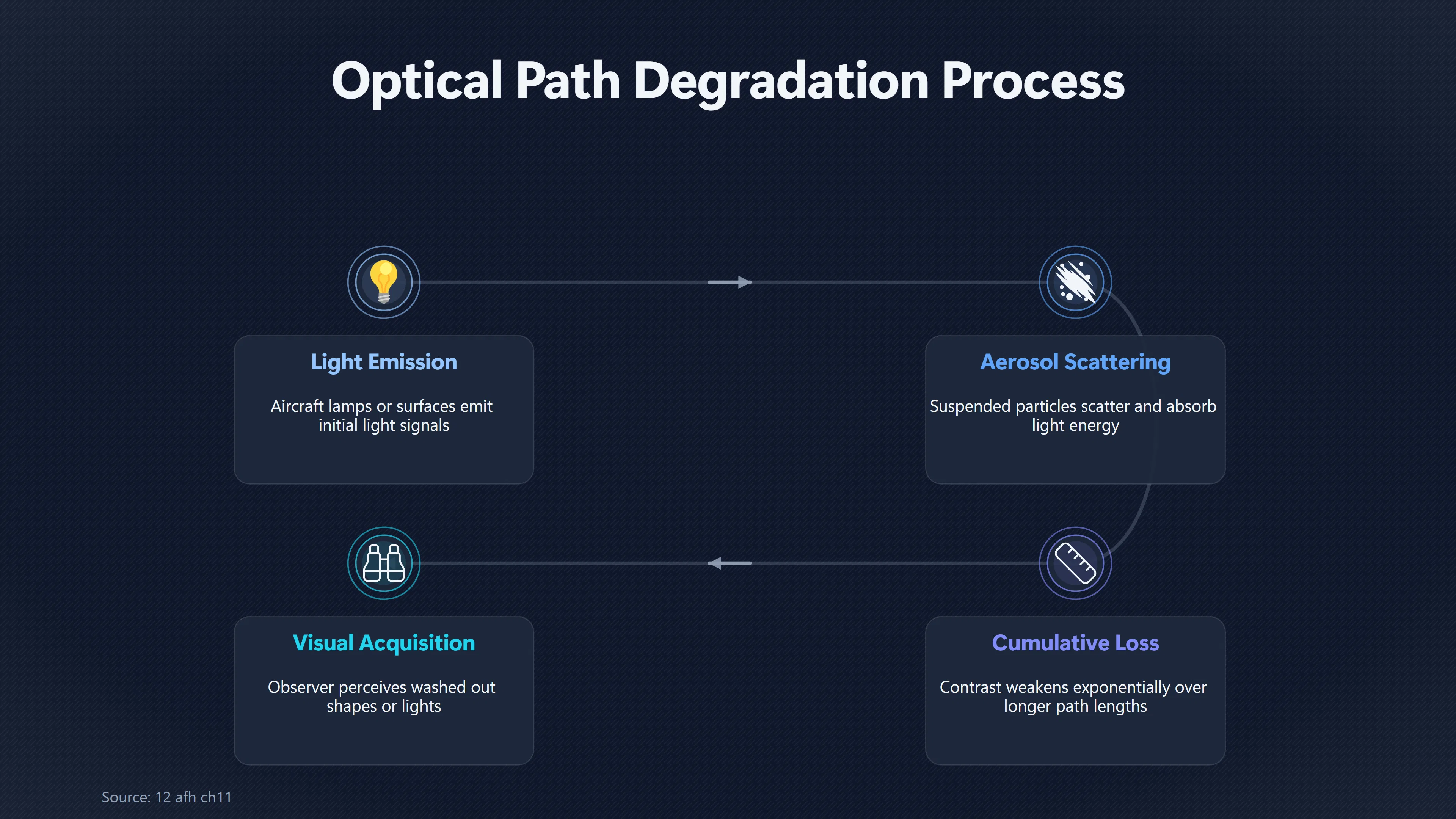
Mild haze can hide a distant aircraft even when nearby buildings, trees and other landmarks still look reasonably clear. The key is path length. Light from a low aircraft near the horizon may have to travel through tens of kilometres of aerosol-rich lower atmosphere before reaching an observer. Every additional kilometre adds more scattering and absorption, progressively weakening the contrast that reveals wings, fuselage and tail.
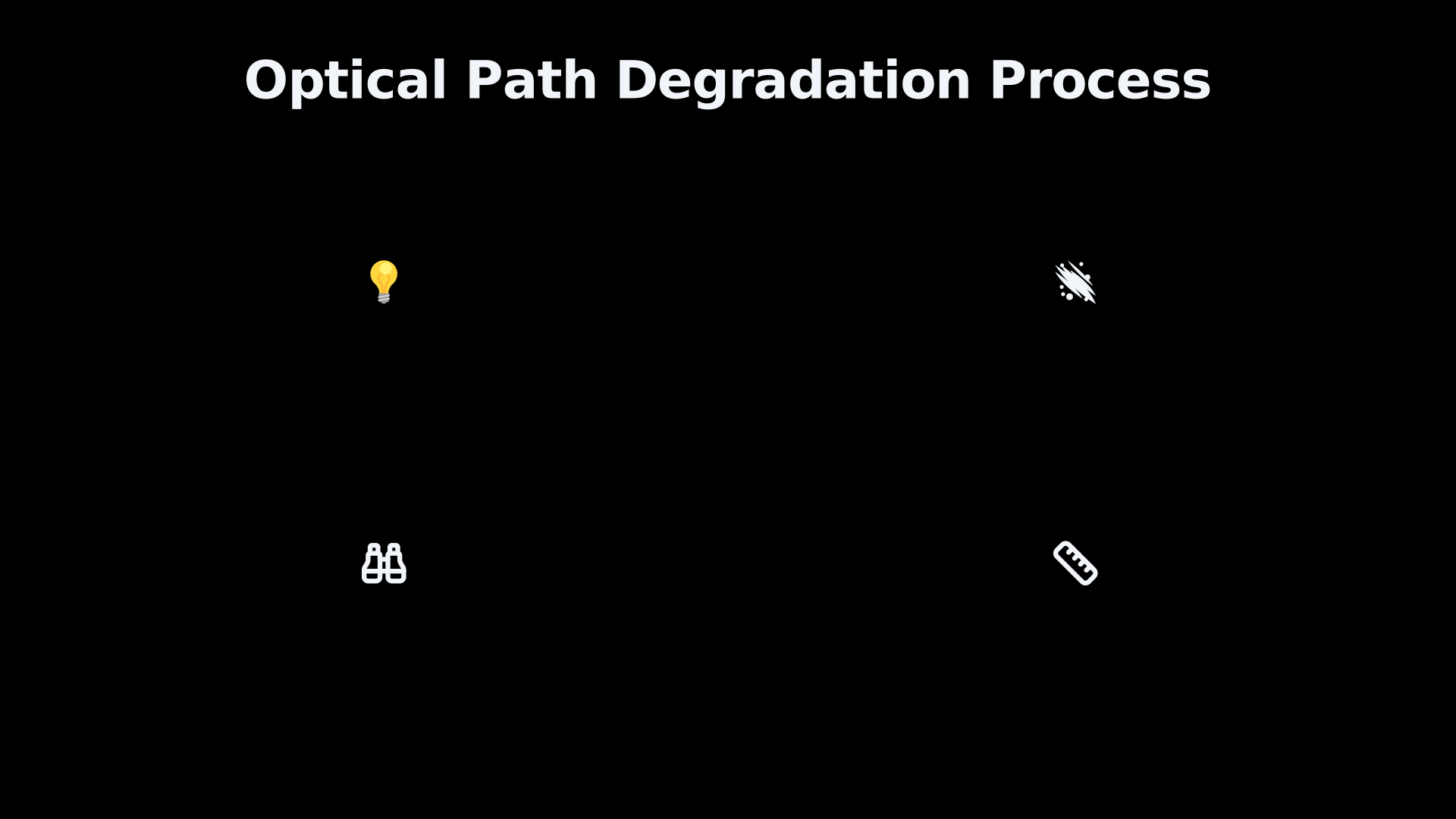
This is why a scene can be deceptive in UFO or UAP reports. A witness may look around, see sharp nearby scenery and reasonably blue sky, and conclude that the air is too clear for haze to matter. Yet the aircraft may be viewed along a much longer, shallower path through the same apparently modest haze. Aviation guidance explicitly recognises this geometry: horizontal visibility through haze can be considerably worse than visibility looking more nearly vertically through the same obscuring layer.[Federal Aviation Administration]faa.gov12 afh ch11Federal Aviation AdministrationAirplane Flying Handbook (3C) Chapter 11September 24, 2021 — If a descent occurs through clouds, smoke, or…
Why optical losses accumulate with distance
Haze is made of suspended particles that scatter light and, to a lesser extent in many conditions, absorb it. The US Environmental Protection Agency describes the practical result plainly: scattering and absorption reduce the clarity and colour of distant objects. The important point for a distant aircraft is that these effects are cumulative along the viewing path.[US EPA]epa.govbasic information about visibilityUS EPABasic Information about Visibility | US EPAMay 18, 2026…
Atmospheric optics describes this cumulative loss using an extinction coefficient, which expresses how strongly a volume of atmosphere removes image-forming light from a beam. Under simplified uniform conditions, contrast decreases approximately exponentially with distance. This means doubling the distance does not merely add a fixed amount of degradation: it exposes the image to additional extinction throughout the extra path, progressively driving the aircraft’s contrast towards the brightness of the surrounding sky. EPA visibility material describes distant bright and dark targets as becoming increasingly “washed out” and approaching the brightness of the horizon as distance increases.[NEPIS]nepis.epa.govNEPISProtecting Visibility an EPA Report to CongressNEPISProtecting Visibility an EPA Report to Congress
The traditional Koschmieder relationship makes the distance dependence easier to appreciate. In its idealised form, meteorological optical range is inversely related to the extinction coefficient; ICAO technical material gives the approximate relationship MOR ≈ 3/σ, where σ is atmospheric extinction. The formula has important assumptions — including a sufficiently uniform atmosphere and a suitable contrast target — so it should not be treated as a precise predictor of whether a particular aeroplane will be visible. Its value here is that it captures the central principle: the same modest extinction becomes increasingly consequential as the optical path grows.[ICAO]icao.intEANPG/48 - REPORTJanuary 30, 2007 — 28 Nov 2006 — Based on Koschmieder's law the formula is MOR ≡ 3/σ is derived, whereby MOR is the…
Consider an illustrative atmosphere with a meteorological optical range of roughly 30 km. Using that simplified relationship gives an extinction coefficient near 0.1 km⁻¹. A contrast signal travelling 5 km through uniform air would retain about 61 per cent of its initial value under the corresponding exponential model; after 20 km it would retain only about 14 per cent, and after 30 km about 5 per cent. These are illustrative optical figures rather than aircraft-identification thresholds, but they show why haze that seems inconsequential across a suburb can become decisive across a long horizon view. The atmosphere has not suddenly become “thick”; the observer is simply looking through much more of it.[ICAO]icao.intEANPG/48 - REPORTJanuary 30, 2007 — 28 Nov 2006 — Based on Koschmieder's law the formula is MOR ≡ 3/σ is derived, whereby MOR is the…
This distance effect matters particularly for aircraft because detecting an aeroplane is fundamentally a contrast problem. FAA guidance notes that an aircraft with strong contrast against its background may be easy to see while an aircraft at the same distance with low contrast may be impossible to see. Experimental and modelling work on aircraft visibility likewise treats contrast, target size and atmospheric conditions as important determinants of visual acquisition.[faa.gov]faa.govFederal Aviation AdministrationAdvisory Circular 90-48EOctober 26, 2022 — 20 Oct 2022 — An aircraft that has a high degree of contrast ag…
Why low-angle views are especially vulnerable
A distant aircraft close to the apparent horizon presents an unfavourable geometry because its line of sight can remain within the aerosol-rich lower atmosphere for a long distance. Looking steeply upwards, by comparison, carries the sight line through the lower layer relatively quickly.
This distinction is well established outside the UFO context. Atmospheric remote-sensing techniques deliberately use low-elevation observations because shallow viewing angles create long paths through the lowest atmospheric layers and therefore increase sensitivity to aerosols. Research using multi-axis differential optical absorption spectroscopy reports stronger aerosol effects as elevation decreases, while the University of Bremen’s atmospheric-science guidance notes that horizon-pointing measurements obtain much of their absorption signal from a slant path through the lowest layers.[AGU Publications]agupubs.onlinelibrary.wiley.comOpen source on wiley.com.
Aviation guidance describes the same geometry from a pilot’s perspective. The FAA’s Airplane Flying Handbook warns that when descending through cloud, smoke or haze, horizontal visibility through the restriction can be considerably less than visibility looking down through it from above. That is essentially the geometry faced by a ground observer watching a low, distant aircraft: instead of looking through the haze layer’s comparatively small vertical depth, the observer may be looking along it.[Federal Aviation Administration]faa.gov12 afh ch11Federal Aviation AdministrationAirplane Flying Handbook (3C) Chapter 11September 24, 2021 — If a descent occurs through clouds, smoke, or…
The difference becomes especially important when haze is concentrated near the surface. EPA material describes “layered haze” arising when stagnant conditions trap aerosols. In such circumstances, the total amount of haze overhead need not seem impressive. What matters to the aircraft sighting is how much of the observer-to-aircraft ray lies inside the layer. A shallow ray can spend kilometre after kilometre in polluted or humid lower air even though a steeper view soon reaches cleaner atmosphere.[US EPA]epa.govUS EPAIntroduction to VisibilityUnder stagnant air mass conditions, aerosols can be “trapped” and produce a visibility condi tion usually…
This is one reason surface impressions of a clear day are an unreliable guide to the visibility of a particular distant aircraft. Operational weather visibility is itself based on the ability to see and identify objects at known distances, and reported prevailing visibility need not represent every sector equally; FAA guidance allows significantly different visibility in parts of the horizon to be reported separately.[Federal Aviation Administration]faa.govFederal Aviation Administration Chapter 7. Safety of FlightFederal Aviation Administration Chapter 7. Safety of Flight
Humidity can amplify the discrepancy. EPA notes that haze-related visibility degradation is especially important during humid conditions. Many aerosol particles take up water as relative humidity rises, becoming more effective scatterers. A modest-looking aerosol burden can therefore produce appreciable loss of distant contrast without creating the opaque appearance people normally associate with fog.[US EPA]epa.govOpen source on epa.gov.
Why nearby scenery can still look clear
The most intuitive objection to a haze explanation is often: “But I could see everything else perfectly.” That observation can be entirely genuine without establishing that a much more distant aircraft should also have been sharply visible.
Suppose houses are 500 metres away, trees are 1 km away and the aircraft is 15 or 20 km away. The aircraft’s light has crossed perhaps twenty to forty times as much atmosphere as the nearby scenery. Under approximately uniform haze, the foreground therefore samples only a small fraction of the optical depth affecting the aeroplane. The foreground can retain strong edges, colours and textures while the distant target is already badly washed out. This distance-dependent loss of contrast is exactly what visibility science measures.[NEPIS]nepis.epa.govNEPISProtecting Visibility an EPA Report to CongressNEPISProtecting Visibility an EPA Report to Congress
There is also a selection effect in what the witness compares. A nearby tree, roofline or tower is generally a large angular object with numerous high-contrast edges. A distant aircraft is tiny. Even before haze is considered, its identifying features occupy very small angles in the observer’s visual field. Atmospheric extinction then acts on a target that may already be close to the limits of useful recognition.
That distinction between detecting something and recognising its form is important. FAA collision-avoidance guidance stresses that aircraft conspicuity depends strongly on contrast against the background. Research into aircraft visual acquisition similarly shows that visual detection is constrained by target size, contrast and viewing conditions rather than ordinary eye-chart acuity alone.[faa.gov]faa.govFederal Aviation AdministrationAdvisory Circular 90-48EOctober 26, 2022 — 20 Oct 2022 — An aircraft that has a high degree of contrast ag…
Consequently, “the nearby landscape was clear” and “the distant aircraft had no visible structure” are not contradictory observations. They describe targets seen through very different atmospheric distances and at very different angular scales.
A horizon aircraft can cross a much longer haze path
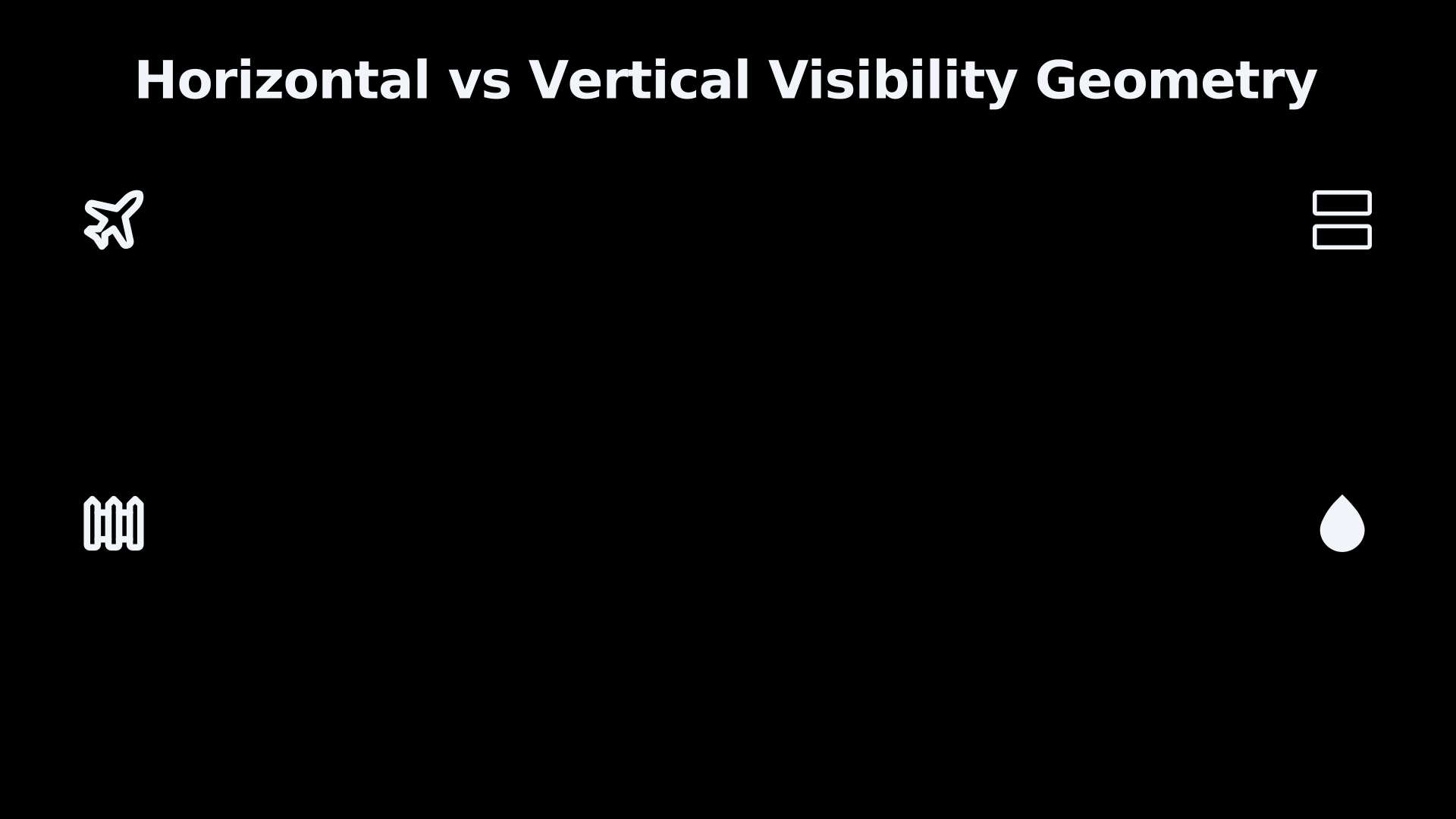
A simple geometric example shows how quickly the disparity grows. Imagine an aerosol-rich layer roughly 1 km deep. An observer looking at something nearly overhead sees through a path comparable to that vertical depth. A sight line only a few degrees above the horizon, however, can remain inside the same layer for many kilometres.
The real atmosphere is more complicated than a perfectly uniform slab: aerosol concentration changes with height and distance, terrain intervenes, humidity varies and Earth’s curvature eventually matters. That is why researchers distinguish horizontal, vertical and slant-path visibility rather than assuming that a single visibility number completely describes every viewing direction. Measurements of atmospheric aerosols likewise exploit different viewing angles precisely because those angles sample different paths through the atmosphere.[researchgate.net]researchgate.netOpen source on researchgate.net.
The effect is strongest close to the horizon. Atmospheric research on long-distance viewing notes that optical thickness becomes particularly large for horizon paths, while astronomical observations encounter the analogous phenomenon of increasing atmospheric extinction towards the horizon because radiation traverses a greater atmospheric path.[Optica Publishing Group]opg.optica.orgupcoming pdf.cfmupcoming pdf.cfm
For an aircraft sighting, the useful question is therefore not simply “Was it hazy?” It is “How much hazy atmosphere lay between the witness and the aircraft?” A small aerosol concentration integrated over a long path can matter more than a visibly thicker patch encountered over a short distance.
Why the remaining light can mislead
Once a long haze path has suppressed the aircraft’s weak structural contrast, its brightest lamps may become disproportionately important to what the witness perceives. This does not mean haze leaves lights unaffected. Light from the lamps is attenuated too. The difference is that a powerful, compact source can remain detectable after the much weaker contrast defining the surrounding airframe has become unusable.
ICAO’s treatment of visibility reflects this distinction mathematically. Meteorological optical range based on recognition of a dark object is described using Koschmieder’s law, while the visual range of a light source is treated separately with Allard’s law, which incorporates the source’s luminous intensity as well as atmospheric extinction and distance. In other words, “how far away can I recognise an unlighted object?” and “how far away can I detect a bright light?” are inherently different questions.[ICAO]icao.intEANPG/48 - REPORTJanuary 30, 2007 — 28 Nov 2006 — Based on Koschmieder's law the formula is MOR ≡ 3/σ is derived, whereby MOR is the…
This can produce the observational combination relevant to some UFO/UAP reports: nearby terrain appears normal, a distant object has no obvious wings or fuselage, yet one or more intense lights remain conspicuous. The long sight path explains why those observations can coexist without requiring an unusually dense fog bank.
The same atmospheric degradation has practical significance within aviation itself. FAA material warns that haze can create erroneous impressions of distance, and collision-avoidance guidance emphasises that atmospheric effects and low target contrast can make aircraft difficult to acquire visually. These are operationally recognised limitations of human vision, not mechanisms invented specifically to explain unusual-object reports.[Federal Aviation Administration]faa.govFederal Aviation Administration Robinson R44Federal Aviation Administration Robinson R44
What this means when assessing a UAP report
A claim that “there was only slight haze” should therefore be treated as useful but incomplete evidence. The strength of the haze explanation depends heavily on geometry.
For a distant luminous object near the horizon, the most informative reconstruction asks how far away the candidate aircraft was, its elevation above the observer’s horizon, whether the lower atmosphere contained haze or an inversion layer, and what direction the observer was facing. Airport observations can help, but a single prevailing-visibility figure should not automatically be interpreted as the visibility along every possible line of sight; FAA procedures explicitly recognise directional differences around the horizon.[Federal Aviation Administration]faa.govFederal Aviation Administration Chapter 7. Safety of FlightFederal Aviation Administration Chapter 7. Safety of Flight
Conversely, long-path haze should not become a catch-all explanation. If a proposed aircraft was nearby, high in the sky, or viewed through demonstrably clean air, the path-length argument becomes weaker. The simplified exponential visibility laws also assume conditions that real atmospheres do not perfectly satisfy; classic research on the Koschmieder formula stresses that illumination, target properties, aerosol distribution and human contrast thresholds can all alter the result.[ScienceDirect]sciencedirect.comScienceDirect On the applicability of the koschmieder visibility formulaOn the applicability of the koschmieder visibility formula - ScienceDirect…
The strongest use of this mechanism is therefore comparative. A distant, low-elevation aircraft can be far harder to recognise than nearby scenery under the same apparently mild haze, because the two are not being viewed through comparable amounts of atmosphere. Once that geometric difference is recognised, the apparently puzzling report of a bright, featureless object against an otherwise fairly clear landscape becomes much less paradoxical.
Amazon book picks
Further Reading
Books and field guides related to Why Mild Haze Can Hide a Distant Aircraft. Use these as the next step if you want deeper reading beyond the article.
Light and Color in the Outdoors
All of science springs from the observation of nature. In this classic book, the late Professor Minnaert accompanies the reader on a tour...
The Nature of Light & Colour in the Open Air
Explains such natural phenomena as rainbows, mirages, iridescent clouds, and halos for the scientist and the artist
Sensation and Perception
. Bruce Goldstein's SENSATION AND PERCEPTION, the best-seller which has helped over 150,000 students understand the ties between how we s...
Human Factors in Aviation
Since the 1950s, a number of specialized books dealing with human factors has been published, but very little in aviation. Human Factors...
eBay marketplace picks
Marketplace Samples
Live-tested eBay searches with available results related to this page.
Selected fromaircraft wall art oneBay.co.uk.



Endnotes
1.
Source: faa.gov
Title: 12 afh ch11
Link:https://www.faa.gov/sites/faa.gov/files/regulations_policies/handbooks_manuals/aviation/airplane_handbook/12_afh_ch11.pdf
Source snippet
Federal Aviation AdministrationAirplane Flying Handbook (3C) Chapter 11September 24, 2021 — If a descent occurs through clouds, smoke, or...
Published: September 24, 2021
2.
Source: epa.gov
Link:https://www.epa.gov/sites/default/files/2016-07/documents/introvis.pdf
Source snippet
US EPAIntroduction to VisibilityUnder stagnant air mass conditions, aerosols can be “trapped” and produce a visibility condi tion usually...
3.
Source: epa.gov
Title: basic information about visibility
Link:https://www.epa.gov/visibility/basic-information-about-visibility
Source snippet
US EPABasic Information about Visibility | US EPAMay 18, 2026...
Published: May 18, 2026
4.
Source: nepis.epa.gov
Title: NEPISProtecting Visibility an EPA Report to Congress
Link:https://nepis.epa.gov/Exe/ZyPURL.cgi?Dockey=P1003OJ9.TXT
5.
Source: sciencedirect.com
Title: ScienceDirect On the applicability of the koschmieder visibility formula
Link:https://www.sciencedirect.com/science/article/pii/0004698171900813
Source snippet
On the applicability of the koschmieder visibility formula - ScienceDirect...
6.
Source: icao.int
Link:https://www.icao.int/sites/default/files/EURNAT/Documents/EUR%20and%20Nat%20Docs/EUR%20Documents/EANPG%20Reports/EANPG48-Report.pdf
Source snippet
EANPG/48 - REPORTJanuary 30, 2007 — 28 Nov 2006 — Based on Koschmieder's law the formula is MOR ≡ 3/σ is derived, whereby MOR is the...
Published: January 30, 2007
7.
Source: faa.gov
Link:https://www.faa.gov/documentLibrary/media/Advisory_Circular/AC_90-48E.pdf
Source snippet
Federal Aviation AdministrationAdvisory Circular 90-48EOctober 26, 2022 — 20 Oct 2022 — An aircraft that has a high degree of contrast ag...
Published: October 26, 2022
8.
Source: faa.gov
Title: Federal Aviation Administration Chapter 7. Safety of Flight
Link:https://www.faa.gov/air_traffic/publications/atpubs/aim_html/chap7_section_1.html
9.
Source: epa.gov
Link:https://www.epa.gov/visibility
10.
Source: researchgate.net
Link:https://www.researchgate.net/publication/269523007_Vision_Through_Atmosphere_and_Atmospheric_Visibility
11.
Source: jstor.org
Link:https://www.jstor.org/stable/26179103
12.
Source: opg.optica.org
Title: upcoming pdf.cfm
Link:https://opg.optica.org/ao/upcoming_pdf.cfm?id=315615
13.
Source: faa.gov
Title: Federal Aviation Administration Robinson R44
Link:https://www.faa.gov/lessons_learned/rotorcraft/accidents/N474FA
14.
Source: epa.gov
Title: visibility parks and wilderness areas
Link:https://www.epa.gov/visibility/visibility-parks-and-wilderness-areas
15.
Source: researchgate.net
Link:https://www.researchgate.net/publication/390480628_The_influence_of_rainfall_on_the_extinction_coefficient_and_the_meteorological_optical_range
16.
Source: researchgate.net
Link:https://www.researchgate.net/publication/339757468_Error_Analysis_of_Atmospheric_Visibility_Measurements_Based_on_an_Image_Brightness_Contrast_Method
17.
Source: epa.gov
Title: issues guidance support states regional haze planning
Link:https://www.epa.gov/newsreleases/epa-issues-guidance-support-states-regional-haze-planning
18.
Source: hf.tc.faa.gov
Title: 2019 assessments of flight and wx
Link:https://hf.tc.faa.gov/publications/2019-assessments-of-flight-and-wx/
19.
Source: 19january2017snapshot.epa.gov
Title: visibility basic information
Link:https://19january2017snapshot.epa.gov/visibility/visibility-basic-information_.html
20.
Source: faa.gov
Title: Chapter 7. Safety of Flight
Link:https://www.faa.gov/air_traffic/publications/atpubs/aim/aim0701.html
21.
Source: faa.gov
Title: Chapter 3. Airspace
Link:https://www.faa.gov/air_traffic/publications/ATpubs/AIM/aim0301.html
22.
Source: faa.gov
Link:https://www.faa.gov/air_traffic/publications/ATpubs/ATC/PCG/V.HTM
23.
Source: faa.gov
Title: GE N 3.5: Meteorological Services
Link:https://www.faa.gov/air_traffic/publications/atpubs/aip_html/part1_gen_section_3.5.html
24.
Source: sciencedirect.com
Title: Distant contrast measurements through fog and thick haze
Link:https://www.sciencedirect.com/science/article/abs/pii/S1352231001003338
25.
Source: nepis.epa.gov
Title: Zy PURL.cgi
Link:https://nepis.epa.gov/Exe/ZyPURL.cgi?Dockey=9101H7KT.TXT
26.
Source: nepis.epa.gov
Title: Zy PURL.cgi
Link:https://nepis.epa.gov/Exe/ZyPURL.cgi?Dockey=9101143E.TXT
27.
Source: nepis.epa.gov
Title: Zy PURL.cgi
Link:https://nepis.epa.gov/Exe/ZyPURL.cgi?Dockey=9100ZHLQ.TXT
28.
Source: airporttech.tc.faa.gov
Title: slant and runway visual range relationships
Link:https://www.airporttech.tc.faa.gov/Products/Airport-Safety-Papers-Publications/Airport-Safety-Detail/slant-and-runway-visual-range-relationships
29.
Source: sciencedirect.com
Title: On the applicability of the koschmieder visibility formula
Link:https://www.sciencedirect.com/science/article/abs/pii/0004698171900813
30.
Source: forecast.weather.gov
Link:https://forecast.weather.gov/glossary.php?word=VISIBILITY
31.
Source: weather.gov
Link:https://www.weather.gov/media/zhu/ZHU_Training_Page/Met_Tutorials/Forecasters_Reference_Book_1997.pdf
32.
Source: forecast.weather.gov
Link:https://forecast.weather.gov/glossary.php?word=A
33.
Source: forecast.weather.gov
Link:https://forecast.weather.gov/glossary.php?word=R
34.
Source: sciencedirect.com
Title: Visibility in absorbing aerosols
Link:https://www.sciencedirect.com/science/article/pii/0004698181900068
35.
Source: sciencedirect.com
Title: Visibility in absorbing aerosols
Link:https://www.sciencedirect.com/science/article/abs/pii/0004698181900068
36.
Source: sciencedirect.com
Title: Extinction Coefficient
Link:https://www.sciencedirect.com/topics/earth-and-planetary-sciences/extinction-coefficient
37.
Source: sciencedirect.com
Title: Aerosol Optical Depth
Link:https://www.sciencedirect.com/topics/engineering/aerosol-optical-depth
38.
Source: sciencedirect.com
Link:https://www.sciencedirect.com/science/article/abs/pii/S1352231014002350
39.
Source: sciencedirect.com
Link:https://www.sciencedirect.com/science/article/pii/S1352231026001986
40.
Source: hero.epa.gov
Link:https://hero.epa.gov/reference/3120005/
41.
Source: nepis.epa.gov
Title: Zy PURL.cgi
Link:https://nepis.epa.gov/Exe/ZyPURL.cgi?Dockey=2000HCJ4.TXT
42.
Source: researchgate.net
Link:https://www.researchgate.net/publication/261708566_Contrast_sensitivity_in_IAF_aircrew
43.
Source: researchgate.net
Title: 337147270 Review of aerosol optical depth retrieval using visibility data
Link:https://www.researchgate.net/publication/337147270_Review_of_aerosol_optical_depth_retrieval_using_visibility_data
44.
Source: researchgate.net
Link:https://www.researchgate.net/publication/233894242_MAX-DOAS_O4_measurements_A_new_technique_to_derive_information_on_atmospheric_aerosols-Principles_and_information_content
45.
Source: opg.optica.org
Link:https://opg.optica.org/ao/fulltext.cfm?uri=ao
46.
Source: faa.gov
Link:https://www.faa.gov/air_traffic/publications/atpubs/aip_html/chap7_section_1.html
47.
Source: faa.gov
Link:https://www.faa.gov/Air_traffic/publications/atpubs/aim_html/chap_7.html
48.
Source: faa.gov
Title: glossary v
Link:https://www.faa.gov/air_traffic/publications/atpubs/pcg_html/glossary-v.html
49.
Source: faa.gov
Title: AIM Chg2 dtd 1 22 26
Link:https://www.faa.gov/air_traffic/publications/media/AIM_Chg2_dtd_1-22-26.pdf
50.
Source: faa.gov
Link:https://www.faa.gov/sites/faa.gov/files/regulations_policies/handbooks_manuals/aviation/faa-h-8083-21.pdf
51.
Source: faa.gov
Title: pilot vision
Link:https://www.faa.gov/pilots/safety/pilotsafetybrochures/media/pilot_vision.pdf
52.
Source: faa.gov
Link:https://www.faa.gov/lessons_learned/rotorcraft/accidents/N828AC
53.
Source: faa.gov
Title: N 8900.206
Link:https://www.faa.gov/documentLibrary/media/Notice/N%208900.206.pdf
54.
Source: faa.gov
Link:https://www.faa.gov/sites/faa.gov/files/about/office_org/headquarters_offices/avs/veronneau.pdf
55.
Source: faa.gov
Link:https://www.faa.gov/sites/faa.gov/files/2022-01/NovDec2020.pdf
56.
Source: faa.gov
Title: AIM Chg 2 dtd 3 21 24
Link:https://www.faa.gov/air_traffic/publications/media/AIM-Chg-2-dtd-3-21-24.pdf
57.
Source: icao.int
Link:https://www.icao.int/frequently-asked-questions-faqs
58.
Source: pmc.ncbi.nlm.nih.gov
Title: Pub Med Central (PMC)Predicting Visibility of Aircraft
Link:https://pmc.ncbi.nlm.nih.gov/articles/PMC2680596/
Source snippet
We constructed a set of aircraft images from...Read more...
59.
Source: agupubs.onlinelibrary.wiley.com
Link:https://agupubs.onlinelibrary.wiley.com/doi/full/10.1029/2005jd006618
60.
Source: agupubs.onlinelibrary.wiley.com
Link:https://agupubs.onlinelibrary.wiley.com/doi/pdf/10.1029/2005JD006618
61.
Source: doi.org
Link:https://doi.org/10.13140/RG.2.2.32110.47684
62.
Source: studylib.net
Link:https://studylib.net/doc/28228878/weather
63.
Source: rmets.onlinelibrary.wiley.com
Link:https://rmets.onlinelibrary.wiley.com/doi/10.1002/asl.925
64.
Source: agupubs.onlinelibrary.wiley.com
Link:https://agupubs.onlinelibrary.wiley.com/doi/abs/10.1029/2008JD011130
65.
Source: library.metoffice.gov.uk
Link:https://library.metoffice.gov.uk/portal/Default/en-GB/RecordView/Index/457195
66.
Source: digital.nmla.metoffice.gov.uk
Link:https://digital.nmla.metoffice.gov.uk/download/file/IO_1cec09db-b2ac-490f-b711-71d21f853b67
67.
Source: digital.nmla.metoffice.gov.uk
Link:https://digital.nmla.metoffice.gov.uk/download/file/IO_88a73c2b-bbc1-48ab-974a-4f7563e24e3f
68.
Source: digital.nmla.metoffice.gov.uk
Link:https://digital.nmla.metoffice.gov.uk/download/file/IO_a5237e05-8679-4597-95d8-bace02b1fb02
69.
Source: digital.nmla.metoffice.gov.uk
Link:https://digital.nmla.metoffice.gov.uk/download/file/IO_f7764e9e-7782-42e3-aace-5b8f35617c61
70.
Source: digital.nmla.metoffice.gov.uk
Link:https://digital.nmla.metoffice.gov.uk/download/file/IO_7c898986-f054-4efe-a139-c4a0b70173c1
71.
Source: iala.int
Title: Meteorological Optical Range
Link:https://www.iala.int/wiki/dictionary/index.php/Meteorological_Optical_Range
72.
Source: doi.org
Link:https://doi.org/10.1029/2011jd015938
73.
Source: origin-west-www-spc.woc.noaa.gov
Link:https://origin-west-www-spc.woc.noaa.gov/publications/corfidi/haze.html
Additional References
74.
Source: youtube.com
Title: Rayleigh Scattering Explained in Simple Words for Beginners
Link:https://www.youtube.com/watch?v=l-2ekH1QPpY
Source snippet
Slanted path slant range visibility atmospheric haze aviation How Can Airplanes Land in NO VISIBILITY?! | ILS Explained...
75.
Source: youtube.com
Title: METAR Visibility & RVR Explained: Prevailing / Runway Visual Range
Link:https://www.youtube.com/watch?v=1IT433Ht_iM
Source snippet
How Does Rayleigh Scattering ACTUALLY Work? (The Blue Sky)...
76.
Source: youtube.com
Title: Visibility & Fog Explained Simply | Aviation Meteorology
Link:https://www.youtube.com/watch?v=avJ-xoy22_g
Source snippet
METAR Visibility & RVR Explained: Prevailing / Runway Visual Range...
77.
Source: youtube.com
Title: How Does Rayleigh Scattering ACTUALLY Work? (The Blue Sky)
Link:https://www.youtube.com/watch?v=4HBuHX4-VU8
Source snippet
Rayleigh Scattering Explained in Simple Words for Beginners...
78.
Source: arxiv.org
Title: arXiv Haze Visibility Enhancement: A Survey and Quantitative Benchmarking
Link:https://arxiv.org/abs/1607.06235
79.
Source: scribd.com
Link:https://www.scribd.com/document/391645093/ABC-3rd-Edition-Rev-1r
80.
Source: faraim.org
Link:https://www.faraim.org/faa/aim/chapter-7/section-7-1-15.html
81.
Source: facebook.com
Link:https://www.facebook.com/aviation247/posts/-big-changes-for-helicopter-safety-the-end-of-see-and-avoidthe-faa-just-announce/1397628639071872/
82.
Source: indjaerospacemed.com
Link:https://indjaerospacemed.com/?article=a5fc38f900517d7ab288a271337b82662nXl70o2cvM%3D&embedded=true&view-pdf=1
83.
Source: soldata.dk
Link:https://www.soldata.dk/PDF/Bason%20-%20Diffuse%20irradiance%20and%20visibility.PDF