Within Why Military Flares
Why 'Phoenix Lights Were Flares' Is Too Broad
Explaining one Phoenix time window with flares does not automatically explain earlier reports of moving V-shaped lights.
On this page
- Separating the early and late sightings
- What the flare evidence actually explains
- Why investigators must match each report individually
Page outline Jump by section
Introduction
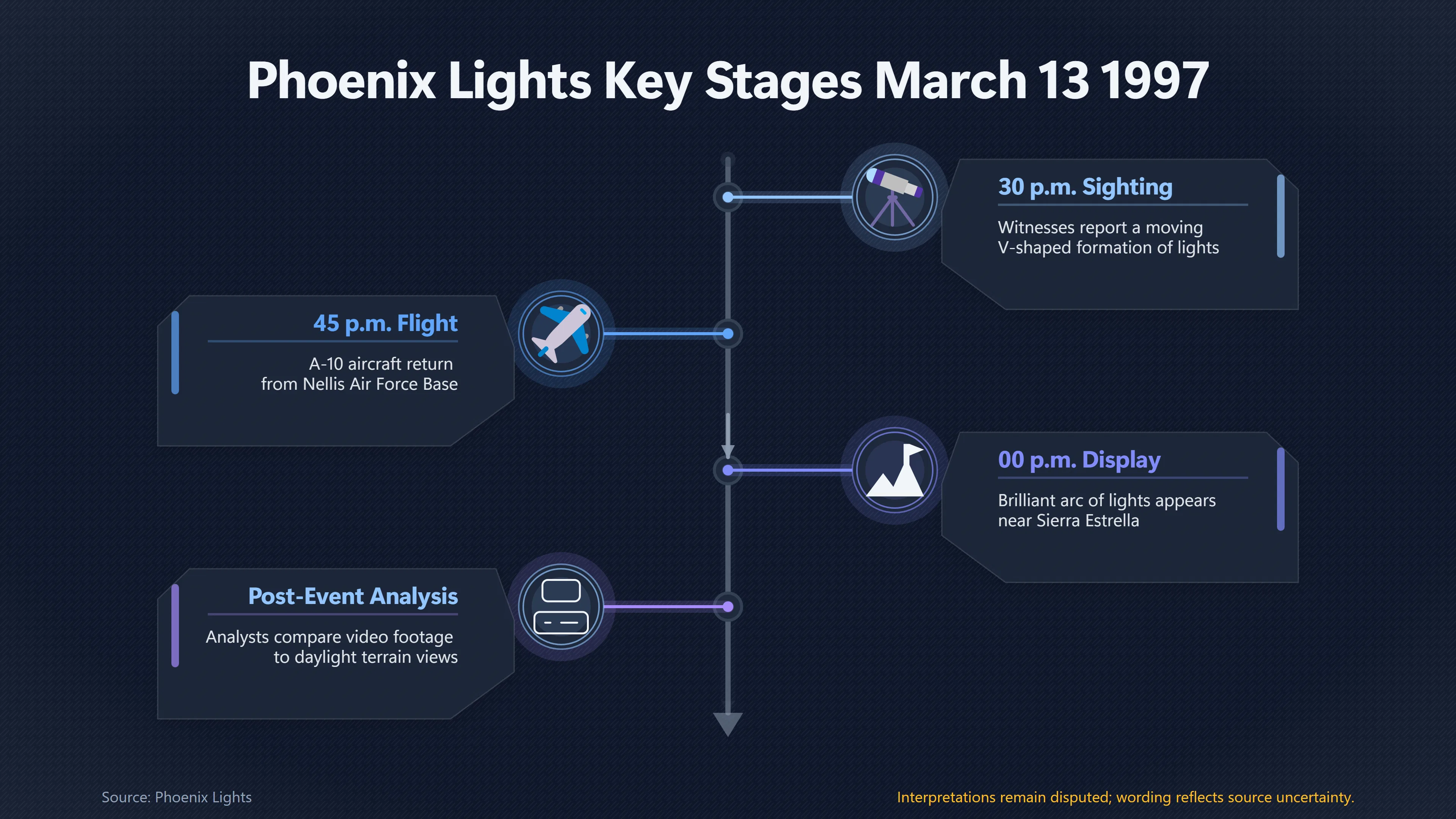
The phrase “Phoenix Lights” is too broad to function as an explanation. On 13 March 1997, materially different observations were reported over Arizona during different time windows. The best-supported flare explanation concerns the later display, around 10 p.m., when bright lights appeared south-west of Phoenix near the Sierra Estrella and were extensively photographed and videotaped. Military activity, the behaviour of parachute illumination flares and analysis of the terrain all fit that episode well.[Skeptical Inquirer]skepticalinquirer.orgOpen source on skepticalinquirer.org.
Earlier, however, witnesses reported a moving V- or chevron-shaped group of lights, crossing the state and the Phoenix area during the eight o’clock hour. That earlier event has its own conventional-aircraft evidence, including an important telescopic observation, but calling it “flares” simply imports the explanation for the later display into the wrong time window.[Skeptical Inquirer]skepticalinquirer.orgOpen source on skepticalinquirer.org.
That distinction matters whenever UFO or UAP reports are investigated as possible identified flying objects. A plausible explanation is useful only when it matches the particular observation being explained.
Separating the early and late sightings
The central problem with saying “the Phoenix Lights were flares” is that the name retrospectively bundles separate observations into one famous incident.
Around 8:30 p.m., people in the greater Phoenix area reported a chevron or V-shaped arrangement of lights moving through the sky. Reports had also come from farther north, and the formation subsequently continued south. Contemporary and later accounts vary considerably: witnesses disagreed over the number and colour of the lights, their apparent speed and altitude, and whether they were independent lights or attached to a single enormous dark object. The National UFO Reporting Center’s early summary itself cautioned that its account was preliminary and subject to revision as further witness reports arrived.[Skeptical Inquirer]skepticalinquirer.orgOpen source on skepticalinquirer.org.
The later episode looked different. Shortly after 10 p.m., a line or arc of brilliant lights appeared towards the south-west of Phoenix. Rather than traversing the city in the manner attributed to the earlier formation, these lights seemed to hang in the distance or descend slowly before disappearing. Crucially, this is also the episode that generated much of the familiar Phoenix Lights imagery. Later reporting continues to distinguish the moving earlier formation from the line of glowing lights near the Sierra Estrella roughly 75 minutes afterwards.[Phoenix New Times]phoenixnewtimes.comOpen source on phoenixnewtimes.com.
That time separation is not a minor chronological detail. It changes what evidence is relevant. Evidence that explains stationary or slowly descending lights at about 10 p.m. cannot simply be projected backwards onto moving lights reported around 8:30 p.m.
The confusion is particularly easy to perpetuate because both episodes occurred on the same evening, involved multiple lights and became attached to the same memorable label. Even some discussions of the case have mixed characteristics from the two. McGaha and Nickell explicitly note this problem in their retrospective investigation, while Robert Sheaffer likewise treats the episode as two distinct incidents.[Skeptical Inquirer]skepticalinquirer.orgOpen source on skepticalinquirer.org.
What the flare evidence actually explains
The flare case becomes much stronger once it is restricted to the later lights.
A-10 aircraft from the Maryland Air National Guard were conducting training associated with Operation Snowbird and used the Barry Goldwater training range south-west of Phoenix. Accounts obtained from the military identified the later display with the release of LUU-series parachute illumination flares. According to the account given by flight leader Edward Jones to investigator James McGaha, nine remaining illumination flares were released at roughly 15,000 feet before the aircraft departed the range.[Skeptical Inquirer]skepticalinquirer.orgOpen source on skepticalinquirer.org.
These were not the brief defensive flares commonly seen shooting rapidly away from combat aircraft. LUU illumination flares are intended to remain bright while descending beneath parachutes. McGaha and Nickell report a brightness of about 1.8 million candlepower and a burning time of roughly four minutes for the type involved. At the distances involved, intensely bright, slowly descending lights could therefore look almost stationary against a dark sky.[Skeptical Inquirer]skepticalinquirer.orgOpen source on skepticalinquirer.org.
There is also an unusually useful geographic test. Image analyst Leonid Rudin compared witness video with a daylight view taken from the same position, allowing the otherwise poorly visible Sierra Estrella skyline to be restored as a reference. The analysis indicated that the lights descended behind the mountain ridge rather than simply extinguishing at unexplained positions in open sky. McGaha and Nickell report that another analyst independently reached the same conclusion.[Skeptical Inquirer]skepticalinquirer.orgOpen source on skepticalinquirer.org.
That combination is considerably stronger than resemblance alone:
- there was relevant military activity in the appropriate direction;
- the aircraft involved carried and released illumination flares;
- the reported lights behaved in a way compatible with slowly descending parachute flares;
- and video-to-terrain comparison provided a mundane reason for their sequential disappearance.[Skeptical Inquirer]skepticalinquirer.orgOpen source on skepticalinquirer.org.
Even sources that remain sympathetic to UFO interpretations have sometimes accepted the later flare identification. McGaha and Nickell, for example, quote author Leslie Kean acknowledging analyses that concluded that the brilliant lights hanging above the mountain range and dropping from sight were flares.[Skeptical Inquirer]skepticalinquirer.orgOpen source on skepticalinquirer.org.
So the useful conclusion is narrower but stronger than “Phoenix was flares”: the approximately 10 p.m. Sierra Estrella display has substantial evidence supporting a military illumination-flare explanation.

The earlier V needs a different explanation
Rejecting “flares” for the earlier reports does not mean that those reports must therefore describe an extraordinary craft. It means that the earlier observations have to be tested against their own evidence.
One particularly important witness was amateur astronomer Mitch Stanley, who was observing from Scottsdale with a 10-inch Dobsonian telescope. Stanley told Phoenix New Times that when he put the approaching formation under magnification, the apparently individual lights resolved into pairs associated with objects having squarish wings. His conclusion was unequivocally mundane: he believed he was looking at aeroplanes.[Phoenix New Times]phoenixnewtimes.comOpen source on phoenixnewtimes.com.
That observation carries unusual evidential value because it involved optical magnification rather than naked-eye estimates of an unknown object’s distance and size. Stanley’s telescope provided roughly 60-power magnification, according to the contemporary investigation. The same investigation reported that the objects still appeared relatively small through the telescope, which is consistent with aircraft at substantial distance or altitude rather than an enormous object immediately overhead.[Phoenix New Times]phoenixnewtimes.comOpen source on phoenixnewtimes.com.
There is also evidence from the limited video record. McGaha and Nickell argue that the lights in footage of the earlier formation change position relative to one another. If so, that undermines the interpretation of the visible lights as fixed lamps mounted on one rigid V-shaped structure. It is compatible instead with several separate objects travelling in formation.[Skeptical Inquirer]skepticalinquirer.orgOpen source on skepticalinquirer.org.
Sceptical reconstructions have therefore proposed conventional aircraft for the earlier event, with Operation Snowbird aircraft flying south towards Tucson among the candidates. Sheaffer gives a specific reconstruction involving five A-10s returning from Nellis Air Force Base and reaching Davis-Monthan at about 8:45 p.m.; McGaha and Nickell likewise connect a five-aircraft formation on the Nellis-to-Tucson route with the observations.[Skeptical Inquirer]skepticalinquirer.orgOpen source on skepticalinquirer.org.
Later Phoenix New Times coverage summarises the conventional interpretation similarly: the first sighting is generally attributed by sceptical investigators to aircraft in formation, supported especially by Stanley’s telescopic observation, whereas the second is attributed to another group of A-10s dropping parachute flares.[Phoenix New Times]phoenixnewtimes.comOpen source on phoenixnewtimes.com.
The distinction in confidence is worth preserving. The late event has unusually direct flare-specific evidence: a relevant flare exercise, a pilot account and image analysis consistent with lights descending behind terrain. The early event instead involves competing interpretations of moving lights, witness perceptions, limited imagery and evidence pointing towards aircraft. Saying that the early V was not the documented 10 p.m. flare display is therefore more precise than either calling the whole night flares or declaring the early reports unexplained in the strongest possible sense.
Why eyewitness descriptions cannot simply be merged
Phoenix also demonstrates a recurring difficulty in mass UFO cases: multiple sincere observers do not necessarily report the same physical properties.
Descriptions of the early event varied over matters that would be fundamental if everyone had been observing one rigid object. Accounts differed over whether there were five, seven or more lights; whether they were orange, red, white or yellow; whether they moved rapidly, slowly or apparently hovered; and whether a solid body was visible at all.[Skeptical Inquirer]skepticalinquirer.orgOpen source on skepticalinquirer.org.
Some witnesses nevertheless described something much more impressive than distant aeroplanes: a huge, low, silent object, sometimes said to block stars as it passed. Those accounts are an important part of the case and should not be silently rewritten into reports of “five aeroplanes”. But neither should perception of a solid outline automatically override evidence that the individual lights may have moved relative to one another or Stanley’s magnified observation of separate aircraft-like objects.[Skeptical Inquirer]skepticalinquirer.orgOpen source on skepticalinquirer.org.
Night viewing makes this especially difficult. When the main visible information consists of several bright points against a dark background, the observer has few reliable cues for distance, altitude or physical scale. If the points form a recognisable V, the visual system can interpret the arrangement as the outline of a larger whole. A distant formation can consequently be perceived as a nearby, enormous object even when the observer is accurately reporting the positions of the lights themselves.
This does not establish that every early Phoenix witness made exactly the same perceptual error. It explains why an investigator cannot safely convert statements such as “it looked enormous”, “it was silent” or “the lights formed a V” directly into measurements of an object’s actual dimensions, altitude or structure.
Why each Phoenix report needs its own match
The Phoenix case is most useful as a lesson in identification discipline rather than as a contest between “UFO” and “flare” narratives. An explanation should be attached to observations only when the relevant time, location, direction and behaviour line up.
For the later, approximately 10 p.m. lights, those elements converge strongly on parachute illumination flares. The documented training activity occurred in the relevant region; the lights’ slow apparent descent fits the mechanism; and terrain analysis explains an important feature of the videos.[Skeptical Inquirer]skepticalinquirer.orgOpen source on skepticalinquirer.org.
For the earlier V-shaped procession, the same flare mechanism is a poor fit because these reports preceded the documented flare display and described lights travelling across a large area. Conventional aircraft in formation are a separate hypothesis with separate supporting evidence, particularly Stanley’s telescopic observation and analyses of the changing geometry of the lights.[Skeptical Inquirer]skepticalinquirer.orgOpen source on skepticalinquirer.org.
That leaves an important middle ground that is easily lost in polarised retellings. It is possible to conclude simultaneously that the famous later Phoenix footage is well explained by military flares, that those flares cannot retrospectively explain sightings made much earlier, and that the earlier sightings nevertheless have significant evidence for a conventional aircraft explanation.
Calling every report “the Phoenix Lights” is convenient history. Calling all of them “flares” is not careful identification. The stronger method is to split the night into its actual observation windows and ask what known source best fits each one.
Amazon book picks
Further Reading
Books and field guides related to Why 'Phoenix Lights Were Flares' Is Too Broad. Use these as the next step if you want deeper reading beyond the article.
The Phoenix Lights: A Skeptic's Discovery That We Are Not Alone
An account of the March 13, 1997, appearance in the sky over Phoenix, Arizona, of a mile-long, v-shaped formation of lights, is accompani...
The UFO Experience: A Scientific Inquiry
Cited by the New York Review of Books as "the best brief for visitation," this classic study presents an analysis of UFO reports and conc...
The UFO Handbook: A Guide to Investigating, Evaluating, and R...
An explanation of the usual reasons for confusing IFOs (identified flying objects) with UFOs and a survey of the tools used to investigat...
UFOs Explained
Analyzing several UFO cases, the author exposes the myth of extraterrestrial visitors to earth.
eBay marketplace picks
Marketplace Samples
Live-tested eBay searches with available results related to this page.
Selected fromUFO patch oneBay.co.uk.
Endnotes
1.
Source: youtube.com
Title: Phoenix Lights
Link:https://www.youtube.com/watch?v=N1fW1l1sh-A
Source snippet
The Phoenix Lights: 28 years later, the mystery endures...
2.
Source: youtube.com
Link:https://www.youtube.com/watch?v=LNgtgP4uQkg
Source snippet
The Phoenix Lights - Trailer...
3.
Source: youtube.com
Title: The Phoenix Lights
Link:https://www.youtube.com/watch?v=TjV2Vj1A7F8
Source snippet
Phoenix Lights - The Dark Truth?...
Additional References
4.
Source: youtube.com
Title: The Phoenix Lights: 28 years later, the mystery endures
Link:https://www.youtube.com/watch?v=KKDy1QfBlxs
Source snippet
Former Arizona Governor Fife Symington on witnessing the Phoenix Lights...
5.
Source: youtube.com
Title: Former Arizona Governor Fife Symington on witnessing the Phoenix Lights
Link:https://www.youtube.com/watch?v=v1Fh0g5wJ7A
Source snippet
Phoenix Lights 1997 - Original UFO footage...
6.
Source: static.e-publishing.af.mil
Link:https://static.e-publishing.af.mil/production/1/af_a3/publication/afman11-2mc-130jv3/afman11-2mc-130jv3.pdf
7.
Source: govinfo.gov
Link:https://www.govinfo.gov/content/pkg/FR-2010-06-08/pdf/2010-13748.pdf