Within Fireworks
Why Distant Fireworks Can Seem Completely Silent
A distant firework can be seen several seconds before its bang arrives, making a normal burst seem like a silent aerial light.
On this page
- How distance separates a flash from its bang
- Why terrain and weather can weaken firework sound
- When reported silence does and does not count against fireworks
Page outline Jump by section
Introduction
A distant firework can look completely silent for several seconds even though it produced a powerful bang. The reason is simple but easy to misread during an unexpected night-sky sighting: light reaches an observer effectively at once, while sound in ordinary air takes about three seconds to travel one kilometre. A firework three kilometres away can therefore flash roughly nine seconds before its report arrives. NOAA uses essentially the same timing rule for lightning and thunder.[NOAA]noaa.govOpen source on noaa.gov.
That gap matters when fireworks are mistaken for UFOs or unidentified anomalous phenomena (UAP). An observer may see an isolated orange, red or white light appear and disappear, wait briefly for a noise, hear nothing, and conclude that fireworks are unlikely. Yet apparent silence is weak evidence against a distant pyrotechnic source unless the observer knows the source distance and has allowed enough time for the sound to arrive. Atmospheric conditions, terrain, buildings and background noise can weaken the report still further. Fireworks are a documented UAP explanation: the US All-domain Anomaly Resolution Office (AARO) currently lists four closed cases resolved as fireworks.[AARO]aaro.milOpen source on aaro.mil.
How distance separates a flash from its bang
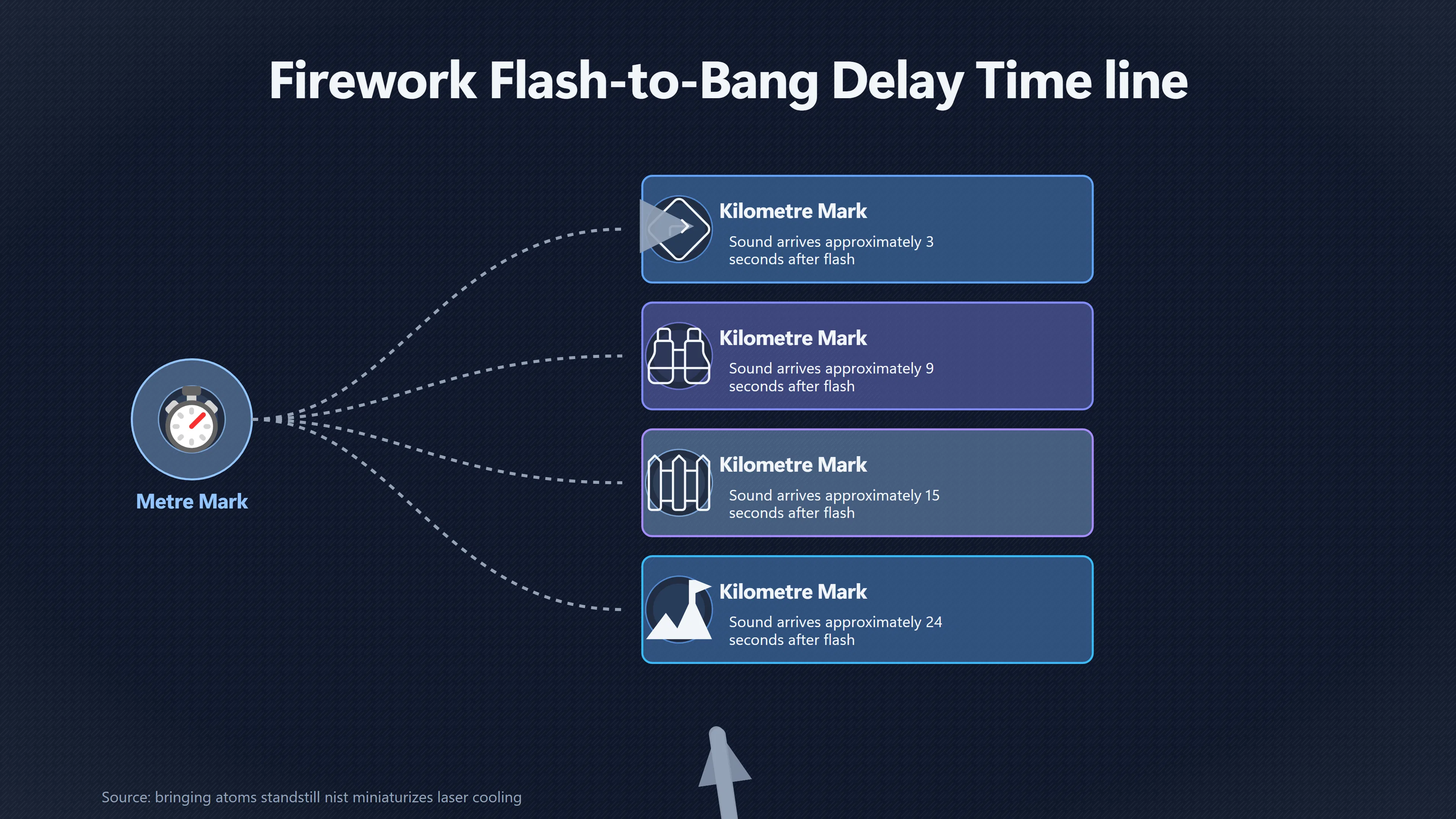
The visual and acoustic parts of a firework effectively travel on two different timescales. Light is so fast over terrestrial distances that its travel time can be ignored for an ordinary observation. Sound is dramatically slower. NOAA gives a useful approximation of one kilometre every three seconds, with the precise speed varying with air temperature.[NOAA]noaa.govOpen source on noaa.gov.
That produces delays large enough to alter how a witness interprets what they have seen:
Approximate distanceFlash-to-bang delay500 metres1.5 seconds1 kilometre3 seconds2 kilometres6 seconds3 kilometres9 seconds5 kilometres15 seconds8 kilometres24 seconds
These figures are approximate rather than a way to calculate an unknown firework’s range precisely. But they demonstrate the scale of the perceptual problem. A person watching a light two or three kilometres away may have several seconds in which the event genuinely appears silent.
The effect becomes more confusing during a sequence of fireworks. Suppose bursts occur every few seconds at an unseen display site three kilometres away. The observer sees burst A, then B and C. Around nine seconds after A, its sound arrives — perhaps when C is visible. Unless the witness deliberately tracks the delay, the bang can be associated with the wrong flash. With irregular firing intervals, the sounds and lights may appear almost unrelated.
The same phenomenon is familiar from thunderstorms. NOAA notes that distant lightning is seen before its thunder because of the enormous difference between the speeds of light and sound; counting the interval is routinely used to estimate the lightning’s distance.[NOAA Satellite Service]noaa.govOpen source on noaa.gov. A distant firework is governed by the same basic propagation physics.
For UFO-style observations, however, witnesses are not necessarily expecting fireworks. They may begin watching only after the first unexplained light catches their attention. A bang arriving several seconds later can consequently be treated as unrelated background noise rather than recognised as the delayed acoustic signature of what they have just seen.
Why the bang may be much weaker than the light suggests
Delay alone does not explain every report of apparently silent fireworks. With increasing range, the acoustic signal also becomes weaker and more vulnerable to its surroundings.
Sound energy spreads as it travels away from its source. Outdoor propagation is then modified by the ground, atmospheric absorption, temperature and wind gradients, turbulence, and shielding by natural or artificial structures. The US Federal Highway Administration’s technical guidance identifies all of these as factors capable of changing the sound reaching a receiver.[Federal Highway Administration]dot.govOpen source on dot.gov.
This creates an important asymmetry in a night-sky observation. A bright pyrotechnic flash can remain conspicuous against a dark background even when its bang has become faint. Fireworks themselves can be extremely loud close to the source: current UK government material notes noise limits of up to 120 dBAimp at specified distances for certain consumer categories, while professional F4 display fireworks do not have the same numerical product limit.[GOV.UK]gov.ukOpen source on gov.uk. Being intrinsically loud, however, does not guarantee that a particular observer kilometres away will clearly hear every burst.
There is also no requirement for the visual and acoustic paths to be equally unobstructed. A burst hundreds of metres above the firing site may be visible over distant rooftops or a ridge while much of its sound propagation towards an observer occurs close enough to the ground to be affected by intervening terrain and structures.
Research into terrain masking illustrates the principle. NASA-published experimental work found that a small hill between a source and microphones caused additional sound attenuation, with stronger effects at higher frequencies.[NASA Technical Reports Server]nasa.govOpen source on nasa.gov. More generally, research on irregular topography shows that hills and uneven ground materially change long-range outdoor acoustic propagation.[NASA Technical Reports Server]nasa.govOpen source on nasa.gov.
Urban environments introduce another complication. Firework explosions have been used experimentally as impulsive acoustic sources for measuring how sound travels through cities; recent research found distinct echoes associated with buildings and surrounding mountains.[PubMed]nih.govOpen source on nih.gov. A distant bang may therefore arrive not as the crisp report expected from a nearby firework but as a weaker, muffled or reverberant sound that is harder to associate with the light.
Weather can create surprisingly uneven audibility
Sound does not simply radiate through the atmosphere in identical straight paths under all conditions. Wind and vertical temperature differences change the effective propagation of acoustic waves, bending or refracting sound and altering how strongly it reaches particular locations. The Federal Highway Administration consequently treats atmospheric absorption, refraction and turbulence as explicit components of outdoor sound propagation.[Federal Highway Administration]dot.govOpen source on dot.gov.
This helps explain a seemingly odd feature of distant fireworks: two observers at similar distances from the same display need not hear it equally well. The direction of the wind, temperature structure of the lower atmosphere, terrain and source-receiver geometry can all matter.
The effect is well established beyond fireworks. Acoustic research describes “shadow” regions produced by wind-speed and temperature gradients near the ground, where ordinary direct sound rays do not reach the receiver in the expected way.[Institute of Acoustics]ioa.org.ukOpen source on ioa.org.uk. Modern measurements of controlled explosions likewise show that atmospheric winds can change the acoustic spectrum depending on propagation direction, even over ranges of only a few kilometres.[arXiv]arxiv.orgOpen source on arxiv.org.
This does not mean weather routinely makes a nearby major firework display literally noiseless. Rather, it means that distance alone cannot predict audibility. A weak or absent bang at one observation point is compatible with a firework explanation over a wider range of circumstances than the simple question “Wouldn’t I have heard it?” suggests.
Background noise can finish the job. Traffic, music, conversation, television heard through an open window, aircraft, wind in trees or ordinary urban noise may mask a distant report that would be noticeable in a quiet field. The flash does not face an equivalent problem: a bright point appearing against a dark sky can attract attention despite considerable ambient noise.
When reported silence counts against fireworks
“Silent” is therefore not a binary diagnostic. Investigators need to distinguish several quite different observations.
No bang at the instant of the flash is almost meaningless for a distant object. A one-kilometre firework is not expected to be heard for roughly three seconds, and the delay grows approximately linearly with distance.[NOAA]noaa.govOpen source on noaa.gov.
No remembered bang afterwards is more informative, but still ambiguous. The witness may not have known to listen, may have stopped observing, or may have heard a delayed noise without associating it with the earlier light.
Continuous observation in quiet conditions with no sound for tens of seconds carries more weight, particularly if other evidence places the light relatively nearby. At that point an investigator should ask whether a conventional explosive firework at the proposed distance ought reasonably to have been audible.
The crucial qualification is “at the proposed distance”. Night-time point lights provide poor range information. Without a known object size, visible terrain contact or other distance cue, an apparently nearby light can actually be much farther away. Treating the witness’s visual distance estimate as certain and then arguing that a firework “should have been audible” risks circular reasoning.
Conversely, sound can sometimes strengthen the firework hypothesis. If video preserves both the flashes and later bangs, investigators can measure their separation. A repeated lag of about six seconds, for example, would be broadly compatible with an explosive source around two kilometres away. If a candidate display site lies at roughly that range and in the correct direction, the acoustic timing becomes useful corroborating evidence rather than an inconvenience.

The strongest test is timing, not the word “silent”
For a UFO/UAP report involving unexplained flashes, the useful question is not simply whether the witness heard fireworks. It is whether the observed combination of light, delay and acoustic conditions is consistent with fireworks.
A good reconstruction therefore preserves exact timestamps where possible. Investigators can compare video frames or witness timing with delayed bangs, estimate the expected sound travel time to known display locations, and check whether hills or buildings lie between the observer and the suspected source. Weather conditions can then be considered if audibility appears unexpectedly poor.
This evidence-based approach is preferable to assuming that fireworks must always look and sound like fireworks. AARO’s reporting statistics provide a modest but concrete reminder that pyrotechnics do enter the UAP reporting stream: its current closed-case table attributes four cases to fireworks, alongside much larger numbers attributed to balloons, satellites, unmanned aircraft and other ordinary sources.[AARO]aaro.milOpen source on aaro.mil. The small number should not be inflated into a general explanation for unexplained lights, but it establishes that the misidentification occurs in real investigative data.
The most important diagnostic lesson is narrower. Silence immediately after an unexplained flash does not rule out a distant firework. At one kilometre, wait roughly three seconds; at three kilometres, roughly nine; at five kilometres, roughly fifteen. Beyond that simple delay, weakening, masking, terrain and atmospheric refraction can make the eventual report less obvious still.[NOAA]noaa.govOpen source on noaa.gov.
When a supposedly silent UFO-like light appears near the horizon or above an obscured landscape, the absence of an instantaneous bang is therefore exactly what ordinary physics predicts for a sufficiently distant firework. The meaningful evidence comes from what happens in the seconds afterwards — and from whether the timing, direction and acoustic environment fit a real pyrotechnic source.
Amazon book picks
Further Reading
Books and field guides related to Why Distant Fireworks Can Seem Completely Silent. Use these as the next step if you want deeper reading beyond the article.
The Science of Sound
Written for students without a background in mathematics or physics, this textbook provides an introduction to the study of acoustics. It...
Fireworks: The Art, Science and Technique
First published 1988. Subjects: Fireworks, Poudres (pyrotechnie), Feux d'artifice, Pyrotechnie.

Why You Hear What You Hear: An Experiential Approach to Sound...
First published 2012.
eBay marketplace picks
Marketplace Samples
Live-tested eBay searches with available results related to this page.
Selected fromUFO poster oneBay.co.uk.
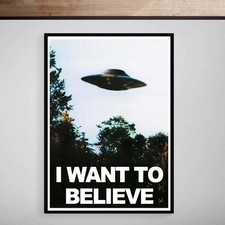
Current eBay listing
I Want To Believe UFO Poster Giclée Fine Art Heavyweight Print


Current eBay listing
VINTAGE UFO FLYING SAUCERS COMIC ADVERTISING A2 POSTER PRINT

Endnotes
1.
Source: aaro.mil
Link:https://www.aaro.mil/UAP-Cases/UAP-Reporting-Trends/
2.
Source: noaa.gov
Link:https://www.noaa.gov/jetstream/lightning/sound-of-thunder
Additional References
3.
Source: youtube.com
Title: Comparison of Speed of Sound with Speed of Light
Link:https://www.youtube.com/watch?v=PXR49LSjzTQ
Source snippet
This video explains the physics of the speed of light versus the speed of sound, demonstrating how distant aerial flashes (such as firewo...
4.
Source: youtube.com
Title: Why thunder is not heard immediately lightning discharge
Link:https://www.youtube.com/watch?v=6iaXtOl-g80
Source snippet
Comparison of Speed of Sound with Speed of Light...
5.
Source: youtube.com
Title: Distance to Storm from Thunder Time Delay
Link:https://www.youtube.com/watch?v=DEhHioZLLaw
Source snippet
Why thunder is not heard immediately lightning discharge...
6.
Source: nist.gov
Title: bringing atoms standstill nist miniaturizes laser cooling
Link:https://www.nist.gov/news-events/news/2021/01/bringing-atoms-standstill-nist-miniaturizes-laser-cooling
7.
Source: youtube.com
Title: Find Distance to Firework Or Lightning Using Sound (Flash and Bang Method)
Link:https://www.youtube.com/watch?v=rw4Abwcn6gs
Source snippet
Measuring the Speed of Sound...
8.
Source: youtube.com
Title: Measuring the Speed of Sound
Link:https://www.youtube.com/watch?v=xVzHT5BP-Sw
Source snippet
Distance to Storm from Thunder Time Delay...