Within Distance
Why Go Fast's Range Still Did Not Fix Its Size
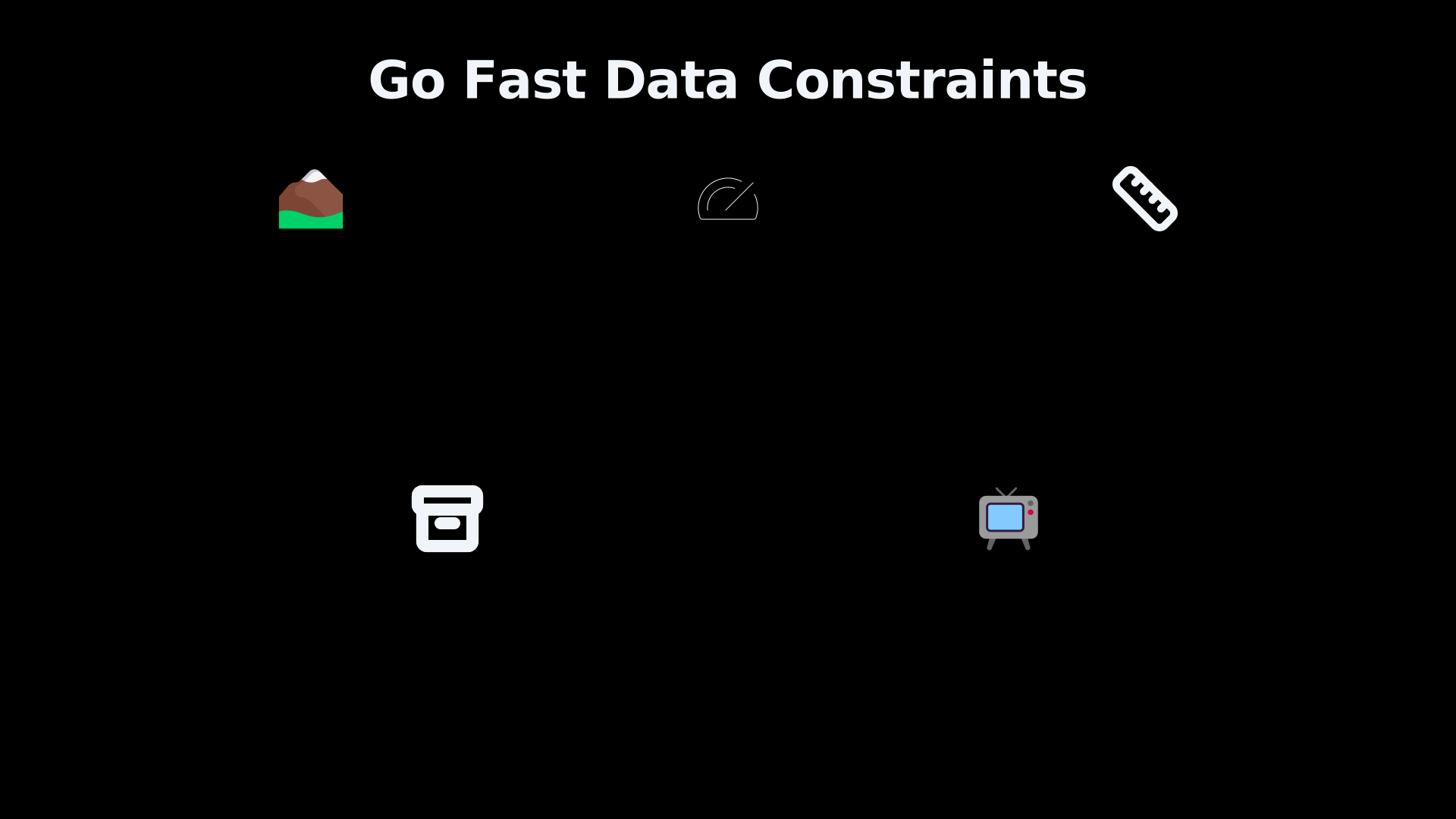
Even after investigators constrained the Go Fast object's range, limited image resolution prevented a definitive physical size measurement.
On this page
- What range data added to the Go Fast reconstruction
- Why poor resolution limited size measurement
- Why the one metre estimate remained provisional
Page outline Jump by section
Introduction
The Navy’s “Go Fast” video is a useful demonstration of a less obvious problem in UFO size estimates: even when investigators can constrain an object’s distance, they may still be unable to measure its physical size reliably. Range solves one major part of the geometry, but the image must also resolve the object well enough to establish its angular dimensions.
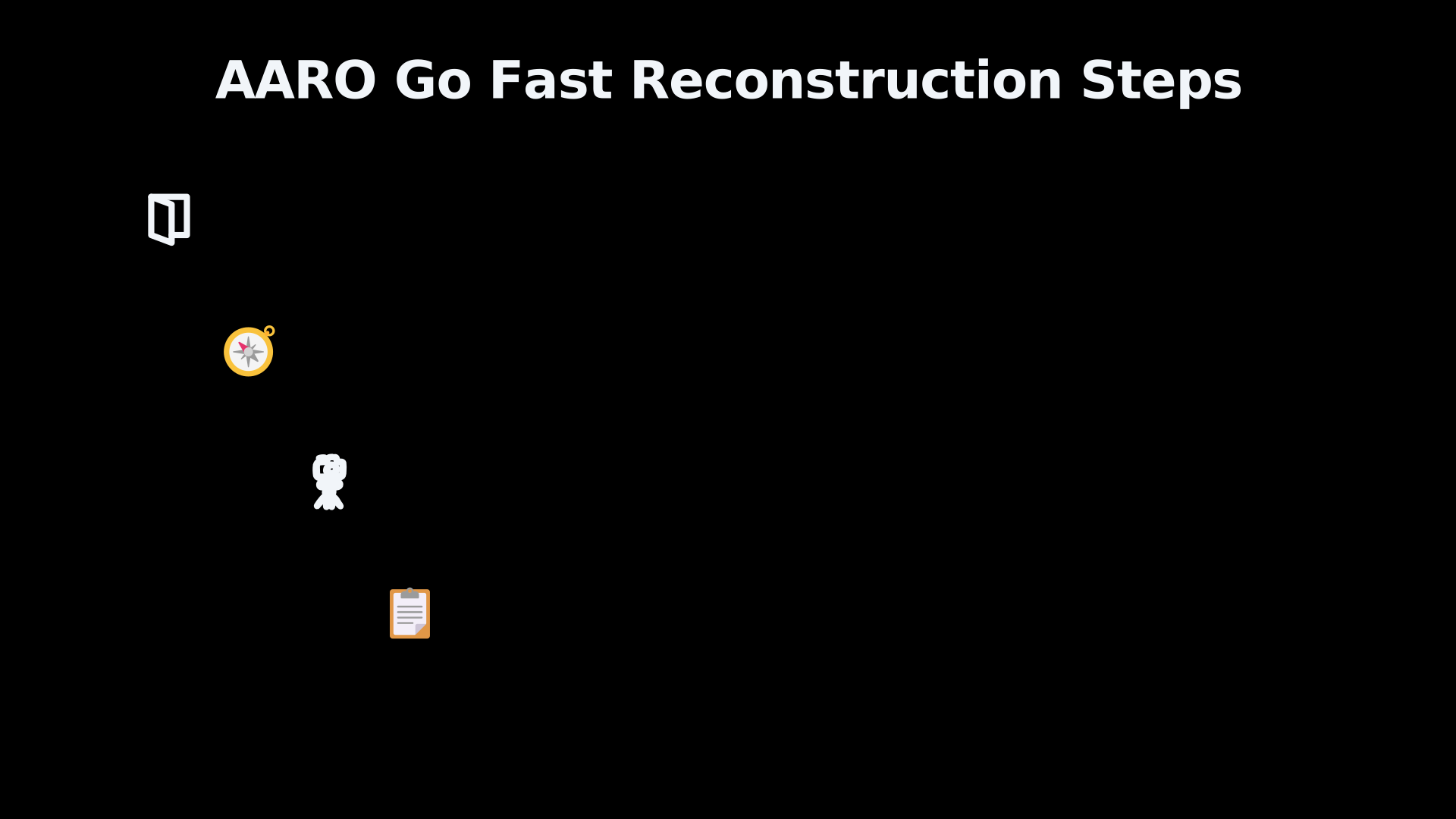
That distinction became explicit in the US All-domain Anomaly Resolution Office’s (AARO) 2025 analysis. Using range and other information displayed in the infrared footage, AARO reconstructed the object at roughly 13,000 feet altitude and concluded that its striking apparent motion was largely a parallax effect. Yet the agency simultaneously said it could not determine the object’s physical size because of the footage’s low resolution and observing range. A separate pixel analysis suggested one metre or less, but AARO treated that as an estimate rather than a definitive measurement.[AARO]aaro.milOpen source on aaro.mil.
Go Fast therefore illustrates an important boundary in UAP analysis: better range information can transform what investigators know about an encounter without turning every blurred image into a measurable object.
What range data added to the reconstruction
Go Fast was recorded in January 2015 by a US Navy F/A-18F using a forward-looking infrared sensor. The publicly released footage contains unusually useful numerical information around the image, including the sensor-to-target range, camera azimuth and elevation, aircraft altitude, airspeed and bank angle. That made the case considerably more tractable than a UFO photograph or video containing only an unidentified dot against the sky.[AARO]aaro.milOpen source on aaro.mil.
NASA highlighted this advantage in its 2023 UAP independent-study report. Its analysis combined the displayed range with the camera elevation and aircraft altitude to calculate an object altitude of about 13,000 feet. NASA also found that the object was roughly 4.2 miles above the ocean visible behind it. In other words, the apparently low object was not skimming just above the water: the sea was a much more distant background.[NASA]nasa.govOpen source on nasa.gov.
That changed the interpretation of the video’s most dramatic visual feature. An object apparently racing across a distant background can seem extraordinarily fast when the camera itself is travelling rapidly. NASA estimated that the aircraft’s ground speed was about 435 mph and concluded that the sensor’s motion, combined with parallax, contributed substantially to the impression of extreme object speed. Its simplified reconstruction produced an average object speed of about 40 mph, while noting uncertainties including its neglect of wind effects on the aircraft.[NASA]nasa.govOpen source on nasa.gov.
AARO later performed a more elaborate reconstruction. Because the aircraft’s exact heading was absent from the displayed information, it modelled the full range of possible headings rather than claiming one exact trajectory. AARO ultimately assessed with high confidence that the object did not exhibit anomalous speed and placed it at approximately the same 13,000-foot altitude.[AARO]aaro.milOpen source on aaro.mil.
This is precisely what reliable range information is supposed to accomplish. Instead of inferring the object’s location from its apparent proximity to the sea, investigators could reconstruct the three-dimensional viewing geometry. A visual impression that initially suggested a low and extremely fast object became compatible with something considerably higher and slower.
But knowing where the target approximately was did not make its dimensions equally recoverable.
Why poor resolution still blocked a firm size
Physical size normally requires two ingredients: distance and angular size. Once distance is constrained, a well-resolved object’s angular width can in principle be converted into a linear width. Go Fast’s difficulty was that the second ingredient remained weak.
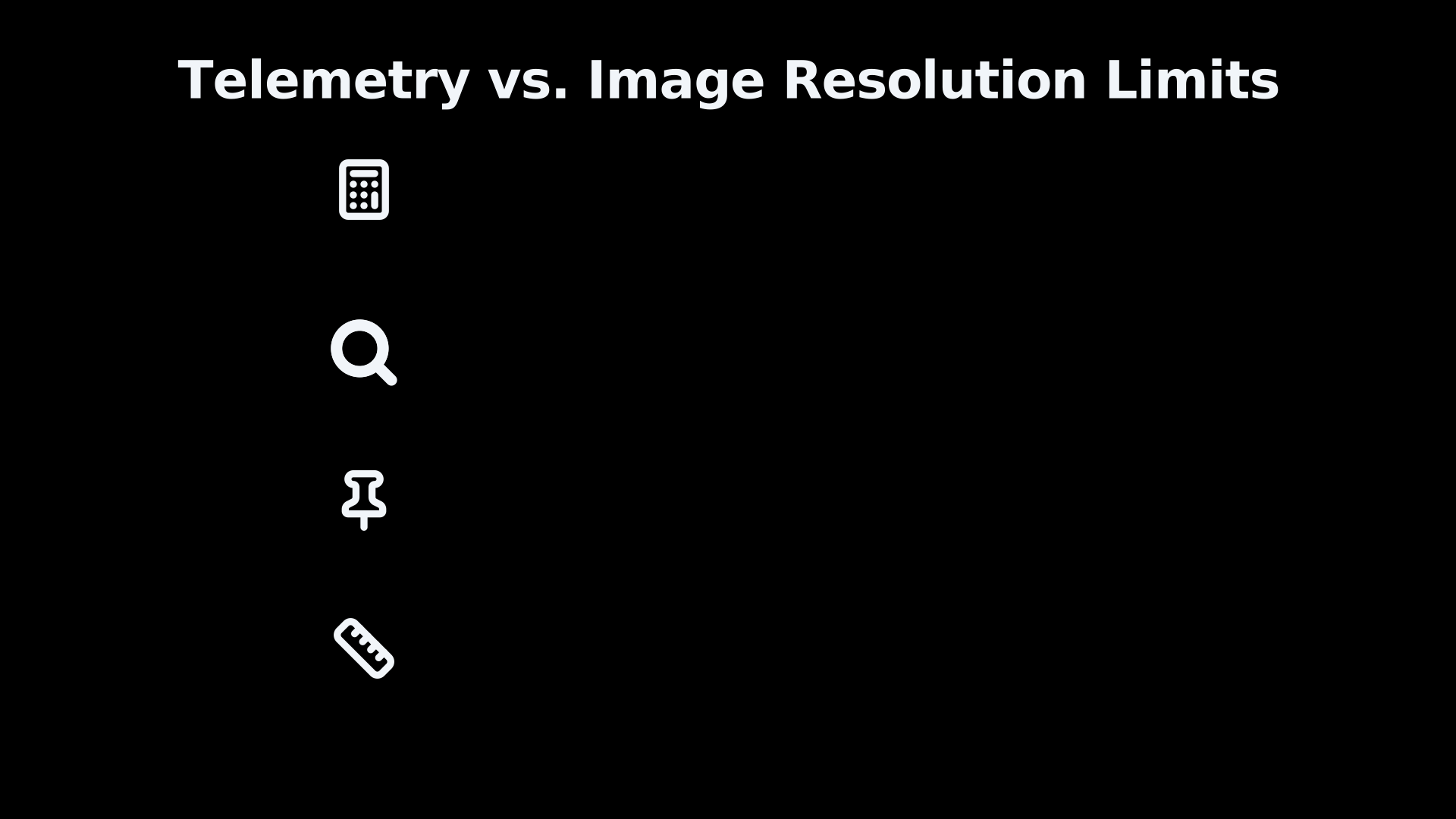
AARO states this unusually clearly: it could not determine the object’s size because of the video’s low resolution and the range from sensor to object. An Intelligence Community partner nevertheless conducted pixel analysis and suggested that the target was one metre or less across, putting it in a size range compatible with objects such as a small drone or bird.[AARO]aaro.milOpen source on aaro.mil.
There is no contradiction between those two statements. “The range is known” does not mean “the object’s edges are known”. If a distant target occupies only a very small image area, its apparent boundary becomes sensitive to the imaging system, sampling, processing and compression. The resulting blob can support a rough size constraint without supporting a precise measurement.
The provenance of the material available to AARO makes that caution particularly important. AARO reported that the original Go Fast file and its accompanying metadata were no longer available. Its reconstruction instead used the publicly available 34-second compressed Windows Media file. The office had enough displayed telemetry to estimate altitude and motion, but it did not have the pristine original sensor product from which every possible image-quality question could be revisited.[AARO]aaro.milOpen source on aaro.mil.
The publicly released footage is itself only a modest-resolution representation. The official-release version preserved on Wikimedia Commons is 640 × 480 pixels. Earlier investigation of circulating Go Fast files also found multiple versions and re-encodings, illustrating why simply counting pixels in a web-distributed copy should not automatically be treated as equivalent to measuring the target in original sensor data.[Wikimedia Commons]wikimedia.orgOpen source on wikimedia.org.
This produces an important asymmetry. Telemetry can remain quantitatively useful even when the pictured object is poorly resolved. Numbers printed onto the display can constrain where the line of sight went, while the tiny target inside that same display can contain too little spatial information to reveal a reliable outline. Go Fast therefore allowed investigators to say considerably more about where the object was than exactly how large it was.
Why the one-metre estimate remained provisional
AARO’s wording matters. Its Intelligence Community partner’s pixel analysis suggested that the object was one metre or less; the report did not replace that qualification with a definitive finding that Go Fast measured exactly one metre across. AARO continued to state that it could not determine the object’s size.[AARO]aaro.milOpen source on aaro.mil.
That distinction also limits what can responsibly be inferred about identity. A one-metre-or-less estimate makes mundane candidates such as a bird or small drone physically plausible, but size compatibility is not identification. AARO explicitly said that it could not definitively identify the Go Fast object, even while concluding that the observed performance was not anomalous.[UFO Transparency]ufotransparency.comOpen source on ufotransparency.com.
NASA had reached a similarly restrained endpoint before AARO’s detailed report. Its 2023 analysis argued that the object’s motion did not require extraordinary speed and said additional data would be needed for a firmer conclusion about its nature.[NASA]nasa.govOpen source on nasa.gov.
The distinction can be summarised as three different evidential questions:
- Where was it? The displayed range and viewing geometry allowed a much stronger reconstruction than visual impression alone, placing it at roughly 13,000 feet altitude.
- How fast was it? Once that geometry and the aircraft’s motion were considered, the footage no longer required extraordinary speed, although incomplete aircraft-heading information prevented a single unique trajectory.
- How big was it? The target itself remained too poorly resolved for AARO to claim a definitive physical dimension; pixel analysis supplied only an approximate upper-scale estimate.[AARO]aaro.milOpen source on aaro.mil.
This separation is easy to lose when UFO footage is discussed as though “solving the geometry” solves the entire case. It does not. Different properties can have very different uncertainty even when they are derived from the same video.
Go Fast’s lesson for UFO size claims
Go Fast sharpens the broader problem of unknown distance distorting UFO size estimates because it shows what happens after part of that uncertainty is removed. Without range, apparent size cannot normally be converted into physical size at all. With useful range information, investigators can constrain the geometry — but only to the level permitted by the image itself.
In this case, the telemetry was strong enough to overturn the intuitive impression that the target was immediately above the ocean and moving across it at extraordinary speed. It was not strong enough to manufacture detail that the infrared image had never resolved. AARO could therefore reconstruct altitude and plausible motion while still declining to assign the target a firm diameter.[AARO]aaro.milOpen source on aaro.mil.
The one-metre-or-less result is useful precisely when read at the level of confidence AARO gave it. It changes the plausible scale of the object and demonstrates that the footage does not require a large craft. But it should not be converted into a statement that investigators “measured a one-metre UFO”. The official finding is narrower: pixel analysis suggested that scale, while low resolution prevented a definitive size determination.[AARO]aaro.milOpen source on aaro.mil.
That makes Go Fast an unusually instructive case. Range data removed one major source of UFO-size ambiguity, yet image resolution imposed another. Distance tells investigators how to convert angular dimensions into metres; it cannot supply angular detail that the sensor failed to record. For a tiny, poorly resolved target, the result can therefore be a well-constrained location, a much improved motion reconstruction, and still only a provisional physical size.
Amazon book picks
Further Reading
Books and field guides related to Why Go Fast's Range Still Did Not Fix Its Size. Use these as the next step if you want deeper reading beyond the article.
Optics
For courses in Optics A Contemporary Approach to Optics with Practical Applications and New Focused Pedagogy Hecht Optics balances theory...
UFOs: Generals, Pilots, and Government Officials Go on the Re...
NEW YORK TIMES BESTSELLER • Impeccably researched, this riveting journalistic investigation separates fact from fiction, and documents th...
Sensation and Perception
. Bruce Goldstein's SENSATION AND PERCEPTION, the best-seller which has helped over 150,000 students understand the ties between how we s...
The UFO Experience: A Scientific Inquiry
Cited by the New York Review of Books as "the best brief for visitation," this classic study presents an analysis of UFO reports and conc...
eBay marketplace picks
Marketplace Samples
Live-tested eBay searches with available results related to this page.
Selected fromUFO poster oneBay.co.uk.

Current eBay listing
VINTAGE UFO FLYING SAUCERS COMIC ADVERTISING A2 POSTER PRINT


Current eBay listing
I Want To Believe UFO Poster Giclée Fine Art Heavyweight Print

Endnotes
1.
Source: science.nasa.gov
Title: uap independent study team final report
Link:https://science.nasa.gov/wp-content/uploads/2023/09/uap-independent-study-team-final-report.pdf
Additional References
2.
Source: youtube.com
Title: Explained: “Go Fast” UFO Video
Link:https://www.youtube.com/watch?v=PLyEO0jNt6M
Source snippet
The SHOCKING Math Error Behind Viral UFO Videos | Mick West...
3.
Source: youtube.com
Title: Simulating/Recreating the GOFAST Pentagon UFO video
Link:https://www.youtube.com/watch?v=FlJvyewbfpA
Source snippet
Public Meeting on Unidentified Anomalous Phenomena (Official NASA Broadcast)...
4.
Source: faa.gov
Link:https://www.faa.gov/sites/faa.gov/files/regulations_policies/handbooks_manuals/aviation/airplane_handbook/12_afh_ch11.pdf
5.
Source: youtube.com
Title: The SHOCKING Math Error Behind Viral UFO Videos | Mick West
Link:https://www.youtube.com/watch?v=ypfbhfEXnBo
Source snippet
Quantum physicists analyze pentagon US navy UFO video footage...
6.
Source: youtube.com
Title: Quantum physicists analyze pentagon US navy UFO video footage
Link:https://www.youtube.com/watch?v=cwACSrLEPeM
Source snippet
Simulating/Recreating the GOFAST Pentagon UFO video...
7.
Source: youtube.com
Title: Public Meeting on Unidentified Anomalous Phenomena (Official NASA Broadcast)
Link:https://www.youtube.com/watch?v=bQo08JRY0iM
Source snippet
Explained: New Navy UFO Videos...
8.
Source: youtube.com
Title: Explained: New Navy UFO Videos
Link:https://www.youtube.com/watch?v=Q7jcBGLIpus
Source snippet
"Go Fast" UFO parallax Go Fast UFO - Parallax on a balloon...
9.
Source: itu.physics.uiowa.edu
Link:https://itu.physics.uiowa.edu/glossary/small-angle-formula
10.
Source: youtu.be
Link:https://youtu.be/IRd1RY2PuvA
Source snippet
Explained: "Go Fast" UFO Video - Not Low and Not Fast - Like a Balloon...
11.
Source: pmc.ncbi.nlm.nih.gov
Link:https://pmc.ncbi.nlm.nih.gov/articles/PMC5723144/