Within UFO Identifications
How Zoomed Cameras Strip Away Motion Clues
Zoomed or narrow-field sensors remove surrounding landmarks that normally help viewers judge direction, speed and scale.
On this page
- Why context disappears at high magnification
- Tracking motion versus target motion
- Using wider views to restore orientation
Page outline Jump by section
Introduction
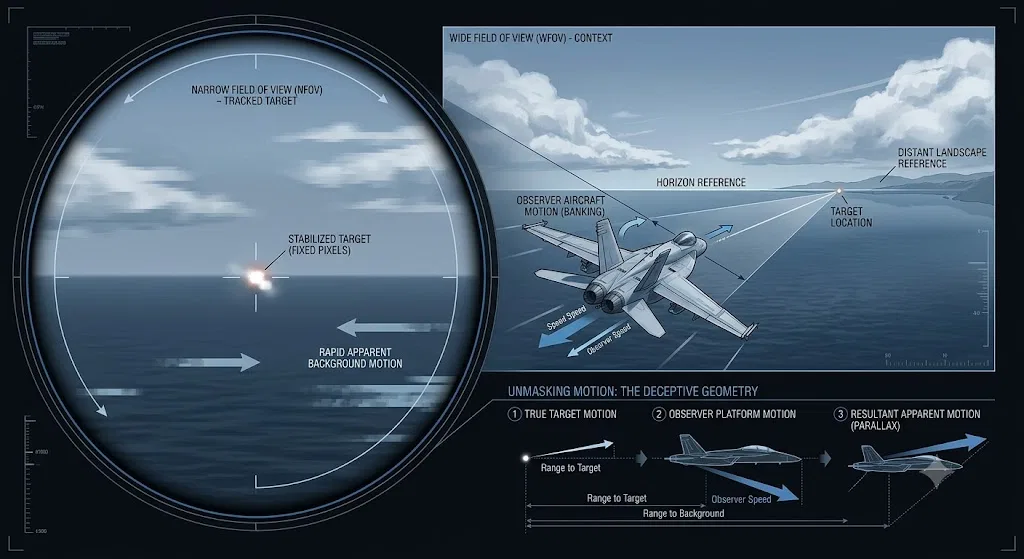
A narrow field of view can make ordinary motion look extraordinary because it removes the visual surroundings that normally tell us how fast something is moving, how far away it is and whether the observer is moving too. In a highly zoomed or tightly cropped sensor image, a small target may remain fixed near the centre while the background streams past. That can create a powerful impression that the target itself is racing across the scene, even when much of the apparent motion is produced by the aircraft or camera carrying the sensor. AARO explicitly identifies observer speed, field of view and motion parallax as reasons that apparently fast UAP can later prove slow-moving or nearly stationary.[AARO]aaro.milAARO FAQOptical phenomena, such as motion parallax, can explain how a stationary or… In such cases, it is the observer's speed and…
This matters for UFO and UAP reports because modern military imagery is often optimised for detecting and tracking a target, not for giving a human viewer an intuitive sense of the target’s speed relative to the landscape. The resulting video can look persuasive while still being geometrically misleading.
Why context disappears at high magnification
A wide view contains natural reference points: the horizon, clouds, coastlines, buildings, terrain and other objects at different distances. Together they provide clues about orientation, depth and relative motion. Zooming in trades those clues for detail. The target becomes larger on the display, but the surrounding scene becomes smaller or disappears altogether.
That trade-off is well recognised in display design. Federal Aviation Administration human-factors guidance says that a display’s field of view should be sufficient not only for recognising objects but also for maintaining spatial orientation. In other words, seeing the target clearly and understanding where it sits in the wider scene are separate requirements.[FAA Human-Systems Integration Branch]hf.tc.faa.govFAA Human-Systems Integration BranchHuman Factors Criteria for Displays: A Human Factors Design Standard Update of Chapter 5…
The problem becomes particularly important when the camera itself is travelling quickly. Visual motion on a screen is not a direct speedometer. It records how the line of sight from camera to target changes. If the camera moves hundreds of miles per hour while pointing at a much slower object, the changing viewing geometry can make the distant background appear to sweep rapidly behind the tracked target.
This is motion parallax. Objects at different distances shift across the observer’s view by different angular amounts as the observer moves. On the ground, people use this effect constantly without thinking about it: roadside posts seem to flash backwards while distant hills barely move. In airborne sensor footage, the same geometry can be harder to recognise because a narrow field of view may hide the broad scene that would make the observer’s own motion obvious. AARO describes this effect as capable of making a slow or stationary object appear much faster because of the observer’s speed and viewing geometry.[AARO]aaro.milAARO FAQOptical phenomena, such as motion parallax, can explain how a stationary or… In such cases, it is the observer's speed and…

Tracking motion is not the same as target motion
A tracking camera introduces another layer of potential confusion. Once a sensor locks onto an object, its control system turns the camera to keep that object near the middle of the frame. The target therefore appears relatively stable on the screen even as the camera, aircraft and line of sight are all changing.
That stabilisation is useful operationally: an operator wants to inspect the object rather than watch it immediately leave the frame. But it changes what the video means perceptually. The viewer no longer sees an ordinary fixed-camera scene in which screen position maps simply onto movement. Instead, the camera is continually moving to cancel the target’s angular motion.
The background then becomes the most conspicuous moving feature. A sea surface, cloud layer or terrain patch may race through the narrow image while the tracked object stays central. Without an obvious horizon or fixed landmark, it is easy to assign that background motion to the target. NASA’s UAP study warned more broadly that many UAP observations come from instruments not designed or calibrated to determine anomalous-object motion and that missing metadata can prevent reliable conclusions about size, movement and distance. It specifically noted that apparent anomalous behaviour in the well-known GoFast footage could be explained substantially by motion of the sensor platform.[NASA Science]science.nasa.govNASA Science…
This distinction is fundamental:
- Image motion describes how pixels and features move across the sensor display.
- Line-of-sight motion describes how the camera’s direction towards a target changes.
- Relative motion describes how observer and target move with respect to each other.
- True target motion requires enough range, attitude, platform-motion and timing information to separate those effects.
A dramatic-looking clip may provide the first two while leaving the last one uncertain.
GoFast shows how deceptive the geometry can be
The US Navy’s GoFast infrared video is a particularly useful example because its visual impression and its measurable geometry differ sharply. The footage shows a small tracked object against the ocean. To an unaided viewer it appears low over the water and exceptionally fast. NASA’s independent UAP study described precisely that impression before using the display’s own numerical information to test it.[NASA Science]science.nasa.govNASA Science…
NASA used the camera elevation angle, target range and aircraft altitude shown on the sensor display to estimate that the object was roughly 13,000 feet above sea level, not skimming just above the ocean. The sea visible behind it was therefore several miles farther from the aircraft than the target. With the observing aircraft itself travelling at roughly 435 mph, NASA concluded that much of the apparent rapid sweep was caused by the fast-moving sensor platform and parallax. Its illustrative calculation placed the object’s motion at about 40 mph, although NASA expressly noted that this simplified calculation did not account for wind effects on the aircraft.[NASA Science]science.nasa.govNASA Science…
AARO later published a much more detailed geospatial analysis. It likewise calculated an altitude of about 3,962 metres, or 13,000 feet, with high confidence based on the sensor pointing angles and range. It then modelled different wind and flight-path possibilities rather than treating one speed estimate as definitive. AARO found that the exact target speed and heading varied with those assumptions, but concluded that the object showed no anomalous or exceptional performance.[AARO]aaro.milGo Fast Case ResolutionAARO GoFast Case Resolution…
That later analysis is important because it clarifies what the GoFast example does and does not demonstrate. It does not establish a single exact speed from the public video. AARO said the aircraft’s precise track and atmospheric conditions were unavailable, limiting quantitative accuracy. What the geometry does establish much more robustly is that the apparent low-altitude, extreme-speed interpretation is not required by the footage.[AARO]aaro.milGo Fast Case ResolutionAARO GoFast Case Resolution…
AARO illustrated the parallax directly by projecting the target’s apparent path onto the ocean surface. The projected distance across the background could be far greater than the target’s actual displacement at 13,000 feet. That difference is what makes the object seem to streak across the water. Under some wind geometries, AARO found the effect became still more pronounced, increasing the likelihood of misinterpreting apparent speed as real speed.[AARO]aaro.milGo Fast Case ResolutionAARO GoFast Case Resolution…

Why viewers instinctively assume the wrong distance
Speed cannot be recovered from apparent angular movement alone unless distance is known. This creates an especially serious problem for small, unresolved UAP images.
Imagine two objects crossing the same angle on a camera display in one second. One is 500 metres away; the other is 20 kilometres away. Their true sideways speeds would be radically different even though the screen motion looked identical. Conversely, an object that seems to cross a large distance over the ocean may in reality be much nearer to the sensor than the background, so the apparent path painted against the water grossly exaggerates the physical distance travelled.
The human visual system normally resolves some of this ambiguity by using size, perspective, stereoscopic depth, familiar objects and the wider pattern of visual flow. A tightly zoomed infrared image can remove most of those clues simultaneously. It may show little more than an unresolved blob against an almost textureless sea or sky.
That is why apparent speed should be treated as a geometric inference, not something that can simply be read off a video. NASA’s study emphasised that without calibrated sensor information and sufficient metadata, many UAP observations cannot support firm conclusions about size or motion.[NASA Science]science.nasa.govNASA Science…
A narrow view can hide the observer’s own turn
Aircraft motion need not be straight. Banking and turning alter the viewing geometry continuously, and a gimballed sensor compensates by rotating to maintain track. In a cropped video, those changes may be almost invisible to the viewer.
The GoFast analyses demonstrate why this matters. NASA incorporated the aircraft’s left bank when estimating the encounter geometry, while AARO reconstructed the F/A-18’s curved path frame by frame using sensor azimuth, elevation, range, airspeed and estimated aircraft attitude. AARO stressed that the position of the target had to be calculated relative to the moving aircraft rather than inferred from how fast the background appeared to move.[AARO]aaro.milGo Fast Case ResolutionAARO GoFast Case Resolution…
The general lesson extends beyond that case. When a sensor is mounted on a manoeuvring aircraft, three motions can occur at once: the aircraft changes position, the aircraft changes attitude, and the sensor turret turns independently. A viewer looking only at the central tracked image sees the combined result without necessarily seeing which component produced it.
That is one reason sensor symbology matters. Azimuth, elevation, range, aircraft speed, altitude and tracking mode can carry more useful information about motion than the apparent sweep of the image itself. Removing those overlays when a clip is reposted or cropped strips away precisely the data needed to reconstruct what happened.
Using wider views to restore orientation
The most useful remedy is not simply “zoom out” and abandon magnification. Narrow-field sensors are valuable because they provide the detail needed to inspect and track small objects. The stronger approach is to preserve both detail and orientation.
For UAP analysis, that means combining the zoomed target view with wider contextual information wherever possible. NASA has argued for multisensor observations capable of recording motion together with imaging and other physical characteristics, while research programmes studying unusual aerial objects have proposed paired wide-field cameras for detection and kinematics alongside narrow-field instruments for detailed characterisation.[NASA Science]science.nasa.govNASA Science…
A wider contextual view can answer questions that a close-up cannot: Where is the horizon? Is the aircraft turning? How quickly are nearby and distant background features moving? Does the target pass identifiable landmarks? Is its apparent movement consistent with parallax from platform motion?
The strongest reconstruction therefore preserves several layers of information together:
- The narrow tracked view, for target shape and fine detail.
- A wide or medium field view, showing horizon, terrain or other orientation cues.
- Platform telemetry, including position, altitude, attitude and speed.
- Sensor pointing data, showing azimuth, elevation, zoom or field-of-view state and tracking behaviour.
- Range information, ideally measured independently rather than guessed from apparent size.
- A continuous time record, so analysts can reconstruct motion rather than judging isolated frames.
This is as much a governance issue as an optics issue. Agencies responsible for collecting and evaluating UAP reports need procedures that preserve the surrounding metadata rather than treating a visually dramatic clip as a self-contained record. NASA’s study found that missing metadata is a recurring obstacle to scientific analysis, and AARO’s GoFast work shows how much the interpretation changes when range, sensor angles and aircraft motion are incorporated.[NASA Science]science.nasa.govNASA Science…
What should count as evidence of exceptional speed?
A narrow-field video can be evidence that something was detected. By itself, it is much weaker evidence that the object possessed extraordinary speed.
A strong speed claim should survive reconstruction using measured range, observer motion, camera pointing, field of view and timing. Ideally, independent sensors should agree. If the impression of extreme movement disappears once those quantities are included, the original appearance remains interesting as a perception and sensor-geometry problem, but it is no longer evidence of exceptional propulsion or manoeuvring.
Conversely, analysts should not assume that every apparently rapid object is merely parallax. The correct procedure is to test that explanation quantitatively. AARO’s later GoFast analysis is instructive precisely because it retained uncertainty about wind and exact speed while still showing that anomalous performance was unnecessary.[AARO]aaro.milGo Fast Case ResolutionAARO GoFast Case Resolution…
For identifying ordinary causes of UFO and UAP reports, the broader lesson is simple: magnification can increase visual detail while decreasing motion understanding. When the wider scene disappears, the viewer loses the landmarks, depth cues and optic flow that distinguish target movement from observer movement. Restoring that context—through wider imagery, telemetry and geometry—is often what turns an apparently astonishing motion into an ordinary one.
Amazon book picks
Further Reading
Books and field guides related to How Zoomed Cameras Strip Away Motion Clues. Use these as the next step if you want deeper reading beyond the article.
Computer Vision: Algorithms and Applications
Computer Vision: Algorithms and Applications explores the variety of techniques used to analyze and interpret images. It also describes c...
Multiple View Geometry in Computer Vision
A basic problem in computer vision is to understand the structure of a real world scene given several images of it. Techniques for solvin...
Sensation and Perception
. Bruce Goldstein's SENSATION AND PERCEPTION, the best-seller which has helped over 150,000 students understand the ties between how we s...
eBay marketplace picks
Marketplace Samples
Live-tested eBay searches with available results related to this page.
Selected fromUFO poster oneBay.co.uk.


Current eBay listing
VINTAGE UFO FLYING SAUCERS COMIC ADVERTISING A2 POSTER PRINT


Current eBay listing
I Want To Believe UFO Poster Giclée Fine Art Heavyweight Print
Endnotes
1.
Source: aaro.mil
Link:https://www.aaro.mil/FAQ/
Source snippet
AARO FAQOptical phenomena, such as motion parallax, can explain how a stationary or... In such cases, it is the observer's speed and...
2.
Source: hf.tc.faa.gov
Link:https://hf.tc.faa.gov/publications/2007-human-factors-criteria-for-displays/full_text.pdf
Source snippet
FAA Human-Systems Integration BranchHuman Factors Criteria for Displays: A Human Factors Design Standard Update of Chapter 5...
3.
Source: science.nasa.gov
Link:https://science.nasa.gov/wp-content/uploads/2023/09/uap-independent-study-team-final-report.pdf?emrc=80696d
Source snippet
NASA Science...
4.
Source: aaro.mil
Title: [Go Fast]({{ ‘go-fast/’ | relative_url }}) Case Resolution
Link:https://www.aaro.mil/Portals/136/PDFs/case_resolution_reports/AARO_GoFast_Case_Resolution_Card_Methodology_Final.pdf
Source snippet
AARO GoFast Case Resolution...
5.
Source: aaro.mil
Title: all-domain anomaly
Link:https://www.aaro.mil/Portals/136/PDFs/SASC_AARO_Open_Hearing_Case_Slides_19Nov2024.pdf
6.
Source: aaro.mil
Link:https://www.aaro.mil/
7.
Source: faa.gov
Link:https://www.faa.gov/data_research/research/med_humanfacs/oamtechreports/media/202507.pdf
8.
Source: faa.gov
Link:https://www.faa.gov/data_research/research/med_humanfacs/oamtechreports/media/202602.pdf
9.
Source: faa.gov
Link:https://www.faa.gov/data_research/research/med_humanfacs/oamtechreports/media/202601.pdf
10.
Source: faa.gov
Link:https://www.faa.gov/sites/faa.gov/files/data_research/research/med_humanfacs/oamtechreports/202007.pdf
11.
Source: faa.gov
Title: Intro Aviation Physiology
Link:https://www.faa.gov/sites/faa.gov/files/2022-11/Intro_Aviation_Physiology.pdf
12.
Source: faa.gov
Link:https://www.faa.gov/sites/faa.gov/files/data_research/research/med_humanfacs/oamtechreports/0117.pdf
13.
Source: faa.gov
Link:https://www.faa.gov/documentLibrary/media/Advisory_Circular/AC_20-167B.pdf
14.
Source: faa.gov
Title: pilot handbook 1
Link:https://www.faa.gov/sites/faa.gov/files/pilot_handbook_1.pdf
15.
Source: faa.gov
Link:https://www.faa.gov/regulations_policies/handbooks_manuals/aviation/Balloon_Flying_Handbook_FAA-H-8083-11B/bfh_chapter_9.pdf
16.
Source: science.nasa.gov
Title: uap independent study team final report
Link:https://science.nasa.gov/wp-content/uploads/2023/09/uap-independent-study-team-final-report.pdf
17.
Source: science.nasa.gov
Link:https://science.nasa.gov/uap/
18.
Source: science.nasa.gov
Link:https://science.nasa.gov/uap/faqs/
19.
Source: science.gsfc.nasa.gov
Link:https://science.gsfc.nasa.gov/sci/bio/david.p.bennett
20.
Source: nasa.gov
Title: announces unidentified aerial phenomena study team members
Link:https://www.nasa.gov/general/nasa-announces-unidentified-aerial-phenomena-study-team-members/
21.
Source: nasa.gov
Title: to release discuss unidentified anomalous phenomena report
Link:https://www.nasa.gov/news-release/nasa-to-release-discuss-unidentified-anomalous-phenomena-report/
22.
Source: nightsky.jpl.nasa.gov
Link:https://nightsky.jpl.nasa.gov/news/39/
23.
Source: ntrs.nasa.gov
Link:https://ntrs.nasa.gov/api/citations/19800010907/downloads/19800010907.pdf
24.
Source: ntrs.nasa.gov
Link:https://ntrs.nasa.gov/api/citations/19940008842/downloads/19940008842.pdf
25.
Source: ntrs.nasa.gov
Link:https://ntrs.nasa.gov/api/citations/19960033220/downloads/19960033220.pdf
26.
Source: ntrs.nasa.gov
Link:https://ntrs.nasa.gov/api/citations/19810012531/downloads/19810012531.pdf
27.
Source: hsi.arc.nasa.gov
Title: Mc Cann SAEWAC96 partask
Link:https://hsi.arc.nasa.gov/groups/hcsl/publications/McCann_SAEWAC96_partask.pdf
28.
Source: hsi.arc.nasa.gov
Title: Wickens SABias
Link:https://hsi.arc.nasa.gov/groups/HCSL/publications/Wickens_SABias.pdf
29.
Source: ntrs.nasa.gov
Link:https://ntrs.nasa.gov/api/citations/19970005476/downloads/19970005476.pdf
30.
Source: ntrs.nasa.gov
Link:https://ntrs.nasa.gov/api/citations/19830018578/downloads/19830018578.pdf
31.
Source: ntrs.nasa.gov
Link:https://ntrs.nasa.gov/api/citations/20190028242/downloads/20190028242.pdf?attachment=true
32.
Source: ntrs.nasa.gov
Link:https://ntrs.nasa.gov/api/citations/19990063756/downloads/19990063756.pdf?attachment=true
33.
Source: ntrs.nasa.gov
Link:https://ntrs.nasa.gov/api/citations/19880007270/downloads/19880007270.pdf
34.
Source: history.navy.mil
Title: mil Naval Aviation News
Link:https://www.history.navy.mil/content/dam/nhhc/research/histories/naval-aviation/Naval%20Aviation%20News/1970/pdf/dec78.pdf
35.
Source: onr.navy.mil
Title: mil LT A 5-16 sized.jpg
Link:https://www.onr.navy.mil/media/document/2006rptlighterthanairpdf
36.
Source: navalsafetycommand.navy.mil
Title: NAVAL AEROMEDICAL OFFICER SAFETY INVESTIGATION GUIDE 8th Edition FINAL
Link:https://navalsafetycommand.navy.mil/Portals/100/Documents/NAVAL-AEROMEDICAL-OFFICER-SAFETY-INVESTIGATION-GUIDE-8th-Edition-FINAL.pdf?ver=j_PTTgKeCu5_f4tYXmBWjw%3D%3D
37.
Source: history.navy.mil
Title: milnaval aviation
Link:https://www.history.navy.mil/content/dam/nhhc/research/histories/naval-aviation/Naval%20Aviation%20News/1990/pdf/ja94.pdf
38.
Source: secnav.navy.mil
Title: RDTEN BA 1 3 BOOK
Link:https://www.secnav.navy.mil/fmc/fmb/Documents/99pres/rdten/RDTEN_BA_1-3_BOOK.pdf
39.
Source: navair.navy.mil
Title: mil UHFHLYH V
Link:https://www.navair.navy.mil/comfrc/sites/g/files/jejdrs631/files/2019-05/Vol%201-2%20Jul-Aug%2007_0.pdf
40.
Source: history.navy.mil
Title: mil U S Navy
Link:https://www.history.navy.mil/content/dam/nhhc/research/histories/naval-aviation/Naval%20Aviation%20News/1980/pdf/jf88.pdf
41.
Source: navalaviationnews.navy.mil
Link:https://navalaviationnews.navy.mil/Portals/59/Documents/InteractiveIssues/2024_Summer/index.html?ver=BFglXlOZlh4-akqTSebBjg%3D%3D
42.
Source: uap.ca
Link:https://www.uap.ca/
Additional References
43.
Source: youtube.com
Title: The SHOCKING Math Error Behind Viral UFO Videos | Mick West
Link:https://www.youtube.com/watch?v=ypfbhfEXnBo
Source snippet
This video explains how a narrow sensor field of view and high observer speed create motion parallax illusions that make slow or stationa...
44.
Source: arxiv.org
Link:https://arxiv.org/abs/2305.18566
45.
Source: govinfo.gov
Link:https://www.govinfo.gov/content/pkg/GOVPUB-C13-83afdcf7a016d9e0b5f7731e862cdeec/pdf/GOVPUB-C13-83afdcf7a016d9e0b5f7731e862cdeec.pdf
46.
Source: govinfo.gov
Link:https://www.govinfo.gov/content/pkg/CHRG-113shrg85630/html/CHRG-113shrg85630.htm
47.
Source: war.gov
Link:https://www.war.gov/ufo/
48.
Source: govinfo.gov
Link:https://www.govinfo.gov/content/pkg/GOVPUB-D301-PURL-gpo111110/pdf/GOVPUB-D301-PURL-gpo111110.pdf
49.
Source: facebook.com
Link:https://www.facebook.com/newshour/posts/boston-university-space-physicist-joshua-semeter-was-part-of-an-independent-pane/1143879570940621/
50.
Source: reddit.com
Link:https://www.reddit.com/r/UFOs/comments/16iix64/nasas_gofast_analysis_says_object_going_40mph/
51.
Source: youtube.com
Title: The Truth Behind Famous UFO Sightings
Link:https://www.youtube.com/watch?v=q0Gv9TWY774
Source snippet
Pentagon UAP Videos: What the Cameras Really Show...
52.
Source: youtube.com
Title: Explained: New Navy UFO Videos
Link:https://www.youtube.com/watch?v=Q7jcBGLIpus
Source snippet
The SHOCKING Math Error Behind Viral UFO Videos | Mick West...