Within Radar
When Radar Displays the Wrong Target Speed
Doppler radar can fold motion outside its unambiguous velocity interval into a misleading displayed speed or direction.
On this page
- How Doppler radar derives velocity
- What happens beyond the unambiguous velocity limit
- Why extraordinary speed claims need mode specific checks
Page outline Jump by section
Introduction
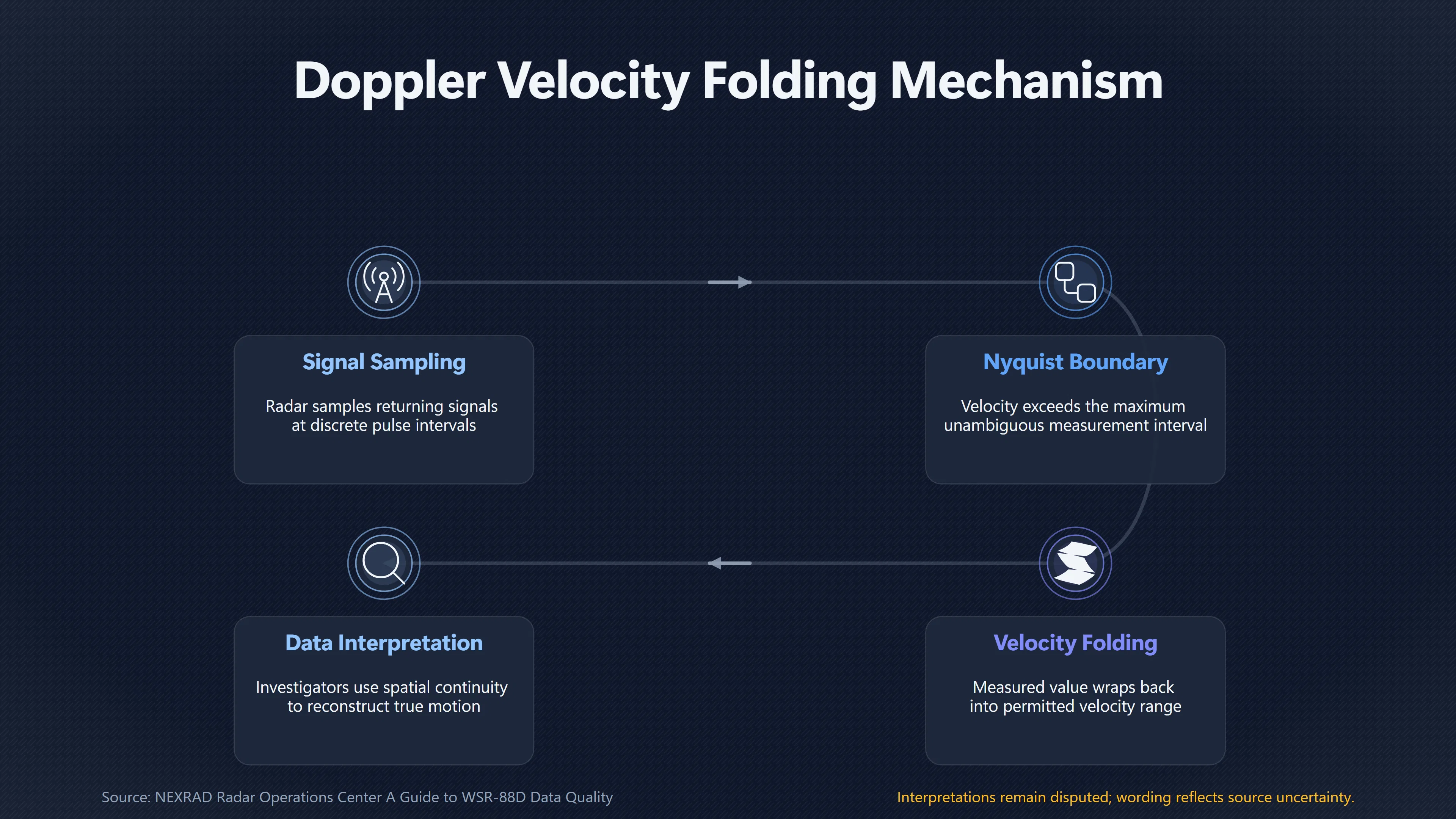
Velocity folding is a Doppler-radar measurement ambiguity that can make a target appear to have the wrong radial speed — and, in some circumstances, even the wrong direction of radial motion. It occurs when the Doppler shift produced by motion exceeds the velocity interval that a particular radar waveform can measure unambiguously. Instead of displaying the true value, the measured velocity wraps back into the permitted interval. NOAA’s National Severe Storms Laboratory gives a simple example: with an unambiguous interval of ±30 metres per second, a true m/s radial velocity is measured as −24 m/s.[National Severe Storms Laboratory]nssl.noaa.govOpen source on noaa.gov.
That mechanism matters when radar observations are used to support claims of extraordinary UFO or UAP speed. A displayed Doppler velocity is not simply a direct reading of an object’s full speed through space. It is an estimate of motion along the radar’s line of sight, derived under the constraints of the radar’s wavelength, pulse repetition frequency and processing mode. Before treating an exceptional displayed speed or sudden velocity reversal as exceptional physical motion, investigators need to establish whether the measurement was inside the relevant radar’s unambiguous velocity interval and whether ambiguity-resolution processing was operating correctly.
How Doppler radar derives velocity
Doppler radar estimates radial velocity from changes in the phase or frequency of successive radar returns. Motion towards or away from the radar produces a Doppler shift; the radar samples that changing signal over a sequence of transmitted pulses and converts it into an estimate of radial velocity.
The crucial word is radial. Doppler velocity describes the component of motion along the radar’s line of sight, rather than necessarily giving the target’s total speed over the ground or through the air. The conversion between Doppler shift and radial velocity also depends on the radar wavelength. Consequently, interpreting a number shown on a radar display requires knowledge of how that particular system obtained it.
For a conventional pulsed Doppler radar, there is another constraint: the radar samples the returning signal only at discrete intervals determined by its pulse repetition frequency (PRF). That creates a Nyquist limit analogous to aliasing in other sampled signals. For a radar wavelength λ and PRF, the maximum unambiguous radial velocity is:
Vmax = ± PRF × λ / 4
NOAA’s Doppler-radar guide uses precisely this relationship. The implication is straightforward: the same physical radial velocity may be unambiguous in one radar mode but ambiguous in another because changing PRF changes the interval over which velocity can be measured uniquely.[National Severe Storms Laboratory]nssl.noaa.govOpen source on noaa.gov.
This is part of the long-recognised Doppler dilemma. Reducing PRF gives a pulsed radar more time to receive distant echoes before transmitting again, improving its unambiguous range. But reducing PRF simultaneously lowers its unambiguous Doppler velocity. Increasing PRF works in the opposite direction. For a given wavelength, NOAA describes the product of maximum unambiguous range and maximum unambiguous velocity as constrained by this trade-off.[National Severe Storms Laboratory]nssl.noaa.govOpen source on noaa.gov.
The issue is therefore not an exotic failure peculiar to unusual targets. It is a basic engineering limitation of periodically sampled Doppler measurements. Radar designers have spent decades developing waveform and processing techniques specifically to manage it.
What happens beyond the unambiguous velocity limit
Once the actual Doppler velocity crosses a radar’s Nyquist boundary, the displayed value does not necessarily stop at the maximum or carry an obvious warning saying that the target is faster. Instead, the measurement can fold, or alias, into the opposite side of the permitted interval.
Suppose a radar has a Nyquist velocity of ±30 m/s. Its unambiguous interval is therefore 60 m/s wide. NOAA’s worked example shows the consequence:
- a true ** m/s** remains m/s;
- a true ** m/s** folds to −24 m/s;
- a true −36 m/s folds to ** m/s**;
- a true ** m/s** can fold to 0 m/s.
The rule is that the true velocity can differ from the observed value by an integer multiple of twice the Nyquist velocity. In the ±30 m/s example, possible solutions are separated by 60 m/s.[National Severe Storms Laboratory]nssl.noaa.govOpen source on noaa.gov.
This produces a counter-intuitive result. A target that accelerates smoothly away from the radar can approach the positive velocity limit, cross it and suddenly be represented by a large negative velocity. Nothing has physically reversed direction. The discontinuity has occurred in the sampled measurement.
The effect is closely analogous to the apparent backwards rotation of a wheel in sampled video. Once successive observations are too widely spaced to distinguish the real progression uniquely, several different motions become compatible with the samples. The radar is not inventing a random speed: it is reporting one member of a repeating family of mathematically indistinguishable Doppler solutions.
That distinction is especially important in retrospective analysis. NOAA notes that, without additional information, an individual aliased Doppler data point cannot necessarily be identified as aliased from that point alone. Spatial continuity, neighbouring measurements and other information are used to recognise the folding and reconstruct the likely true velocity.[National Severe Storms Laboratory]nssl.noaa.govOpen source on noaa.gov.
Dealiasing fixes the problem — but not perfectly
Operational radar systems do not normally leave every folded velocity for an operator to interpret manually. They employ velocity dealiasing or ambiguity-resolution techniques intended to determine which velocity interval contains the physically plausible answer.
Weather radar provides unusually well-documented examples because its raw and processed data are extensively studied. The US WSR-88D network uses a Two-Dimensional Velocity Dealiasing Algorithm, or 2DVDA, for relevant processed velocity products. The Radar Operations Center describes 2DVDA as the default dealiasing algorithm contributing to Level III elevation-based velocity products.[NEXRAD Radar Operations Center]roc.noaa.govNEXRAD Radar Operations CenterNEXRAD Radar Operations Center - 2DVDA (Two-Dimensional Velocity Dealiasing Algorithm)…
The basic idea is that genuine velocity fields usually contain enough continuity and contextual information to expose a fold. If neighbouring measurements progress smoothly towards the Nyquist boundary and then apparently jump by roughly twice the Nyquist velocity, software can infer that the discontinuity probably represents aliasing and add or subtract the appropriate velocity interval.
Historically, however, increasingly sophisticated algorithms have been needed because real radar scenes are not always smooth. NOAA documentation identifies difficult conditions including far-range echoes, strong velocity gradients and outflow boundaries. Its current data-quality guide explicitly illustrates velocity-dealiasing errors and notes that the operational algorithm continues to be refined when new problems are encountered.[NEXRAD Radar Operations Center]roc.noaa.govNEXRAD Radar Operations Center A Guide to WSR-88D Data QualityNEXRAD Radar Operations CenterA Guide to WSR-88D Data QualityOctober 4, 2025…
The distinction between raw folding and an incorrect dealiasing correction is therefore important. The first is the predictable consequence of exceeding the unambiguous Doppler interval. The second occurs when processing attempts to reconstruct the true interval but chooses the wrong one. In that situation a processed display can contain a confident-looking velocity which is wrong by one or more complete ambiguity intervals.
This is not merely theoretical. Testing of an earlier WSR-88D dealiasing system against the newer two-dimensional approach found substantial differences in error rates. In one historical evaluation, 252 of 520 low-level products examined with the older algorithm contained dealiasing errors, compared with 71 using the newer method; for the hurricane subset, the corresponding counts were 185 and five.[NEXRAD Radar Operations Center]roc.noaa.govabstractIHCpaper2Dveldeal rev4NEXRAD Radar Operations CenterA Two-Dimensional Velocity Dealiasing Algorithm for the WSR-88DApril 5, 2011…
Modern processing has improved greatly, but the underlying problem has not disappeared. NOAA’s Radar Operations Center notes that turbulence, strong vertical wind shear and non-representative background wind estimates can still contribute to dealiasing errors, motivating continuing software improvements.[NEXRAD Radar Operations Center]roc.noaa.govNEXRAD Radar Operations CenterNEXRAD Radar Operations Center - Software Engineering… A 2022 NOAA-linked study of staggered and dual-PRF research radars likewise describes processor dealiasing errors that can be widely dispersed or clustered in regions of high shear.[NOAA Institutional Repository]repository.library.noaa.govNOAA Institutional RepositoryA Method for Correcting Staggered Pulse Repetition Time (PRT) and Dual Pulse Repetition Frequency (PRF) Proc…
Radar designers change the waveform to reduce folding
Velocity ambiguity has been recognised for decades, so sophisticated radar systems do not depend on a single fixed measurement interval if their mission requires velocities beyond it. One established approach is to change or stagger the pulse repetition frequency and compare measurements obtained under different ambiguity conditions.
The logic is powerful because changing PRF changes the locations of the ambiguous solutions. A velocity that folds to one apparent value under one PRF will generally fold differently under another. Combining the observations can therefore reveal the velocity consistent with both measurements. Multiple-PRF techniques are consequently used to resolve ambiguous target kinematics in pulse-Doppler radar.[Journal of Electronics]jeit.ac.cnJournal of ElectronicsResearch on Velocity Ambiguity Resolution for Multiple PRF RadarDecember 19, 2017…
This history also demonstrates why there is no universal “radar maximum speed” applicable to every observation. The limit depends on wavelength and waveform parameters, and the effective usable interval may be extended by processing multiple measurements. Different operating modes of the same radar can therefore have substantially different ambiguity characteristics.
Operational weather radar provides a concrete comparison. The US NEXRAD system has used different Volume Coverage Patterns with different pulse and processing choices. The National Centers for Environmental Information notes that one clear-air pattern used a short pulse specifically to provide a higher unambiguous velocity, while other patterns incorporated a multi-PRF detection algorithm to mitigate the range/velocity ambiguity associated with the Doppler dilemma.[NCEI]ncei.noaa.govOpen source on noaa.gov.
The technology continues to evolve. The Radar Operations Center reports that field testing begun in January 2026 for staggered pulse repetition time processing is intended, among other improvements, to produce less velocity aliasing and extend Nyquist velocity to as much as 116 knots in the relevant WSR-88D application.[NEXRAD Radar Operations Center]roc.noaa.govOpen source on noaa.gov. Research has also explored dual-frequency, staggered-PRT and other waveform strategies for enlarging the unambiguous velocity region while managing the competing requirement for useful range coverage.[American Meteorological Society Journals]journals.ametsoc.orgOpen source on ametsoc.org.
The historical trend is therefore not from “unreliable radar” to “reliable radar”. It is from a fundamental ambiguity towards increasingly sophisticated ways of resolving it.

Why extraordinary speed claims need mode-specific checks
For UAP investigation, velocity folding supplies a narrowly defined but important caution. It does not mean that every unusual radar speed is an artefact, nor does it explain every radar-associated UAP report. It means that a Doppler-derived speed cannot be evaluated properly without knowing the measurement conditions under which that speed was produced.
An investigator confronted with a claim that a radar target suddenly accelerated, reversed its radial motion or exhibited an exceptionally high velocity should therefore establish several facts before treating the displayed number as physical performance:
- Was the quoted velocity actually Doppler-derived? A speed reconstructed by tracking changes in position over time is not the same measurement as instantaneous radial velocity inferred from Doppler.
- What was the radar wavelength and PRF? These determine the nominal unambiguous Doppler interval.
- Which operating mode was active? Different PRFs, scan strategies and waveform modes can have different ambiguity limits.
- Was the value raw or processed? A processed velocity may already have passed through ambiguity-resolution or tracking algorithms.
- Was multiple-PRF, staggered-PRT or another ambiguity-resolution method being used? The nominal single-PRF Nyquist velocity may not describe the effective capability of the complete system.
- Did the apparent velocity jump by an ambiguity interval? Changes close to multiples of twice the Nyquist velocity are a strong diagnostic clue.
- Do independent measurements support the reconstructed motion? Range history, successive positions and observations from another radar or sensor can distinguish a genuine manoeuvre from a Doppler ambiguity.
The last point is particularly important. A Doppler measurement outside its unambiguous interval has multiple mathematically possible velocities. Additional information is what turns that ambiguous observation into a defensible kinematic estimate. NOAA’s explanation makes the limitation explicit: an isolated Doppler point does not by itself reveal whether aliasing has occurred.[National Severe Storms Laboratory]nssl.noaa.govOpen source on noaa.gov.
The same principle explains why a striking colour discontinuity or numerical jump on a radar display is weaker evidence than a trajectory independently reconstructed from several measurements. In weather radar, folded velocities often reveal themselves because neighbouring parts of a continuous wind field provide context. A small isolated radar target offers less contextual information, making knowledge of the radar’s ambiguity-resolution process correspondingly more important.
What velocity folding can and cannot explain
Velocity folding is most relevant to claims based specifically on radar-derived radial speed or sudden changes in that speed. It provides a straightforward mechanism by which a physically ordinary velocity can be represented with the wrong magnitude or sign, and by which an ambiguity-resolution algorithm can occasionally assign the wrong velocity interval.
It should not, however, be used as a universal explanation for radar anomalies. Folding does not by itself create a radar echo, explain why a target was detected at a particular range, or automatically account for a trajectory independently established by repeated positional measurements. Those questions belong to other radar-artifact mechanisms or to the identification of whatever generated the original return.
Its value in UFO and UAP analysis is more precise. When an argument for extraordinary performance depends heavily on a displayed Doppler speed, the number has to be traced back through the radar’s measurement chain. The relevant question is not simply, “What speed appeared on the scope?” It is: what velocities could that radar, in that operating mode, distinguish unambiguously, and what processing was used when the true velocity lay outside that interval?
That is the point at which a seemingly spectacular radar velocity becomes a testable engineering claim. If the reported motion remains extraordinary after the waveform, Nyquist interval, ambiguity resolution, raw measurements and independent tracking information have been checked, velocity folding becomes a weaker explanation. If those details are unavailable, however, the displayed speed alone cannot establish extraordinary target performance.
Amazon book picks
Further Reading
Books and field guides related to When Radar Displays the Wrong Target Speed. Use these as the next step if you want deeper reading beyond the article.
Doppler Radar and Weather Observations
Doppler Radar and Weather Observations deals with the use of Doppler radar to make observations of a variety of weather phenomena such as...
Introduction to Radar Systems
Since the publication of the second edition of "Introduction to Radar Systems," there has been continual development of new radar capabil...

Fundamentals of Radar Signal Processing
Fully updated and expanded, Fundamentals of Radar Signal Processing, Second Edition, offers comprehensive coverage of the basic digital s...
eBay marketplace picks
Marketplace Samples
Live-tested eBay searches with available results related to this page.
Selected fromUFO poster oneBay.co.uk.


Current eBay listing
I Want To Believe UFO Poster Giclée Fine Art Heavyweight Print

Current eBay listing
VINTAGE UFO FLYING SAUCERS COMIC ADVERTISING A2 POSTER PRINT

Endnotes
1.
Source: nssl.noaa.gov
Link:https://www.nssl.noaa.gov/publications/dopplerguide/chapter1.php
2.
Source: nssl.noaa.gov
Link:https://www.nssl.noaa.gov/publications/dopplerguide/chapter3.php
3.
Source: roc.noaa.gov
Link:https://www.roc.noaa.gov/radar-techniques/2dvd.php
Source snippet
NEXRAD Radar Operations CenterNEXRAD Radar Operations Center - 2DVDA (Two-Dimensional Velocity Dealiasing Algorithm)...
4.
Source: roc.noaa.gov
Title: NEXRAD Radar Operations Center A Guide to WSR-88D Data Quality
Link:https://www.roc.noaa.gov/public-documents/operations-branch/Data_Quality_Oddities_and_Anomalies.pdf
Source snippet
NEXRAD Radar Operations CenterA Guide to WSR-88D Data QualityOctober 4, 2025...
Published: October 4, 2025
5.
Source: roc.noaa.gov
Title: abstractIHCpaper2Dveldeal rev4
Link:https://www.roc.noaa.gov/public-documents/engineering-branch/new-technology/misc/tdvdia/abstractIHCpaper2Dveldeal_rev4.pdf
Source snippet
NEXRAD Radar Operations CenterA Two-Dimensional Velocity Dealiasing Algorithm for the WSR-88DApril 5, 2011...
Published: April 5, 2011
6.
Source: roc.noaa.gov
Link:https://www.roc.noaa.gov/branches/engineering-branch/software-engineering.php
Source snippet
NEXRAD Radar Operations CenterNEXRAD Radar Operations Center - Software Engineering...
7.
Source: repository.library.noaa.gov
Link:https://repository.library.noaa.gov/view/noaa/47757
Source snippet
NOAA Institutional RepositoryA Method for Correcting Staggered Pulse Repetition Time (PRT) and Dual Pulse Repetition Frequency (PRF) Proc...
8.
Source: ncei.noaa.gov
Link:https://www.ncei.noaa.gov/products/radar/next-generation-weather-radar
9.
Source: roc.noaa.gov
Link:https://www.roc.noaa.gov/branches/engineering-branch/radar-product-improvement.php
10.
Source: roc.noaa.gov
Title: build loaded
Link:https://www.roc.noaa.gov/build-loaded.php
11.
Source: emc.ncep.noaa.gov
Link:https://www.emc.ncep.noaa.gov/emc/pages/infrastructure/bufrlib/tables/TableB_0_STDv44_LOC7.html
12.
Source: preview.weather.gov
Title: 061522 severe event
Link:https://preview.weather.gov/grb/061522_severe_event
13.
Source: weather.gov
Title: Severe Storm
Link:https://www.weather.gov/grb/061522_severe_event
14.
Source: weather.gov
Link:https://www.weather.gov/phi/EventReview20190530
15.
Source: weather.gov
Link:https://www.weather.gov/phi/EventReview20190529
16.
Source: weather.gov
Link:https://www.weather.gov/phi/EventReview20190528
17.
Source: weather.gov
Link:https://www.weather.gov/phi/EventReview20190426
18.
Source: nco.ncep.noaa.gov
Link:https://www.nco.ncep.noaa.gov/sib/jeff/TableB_0_STDv23_LOC7.html
19.
Source: aoml.noaa.gov
Title: HRD P3 radar
Link:https://www.aoml.noaa.gov/hrd/HRD-P3_radar.html
20.
Source: test.roc.noaa.gov
Title: software engineering
Link:https://www.test.roc.noaa.gov/branches/engineering-branch/software-engineering.php
21.
Source: roc.noaa.gov
Title: reports and conferences
Link:https://www.roc.noaa.gov/branches/operations-branch/field-requirements/reports-and-conferences.php
22.
Source: roc.noaa.gov
Title: radar techniques
Link:https://www.roc.noaa.gov/radar-techniques.php
23.
Source: roc.noaa.gov
Title: wf impact
Link:https://www.roc.noaa.gov/windfarms/wf-impact.php
24.
Source: test.roc.noaa.gov
Title: radar techniques
Link:https://www.test.roc.noaa.gov/radar-techniques.php
25.
Source: roc.noaa.gov
Title: vcp improvement initiatives
Link:https://www.roc.noaa.gov/radar-techniques/vcp-improvement-initiatives.php
26.
Source: roc.noaa.gov
Link:https://www.roc.noaa.gov/radar-techniques/mpda.php
27.
Source: roc.noaa.gov
Link:https://www.roc.noaa.gov/windfarms.php
28.
Source: roc.noaa.gov
Title: wf analysis
Link:https://www.roc.noaa.gov/windfarms/wf-analysis.php
29.
Source: nssl.noaa.gov
Link:https://www.nssl.noaa.gov/publications/dopplerguide/chapter2.php
30.
Source: nssl.noaa.gov
Link:https://www.nssl.noaa.gov/about/events/review2015/publications/
31.
Source: origin-east-www-trainweather.woc.noaa.gov
Link:https://origin-east-www-trainweather.woc.noaa.gov/wdtd/scripts/Glossary/glossary.php
32.
Source: psl.noaa.gov
Title: determine moments
Link:https://psl.noaa.gov/psd3/boundary/MstToga/determine_moments.html
33.
Source: prod-01-alb-www-noaa.woc.noaa.gov
Title: weather glossary n
Link:https://prod-01-alb-www-noaa.woc.noaa.gov/jetstream/appendix/weather-glossary-n
34.
Source: repository.library.noaa.gov
Link:https://repository.library.noaa.gov/view/noaa/47421
35.
Source: prod-01-alb-www-noaa.woc.noaa.gov
Title: vcp max
Link:https://prod-01-alb-www-noaa.woc.noaa.gov/jetstream/vcp_max
36.
Source: roc.noaa.gov
Title: level two data types
Link:https://www.roc.noaa.gov/level-two-data-types.php
37.
Source: training.weather.gov
Link:https://training.weather.gov/wdtd/scripts/Glossary/glossary.php
38.
Source: weather.gov
Link:https://www.weather.gov/mlb/Doppler_Dual_Pol_Weather_Radar
39.
Source: weather.gov
Link:https://www.weather.gov/okx/tour_doppler_radar
40.
Source: forecast.weather.gov
Link:https://forecast.weather.gov/glossary.php?word=doppler
41.
Source: forecast.weather.gov
Link:https://forecast.weather.gov/glossary.php?word=CI
42.
Source: weather.gov
Link:https://www.weather.gov/rah/virtualtourradar
43.
Source: weather.gov
Link:https://www.weather.gov/cle/area_radars
44.
Source: weather.gov
Link:https://www.weather.gov/mkx/using-radar
45.
Source: forecast.weather.gov
Link:https://forecast.weather.gov/glossary.php?letter=m
46.
Source: forecast.weather.gov
Link:https://forecast.weather.gov/glossary.php?word=r
47.
Source: forecast.weather.gov
Link:https://forecast.weather.gov/glossary.php?word=MAX
48.
Source: weather.gov
Link:https://www.weather.gov/bmx/radar_aboutnwsradar_howdoesitwork
49.
Source: youtube.com
Title: What Is Velocity Aliasing?
Link:https://www.youtube.com/watch?v=zMUe-l8W7-E
Source snippet
Pulse-Doppler Radar | Understanding Radar Principles...
50.
Source: youtube.com
Title: Pulse-Doppler Radar | Understanding Radar Principles
Link:https://www.youtube.com/watch?v=NtyU6aKZ-cY
Source snippet
How Weather Radar Works...
51.
Source: jeit.ac.cn
Link:https://jeit.ac.cn/en/article/doi/10.11999/JEIT170259
Source snippet
Journal of ElectronicsResearch on Velocity Ambiguity Resolution for Multiple PRF RadarDecember 19, 2017...
Published: December 19, 2017
52.
Source: journals.ametsoc.org
Link:https://journals.ametsoc.org/view/journals/atot/27/9/2010jtecha1355_1.xml
53.
Source: journals.ametsoc.org
Link:https://journals.ametsoc.org/view/journals/atot/39/11/JTECH-D-21-0176.1.xml
54.
Source: doi.org
Title: A Combined Algorithm Approach for Dealiasing Doppler Radar Velocities
Link:https://doi.org/10.3390/rs17244063
55.
Source: doi.org
Link:https://doi.org/10.1175%2FAIES-D-22-0084.1
56.
Source: doi.org
Link:https://doi.org/10.3390/rs15030802
57.
Source: doi.org
Link:https://doi.org/10.1175%2FJTECH-D-20-0054.1
58.
Source: doi.org
Link:https://doi.org/10.1002%2F2015jd023464
59.
Source: courses.comet.ucar.edu
Link:https://courses.comet.ucar.edu/mod/page/view.php?id=1682
60.
Source: journals.ametsoc.org
Link:https://journals.ametsoc.org/view/journals/wefo/27/1/waf-d-11-00054_1.xml
61.
Source: journals.ametsoc.org
Title: 2010jtecha1444 1.xml
Link:https://journals.ametsoc.org/view/journals/atot/28/1/2010jtecha1444_1.xml
62.
Source: journals.ametsoc.org
Title: 2010jtecha1415 1.xml
Link:https://journals.ametsoc.org/view/journals/atot/27/9/2010jtecha1415_1.xml
63.
Source: journals.ametsoc.org
Title: 2010jtecha1300 1.xml
Link:https://journals.ametsoc.org/view/journals/atot/27/7/2010jtecha1300_1.xml
64.
Source: journals.ametsoc.org
Title: jtech1910 1.xml
Link:https://journals.ametsoc.org/view/journals/atot/23/9/jtech1910_1.xml
65.
Source: journals.ametsoc.org
Title: 1520 0426 2000 017 0323 cfasme 2 0 co 2.xml
Link:https://journals.ametsoc.org/view/journals/atot/17/3/1520-0426_2000_017_0323_cfasme_2_0_co_2.xml
66.
Source: glossary.ametsoc.org
Title: orgvelocity aliasing
Link:https://glossary.ametsoc.org/wiki/velocity-aliasing/
67.
Source: glossary.ametsoc.org
Title: orgmaximum unambiguous velocity
Link:https://glossary.ametsoc.org/wiki/maximum-unambiguous-velocity/
68.
Source: sciencedirect.com
Title: Doppler Radar
Link:https://www.sciencedirect.com/topics/physics-and-astronomy/doppler-radar
69.
Source: jeit.ac.cn
Link:https://jeit.ac.cn/cn/article/doi/10.3724/SP.J.1146.2008.01054
70.
Source: jeit.ac.cn
Link:https://jeit.ac.cn/cn/article/doi/10.11999/JEIT170259
71.
Source: skybrary.aero
Link:https://skybrary.aero/index.php/articles/doppler-radar
Additional References
72.
Source: sciencedirect.com
Link:https://www.sciencedirect.com/science/article/pii/S0165168420301912
Source snippet
Multi-PRF and multi-frame track-before-detect algorithm in multiple PRF radar system - ScienceDirect...
73.
Source: youtube.com
Title: STOP Using Weather Radar WRONG
Link:https://www.youtube.com/watch?v=q4fwYUScwOM
Source snippet
For detailed context on this phenomenon, What Is Velocity Aliasing? provides a clear breakdown of how exceeding maximum unambiguous veloc...
74.
Source: osti.gov
Link:https://www.osti.gov/pages/biblio/1371614
75.
Source: researchgate.net
Link:https://www.researchgate.net/publication/399040103_A_Novel_Doppler_Velocity_Unfolding_Technique_for_94-GHz_Cloud_Profiling_Radar_Application_to_Cloud_Microphysics_and_Dynamics
76.
Source: researchgate.net
Link:https://www.researchgate.net/publication/24388766_Application_of_an_Interferometric_Phase_Unwrapping_Technique_to_Dealiasing_of_Weather_Radar_VelocitY_Fields
77.
Source: researchgate.net
Link:https://www.researchgate.net/publication/258724574_Applications_of_a_Velocity_Dealiasing_Scheme_to_Data_from_the_China_New_Generation_Weather_Radar_System_CINRAD
78.
Source: researchgate.net
Link:https://www.researchgate.net/publication/237268031_P516_OBSERVED_FAILURE_MODES_OF_THE_WSR-88D_VELOCITY_DEALIASING_ALGORITHM_DURING_SEVERE_WEATHER_OUTBREAKS
79.
Source: doczz.net
Link:https://doczz.net/doc/8013592/a-dual-pulse-repetition-frequency-scheme-for-mitigating-v
80.
Source: mdpi.com
Link:https://www.mdpi.com/2073-4433/9/6/234
81.
Source: mendeley.com
Link:https://www.mendeley.com/catalogue/f84218c9-57e8-3cf2-a9be-ca1fc4bd9690/