Within Formations
How Satellite Flares Turn Into UAP Reports
AARO reported resolving 238 earlier UAP cases as satellite flaring by matching sightings to orbital position and illumination geometry.
On this page
- Why satellites suddenly brighten or change color
- The 238 cases resolved as satellite flaring
- How three dimensional modelling tests a sighting
Page outline Jump by section
Introduction
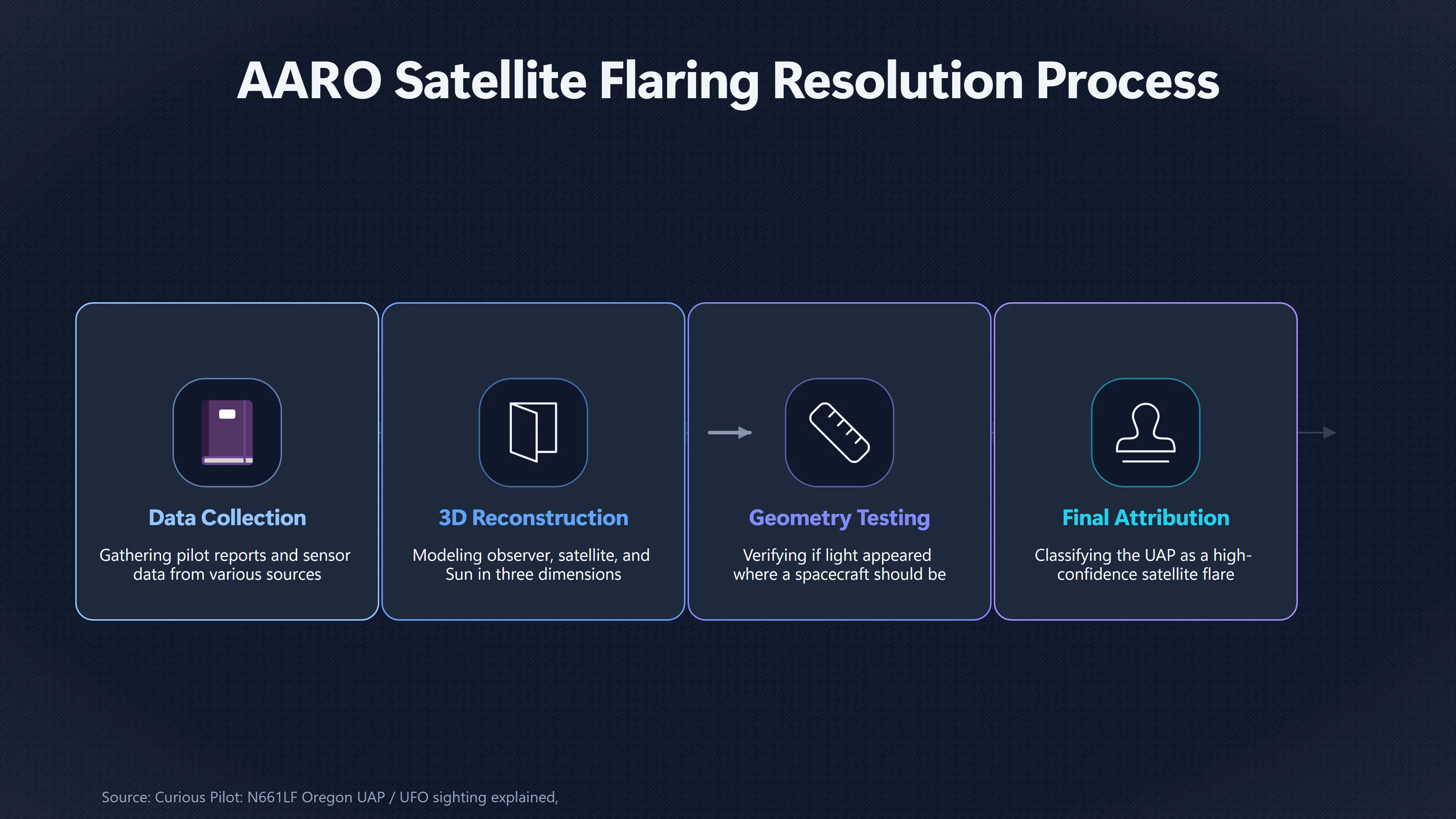
Satellite flares have become one of the clearest examples of how ordinary lights can generate convincing UAP reports. In its fiscal year 2025 report, the US All-domain Anomaly Resolution Office (AARO) said a newly introduced analytical capability enabled its investigators to resolve 238 reported UAP as satellite flaring. The method does more than label a mysterious light “probably a satellite”: it reconstructs the observer, satellite and Sun in three dimensions and tests whether the reported light appeared where an illuminated spacecraft should have been.[AARO]aaro.milOpen source on aaro.mil.
The phenomenon is especially relevant to reports of multiple lights resembling formations. Operational Starlink satellites can brighten dramatically within a relatively small “flare window”, with different satellites appearing and disappearing in succession or simultaneously. AARO says this can produce apparent spinning lights, glowing orbs and even geometric arrangements such as triangles.[AARO]aaro.milOpen source on aaro.mil.
Why satellites suddenly brighten or change colour
A satellite does not produce the visible light involved in a flare. It reflects sunlight. Even when an observer is standing or flying in darkness, a spacecraft hundreds of kilometres above Earth can remain illuminated because it still has a line of sight to the Sun.
The important distinction is between diffuse reflection, in which light scatters broadly from a surface, and specular reflection, in which a relatively smooth surface directs a concentrated reflection towards a particular viewing direction. The latter is comparable in principle to the sudden glare from a window or mirror when the Sun, reflective surface and observer briefly align. AARO defines satellite flaring as reflected sunlight becoming visible from particular viewing angles and notes that the resulting lights can be many times brighter than surrounding stars.[AARO]aaro.milOpen source on aaro.mil.
Starlink adds an important complication because the satellites change configuration during deployment. Soon after launch, groups of spacecraft travelling together can produce the familiar Starlink train. Once they reach operational orbit, however, they are dispersed spacecraft rather than a compact procession. AARO describes operational Starlink satellites as having their bus and reflective surfaces oriented towards Earth while their solar panels extend to collect sunlight. Under the right Sun-satellite-observer geometry, this operational configuration produces the flare or glint.[AARO]aaro.milOpen source on aaro.mil.
That explains why knowing what a Starlink “train” looks like does not necessarily prepare an observer to recognise a Starlink flare. The latter may look like a single brilliant orb that gradually appears, peaks and vanishes. Another satellite can then brighten nearby, potentially creating the impression that one luminous object has moved rapidly, reversed direction or returned to the same part of the sky.
Independent astronomical research supports the underlying optical mechanism. Anthony Mallama and Richard Cole modelled unusually bright Starlink flares as specular reflections from the spacecraft chassis and applied the model to an event that pilots aboard two commercial aircraft had reported as UAP. Their calculated brightness was consistent with the reflective properties and geometry of the satellites.[arXiv]arxiv.orgOpen source on arxiv.org. Earlier photometric work had likewise found that Starlink brightness varies strongly with illumination and viewing geometry, while measurements from large datasets demonstrated significant forward scattering and short-duration brightness flares.[arXiv]arxiv.orgOpen source on arxiv.org.
Colour is not necessarily a reliable discriminator either. AARO says reports it attributes to satellites commonly describe bright, coloured lights or moving “orbs”. Its technical presentation on the phenomenon records reports ranging from reddish-orange to white. Atmospheric extinction and scattering are particularly relevant when a bright source is viewed through a long path of atmosphere near the horizon, so a satellite reflection need not resemble the steady white point many people expect a satellite to be.[AARO]aaro.milOpen source on aaro.mil.
Why several flares can resemble one formation
The visually striking part of the phenomenon is not merely that one satellite can become bright. Thousands of operational spacecraft occupy multiple orbital planes, so several independently moving satellites can pass through favourable reflection geometry within the same region of sky.
AARO calls this region the flare window. Its modelling indicates that operational Starlink flares can occur simultaneously even when the satellites are travelling in different orbits. Seen without reliable distance cues, those separate reflections may resemble “spinning lights”, disappearing and reappearing orbs, or points tracing apparent geometric shapes including triangles.[AARO]aaro.milOpen source on aaro.mil.
This directly connects satellite flaring with the wider problem of ordinary lights resembling formations. The observer sees only angular positions against a dark sky. If one point fades while another brightens nearby, perception does not automatically reveal that the first source continued along its orbit after becoming invisible while an entirely different satellite produced the second light. The sequence can instead look like one object changing direction.
The reports pilots began calling “racetrack” UAP provide a particularly useful example. From 2022 onwards, commercial pilots described lights gradually becoming bright and fading again, sometimes giving the impression of several objects repeatedly circling in a holding-pattern or racetrack-like path. Investigators using orbital data found that recorded examples with sufficiently recoverable times and locations corresponded with deployed Starlink satellites passing through the appropriate reflection region.[Skeptical Inquirer]skepticalinquirer.orgOpen source on skepticalinquirer.org.
That apparent circular motion illustrates an important failure mode in interpreting multiple lights. The satellites themselves need not circle within the small visible patch. Successive spacecraft can enter the favourable geometry, brighten, move briefly while visible and fade. If the next satellite becomes conspicuous elsewhere in the same patch, the observer can perceive continuity between physically separate objects.
The 238 cases resolved as satellite flaring
AARO’s FY2025 figures provide unusually concrete evidence for how much difference this mechanism can make to UAP case resolution. The office received 319 UAP reports covered by the annual report: 284 concerning events during the reporting period of 2 June 2024 to 30 May 2025, plus 35 older events that had not appeared in previous annual reporting. AARO resolved 114 of those reports and another 256 cases from previous periods, for 370 resolutions during the reporting cycle.[AARO]aaro.milOpen source on aaro.mil.
Within that broader analytical workload, AARO says its new capability enabled analysts to resolve 238 reported UAP as satellite flaring. That number should not be confused with the number of newly received cases. It includes work against AARO’s wider holdings and backlog rather than meaning that 238 of the year’s 319 incoming reports were flares.[AARO]aaro.milOpen source on aaro.mil.
A smaller subset shows what the method looks like when applied to the current reporting cohort. Of the 319 reports, AARO classified 44 as space-domain observations. Forty-two originated with civilian pilots through the Federal Aviation Administration and two from ground-based US Space Command sensors. AARO reports applying all-source analysis and three-dimensional modelling to reach a high-confidence satellite-flaring assessment for all 44.[AARO]aaro.milOpen source on aaro.mil.
The pilot reports are significant because they also expose the difficulty of estimating distance and altitude from an isolated light. AARO found that civilian pilots sometimes estimated apparent phenomena to be at roughly 45,000–60,000 feet. Yet many such reports were ultimately resolved as satellite flares — sources actually orbiting vastly farther away.[AARO]aaro.milOpen source on aaro.mil.
This does not imply that pilots reported inaccurately what they saw. Rather, it demonstrates that an angular observation does not by itself provide range. A bright unresolved point against a dark background offers few depth cues, so an observer can describe its direction, colour and apparent movement reasonably well while being unable to determine whether it is tens, hundreds or thousands of kilometres away.
There was already evidence of this trend in AARO’s preceding FY2024 report. That document said the office was increasingly resolving cases to the Starlink constellation and described a commercial pilot’s report of white flashing lights that correlated with a Starlink launch and the satellites’ known orbital path. AARO was then investigating whether other unresolved cases could similarly be attributed to expanding low-Earth-orbit megaconstellations.[U.S. Department of War]defense.govOpen source on defense.gov. The subsequent 238-case result shows how much that line of investigation expanded once modelling became operational.
How three-dimensional modelling tests a sighting
Satellite flaring is unusually amenable to reconstruction because the explanation makes specific geometrical predictions. A useful identification requires more than saying that satellites existed somewhere overhead. Investigators can ask whether the correct spacecraft were in the correct locations, illuminated by the Sun and capable of directing reflected light towards the observer at the reported time.
AARO’s published flare analysis makes the required variables explicit: the flare’s position depends on the satellite’s location, the Sun’s position, date, time and observer’s latitude. Solar altitude and azimuth establish where the illumination originates, while the satellite orbit establishes where the reflective object should appear relative to the observer.[AARO]aaro.milOpen source on aaro.mil.
For operational Starlink spacecraft at roughly 540–570 kilometres altitude, AARO’s simplified model predicts a particularly favourable region when the Sun is well below the observer’s horizon. Under the assumptions used in its paper, flares are generally expected with solar altitude roughly −38° to −46°, appearing from the horizon to about 10° elevation. AARO stresses that this is an approximate guide rather than an immutable boundary: satellite altitude, surface orientation and departures from perfect specular reflection change the precise geometry.[AARO]aaro.milOpen source on aaro.mil.
That constraint is analytically powerful. A claimed satellite explanation becomes much stronger when several independent quantities agree:
- the witness’s position and time place the observation within an appropriate illumination geometry;
- orbital data put candidate satellites along the reported line of sight;
- the Sun is positioned so those satellites remain illuminated despite darkness at the observer;
- the predicted flare region agrees with the reported azimuth and elevation; and
- the reported appearance — brightening, fading, colour, duration or multiple lights — is compatible with satellite reflection.
AARO did not rely only on theoretical calculations. Its personnel used the model to predict and then photograph Starlink flares near Sidney, Nebraska, before sunrise on 11 March 2024, including multiple flares in the predicted region. The office published those observations alongside its geometry and prediction procedure.[AARO]aaro.milOpen source on aaro.mil.
The same general principle is used in astronomical brightness modelling. Researchers calculate spacecraft brightness from the orientation and reflective behaviour of satellite surfaces together with the positions of the Sun, satellite and observer. More sophisticated models use a bidirectional reflectance distribution function, or BRDF, describing how strongly a particular surface reflects incoming light in different directions. Such models have reproduced measured Starlink brightness and explain why apparently similar satellite passes can differ dramatically in visibility.[arXiv]arxiv.orgOpen source on arxiv.org.
What the 238 resolutions do — and do not — establish
The main significance of AARO’s result is methodological. Satellite flaring is no longer merely a generic possibility invoked whenever somebody reports a light near the horizon. In hundreds of cases, AARO says it could use orbital and three-dimensional analysis to make a specific attribution, while the 44 space-domain reports in its latest intake received high-confidence flare assessments.[AARO]aaro.milOpen source on aaro.mil.
At the same time, 238 is not evidence that every unexplained light is Starlink. A satellite-flare identification depends on adequate observation details and a successful geometrical match. AARO itself says that insufficient timely and actionable sensor information remains a major constraint on case resolution. Cases lacking enough data cannot legitimately be converted into satellite identifications simply because flares are common.[AARO]aaro.milOpen source on aaro.mil.
That distinction is particularly important when evaluating reports of formations. Three lights forming a triangle are not automatically satellites, just as three lights forming a triangle do not automatically demonstrate one triangular craft. What satellite-flare modelling provides is a way to move beyond appearance: investigators can determine whether independent spacecraft occupied the relevant lines of sight and whether illumination geometry predicts that they should have become conspicuous at that moment.
The broader lesson from the 238 cases is therefore more precise than “UAP are satellites”. A remarkable-looking formation can emerge from ordinary objects whose visibility is switching on and off according to predictable geometry. When the observer lacks range information, several separately orbiting spacecraft can look like coordinated luminous objects; when their positions, trajectories and illumination are reconstructed in three dimensions, the apparent formation can resolve into its individual components.
Amazon book picks
Further Reading
Books and field guides related to How Satellite Flares Turn Into UAP Reports. Use these as the next step if you want deeper reading beyond the article.
The UFO Files: The Inside Story of Real-life Sightings
'What does all this stuff about flying saucers amount to? What can it mean? What is the truth?' Winston Churchill, prime minister's perso...
NightWatch: A Practical Guide to Viewing the Universe
A practical guide to viewing the universe.
The Backyard Astronomer's Guide
Discusses the practical aspects of stargazing, including how to choose appropriate equipment, contending with light pollution, taking suc...
Turn Left at Orion
With over 100,000 copies sold since first publication, this is one of the most popular astronomy books of all time. It is a unique guideb...
eBay marketplace picks
Marketplace Samples
Live-tested eBay searches with available results related to this page.
Selected fromUFO patch oneBay.co.uk.
Endnotes
1.
Source: aaro.mil
Link:https://www.aaro.mil/UAP-Records/
Additional References
2.
Source: youtube.com
Title: Curious Pilot: N661LF Oregon UAP / UFO sighting explained,
Link:https://www.youtube.com/watch?v=GyXRO7MR75c
Source snippet
Pilot gives insight on mysterious lights over Oregon...
Published: December 7, 2024
3.
Source: youtube.com
Title: Pilot gives insight on mysterious lights over Oregon
Link:https://www.youtube.com/watch?v=DCm_0dsMxg0
Source snippet
AARO satellite flares UAP report How 238 “UFOs” Turned Out to Be Satellite Flares...
4.
Source: youtube.com
Title: These UFOs are Starlink Flares, 100%
Link:https://www.youtube.com/watch?v=Ea8BCl2yVU0
Source snippet
Curious Pilot: N661LF Oregon UAP / UFO sighting explained, December 7, 2024...
Published: December 7, 2024
5.
Source: skyandtelescope.org
Link:https://skyandtelescope.org/astronomy-news/observing-news/spacex-[launches
6.
Source: youtube.com
Title: How 238 “UFOs” Turned Out to Be Satellite Flares
Link:https://www.youtube.com/watch?v=pDm5N04DMms
Source snippet
Why "Racetrack" UFOs are mostly Starlink Flares...
7.
Source: asrs.arc.nasa.gov
Link:https://asrs.arc.nasa.gov/publications/callback/cb_246.htm
8.
Source: youtube.com
Title: Why “Racetrack” UFOs are mostly Starlink Flares
Link:https://www.youtube.com/watch?v=_VmrRGln1XA
Source snippet
These UFOs are Starlink Flares, 100%...
9.
Source: pmc.ncbi.nlm.nih.gov
Link:https://pmc.ncbi.nlm.nih.gov/articles/PMC3482144/
10.
Source: youtube.com
Title: Mick West
Link:https://www.youtube.com/watch?v=e-WDx7byI0k
Source snippet
The Problem with Starlink Mick West...