Within Radar
How Radar Software Can Build a False Track
Tracking software can join ambiguous detections into a coherent-looking path even when the underlying returns do not belong to one object.
On this page
- How detections become maintained radar tracks
- Why intermittent returns can be linked incorrectly
- What track splits and false associations look like
Page outline Jump by section
Introduction
A radar track is not simply a line drawn through direct observations of one object. It is an estimate maintained by tracking software, which repeatedly decides which new radar detections should be associated with an existing target. When several detections are plausible — because of clutter, missed detections, measurement uncertainty or nearby targets — that decision can be wrong. A sequence of individually real radar returns can therefore be assembled into a coherent-looking track that does not describe the motion of any single physical object.[IET Research Journals]ietresearch.onlinelibrary.wiley.comIET Research JournalsRobust measurement validation for radar target tracking using prior information - Lee - 2019 - IET Radar, Sonar & Na…
This is particularly important when evaluating UFO or UAP reports. A smooth radar symbol moving across a display may look more persuasive than a collection of intermittent blips, but the smoothness partly reflects the tracker’s modelling and association logic. Radar engineers consequently treat false-track probability, track initiation and false-track discrimination as explicit performance problems rather than assuming every maintained track corresponds to a real target.[OSTI]osti.govIFT&E Industry Report Wind Turbine-Radar Interference…by B Karlson · 2014 · Cited by 4 — More simply, a false track is any track r…
How detections become maintained radar tracks
A radar initially produces measurements or detections: estimates such as range, bearing, elevation or radial velocity at particular times. A tracker has a different job. It attempts to decide which measurements belong together and then estimates the target’s changing state — typically its position and velocity — from that sequence. In technical terminology, deciding which measurement originated from which target is the data-association problem.[IET Research Journals]ietresearch.onlinelibrary.wiley.comIET Research JournalsRobust measurement validation for radar target tracking using prior information - Lee - 2019 - IET Radar, Sonar & Na…
The distinction matters because the tracker does not know the true origin of every return. A surveillance volume may simultaneously contain genuine targets, unwanted clutter and false alarms, while a real target can occasionally fail to generate a usable detection. Modern tracking methods are specifically designed to operate under this uncertainty.[WINS Lab]winslab.lids.mit.edumeykrowillauhlabrawin j18more…
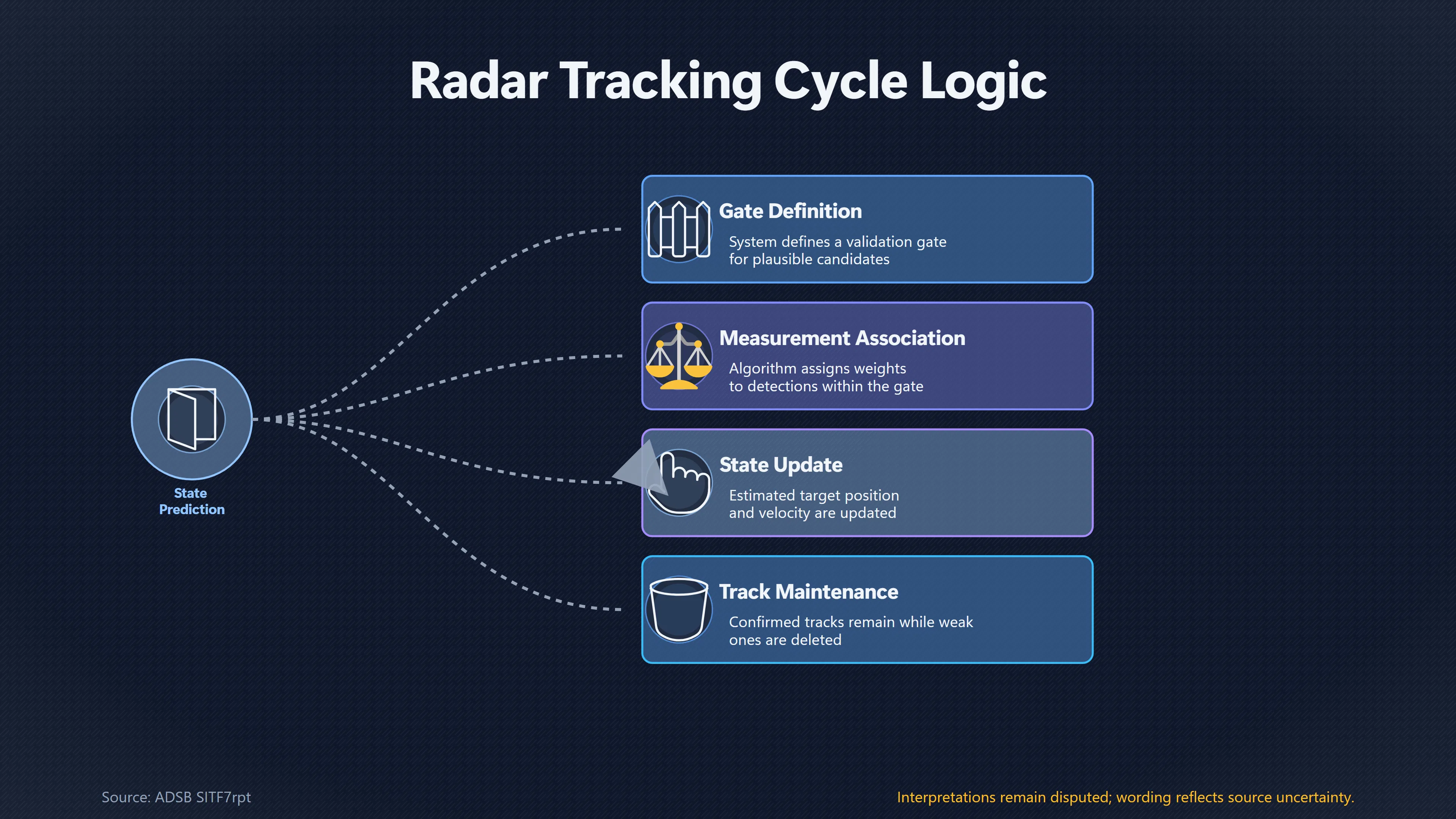
A simplified tracking cycle looks like this:
- The tracker predicts where an existing target ought to appear on the next radar scan.
- It defines a region around that prediction in which new measurements are considered plausible candidates. This is commonly called a validation gate.
- If one or more measurements fall inside the gate, an association method decides how much weight — or, in some trackers, which assignment — each should receive.
- The estimated target state is updated.
- Tracks receiving sufficient supporting evidence are maintained or confirmed; weak tracks can eventually be deleted.
The gate is necessary because testing every detection against every track would be both computationally expensive and physically unreasonable. But it introduces a trade-off. A very restrictive gate can reject a genuine measurement from a manoeuvring or poorly estimated target. A generous gate admits more competing clutter and measurements from other targets, increasing the opportunity for incorrect associations. Research on radar measurement validation therefore explicitly treats the selection of measurements inside the tracking gate as a defence against clutter being incorporated into a target estimate.[IET Research Journals]ietresearch.onlinelibrary.wiley.comIET Research JournalsRobust measurement validation for radar target tracking using prior information - Lee - 2019 - IET Radar, Sonar & Na…
This also explains why tracking can make radar data look cleaner than the underlying detections. A maintained symbol may move continuously between scans because the filter predicts the target’s state even when no measurement is assigned on a particular scan. The resulting track is an inference from detections and a motion model, not a frame-by-frame photograph of an object’s position.[ESSRG]essrg.iiitd.edu.inESSRGStudy of Data-Association Algorithms for Object TrackingAn ND… Fortmann, “Tracking and data association,” Ph.D. dissertation. Academic…Read more…
Why intermittent returns can be linked incorrectly
The association problem becomes difficult whenever more than one explanation fits the available measurements. Suppose a tracker has followed a target through several scans. On the next scan the expected detection is absent, but an unrelated return appears nearby. If that return lies within the track’s validation region and fits its predicted motion reasonably well, the tracker may associate it with the existing track.
If similar ambiguities continue, the displayed trajectory can survive even though its constituent measurements have changed physical source.
Clutter makes this especially important. Target-tracking research distinguishes genuine target measurements from unwanted observations generated by other objects or processes, and warns that allowing clutter or noise measurements to update a track can increase false-track probability or cause the genuine target to be lost.[IET Research Journals]ietresearch.onlinelibrary.wiley.comIET Research JournalsRobust measurement validation for radar target tracking using prior information - Lee - 2019 - IET Radar, Sonar & Na… A false track therefore need not begin with one spectacularly erroneous radar measurement. It can emerge incrementally from a succession of locally plausible association decisions.
Track initiation creates a related risk. A tracker cannot initially know whether an isolated detection represents a new aircraft or a false alarm. It must look for subsequent measurements that are sufficiently compatible with the first detection to constitute a plausible trajectory. If unrelated clutter happens to satisfy those tests across enough scans, the candidate can mature into a confirmed false track. The radar-tracking literature consequently treats track formation in the presence of false alarms as a distinct technical problem.[IEEE Long Island]ieee.li4] Bar-Shalom, Y., and Li, X. R., Multitarget-Multisensor Tracking: Principles and Tech-.Read more…
This is not merely theoretical. MIT Lincoln Laboratory’s work on aviation surveillance has documented operational algorithms whose false-track performance depended strongly on correlation and tracking design. A report on TCAS surveillance, for example, notes that an earlier algorithm worked adequately in low-density conditions but produced an excessively high false-track rate when applied to Los Angeles data, prompting redesign of its reply-correlation and range-tracking logic.[MIT Lincoln Laboratory]archive.ll.mit.eduLincoln Laboratory TCAS II ATCRBS Surveillance AlgorithmsLincoln Laboratory TCAS II ATCRBS Surveillance Algorithms Another Lincoln Laboratory study observed that improving the accuracy of radar reports allowed smaller correlation search regions, thereby reducing false-track initiations.[Lincoln Laboratory]ll.mit.eduLincoln Laboratory Comparison of the Performance of the Moving Target DetectorLincoln Laboratory Comparison of the Performance of the Moving Target Detector
These examples expose the central mechanism: a tracker can turn ambiguity into apparent continuity. Each individual association can look reasonable while the resulting history is nevertheless wrong.
When two targets confuse one another
Association errors are not confined to clutter. They also occur when two genuine targets come sufficiently close that the tracker has difficulty determining which detection belongs to which track.
This is one reason multi-target tracking is considerably harder than simply detecting several objects. When validation gates overlap, measurements can plausibly belong to more than one target. Different association algorithms handle that ambiguity differently, and some have characteristic failure modes.[IET Research Journals]ietresearch.onlinelibrary.wiley.comOpen source on wiley.com.
One well-studied example is track coalescence. Joint probabilistic data association (JPDA) methods consider alternative measurement-to-target associations probabilistically rather than making a single hard choice. This can be valuable in clutter, but closely spaced targets can cause estimated tracks to converge towards one another. Research describes JPDA track coalescence as neighbouring tracks tending to merge and potentially becoming indistinguishable.[TU Delft Research Portal]research.tudelft.nlOpen source on tudelft.nl.
The opposite behaviour can occur with other approaches. Research comparing JPDA with multiple hypothesis tracking (MHT) reports that MHT can exhibit track repulsion, in which estimated tracks are pushed apart. The important point for interpreting a radar display is not that one particular algorithm is universally unreliable; it is that the displayed geometry can contain behaviour produced partly by the association method rather than purely by target motion.[arXiv]arxiv.orgOpen source on arxiv.org.
A related practical failure is a track swap or identity error. Imagine two aircraft approaching one another on crossing paths. Before the crossing, the tracker maintains tracks A and B. Around the closest approach, measurement uncertainty makes either detection compatible with either predicted track. An incorrect assignment can cause the software to continue track A using detections physically produced by aircraft B, and vice versa. Both displayed tracks may remain smooth even though their identities have exchanged.
That last point is especially counter-intuitive: smoothness alone does not prove correct association. Tracking algorithms are designed precisely to favour dynamically plausible continuity. A wrong assignment that remains compatible with the motion model can therefore produce a visually convincing trajectory.
What track splits and false associations look like
Association failures need not create one neat phantom trajectory. Their visible effects depend on the geometry, clutter environment and track-management rules.
A false continuation occurs when a genuine target disappears or is missed and unrelated detections are subsequently attached to its predicted trajectory. The track may appear to continue after the original physical source has ceased contributing measurements.
A false initiation occurs when unrelated detections or clutter are correlated across successive scans strongly enough to satisfy the system’s criteria for creating and confirming a new track. Studies of automatic multi-target tracking explicitly distinguish confirmed true tracks from confirmed false tracks for this reason.[IET Research Journals]ietresearch.onlinelibrary.wiley.comOpen source on wiley.com.
Track duplication or coalescence can make several maintained tracks effectively describe the same target or cause several nearby targets to collapse into an ambiguous common estimate. Technical literature distinguishes forms of coalescence in which multiple tracks follow one target from cases in which estimates move towards the centre of several targets.[ResearchGate]researchgate.netOpen source on researchgate.net.
Fragmentation or splitting can produce the opposite visual impression. When a tracker can no longer maintain a sufficiently confident association, one track may terminate while another is initiated from subsequent detections. To someone examining only displayed track histories, one physical object’s journey may consequently resemble two separate target appearances.
These behaviours explain why operational surveillance systems explicitly carry track-quality information rather than treating the existence of a track number as proof of a corresponding object. EUROCONTROL’s ASTERIX specification for system track data, for example, includes a Potential False Track Indication in the track-status information.[EUROCONTROL]eurocontrol.intSDPS Track MessagesSDPS Track Messages Civil-aviation performance discussions likewise recognise false-track probability and track-initiation delay as measurable surveillance-system characteristics.[ICAO]icao.intADSB SITF7rptINTERNATIONAL CIVIL AVIATION ORGANIZATION ASIA…11 Apr 2008 — The Australian UAP is late and there are no results yet available…
A coherent trajectory can emerge from unrelated returns
A useful thought experiment shows why this mechanism matters for unusual-target reports.
Suppose a radar scans once every few seconds. On scan 1 it records detection a. On scan 2, another detection b appears at a position compatible with an object moving east. On scan 3 the expected target return is absent, but clutter detection c lies inside the predicted validation gate. On scans 4 and 5, detections d and e again lie close enough to the evolving prediction to be accepted.
The operator may ultimately see something resembling:
a → b → c → d → e
and interpret that as one object moving continuously through the airspace.
But the physical history could instead have been:
aircraft 1 → aircraft 1 → clutter → aircraft 2 → aircraft 2[faa.gov]faa.govSource details in endnotes.
or some other mixture of target and false-alarm measurements.
Nothing in that example requires the radar receiver to fabricate every detection. The error lies in asserting that all five detections have a common origin. This is why data association is conceptually different from simple false echoes: real measurements can be assembled into a false trajectory.
The risk rises when detection probability falls, clutter density rises or targets approach one another, because there are then more plausible alternatives for the tracker to resolve. Contemporary tracking research continues to develop probabilistic association and false-track-discrimination techniques specifically because missed detections, clutter and uncertain measurement origins remain fundamental problems.[WINS Lab]winslab.lids.mit.edumeykrowillauhlabrawin j18more…
Why the tracker does not simply reject every uncertain detection
It might seem safer to require overwhelming evidence before associating any return with an existing track. In practice, that would introduce a different failure mode: genuine tracks would be dropped whenever a target manoeuvred, weakened temporarily or was missed for a scan.
Tracking design therefore balances competing errors. Wider validation gates and tolerant track-maintenance rules help preserve real targets through uncertainty, but can admit more false measurements. Narrower criteria reject clutter more effectively, but increase the chance of losing real targets. Likewise, algorithms that retain several possible association histories can postpone premature decisions, but the number of hypotheses can grow rapidly as the number of targets and measurements increases.[IET Research Journals]ietresearch.onlinelibrary.wiley.comIET Research JournalsRobust measurement validation for radar target tracking using prior information - Lee - 2019 - IET Radar, Sonar & Na…
Multiple hypothesis tracking illustrates the principle. Rather than immediately committing to one interpretation when several associations are plausible, MHT maintains competing hypotheses and evaluates them as later measurements arrive. Probabilistic methods take different approaches to the same underlying uncertainty. No method abolishes the fact that the tracker must infer measurement origin from incomplete evidence.[arXiv]arxiv.orgOpen source on arxiv.org.
Track-management logic provides another layer of protection. Candidate tracks can require repeated supporting detections before confirmation, while tracks with too many missed detections can be deleted. Some systems estimate a probability that the target actually exists and use that as a track-quality measure for distinguishing true and false tracks.[IET Research Journals]ietresearch.onlinelibrary.wiley.comOpen source on wiley.com.
The existence of these safeguards should not be read as evidence that radar tracking is generally untrustworthy. It shows the opposite: false association is a known engineering problem for which surveillance systems deliberately incorporate countermeasures.
What this changes when assessing a UAP radar report
For a UFO or UAP case, saying that something was “tracked on radar” is important information, but it is not yet enough to establish that one physical object followed every point of the displayed trajectory. AARO, the US All-domain Anomaly Resolution Office, explicitly notes that even technical sensors such as radar can misperceive airborne clutter as behaving strangely, while its historical review includes sensor artefacts and vague radar returns among the disparate phenomena that have entered the UAP record.[AARO]aaro.milOpen source on aaro.mil.
The most useful question is therefore not simply whether a radar track existed, but what evidence supports the track’s continuity as one object. Investigators ideally need the underlying measurements and tracking metadata: detection times, uncertainties, missed detections, track-quality flags, association behaviour and information about other targets or clutter in the relevant gates. A screenshot or recollection of a moving track symbol contains much less diagnostic information.
Independent corroboration is especially valuable. If another radar with different geometry independently tracks the same trajectory, or an optical or infrared sensor observes an object at positions and times consistent with the radar solution, the explanation that one tracker merely stitched together ambiguous returns becomes harder to sustain. This is one reason scientific UAP-observation proposals emphasise multiple sensor modalities: independent measurements make it easier to recognise artefacts and verify genuine detections.[arXiv]arxiv.orgOpen source on arxiv.org.
Conversely, an apparently extraordinary manoeuvre deserves particular scrutiny if it occurs exactly where a track is briefly lost, two targets approach one another, clutter becomes dense, or one track terminates and another appears nearby. A sudden jump, reversal or acceleration inferred across such a discontinuity may represent incorrect association rather than the dynamics of a physical craft.
That does not demonstrate that every unusual radar trajectory is false. It establishes a narrower and more useful point: the displayed path itself is partly a software product, and the physical interpretation must be tested against the measurements from which that path was constructed.
The key distinction for UFO and UAP evidence
False tracks from target-association errors differ from many other radar artefacts because the individual returns need not themselves be fictitious. The radar may genuinely have detected reflective objects at each stage. What can be false is the proposition that those returns all came from the same object.
That distinction makes association errors unusually capable of producing persuasive evidence. A random isolated blip looks uncertain. Once tracking software connects a sequence of ambiguous detections, however, the result can acquire an apparent identity, velocity and flight path. Under some conditions it may even appear to manoeuvre.
Radar engineers have spent decades developing validation gates, probabilistic association, multiple-hypothesis methods, track-quality measures and false-track discrimination precisely because that transformation from detections to trajectories is not infallible.[tudelft.nl]research.tudelft.nlOpen source on tudelft.nl.
For UAP analysis, the appropriate evidential hierarchy therefore runs from the displayed track back towards its foundations: the raw or minimally processed detections, their uncertainties and timing, the association history, the tracker’s confidence and status flags, and finally independent sensor confirmation. A coherent radar track can be strong evidence when those layers agree. Without them, its apparent continuity should not by itself be treated as proof that a single unknown object performed the displayed motion.
Amazon book picks
Further Reading
Books and field guides related to How Radar Software Can Build a False Track. Use these as the next step if you want deeper reading beyond the article.
Estimation with Applications to Tracking and Navigation
Expert coverage of the design and implementation of state estimation algorithms for tracking and navigation Estimation with Applications...
Design and Analysis of Modern Tracking Systems
Here's a thorough overview of the state-of-the-art in design and implementation of advanced tracking for single and multiple sensor syste...
Introduction to Radar Systems
Since the publication of the second edition of "Introduction to Radar Systems," there has been continual development of new radar capabil...
eBay marketplace picks
Marketplace Samples
Live-tested eBay searches with available results related to this page.
Selected fromradar operator patch oneBay.co.uk.

Related eBay result
Royal Navy White Blue Radar Operator Trade Uniform Fabric Patch
Related eBay result
British Military Issue Royal Navy Radar Operator Trade Patch
Endnotes
1.
Source: ieee.li
Link:https://www.ieee.li/pdf/essay/target_tracking.pdf
Source snippet
[4] Bar-Shalom, Y., and Li, X. R., Multitarget-Multisensor Tracking: Principles and Tech-.Read more...
2.
Source: osti.gov
Link:https://www.osti.gov/servlets/purl/1163088
Source snippet
IFT&E Industry Report Wind Turbine-Radar Interference...by B Karlson · 2014 · Cited by 4 — More simply, a false track is any track r...
3.
Source: icao.int
Title: ADSB SITF7rpt
Link:https://www.icao.int/sites/default/files/sp-files/APAC/Documents/Meetings/2008/ADSB_SITF7rpt.pdf
Source snippet
INTERNATIONAL CIVIL AVIATION ORGANIZATION ASIA...11 Apr 2008 — The Australian UAP is late and there are no results yet available...
4.
Source: winslab.lids.mit.edu
Title: meykrowillauhlabrawin j18
Link:https://winslab.lids.mit.edu/wp-content/papercite-data/pdf/meykrowillauhlabrawin-j18.pdf
Source snippet
more...
5.
Source: essrg.iiitd.edu.in
Title: ESSRGStudy of Data-Association Algorithms for Object Tracking
Link:https://essrg.iiitd.edu.in/wp-content/uploads/2020/03/Farah-Jabin-Mtech-Thesis.pdf
Source snippet
An ND... Fortmann, “Tracking and data association,” Ph.D. dissertation. Academic...Read more...
6.
Source: archive.ll.mit.edu
Title: Lincoln Laboratory TCAS II ATCRBS Surveillance Algorithms
Link:https://archive.ll.mit.edu/mission/aviation/publications/publication-files/atc-reports/Wood_1985_ATC-131_WW-15318.pdf
7.
Source: ll.mit.edu
Title: Lincoln Laboratory Comparison of the Performance of the Moving Target Detector
Link:https://www.ll.mit.edu/sites/default/files/publication/doc/2018-12/ODonnell_1977_ATC-70_WW-15318.pdf
8.
Source: arxiv.org
Link:https://arxiv.org/abs/2308.06326
9.
Source: researchgate.net
Link:https://www.researchgate.net/publication/224341534_Controlling_track_coalescence_with_scaled_Joint_Probabilistic_Data_Association
10.
Source: researchgate.net
Title: Research Gate(PDF) Joint Integrated PDA Avoiding Track Coalescence
Link:https://www.researchgate.net/publication/224627942_Joint_Integrated_PDA_Avoiding_Track_Coalescence
11.
Source: eurocontrol.int
Title: SDPS Track Messages
Link:https://www.eurocontrol.int/sites/default/files/content/documents/nm/asterix/20141201-asterix-sdps-cat062-part9-v1.17.pdf
12.
Source: aaro.mil
Link:https://www.aaro.mil/FAQ/
13.
Source: aaro.mil
Title: AARO Historical Record Report Vol 1 2024
Link:https://www.aaro.mil/Portals/136/PDFs/AARO_Historical_Record_Report_Vol_1_2024.pdf
14.
Source: arxiv.org
Link:https://arxiv.org/abs/2305.18566
15.
Source: icao.int
Title: APA C Meetings | International Civil Aviation Organization
Link:https://www.icao.int/ar/node/4311?fid=88209
16.
Source: eurocontrol.int
Title: transponder code function
Link:https://www.eurocontrol.int/function/transponder-code-function
17.
Source: icao.int
Title: APA C Meetings | International Civil Aviation Organization
Link:https://www.icao.int/es/node/4311?fid=41026
18.
Source: icao.int
Title: APA C Meetings | International Civil Aviation Organization
Link:https://www.icao.int/ru/node/4311?fid=41026
19.
Source: researchgate.net
Link:https://www.researchgate.net/publication/398224162_Bridging_the_Domain_Gap_Between_Target_Detection_and_Parameter_Estimation_A_Time-Frequency_Parameter_Estimation_Scheme_for_HFSWR
20.
Source: eurocontrol.int
Title: CA T062
Link:https://www.eurocontrol.int/publication/cat062-eurocontrol-specification-surveillance-data-exchange-asterix-part-9-category-062
21.
Source: researchgate.net
Link:https://www.researchgate.net/publication/366919598_Consensus_based_target_tracking_against_deception_jamming_in_distributed_radar_networks?_tp=eyJjb250ZXh0Ijp7InBhZ2UiOiJzY2llbnRpZmljQ29udHJpYnV0aW9ucyIsInByZXZpb3VzUGFnZSI6bnVsbCwic3ViUGFnZSI6bnVsbH19
22.
Source: icao.int
Title: Air Traffic Services Guidance for Operation in a COVID-19 Context
Link:https://www.icao.int/events/air-traffic-services-guidance-operation-covid-19-context
23.
Source: eurocontrol.int
Title: european pbn route spacing handbook
Link:https://www.eurocontrol.int/publication/european-pbn-route-spacing-handbook
24.
Source: eurocontrol.int
Title: real safety and capacity gains heathrow artificial intelligence initiatives
Link:https://www.eurocontrol.int/article/real-safety-and-capacity-gains-heathrow-artificial-intelligence-initiatives
25.
Source: researchgate.net
Link:https://www.researchgate.net/publication/338673679_Method_for_the_Sea_Clutter_Characterization_in_HF_Surface_Wave_Radars_From_the_Fields_Diffracted_by_the_Sea_Surface
26.
Source: researchgate.net
Link:https://www.researchgate.net/figure/Doppler-spectrum-for-a-Jonswap-sea-surface-th-0-10-u-f-19-cm-s-of-256-m-256-m-in_fig13_338673679
27.
Source: researchgate.net
Title: (PDF) An approach of track managements system in software defined radar
Link:https://www.researchgate.net/publication/331941821_An_approach_of_track_managements_system_in_software_defined_radar
28.
Source: researchgate.net
Title: (PDF) Intelligence Based Tracking for Two Radar Applications
Link:https://www.researchgate.net/publication/317291031_Intelligence_Based_Tracking_for_Two_Radar_Applications
29.
Source: researchgate.net
Title: (PDF) HF Over-The-Horizon Radar (OTHR) in Canada
Link:https://www.researchgate.net/publication/318506186_HF_Over-The-Horizon_Radar_OTHR_in_Canada
30.
Source: researchgate.net
Title: (PDF) Towards a Cognitive Radar
Link:https://www.researchgate.net/publication/301542300_Towards_a_Cognitive_Radar
31.
Source: eurocontrol.int
Title: mitigating wind turbine interference
Link:https://www.eurocontrol.int/initiative/mitigating-wind-turbine-interference
32.
Source: scientific.net
Link:https://www.scientific.net/AMR.433-440.2298
33.
Source: researchgate.net
Title: (PDF) Two-stage algorithm for extended target tracking by multistatic UWB radar
Link:https://www.researchgate.net/publication/254055482_Two-stage_algorithm_for_extended_target_tracking_by_multistatic_UWB_radar
34.
Source: researchgate.net
Title: (PDF) Extended target tracking using principal components
Link:https://www.researchgate.net/publication/252027642_Extended_target_tracking_using_principal_components
35.
Source: researchgate.net
Title: (PDF) Decision Support Real-Time Tools in Maritime Traffic Surveillance Systems
Link:https://www.researchgate.net/publication/263283001_Decision_Support_Real-Time_Tools_in_Maritime_Traffic_Surveillance_Systems
36.
Source: researchgate.net
Title: (PDF) Multiple-Hypothesis Trilateration and Tracking with Distributed Radars
Link:https://www.researchgate.net/publication/228895023_Multiple-Hypothesis_Trilateration_and_Tracking_with_Distributed_Radars
37.
Source: researchgate.net
Title: (PDF) Performance Comparison of Tracking Algorithms for a Ground Based Radar
Link:https://www.researchgate.net/publication/4242190_Performance_Comparison_of_Tracking_Algorithms_for_a_Ground_Based_Radar
38.
Source: eurocontrol.int
Title: development mathematical weighted formula eliminate overlapping aircraft labels
Link:https://www.eurocontrol.int/publication/development-mathematical-weighted-formula-eliminate-overlapping-aircraft-labels
39.
Source: ll.mit.edu
Title: radar correlation and interpolation ci algorithms deployed asr 9 processor
Link:https://www.ll.mit.edu/r-d/publications/radar-correlation-and-interpolation-ci-algorithms-deployed-asr-9-processor
40.
Source: ll.mit.edu
Title: asr 9 processor augmentation card 9 pac phase ii scan scan correlator algorithms
Link:https://www.ll.mit.edu/r-d/publications/asr-9-processor-augmentation-card-9-pac-phase-ii-scan-scan-correlator-algorithms
41.
Source: ll.mit.edu
Title: connected components and temporal association airport surface radar tracking
Link:https://www.ll.mit.edu/r-d/publications/connected-components-and-temporal-association-airport-surface-radar-tracking
42.
Source: ll.mit.edu
Title: automating radars air traffic control
Link:https://www.ll.mit.edu/r-d/publications/automating-radars-air-traffic-control
43.
Source: researchgate.net
Link:https://www.researchgate.net/publication/224739912_Interacting_multiple_model_joint_probabilistic_data_association_avoiding_track_coalescence
44.
Source: researchgate.net
Link:https://www.researchgate.net/publication/252023212_A_novel_method_of_target_tracking_based_on_tracks_splitting
45.
Source: researchgate.net
Link:https://www.researchgate.net/scientific-contributions/Laurence-Zsu-Hsin-Chuang-71908316
46.
Source: researchgate.net
Link:https://www.researchgate.net/publication/324822810_Linear_Multitarget_Integrated_Probabilistic_Data_Association_for_Multiple_Detection_Target_Tracking
47.
Source: researchgate.net
Link:https://www.researchgate.net/publication/224330408_Feature_aided_probabilistic_data_association_for_multi-target_tracking
48.
Source: researchgate.net
Link:https://www.researchgate.net/publication/2986277_Probabilistic_Data_Association_Techniques_for_Target_Tracking_in_Clutter
49.
Source: researchgate.net
Link:https://www.researchgate.net/publication/371163081_SkyWatch_A_Passive_Multistatic_Radar_Network_for_the_Measurement_of_Object_Position_and_Velocity
50.
Source: aaro.mil
Link:https://www.aaro.mil/UAP-Cases/Official-UAP-Imagery/
51.
Source: technav.ieee.org
Title: radar tracking
Link:https://technav.ieee.org/topic/radar-tracking/
52.
Source: ieeexplore.ieee.org
Link:https://ieeexplore.ieee.org/iel8/6287639/10380310/10634509.pdf
53.
Source: ieeexplore.ieee.org
Link:https://ieeexplore.ieee.org/iel7/6287639/9668973/09648188.pdf
54.
Source: ieeexplore.ieee.org
Link:https://ieeexplore.ieee.org/iel7/36/9633014/09796557.pdf
55.
Source: ieeexplore.ieee.org
Link:https://ieeexplore.ieee.org/iel8/5971804/11511537/11511541.pdf
56.
Source: ieeexplore.ieee.org
Link:https://ieeexplore.ieee.org/iel7/6287639/7859429/07850967.pdf
57.
Source: ieeexplore.ieee.org
Link:https://ieeexplore.ieee.org/iel7/6287639/10380310/10509680.pdf
58.
Source: ieeexplore.ieee.org
Link:https://ieeexplore.ieee.org/iel5/2198/32393/01512724.pdf
59.
Source: ieeexplore.ieee.org
Link:https://ieeexplore.ieee.org/iel7/5/8290589/08290605.pdf
60.
Source: ieeexplore.ieee.org
Link:https://ieeexplore.ieee.org/iel7/6287639/9312710/09359743.pdf
61.
Source: ieeexplore.ieee.org
Link:https://ieeexplore.ieee.org/iel8/78/11345506/11353058.pdf
62.
Source: osti.gov
Link:https://www.osti.gov/servlets/purl/82468
63.
Source: osti.gov
Link:https://www.osti.gov/servlets/purl/1420848
64.
Source: osti.gov
Link:https://www.osti.gov/servlets/purl/1772302
65.
Source: osti.gov
Link:https://www.osti.gov/pages/servlets/purl/2472169
66.
Source: osti.gov
Link:https://www.osti.gov/servlets/purl/1267244
67.
Source: osti.gov
Link:https://www.osti.gov/servlets/purl/221056
68.
Source: osti.gov
Link:https://www.osti.gov/servlets/purl/1863221
69.
Source: osti.gov
Link:https://www.osti.gov/servlets/purl/2482520
70.
Source: osti.gov
Link:https://www.osti.gov/servlets/purl/1222445
71.
Source: ll.mit.edu
Link:https://www.ll.mit.edu/r-d/publications?author=3606
72.
Source: ll.mit.edu
Link:https://www.ll.mit.edu/r-d/publications?page=0&tag=201
73.
Source: ll.mit.edu
Link:https://www.ll.mit.edu/r-d/publications?author=3536
74.
Source: ll.mit.edu
Link:https://www.ll.mit.edu/r-d/publications?author=3611
75.
Source: ll.mit.edu
Link:https://www.ll.mit.edu/r-d/publications?page=10&rdgroup=772
76.
Source: archive.ll.mit.edu
Link:https://archive.ll.mit.edu/publications/technotes/PCL.html
77.
Source: ll.mit.edu
Link:https://www.ll.mit.edu/r-d/publications?page=157
78.
Source: ll.mit.edu
Link:https://www.ll.mit.edu/r-d/publications?page=11&rdgroup=772
79.
Source: dspace.mit.edu
Link:https://dspace.mit.edu/bitstream/handle/1721.1/135210/09098068.pdf?sequence=2
80.
Source: archive.ll.mit.edu
Title: Fischer 1980 TN 1980 40 WW 18358
Link:https://archive.ll.mit.edu/mission/aviation/publications/publication-files/technical_notes/Fischer_1980_TN-1980-40_WW-18358.pdf
81.
Source: dspace.mit.edu
Link:https://dspace.mit.edu/server/api/core/bitstreams/cd5c205d-f572-47cc-81d4-69eb9f0747f6/content
82.
Source: ll.mit.edu
Title: Wood 1999 ATC 272 WW 16278
Link:https://www.ll.mit.edu/sites/default/files/publication/doc/2018-12/Wood_1999_ATC-272_WW-16278.pdf
83.
Source: dspace.mit.edu
Link:https://dspace.mit.edu/bitstreams/400a83fb-f871-497c-b0fb-ec8902d11ad0/download
84.
Source: archive.ll.mit.edu
Title: Welch 1983 ATC 119 WW 15318
Link:https://archive.ll.mit.edu/mission/aviation/publications/publication-files/atc-reports/Welch_1983_ATC-119_WW-15318.pdf
85.
Source: dspace.mit.edu
Title: Patrikalakis A random finite
Link:https://dspace.mit.edu/bitstream/handle/1721.1/79084/Patrikalakis_A%20random%20finite.pdf?isAllowed=y&sequence=2
86.
Source: ll.mit.edu
Link:https://www.ll.mit.edu/r-d/publications?keywords=radar+&page=24&rdarea=All&rdgroup=All
87.
Source: dspace.mit.edu
Title: Hover X band radar
Link:https://dspace.mit.edu/bitstream/handle/1721.1/78656/Hover_X-band%20radar.pdf?isAllowed=y&sequence=1
88.
Source: archive.ll.mit.edu
Title: Cartledge 1977 ATC 69 WW 15318
Link:https://archive.ll.mit.edu/mission/aviation/publications/publication-files/atc-reports/Cartledge_1977_ATC-69_WW-15318.pdf
89.
Source: mit.edu
Link:https://www.mit.edu/~hamsa/pubs/HwangBalakrishnanRoyTomlinJGCD2007.pdf
90.
Source: archive.ll.mit.edu
Title: Muehe 1973 ATC 14 WW 15318
Link:https://archive.ll.mit.edu/mission/aviation/publications/publication-files/atc-reports/Muehe_1973_ATC-14_WW-15318.pdf
91.
Source: dspace.mit.edu
Link:https://dspace.mit.edu/bitstream/handle/1721.1/145552/Cooperative_Localization_and_Multitarget_Tracking_in_Agent_Networks_with_the_Sum-Product_Algorithm.pdf?isAllowed=y&sequence=2
92.
Source: web.mit.edu
Title: cornell vehicle tracking08
Link:https://web.mit.edu/2.166/www/handouts/cornell_vehicle_tracking08.pdf
93.
Source: dspace.mit.edu
Title: 55693398 MIT
Link:https://dspace.mit.edu/bitstream/handle/1721.1/30100/55693398-MIT.pdf?sequence=2
94.
Source: ll.mit.edu
Title: Welch 1980 ATC 102 WW 15318(1)
Link:https://www.ll.mit.edu/sites/default/files/publication/doc/2018-12/Welch_1980_ATC-102_WW-15318%281%29.pdf
95.
Source: arxiv.org
Link:https://arxiv.org/html/2506.00125v1
96.
Source: eurocontrol.int
Link:https://www.eurocontrol.int/tool/centralised-code-assignment-and-management-system
97.
Source: eurocontrol.int
Link:https://www.eurocontrol.int/product/artas
98.
Source: eurocontrol.int
Link:https://www.eurocontrol.int/service/call-sign-similarity-service
99.
Source: eurocontrol.int
Link:https://www.eurocontrol.int/service/handling-non-equipped-mode-s-and-ads-b-state-aircraft
100.
Source: eurocontrol.int
Link:https://www.eurocontrol.int/online-tool/surveillance-analysis-support-system-atc-centres
101.
Source: eurocontrol.int
Link:https://www.eurocontrol.int/service/mode-5-frequency-supportability
102.
Source: eurocontrol.int
Link:https://www.eurocontrol.int/sites/default/files/2019-05/cat048pt4ed124.pdf
103.
Source: igat.icao.int
Title: int ICA O Training
Link:https://igat.icao.int/ated/trainingcatalogue/course/651
104.
Source: icao.int
Title: implementation support amendments and manuals amendments adopted 2018
Link:https://www.icao.int/implementation-support-amendments-and-manuals-amendments-adopted-2018
105.
Source: icao.int
Title: Annex 10
Link:https://www.icao.int/sites/default/files/postalhistory/annex_10_aeronautical_telecommunications.htm
106.
Source: icao.int
Link:https://www.icao.int/fr/publications/no
107.
Source: icao.int
Link:https://www.icao.int/nacc/tf-ecarntg
108.
Source: icao.int
Link:https://www.icao.int/ru/node/4311?fid=38390
109.
Source: icao.int
Link:https://www.icao.int/publications/no
110.
Source: icao.int
Link:https://www.icao.int/publications/no
111.
Source: youtube.com
Link:https://www.youtube.com/watch?v=IIt1LHIHYc4
Source snippet
Data Association...
112.
Source: youtube.com
Title: Data Association
Link:https://www.youtube.com/watch?v=DK1DIcPwCOU
Source snippet
Introduction to Radar Systems – Lecture 7 – Radar Clutter and Chaff; Part 1...
113.
Source: ietresearch.onlinelibrary.wiley.com
Link:https://ietresearch.onlinelibrary.wiley.com/doi/10.1049/iet-rsn.2019.0019
Source snippet
IET Research JournalsRobust measurement validation for radar target tracking using prior information - Lee - 2019 - IET Radar, Sonar & Na...
114.
Source: ietresearch.onlinelibrary.wiley.com
Link:https://ietresearch.onlinelibrary.wiley.com/doi/abs/10.1049/iet-rsn.2018.5142
115.
Source: research.tudelft.nl
Link:https://research.tudelft.nl/en/publications/probabilistic-data-association-avoiding-track-coalescence/
116.
Source: ietresearch.onlinelibrary.wiley.com
Link:https://ietresearch.onlinelibrary.wiley.com/doi/10.1049/iet-rsn.2017.0481
117.
Source: ietresearch.onlinelibrary.wiley.com
Link:https://ietresearch.onlinelibrary.wiley.com/doi/10.1049/iet-rsn.2015.0110
118.
Source: ietresearch.onlinelibrary.wiley.com
Link:https://ietresearch.onlinelibrary.wiley.com/doi/10.1049/rsn2.12672
119.
Source: ietresearch.onlinelibrary.wiley.com
Link:https://ietresearch.onlinelibrary.wiley.com/doi/abs/10.1049/tje2.70024
120.
Source: ietresearch.onlinelibrary.wiley.com
Link:https://ietresearch.onlinelibrary.wiley.com/doi/10.1049/rsn2.12371
121.
Source: doi.org
Link:https://doi.org/10.1049/rsn2.12371?urlappend=%3Futm_source%3Dresearchgate.net%26utm_medium%3Darticle
122.
Source: ietresearch.onlinelibrary.wiley.com
Link:https://ietresearch.onlinelibrary.wiley.com/doi/full/10.1049/rsn2.12107
123.
Source: ietresearch.onlinelibrary.wiley.com
Title: iet rsn.2016.0409
Link:https://ietresearch.onlinelibrary.wiley.com/doi/10.1049/iet-rsn.2016.0409
124.
Source: ietresearch.onlinelibrary.wiley.com
Title: iet rsn.2016.0409
Link:https://ietresearch.onlinelibrary.wiley.com/doi/abs/10.1049/iet-rsn.2016.0409
125.
Source: ietresearch.onlinelibrary.wiley.com
Title: iet rsn.2015.0312
Link:https://ietresearch.onlinelibrary.wiley.com/doi/full/10.1049/iet-rsn.2015.0312
126.
Source: ietresearch.onlinelibrary.wiley.com
Title: iet rsn.2013.0396
Link:https://ietresearch.onlinelibrary.wiley.com/doi/10.1049/iet-rsn.2013.0396
127.
Source: ietresearch.onlinelibrary.wiley.com
Title: iet rsn.2014.0021
Link:https://ietresearch.onlinelibrary.wiley.com/doi/full/10.1049/iet-rsn.2014.0021
128.
Source: doi.org
Link:https://doi.org/10.1007%2Fs12369-009-0039-x
129.
Source: doi.org
Link:https://doi.org/10.1049%2Fip-rsn%3A19970976
130.
Source: research.tudelft.nl
Title: nl Bayesian Tracking of Two Possibly Unresolved Maneuvering Targets
Link:https://research.tudelft.nl/en/publications/bayesian-tracking-of-two-possibly-unresolved-maneuvering-targets/
131.
Source: repository.tudelft.nl
Link:https://repository.tudelft.nl/record/uuid%3Abd1d8745-9086-4676-bf46-c9ec35bb798a
132.
Source: research.tudelft.nl
Link:https://research.tudelft.nl/files/154842747/acp_23_7257_2023.pdf
133.
Source: research.tudelft.nl
Title: AI for and in Urban Planning
Link:https://research.tudelft.nl/files/235406912/AI_for_and_in_Urban_Planning.pdf
134.
Source: research.tudelft.nl
Title: nl The+Space+of+Technicityby RA Gorny · Cited by 3 — Book
Link:https://research.tudelft.nl/files/186232159/The_Space_of_Technicity.pdf
135.
Source: ietresearch.onlinelibrary.wiley.com
Title: iet rsn.2019.0075
Link:https://ietresearch.onlinelibrary.wiley.com/doi/full/10.1049/iet-rsn.2019.0075
136.
Source: onlinelibrary.wiley.com
Link:https://onlinelibrary.wiley.com/doi/10.1155/2013/521630
137.
Source: digital.library.adelaide.edu.au
Link:https://digital.library.adelaide.edu.au/items/e222f469-ee25-4347-a2bc-c746e706d307
Additional References
138.
Source: sciencedirect.com
Link:https://www.sciencedirect.com/science/article/pii/S0957417425008152
Source snippet
Advanced data association technique using integrated track splitting filter for multi-target tracking in clutter and occlusi...
139.
Source: youtube.com
Title: Gimbal UFO
Link:https://www.youtube.com/watch?v=qsEjV8DdSbs
Source snippet
Radar tracking data association multi target tracking Kalman filter track initiation How does a Radar Track Manoeuvring Targets?...
140.
Source: faa.gov
Link:https://www.faa.gov/air_traffic/publications/atpubs/aim_html/chap4_section_5.html
141.
Source: faa.gov
Link:https://www.faa.gov/air_traffic/publications/atpubs/atc_html/chap5_section_3.html
142.
Source: faa.gov
Link:https://www.faa.gov/air_traffic/publications/atpubs/atc_html/chap5_section_4.html
143.
Source: faa.gov
Link:https://www.faa.gov/air_traffic/publications/atpubs/atc_html/chap5_section_8.html
144.
Source: faa.gov
Link:https://www.faa.gov/air_traffic/publications/atpubs/pcg_html/chap1_section_19.html
145.
Source: cia.gov
Link:https://www.cia.gov/readingroom/document/cia-rdp81r00560r000100010010-0
146.
Source: youtube.com
Title: How does a Radar Track Manoeuvring Targets?
Link:https://www.youtube.com/watch?v=ibvlKTGQ4zQ
Source snippet
Understanding Sensor Fusion and Tracking, Part 5: How to Track Multiple Objects at Once...
147.
Source: academia.edu
Link:https://www.academia.edu/52385418/Comparison_of_nearest_neighbor_and_probabilistic_data_association_methods_for_non_linear_target_tracking_data_association