Within Compression
Can Compression Invent UFO Wings and Appendages?
Ringing and mosquito noise can make edge pixels flicker into apparent halos, spikes or short-lived appendages around a tiny target.
On this page
- How ringing forms beside sharp target edges
- Why mosquito noise changes from frame to frame
- Clues that an appendage may be a codec artefact
Page outline Jump by section
Introduction
Yes. Compression noise can make a tiny object in UFO or UAP footage appear to grow brief “wings”, spikes, lobes, halos or tail-like appendages that were not stable physical structures on the object. The main mechanisms are ringing, which creates false brightness or darkness fluctuations beside sharp boundaries, and mosquito noise, a time-varying compression impairment that makes fine errors shimmer around edges. These effects are well established in image and video engineering, and they become particularly important when the target itself occupies only a few pixels.[CiteSeerX]psu.eduOpen source on psu.edu.
The key warning is morphological: a compressed frame is not necessarily a faithful map of the object’s outline. A small protrusion visible after enlargement may instead be an unstable reconstruction error generated beside the real target edge. US government UAP analysis provides a useful real-world precedent: the All-domain Anomaly Resolution Office (AARO) has assessed an apparent trailing feature in infrared UAP footage as a video-compression sensor artefact rather than a physical wake.[AARO]aaro.milOpen source on aaro.mil.
How ringing forms beside sharp target edges
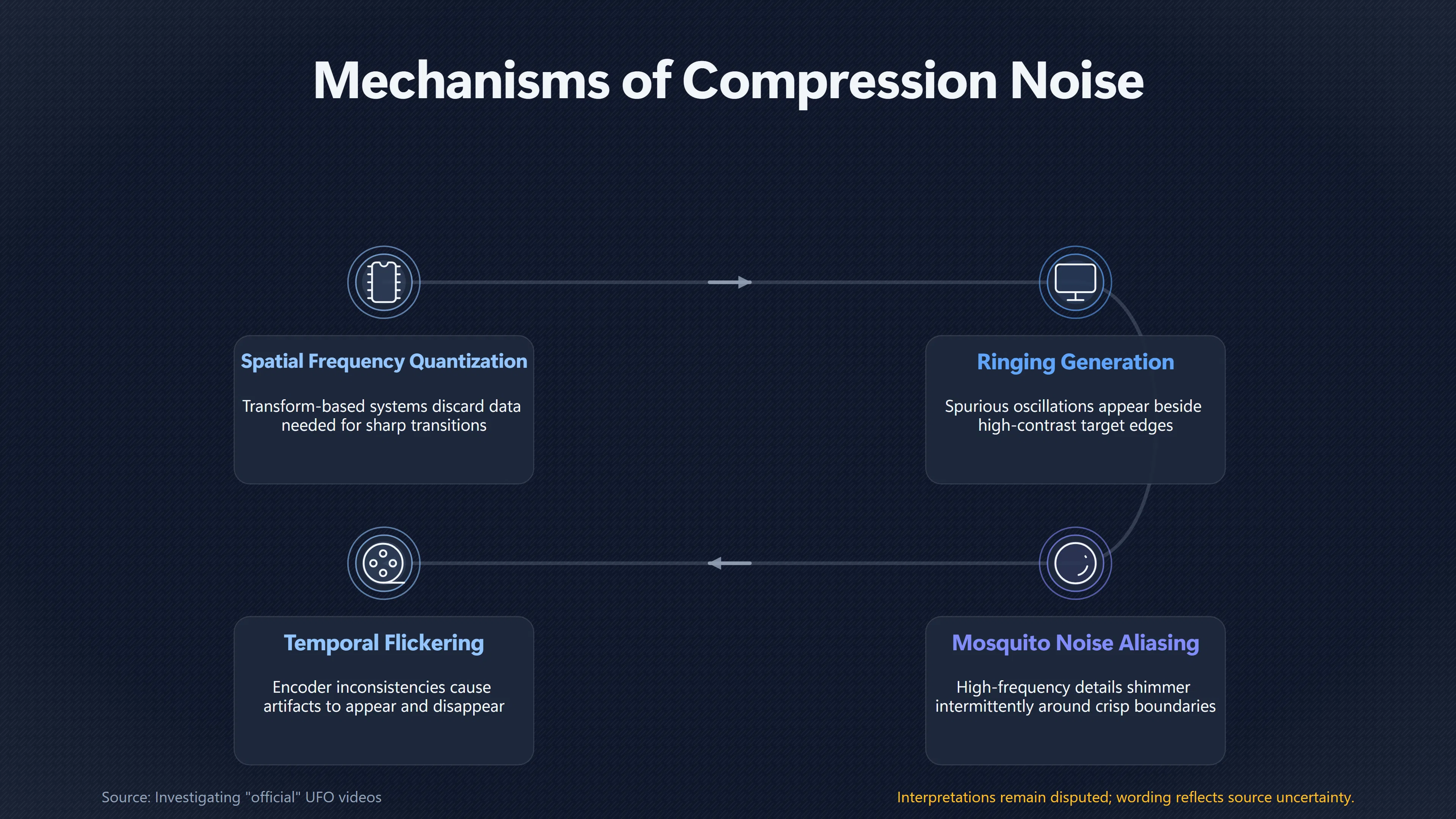
A sharp boundary is difficult to reproduce perfectly after lossy compression. Transform-based compression represents image information partly in terms of spatial frequencies and then quantises that information to save data. When information needed to reconstruct a sharp transition is represented too coarsely or discarded, the decoded boundary can acquire artificial fluctuations beside it. Compression research describes ringing as spurious oscillation or intensity variation in the vicinity of major edges.[psu.edu]psu.eduOpen source on psu.edu.
That distinction is important in UFO imagery because an oscillation beside an edge does not necessarily look like an abstract signal-processing error. In an enlarged frame it can become something visually concrete. A bright target against a relatively uniform sky might acquire a narrow bright or dark extension on one side. Several disturbed pixels can resemble a fin, wing tip, antenna or exhaust-like streak. Around a roughly circular target, ringing may instead produce a partial halo or small peripheral lobes.
The effect can be disproportionately persuasive when the object is tiny. Suppose the genuine target is only several pixels across. An artefact extending another pixel or two from its edge is then large relative to the apparent body. Once the image is enlarged for viewing, those few reconstructed pixels can become a conspicuous fraction of the displayed “craft”. The viewer sees a large geometric feature on screen even though the underlying evidence for it consists of a very small number of encoded samples.
This is why ringing research concentrates specifically on regions around edges. Work on detecting ringing in compressed images uses edge detection to identify areas susceptible to the artefact, while experimental examples show intensity fluctuations extending into areas that should otherwise be comparatively uniform. Ringing is also easier to notice against smooth surroundings than amid complicated texture because there is less background detail to mask it.[CiteSeerX]psu.eduOpen source on psu.edu.
That combination is unusually relevant to distant aerial targets: a small, high-contrast spot surrounded by comparatively featureless sky is close to the sort of visual situation in which an edge artefact can attract attention.
Why mosquito noise changes from frame to frame
A still frame can conceal the strongest clue that an apparent appendage is artificial: its instability through time.
The US National Institute of Standards and Technology (NIST) describes mosquito noise as a time-dependent compression impairment in which high-frequency detail around crisp edges is intermittently aliased. Crucially, NIST found that even static test patterns could produce mosquito noise because of the behaviour of the encoder. Its experiments also found relationships between the temporal pattern of the noise and MPEG Group-of-Pictures structure — the sequence of differently encoded frames used in compressed video.[NIST]nist.govOpen source on nist.gov.
For a UAP clip, that means the reconstructed boundary does not have to fail identically in every frame. Pixels around the target may appear, disappear or change intensity as the encoder deals with successive frames. An edge that looks reasonably compact at one moment may sprout a bright speck or short projection in the next, lose it shortly afterwards, and then develop a similar disturbance somewhere else.
Modern compression research likewise treats spatial ringing and temporal flickering as recognisable categories of encoding impairment. A study of H.265/HEVC compressed video, for example, built a large labelled database containing spatial artefacts including ringing and temporal artefacts including flickering. More recent work examining several codec families reports that aggressive compression can reduce frame-to-frame consistency and produce unstable textures and flicker.[arXiv]arxiv.orgOpen source on arxiv.org.
This gives investigators an important distinction between shape and shape persistence. A single frame might show something that looks surprisingly structured. The stronger question is whether that same structure remains attached to the same part of the target in neighbouring frames in a physically coherent way.
A genuine wing or boom should normally have some relationship to the object’s orientation and motion, even if blur, perspective and sensor resolution sometimes hide it. Mosquito noise has no obligation to maintain such geometry. It can shimmer, fragment or migrate as the reconstruction changes.
When a codec artefact starts looking like a UFO feature
The risk is greatest when several conditions coincide: the object is small, its boundary contrasts strongly with the background, the available footage is compressed, and investigators inspect enlarged individual frames.
Consider a hypothetical ten-pixel-wide bright target. If compression produces disturbed pixels just outside its boundary, enlarging the frame by 20 times does not create new source information; it simply makes those pixels easier to see. A two-pixel protrusion becomes a visually substantial 40-pixel projection in the enlarged display. The enlargement makes the feature more legible without making its origin more trustworthy.
Repeated transcoding can complicate interpretation further. Lossy compression itself is known to introduce blocking, ringing and blurring, while research into double MPEG-4 compression demonstrates that a second compression operation leaves additional measurable traces in transform coefficients. Consequently, a social-media copy, screen recording or repeatedly exported UFO clip need not preserve exactly the same fine edge structure as the earliest available file.[arXiv]arxiv.orgOpen source on arxiv.org.
There is another trap: sharpening or enhancement can make already questionable boundaries appear more definite. Compression-artifact research notes the tension between suppressing artefacts and restoring sharpness, because sharpening can itself be accompanied by ringing. An enhanced outline may therefore look cleaner or more “mechanical” without providing stronger evidence that its smallest protrusions existed in the original scene.[arXiv]arxiv.orgOpen source on arxiv.org.
For UFO analysis, this means a striking enlarged frame should not automatically outrank a less impressive but less processed source. If the claimed antenna, wing or tail becomes convincing only after heavy magnification, sharpening or another export, its processing history is part of the evidence.
A real UAP warning: the apparent South Asian wake
AARO’s South Asian “Atmospheric Wake” footage provides a particularly relevant example because the disputed feature appeared to extend physically away from the observed target.
The footage was recorded by an MQ-9 forward-looking infrared sensor. AARO says that after examining the full-motion video, additional footage taken at longer focal length and commercial flight information, it assessed the object as probably a commercial aircraft. More importantly for this issue, AARO concluded that the apparent trailing “cavitation” was a sensor artefact resulting from video compression.[AARO]aaro.milOpen source on aaro.mil.
The US Department of Defense similarly described the apparent atmospheric wake and reported AARO’s assessment that the trailing feature resulted from video compression. The additional longer-focal-length footage was part of the evidence considered in reaching the aircraft assessment.[U.S. Department of War]defense.govOpen source on defense.gov.
That case should not be generalised into a claim that every UAP appendage or trail is compression noise. It demonstrates the narrower and more useful point: compression can generate a feature sufficiently object-like and spatially associated with a target to be interpreted initially as something physically trailing it.
That is precisely the interpretive hazard with supposed wings, spikes and other small extensions. Their proximity to the target is not proof that they belong to it. Compression errors themselves concentrate around boundaries, so the location where a physical appendage would be sought is also where certain codec artefacts naturally occur.[ORCA]cardiff.ac.ukOpen source on cardiff.ac.uk.
Clues that an appendage may be a codec artefact
No single visual clue proves that a feature is compression-generated, particularly when the original uncompressed recording is unavailable. The most useful assessment comes from examining how the alleged structure behaves across time and across different versions of the footage.
Several warning signs deserve particular attention:
- The feature exists for only one or a few frames. Short life alone is not decisive, but rapidly appearing and disappearing edge structure is compatible with the time-dependent behaviour documented for mosquito noise.[NIST]nist.govOpen source on nist.gov.
- Its geometry is unstable. A spike that changes length, breaks into specks or shifts around the target without a corresponding change in object orientation is weaker evidence for physical structure.
- Other edges shimmer too. Similar crawling noise around unrelated high-contrast boundaries suggests a video-wide encoding problem rather than unique structure on the UAP.
- The feature is strongest against smooth background. Ringing can be particularly conspicuous beside edges in relatively homogeneous regions, where surrounding texture does not mask it.[CiteSeerX]psu.eduOpen source on psu.edu.
- The appendage changes between copies or encodes. If an early or higher-quality source does not show the structure found in a later compressed version, the later feature cannot safely be treated as original morphology.
- It becomes convincing mainly after aggressive enlargement or sharpening. Enlargement makes existing pixel errors larger, while sharpening can accentuate ringing rather than recover lost source information.[arXiv]arxiv.orgOpen source on arxiv.org.
- The feature behaves like a halo rather than rigid geometry. Alternating bright and dark disturbances immediately beside a strong boundary are characteristic of ringing-type behaviour.[CiteSeerX]psu.eduOpen source on psu.edu.
The strongest test is therefore temporal rather than photographic. Instead of selecting the one frame in which a tiny target looks most structured, investigators should examine the frames immediately before and after it at native resolution. A feature that persists coherently deserves more attention than one that flickers into existence only when the codec’s edge reconstruction changes.
Why single-frame UFO morphology is especially risky
Compression artefacts expose a basic weakness in analysing tiny UAP by silhouette. There may be too little genuine image information to distinguish physical structure from reconstruction error.
This does not mean that compressed video contains no useful evidence. Position, motion, brightness behaviour and larger-scale shape may remain informative. Nor does an unstable outline prove that the underlying object is mundane. The narrower conclusion is that very small edge features have a lower evidential value when the target approaches the resolution and compression limits of the recording.
A useful hierarchy is therefore to give more weight to features that are present in the earliest available source, persist over many consecutive frames, maintain sensible geometry as the target moves, survive comparison across independent sensors or recordings, and are substantially larger than the surrounding compression noise. A one-frame spike visible only after enlargement sits near the opposite end of that scale.
That distinction matters because human perception naturally turns irregular pixels into meaningful shape. Once a few bright pixels are described as a “wing”, subsequent frames may be viewed through that interpretation. But the technical literature establishes that compression itself produces edge-localised ringing, intermittent mosquito noise and temporal flicker.[nist.gov]nist.govOpen source on nist.gov.
For a tiny compressed UFO, therefore, the right question is not simply “Can I see an appendage?” It is “Does the recording contain enough stable information to show that this appendage belongs to the object?” When the supposed feature flickers, shifts or disappears while neighbouring edge pixels behave similarly, compression noise is a serious alternative explanation rather than a cosmetic footnote.
Amazon book picks
Further Reading
Books and field guides related to Can Compression Invent UFO Wings and Appendages?. Use these as the next step if you want deeper reading beyond the article.
Digital Image Processing
This is the eBook of the printed book and may not include any media, website access codes, or print supplements that may come packaged wi...
H.264 and MPEG-4 Video Compression: Video Coding for Next-gen...
Following on from the successful MPEG-2 standard, MPEG-4 Visual is enabling a new wave of multimedia applications from Internet video str...
Digital Video and HD: Algorithms and Interfaces
& Quot;Digital Video and HDTV Algorithms and Interfaces covers the theory and engineering of digital video systems in a manner that is eq...
The H.264 Advanced Video Compression Standard
H.264 Advanced Video Coding or MPEG-4 Part 10 is fundamental to a growing range of markets such as high definition broadcasting, internet...
eBay marketplace picks
Marketplace Samples
Live-tested eBay searches with available results related to this page.
Selected fromUFO poster oneBay.co.uk.

Current eBay listing
I Want To Believe UFO Poster Giclée Fine Art Heavyweight Print

Current eBay listing
VINTAGE UFO FLYING SAUCERS COMIC ADVERTISING A2 POSTER PRINT


Endnotes
1.
Source: aaro.mil
Link:https://www.aaro.mil/UAP-Cases/Official-UAP-Imagery/
Additional References
2.
Source: youtube.com
Title: Investigating “official” UFO videos
Link:https://www.youtube.com/watch?v=KrySRAuk-WQ
Source snippet
AARO UAP sensor compression artifact video DOD 109584439 UAP Video: Atmospheric Wake - South Asian Object (Sensor #2) Goverment UFO/UAP F...
3.
Source: youtube.com
Title: DECLASSIFIED VIDEO: UFO FILES
Link:https://www.youtube.com/watch?v=AdJvR5MmEAM
Source snippet
UFO video captured by the U.S. military on January 15, 2023...
Published: January 15, 2023
4.
Source: youtube.com
Link:https://www.youtube.com/watch?v=eI2XAkp0pyw
Source snippet
UAP Video: South Asian Object (Sensor #1)...
Published: January 15, 2023
5.
Source: eceweb.uwaterloo.ca
Link:https://eceweb.uwaterloo.ca/~z70wang/publications/HVEI14.pdf
6.
Source: youtube.com
Title: UAP Video: South Asian Object (Sensor #1)
Link:https://www.youtube.com/watch?v=JQi-ZFrsF50
Source snippet
Gimbal UFO - A New Analysis...
7.
Source: youtube.com
Title: Gimbal UFO
Link:https://www.youtube.com/watch?v=qsEjV8DdSbs
Source snippet
Investigating "official" UFO videos...