Within Field of View
Can a Hidden Aircraft Turn Fake a UFO Maneuver?
A tight sensor view can conceal the horizon and aircraft banking, making changes in camera direction look like sudden UFO movement.
On this page
- Why narrow views remove bank and horizon cues
- How aircraft turns redirect the sensor line of sight
- Clues that distinguish platform rotation from target maneuvering
Page outline Jump by section
Introduction
Yes. A hidden turn by the observing aircraft can make an airborne UFO or UAP appear to change direction, slow, accelerate or swing across the scene even when the target itself has not performed the manoeuvre suggested by the video. The crucial problem is that a tightly zoomed sensor view may omit the natural horizon and most cockpit context. Those missing references are precisely the cues that normally reveal that the camera platform is banking and changing heading.
This is not merely a perceptual curiosity. In the US government’s analysis of the Navy’s “GoFast” footage, the observing F/A-18 was calculated to be in a roughly 14-degree bank, and its changing position and sensor pointing direction had to be incorporated explicitly into the reconstruction. NASA has likewise warned that apparent anomalous behaviour in UAP footage can sometimes be explained by motion of the sensor platform rather than extraordinary target motion.[AARO]aaro.milGo Fast Case ResolutionAARO GoFast Case ResolutionFebruary 24, 2025…
Why losing the horizon hides the bank
For someone looking out of an aircraft window, a bank is usually obvious because the aircraft and horizon rotate relative to one another. Aviation instruments deliberately recreate that relationship when the real horizon cannot be seen. An attitude indicator supplies an artificial horizon against which pitch and roll can be judged; when an aircraft banks, the displayed relationship between the aircraft symbol and horizon changes accordingly.[Skybrary]skybrary.aeroFlight Instrument Presentation of Aircraft Attitude | SKYbrary Aviation SafetyFlight Instrument Presentation of Aircraft Attitude | SKYbrary Aviation Safety…
That reference is so important that the US Federal Aviation Administration (FAA) treats loss or corruption of horizon cues as a significant spatial-orientation problem. Its guidance notes that vision supplies crucial information about aircraft attitude relative to the ground, while an obscured natural horizon can leave pilots dependent on instruments for reliable attitude information. FAA research has also specifically investigated peripheral visual cues relating to aircraft roll and bank angle, illustrating that orientation depends on more than the small central patch of the scene on which attention happens to be focused.[Federal Aviation Administration]faa.govFederal Aviation AdministrationAirman Education Programs | Federal Aviation AdministrationDecember 16, 2024…
A narrow targeting-sensor video removes much of that information from the later viewer. The pilot may have an attitude display, navigation information and awareness of the aircraft’s manoeuvre, but somebody watching a cropped infrared clip may see only a target, some clouds or sea and a few pieces of symbology. If the horizon lies outside the field of view, the most intuitive indicator of aircraft roll has disappeared.
The resulting perceptual trap is subtle. A viewer naturally treats the video frame as though it were a stable window onto the world. In reality, the frame belongs to a sensor carried by a fast-moving, potentially banking aircraft, while the sensor itself can point independently of the airframe. A gimbal is specifically designed to compensate for movement of its platform and redirect a camera towards a chosen target. Consequently, “up”, “left” and “right” on the recorded image cannot automatically be treated as fixed directions in the outside world.[DJI Developer]developer.dji.comDeveloper GimbalDeveloper Gimbal
How an aircraft turn redirects the line of sight
The important quantity in this problem is the line of sight: the imaginary line joining the sensor to the target. A targeting video records the target along that changing line rather than providing a fixed overhead map of both aircraft.
Suppose an F/A-18 is flying towards a distant, relatively slow object. If the fighter then banks into a turn, its position and heading begin changing continuously. The targeting pod must alter its pointing angles to continue looking at the same object. From the cockpit this is unsurprising: the aircraft is turning while the sensor keeps tracking. In a narrow video stripped of the wider horizon, however, the resulting change in viewing angle can look as though something dramatic has happened at the target.
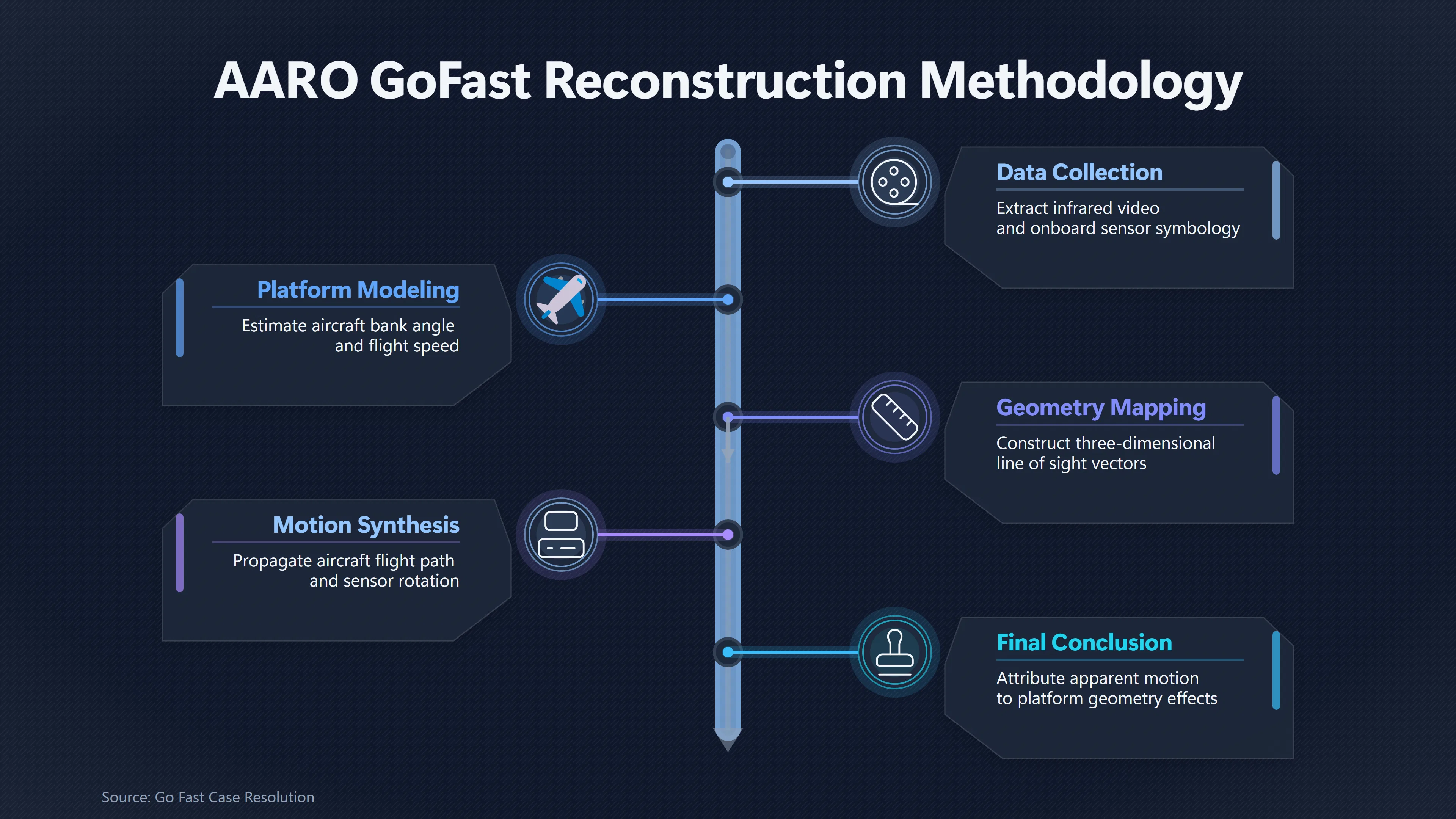
AARO’s detailed reconstruction of GoFast demonstrates why aircraft attitude cannot simply be ignored. Its methodology treated the target’s position as a line-of-sight vector that had to be rotated using the sensor and aircraft geometry. AARO describes aircraft roll as one of the relevant rotations and states that the F/A-18 was banking at approximately 14 degrees during the analysed interval. The sensor azimuth changed from about 49 degrees to 57 degrees and elevation from about −29 degrees to −35 degrees over 13 seconds.[AARO]aaro.milUNCLASSIFIED…
Those figures are important because the video alone can invite a target-centred interpretation: the object is what the eye follows, so apparent changes tend to be attributed to it. The reconstruction instead requires an observer-centred question: where did the aircraft move, how did it rotate, and where did the sensor have to point as a result?
AARO ultimately concluded that GoFast’s striking apparent motion did not require extreme target speed. Its broader explanation of such cases is that motion parallax can make stationary or slow objects appear to move rapidly when observed from a fast platform, particularly through a small field of view.[AARO]aaro.milOpen source on aaro.mil.
The hidden-turn problem is related but more specific. Translation of the aircraft changes the viewing geometry; a turn additionally changes the platform’s orientation and trajectory. When the horizon is missing, the viewer loses one of the easiest ways of noticing that this second ingredient is present.
Why sensor pointing can be mistaken for target manoeuvring
A tracked object staying near the centre of a targeting display does not mean the observing aircraft is flying directly towards it, nor does movement of the scenery prove that the target itself has changed course. Tracking systems deliberately steer their line of sight independently of the platform.
This creates several overlapping motions:
- Aircraft translation: the observing aircraft is travelling through space, often at hundreds of knots.
- Aircraft rotation: banking changes its attitude and, in a sustained turn, its heading and flight path.
- Sensor rotation: the gimballed camera changes azimuth and elevation to maintain its view of the target.
- Target motion: the object may have its own velocity and course.
- Image stabilisation: the displayed scene may be processed so that some platform rotation is suppressed rather than appearing as straightforward frame rotation.
A short infrared clip is therefore the projection of several motions onto a two-dimensional display. Without aircraft attitude, heading, position and sensor-angle information, there is generally no safe shortcut from “the target looks as though it turned” to “the target physically executed that turn”.
NASA’s UAP Independent Study Team highlighted essentially this measurement problem. It found that UAP observations are frequently made with instruments not designed or calibrated specifically to constrain anomalous-object motion, while important metadata may be absent. That can prevent reliable determination of an object’s size, motion and nature even when video exists. NASA singled out GoFast as an example in which apparently anomalous behaviour could be substantially explained by motion of the sensor platform.[NASA Science]smd-cms.nasa.govScience NASAUNIDENTIFIED ANOMALOUS PHENOMENA Independent…
GoFast shows why the bank angle matters
GoFast provides an unusually useful concrete example because AARO published enough of its reconstruction to show how an analyst must restore context that the visual impression does not supply.
AARO did not possess the original sensor file and associated metadata, so its analysis relied on the publicly available 34-second infrared video and information displayed within it. The footage supplied range, sensor azimuth and elevation, aircraft altitude, speed and bank information, but not the aircraft’s exact location and heading. Because those missing quantities affected the calculated geometry, AARO modelled the possible aircraft headings rather than pretending the video contained information it did not.[AARO]aaro.milGo Fast Case ResolutionAARO GoFast Case ResolutionFebruary 24, 2025…
For the 13-second interval used in its calculations, AARO estimated a roughly 14-degree F/A-18 bank and an aircraft speed of about 190 metres per second. It then constructed the sensor’s line of sight in three dimensions and propagated the aircraft’s own flight path.[AARO]aaro.milUNCLASSIFIED…
That procedure illustrates the core lesson better than the video’s visual appearance does. The bank angle is not incidental cockpit trivia. It changes the observer’s trajectory and the geometry from which apparent target motion is being inferred.
The result was markedly less exotic than the impression produced by the tightly framed clip. AARO concluded that motion parallax accounted for the object’s apparent high speed; its analysis found a range of ordinary possible speeds rather than the extraordinary velocity the video can seem to suggest.[AARO]aaro.milOpen source on aaro.mil.
GoFast should not be stretched into proof that every disputed military UAP video has the same explanation. It demonstrates the narrower point: when a sensor platform is banking and the wider orientation cues are absent, interpreting motion directly from the picture can be badly misleading.
What would reveal a hidden platform turn?
The strongest analysis does not depend on whether a manoeuvre merely looks impressive. It asks whether independent information shows that the target, rather than the observer-sensor system, actually produced the angular change.
Several clues are particularly useful.
Aircraft bank and attitude data. A changing roll angle is direct evidence that the observing platform is manoeuvring. If that information is available in display symbology or telemetry, it should be incorporated before attributing changes in the image to the target. GoFast is a clear example of AARO doing exactly this.[AARO]aaro.milUNCLASSIFIED…
Aircraft heading and position. A bank becomes a curved flight path when the aircraft turns. Knowing successive positions and headings permits analysts to reconstruct the observer’s trajectory instead of treating the camera as stationary. AARO noted that missing exact heading and location prevented it from calculating a single unique GoFast solution, forcing it to examine a range of possible headings.[AARO]aaro.milGo Fast Case ResolutionAARO GoFast Case ResolutionFebruary 24, 2025…
Sensor azimuth and elevation. If the targeting pod is steadily changing its pointing angles while keeping an object centred, those angles contain information about the evolving line of sight. They must be interpreted alongside aircraft attitude, rather than treated as a direct record of target steering.
A visible horizon or stable distant reference. A natural horizon can expose roll immediately. Its absence removes that intuitive check. Aviation’s reliance on attitude instruments when reliable outside references disappear is a reminder of how important this cue is.[Federal Aviation Administration]faa.govFederal Aviation AdministrationAirman Education Programs | Federal Aviation AdministrationDecember 16, 2024…
Independent tracking. Radar tracks, telemetry or observations from another suitably separated sensor can help distinguish movement of the target from movement peculiar to one camera-platform geometry. NASA’s UAP study therefore emphasised calibrated observations, thorough sensor metadata and multiple measurements rather than relying on isolated imagery.[NASA]nasa.govUPDATE: NASA Shares UAP Independent Study Report; Names DirectorUPDATE: NASA Shares UAP Independent Study Report; Names Director
A particularly useful diagnostic question is: does the supposed target manoeuvre survive when the aircraft’s own motion and the sensor’s pointing history are reconstructed in an Earth-fixed coordinate system? If the extraordinary turn disappears after that transformation, it was principally a viewing-geometry effect. If it remains and is independently corroborated, the case for genuine target manoeuvring becomes substantially stronger.

A hidden turn is a risk, not a universal explanation
Missing horizon cues do not prove that a UAP was stationary, slow-moving or conventional. Nor can every unusual trajectory be dismissed simply by pointing out that the observer was aboard an aircraft. The correct criticism is narrower: a narrow airborne video cannot establish extraordinary target manoeuvring until platform motion has been separated from target motion.
That distinction matters because some disputed UAP cases remain contested precisely over assumptions about range, sensor behaviour, aircraft trajectory or supporting observations. For example, published researchers reconstructing the 2015 “Gimbal” encounter have argued for target motion consistent with aviator accounts under particular range assumptions, while alternative interpretations attribute important apparent behaviour to the imaging system and observing geometry. The disagreement demonstrates why a visually compelling clip alone cannot settle the kinematics.[arXiv]arxiv.orgOpen source on arxiv.org.
A scientifically stronger UAP record would therefore preserve both views of the event: the narrow sensor imagery that resolves the object and the broader contextual information that locates the sensor itself. NASA has stressed the need for systematic calibration, multiple measurements and complete metadata, while research programmes designed specifically for UAP observation have proposed combining narrow-field instruments with wide-field cameras and independent methods of determining position and motion.[NASA]nasa.govUPDATE: NASA Shares UAP Independent Study Report; Names DirectorUPDATE: NASA Shares UAP Independent Study Report; Names Director
The practical lesson is simple but consequential. When the horizon disappears from an airborne UAP video, the observer’s turn can disappear from human perception with it. The target may then seem to inherit motion that actually belongs partly—or sometimes predominantly—to the aircraft and its tracking sensor. Restoring the aircraft’s bank, heading, position and line-of-sight history is therefore not an optional refinement. It is a prerequisite for deciding whether the manoeuvre seen on screen was really performed by the object at all.
Amazon book picks
Further Reading
Books and field guides related to Can a Hidden Aircraft Turn Fake a UFO Maneuver?. Use these as the next step if you want deeper reading beyond the article.
Flight Dynamics Principles
Flight dynamicists today need not only a thorough understanding of the classical stability and control theory of aircraft, but also a wor...
Introduction to Flight
Noted for its highly readable style, the new edition of this bestseller provides an updated overview of aeronautical and aerospace engine...
Aircraft Control and Simulation
This second edition covers aerodynamics, the control systems and the mathematics involved in analysing the performance of aircraft not on...
Computer Vision: Algorithms and Applications
Computer Vision: Algorithms and Applications explores the variety of techniques used to analyze and interpret images. It also describes c...
eBay marketplace picks
Marketplace Samples
Live-tested eBay searches with available results related to this page.
Selected fromUFO poster oneBay.co.uk.


Current eBay listing
I Want To Believe UFO Poster Giclée Fine Art Heavyweight Print

Current eBay listing
VINTAGE UFO FLYING SAUCERS COMIC ADVERTISING A2 POSTER PRINT

Endnotes
1.
Source: aaro.mil
Title: [Go Fast]({{ ‘go-fast/’ | relative_url }}) Case Resolution
Link:https://www.aaro.mil/Portals/136/PDFs/case_resolution_reports/AARO_GoFast_Case_Resolution_Card_Methodology_Final.pdf
Source snippet
AARO GoFast Case ResolutionFebruary 24, 2025...
Published: February 24, 2025
2.
Source: aaro.mil
Link:https://www.aaro.mil/Portals/136/PDFs/case_resolution_reports/AARO_GoFast_Case_Resolution_Card_Methodology_Final.pdf?ver=qXvjrruO_0MgtnTsfYnCEQ%3D%3D
Source snippet
UNCLASSIFIED...
3.
Source: smd-cms.nasa.gov
Title: Science NASA
Link:https://smd-cms.nasa.gov/wp-content/uploads/2023/09/uap-independent-study-team-final-report.pdf
Source snippet
UNIDENTIFIED ANOMALOUS PHENOMENA Independent...
4.
Source: skybrary.aero
Title: Flight Instrument Presentation of Aircraft Attitude | SKYbrary Aviation Safety
Link:https://skybrary.aero/index.php/articles/flight-instrument-presentation-aircraft-attitude
Source snippet
Flight Instrument Presentation of Aircraft Attitude | SKYbrary Aviation Safety...
5.
Source: skybrary.aero
Title: Electronic Attitude Direction Indicator (EADI) | SKYbrary Aviation Safety
Link:https://skybrary.aero/index.php/articles/electronic-attitude-direction-indicator-eadi
Source snippet
Electronic Attitude Direction Indicator (EADI) | SKYbrary Aviation Safety...
6.
Source: faa.gov
Link:https://www.faa.gov/pilots/training/airman_education/topics_of_interest/spatial_disorientation
Source snippet
Federal Aviation AdministrationAirman Education Programs | Federal Aviation AdministrationDecember 16, 2024...
Published: December 16, 2024
7.
Source: faa.gov
Link:https://www.faa.gov/lessons_learned/rotorcraft/accidents/N828AC
8.
Source: faa.gov
Link:https://www.faa.gov/data_research/research/med_humanfacs/oamtechreports/1960s/1968/196811
9.
Source: faa.gov
Link:https://www.faa.gov/data_research/research/med_humanfacs/oamtechreports/1960s/1968/196822
10.
Source: developer.dji.com
Title: Developer Gimbal
Link:https://developer.dji.com/mobile-sdk/documentation/introduction/component-guide-gimbal.html
11.
Source: aaro.mil
Link:https://www.aaro.mil/FAQ/
12.
Source: nasa.gov
Title: UPDATE: NASA Shares UAP Independent Study Report; Names Director
Link:https://www.nasa.gov/news-release/update-nasa-shares-uap-independent-study-report-names-director/
13.
Source: faa.gov
Title: Federal Aviation Administration Chapter 8. Medical Facts for Pilots
Link:https://www.faa.gov/air_traffic/publications/atpubs/aim/aim0801.html
14.
Source: arxiv.org
Link:https://arxiv.org/abs/2306.08773
15.
Source: arxiv.org
Link:https://arxiv.org/abs/2305.18566
16.
Source: developer.dji.com
Title: gimbal function
Link:https://developer.dji.com/doc/payload-sdk-tutorial/en/function-overview/basic-function/gimbal-function.html
17.
Source: navsea.navy.mil
Link:https://www.navsea.navy.mil/Media/News/Article-View/Article/4494885/navys-directed-energy-systems-integration-lab-to-train-sailors-on-laser-weapons/
18.
Source: science.nasa.gov
Link:https://science.nasa.gov/uap/faqs/
19.
Source: aaro.mil
Link:https://www.aaro.mil/Next-AARO-Home-redesign/Next-Parent/Next-AARO-UAP-Imagery-Acc-Table/
20.
Source: aaro.mil
Link:https://www.aaro.mil/Next-AARO-Home-redesign/Next-Parent/Next-UAP-Report-Documents/poster/dividLink/
21.
Source: faa.gov
Title: Beechcraft Bonanza 35 | Federal Aviation Administration
Link:https://www.faa.gov/lessons_learned/small_airplane/accidents/N3794N
22.
Source: science.nasa.gov
Link:https://science.nasa.gov/uap/
23.
Source: nasa.gov
Link:https://www.nasa.gov/directorates-armd-aosp-atm-x-utm-bvlos/
24.
Source: techport.nasa.gov
Link:https://techport.nasa.gov/projects/103134
25.
Source: aaro.mil
Link:https://www.aaro.mil/Next-AARO-Home-redesign/Next-Parent/Presidential-UAP-Transparency-Initiative/
26.
Source: nasa.gov
Title: Parabolic Flight
Link:https://www.nasa.gov/mission/parabolic-flight/
27.
Source: aaro.mil
Link:https://www.aaro.mil/Next-AARO-Home-redesign/Next-Parent/Presidential-UAP-Transparency-Initiative/videoid/1014097/dvpcc/false/
28.
Source: ntrs.nasa.gov
Link:https://ntrs.nasa.gov/citations/20230018164
29.
Source: ntrs.nasa.gov
Link:https://ntrs.nasa.gov/citations/20230017968
30.
Source: aaro.mil
Link:https://www.aaro.mil/Next-AARO-Home-redesign/Next-Parent/Presidential-UAP-Transparency-Initiative/videoid/1006080/dvpmoduleid/77396/
31.
Source: aaro.mil
Link:https://www.aaro.mil/Next-AARO-Home-redesign/Next-Parent/Presidential-UAP-Transparency-Initiative/videoid/1006062/dvpcc/false/
32.
Source: aaro.mil
Link:https://www.aaro.mil/Next-AARO-Home-redesign/Next-Parent/Presidential-UAP-Transparency-Initiative/videoid/1006060/dvpcc/false/
33.
Source: aaro.mil
Link:https://www.aaro.mil/Next-AARO-Home-redesign/Next-Parent/Presidential-UAP-Transparency-Initiative/videoid/1007791/dvpmoduleid/77396/
34.
Source: ntrs.nasa.gov
Link:https://ntrs.nasa.gov/citations/20210024622
35.
Source: aaro.mil
Link:https://www.aaro.mil/Next-AARO-Home-redesign/Next-Parent/Presidential-UAP-Transparency-Initiative/videoid/1007740/dvpcc/false/
36.
Source: aaro.mil
Link:https://www.aaro.mil/Next-AARO-Home-redesign/Next-Parent/Presidential-UAP-Transparency-Initiative/videoid/1006093/dvpcc/false/
37.
Source: nasa.gov
Title: Testing of X-59 Virtual Forward Window Successful
Link:https://www.nasa.gov/aeronautics/testing-of-x-59-virtual-forward-window-successful/
38.
Source: ntrs.nasa.gov
Link:https://ntrs.nasa.gov/citations/20170003878
39.
Source: ntrs.nasa.gov
Link:https://ntrs.nasa.gov/citations/20150002789
40.
Source: faa.gov
Link:https://www.faa.gov/about/office_org/headquarters_offices/avs/offices/aam/cami/library/online_libraries/aerospace_medicine/sd/hfm/session6
41.
Source: navair.navy.mil
Link:https://www.navair.navy.mil/node/17521
42.
Source: navair.navy.mil
Link:https://www.navair.navy.mil/node/10591
43.
Source: navair.navy.mil
Link:https://www.navair.navy.mil/node/10226
44.
Source: navair.navy.mil
Link:https://www.navair.navy.mil/node/4906
45.
Source: navair.navy.mil
Link:https://www.navair.navy.mil/node/4926
46.
Source: navair.navy.mil
Link:https://www.navair.navy.mil/node/11516
47.
Source: navair.navy.mil
Link:https://www.navair.navy.mil/node/7331
48.
Source: navair.navy.mil
Link:https://www.navair.navy.mil/node/6051
49.
Source: navair.navy.mil
Link:https://www.navair.navy.mil/node/7701
50.
Source: navair.navy.mil
Link:https://www.navair.navy.mil/node/3881
51.
Source: asrs.arc.nasa.gov
Title: cb 246
Link:https://asrs.arc.nasa.gov/publications/callback/cb_246.htm
52.
Source: navair.navy.mil
Link:https://www.navair.navy.mil/node/3091
53.
Source: ntrs.nasa.gov
Link:https://ntrs.nasa.gov/citations/19980018292
54.
Source: ntrs.nasa.gov
Link:https://ntrs.nasa.gov/citations/19980019496
55.
Source: ntrs.nasa.gov
Link:https://ntrs.nasa.gov/citations/19930048007
56.
Source: ntrs.nasa.gov
Link:https://ntrs.nasa.gov/citations/19920007932
57.
Source: ntrs.nasa.gov
Link:https://ntrs.nasa.gov/citations/19860030944
58.
Source: ntrs.nasa.gov
Link:https://ntrs.nasa.gov/citations/19830005275
59.
Source: ntrs.nasa.gov
Link:https://ntrs.nasa.gov/citations/19800028905
60.
Source: ntrs.nasa.gov
Link:https://ntrs.nasa.gov/citations/19770007902
61.
Source: faa.gov
Title: Office of Aerospace Medicine Technical Reports | Federal Aviation Administration
Link:https://www.faa.gov/data_research/research/med_humanfacs/oamtechreports/1970s/1973/7309
62.
Source: faa.gov
Link:https://www.faa.gov/data_research/research/med_humanfacs/oamtechreports/1960s/1968/196812
63.
Source: faa.gov
Link:https://www.faa.gov/air_traffic/publications/atpubs/aip_html/part2_enr_section_1.1.html
64.
Source: faa.gov
Link:https://www.faa.gov/data_research/research/med_humanfacs/oamtechreports/1960s/1962/196215
65.
Source: faa.gov
Link:https://www.faa.gov/air_traffic/publications/atpubs/fs_html/chap3_section_3.html
66.
Source: www1.grc.nasa.gov
Title: object motion due to a side force
Link:https://www1.grc.nasa.gov/beginners-guide-to-aeronautics/object-motion-due-to-a-side-force/
67.
Source: impact.earthdata.nasa.gov
Link:https://impact.earthdata.nasa.gov/casei/instrument/APU/
68.
Source: skybrary.aero
Title: S E201: Airplane State Awareness
Link:https://skybrary.aero/articles/se201-airplane-state-awareness-bank-angle-alerting-and-recovery-guidance-systems
69.
Source: skybrary.aero
Link:https://skybrary.aero/articles/spatial-disorientation-oghfa-se
70.
Source: skybrary.aero
Link:https://skybrary.aero/index.php/articles/vision-oghfa-bn
71.
Source: skybrary.aero
Link:https://skybrary.aero/index.php/articles/flight-path-vector-fpv
72.
Source: skybrary.aero
Link:https://skybrary.aero/index.php/articles/visual-illusions
73.
Source: skybrary.aero
Link:https://skybrary.aero/index.php/articles/general-aviation-night-flying-guidance
74.
Source: skybrary.aero
Link:https://skybrary.aero/index.php/articles/spatial-disorientation
75.
Source: skybrary.aero
Link:https://skybrary.aero/index.php/articles/somatogravic-and-somatogyral-illusions
76.
Source: skybrary.aero
Link:https://skybrary.aero/index.php/articles/vestibular-system-and-illusions-oghfa-bn
77.
Source: skybrary.aero
Link:https://skybrary.aero/index.php/articles/situational-awareness-oghfa-bn
78.
Source: aaro.mil
Link:https://www.aaro.mil/
79.
Source: aaro.mil
Link:https://www.aaro.mil/UAP-Cases/Official-UAP-Imagery/4/
80.
Source: aaro.mil
Title: AAR O UAP Trends All-domain Anomaly Resolution Office UAP REPORTING TRENDS
Link:https://www.aaro.mil/UAP-Cases/UAP-Reporting-Trends/
81.
Source: aaro.mil
Link:https://www.aaro.mil/Next-AARO-Home-redesign/Next-Parent/Next-AARO-UAP-Trends/
82.
Source: aaro.mil
Link:https://www.aaro.mil/Next-AARO-Home-redesign/Next-Parent/Next-AARO-UAP-Imagery-Fixed-Table/
83.
Source: aaro.mil
Link:https://www.aaro.mil/Next-AARO-Home-redesign/Next-Parent/Next-UAP-Case-RR-Data-Table/
84.
Source: aaro.mil
Link:https://www.aaro.mil/UAP-Cases/Official-UAP-Imagery/ftag/MSF0951a18/
85.
Source: aaro.mil
Link:https://www.aaro.mil/Next-AARO-Home-redesign/Next-Parent/AARO-UAP-Case-Resolution-DT/
86.
Source: aaro.mil
Title: UAP Imagery* “Go Fast” Object NAVAIR
Link:https://www.aaro.mil/Next-AARO-Home-redesign/Inactive-Parent/Next-UAP-Imagery-dup/
87.
Source: aaro.mil
Link:https://www.aaro.mil/Next-AARO-Home-redesign/Bruce-working/Next-AARO-UAP-Trends-Charts/
88.
Source: aaro.mil
Title: AAR O UAP Trends All-domain Anomaly Resolution Office UAP REPORTING TRENDS
Link:https://www.aaro.mil/UAP-Cases/UAP-Reporting-Trends/quot/
89.
Source: iufodb.com
Link:https://www.iufodb.com/gimbal/
90.
Source: metabunk.org
Link:https://www.metabunk.org/threads/gimbal-3d-analysis.12303/
91.
Source: ufodisclosure.us
Link:https://ufodisclosure.us/gimbal/
92.
Source: zfilesuap.com
Link:https://zfilesuap.com/en/cases
93.
Source: atsb.gov.au
Link:https://www.atsb.gov.au/taxonomy/term/385
Additional References
94.
Source: youtube.com
Link:https://www.youtube.com/watch?v=fh3znHctOkA
Source snippet
The SHOCKING Math Error Behind Viral UFO Videos | Mick West...
95.
Source: youtube.com
Title: How to Recognize and Overcome Spatial Disorientation
Link:https://www.youtube.com/watch?v=YatlPrTZUNs
Source snippet
ATPL Instruments 022 - Ep.29: Artificial Horizon | ATPL Training | ATPL Exams...
96.
Source: youtube.com
Title: The SHOCKING Math Error Behind Viral UFO Videos | Mick West
Link:https://www.youtube.com/watch?v=ypfbhfEXnBo
Source snippet
GOFAST UFO Analysis (yeah no, probably just a balloon)...
97.
Source: youtube.com
Title: GOFAST UFO Analysis (yeah no, probably just a balloon)
Link:https://www.youtube.com/watch?v=-3NYowlCoDc
Source snippet
How to Recognize and Overcome Spatial Disorientation...
98.
Source: metabunk.org
Link:https://www.metabunk.org/threads/go-fast-footage-from-tom-delonges-to-the-stars-academy-bird-balloon.9569/page-9
99.
Source: metabunk.org
Link:https://www.metabunk.org/threads/go-fast-footage-from-tom-delonges-to-the-stars-academy-bird-balloon.9569/post-240166
100.
Source: tumgik.com
Link:https://www.tumgik.com/tag/transmedium%20objects
101.
Source: studylib.net
Link:https://studylib.net/doc/28152514/book-05-aircraft-general-knowledge-4-instrumentation
102.
Source: manualzz.com
Link:https://manualzz.com/doc/78396313/autel-robotics-evo-ii-rtk-v3-series-user-manual
103.
Source: ar15.com
Link:https://www.ar15.com/forums/topic.html?b=1&f=5&fvx=1&page=9&t=2456591&tl=Extraordinary-explanations-for-UFOs-look-increasingly-plausible