Within Bright Stars
Can Moving Clouds Make a Star Look Mobile?
Clouds crossing a fixed star can create apparent sliding, blinking and sudden movement that resembles an active light in the sky.
On this page
- How induced motion changes the apparent direction of a star
- How cloud gaps create blinking and disappearing lights
- How foreground references can reveal the illusion
Page outline Jump by section
Introduction
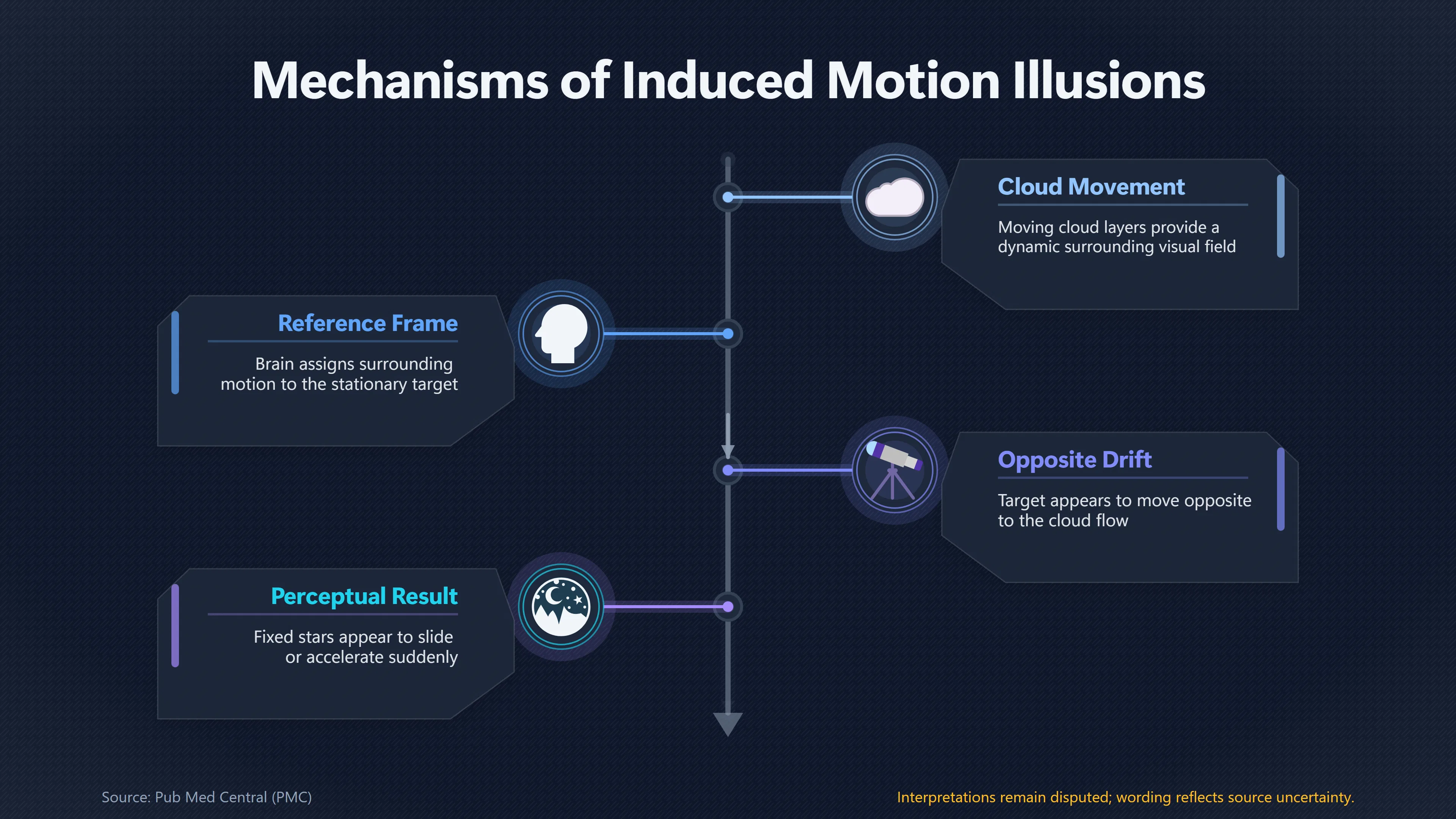
Yes. Moving clouds can make a fixed star or planet appear to slide, accelerate, reverse direction, blink or suddenly vanish even though the astronomical object has not made any comparable movement. The key perceptual mechanism is induced motion: when a stationary target is seen against, beside or through a moving visual field, the brain can attribute some of the surrounding field’s motion to the target itself. The classic psychology example is the Moon apparently travelling in the opposite direction to clouds crossing in front of it. Laboratory research confirms the same general effect with stationary targets and moving surrounds.[PubMed Central (PMC)]pmc.ncbi.nlm.nih.govPub Med Central (PMCYes. Moving clouds can make a fixed star or planet appear to slide, accelerate, reverse direction, blink or suddenly vanish even though t…
For UFO/UAP identification, this matters because a bright star is already a small, distant point with few useful depth cues. Add a moving cloud layer and the observer gains a powerful but misleading reference frame. Broken cloud can also alternately reveal and conceal the light, turning steady starlight into what looks like a manoeuvring or intermittently illuminated aerial object. Historical UFO investigations explicitly recognised bright astronomical objects viewed through moving cloud as a source of reports.[Wikisource]en.wikisource.orgPage:AARO Historical Record Report VolumeFor UFO/UAP identification, this matters because a bright star is already a small, distant point with few useful depth cues. Add a moving…
How clouds can make a star move the wrong way
The most important distinction is between physical motion and perceived relative motion. A cloud really does cross the observer’s line of sight. The distant star, over the few seconds involved, is effectively fixed relative to the surrounding star field. Yet the visual system has to decide which part of the scene is moving.
It does not determine motion solely from an object’s absolute position. Visual perception makes extensive use of relationships between objects and their surroundings. In induced motion, genuine movement of a surrounding stimulus can produce illusory movement of a stationary target in the opposite direction. The Oxford Compendium of Visual Illusions describes object-centred reference frames — the tendency to encode objects relative to one another — as a central idea in explanations of the effect.[OUP Academic]academic.oup.comIt does not determine motion solely from an object's absolute position. Visual perception makes extensive use of relationships between ob…
The cloud-and-celestial-object example is sufficiently characteristic that perception researchers use it explicitly. In an experimental study of induced motion, researchers Robert Post and colleagues describe the familiar case of the Moon viewed through moving clouds: although the Moon is essentially stationary from the observer’s perspective, it appears to travel opposite to the cloud movement. Experiments in the same study produced corresponding effects by placing a stationary target within an oscillating visual surround.[PubMed]pubmed.ncbi.nlm.nih.govPub MedThe cloud-and-celestial-object example is sufficiently characteristic that perception researchers use it explicitly. In an experimental s…
A star can occupy the same perceptual role as the Moon, although it provides an even poorer indication of its true distance. Imagine a brilliant star visible through a broad gap in cloud moving from west to east. If the moving cloud edges become the dominant visual reference, some of their eastward displacement may be perceptually assigned to the star in the opposite direction. The observer can consequently experience the star as sliding westwards.
This is not simply a theoretical peculiarity. Research has found that the speed of the moving inducer is an important factor in the strength of induced motion, while experiments show that motion elsewhere in the visual field can alter the perceived movement of a physically stationary target. Brain-imaging work likewise finds activity in motion-sensitive visual cortex corresponding more closely to the perceived speed produced by induced motion than to the target’s actual physical speed.[PubMed]pubmed.ncbi.nlm.nih.govPub MedThis is not simply a theoretical peculiarity. Research has found that the speed of the moving inducer is an important factor in the stren…
That combination helps explain why the illusion can feel convincing. The observer is not necessarily making a conscious inference such as “the cloud is stationary, therefore the light must be moving”. The apparent movement can arise within the mechanisms that construct visual motion in the first place.
Why the apparent direction can be misleading
A useful clue is that induced motion commonly runs opposite to the motion of the surrounding field. That means a witness’s description of the light’s direction does not necessarily describe the physical movement of the astronomical source.[PubMed]pubmed.ncbi.nlm.nih.govPub MedA useful clue is that induced motion commonly runs opposite to the motion of the surrounding field. That means a witness's description of…
The everyday analogy is sitting in a stationary train when the train beside it starts moving. For a moment, it can feel as though one’s own carriage has begun travelling in the opposite direction. The retinal information establishes strong relative movement, but there may initially be insufficient external information to assign that movement correctly. Moving clouds and a bright astronomical object create a related visual ambiguity.[aboonline.org.br]aboonline.org.brbasics of seeing motionThe everyday analogy is sitting in a stationary train when the train beside it starts moving. For a moment, it can feel as though one's o…
Clouds are especially effective because they can occupy a large fraction of the visual field. Instead of comparing the star with a clearly fixed building or horizon, an observer looking upwards may see little except the bright point and an extensive layer of cloud drifting around it. Research on induced motion distinguishes several interacting mechanisms and reference frames, rather than reducing the phenomenon to a single simple trick, but the practical result remains the same: movement in a surrounding scene can be misallocated to a stationary target.[PubMed]pubmed.ncbi.nlm.nih.govPub MedA useful clue is that induced motion commonly runs opposite to the motion of the surrounding field. That means a witness's description of…
The perceived movement need not remain perfectly smooth. Real clouds have irregular edges, gaps and differences in speed and opacity. The visual relationship between the star and its immediate surroundings therefore changes continually. A light may appear to drift during one interval, become apparently stationary when the reference pattern changes, and then seem to move again when another cloud edge crosses the area.
That pattern can be more suggestive of an active aerial object than a simple constant drift would be. A witness might describe a light as “hovering, then moving”, “changing course” or “sliding sideways”, even though the principal physical movement in the scene belongs to the cloud layer.
How cloud gaps create blinking and disappearing lights
Cloud does something else that is particularly important in unusual-light reports: it changes whether the astronomical source can be seen at all.
Cloud cover is not a uniform shutter. Thin areas transmit more starlight than thick ones, while gaps expose the star directly. Astronomers exploit precisely this relationship when monitoring cloud: an astronomical cloud-monitoring system described by Shamir and Nemiroff derived relative atmospheric opacity from measurements of numerous background stars, demonstrating how cloud transmission changes the recorded brightness of stellar sources.[arXiv]arxiv.orgCloud cover is not a uniform shutter. Thin areas transmit more starlight than thick ones, while gaps expose the star directly. Astronomer…
To a naked-eye observer, the sequence can therefore look surprisingly dynamic. A bright star may remain visible through thin cloud but become dimmer; disappear as a denser patch crosses it; reappear through a gap; brighten again as the cloud thins; and disappear abruptly behind another opaque section.
In a UFO/UAP account, those ordinary visibility changes can acquire behavioural language: the light “switched off”, “flashed”, “vanished”, “returned” or “shot away”. UFO investigator Allan Hendry specifically discussed stars becoming suddenly obscured by moving cloud as one route to dramatic apparent disappearances, an observation subsequently summarised in discussions of UFO identification.[Google Books]books.google.comIn a UFO/UAP account, those ordinary visibility changes can acquire behavioural language: the light “switched off”, “flashed”, “vanished”…
The particularly deceptive situation is one in which occlusion and induced motion occur together. Suppose a star appears to drift towards the edge of a moving cloud gap. It then disappears as the cloud crosses the line of sight. Perceptually, those two events can form a coherent story: the “object” seemed to move and then vanished. Physically, however, the star remained behind the cloud while the foreground opening moved past it.
A later gap can make the same light reappear somewhere that seems displaced relative to the remembered cloud pattern. Because the clouds themselves have moved in the meantime, the observer may have difficulty reconstructing the star’s original location. What was actually intermittent visibility of one fixed celestial source can therefore resemble a light performing separate movements.
Why this can resemble an active aerial light
Cloud-induced motion is particularly relevant to bright-star UFO reports because several ambiguities reinforce one another. The observer usually cannot judge the star’s distance directly; the surrounding cloud provides obvious movement; the cloud may intermittently alter the light’s brightness; and the star may already be conspicuous enough to attract sustained attention.
Official historical UFO material recognised this combination. Project Blue Book described astronomical sightings — including bright stars and planets — as a common identification category and noted that planets observed through haze, light fog, moving clouds or other obscuring conditions had been reported as UFOs. The US Department of Defense’s All-domain Anomaly Resolution Office repeated this historical finding in its 2024 review of US government UAP investigations.[bahaistudies.net]bahaistudies.netproject blue bookOfficial historical UFO material recognised this combination. Project Blue Book described astronomical sightings — including bright stars…
There is also a separate visual illusion that can strengthen the impression of movement: autokinesis. When a person stares at a small stationary light in darkness without adequate reference points, the light itself can appear to wander. The US Federal Aviation Administration treats this as a genuine night-flying hazard, warning that a stationary light stared at for several seconds can seem to move.[Federal Aviation Administration]faa.govThere is also a separate visual illusion that can strengthen the impression of movement: autokinesis. When a person stares at a small sta…
Autokinesis and cloud-induced motion should not be treated as interchangeable explanations. The first is especially associated with an isolated stationary point in darkness; induced motion specifically involves movement elsewhere in the visual scene altering the perceived movement of the target. But an actual night-sky observation can move between those conditions. A star might first be watched in a largely featureless patch of sky and then become surrounded by drifting cloud, allowing different perceptual effects to reinforce the overall impression that the light is mobile.[Skybrary]skybrary.aeroautokinetic effectAutokinesis and cloud-induced motion should not be treated as interchangeable explanations. The first is especially associated with an is…
Foreground references can expose the illusion
The most useful test is to stop judging the star’s position relative to the clouds and compare it instead with something known to be stationary.
A roof edge, chimney, telegraph pole, distant ridge or other fixed landmark provides a reference frame independent of the moving cloud. If the supposed aerial light appears to race through the clouds while maintaining essentially the same relationship to a fixed terrestrial reference over a short interval, that is strong evidence that the clouds — rather than the light — are supplying the conspicuous motion.
Other stars can serve the same purpose when conditions permit. If several stars retain their pattern while cloud passes across them, the observer has a much stronger celestial reference frame. The allegedly moving light can then be checked against neighbouring stars rather than against the foreground cloud.
A recording can be particularly informative if it includes those references. Instead of asking whether the bright point looks as though it moves, compare its position frame by frame with a fixed roofline or with other identifiable stars. If its separation from those references remains stable while cloud structures cross the image, the recording distinguishes genuine angular displacement from perceived motion.
This illustrates a broader principle demonstrated experimentally in induced-motion research: motion judgements depend heavily on the reference frame available to the visual system. A moving surround can bias the apparent position and motion of a stationary target; introducing independent positional information gives the observer a better basis for deciding which part of the scene is actually moving.[PubMed]pubmed.ncbi.nlm.nih.govPub MedThe cloud-and-celestial-object example is sufficiently characteristic that perception researchers use it explicitly. In an experimental s…
What cloud motion can — and cannot — establish
Moving cloud is therefore a credible explanation for a specific family of observations: a star-like light that seems to drift or slide while cloud crosses nearby, repeatedly dims or disappears as cloud passes over it, or appears to move in a direction related to the movement of the surrounding cloud field.
It is not, by itself, proof that every apparently moving light near cloud is astronomical. A sound identification still requires the proposed star or planet to have been in the correct part of the sky at the reported time, and any recorded displacement should be tested against fixed references rather than assumed to be illusory.
The diagnostic value lies in the combination of clues. Apparent movement opposite to the cloud flow fits induced motion particularly well; fading or disappearance as a cloud edge reaches the light supports obscuration; reappearance through another gap strengthens that interpretation; and stability relative to stars or terrestrial landmarks is the strongest straightforward check that the source itself has not executed the apparent manoeuvre. These expectations follow directly from experimental work on induced motion and from the established effect of variable cloud opacity on stellar visibility.[nih.gov]pmc.ncbi.nlm.nih.govPub Med Central (PMCYes. Moving clouds can make a fixed star or planet appear to slide, accelerate, reverse direction, blink or suddenly vanish even though t…
For the broader problem of bright stars mistaken for hovering aerial objects, moving clouds are therefore more than incidental bad weather. They can actively restructure the visual scene: supplying a false moving reference frame, modulating the brightness of the source and intermittently removing it from view. The resulting experience can contain apparent motion, stopping, blinking and disappearance even though the astronomical light remains where celestial geometry predicts it should be.
Amazon book picks
Further Reading
Books and field guides related to Can Moving Clouds Make a Star Look Mobile?. Use these as the next step if you want deeper reading beyond the article.
The Invisible Gorilla: How Our Intuitions Deceive Us
NEW YORK TIMES BESTSELLER • Our minds don’t work the way we think they do. Two renowned psychologists explain how and why our intuitions...
Visual Intelligence: Sharpen Your Perception, Change Your Life
An engrossing guide to seeing—and communicating—more clearly from the groundbreaking course that helps FBI agents, cops, CEOs, ER docs, a...
Color and Light in Nature
We live in a world of optical marvels - from the commonplace but beautiful rainbow, to the rare and eerie superior mirage. But how many o...
NightWatch: A Practical Guide to Viewing the Universe
A practical guide to viewing the universe.
eBay marketplace picks
Marketplace Samples
Live-tested eBay searches with available results related to this page.
Selected fromstar wall art oneBay.co.uk.



Endnotes
1.
Source: pmc.ncbi.nlm.nih.gov
Title: Pub Med Central (PMC)
Link:https://pmc.ncbi.nlm.nih.gov/articles/PMC2652014/
Source snippet
Yes. Moving clouds can make a fixed star or planet appear to slide, accelerate, reverse direction, blink or suddenly vanish even though t...
2.
Source: en.wikisource.org
Title: Page:AARO Historical Record Report Volume 1 2024
Link:https://en.wikisource.org/wiki/Page%3AAARO_Historical_Record_Report_Volume_1_2024.pdf/18
Source snippet
For UFO/UAP identification, this matters because a bright star is already a small, distant point with few useful depth cues. Add a moving...
3.
Source: academic.oup.com
Link:https://academic.oup.com/book/27344/chapter/197069671
Source snippet
It does not determine motion solely from an object's absolute position. Visual perception makes extensive use of relationships between ob...
4.
Source: pubmed.ncbi.nlm.nih.gov
Title: Pub Med
Link:https://pubmed.ncbi.nlm.nih.gov/18751688/
Source snippet
The cloud-and-celestial-object example is sufficiently characteristic that perception researchers use it explicitly. In an experimental s...
5.
Source: pubmed.ncbi.nlm.nih.gov
Title: Pub Med
Link:https://pubmed.ncbi.nlm.nih.gov/20884559/
Source snippet
This is not simply a theoretical peculiarity. Research has found that the speed of the moving inducer is an important factor in the stren...
6.
Source: pubmed.ncbi.nlm.nih.gov
Title: Pub Med
Link:https://pubmed.ncbi.nlm.nih.gov/1762872/
Source snippet
A useful clue is that induced motion commonly runs opposite to the motion of the surrounding field. That means a witness's description of...
7.
Source: aboonline.org.br
Title: basics of seeing motion
Link:https://www.aboonline.org.br/details/509/en-US/basics-of-seeing-motion
Source snippet
The everyday analogy is sitting in a stationary train when the train beside it starts moving. For a moment, it can feel as though one's o...
8.
Source: arxiv.org
Link:https://arxiv.org/abs/astro-ph/0506354
Source snippet
Cloud cover is not a uniform shutter. Thin areas transmit more starlight than thick ones, while gaps expose the star directly. Astronomer...
9.
Source: books.google.com
Link:https://books.google.com/books/about/The_UFO_Handbook.html?id=ATZGAAAAYAAJ
Source snippet
In a UFO/UAP account, those ordinary visibility changes can acquire behavioural language: the light “switched off”, “flashed”, “vanished”...
10.
Source: bahaistudies.net
Title: project blue book
Link:https://www.bahaistudies.net/asma/project_blue_book.pdf
Source snippet
Official historical UFO material recognised this combination. Project Blue Book described astronomical sightings — including bright stars...
11.
Source: faa.gov
Title: Federal Aviation Administration
Link:https://www.faa.gov/sites/faa.gov/files/regulations_policies/handbooks_manuals/aviation/airplane_handbook/12_afh_ch11.pdf
Source snippet
There is also a separate visual illusion that can strengthen the impression of movement: autokinesis. When a person stares at a small sta...
12.
Source: skybrary.aero
Title: autokinetic effect
Link:https://skybrary.aero/articles/autokinetic-effect
Source snippet
Autokinesis and cloud-induced motion should not be treated as interchangeable explanations. The first is especially associated with an is...
Additional References
13.
Source: youtube.com
Title: Relative Motion and Inertial Reference Frames
Link:https://www.youtube.com/watch?d=&v=wD7C4V9smG4
Source snippet
Patrick Cavanagh | Frame-induced Position Shifts...
14.
Source: youtube.com
Title: Auto Kinetic Effect (example)
Link:https://www.youtube.com/watch?d=&v=4SwfYCGc5O8
Source snippet
Autokinetic effect optical illusion UFO Autokinetic effect...
15.
Source: youtube.com
Title: Autokinetic effect
Link:https://www.youtube.com/watch?d=&v=pJcizDJoins
Source snippet
A paradoxical misperception of relative motion...
16.
Source: youtube.com
Title: “A paradoxical misperception of relative motion.”
Link:https://www.youtube.com/watch?d=&v=PPvfQVHwrpY
Source snippet
AutoKinetic Effect (example)...
17.
Source: youtube.com
Title: Patrick Cavanagh | Frame-induced Position Shifts
Link:https://www.youtube.com/watch?d=&v=BpRi-kfXP1I
Source snippet
Autokinetic effect...