Within Reentry
Why Separate Reentry Lights Can Look Solid
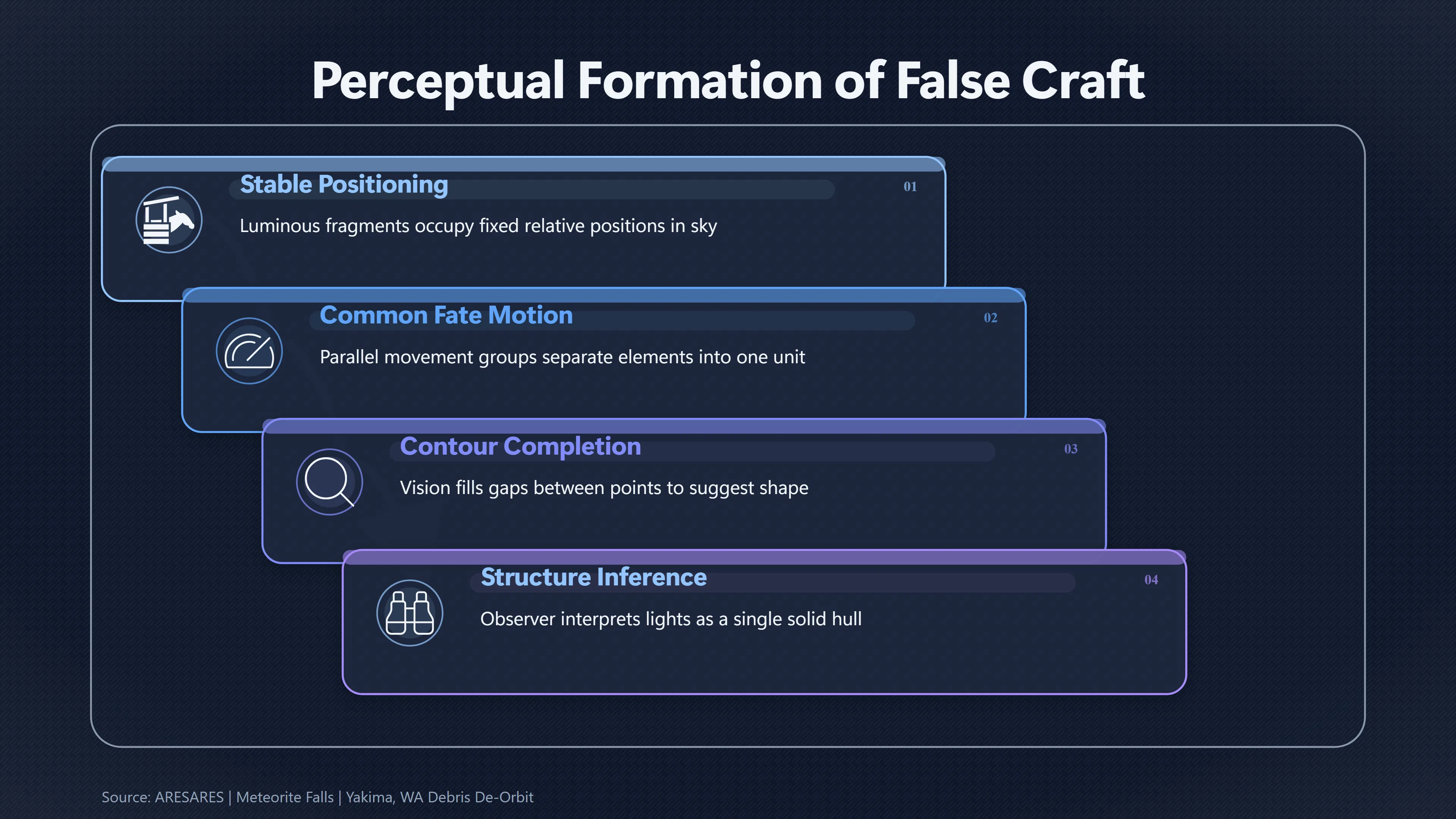
Fragments inherit nearly the same motion after breakup, allowing separated lights to preserve a formation that the eye may connect into one dark object.
On this page
- Why breakup fragments keep nearly parallel apparent tracks
- How the eye completes triangles and other missing contours
- How fading and differential slowing mimic manoeuvres
Page outline Jump by section
Introduction
A spacecraft or rocket body that breaks apart during atmospheric reentry can produce several bright fragments that continue across the sky on almost parallel tracks. To an observer, those lights may appear to keep fixed positions relative to one another for long enough to suggest the corners, edges or windows of one enormous craft. Yet no solid structure need exist between them. Instrumented observations confirm that reentry breakup produces fragments following closely related apparent trajectories, while vision research shows that elements sharing the same motion are especially likely to be perceptually grouped.[ESA Proceedings Database]conference.sdo.esoc.esa.intESA Proceedings DatabaseAnalysis of re-entry event of CZ-3B R/B observed by all-sky meteor cameras AMOS | ESA Proceedings Database…
This combination makes reentry unusually capable of producing a false impression of structure. The important distinction is between a formation of physical fragments and a physical object whose lights form a pattern. Common motion alone cannot establish the latter. When brightness changes and aerodynamic drag subsequently alter individual fragments, the apparent “craft” may even seem to change shape, shed lights or manoeuvre.
Why the fragments stay together
The apparent formation begins with the physics of breakup. NASA states that reentering spacecraft typically break apart at roughly 72–84 kilometres altitude when aerodynamic forces exceed structural limits, with about 78 kilometres used as a nominal breakup altitude. Once the parent vehicle fails, its components continue descending independently while undergoing further heating and drag.[Orbital Debris Program Office]orbitaldebris.jsc.nasa.govOpen source on nasa.gov.
Crucially, fragmentation does not reset each piece’s motion. Immediately before breakup, every component was travelling as part of the same vehicle. Immediately afterwards, the fragments therefore retain broadly similar velocities and directions, apart from comparatively small differences introduced by structural separation, aerodynamic forces and subsequent fragmentation. From a distant observer’s viewpoint, several luminous pieces can consequently sweep across the sky together rather than exploding radially apart like fragments in a cinematic blast.
A particularly useful instrumented example is the reentry of a Long March 3B third stage recorded by three AMOS camera systems in Hawaii. The European Space Agency conference analysis describes breakup of the parent body as producing fragments travelling along similar trajectories in the sky. The event lasted more than 50 seconds, and observations from two locations allowed individual fragment trajectories to be reconstructed to within tens of metres.[ESA Proceedings Database]conference.sdo.esoc.esa.intESA Proceedings DatabaseAnalysis of re-entry event of CZ-3B R/B observed by all-sky meteor cameras AMOS | ESA Proceedings Database…
That duration matters perceptually. The Aerospace Corporation notes that human-made reentries commonly remain visible for about 20–90 seconds or more and identifies a tight cluster of bright points moving in the same direction at similar speeds as a characteristic appearance of reentry breakup. Unlike a momentary flash, such a display gives an observer ample time to inspect the relative positions of the lights and interpret them as a coherent object.[The Aerospace Corporation]aerospace.orgOpen source on aerospace.org.
The March 2021 Falcon 9 upper-stage reentry over the US Pacific Northwest provides another well-documented example. NASA described it as a long-lasting, slow-moving cascade containing many fragments, with further fragmentation visible as the debris progressed across the sky. Sixty-eight eyewitness reports were submitted across four states, while weather radar subsequently detected falling metallic debris.[ARES]ares.jsc.nasa.govARESARES | Meteorite Falls | Yakima, WA Debris De-OrbitMarch 26, 2021…
These observations establish the physical half of the false-craft mechanism: separate reentry fragments really can maintain sufficiently similar apparent motion to look organised. The organisation does not have to be imaginary; what can be mistaken is the inference that a solid vehicle connects the organised lights.
Why separate lights can become one perceived object
Parallel motion is a particularly strong visual grouping cue. Vision researchers call the relevant principle common fate: spatially separated elements tend to be grouped when they undergo the same pattern of motion. Experiments have demonstrated that human vision can organise physically separate moving elements into coherent perceptual groups, with common direction of motion playing an important role.[PubMed Central (PMC)]pmc.ncbi.nlm.nih.govPub Med Central (PMC)Common-Fate Grouping as Feature SelectionPubMed Central (PMC)Common-Fate Grouping as Feature Selection - PMC…
This is almost tailor-made for a fragmented reentry. Imagine three bright fragments forming a loose triangle. If all three cross the sky at approximately the same angular speed and direction, the observer does not necessarily experience them merely as three unrelated dots. Their common motion provides evidence, perceptually, that they belong together.
That grouping can occur even though the supposed connecting surface is invisible. Experimental work on contour completion shows that the visual system can perceive boundaries between spatially separate inducing elements where no corresponding physical contour exists. The familiar Kanizsa-triangle family of illusions demonstrates the underlying point particularly clearly: appropriately positioned visual elements can make an observer perceive an organised shape whose complete boundary was never drawn.[PubMed]pubmed.ncbi.nlm.nih.govPub Med Visual inter-attribute contour completionVisual inter-attribute contour completion - PubMed…
A night-time reentry is not literally a Kanizsa illusion, and the laboratory result should not be treated as proof that every triangular group of lights will generate an illusory hull. It demonstrates a more limited but relevant fact: human vision does not require every edge of an object to be physically visible before organising separated cues into a coherent shape. Common motion strengthens that grouping further. Research combining spatial continuation with common-fate motion has found that the two forms of organisation can reinforce one another.[PubMed]pubmed.ncbi.nlm.nih.govNeural synergy in visual grouping: when good continuation meets common fate - PubMed…
This creates a plausible progression in an eyewitness observation:
- Several luminous fragments occupy stable relative positions.
- Their nearly parallel motion groups them perceptually.
- Three prominent lights can define a triangle; a longer row can suggest an elongated body.
- The dark sky between those points provides little competing surface information.
- The observer can consequently interpret the lights as belonging to the perimeter of one object rather than as independent objects.
The last step is an interpretation, not direct evidence of a connecting hull.
Why the “dark craft” can seem convincing
The night sky makes the distinction between lights belonging together and lights attached to one body unusually difficult. Distance, scale and altitude are poorly constrained when there are no nearby reference objects. If several points maintain their configuration while crossing an otherwise dark field, there may be little visual information available to reveal the actual distances separating them.
Historical UFO records show why that distinction matters. Britain’s National Archives notes that satellite reentries have generated large numbers of UFO reports and that most archived reports concern lights rather than directly observed craft. In the widely reported 31 March 1993 event over Britain, witnesses offered descriptions ranging from star-like lights and large bright objects to an oval dark silhouette and an object with a vapour trail. The event was ultimately identified as the reentry of rocket hardware associated with Cosmos 2238.[National Archives]nationalarchives.gov.ukNational Archives UFO reportsNational ArchivesUFO reports - The National Archives…
That range of descriptions is important. A single physical event need not produce identical witness reports, because different observers see different portions of the trajectory, from different viewing angles, under different lighting and atmospheric conditions. Some may notice the fragmentation and interpret it as debris; others may principally notice the arrangement and common motion of the brightest points.
A specialist reconstruction of another historical reentry, object 1974-060B, discusses precisely this reported transition from separate lights to apparent structured craft. Accounts associated with the event included formations of lights but also descriptions of an enormous cigar-shaped object. The analysis argues that reentry fragments distributed along a common trajectory can be interpreted as lights attached to a dark elongated body — sometimes called the “airship effect”.[Satellites Above]satobs.org1974 060B1974 060B
That source is a specialist satellite-observer reconstruction rather than an official investigation or controlled perceptual experiment, so its historical interpretation warrants more caution than the NASA and ESA instrumented evidence. Nevertheless, it illustrates the specific observational error at issue: the lights themselves can be genuine while the inferred surface joining them is not.
Why the formation eventually changes
If the fragments begin with nearly the same motion, why do they not remain in perfect formation? Because after breakup they are no longer aerodynamically identical.
NASA’s reentry modelling explicitly accounts for object shape, drag coefficient, mass, atmospheric conditions, spinning or tumbling behaviour and heating. Components made from different materials also heat and ablate differently.[Orbital Debris Program Office]orbitaldebris.jsc.nasa.govOpen source on nasa.gov.
These differences become increasingly important as the fragments penetrate denser atmosphere. A compact, heavy component may retain speed differently from a broad, light piece. One fragment may tumble and flare; another may dim as material is consumed; a third may undergo secondary fragmentation. NASA notes that components continue receiving aerodynamic heating after parent-body breakup until they either demise or survive towards the ground.[Orbital Debris Program Office]orbitaldebris.jsc.nasa.govOpen source on nasa.gov.
Modern measurements demonstrate that such divergence can be reconstructed rather than merely inferred. A 2026 study of the 19 February 2025 Falcon 9 upper-stage reentry used observations from 43 meteor cameras across central Europe to reconstruct 30 fragment trajectories. Researchers identified two main fragment families and fitted ballistic trajectories to estimate their loss of kinetic energy, with optical fragment emissions detected from roughly 85 down to 36 kilometres altitude.[arXiv]arxiv.orgOpen source on arxiv.org.
For an eyewitness who has already interpreted several lights as one craft, these independent changes can produce misleading impressions of behaviour. A fragment slowing relative to the others alters the apparent geometry. A fading fragment makes one “corner” disappear. A new breakup can create additional “lights”. A flare can make one point suddenly dominate the formation.
None of those effects requires controlled manoeuvring.
There is an especially important perceptual asymmetry here. The observer may first infer a single craft because the lights move together, then interpret later deviations as movements of parts of that same craft. In physical reality, the opposite sequence has occurred: one real object broke into several independent bodies, whose initially similar trajectories gradually diverged.
Apparent manoeuvres from fading and differential slowing
The strongest warning sign is therefore not simply that the formation changes. The manner in which it changes matters.
A powered aircraft or spacecraft holding a deliberate formation would be expected to display coordinated dynamics. Reentry fragments instead tend towards increasingly independent behaviour as drag, ablation and secondary fragmentation act differently upon them. The Aerospace Corporation specifically identifies numerous bright objects travelling together and leaving streaks as characteristic of reentry breakup.[The Aerospace Corporation]aerospace.orgOpen source on aerospace.org.
Several effects can look more purposeful than they are:
- One light “drops back”. Greater deceleration changes its position relative to neighbouring fragments.
- A corner disappears. The fragment may simply cease producing enough visible light.
- A light suddenly accelerates away. Relative motion within the group can be misread as acceleration, particularly without reliable distance information.
- The craft appears to rotate or deform. Changing relative positions alter the triangle, V-shape or line that the observer had mentally treated as a rigid outline.
- Small objects seem to emerge from a larger one. Secondary breakup can introduce new luminous fragments part-way through the sighting.
- The whole structure appears to dissolve. Fragments can fade at different times until the grouping cue that created the impression of a single object disappears.
These are not universal signatures: some genuine reentries remain relatively compact, others spread extensively, and viewing geometry can conceal much of the evolution. The diagnostic point is that changing geometry does not by itself establish manoeuvring.

What separates a false structure from a solid craft
No single visual cue is decisive. A triangular pattern, constant spacing or common velocity can all arise temporarily from fragments sharing the trajectory of their former parent body. Conversely, merely labelling any formation of lights “space debris” without matching it to a plausible reentry is not a satisfactory identification.
The strongest assessment combines the visual behaviour with independent constraints. A long-duration procession moving steadily across a large part of the sky, containing multiple luminous points, streaks and progressive fragmentation is consistent with the documented appearance of artificial reentry. NASA’s Pacific Northwest case and ESA’s Long March observations provide instrumented examples rather than relying solely on eyewitness interpretation.[ARES]ares.jsc.nasa.govARESARES | Meteorite Falls | Yakima, WA Debris De-OrbitMarch 26, 2021…
Timing and trajectory are even more valuable. Known orbital objects can often be associated with reentries, and multi-station observations can reconstruct fragment paths. That turns the question from “Does this look like a craft?” into the much stronger test: “Was a known artificial object entering the atmosphere along this path at this time?”
The wider UAP record makes that discipline worthwhile. The US All-domain Anomaly Resolution Office’s published statistics show satellites among its major categories of resolved cases, while British archival material likewise records satellite reentries among phenomena generating UFO reports. Those statistics do not imply that every structured-light report has this explanation; they establish that space objects are a demonstrated source of reports that initially appear anomalous.[AARO]aaro.milUAP TrendsUAP Trends
The key diagnostic lesson
Parallel reentry fragments demonstrate why apparent structure should be treated as an inference rather than an observed fact unless a connecting body is independently resolved. Atmospheric breakup can create physically separate luminous pieces with a shared origin, similar velocity and nearly parallel apparent tracks. Human vision, meanwhile, is strongly disposed to group elements that move together and can complete shapes and contours from incomplete visual information.[esa.int]conference.sdo.esoc.esa.intESA Proceedings DatabaseAnalysis of re-entry event of CZ-3B R/B observed by all-sky meteor cameras AMOS | ESA Proceedings Database…
Those two mechanisms reinforce each other. Physics supplies a formation; perception can supply the missing craft.
The most misleading stage may be the transition between coherence and dispersal. Early in the breakup, several fragments can look like fixed lights on one rigid vehicle. Later, differential drag, fading and secondary fragmentation alter the pattern. Once the observer has interpreted the original formation as a craft, those ordinary changes can be recast as rotation, acceleration, deployment of smaller objects or disappearance of parts of the vehicle.
For UFO and UAP investigation, therefore, several lights maintaining a geometric pattern do not establish a solid object between them. The stronger evidence is whether the alleged structure behaves as one physical body when the individual points are measured — and whether its time, direction, duration and evolving fragmentation match a known atmospheric reentry.
Amazon book picks
Further Reading
Books and field guides related to Why Separate Reentry Lights Can Look Solid. Use these as the next step if you want deeper reading beyond the article.
Sensation and Perception
. Bruce Goldstein's SENSATION AND PERCEPTION, the best-seller which has helped over 150,000 students understand the ties between how we s...
Visual Perception: Physiology, Psychology, and Ecology
This edition contains over 460 additional references and the treatment of visual psychology in the early chapters has been extensively re...
Space Debris: Models and Risk Analysis
In Space Debris Models and Risk Analysis the authors will provide the reader with a comprehensive background to understand the various so...
Orbital Mechanics for Engineering Students
Orbital Mechanics for Engineering Students, Second Edition, provides an introduction to the basic concepts of space mechanics. These incl...
eBay marketplace picks
Marketplace Samples
Live-tested eBay searches with available results related to this page.
Selected fromspacecraft display model oneBay.co.uk.
Endnotes
1.
Source: conference.sdo.esoc.esa.int
Link:https://conference.sdo.esoc.esa.int/proceedings/neosst2/paper/19
Source snippet
ESA Proceedings DatabaseAnalysis of re-entry event of CZ-3B R/B observed by all-sky meteor cameras AMOS | ESA Proceedings Database...
2.
Source: orbitaldebris.jsc.nasa.gov
Link:https://orbitaldebris.jsc.nasa.gov/reentry/index.html
3.
Source: aerospace.org
Link:https://aerospace.org/article/what-does-reentry-look-like
4.
Source: ares.jsc.nasa.gov
Title: ARESARES | Meteorite Falls | Yakima, WA Debris De-Orbit
Link:https://ares.jsc.nasa.gov/meteorite-falls/events/yakima-wa-debris-de-orbit
Source snippet
March 26, 2021...
Published: March 26, 2021
5.
Source: arxiv.org
Title: arXiv Contours information and the perception of various visual illusions
Link:https://arxiv.org/abs/2011.11495
6.
Source: orbitaldebris.jsc.nasa.gov
Link:https://orbitaldebris.jsc.nasa.gov/reentry/orsat.html
7.
Source: ntrs.nasa.gov
Title: Technical Reports Server Spacecraft Orbital Debris Reentry: Aerothermal Analysis
Link:https://ntrs.nasa.gov/citations/19970040121
8.
Source: arxiv.org
Link:https://arxiv.org/abs/2605.29124
9.
Source: aaro.mil
Title: UAP Trends
Link:https://www.aaro.mil/UAP-Cases/UAP-Reporting-Trends/
10.
Source: indico.esa.int
Link:https://indico.esa.int/event/644/contributions/12244/
11.
Source: indico.esa.int
Link:https://indico.esa.int/event/608/contributions/12301/
12.
Source: science.nasa.gov
Title: great balls of fire
Link:https://science.nasa.gov/earth/earth-observatory/great-balls-of-fire/
13.
Source: aaro.mil
Link:https://www.aaro.mil/Next-AARO-Home-redesign/Next-Parent/Next-UAP-Report-Documents/poster/dividLink/
14.
Source: aaro.mil
Link:https://www.aaro.mil/Next-AARO-Home-redesign/Next-Parent/Next-AARO-UAP-Imagery-Acc-Table/
15.
Source: ares.jsc.nasa.gov
Title: meteorite falls
Link:https://ares.jsc.nasa.gov/meteorite-falls/?os=ios
16.
Source: ares.jsc.nasa.gov
Title: cz 4c rocket body re entry minnesota
Link:https://ares.jsc.nasa.gov/meteorite-falls/events/cz-4c-rocket-body-re-entry-minnesota
17.
Source: aaro.mil
Link:https://www.aaro.mil/Next-AARO-Home-redesign/Next-Parent/Presidential-UAP-Transparency-Initiative/dvpmoduleid/77396/
18.
Source: scifli.larc.nasa.gov
Link:https://scifli.larc.nasa.gov/spacex/
19.
Source: ntrs.nasa.gov
Link:https://ntrs.nasa.gov/citations/20250006089
20.
Source: reentry.esoc.esa.int
Title: int ES A’s re-entry predictions
Link:https://reentry.esoc.esa.int/
21.
Source: reentry.esoc.esa.int
Title: int ES A’s re-entry predictions
Link:https://reentry.esoc.esa.int/home/blog/cosmos-482-reentry
22.
Source: indico.esa.int
Link:https://indico.esa.int/event/516/contributions/10031/
23.
Source: reentry.esoc.esa.int
Title: int ES A’s re-entry predictions
Link:https://reentry.esoc.esa.int/home/blog/cluster-reentry
24.
Source: nasa.gov
Title: FA Qs: The International Space Station Transition Plan
Link:https://www.nasa.gov/faqs-the-international-space-station-transition-plan/
25.
Source: indico.esa.int
Link:https://indico.esa.int/event/471/contributions/9567/
26.
Source: indico.esa.int
Link:https://indico.esa.int/event/471/sessions/2024/
27.
Source: indico.esa.int
Link:https://indico.esa.int/event/471/contributions/9571/
28.
Source: reentry.esoc.esa.int
Title: int ES A’s re-entry predictions
Link:https://reentry.esoc.esa.int/home/blog/ers-2-reentry
29.
Source: jpl.nasa.gov
Link:https://www.jpl.nasa.gov/news/us-space-force-releases-decades-of-bolide-data-to-nasa-for-planetary-defense-studies/
30.
Source: nasa.gov
Link:https://www.nasa.gov/solar-system/u-s-space-force-releases-decades-of-bolide-data-to-nasa-for-planetary-defense-studies/
31.
Source: nasa.gov
Title: Main Engine Cuts Off, Falcon 9 First Stage Separates
Link:https://www.nasa.gov/blogs/commercialresupply/2021/12/21/main-engine-cuts-off-falcon-9-first-stage-separates/
32.
Source: nasa.gov
Title: Successful Landing for Falcon 9 First Stage
Link:https://www.nasa.gov/blogs/commercialresupply/2021/12/21/successful-landing-for-falcon-9-first-stage/
33.
Source: science.nasa.gov
Title: falcon 9 second stage separates from ixpe spacecraft
Link:https://science.nasa.gov/blogs/ixpe/2021/12/09/falcon-9-second-stage-separates-from-ixpe-spacecraft/
34.
Source: indico.esa.int
Link:https://indico.esa.int/event/389/contributions/6638/
35.
Source: nas.nasa.gov
Link:https://www.nas.nasa.gov/pubs/ams/2021/09-23-21.html
36.
Source: nasa.gov
Title: Main Engine Cuts Off, Falcon 9 First Stage Separates
Link:https://www.nasa.gov/blogs/commercialresupply/2021/08/29/main-engine-cuts-off-falcon-9-first-stage-separates-2/
37.
Source: nasa.gov
Title: Successful Landing for Falcon 9 First Stage
Link:https://www.nasa.gov/blogs/commercialresupply/2021/08/29/successful-landing-for-falcon-9-first-stage-2/
38.
Source: nasa.gov
Title: Main Engine Cutoff; Falcon 9’s First Stage Separates
Link:https://www.nasa.gov/blogs/commercialresupply/2021/06/03/main-engine-cutoff-falcon-9s-first-stage-separates-2/
39.
Source: blogs.nasa.gov
Title: main engine cutoff falcon 9s first stage separates
Link:https://blogs.nasa.gov/spacex/2021/06/03/main-engine-cutoff-falcon-9s-first-stage-separates/
40.
Source: blogs.nasa.gov
Title: dragon separates from falcon 9 3
Link:https://blogs.nasa.gov/spacex/2021/06/03/dragon-separates-from-falcon-9-3/
41.
Source: nasa.gov
Title: Dragon Separates from Falcon 9
Link:https://www.nasa.gov/blogs/spacexcrs22/2021/06/03/dragon-separates-from-falcon-9/
42.
Source: nasa.gov
Title: Falcon 9 First Stage Lands!
Link:https://www.nasa.gov/blogs/commercialresupply/2021/06/03/falcon-9-first-stage-lands/
43.
Source: blogs.nasa.gov
Title: falcon 9 first stage lands
Link:https://blogs.nasa.gov/spacex/2021/06/03/falcon-9-first-stage-lands/
44.
Source: reentry.esoc.esa.int
Title: int ES A’s re-entry predictions
Link:https://reentry.esoc.esa.int/home/blog/long-march-5b-reentry
45.
Source: aerospace.org
Title: Long March 5B Rocket Debris | The Aerospace Corporation
Link:https://aerospace.org/article/long-march-5b-rocket-debris
46.
Source: esa.int
Link:https://www.esa.int/ESA_Multimedia/Images/2021/04/Breaking_apart_on_reentry
47.
Source: space.com
Title: Debris from Space X rocket launch falls on farm in central Washington | Space
Link:https://www.space.com/spacex-rocket-debris-found-washington-farm
48.
Source: aerospace.org
Link:https://aerospace.org/reentries/47782
49.
Source: hawaii.edu
Title: UF O spotted over Hawaii likely spent rocket | University of Hawaiʻi System News
Link:https://www.hawaii.edu/news/2020/10/26/ufo-spotted-over-hawaii/
50.
Source: aaro.mil
Link:https://www.aaro.mil/Next-AARO-Home-redesign/Next-Parent/Presidential-UAP-Transparency-Initiative/videoid/1006083/dvpcc/false/
51.
Source: activities.esa.int
Link:https://activities.esa.int/4000130436
52.
Source: esa.int
Link:https://www.esa.int/Space_Safety/Rocket_break-up_provides_rare_chance_to_test_debris_formation
53.
Source: aerospace.org
Title: Satellite Reentry: Manipulating the Plunge | The Aerospace Corporation
Link:https://aerospace.org/article/satellite-reentry-manipulating-plunge
54.
Source: ntrs.nasa.gov
Link:https://ntrs.nasa.gov/citations/20170010187
55.
Source: blogs.esa.int
Title: int How do materials behave during atmospheric re-entry? – The Clean Space blog
Link:https://blogs.esa.int/cleanspace/2017/03/02/how-do-materials-behave-during-atmospheric-re-entry/
56.
Source: weather.com
Link:https://weather.com/science/space/news/space-junk-breaks-up-in-fiery-entry
57.
Source: sma.nasa.gov
Title: orbital debris future of orbital debris
Link:https://sma.nasa.gov/sma-disciplines/orbital-debris/orbital-debris-future-of-orbital-debris
58.
Source: ntrs.nasa.gov
Link:https://ntrs.nasa.gov/search.jsp?R=20080012520&hterms=fragment
59.
Source: svs.gsfc.nasa.gov
Link:https://svs.gsfc.nasa.gov/3430
60.
Source: heasarc.gsfc.nasa.gov
Title: Beppo SAX FAQs
Link:https://heasarc.gsfc.nasa.gov/docs/sax/BeppoSAX_FAQs.html
61.
Source: ntrs.nasa.gov
Link:https://ntrs.nasa.gov/search.jsp?R=20000099679
62.
Source: ntrs.nasa.gov
Link:https://ntrs.nasa.gov/citations/19920036031
63.
Source: ntrs.nasa.gov
Link:https://ntrs.nasa.gov/citations/19880010028
64.
Source: ntrs.nasa.gov
Link:https://ntrs.nasa.gov/citations/19870011583
65.
Source: ntrs.nasa.gov
Link:https://ntrs.nasa.gov/archive/nasa/casi.ntrs.nasa.gov/19790006807.pdf
66.
Source: ntrs.nasa.gov
Link:https://ntrs.nasa.gov/citations/19790061297
67.
Source: orbitaldebris.jsc.nasa.gov
Link:https://orbitaldebris.jsc.nasa.gov/faq/
68.
Source: orbitaldebris.jsc.nasa.gov
Title: reference documents
Link:https://orbitaldebris.jsc.nasa.gov/reference-documents/
69.
Source: orbitaldebris.jsc.nasa.gov
Link:https://orbitaldebris.jsc.nasa.gov/
70.
Source: ntrs.nasa.gov
Link:https://ntrs.nasa.gov/search?page=%7B%22from%22%3A0%2C%22size%22%3A25%7D&q=reentry+survival
71.
Source: cneos.jpl.nasa.gov
Link:https://cneos.jpl.nasa.gov/fireballs/lc/
72.
Source: orbitaldebris.jsc.nasa.gov
Link:https://orbitaldebris.jsc.nasa.gov/reentry/
73.
Source: conference.sdo.esoc.esa.int
Title: int AIRBORN E OBSERVATIONS OF RE-ENTERING SPACE DEBRIS
Link:https://conference.sdo.esoc.esa.int/proceedings/sdc7/paper/410
74.
Source: indico.esa.int
Link:https://indico.esa.int/event/608/timetable/?print=1&view=standard_numbered
75.
Source: esa.int
Link:https://www.esa.int/Space_Safety/Space_Debris/Reentry_and_collision_avoidance
76.
Source: conference.sdo.esoc.esa.int
Link:https://conference.sdo.esoc.esa.int/proceedings/sdc7/paper/652
77.
Source: conference.sdo.esoc.esa.int
Link:https://conference.sdo.esoc.esa.int/proceedings/sdc9/paper/144
78.
Source: conference.sdo.esoc.esa.int
Link:https://conference.sdo.esoc.esa.int/proceedings/sdc9/paper/217
79.
Source: conference.sdo.esoc.esa.int
Link:https://conference.sdo.esoc.esa.int/proceedings/sdc7/paper/734
80.
Source: conference.sdo.esoc.esa.int
Link:https://conference.sdo.esoc.esa.int/proceedings/sdc7/paper/527
81.
Source: conference.sdo.esoc.esa.int
Link:https://conference.sdo.esoc.esa.int/proceedings/sdc7/paper/315
82.
Source: conference.sdo.esoc.esa.int
Link:https://conference.sdo.esoc.esa.int/proceedings/sdc5/paper/84
83.
Source: conference.sdo.esoc.esa.int
Link:https://conference.sdo.esoc.esa.int/proceedings/neosst1/paper/499
84.
Source: conference.sdo.esoc.esa.int
Link:https://conference.sdo.esoc.esa.int/proceedings/sdc9/paper/135
85.
Source: conference.sdo.esoc.esa.int
Link:https://conference.sdo.esoc.esa.int/proceedings/sdc9/paper/207
86.
Source: conference.sdo.esoc.esa.int
Link:https://conference.sdo.esoc.esa.int/proceedings/sdc9/paper/394
87.
Source: conference.sdo.esoc.esa.int
Link:https://conference.sdo.esoc.esa.int/proceedings/sdc3/paper/56
88.
Source: conference.sdo.esoc.esa.int
Link:https://conference.sdo.esoc.esa.int/proceedings/sdc7/paper/478
89.
Source: conference.sdo.esoc.esa.int
Link:https://conference.sdo.esoc.esa.int/proceedings/sdc9/paper/235
90.
Source: conference.sdo.esoc.esa.int
Link:https://conference.sdo.esoc.esa.int/proceedings/neosst2/paper/12
91.
Source: conference.sdo.esoc.esa.int
Link:https://conference.sdo.esoc.esa.int/proceedings/sdc3/paper/77
92.
Source: aaro.mil
Link:https://www.aaro.mil/Next-AARO-Home-redesign/Next-Parent/Next-AARO-UAP-Trends/
93.
Source: aaro.mil
Link:https://www.aaro.mil/Next-AARO-Home-redesign/Inactive-Parent/Next-AARO-UAP-DT-Records/
94.
Source: aaro.mil
Link:https://www.aaro.mil/UAP-Cases/Official-UAP-Imagery/4/
95.
Source: aaro.mil
Link:https://www.aaro.mil/Next-AARO-Home-redesign/Next-Parent/Next-Submit-a-Report-dup/
96.
Source: aaro.mil
Link:https://www.aaro.mil/Next-AARO-Home-redesign/Next-Parent/Next-AARO-UAP-Imagery-Fixed-Table/
97.
Source: aaro.mil
Link:https://www.aaro.mil/FAQ/
98.
Source: aaro.mil
Link:https://www.aaro.mil/Next-AARO-Home-redesign/Next-Parent/Next-UAP-Case-RR-Data-Table/
99.
Source: aerospace.org
Link:https://aerospace.org/article/space-debris-101
100.
Source: aerospace.org
Link:https://aerospace.org/cords
101.
Source: aerospace.org
Link:https://aerospace.org/node/21906/printable/print
102.
Source: aerospace.org
Link:https://aerospace.org/reentries
103.
Source: aerospace.org
Link:https://aerospace.org/reentries/grid
104.
Source: aerospace.org
Link:https://aerospace.org/reentries/grid?field_reentry_sighting_value=All&field_reentry_type_target_id%5B0%5D=31&field_reentry_type_target_id%5B1%5D=4190&field_reentry_type_target_id%5B2%5D=32&field_reentry_type_target_id%5B3%5D=33&format_select=table&order=field_reentry_type&page=34&reentry_timezone_selector=Europe%2FCopenhagen&sort=desc
105.
Source: aerospace.org
Link:https://aerospace.org/reentries?page=1
106.
Source: aerospace.org
Link:https://aerospace.org/reentries?page=0
107.
Source: aerospace.org
Link:https://aerospace.org/reentries/grid?field_reentry_sighting_value=All&format_select=table&order=field_launched&page=0&reentry_timezone_selector=Europe%2FMadrid&sort=desc
108.
Source: aerospace.org
Link:https://aerospace.org/reentries/grid?field_reentry_sighting_value=All&format_select=table&order=field_launched&page=0&reentry_timezone_selector=Asia%2FSeoul&sort=desc
109.
Source: ntrs.nasa.gov
Link:https://ntrs.nasa.gov/citations/19660027566
110.
Source: pmc.ncbi.nlm.nih.gov
Title: Pub Med Central (PMC)Common-Fate Grouping as Feature Selection
Link:https://pmc.ncbi.nlm.nih.gov/articles/PMC4395002/
Source snippet
PubMed Central (PMC)Common-Fate Grouping as Feature Selection - PMC...
111.
Source: pubmed.ncbi.nlm.nih.gov
Title: Pub Med Visual inter-attribute contour completion
Link:https://pubmed.ncbi.nlm.nih.gov/11515957/
Source snippet
Visual inter-attribute contour completion - PubMed...
112.
Source: pubmed.ncbi.nlm.nih.gov
Link:https://pubmed.ncbi.nlm.nih.gov/11403790/
Source snippet
Neural synergy in visual grouping: when good continuation meets common fate - PubMed...
113.
Source: nationalarchives.gov.uk
Title: National Archives UFO reports
Link:https://www.nationalarchives.gov.uk/explore-the-collection/explore-by-time-period/postwar/ufo-reports/
Source snippet
National ArchivesUFO reports - The National Archives...
114.
Source: media.nationalarchives.gov.uk
Title: The Cold War and UFOs | The National Archives
Link:https://media.nationalarchives.gov.uk/index.php/cold-war-ufos/
115.
Source: satobs.org
Title: 1974 060B
Link:https://satobs.org/reentry/1974-060B/1974-060B.html
116.
Source: GOV.UK
Title: how we protected the uk and space in may 2026
Link:https://www.gov.uk/government/news/how-we-protected-the-uk-and-space-in-may-2026
Published: may 2026
117.
Source: philsa.gov.ph
Title: Philippine Space Agency
Link:https://philsa.gov.ph/news/advisory-on-the-long-march-3b-rocket-launch-4/
118.
Source: merton.gov.uk
Title: Hanbury drinking fountain restoration | Merton Council
Link:https://www.merton.gov.uk/planning-and-buildings/regeneration-projects/hanbury-fountain
119.
Source: GOV.UK
Title: how we protected the uk and space in april 2026
Link:https://www.gov.uk/government/news/how-we-protected-the-uk-and-space-in-april-2026
Published: april 2026
120.
Source: GOV.UK
Title: how we protected the uk and space in march 2026
Link:https://www.gov.uk/government/news/how-we-protected-the-uk-and-space-in-march-2026
Published: march 2026
121.
Source: GOV.UK
Title: how we protected the uk and space in february 2026
Link:https://www.gov.uk/government/news/how-we-protected-the-uk-and-space-in-february-2026
Published: february 2026
122.
Source: pubmed.ncbi.nlm.nih.gov
Link:https://pubmed.ncbi.nlm.nih.gov/41570146/
123.
Source: philsa.gov.ph
Title: Philippine Space Agency
Link:https://philsa.gov.ph/news/advisory-on-the-long-march-3b-rocket-launch-3/
124.
Source: pmc.ncbi.nlm.nih.gov
Link:https://pmc.ncbi.nlm.nih.gov/articles/PMC12033228/
125.
Source: pmc.ncbi.nlm.nih.gov
Link:https://pmc.ncbi.nlm.nih.gov/articles/PMC10746863/
126.
Source: pubmed.ncbi.nlm.nih.gov
Link:https://pubmed.ncbi.nlm.nih.gov/38091030/
127.
Source: philsa.gov.ph
Title: Philippine Space Agency
Link:https://philsa.gov.ph/news/public-advisory-on-estimated-debris-drop-zones-from-long-march-3b-launch/
128.
Source: pmc.ncbi.nlm.nih.gov
Link:https://pmc.ncbi.nlm.nih.gov/articles/PMC9718786/
129.
Source: space.blog.gov.uk
Link:https://space.blog.gov.uk/2021/05/14/the-free-falling-rocket-how-we-knew-the-uk-was-safe/
130.
Source: pubmed.ncbi.nlm.nih.gov
Link:https://pubmed.ncbi.nlm.nih.gov/31425094/
131.
Source: media.nationalarchives.gov.uk
Link:https://media.nationalarchives.gov.uk/index.php/ufo-files-national-archives/
132.
Source: pubmed.ncbi.nlm.nih.gov
Link:https://pubmed.ncbi.nlm.nih.gov/28718748/
133.
Source: media.nationalarchives.gov.uk
Title: nationalarchives.gov.uk Defeating the Zeppelins | The National Archives
Link:https://media.nationalarchives.gov.uk/index.php/defeating-zeppelins/
134.
Source: nuforc.org
Link:https://nuforc.org/sighting/?id=130231
135.
Source: satobs.org
Title: See Sat-L Jan-14: Misperception of Satellite Re-Entries
Link:https://satobs.org/seesat/Jan-2014/0039.html
136.
Source: pubmed.ncbi.nlm.nih.gov
Link:https://pubmed.ncbi.nlm.nih.gov/22584000/
137.
Source: satobs.org
Title: See Sat-L Apr-12: Old Unknown Identified as a Re-entry
Link:https://www.satobs.org/seesat/Apr-2012/0331.html
138.
Source: pubmed.ncbi.nlm.nih.gov
Link:https://pubmed.ncbi.nlm.nih.gov/21828350/
139.
Source: pmc.ncbi.nlm.nih.gov
Link:https://pmc.ncbi.nlm.nih.gov/articles/PMC3119792/
140.
Source: media.nationalarchives.gov.uk
Link:https://media.nationalarchives.gov.uk/index.php/the-great-escape-youve-seen-the-film-now-hear-the-truth/
141.
Source: media.nationalarchives.gov.uk
Title: ufo file release march 2009
Link:https://media.nationalarchives.gov.uk/index.php/ufo-file-release-march-2009/
Published: march 2009
142.
Source: nuforc.org
Link:https://nuforc.org/sighting/?id=52636
143.
Source: find-business-regulations.private-beta.service.trade.gov.uk
Link:https://find-business-regulations.private-beta.service.trade.gov.uk/document/7cbb0c2dfddef8aaef8205246ea1c3d7
144.
Source: pubmed.ncbi.nlm.nih.gov
Link:https://pubmed.ncbi.nlm.nih.gov/15693670/
145.
Source: nationalarchives.gov.uk
Link:https://www.nationalarchives.gov.uk/help-with-your-research/research-guides/ufos/
146.
Source: nationalarchives.gov.uk
Title: cas 318549 h8g1b0
Link:https://www.nationalarchives.gov.uk/freedom-of-information/requests/cas-318549-h8g1b0/
147.
Source: nationalarchives.gov.uk
Link:https://www.nationalarchives.gov.uk/freedom-of-information/requests/
148.
Source: discovery.nationalarchives.gov.uk
Link:https://discovery.nationalarchives.gov.uk/details/r/ec4b766b-ee4d-46b2-aa5b-454d8cf45df7
149.
Source: media.nationalarchives.gov.uk
Link:https://media.nationalarchives.gov.uk/index.php/author/dr-david-clarke/
150.
Source: shop.nationalarchives.gov.uk
Title: nationalarchives.gov.uk Most Secret: The Hidden History of Orford Ness
Link:https://shop.nationalarchives.gov.uk/products/most-secret-hidden-orford-nes
151.
Source: hero.epa.gov
Link:https://hero.epa.gov/reference/568847/
152.
Source: metabunk.org
Link:https://www.metabunk.org/tags/light/
153.
Source: libraries.newham.gov.uk
Link:https://libraries.newham.gov.uk/manifestations/69DC044957C3442E9D384C5DF4E074%3A2043913
154.
Source: libraries.newham.gov.uk
Link:https://libraries.newham.gov.uk/manifestations/69DC044957C3442E9D384C5DF4E074%3A242302
155.
Source: eastsussex.gov.uk
Title: funding news july 2026
Link:https://www.eastsussex.gov.uk/community/funding/news/funding-news-july-2026?print=true
Published: july 2026
Additional References
156.
Source: psychologicalscience.org
Link:https://www.psychologicalscience.org/journals/psychological-science/1467-9280.00123/
Source snippet
Association for Psychological SciencePerceptual Grouping and Motion Coherence in Visual Search - Psychological Science - APS...
157.
Source: youtube.com
Title: China’s rocket debris passes over Spain’s sky
Link:https://www.youtube.com/watch?v=RK6bSGxAyqE
Source snippet
Scott Manley's explainer on satellite reentries vs [meteors]({{ 'meteors/' | relative_url }}) is relevant because it directly analyzes how reentering satellites and rocket...
158.
Source: nature.com
Link:https://www.nature.com/articles/s43247-025-03154-8
159.
Source: youtube.com
Title: Space X Crew-5 Dragon trunk creates spectacular fireball during re-entry
Link:https://www.youtube.com/watch?v=8OBbq5yiM-Y
Source snippet
Fireball Seen Over Western US Was Spent Chinese Rocket...
160.
Source: nature.com
Title: A computational theory for the perception of coherent visual motion | Nature
Link:https://www.nature.com/articles/333071a0
161.
Source: youtube.com
Title: Fireball Seen Over Western US Was Spent Chinese Rocket
Link:https://www.youtube.com/watch?v=mcuwaTnNdZw
Source snippet
Fireball over Michigan likely dead Russian satellite reentry...
162.
Source: youtube.com
Title: Fireball over Michigan likely dead Russian satellite reentry
Link:https://www.youtube.com/watch?v=KD-3ga6vRiU
Source snippet
China's rocket debris passes over Spain's sky...
163.
Source: youtube.com
Title: How To Recognize Space Rocks vs Satellites
Link:https://www.youtube.com/watch?v=y5bYAjCMcwM
Source snippet
SpaceX Crew-5 Dragon trunk creates spectacular fireball during re-entry...
164.
Source: researchgate.net
Link:https://www.researchgate.net/publication/375021905_Meteoroid_ablation_simulations_with_ESA%27s_SCARAB_software
165.
Source: researchgate.net
Link:https://www.researchgate.net/publication/12523292_Motion_and_shape_in_common_fate