Within Fireworks
How Hidden Fireworks Become Strange Hovering Lights
Roofs, trees and ridges can hide a firework's launch and lower burst, leaving only isolated lights that appear to hover or blink into existence.
On this page
- What an obstructed horizon removes from a normal display
- Why partial bursts can look like orbs and fixed lights
- How investigators can test the skyline geometry
Page outline Jump by section
Introduction
A firework can look least like a firework when the place it was fired from is hidden. A roofline, belt of trees, ridge or dense urban skyline may conceal the mortar, the launch flash and most of the shell’s climb while leaving its highest luminous effects visible. To a witness on the other side of the obstruction, a coloured point can therefore appear suddenly in otherwise empty sky, linger or drift slightly, extinguish, and then be replaced by another light in almost the same place.
That geometry matters in UFO/UAP investigation because “lights” and “orb/round/sphere” are the two most commonly recorded morphologies in the US All-domain Anomaly Resolution Office’s published reporting statistics. AARO has also explicitly resolved four of its published closed cases as fireworks.[AARO]aaro.milUAP TrendsAARO UAP Trends… Hidden launches are therefore a small but concrete identification problem: the obstruction removes precisely the visual information that would normally make the source obvious.
What an obstructed horizon removes from a normal display
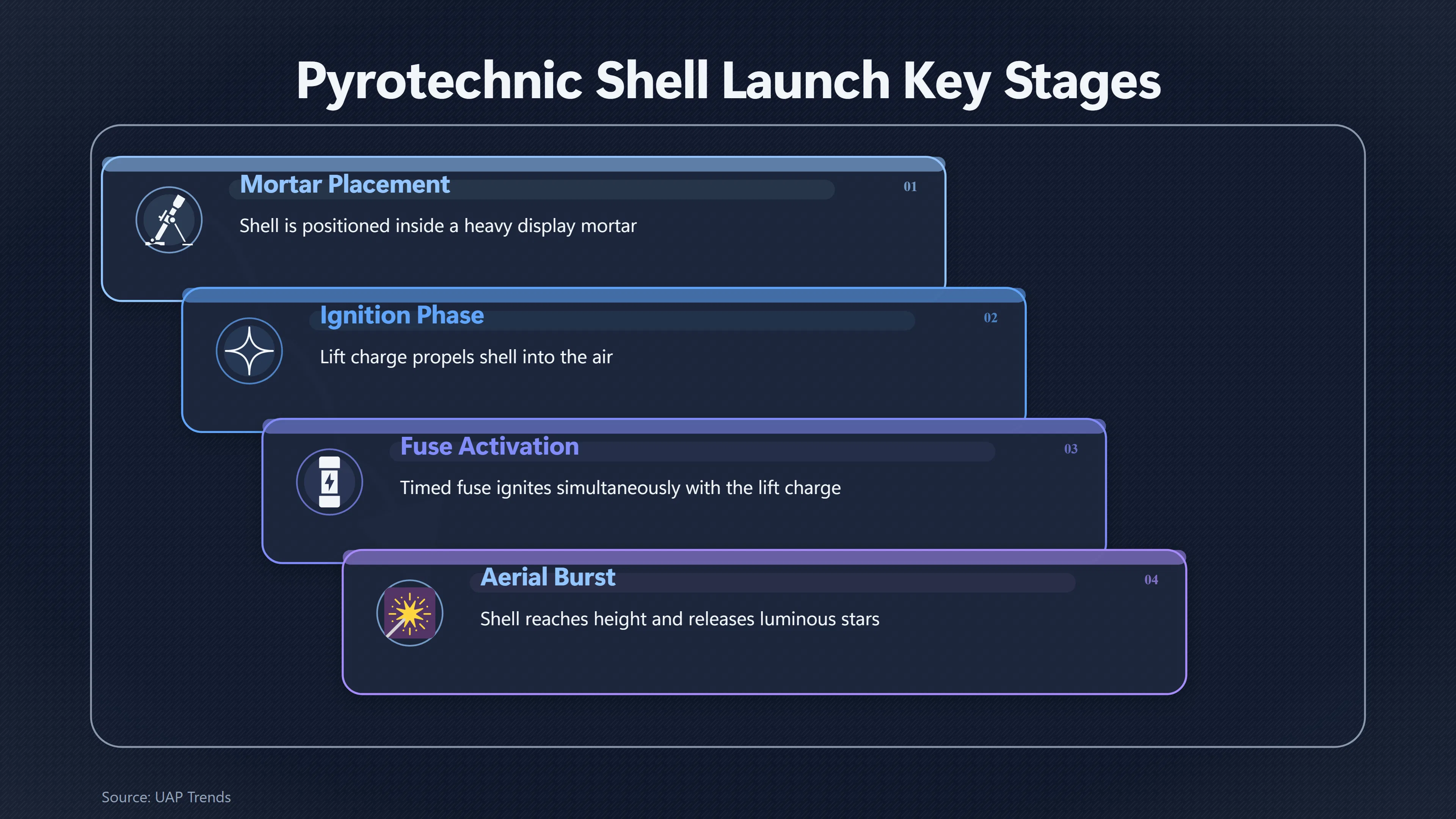
Recognising fireworks is normally a process, not simply recognition of a bright colour. In a conventional aerial display, a shell is placed in a mortar above a lift charge. Ignition propels the shell upwards while a timed fuse leads to the aerial burst. The Library of Congress describes this basic sequence explicitly: the lift charge launches the shell and simultaneously lights the shell’s fuse.[The Library of Congress]loc.govThe Library of Congress How do fireworks work? | Library of CongressThe Library of CongressHow do fireworks work? | Library of CongressNovember 19, 2019… US occupational-safety guidance likewise requires display mortars to be capable of propelling shells to suitable deflagration heights.[OSHA]osha.govPyrotechnics IndustryPyrotechnics Industry - Fireworks Display | Occupational Safety and Health Administration…
Put a sufficiently high obstruction between that sequence and the observer and the information changes dramatically. The witness need not see the mortar flash, rising shell, ascending trail or lower effects at all. Only material reaching an elevation angle above the local roof, treeline or ridge becomes visible.
The result is a kind of natural visual crop. Imagine a distant display taking place beyond a wooded ridge. Every shell rises invisibly behind the trees. A shell bursts partly below the ridge, but its highest stars clear it. The observer does not see an expanding sphere beginning at a recognisable burst point; they may see only two or three lights emerging above the ridge. As those stars descend, they disappear behind the obstruction again.
The apparent sequence becomes:
nothing → lights appear → lights persist or drift → lights vanish
rather than:
launch → ascent → explosion → expanding firework → falling debris
That difference is enough to make an ordinary pyrotechnic event considerably harder to recognise.
This is not merely a hypothetical problem of fireworks being fired at ground level. Professional pyrotechnics can themselves be launched from elevated structures. The British Pyrotechnists Association’s Shellcalc modelling explicitly includes the height and elevation of a launch site and allows for firing from buildings, while also distinguishing open, wooded and built-up terrain.[British Pyrotechnists Association]pyro.org.ukBritish Pyrotechnists AssociationShellcalc© – ©British Pyrotechnists Association 2025… UK government guidance similarly tells display organisers to inspect sites for obstructions, reflecting how strongly local geometry matters to firing and visibility.[GOV.UK]GOV.UKOrganising non-professional fireworks displays15, 2025…
Why partial bursts can look like orbs and fixed lights
Once the lower display is concealed, several ordinary firework behaviours map surprisingly well onto descriptions used in unusual-light reports.
A large aerial shell normally spreads many burning “stars” outwards after its burst charge ignites them.[Geology]geology.comHow Fourth of July Fireworks Displays Work!How Fourth of July Fireworks Displays Work… If a building or ridge masks most of that expanding pattern, however, the visible fragment need not resemble a radial explosion. A single bright star just above the obstruction can register as an isolated red, green, orange or white orb. Two visible stars can look like a pair of lights. The next shell can create another point in roughly the same area of sky.
The effect becomes more persuasive with pyrotechnics deliberately designed to remain luminous while descending. “Falling leaves”, for example, are recognised in the fireworks trade as stars that drift slowly downwards, while willow-like effects use persistent burning stars to create a slow cascade.[UKFR]ukfr.comFireworks Glossary – UKFRFireworks Glossary – UKFR… Contemporary reporting on professional pyrotechnics likewise describes named effects such as willow, palm, crossette and falling leaves, illustrating how different the visible motion can be from the stereotypical instantaneous spherical explosion.[The New Yorker]newyorker.comThe New Yorker The American Art of Blowing Stuff UpIt follows the tradition through modern-day spectacles in Las Vegas and traces its roots to imperial China. Highlighted throughout is Fir…
When most of a slow-descending effect is hidden, the visible portion can look stranger still. A luminous component may:
- appear with no visible object approaching it;
- remain within a small angular area long enough to be described as “hovering”;
- flicker or change brightness as its composition burns;
- drift slightly sideways or downwards;
- disappear abruptly when it burns out or drops behind the obstruction;
- be followed seconds later by another light at a similar bearing.
Low-noise effects can strengthen the ambiguity. Specialist descriptions of quiet fireworks note that falling-leaf and horsetail effects can leave bright stars or embers hanging and descending while producing much less conspicuous sound than conventional loud aerial bursts. Launch noise still exists, but does not necessarily travel as impressively as the visual effect.[UKFR]ukfr.comQuiet & Low Noise Firework Displays – UKFRQuiet & Low Noise Firework Displays – UKFR The useful investigative point is not that such fireworks are literally silent, but that “bright hovering light plus no obvious explosion” is compatible with some pyrotechnic effects, especially at distance.
Apparent hovering does not establish real hovering
The word “hovering” deserves particular caution when a witness is observing a small light against a dark sky. Without a known distance, the eye cannot directly convert a small angular displacement into a reliable physical speed. A distant descending firework component may therefore cross so little of the observer’s visual field during a brief observation that its downward movement is difficult to notice.
There is also a well-established night-vision illusion working in the opposite direction. The US Federal Aviation Administration warns pilots that in darkness a static light stared at for several seconds can appear to move, an effect known as autokinesis.[Federal Aviation Administration]faa.govFederal Aviation Administration Chapter 8. Medical Facts for PilotsFederal Aviation Administration Chapter 8. Medical Facts for Pilots Aviation-safety guidance attributes the effect to the lack of reference points against which movement can be judged.[Skybrary]skybrary.aeroAutokinetic Effect | SKYbrary Aviation SafetyAutokinetic Effect | SKYbrary Aviation Safety
An obscured firework can occupy an awkward perceptual middle ground: genuine slow motion may look stationary, while a nearly stationary point may appear to wander. Investigators should therefore be wary of reconstructing a detailed flight path solely from descriptions such as “it hovered”, “drifted slightly” or “moved around” unless fixed landmarks or usable video provide angular references.
The skyline itself can create the mystery
The most informative feature of this type of sighting may be the part of the scene that initially seems irrelevant: the obstruction beneath the lights.
Suppose an observer sees repeated orange lights just above a row of houses. If their line of sight continues beyond those houses towards an event site, park, stadium or private property, the roofs may be functioning as a mask. A change of viewing position can then change the sighting dramatically. Someone on an upper floor might see an unmistakable burst; somebody in the street may see only three isolated points; a witness farther downhill may see nothing.
Trees produce a less regular version of the same effect. Gaps between branches can reveal and conceal different components as they descend. A ridge is potentially more deceptive because it creates a clean, apparently natural horizon: lights can seem to originate immediately above the landscape even when the actual firing site lies well beyond it.
The key geometric quantity is elevation angle — how high the light appears above the observer’s horizontal line of sight. Obstacle calculations used in other line-of-sight applications work on the same principle: the distance and height of a building, tree or hill determine the minimum elevation angle at which something behind it becomes visible.[SatLex®]satlex.deSat Lex®Sat Lex®Sat Lex®Sat Lex®
This produces a useful prediction. If hidden fireworks are responsible, the disappearance boundary should often correspond to the actual skyline. Lights may repeatedly emerge above approximately the same roof, ridge or treetop and disappear as they descend towards it. That repeated spatial relationship is more informative than the superficial fact that the lights are unusual.
How investigators can test the skyline geometry
An obscured-firework explanation should be tested rather than adopted merely because fireworks happened somewhere in the wider area. A convincing reconstruction has to put the display in the right direction and make its visible altitude compatible with the intervening obstruction.
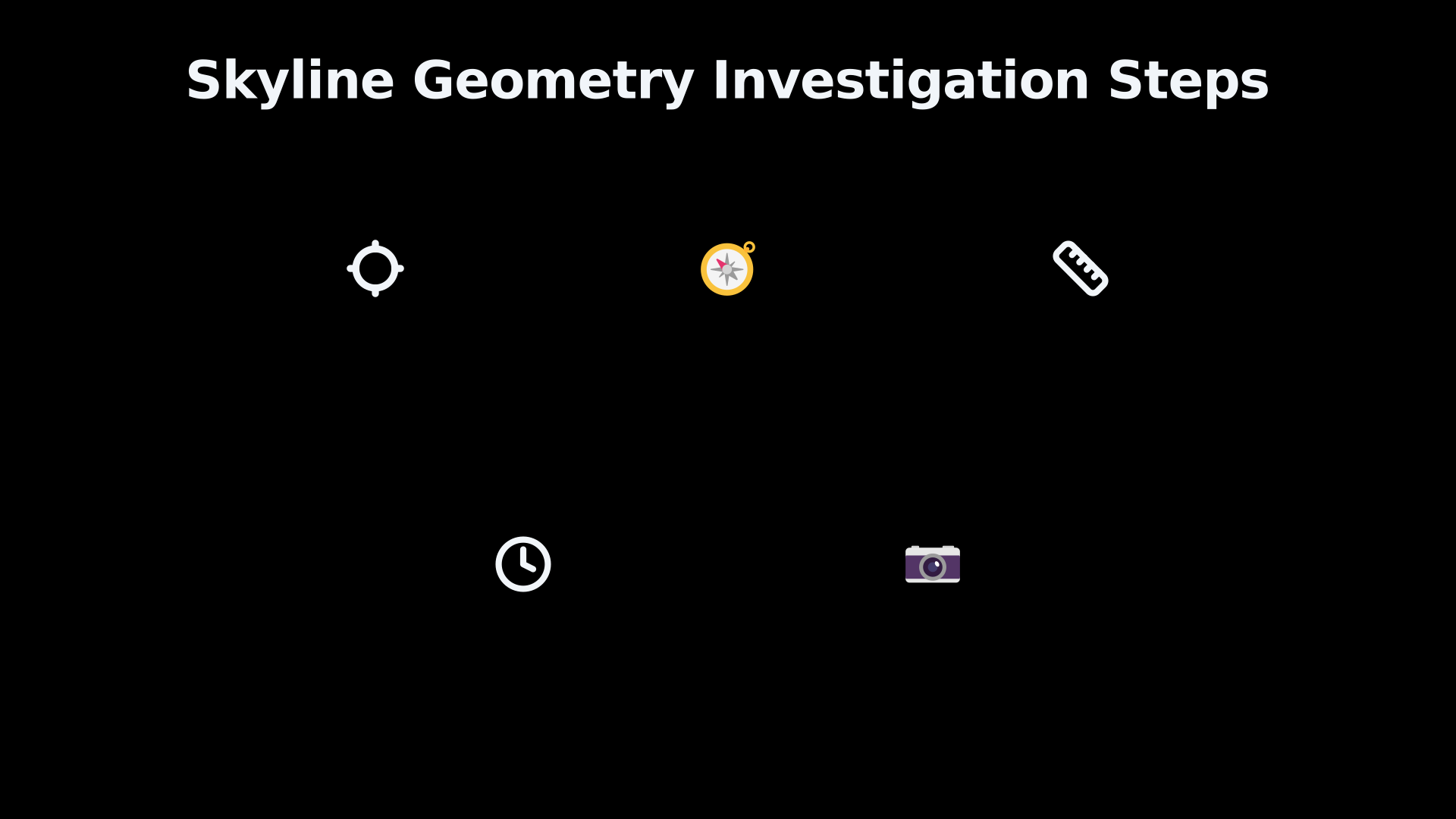
The first priority is preserving the witness’s exact position and view. A few metres can matter beside a building, and a substantial change in elevation can matter near a ridge. Investigators should establish where the witness’s eyes or camera actually were, the direction faced and which roofs, trees or terrain formed the lower boundary of the observation.
Next, identify the azimuth — the compass direction — of the reported lights and extend that line beyond the visible obstruction. Search that corridor for plausible launch locations rather than simply looking for “fireworks nearby”. The relevant display could have been kilometres away and completely invisible at ground level from the witness’s position.
Then reconstruct the vertical geometry. Useful inputs include the observer’s elevation, the height or elevation of the obstruction, its distance from the observer, the candidate firing site’s location and the approximate height reached by the visible effects. Terrain mapping, street-level photographs and video frames with identifiable buildings can all help. At larger distances, Earth curvature and atmospheric refraction may also need consideration, although for many ordinary urban sightings the dominant masking objects will simply be nearby buildings, trees or terrain.
Timing supplies an independent check. A candidate display becomes substantially stronger if the reported lights begin and end within its documented firing period. Repetition is valuable too: several appearances from almost exactly the same sector are what would be expected from shells launched repeatedly from a fixed site.
Video can make the test particularly strong. Rather than concentrating only on the glowing pixels, investigators can stabilise footage against buildings or the skyline and ask whether successive lights share a common apparent origin. A fixed camera also helps distinguish actual motion from autokinesis, since the latter is an observer’s perceptual effect rather than movement recorded relative to the scene. This broader principle — obtaining positional and kinematic measurements rather than relying on visual impression alone — is central to proposed scientific UAP-observation systems using wide-field cameras, triangulation and multiple sensor types.[arXiv]arxiv.orgOpen source on arxiv.org.
When the fireworks explanation becomes weak
Obstruction can explain missing launches; it cannot explain anything whatsoever. Treating “probably fireworks” as an automatic answer risks making the same evidential mistake as treating every unusual light as extraordinary.
A hidden-display hypothesis becomes stronger when several clues converge: the lights occupy one restricted sector, appear only above an obstruction, recur at similar heights, have colours and lifetimes compatible with pyrotechnic stars, descend or spread modestly, and coincide with a confirmed display along the same line of sight.
It becomes weaker when reconstructed geometry fails. If a precisely located candidate display was in a substantially different direction, if terrain would have blocked even its highest effects, or if calibrated footage shows sustained motion incompatible with ballistic or drifting pyrotechnic material, the explanation should not be retained simply because fireworks occurred that night. Likewise, a prolonged light that maintains altitude and travels coherently across a large angle of sky demands a different explanation from a briefly visible star emerging above a roof.
AARO’s published statistics provide useful perspective here. Fireworks account for four cases, or 0.4%, among the closed outcomes in its current reporting-trends table for reports covering 1 January 1996 to 15 June 2026.[AARO]aaro.milUAP TrendsAARO UAP Trends… That is evidence that fireworks genuinely do enter official UAP reporting, not evidence that they explain a large fraction of reports.
The decisive clue is often below the light
Hidden-launch cases illustrate a broader problem in interpreting unusual aerial lights: observers naturally concentrate on the luminous object, while the explanation may depend on the dark foreground beneath it. A roof, stand of trees or ridge can remove the launch, ascent and lower half of a burst, transforming a familiar sequence into isolated points that appear to materialise, hover and vanish.
That makes the skyline part of the evidence rather than incidental scenery. The strongest investigation does not ask only whether a light “looks like a firework”. It asks whether a real firing site could have occupied that bearing, whether the intervening landscape would hide the lower display, whether the highest effects would clear the obstruction, and whether their timing and movement match what was recorded. When those pieces line up, apparently strange hovering lights can be reconstructed as the visible tips of a much larger fireworks display that the witness simply could not see.
Amazon book picks
Further Reading
Books and field guides related to How Hidden Fireworks Become Strange Hovering Lights. Use these as the next step if you want deeper reading beyond the article.
The UFO Handbook: A Guide to Investigating, Evaluating, and R...
An explanation of the usual reasons for confusing IFOs (identified flying objects) with UFOs and a survey of the tools used to investigat...
Fireworks: The Art, Science and Technique
First published 1988. Subjects: Fireworks, Poudres (pyrotechnie), Feux d'artifice, Pyrotechnie.

Light and Color in the Outdoors
First published 1993. Subjects: Color, Light, Popular works, Science: General Issues, Photographic equipment & techniques.
eBay marketplace picks
Marketplace Samples
Live-tested eBay searches with available results related to this page.
Selected fromUFO poster oneBay.co.uk.
Current eBay listing
VINTAGE UFO FLYING SAUCERS COMIC ADVERTISING A2 POSTER PRINT
Current eBay listing
I Want To Believe UFO Poster Giclée Fine Art Heavyweight Print
Endnotes
1.
Source: aaro.mil
Title: UAP Trends
Link:https://www.aaro.mil/UAP-Cases/UAP-Reporting-Trends/
Source snippet
AARO UAP Trends...
2.
Source: osha.gov
Title: Pyrotechnics Industry
Link:https://www.osha.gov/pyrotechnics/display
Source snippet
Pyrotechnics Industry - Fireworks Display | Occupational Safety and Health Administration...
3.
Source: GOV.UK
Title: Organising non-professional fireworks displays
Link:https://www.gov.uk/guidance/organising-non-professional-fireworks-displays
Source snippet
15, 2025...
4.
Source: geology.com
Title: How Fourth of July Fireworks Displays Work!
Link:https://geology.com/articles/fireworks/
Source snippet
How Fourth of July Fireworks Displays Work...
5.
Source: ukfr.com
Title: Fireworks Glossary – UKFR
Link:https://www.ukfr.com/fireworks-glossary
Source snippet
Fireworks Glossary – UKFR...
6.
Source: ukfr.com
Title: Quiet & Low Noise Firework Displays – UKFR
Link:https://www.ukfr.com/quiet-low-noise-firework-displays
7.
Source: skybrary.aero
Title: Autokinetic Effect | SKYbrary Aviation Safety
Link:https://skybrary.aero/index.php/articles/autokinetic-effect
8.
Source: satlex.de
Title: Sat Lex®Sat Lex®
Link:https://satlex.de/en/obstacle-calculator
9.
Source: arxiv.org
Link:https://arxiv.org/abs/2305.18566
10.
Source: GOV.UK
Title: www.gov.uk Fireworks and pyrotechnics in the UK
Link:https://www.gov.uk/government/consultations/fireworks-and-pyrotechnics-in-the-uk/fireworks-and-pyrotechnics-in-the-uk
11.
Source: aaro.mil
Link:https://www.aaro.mil/Next-AARO-Home-redesign/Next-Parent/Next-AARO-UAP-Imagery-Acc-Table/
12.
Source: GOV.UK
Link:https://www.gov.uk/product-safety-alerts-reports-recalls/product-safety-report-encrypted-fireworks-ltd-handheld-60-second-and-90-second-smoke-flares
13.
Source: hse.gov.uk
Title: Organising firework displays
Link:https://www.hse.gov.uk/explosives/fireworks/using.htm
14.
Source: hse.gov.uk
Title: Storing and selling fireworks
Link:https://www.hse.gov.uk/explosives/fireworks/industry.htm
15.
Source: firescotland.gov.uk
Title: Preparing a home firework display | Scottish Fire and Rescue Service
Link:https://www.firescotland.gov.uk/outdoors/fireworks-and-bonfires/preparing-a-home-firework-display/
16.
Source: GOV.UK
Title: www.gov.uk Staying safe with fireworks
Link:https://www.gov.uk/government/news/staying-safe-with-fireworks
17.
Source: GOV.UK
Title: www.gov.uk My safety: fireworks
Link:https://www.gov.uk/guidance/my-safety-fireworks
18.
Source: osha.gov
Link:https://www.osha.gov/enforcement/directives/cpl
19.
Source: fireworks-display.com
Title: 2” single shot red & green falling leaves EMR
Link:https://www.fireworks-display.com/product/2-single-shot-red-green-falling-leaves-emr/
20.
Source: fireworks-display.com
Title: 3” Red & Green Falling Leaves Display Shell
Link:https://www.fireworks-display.com/product/3-red-green-falling-leaves-display-shell-individual/
21.
Source: skybrary.aero
Link:https://skybrary.aero/index.php/articles/visual-illusions
22.
Source: skybrary.aero
Link:https://skybrary.aero/index.php/articles/runway-visual-perspective
23.
Source: skybrary.aero
Link:https://skybrary.aero/index.php/articles/somatogravic-and-somatogyral-illusions
24.
Source: aaro.mil
Link:https://www.aaro.mil/Next-AARO-Home-redesign/Next-Parent/Next-AARO-UAP-Trends/
25.
Source: aaro.mil
Link:https://www.aaro.mil/
26.
Source: aaro.mil
Title: Official UAP Imagery
Link:https://www.aaro.mil/UAP-Cases/Official-UAP-Imagery/4/
27.
Source: hse.gov.uk
Link:https://www.hse.gov.uk/explosives/not-in-scope-civil-explosives.htm
28.
Source: satlex.net
Title: Obstacle Elevation
Link:https://satlex.net/en/obstacle-calculator
29.
Source: mawwfire.gov.uk
Link:https://www.mawwfire.gov.uk/eng/your-safety/your-community-and-events/firework-safety/
30.
Source: thurrock.gov.uk
Link:https://www.thurrock.gov.uk/fireworks-storage-licensing/law-on-fireworks
31.
Source: cornwall.gov.uk
Link:https://www.cornwall.gov.uk/fire-and-rescue-service/business-fire-safety/business-fire-safety-advice/fireworks/
32.
Source: cornwall.gov.uk
Title: Safe Use of Fireworks, Legislation and the Law
Link:https://www.cornwall.gov.uk/fire-and-rescue-service/keeping-safe/fire-safety/fire-safety-outdoors/firework-safety/safe-use-of-fireworks-legislation-and-the-law/
33.
Source: eastsussex.gov.uk
Link:https://www.eastsussex.gov.uk/trading-standards/business/explosives-fireworks/guidance-storing-explosives-selling-fireworks?print=true
34.
Source: fareham.gov.uk
Link:https://www.fareham.gov.uk/licensing_and_inspections/noise_nuisance/fieworksfaqs.aspx
35.
Source: fareham.gov.uk
Link:https://www.fareham.gov.uk/licensing_and_inspections/noise_nuisance/fireworks.aspx
36.
Source: brighton-hove.gov.uk
Title: storing explosives and selling fireworks
Link:https://www.brighton-hove.gov.uk/business-and-licensing-draft/licensing/storing-explosives-and-selling-fireworks
37.
Source: london-fire.gov.uk
Link:https://www.london-fire.gov.uk/safety/fireworks/
38.
Source: loc.gov
Title: The Library of Congress How do fireworks work? | Library of Congress
Link:https://www.loc.gov/everyday-mysteries/browse-all-questions/item/how-do-fireworks-work/
Source snippet
The Library of CongressHow do fireworks work? | Library of CongressNovember 19, 2019...
Published: November 19, 2019
39.
Source: pyro.org.uk
Link:https://pyro.org.uk/?page_id=332
Source snippet
British Pyrotechnists AssociationShellcalc© – ©British Pyrotechnists Association 2025...
40.
Source: newyorker.com
Title: The New Yorker The American Art of Blowing Stuff Up
Link:https://www.newyorker.com/magazine/2026/08/10/the-american-art-of-blowing-stuff-up
Source snippet
It follows the tradition through modern-day spectacles in Las Vegas and traces its roots to imperial China. Highlighted throughout is Fir...
41.
Source: faa.gov
Title: Federal Aviation Administration Chapter 8. Medical Facts for Pilots
Link:https://www.faa.gov/Air_traffic/publications/atpubs/aim_html/chap8_section_1.html
42.
Source: pyro.org.uk
Link:https://pyro.org.uk/?page_id=5103
43.
Source: calculator.academy
Title: Horizon Distance Calculator
Link:https://calculator.academy/horizon-distance-calculator/
44.
Source: nuforc.org
Link:https://nuforc.org/sighting/?id=198195
45.
Source: pyro.org.uk
Link:https://pyro.org.uk/?p=12957
46.
Source: nuforc.org
Link:https://nuforc.org/sighting/?id=194602
47.
Source: nuforc.org
Link:https://nuforc.org/sighting/?id=190824
48.
Source: nuforc.org
Link:https://nuforc.org/sighting/?id=190307
49.
Source: pyro.org.uk
Link:https://pyro.org.uk/?page_id=223
50.
Source: nuforc.org
Link:https://nuforc.org/sighting/?id=181250
51.
Source: science.howstuffworks.com
Link:https://science.howstuffworks.com/innovation/everyday-innovations/fireworks.htm
52.
Source: loc.gov
Title: How do fireworks work? | Library of Congress
Link:https://www.loc.gov/item/how-do-fireworks-work/
53.
Source: nuforc.org
Link:https://nuforc.org/sighting/?id=134945
54.
Source: pyro.org.uk
Link:https://pyro.org.uk/?p=2144
55.
Source: faa.gov
Title: Chapter 8. Medical Facts for Pilots
Link:https://www.faa.gov/air_traffic/publications/atpubs/aim/aim0801.html
56.
Source: pyro.org.uk
Link:https://pyro.org.uk/?p=706
57.
Source: nuforc.org
Link:https://nuforc.org/sighting/?id=64313
58.
Source: nuforc.org
Link:https://nuforc.org/sighting/?id=62696
59.
Source: nuforc.org
Link:https://nuforc.org/sighting/?id=37839
60.
Source: pbs.org
Link:https://www.pbs.org/wgbh/nova/fireworks/
61.
Source: pyro.org.uk
Link:https://pyro.org.uk/?page_id=5207
62.
Source: pyro.org.uk
Link:https://pyro.org.uk/?cat=9
63.
Source: pyro.org.uk
Link:https://pyro.org.uk/?page_id=5195
64.
Source: pyro.org.uk
Title: guidance for organisers of professionally fired firework displays
Link:https://pyro.org.uk/documentation/bpa-guides-2/guidance-for-organisers-of-professionally-fired-firework-displays/
65.
Source: pyro.org.uk
Link:https://pyro.org.uk/
66.
Source: pyro.org.uk
Link:https://pyro.org.uk/?page_id=43
Additional References
67.
Source: dynamicfireworks.co.uk
Title: Dynamic Fireworks Descriptions of Firework Effects
Link:https://dynamicfireworks.co.uk/descriptions-firework-effects
Source snippet
Dynamic FireworksDescriptions of Firework Effects - Dynamic Fireworks...
68.
Source: cpsc.gov
Link:https://www.cpsc.gov/Business–Manufacturing/Business-Education/Business-Guidance/Fireworks
69.
Source: youtube.com
Title: UFO Videos Explained: Mick West’s Expert Analysis
Link:https://www.youtube.com/watch?v=-_4QF__92q0
Source snippet
Unidentified Anomalous Phenomena: Senate Armed Forces Subcommittee Hearing...
70.
Source: singularfortean.com
Link:https://www.singularfortean.com/news/2020/1/9/triangle-ufos-purportedly-filmed-over-new-york-and-texas-within-days-of-each-other
71.
Source: experiencersupport.org
Link:https://www.experiencersupport.org/declassified/aaro-report-on-the-historical-record-of-u-s-government-involvement-with-unidentified-anomalous-phenomena-uap
72.
Source: uap-archive.org
Link:https://uap-archive.org/uap/learn/aaro-case-resolution-reports-overview/
73.
Source: faraim.org
Link:https://www.faraim.org/faa/aim/chapter-8/section-8-1-5.html
74.
Source: americanpyro.com
Link:https://www.americanpyro.com/apa-standard
75.
Source: thepilotexam.com
Link:https://thepilotexam.com/glossary/autokinetic-illusion
76.
Source: simplemaplab.com
Link:https://www.simplemaplab.com/tools/horizon-distance-calculator