Within Missing Data
Can a UFO Be Solved Without Time and Place?
Without precise time and position, investigators may be unable to test whether a sighting matches aircraft, satellites, launches or known sky objects.
On this page
- Why exact timestamps matter
- How position connects reports to known traffic and sky events
- What becomes impossible when basic coordinates are missing
Page outline Jump by section
Introduction
A UFO or UAP report can be impossible to identify for a surprisingly mundane reason: investigators do not know precisely when or where the observation happened. Those two facts are not administrative details. They are the coordinates needed to compare a sighting with the ordinary things that were actually in that part of the sky at that moment.
Aircraft surveillance records, satellite predictions, rocket activity and astronomical sky maps are all tied to time and position. NASA therefore recommends recording the date, time and observing location when trying to identify an unfamiliar light, while its UAP study warns that missing metadata — including acquisition time and sensor location — often prevents a thorough reconstruction of reported events.[NASA Science]science.nasa.govScience Identifying UFOs and UAPsNASA ScienceIdentifying UFOs and UAPs - NASA ScienceDecember 1, 2013…
Without that information, an investigator may be left with a perfectly genuine photograph or eyewitness account but no reliable way to test the most obvious conventional explanations.
Why exact timestamps matter
The night sky is not a static backdrop. Aircraft cross a particular line of sight for seconds or minutes. Satellites follow predictable orbital paths and can brighten or disappear as illumination geometry changes. Planets rise and set. Meteors last seconds. Rocket launches and re-entries occur within defined windows. An observation therefore has to be placed on a timeline before many of these possibilities can be meaningfully checked.
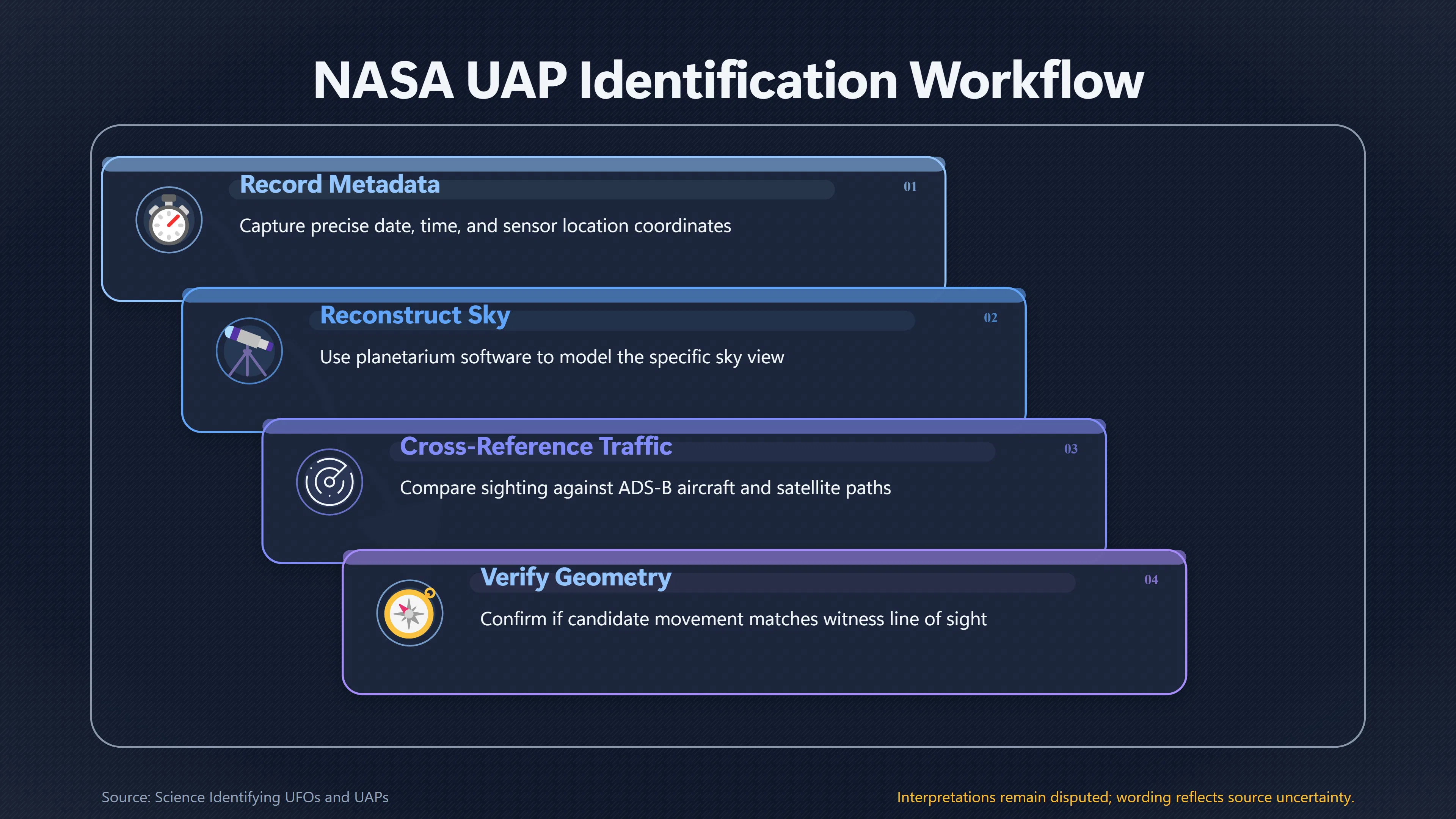
NASA’s guidance on identifying UFOs makes the principle explicit: with a good description plus the date and time, planetarium software can reconstruct the sky for the observation. The same guidance lists Venus, Jupiter, Sirius, satellites, meteors, fireballs, balloons, aircraft and rocket launches among objects and events that can initially appear mysterious.[NASA Science]science.nasa.govScience Identifying UFOs and UAPsNASA ScienceIdentifying UFOs and UAPs - NASA ScienceDecember 1, 2013…
A timestamp is particularly powerful because some ordinary objects have independently recorded movements. Modern Automatic Dependent Surveillance–Broadcast (ADS-B) equipment, for example, broadcasts an equipped aircraft’s position, altitude, ground speed and other information approximately once per second. That creates a time-dependent traffic picture against which an observation can potentially be compared.[Federal Aviation Administration]faa.govFederal Aviation Administration Ins and Outs | Federal Aviation AdministrationFederal Aviation AdministrationIns and Outs | Federal Aviation AdministrationFebruary 7, 2023…
The comparison is not simply, “Were aircraft flying that evening?” Investigators want to know whether a particular aircraft was in the appropriate place at the appropriate moment and whether its movement fits what the sensor or witness saw.
AARO’s resolution of several “atmospheric wake” UAP cases illustrates the value of that approach. Investigators compared aircraft-location information and found that one reported object closely matched a military aircraft track; another case was identified with high confidence as a particular Airbus A380 using commercial flight information.[AARO]aaro.milCase Resolution of 'Atmospheric WakesCase Resolution of 'Atmospheric Wakes'February 26, 2024…
A vague timestamp weakens that test. “About 9pm” may encompass numerous aircraft or satellite passes. “21:03:17”, especially when supplied by a synchronised recording device, reduces the candidate set dramatically. Even when the original estimate cannot be exact, documenting the uncertainty — for example, 21:03 ± two minutes — is more useful than silently treating an approximate recollection as precise.
Time zones matter too. A local time without a date, time zone or daylight-saving context can introduce an hour-long or even date-level error when an investigator compares it with records maintained in Coordinated Universal Time (UTC). Fireball-reporting systems demonstrate the practical solution: International Meteor Organization reports preserve both local and UT times alongside location and viewing geometry.[International Meteor Organization]fireballs.imo.netInternational Meteor Organization Fireball reportInternational Meteor OrganizationFireball reportFebruary 20, 2026…
Why position can turn a UFO into a known object
Knowing the time answers only half the question. Investigators also need to know where the observer or sensor was.
An object’s appearance depends on the observer’s position. The same satellite may be conspicuous from one town and poorly placed or invisible from another. A distant aircraft can appear in one direction from one observer and somewhere quite different from somebody tens of kilometres away. Astronomical objects likewise have positions in the local sky that depend on latitude, longitude and time.
That is why serious observation records pair timestamps with geographical coordinates or a sufficiently precise location. A typical International Meteor Organization fireball report records latitude, longitude, local and UT time, viewing direction, azimuth and elevation. Those measurements allow separate observations to be associated with the same event rather than grouped merely because witnesses described similar-looking lights.[International Meteor Organization]fireballs.imo.netInternational Meteor Organization Fireball reportInternational Meteor OrganizationFireball reportFebruary 20, 2026…
The same principle applies to UAP investigation. NARCAP, an organisation focused on reports from aviation professionals, asks recent witnesses to provide the exact location, nearest aviation facility and time of the incident. Those details make it possible to seek relevant aviation records while they are still obtainable.[Aviation Anomalies Center]narcap.orgOpen source on narcap.org.
AARO’s resolved Western United States case shows what position-based comparison can achieve. Military personnel reported apparently equidistant lights that raised concern about a possible restricted-airspace incursion. Subsequent analysis found that the objects correlated strongly with specific commercial aircraft travelling established routes, some as far as roughly 300 nautical miles from the observing platform. Air-traffic-control data supported the aircraft explanation.[AARO]aaro.milCase Resolution of Western United States Uap 508 02262024Case Resolution of Western United States Uap 508 02262024
That case is instructive because the objects did not necessarily look like distant airliners. They appeared as dots or lights. Their identification emerged from reconstructing where the observer, lines of sight and known traffic were relative to one another.
This is an important distinction. Visual resemblance can suggest a hypothesis; spatiotemporal agreement can test it.
Satellites make the time-and-place problem especially clear
Satellites provide perhaps the clearest example of why an apparently minor omission can prevent an identification.
A satellite is not simply “somewhere overhead”. Its position changes continuously along an orbit, while its visibility from the ground also depends on the observer’s position and illumination by the Sun. Consequently, establishing that a satellite existed, or even that it passed over the same country that evening, is not enough. A useful comparison asks whether a candidate satellite occupied the appropriate part of the observer’s sky at the recorded moment.
This matters increasingly in UAP analysis. AARO’s current published reporting statistics show that satellites account for 312 of 907 closed cases, or 34.4%, second only to balloons among its listed resolution categories.[AARO]aaro.milUAP TrendsUAP Trends AARO also publishes technical material on Starlink satellite flaring, specifically because reflected sunlight from satellites can produce observations interpreted as UAP.[AARO]aaro.milUAP RecordsUAP Records
NASA similarly advises observers to record their location, date and time and notes that satellites are among the ordinary objects frequently requiring consideration.[NASA Science]science.nasa.govScience Identifying UFOs and UAPsNASA ScienceIdentifying UFOs and UAPs - NASA ScienceDecember 1, 2013…
The crucial point is that a satellite explanation should not be based merely on resemblance. A row of lights may suggest Starlink, for example, but a much stronger identification requires the predicted pass to agree with the observation’s time, observer position and direction of travel. Remove the time or position and that geometrical test may no longer be possible.
The same logic applies to the International Space Station, individual satellites and spacecraft re-entries. An observation may be detailed enough to say that something crossed the sky, yet still lack the information required to determine which known orbital object, if any, was responsible.
Aircraft checks depend on the same coordinates
Aircraft present a closely related problem because aviation surveillance is fundamentally organised around time and three-dimensional position.
ADS-B derives position and velocity information from GPS or another suitable navigation source and broadcasts an aircraft’s location, altitude, ground speed and related data. The US Federal Aviation Administration describes ADS-B surveillance as near-instantaneous, with aircraft information generally updating about once per second.[Federal Aviation Administration]faa.govFederal Aviation Administration Ins and Outs | Federal Aviation AdministrationFederal Aviation AdministrationIns and Outs | Federal Aviation AdministrationFebruary 7, 2023…
That allows a powerful investigative question:
At the moment the witness reported the object, which known aircraft were positioned along or near that line of sight?
AARO has repeatedly used this type of comparison. Its Western United States investigation combined video analysis with commercial flight information and concluded that the apparently unusual lights were three separate commercial aircraft seen at considerable distance. Its atmospheric-wake investigations likewise used commercial flight data to associate reported objects with ordinary aircraft.[AARO]aaro.milUAP ImageryUAP Imagery
But such comparisons have limits. Not every aircraft is necessarily represented in a particular publicly accessible tracking dataset, coverage varies geographically and by altitude, and some traffic may not broadcast the information needed for an easy public identification. FAA documentation itself notes limitations in traffic-information services, including that some displays depend on transponder-equipped aircraft and surveillance coverage.[Federal Aviation Administration]faa.govOpen source on faa.gov.
So a failure to find an aircraft track is not automatically evidence that no aircraft was present. Conversely, finding an aircraft somewhere in the region is not sufficient to identify a UFO. The meaningful result comes from agreement between the reported time, observing position, viewing direction and candidate aircraft trajectory.
Missing time or location can prevent that comparison before it even begins.
Launches, balloons and astronomical objects have their own clocks
Aircraft and satellites are not the only conventional explanations that depend on temporal and geographical reconstruction.
Rocket launches and spacecraft re-entries can produce spectacular lights, expanding clouds or groups of moving fragments. The International Astronomical Center notes that launches can generate unfamiliar-looking sky phenomena around launch and stage-separation events, and emphasises accurate time and location information when collecting observational evidence.[International Astronomical Center]astronomycenter.netOpen source on astronomycenter.net.
Weather balloons create a different but related problem. They move through changing winds rather than along fixed airline routes, so investigators need the relevant launch information and atmospheric conditions for the correct period and area. The Met Office notes that weather balloons are released twice daily from nearly 900 locations worldwide and acknowledges that they can sometimes be mistaken for UFOs.[Met Office]metoffice.gov.ukMet Office Take flightMet Office Take flight Balloon forecasting itself is location- and time-sensitive, using winds at different altitudes and forecasts issued for specific sites and periods.[Met Office]metoffice.gov.ukMet Office Ballooning ForecastsMet Office Ballooning Forecasts
Astronomical explanations are even more directly dependent on time and place. Venus, Jupiter, Sirius and other bright objects can appear unexpectedly striking, particularly near the horizon. But saying that Venus was “visible that month” is not a satisfactory identification. Its altitude and direction from the witness’s location at the stated time should agree with the report. NASA specifically recommends reconstructing the sky for the reported date and time when testing such explanations.[NASA Science]science.nasa.govScience Identifying UFOs and UAPsNASA ScienceIdentifying UFOs and UAPs - NASA ScienceDecember 1, 2013…
These are different phenomena governed by different physical processes, but they share one investigative requirement: the observation has to be anchored to the real world before external records can be compared with it.
What becomes impossible when the coordinates are missing
Missing time and position do more than reduce confidence. They can remove entire investigative tests.
NASA’s independent UAP study identified this as part of a broader metadata problem. It defines relevant metadata as including the time of acquisition and sensor location, alongside sensor type, sensitivity, exposure characteristics and other information. Such metadata are often absent from UAP observations, making calibration and contextual interpretation difficult. NASA concluded that many existing observations consequently are poorly suited to systematic scientific analysis.[NASA Science]science.nasa.govScience NASAUNIDENTIFIED ANOMALOUS PHENOMENA Independent…
If an otherwise interesting UFO video lacks reliable time and location, investigators may be unable to:
- reconstruct the astronomical sky and test a planet or bright star;
- calculate which satellites should have crossed the observer’s field of view;
- compare the sighting with a particular aircraft track or air corridor;
- associate it confidently with a rocket launch or spacecraft re-entry;
- determine whether nearby witnesses could have seen the same event;
- check relevant weather and balloon conditions for the correct place and period.
That does not mean those ordinary explanations have been disproved. It means the evidence needed to test them has been lost.
This distinction is central to interpreting unresolved UFO cases. A report can survive investigation because several plausible explanations remain untestable, rather than because investigators have successfully excluded them.
A video is not a substitute for time and place
It is tempting to assume that photographic evidence automatically solves this problem. Often it does not.
A video can preserve shape, brightness and angular motion while saying little about absolute distance or geographical position. If metadata have been stripped during copying, editing or uploading, investigators may not even know exactly when the footage was recorded. A clip labelled only “taken last summer somewhere over Europe” may therefore contain far less usable evidence than a modest eyewitness observation with a GPS position, synchronised timestamp and carefully recorded viewing direction.
NASA’s UAP study makes precisely this broader point: photographs and videos can accompany unresolved reports while still lacking the contextual metadata required for a thorough analysis.[NASA Science]science.nasa.govScience NASAUNIDENTIFIED ANOMALOUS PHENOMENA Independent…
Conversely, when contextual data survive, apparently remarkable footage can become much more tractable. In AARO’s Puerto Rico investigation, analysts reconstructed the observing aircraft’s changing position and viewing geometry. AARO concluded with high confidence that the objects did not display anomalous speeds or enter the water and assessed with moderate confidence that they were a pair of sky lanterns drifting at approximately wind speed.[AARO]aaro.milPuerto Rico UAP Case ResolutionPuerto Rico UAP Case Resolution
AARO’s Western United States case similarly became resolvable when object positions could be compared with additional information and air-traffic data.[AARO]aaro.milCase Resolution of Western United States Uap 508 02262024Case Resolution of Western United States Uap 508 02262024
The lesson is not that every well-documented UFO will prove ordinary. It is narrower and more important: good coordinates make ordinary explanations testable.
When “unresolved” really means “the comparison cannot be made”
Time and location function almost like the lookup keys of a UAP investigation. A witness’s description supplies what was perceived; the timestamp and observing position connect that perception to independent information about what was actually in the surrounding airspace and sky.
That distinction helps explain why missing data can leave otherwise ordinary-looking cases unresolved. A blurry light without a timestamp cannot reliably be compared with satellite passes. A moving infrared dot without adequate positional context may resist matching to air traffic. A stationary glow without a known viewing location cannot be confidently checked against Venus or another astronomical object.
This is also why the growing number of resolved cases should not be interpreted as proof that every unresolved report has the same explanation. AARO’s published closed-case statistics include hundreds of satellites and balloons as well as aircraft, drones, birds, rockets and other causes.[AARO]aaro.milUAP TrendsUAP Trends The practical lesson is instead about evidence quality: conventional explanations frequently become demonstrable when investigators possess enough contextual information to compare the report with independent records.
Without the correct time and place, the question may cease to be “What was this object?” and become a harder one: “What objects were there then?” If the report cannot define then and there precisely enough, even an ordinary answer may remain permanently out of reach.
Amazon book picks
Further Reading
Books and field guides related to Can a UFO Be Solved Without Time and Place?. Use these as the next step if you want deeper reading beyond the article.
The UFO Handbook: A Guide to Investigating, Evaluating, and R...
An explanation of the usual reasons for confusing IFOs (identified flying objects) with UFOs and a survey of the tools used to investigat...
The UFO Experience: A Scientific Inquiry
The author belives that a number of UFO siting are still to be explained.
NightWatch: A Practical Guide to Viewing the Universe
A practical guide to viewing the universe.
The Backyard Astronomer's Guide
Discusses the practical aspects of stargazing, including how to choose appropriate equipment, contending with light pollution, taking suc...
eBay marketplace picks
Marketplace Samples
Live-tested eBay searches with available results related to this page.
Selected fromUFO poster oneBay.co.uk.


Current eBay listing
I Want To Believe UFO Poster Giclée Fine Art Heavyweight Print

Current eBay listing
VINTAGE UFO FLYING SAUCERS COMIC ADVERTISING A2 POSTER PRINT

Endnotes
1.
Source: science.nasa.gov
Title: Science Identifying UFOs and UAPs
Link:https://science.nasa.gov/solar-system/skywatching/night-sky-network/identifying-ufos-and-uaps/
Source snippet
NASA ScienceIdentifying UFOs and UAPs - NASA ScienceDecember 1, 2013...
Published: December 1, 2013
2.
Source: science.nasa.gov
Title: Science NASA
Link:https://science.nasa.gov/wp-content/uploads/2023/09/uap-independent-study-team-final-report.pdf
Source snippet
UNIDENTIFIED ANOMALOUS PHENOMENA Independent...
3.
Source: faa.gov
Title: Federal Aviation Administration Ins and Outs | Federal Aviation Administration
Link:https://www.faa.gov/air_traffic/technology/equipadsb/capabilities/ins_outs
Source snippet
Federal Aviation AdministrationIns and Outs | Federal Aviation AdministrationFebruary 7, 2023...
Published: February 7, 2023
4.
Source: faa.gov
Title: Federal Aviation Administration Automatic Dependent Surveillance
Link:https://www.faa.gov/about/office_org/headquarters_offices/avs/offices/afx/afs/afs400/afs410/ads-b
Source snippet
Federal Aviation AdministrationAutomatic Dependent Surveillance - Broadcast (ADS-B) | Federal Aviation Administration...
5.
Source: aaro.mil
Title: Case Resolution of ‘Atmospheric Wakes’
Link:https://www.aaro.mil/Portals/136/PDFs/case_resolution_reports/Case_Resolution_of_Atmospheric_Wakes_508-02262024.pdf
Source snippet
Case Resolution of 'Atmospheric Wakes'February 26, 2024...
Published: February 26, 2024
6.
Source: aaro.mil
Title: Case Resolution of ‘Atmospheric Wakes’
Link:https://www.aaro.mil/Portals/136/PDFs/case_resolution_reports/Case_Resolution_of_Atmospheric_Wakes_508-02262024.pdf?ver=S7tqVvXUSxHY9LR1W7Mchw%3D%3D
Source snippet
Case Resolution of 'Atmospheric Wakes'...
7.
Source: fireball.imo.net
Title: International Meteor Organization Fireball report
Link:https://fireball.imo.net/members/imo_view/report/419623
8.
Source: fireball.imo.net
Title: International Meteor Organization Fireball report
Link:https://fireball.imo.net/members/imo_view/report/419575
9.
Source: narcap.org
Link:https://www.narcap.org/makeareport
10.
Source: aaro.mil
Title: Case Resolution of Western United States Uap 508 02262024
Link:https://www.aaro.mil/Portals/136/PDFs/case_resolution_reports/Case_Resolution_of%20_Western_United_States_Uap_508-02262024.pdf
11.
Source: aaro.mil
Title: UAP Trends
Link:https://www.aaro.mil/UAP-Cases/UAP-Reporting-Trends/
12.
Source: aaro.mil
Title: UAP Records
Link:https://www.aaro.mil/UAP-Records/
13.
Source: faa.gov
Link:https://www.faa.gov/air_traffic/technology/adsb/atc
14.
Source: aaro.mil
Title: UAP Imagery
Link:https://www.aaro.mil/UAP-Cases/Official-UAP-Imagery/4/
15.
Source: faa.gov
Link:https://www.faa.gov/air_traffic/technology/adsb/pilot
16.
Source: faa.gov
Title: Federal Aviation Administration ENR 1.1: General Rules
Link:https://www.faa.gov/air_traffic/publications/atpubs/aip_html/part2_enr_section_1.1.html
17.
Source: aaro.mil
Title: Puerto Rico UAP Case Resolution
Link:https://www.aaro.mil/Portals/136/PDFs/case_resolution_reports/AARO_Puerto_Rico_UAP_Case_Resolution.pdf
18.
Source: science.nasa.gov
Link:https://science.nasa.gov/science-research/earth-science/principal-investigator-and-quality-assessment-reports-evaluate-umbra-synthetic-aperture-[radar
19.
Source: science.nasa.gov
Title: andrew mitchell
Link:https://science.nasa.gov/people/andrew-mitchell/
20.
Source: science.nasa.gov
Link:https://science.nasa.gov/earth-science/csda/faqs/
21.
Source: science.nasa.gov
Title: satellite data explorer
Link:https://science.nasa.gov/earth-science/csda/satellite-data-explorer/
22.
Source: faa.gov
Title: Performance Reporting Capabilities | Federal Aviation Administration
Link:https://www.faa.gov/nextgen/reporting-benefits/capabilities
23.
Source: science.nasa.gov
Link:https://science.nasa.gov/uap/faqs/
24.
Source: aaro.mil
Link:https://www.aaro.mil/Next-AARO-Home-redesign/Next-Parent/Next-UAP-Report-Documents/
25.
Source: aaro.mil
Link:https://www.aaro.mil/Next-AARO-Home-redesign/Next-Parent/Next-AARO-UAP-Imagery-Acc-Table/
26.
Source: aaro.mil
Link:https://www.aaro.mil/Next-AARO-Home-redesign/Next-Parent/Next-UAP-Report-Documents/poster/
27.
Source: aaro.mil
Link:https://www.aaro.mil/Next-AARO-Home-redesign/Next-Parent/Next-UAP-Report-Documents/poster/dividLink/
28.
Source: science.gsfc.nasa.gov
Title: stella q2 technical details
Link:https://science.gsfc.nasa.gov/stella/instruments/spectral/stella-q2/stella-q2-technical-details/
29.
Source: science.nasa.gov
Title: end user license agreements
Link:https://science.nasa.gov/earth-science/csda/end-user-license-agreements/
30.
Source: science.nasa.gov
Title: quality assessment report evaluates tomorrow io precipitation radar data
Link:https://science.nasa.gov/science-research/earth-science/quality-assessment-report-evaluates-tomorrow-io-precipitation-radar-data/
31.
Source: science.nasa.gov
Link:https://science.nasa.gov/mission/nisar/data/
32.
Source: science.nasa.gov
Title: osdr data processing
Link:https://science.nasa.gov/biological-physical/data/osdr/osdr-data-processing/
33.
Source: science.nasa.gov
Link:https://science.nasa.gov/uap/
34.
Source: aaro.mil
Link:https://www.aaro.mil/Next-AARO-Home-redesign/Next-Parent/Presidential-UAP-Transparency-Initiative/dvpmoduleid/77396/
35.
Source: techport.nasa.gov
Link:https://techport.nasa.gov/projects/113282
36.
Source: science.nasa.gov
Title: osdr faq
Link:https://science.nasa.gov/reference/osdr-faq/
37.
Source: science.nasa.gov
Title: osdr help terms and conditions
Link:https://science.nasa.gov/reference/osdr-help-terms-and-conditions/
38.
Source: faa.gov
Title: Frequently Asked Questions | Federal Aviation Administration
Link:https://www.faa.gov/air_traffic/technology/equipadsb/resources/faq
39.
Source: science.nasa.gov
Title: artificial intelligence metadata tagging
Link:https://science.nasa.gov/science-research/artificial-intelligence-metadata-tagging/
40.
Source: science.nasa.gov
Title: data wrangling with dana ostrenga
Link:https://science.nasa.gov/missions/landsat/data-wrangling-with-dana-ostrenga/
41.
Source: data.nasa.gov
Title: atom aircraft flight track and navigational data 270b3
Link:https://data.nasa.gov/dataset/atom-aircraft-flight-track-and-navigational-data-270b3
42.
Source: faa.gov
Title: AD S-B Privacy | Federal Aviation Administration
Link:https://www.faa.gov/air_traffic/technology/equipadsb/privacy
43.
Source: faa.gov
Title: Benefits | Federal Aviation Administration
Link:https://www.faa.gov/air_traffic/technology/equipadsb/capabilities/benefits
44.
Source: faa.gov
Title: AD S-B FAQ | Federal Aviation Administration
Link:https://www.faa.gov/air_traffic/technology/adsb/faq
45.
Source: ntrs.nasa.gov
Link:https://ntrs.nasa.gov/citations/20250000337
46.
Source: aaro.mil
Link:https://www.aaro.mil/Next-AARO-Home-redesign/Next-Parent/Presidential-UAP-Transparency-Initiative/videoid/1014101/dvpcc/false/
47.
Source: faa.gov
Title: NAARM O Frequently Asked Questions | Federal Aviation Administration
Link:https://www.faa.gov/air_traffic/separation_standards/naarmo/naarmo_faqs
48.
Source: ntrs.nasa.gov
Link:https://ntrs.nasa.gov/citations/20240000721
49.
Source: aaro.mil
Link:https://www.aaro.mil/Next-AARO-Home-redesign/Next-Parent/Presidential-UAP-Transparency-Initiative/videoid/1006110/dvpmoduleid/77396/
50.
Source: aaro.mil
Link:https://www.aaro.mil/Next-AARO-Home-redesign/Next-Parent/Presidential-UAP-Transparency-Initiative/videoid/988676/dvpcc/false/
51.
Source: ntrs.nasa.gov
Link:https://ntrs.nasa.gov/citations/20230018164
52.
Source: ntrs.nasa.gov
Link:https://ntrs.nasa.gov/citations/20230017968
53.
Source: narcap.org
Title: NARCA P NEWS — National Aviation Reporting Center on Anomalous Phenomena
Link:https://www.narcap.org/news
54.
Source: narcap.org
Link:https://www.narcap.org/faa-reporting-recommendation
55.
Source: ntrs.nasa.gov
Link:https://ntrs.nasa.gov/citations/20230000155
56.
Source: aaro.mil
Link:https://www.aaro.mil/Next-AARO-Home-redesign/Next-Parent/Presidential-UAP-Transparency-Initiative/videoid/1006107/dvpcc/false/
57.
Source: aaro.mil
Link:https://www.aaro.mil/Next-AARO-Home-redesign/Next-Parent/Presidential-UAP-Transparency-Initiative/videoid/1010276/dvpcc/false/
58.
Source: ntrs.nasa.gov
Link:https://ntrs.nasa.gov/citations/20205009822
59.
Source: narcap.org
Link:https://www.narcap.org/blog/narcaptr20
60.
Source: ntrs.nasa.gov
Link:https://ntrs.nasa.gov/citations/20170003878
61.
Source: airbornescience.nasa.gov
Title: Ames Format Overview
Link:https://airbornescience.nasa.gov/content/Ames_Format_Overview
62.
Source: data.nasa.gov
Title: uavsar insar metadata
Link:https://data.nasa.gov/dataset/uavsar-insar-metadata
63.
Source: espo.nasa.gov
Link:https://espo.nasa.gov/seac4rs/node/7518
64.
Source: planetarydata.jpl.nasa.gov
Link:https://planetarydata.jpl.nasa.gov/img/data/cassini/cassini_orbiter/CORADR_0256/DOCUMENT/BIDRSIS.HTML
65.
Source: airbornescience.nasa.gov
Title: Ames Format Specification v20
Link:https://airbornescience.nasa.gov/content/Ames_Format_Specification_v20
66.
Source: ntrs.nasa.gov
Link:https://ntrs.nasa.gov/citations/19760008130
67.
Source: www-air.larc.nasa.gov
Title: Icartt Data Format
Link:https://www-air.larc.nasa.gov/missions/etc/IcarttDataFormat.htm
68.
Source: eol.jsc.nasa.gov
Title: Automated Geolocalization
Link:https://eol.jsc.nasa.gov/BeyondThephotography/AutomatedGeolocalization/
69.
Source: gcn.nasa.gov
Link:https://gcn.nasa.gov/circulars/events/grb-240415a?limit=100&page=33&query=gcn+circulars&view=index
70.
Source: lsda.jsc.nasa.gov
Link:https://lsda.jsc.nasa.gov/explore/lsdahome/datasubmit
71.
Source: nasa.gov
Title: update nasa shares uap independent study report names director
Link:https://www.nasa.gov/news-release/update-nasa-shares-uap-independent-study-report-names-director/
72.
Source: science.nasa.gov
Title: uap independent study team final report
Link:https://science.nasa.gov/wp-content/uploads/2023/09/uap-independent-study-team-final-report.pdf?emrc=80696d
73.
Source: nasa.gov
Title: announces unidentified aerial phenomena study team members
Link:https://www.nasa.gov/general/nasa-announces-unidentified-aerial-phenomena-study-team-members/
74.
Source: nasa.gov
Title: to release discuss unidentified anomalous phenomena report
Link:https://www.nasa.gov/news-release/nasa-to-release-discuss-unidentified-anomalous-phenomena-report/
75.
Source: nasa.gov
Title: provides coverage of unidentified anomalous phenomena meeting
Link:https://www.nasa.gov/news-release/nasa-provides-coverage-of-unidentified-anomalous-phenomena-meeting/
76.
Source: science.nasa.gov
Title: UAPISTTermsof Reference Signed
Link:https://science.nasa.gov/wp-content/uploads/2023/04/UAPISTTermsofReference_Signed.pdf
77.
Source: data.nasa.gov
Link:https://data.nasa.gov/
78.
Source: nasa.gov
Title: to discuss new unidentified aerial phenomena study today
Link:https://www.nasa.gov/news-release/nasa-to-discuss-new-unidentified-aerial-phenomena-study-today/
79.
Source: nightsky.jpl.nasa.gov
Link:https://nightsky.jpl.nasa.gov/news/%3Fview%3Dsearch
80.
Source: faa.gov
Link:https://www.faa.gov/air_traffic/publications/atpubs/aim_html/chap4_section_5.html
81.
Source: aaro.mil
Link:https://www.aaro.mil/Next-AARO-Home-redesign/Next-Parent/Next-AARO-UAP-Trends/
82.
Source: aaro.mil
Link:https://www.aaro.mil/FAQ/
83.
Source: aaro.mil
Link:https://www.aaro.mil/Next-AARO-Home-redesign/Next-Parent/Next-AARO-UAP-Imagery-Fixed-Table/
84.
Source: aaro.mil
Title: AAR O UAP Trends All-domain Anomaly Resolution Office UAP REPORTING TRENDS
Link:https://www.aaro.mil/UAP-Cases/UAP-Reporting-Trends/quot/
85.
Source: aaro.mil
Link:https://www.aaro.mil/Next-AARO-Home-redesign/Bruce-working/Next-AARO-UAP-Trends-Charts/
86.
Source: aaro.mil
Link:https://www.aaro.mil/
87.
Source: aaro.mil
Link:https://www.aaro.mil/Next-AARO-Home-redesign/Next-Parent/Next-UAP-Case-RR-Data-Table/
88.
Source: aaro.mil
Link:https://www.aaro.mil/Next-AARO-Home-redesign/Inactive-Parent/Next-AARO-UAP-DT-Records/
89.
Source: aaro.mil
Link:https://www.aaro.mil/UAP-Records/-1/
90.
Source: aaro.mil
Link:https://www.aaro.mil/Resources/Historical-Record-Reports/Volume-II/
91.
Source: aaro.mil
Link:https://www.aaro.mil/Next-AARO-Home-redesign/Next-Parent/AARO-UAP-Case-Resolution-DT/
92.
Source: aaro.mil
Title: UAP Imagery* “[Go Fast]({{ ‘go-fast/’ | relative_url }})” Object NAVAIR
Link:https://www.aaro.mil/Next-AARO-Home-redesign/Inactive-Parent/Next-UAP-Imagery-dup/
93.
Source: narcap.org
Link:https://www.narcap.org/blog/advisoryforpilots
94.
Source: narcap.org
Link:https://www.narcap.org/blog/definition-of-uap
95.
Source: narcap.org
Title: NARCA P
Link:https://www.narcap.org/
96.
Source: narcap.org
Link:https://www.narcap.org/blog/flightdynamicsofuap
97.
Source: narcap.org
Link:https://www.narcap.org/international-reports
98.
Source: narcap.org
Link:https://www.narcap.org/about-narcap
99.
Source: narcap.org
Link:https://www.narcap.org/what-we-do
100.
Source: narcap.org
Link:https://www.narcap.org/project-sphere
101.
Source: fireballs.imo.net
Title: International Meteor Organization Fireball report
Link:https://fireballs.imo.net/members/imo_view/report/407733
Source snippet
International Meteor OrganizationFireball reportFebruary 20, 2026...
Published: February 20, 2026
102.
Source: astronomycenter.net
Link:https://astronomycenter.net/srw/index.html
103.
Source: metoffice.gov.uk
Title: Met Office Take flight
Link:https://www.metoffice.gov.uk/api/assets/file/factsheet_19-take-flight_2023pdf?prefix=assets
104.
Source: metoffice.gov.uk
Title: Met Office Ballooning Forecasts
Link:https://www.metoffice.gov.uk/services/transport/aviation/regulated/training-resources-for-aviation/ballooning-forecasts
105.
Source: metoffice.gov.uk
Title: Met Office Aviation Briefing Service
Link:https://www.metoffice.gov.uk/binaries/content/assets/metofficegovuk/pdf/services/transport/aviation/ga/aviation-briefing-service-user-guide-2022.pdf
106.
Source: fireball.imo.net
Link:https://fireball.imo.net/members/imo_view/report/428120
107.
Source: fireball.imo.net
Link:https://fireball.imo.net/members/imo_view/report/423492
108.
Source: fireball.imo.net
Link:https://fireball.imo.net/members/imo_view/report/418017
109.
Source: fireball.imo.net
Link:https://fireball.imo.net/imo_view/event/2026/1922
110.
Source: fireballs.imo.net
Link:https://fireballs.imo.net/members/imo_view/report/413743
111.
Source: fireball.imo.net
Link:https://fireball.imo.net/members/imo_view/report/407706
112.
Source: fireballs.imo.net
Link:https://fireballs.imo.net/members/imo_view/report/407735
113.
Source: fireball.imo.net
Link:https://fireball.imo.net/members/imo_view/report/407673
114.
Source: fireball.imo.net
Link:https://fireball.imo.net/members/imo_view/report/405588
115.
Source: library.metoffice.gov.uk
Title: metoffice.gov.uk Radiosonde
Link:https://library.metoffice.gov.uk/Portal/recordview/index/631814
116.
Source: weather.metoffice.gov.uk
Title: metoffice.gov.uk Radio broadcast times
Link:https://weather.metoffice.gov.uk/guides/coast-and-sea/radio
117.
Source: weather.metoffice.gov.uk
Title: metoffice.gov.uk Latest weather observations guide
Link:https://weather.metoffice.gov.uk/guides/observations/latest-weather-observations-guide
118.
Source: library.metoffice.gov.uk
Title: metoffice.gov.uk Radiosonde
Link:https://library.metoffice.gov.uk/Portal/recordview/index/631810
119.
Source: library.metoffice.gov.uk
Title: metoffice.gov.uk* Radiosonde
Link:https://library.metoffice.gov.uk/Portal/recordview/index/631811
120.
Source: library.metoffice.gov.uk
Title: metoffice.gov.uk* Radiosonde
Link:https://library.metoffice.gov.uk/Portal/Default/en-GB/recordview/index/631813
121.
Source: metoffice.gov.uk
Title: Protecting our observing capability
Link:https://www.metoffice.gov.uk/services/business-industry/energy/safeguarding
122.
Source: metoffice.gov.uk
Title: MAVI S FAQs
Link:https://www.metoffice.gov.uk/services/transport/aviation/regulated/mavis/faqs
123.
Source: library.metoffice.gov.uk
Title: metoffice.gov.uk* Radiosonde
Link:https://library.metoffice.gov.uk/Portal/Default/en-GB/recordview/index/631812
124.
Source: library.metoffice.gov.uk
Title: metoffice.gov.uk Radiosonde
Link:https://library.metoffice.gov.uk/Portal/recordview/index/631808
125.
Source: library.metoffice.gov.uk
Link:https://library.metoffice.gov.uk/Portal/Default/en-GB/recordview/index/631856
Additional References
126.
Source: youtube.com
Title: UFO Weather: How to find wind direction for older UFO reports
Link:https://www.youtube.com/watch?v=XtNRnMOeJvI
Source snippet
NASA UAP Independent Study Team Public Meeting Watch again: Nasa UFO task force holds first public meeting...
127.
Source: youtube.com
Title: Watch again: Nasa UFO task force holds first public meeting
Link:https://www.youtube.com/watch?v=IapS5r-3HQ8
Source snippet
Why "Racetrack" UFOs are mostly Starlink Flares...
128.
Source: youtube.com
Title: NASA discusses findings from UFO study | full video
Link:https://www.youtube.com/watch?v=PDcI_N2aH4Q
Source snippet
Watch again: Nasa UFO task force holds first public meeting...
129.
Source: bufora.org.uk
Link:https://www.bufora.org.uk/sightings/analysis-of-ufo-photographs
130.
Source: skepticalinquirer.org
Link:https://skepticalinquirer.org/2024/12/quick-guide-to-modern-video-analysis-techniques-for-uap-and-ufos/
131.
Source: skyandtelescope.org
Link:https://skyandtelescope.org/wp-content/plugins/observing-tools/satellite_transit/tracker.html
132.
Source: skyandtelescope.org
Link:https://skyandtelescope.org/wp-content/plugins/observing-tools/satellite_transit/chooser.html
133.
Source: skyandtelescope.org
Link:https://www.skyandtelescope.org/wp-content/plugins/observing-tools/satellite/custom.html
134.
Source: ufo-track.com
Link:https://ufo-track.com/
135.
Source: youtube.com
Title: These UFOs are Starlink Flares, 100%
Link:https://www.youtube.com/watch?v=Ea8BCl2yVU0
Source snippet
UFO Weather: How to find wind direction for older UFO reports...