Within UFO Identifications
Why UFOs Become Harder to Identify at Night
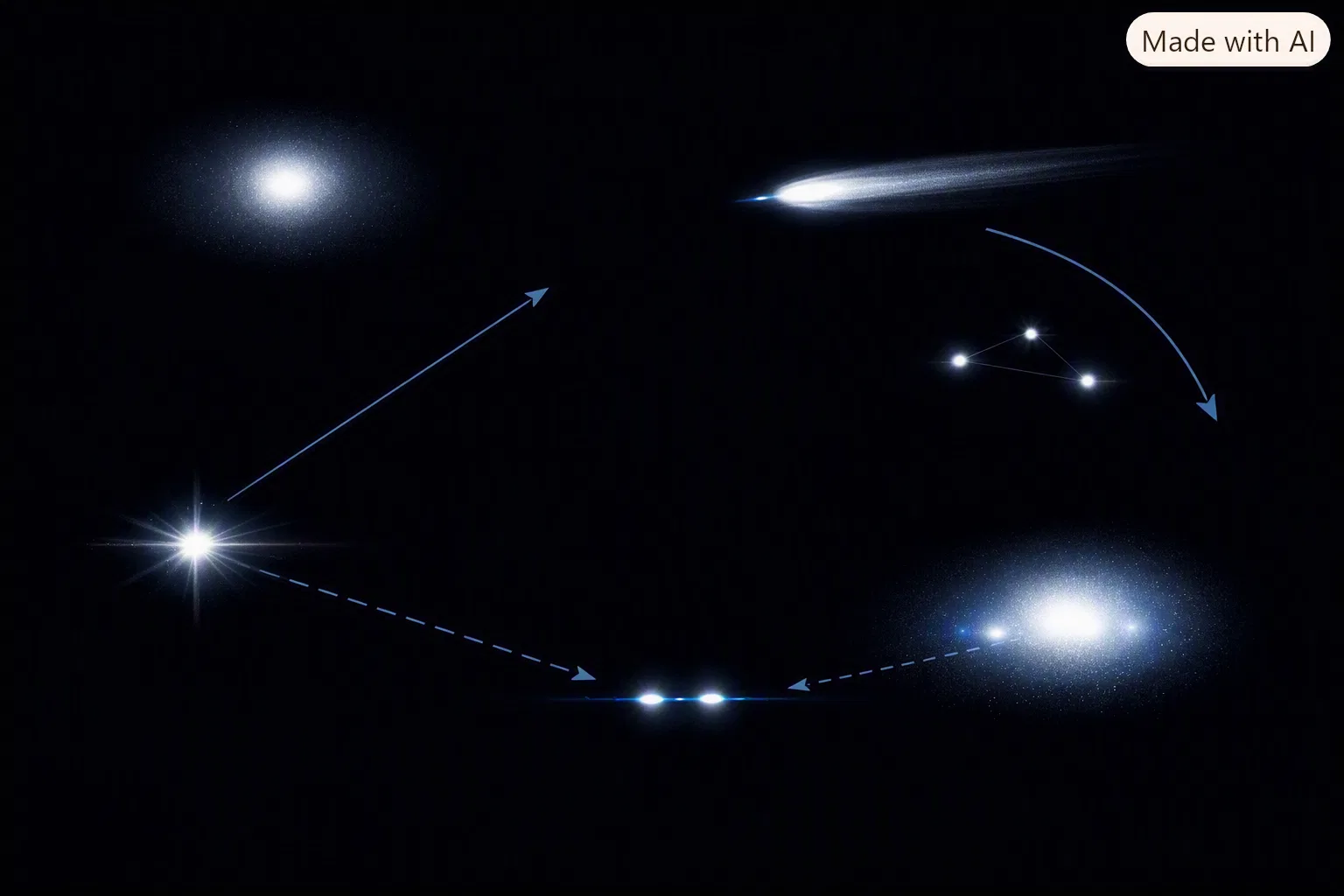
Darkness removes depth, scale, horizon and shape cues, leaving bright points that carry very little information about what produced them.
On this page
- Which visual cues disappear after dark
- Why isolated lights resist size and distance estimates
- How context restores identification
Page outline Jump by section
Introduction
Night sightings are especially easy to misread because darkness removes much of the visual information that normally tells us what an object is, how large it is, how far away it is and how it is moving. A bright point against a dark sky may be very conspicuous while revealing almost nothing about the thing producing the light. Without a visible horizon, surface detail or nearby reference objects, an observer can easily be left with brightness and angular movement but no reliable scale.
This is a recognised limitation of human vision rather than a peculiarity of UFO witnesses. Aviation authorities train pilots specifically for night-time visual illusions, including false horizons and the apparent motion of stationary lights. Modern UAP investigations face the same underlying problem: an impressive-looking light can remain genuinely difficult to identify until investigators recover the missing contextual data.[Federal Aviation Administration]faa.govThe disoriented pilot could lose control of the aircraftFederal Aviation AdministrationAirplane Flying Handbook (3C) Chapter 11September 24, 2021 — Autokinesis In the dark, a stationary light w…
Which visual cues disappear after dark?
In daylight, the visual system estimates distance and three-dimensional layout by combining many imperfect clues. Objects overlap one another; familiar objects supply scale; texture becomes finer with distance; roads and other parallel features converge; shadows reveal shape; atmospheric haze gives clues to remoteness; and movement against foreground and background objects helps establish relative distance. Binocular vision adds further information at comparatively short ranges. At night, particularly when an object is seen high in a featureless sky, many of these cues vanish together.
The Federal Aviation Administration’s night-flying guidance describes the practical consequences. Human vision shifts increasingly towards the rod-dominated system used under low illumination, while sharp central detail and colour perception deteriorate. The FAA also emphasises that the most noticeable difference in night flying is the shortage of outside visual references, and that height, speed and sink rate become more difficult to judge when observable objects are scarce.[Federal Aviation Administration]faa.govThe disoriented pilot could lose control of the aircraftFederal Aviation AdministrationAirplane Flying Handbook (3C) Chapter 11September 24, 2021 — Autokinesis In the dark, a stationary light w…
The horizon is particularly important. During the day, it supplies a stable geometrical reference for judging direction, elevation and apparent motion. On a dark night it may disappear altogether, merge with water or terrain, or become confused with rows of lights. FAA guidance warns that ground lights can become difficult to distinguish from stars and that geometric patterns of lights can create a false impression of where the horizon lies.[Federal Aviation Administration]faa.govThe disoriented pilot could lose control of the aircraftFederal Aviation AdministrationAirplane Flying Handbook (3C) Chapter 11September 24, 2021 — Autokinesis In the dark, a stationary light w…
That matters directly to UFO and UAP reports. A witness who says that a light was “just above the horizon”, “climbing”, “dropping” or “moving level” may be making a perfectly sincere observation while relying on an uncertain reference frame. If the true horizon or surrounding terrain cannot be seen, even describing the light’s direction of travel becomes less secure than it would be in daylight.
The same loss of context affects shape. During daylight, a distant aircraft can still betray itself through wings, fuselage, contrails, shading or changing silhouette. At night those features may disappear while the navigation, anti-collision or landing lights remain visible. The FAA notes that aircraft lights can blend with stars or city lights and that groups of lights visible separately at one distance or altitude can merge perceptually into a single mass from farther away.[Federal Aviation Administration]faa.govThe disoriented pilot could lose control of the aircraftFederal Aviation AdministrationAirplane Flying Handbook (3C) Chapter 11September 24, 2021 — Autokinesis In the dark, a stationary light w…
The result is an important inversion: darkness can make an object easier to notice but harder to identify. A luminous point may stand out dramatically against a black background even though virtually every feature needed to classify its source has been removed.
Why an isolated light tells you so little about size and distance
A lone light in a dark sky has a fundamental ambiguity: the eye receives its angular size, not its physical size or distance independently. A small nearby light and a much larger distant light can therefore occupy a similar angle in the observer’s visual field. Unless something supplies an independent distance or scale cue, the visual image alone cannot cleanly distinguish the alternatives.
This is why statements such as “it was enormous” or “it was only a few hundred metres away” can be much less certain than they sound when the observation concerns a featureless night light. NASA’s UAP independent study stressed that many existing reports lack the information needed to characterise an object’s size, motion or nature conclusively, even when photographs or video exist. The report specifically identifies misjudgements of distance and speed among the issues that cannot be resolved from witness testimony alone.[NASA Science]science.nasa.govNASA Science…
Distance uncertainty also magnifies speed uncertainty. What an observer directly sees is principally a change in viewing angle. Turning that angular motion into kilometres per hour requires a distance estimate. If the assumed distance is badly wrong, the inferred speed will be badly wrong too.
Imagine a light crossing several degrees of sky in a few seconds. If it is nearby, the required physical speed may be modest. If the witness assumes it is tens of kilometres away, the same apparent angular displacement implies a much higher speed. Night conditions make that assumption particularly hazardous because the surrounding scene often contains nothing against which the range can be checked.
The same problem occurs with altitude. A light apparently “high above” an observer may belong to an aircraft, satellite or much nearer object at quite different ranges. AARO’s 2025 reporting illustrates how large those errors can become in operational observations. Civilian pilots had reported some phenomena at estimated altitudes of 45,000 to 60,000 feet, but AARO subsequently resolved many of those reports as satellite flaring after modelling the viewing geometry.[AARO]aaro.milFiscal Year 2025 Consolidated Annual Report on…July 20, 2026 — These reports each described morphological features and behavioral…
Satellite flares are especially instructive because they can appear as bright, isolated “orbs” that intensify and fade without exposing a recognisable physical body. AARO describes the effect as sunlight reflecting from satellite surfaces at particular geometries, producing lights that may become many times brighter than the surrounding stars for anything from a fraction of a second to several minutes. During the 2024–25 reporting period, AARO says it resolved 44 UAP events as satellite flaring.[AARO]aaro.milFiscal Year 2025 Consolidated Annual Report on…July 20, 2026 — These reports each described morphological features and behavioral…
The point is not that every mysterious night light is a satellite. It is that an isolated bright point has very low identifying power. Several physically unrelated sources can generate closely similar visual impressions when shape, range and environmental context are absent.
Apparent movement can be created or exaggerated by the viewing conditions
Night-time uncertainty is not limited to size and distance. A light can also appear to move in ways that do not faithfully represent the motion of its source.
One well-established example is autokinesis. In a dark field with few visual references, a stationary light stared at for several seconds may appear to wander. FAA training treats this as a genuine flight hazard and explicitly warns that a stationary light can appear to move in darkness. Experimental vision research has likewise documented perceived motion while people observe isolated points, showing that the effect belongs to normal perceptual processing rather than to an unusual class of witnesses.[Federal Aviation Administration]faa.govThe disoriented pilot could lose control of the aircraftFederal Aviation AdministrationAirplane Flying Handbook (3C) Chapter 11September 24, 2021 — Autokinesis In the dark, a stationary light w…
Autokinesis is particularly relevant to reports built around descriptions such as “hovering and then drifting”, “making small movements” or “moving back and forth” when the object is a single light against an otherwise empty sky. It does not automatically explain such a report, but it means that small apparent excursions cannot safely be treated as measured object motion unless there are external references or instrumental corroboration.
Observer movement adds another complication. A person in a car, aircraft or boat is moving relative to foreground and background objects. Without visible terrain, the brain has less information with which to separate the observer’s own movement from movement of the light. FAA aviation-physiology material specifically warns that interpreting night lights can become confusing because pilots may have difficulty distinguishing the relationship between their own motion and that of what they see.[Federal Aviation Administration]faa.govPilots can become confused about the relationship between their own motion and the…
Even a stationary observer is not viewing through a perfectly stable optical system. Atmospheric turbulence can vary the apparent brightness and position of point-like celestial sources. NASA material explains stellar scintillation — ordinary “twinkling” — as a consequence of atmospheric turbulence changing the refractive path of light. Under unsuitable viewing conditions, those fluctuations can add colour and brightness changes to an already information-poor target.[Radio JOVE]radiojove.gsfc.nasa.govOpen source on nasa.gov.
None of these effects requires a witness to invent what they saw. The distinction is between perception and physical inference. The perception of a light changing, wandering or accelerating may be vivid; concluding exactly what physical object moved, by how much and at what speed requires information the unaided night view may not contain.

Brightness is a poor substitute for scale
A common intuition is that an exceptionally bright light must either be close or physically large. At night this can be misleading because apparent brightness depends on several variables besides size and distance, including the intrinsic output of the source, whether a beam points towards the observer, reflective geometry and atmospheric conditions.
Aircraft provide an everyday example. A landing light directed approximately towards an observer can dominate the visible appearance of the entire aeroplane. At a great enough distance the airframe itself is below the eye’s useful resolution, leaving what looks like a single intense point. As the aircraft turns, the light can weaken abruptly, disappear or be replaced by a different combination of navigation and anti-collision lights. FAA guidance notes both the importance of aircraft exterior lights for visibility and the possibility of their blending with stars and city lights at night.[Federal Aviation Administration]faa.govThe disoriented pilot could lose control of the aircraftFederal Aviation AdministrationAirplane Flying Handbook (3C) Chapter 11September 24, 2021 — Autokinesis In the dark, a stationary light w…
Satellites demonstrate the same principle without producing their own visible illumination. A small change in Sun-satellite-observer geometry can greatly alter the amount of reflected sunlight reaching a witness. AARO now treats satellite flaring as an increasingly important source of UAP reports and has developed three-dimensional modelling specifically to compare reported lights with predicted satellite geometries.[AARO]aaro.milUAP RecordsUAP Records
Consequently, descriptions such as “too bright to be a star” or “it suddenly became much brighter” are useful observations but weak identifications. Brightness tells investigators something happened optically; by itself it does not establish the object’s physical scale, range or origin.
How context restores identification
Night sightings become much easier to investigate when the missing visual context is replaced with independent information. This is why investigators place so much value on precise time, observing location, viewing direction, elevation, duration, camera metadata and corroborating records.
AARO’s published cases show what this change can accomplish. In its Western United States case, several objects appeared merely as small dots because they were far from the sensor. Analysis of the full video together with commercial flight data showed that radar tracks of three commercial aircraft aligned with the observed objects. The identification came not from extracting a recognisable aeroplane shape from the dots, but from adding information that the original imagery lacked.[AARO]aaro.milOpen source on aaro.mil.
The same principle explains why satellite cases can be resolved after the fact. Once investigators know the observer’s position and the exact time and viewing geometry, they can compare the report with orbital trajectories and calculate whether a spacecraft occupied the relevant line of sight and whether its surfaces could have reflected sunlight towards the observer. AARO explicitly provides satellite, aircraft and balloon tracking resources because those cross-checks can turn an otherwise ambiguous light into a testable identification.[AARO]aaro.milOpen source on aaro.mil.
Multiple viewpoints are even more valuable. If two observers at known locations record the same event at the same time, their lines of sight can potentially constrain its position through triangulation. NASA’s UAP study recommended gathering synchronised smartphone imagery and sensor metadata for this reason, noting that multiple near-simultaneous observations could help estimate location, velocity and size.[NASA Science]science.nasa.govNASA Science…
A useful night-sighting record therefore preserves the information that darkness itself has removed:
- the exact time, preferably to the second;
- the observer’s location;
- the direction and elevation of the light;
- its position relative to stars, planets, buildings, terrain or the horizon;
- the duration and whether it disappeared by fading, moving behind something or simply going out;
- any change in colour, apparent brightness or lighting pattern;
- whether the observer or recording platform was moving;
- original photographs or video with their metadata intact;
- independent observations, radar, flight-tracking or satellite-position data where available.
These details matter more than increasingly elaborate verbal descriptions of a featureless light. NASA’s independent study concluded that UAP analysis is repeatedly hindered by missing metadata, inadequate calibration and lack of multiple measurements. It also cautioned that eyewitness reports may be compelling while still lacking enough reproducible information for definitive conclusions.[NASA Science]science.nasa.govNASA Science…
Why a difficult identification is not the same as an extraordinary object
The hardest night sightings often occupy an awkward evidential category: the witness may have seen something real and unusual-looking, yet the observation may contain too little information to determine what produced it. Darkness itself creates that gap.
Modern official investigations repeatedly encounter cases in which the limiting factor is not the absence of possible ordinary explanations but the absence of discriminating data. In its 2025 annual report, AARO placed 191 of 319 newly received reports into an active archive because corroborating information was insufficient to decide what the underlying events represented. At the same time, it resolved 114 reports as ordinary objects or phenomena including satellites, aircraft, balloons, birds, uncrewed aircraft and a rocket launch.[AARO]aaro.milFiscal Year 2025 Consolidated Annual Report on…July 20, 2026 — These reports each described morphological features and behavioral…
That distinction is crucial when evaluating night-time UFO or UAP accounts. A light that cannot be identified from a witness description remains unidentified within the available evidence. That is not the same claim as saying that no conventional source could have produced it.
Darkness makes that difference unusually important because it strips away precisely the evidence — shape, range, scale, horizon, surface detail and stable reference points — that would normally separate one explanation from another. The most productive question is therefore not simply, “What did the light look like?” but, “What independent information fixes where it was, how far away it was and how it actually moved?” Once those missing constraints are restored, many apparently extraordinary night sightings become ordinary objects seen under unusually poor identifying conditions.[nasa.gov]science.nasa.govNASA Science…
Amazon book picks
Further Reading
Books and field guides related to Why UFOs Become Harder to Identify at Night. Use these as the next step if you want deeper reading beyond the article.
NightWatch: A Practical Guide to Viewing the Universe
A practical guide to viewing the universe.
Sensation and Perception
. Bruce Goldstein's SENSATION AND PERCEPTION, the best-seller which has helped over 150,000 students understand the ties between how we s...
The Backyard Astronomer's Guide
Discusses the practical aspects of stargazing, including how to choose appropriate equipment, contending with light pollution, taking suc...
Eye and Brain: The Psychology of Seeing
Since the publication of the first edition in 1966, Eye and Brain has established itself worldwide as an essential introduction to the ba...
eBay marketplace picks
Marketplace Samples
Live-tested eBay searches with available results related to this page.
Selected fromUFO poster oneBay.co.uk.
Current eBay listing
I Want To Believe UFO Poster Giclée Fine Art Heavyweight Print
Current eBay listing
VINTAGE UFO FLYING SAUCERS COMIC ADVERTISING A2 POSTER PRINT
Endnotes
1.
Source: faa.gov
Title: The disoriented pilot could lose control of the aircraft
Link:https://www.faa.gov/sites/faa.gov/files/regulations_policies/handbooks_manuals/aviation/airplane_handbook/12_afh_ch11.pdf
Source snippet
Federal Aviation AdministrationAirplane Flying Handbook (3C) Chapter 11September 24, 2021 — Autokinesis In the dark, a stationary light w...
Published: September 24, 2021
2.
Source: science.nasa.gov
Link:https://science.nasa.gov/wp-content/uploads/2023/09/uap-independent-study-team-final-report.pdf
Source snippet
NASA Science...
3.
Source: aaro.mil
Link:https://www.aaro.mil/Portals/136/PDFs/FY25%20UAP%20Annual%20Report/AARO_FY2025_Consolidated_Annual_Report_on_UAP.pdf
Source snippet
Fiscal Year 2025 Consolidated Annual Report on...July 20, 2026 — These reports each described morphological features and behavioral...
Published: July 20, 2026
4.
Source: faa.gov
Title: Federal Aviation Administration
Link:https://www.faa.gov/sites/faa.gov/files/2022-11/Intro_Aviation_Physiology.pdf
Source snippet
Pilots can become confused about the relationship between their own motion and the...
5.
Source: radiojove.gsfc.nasa.gov
Link:https://radiojove.gsfc.nasa.gov/newsletters/2015Jan/
6.
Source: faa.gov
Link:https://www.faa.gov/air_traffic/publications/atpubs/aip_html/part2_enr_section_1.15.html
7.
Source: aaro.mil
Title: UAP Records
Link:https://www.aaro.mil/UAP-Records/
8.
Source: aaro.mil
Link:https://www.aaro.mil/UAP-Cases/Official-UAP-Imagery/
9.
Source: aaro.mil
Link:https://www.aaro.mil/Resources/
10.
Source: faa.gov
Link:https://www.faa.gov/sites/faa.gov/files/Night_Ops_Ch13.pdf
11.
Source: faa.gov
Link:https://www.faa.gov/sites/faa.gov/files/regulations_policies/handbooks_manuals/aviation/phak/19_phak_ch17.pdf
12.
Source: faa.gov
Link:https://www.faa.gov/Air_traffic/publications/atpubs/aim_html/chap7_section_6.html
13.
Source: faa.gov
Link:https://www.faa.gov/sites/faa.gov/files/data_research/research/med_humanfacs/oamtechreports/AM81-06.pdf
14.
Source: faa.gov
Link:https://www.faa.gov/sites/faa.gov/files/about/office_org/headquarters_offices/avs/SD_UAV-EV1.pdf
15.
Source: faa.gov
Link:https://www.faa.gov/air_traffic/publications/atpubs/aip_html/part2_enr_section_5.3.html
16.
Source: faa.gov
Title: FA A Safety Briefing
Link:https://www.faa.gov/sites/faa.gov/files/JanFeb2025.pdf
17.
Source: faa.gov
Title: pilot handbook
Link:https://www.faa.gov/sites/faa.gov/files/pilots/pilot_handbook.pdf
18.
Source: faa.gov
Link:https://www.faa.gov/sites/faa.gov/files/02_phak_toc.pdf
19.
Source: faa.gov
Title: pilot handbook 1
Link:https://www.faa.gov/sites/faa.gov/files/pilot_handbook_1.pdf
20.
Source: science.nasa.gov
Link:https://science.nasa.gov/uap/faqs/
21.
Source: science.nasa.gov
Link:https://science.nasa.gov/uap/
22.
Source: science.nasa.gov
Link:https://science.nasa.gov/universe/stars/
23.
Source: imagine.gsfc.nasa.gov
Title: neutron stars2
Link:https://imagine.gsfc.nasa.gov/science/objects/neutron_stars2.html
24.
Source: ntrs.nasa.gov
Link:https://ntrs.nasa.gov/api/citations/19670014580/downloads/19670014580.pdf
25.
Source: ntrs.nasa.gov
Link:https://ntrs.nasa.gov/api/citations/19800018761/downloads/19800018761.pdf
26.
Source: ntrs.nasa.gov
Link:https://ntrs.nasa.gov/api/citations/19820003467/downloads/19820003467.pdf
27.
Source: ntrs.nasa.gov
Link:https://ntrs.nasa.gov/api/citations/19840005329/downloads/19840005329.pdf
28.
Source: eclipse.gsfc.nasa.gov
Link:https://eclipse.gsfc.nasa.gov/SENL/SENL200107B.pdf
29.
Source: ntrs.nasa.gov
Link:https://ntrs.nasa.gov/api/citations/19740002879/downloads/19740002879.pdf
30.
Source: descanso.jpl.nasa.gov
Link:https://descanso.jpl.nasa.gov/propagation/1108/1108Chapter2.pdf
31.
Source: aaro.mil
Title: 2025 UAP Workshop Paper
Link:https://www.aaro.mil/Portals/136/PDFs/Information%20Papers/2025_UAP_Workshop_Paper.pdf
32.
Source: aaro.mil
Title: AARO Historical Record Report Vol 1 2024
Link:https://www.aaro.mil/Portals/136/PDFs/AARO_Historical_Record_Report_Vol_1_2024.pdf
33.
Source: aaro.mil
Link:https://www.aaro.mil/
34.
Source: aaro.mil
Link:https://www.aaro.mil/UAP-Cases/UAP-Reporting-Trends/
35.
Source: aaro.mil
Title: Next UAP Report Documents
Link:https://www.aaro.mil/Next-AARO-Home-redesign/Next-Parent/Next-UAP-Report-Documents/
36.
Source: aaro.mil
Link:https://www.aaro.mil/FAQ/
37.
Source: skybrary.aero
Link:https://skybrary.aero/articles/visual-illusions
38.
Source: nationalcareers.service.gov.uk
Link:https://nationalcareers.service.gov.uk/job-profiles/airline-pilot
39.
Source: careers.ba.com
Link:https://careers.ba.com/pilots
Additional References
40.
Source: pmc.ncbi.nlm.nih.gov
Title: Pub Med Central (PMC)Stability of the Visual World during Eye Drift
Link:https://pmc.ncbi.nlm.nih.gov/articles/PMC2931276/
Source snippet
In the experiments of this study, subjects often reported motion when observing an isolated dot...Read more...
41.
Source: youtube.com
Link:https://www.youtube.com/watch?v=p_O7B6Ld4Zs
Source snippet
PPGS Lesson 14.2 | Aeromedical: Illusions...
42.
Source: intelligence.gov
Link:https://www.intelligence.gov/publics-daily-brief/publics-daily-brief-articles/unidentified-aerial-phenomena-preliminary-intelligence-assessment
43.
Source: youtube.com
Title: Part 107 Night Training (full course)
Link:https://www.youtube.com/watch?v=f_YfFRxOr9o
Source snippet
UFO 'optical illusions:' Astronaut Scott Kelly says it's hard to I.D. strange objects in flight...
44.
Source: youtube.com
Title: Night Illusions (Private Pilot Lesson 15d)
Link:https://www.youtube.com/watch?v=y_HvgmQ3NJs
Source snippet
Spatial Disorientation Explained: Deadly Flight Illusions Every Pilot Must Know...
45.
Source: skybrary.aero
Link:https://skybrary.aero/sites/default/files/bookshelf/6021.pdf
46.
Source: balpa.org
Link:https://www.balpa.org/becoming-a-pilot/
47.
Source: aoa.org
Link:https://www.aoa.org/AOA/Documents/Education/Paraoptometric/Paraoptometric%20Resources/CPC%20approved%20education%20as%20of%207.7.2025.xlsx
48.
Source: facebook.com
Link:https://www.facebook.com/UAPoficialComunidad/
49.
Source: skybrary.aero
Link:https://skybrary.aero/articles/transition-visual-flight-night-oghfa-se