Within Planets
Can Moving Clouds Make Venus Look Mobile?
Wind-blown clouds can create induced motion, making a fixed planet seem to slide, accelerate or move opposite the surrounding cloud field.
On this page
- How induced motion changes perceived direction
- Why faint clouds are deceptive at night
- Recognizing cloud driven apparent movement
Page outline Jump by section
Introduction
Yes. Moving terrestrial clouds can make Venus, Jupiter or another bright, effectively fixed celestial light appear to slide, surge or dart across the sky. The best-established mechanism is induced motion: when a conspicuous stationary target is seen against a moving visual field, part of the relative motion can be perceptually assigned to the target instead of entirely to the background. The textbook natural example is the Moon appearing to move in the opposite direction to wind-blown clouds. Experimental work shows that the same basic effect applies to stationary visual targets.[PubMed Central (PMC)]pmc.ncbi.nlm.nih.govPubMed Central (PMC)Egocentric and Allocentric Localization During Induced Motion - PMC…
For UFO/UAP identification, this matters because bright planets are already plausible sources of reports of apparently hovering or manoeuvring lights. The US All-domain Anomaly Resolution Office (AARO) specifically notes that Venus and Jupiter can be misperceived as hovering or manoeuvring because of perceptual or relative-motion effects.[AARO]aaro.milAARO FAQ… Moving clouds provide a particularly convincing way for a genuinely fixed astronomical light to acquire apparent motion.
How clouds reverse the apparent direction
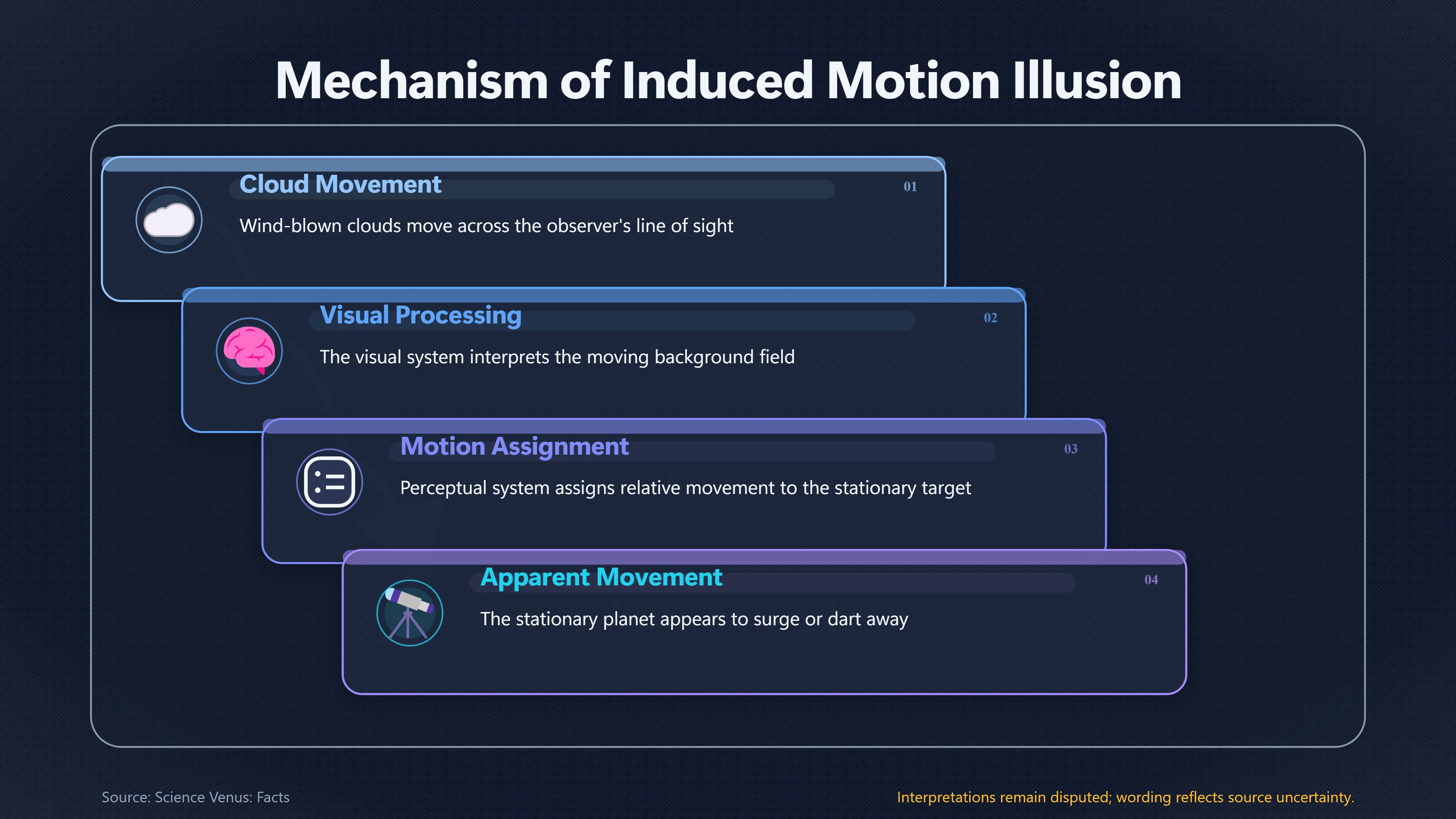
Induced motion is fundamentally a problem of assigning relative movement. Imagine Venus shining through a gap in a sheet of cloud. Across the retina, the planet and the cloud pattern are changing position relative to one another. Physically, almost all of that short-term change comes from the nearby clouds moving across the line of sight. Perceptually, however, the visual system has to decide which part of the scene is moving.
Under suitable conditions it assigns some of the change to the wrong object. A stationary target then appears to move opposite to the direction of the surrounding motion. That is why psychology papers repeatedly use the Moon and wind-blown clouds as the everyday example of induced motion.[PubMed Central (PMC)]pmc.ncbi.nlm.nih.govPubMed Central (PMC)Egocentric and Allocentric Localization During Induced Motion - PMC…
This is not merely a loose analogy for an unusual night-sky impression. Laboratory research defines induced motion as illusory motion of a target away from the motion of its surrounding or unattended background. A 2022 psychophysical study found evidence that the phenomenon involves relatively high-level visual processing rather than being only a simple local interaction between adjacent patches of light. Its results were consistent with the visual system partly subtracting background movement when constructing its judgement of target motion.[PubMed Central (PMC)]pmc.ncbi.nlm.nih.govPubMed Central (PMC)The induced motion effect is a high-level visual phenomenon: Psychophysical evidence - PMC…
That helps explain why the experience can be persuasive. The observer is not necessarily making a conscious inference such as “the clouds look still, therefore the light must be moving”. The apparent movement can emerge during visual processing itself.
The strength of induced motion also depends on properties of the moving scene. Experiments have found that target velocity can matter more than apparent depth separation between target and inducer, showing that a large physical distance between two things does not by itself prevent one from influencing the perceived motion of the other.[PubMed]pubmed.ncbi.nlm.nih.govPub Med Speed, more than depth, determines the strength of induced motionSpeed, more than depth, determines the strength of induced motion - PubMedJune 1, 2010… That is relevant to the sky, where a cloud layer may be kilometres away while a planet is tens or hundreds of millions of kilometres beyond it, yet both are projected into neighbouring parts of the observer’s visual field.
Why faint clouds are especially deceptive at night
The illusion becomes more interesting when the clouds themselves are poorly defined. In daylight, a cloud normally has plenty of visual context: its edges, texture, shading and relationship to the horizon make its movement fairly obvious. At night, a thin cloud layer can be little more than a vague grey texture around a brilliant point of light. The observer therefore has much less information with which to establish a stable frame of reference.
A bright planet is particularly well suited to becoming the perceptual target. NASA describes Venus as the third-brightest object in the sky after the Sun and Moon.[NASA Science]science.nasa.govScience Venus: FactsNASA ScienceVenus: Facts - NASA ScienceJune 23, 2026… NASA’s Night Sky Network likewise notes that Venus is one of the celestial objects most often confused with UFOs, particularly when it is conspicuous near the horizon; Jupiter and Sirius can produce similar identification problems.[Night Sky]nightsky.jpl.nasa.govNight SkyNight Sky Network News & ResourcesDecember 1, 2013…
Now put that intense point of light behind a patchy, wind-driven cloud field. Thin clouds may be visible mainly because their contrast changes near the planet. Their edges can pass over the light, fade into the dark sky and then become visible again. The planet consequently provides the most salient object in the scene even though the clouds supply much of its apparent motion context.
The effect need not feel like a smooth, steady glide. Real cloud fields are irregular. Different patches can cross the line of sight at different apparent speeds and directions; gaps open and close; contrast changes; and the useful reference pattern can disappear altogether. Because induced motion depends on the motion information available to the visual system, changes in that information can change the apparent movement attributed to the target. Research has found that inducer speed is an important determinant of induced-motion strength.[PubMed]pubmed.ncbi.nlm.nih.govPub Med Speed, more than depth, determines the strength of induced motionSpeed, more than depth, determines the strength of induced motion - PubMedJune 1, 2010…
There is even experimental evidence that apparent movement can briefly outlive the stimulus configuration that produced it. Researchers studying a stationary point of light found that induced apparent movement could persist after a moving frame was suddenly removed.[Macquarie University]researchers.mq.edu.auMacquarie UniversityInduced subject-relative movement: Persistence of apparent movement of a stationary point after removal of inducing s… In an outdoor observation, where clouds repeatedly reveal and conceal portions of the sky, such temporal behaviour is one reason the percept should not be expected to behave as neatly as a simple diagram.
The result can therefore be subjectively more dramatic than “the planet slowly moved backwards”. A witness may experience a succession such as apparent drift, pause, renewed motion or a short apparent surge as the cloud pattern changes. That does not establish that every report of abrupt planetary movement is induced motion, but it shows why reported changes of apparent speed are not automatically evidence that the light itself accelerated.
Cloud motion and autokinesis are different effects
Induced motion should be distinguished from autokinesis, although both can occur during night observations.
Autokinesis is the apparent wandering of a small stationary light viewed in darkness or against a nearly featureless background. Aviation guidance treats it as a recognised night-vision illusion: SKYbrary describes a distant stationary light as capable of appearing to move when stared at in darkness because adequate reference points are absent.[Skybrary]skybrary.aeroVisual Illusions | SKYbrary Aviation SafetyVisual Illusions | SKYbrary Aviation Safety
Cloud-induced motion has a different defining ingredient: there is a moving reference field. The clouds themselves supply motion, and the stationary target tends to acquire apparent movement related to that background motion. In the classic configuration, the apparent target movement is opposite the inducer’s direction.[PubMed]pubmed.ncbi.nlm.nih.govOpen source on nih.gov.
In an actual night-sky sighting the distinction may become blurred. A planet might first be observed against nearly invisible sky and appear to wander through autokinesis; a thin cloud field may then become perceptible and create induced motion; later the clouds may disappear again. The resulting recollection could simply be that the light repeatedly “moved”, even though more than one perceptual condition occurred during the observation.
That is why the reported fact that a light seemed to manoeuvre is not, by itself, enough to exclude a planet. AARO’s current guidance explicitly includes perceptual and relative-motion optical effects when explaining why Venus and Jupiter may be reported as manoeuvring UAP.[AARO]aaro.milAARO FAQ…
Recognising cloud-driven apparent movement
Cloud-induced motion becomes a strong candidate when several features occur together. The most diagnostic point is not merely that clouds were present, but that the reported movement tracks changes in the surrounding cloud field.
Look for opposite motion. If clouds clearly drift left while the bright light seems to move right, induced motion is an especially natural explanation. Opposite-direction target motion is the characteristic pattern described in induced-motion research.[PubMed Central (PMC)]pmc.ncbi.nlm.nih.govPubMed Central (PMC)Egocentric and Allocentric Localization During Induced Motion - PMC…
Compare the light with a fixed terrestrial reference. A roof edge, chimney, pole, distant building or other stationary landmark can provide a more reliable reference than clouds. If the planet maintains essentially the same relationship to that reference while appearing mobile relative to the clouds, the supposed manoeuvre is perceptual rather than a large real displacement across the sky.
Watch what happens when the clouds change. If apparent motion begins as a cloud sheet crosses the area, changes when the cloud texture changes and diminishes when a stable clear patch arrives, that temporal relationship supports induced motion. Conversely, a light that independently traverses a substantial angular distance against both clouds and fixed landmarks requires another explanation.
Check the astronomical position independently. A convincing Venus or Jupiter identification should ultimately be geometric, not just psychological. The sighting time, observer location, compass direction and elevation can be compared with astronomical calculations. NASA’s Night Sky Network recommends recording the time, location, duration, direction and behaviour of unidentified sky lights precisely because these details help distinguish ordinary astronomical objects from genuinely unresolved observations.[Night Sky]nightsky.jpl.nasa.govNight SkyNight Sky Network News & ResourcesDecember 1, 2013…
This last check is crucial. “Cloud illusion” should not become a catch-all explanation applied merely because the sky was cloudy. The mechanism explains how a stationary astronomical source can look mobile; astronomy establishes whether the candidate planet was actually in the reported part of the sky.
Why a brief “dart” need not imply real acceleration
The most misleading feature of this illusion is the apparent mismatch between what the witness knows about planets and what they seem to see. A witness may readily accept that Venus can hover but reject a Venus identification because “it suddenly moved”. That objection assumes perceived angular motion is a direct measurement of the planet’s physical motion.
Induced-motion experiments show why that assumption fails. The visual system constructs motion using relationships among target, background, eye movement and broader scene information. Researchers have demonstrated both induced motion opposite moving background contours and circumstances in which motion attributed to the inducing stimulus is effectively transferred, in perceptual terms, to another object.[PubMed]pubmed.ncbi.nlm.nih.govOpen source on nih.gov. More recent psychophysical work likewise supports the idea that induced motion involves higher-level interpretation of target and background movement.[PubMed Central (PMC)]pmc.ncbi.nlm.nih.govPubMed Central (PMC)The induced motion effect is a high-level visual phenomenon: Psychophysical evidence - PMC…
Consequently, an apparent burst of speed does not require a corresponding physical acceleration of the light source. If a fast-moving or newly visible cloud edge suddenly becomes the dominant reference, the perceived motion relationship can change quickly. The appropriate evidential question is therefore not simply, “Did the witness see it dart?” but “Did its measured position change against independent, stationary references?”
For Venus and other bright planets mistaken for UFOs, that distinction is decisive. A planet can remain almost fixed on the relevant timescale while the visual scene around it moves. Under a dark sky with wind-blown cloud, the observer’s perceptual system can transform that relative motion into an impressively mobile light — sometimes apparently travelling in precisely the opposite direction to the clouds.[PubMed Central (PMC)]pmc.ncbi.nlm.nih.govPubMed Central (PMC)Egocentric and Allocentric Localization During Induced Motion - PMC…
Amazon book picks
Further Reading
Books and field guides related to Can Moving Clouds Make Venus Look Mobile?. Use these as the next step if you want deeper reading beyond the article.
Sensation and Perception
. Bruce Goldstein's SENSATION AND PERCEPTION, the best-seller which has helped over 150,000 students understand the ties between how we s...
The UFO Handbook: A Guide to Investigating, Evaluating, and R...
An explanation of the usual reasons for confusing IFOs (identified flying objects) with UFOs and a survey of the tools used to investigat...
NightWatch: A Practical Guide to Viewing the Universe
A practical guide to viewing the universe.
The Backyard Astronomer's Guide
Discusses the practical aspects of stargazing, including how to choose appropriate equipment, contending with light pollution, taking suc...
eBay marketplace picks
Marketplace Samples
Live-tested eBay searches with available results related to this page.
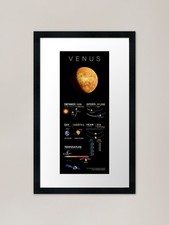
Selected fromVenus poster oneBay.co.uk.


Endnotes
1.
Source: aaro.mil
Link:https://www.aaro.mil/FAQ/
Source snippet
AARO FAQ...
2.
Source: science.nasa.gov
Title: Science Venus: Facts
Link:https://science.nasa.gov/venus/venus-facts/
Source snippet
NASA ScienceVenus: Facts - NASA ScienceJune 23, 2026...
Published: June 23, 2026
3.
Source: nightsky.jpl.nasa.gov
Link:https://nightsky.jpl.nasa.gov/news/39/
Source snippet
Night SkyNight Sky Network News & ResourcesDecember 1, 2013...
Published: December 1, 2013
4.
Source: skybrary.aero
Title: Visual Illusions | SKYbrary Aviation Safety
Link:https://skybrary.aero/index.php/articles/visual-illusions
5.
Source: skybrary.aero
Title: Autokinetic Effect | SKYbrary Aviation Safety
Link:https://skybrary.aero/index.php/articles/autokinetic-effect
6.
Source: aaro.mil
Link:https://www.aaro.mil/
7.
Source: aaro.mil
Link:https://www.aaro.mil/Next-AARO-Home-redesign/Next-Parent/Next-AARO-UAP-Imagery-Acc-Table/
8.
Source: aaro.mil
Link:https://www.aaro.mil/Next-AARO-Home-redesign/Next-Parent/Next-UAP-Report-Documents/poster/dividLink/
9.
Source: aaro.mil
Link:https://www.aaro.mil/Next-AARO-Home-redesign/Next-Parent/Presidential-UAP-Transparency-Initiative/
10.
Source: aaro.mil
Link:https://www.aaro.mil/Next-AARO-Home-redesign/Next-Parent/Presidential-UAP-Transparency-Initiative/videoid/1010269/dvpcc/false/
11.
Source: science.nasa.gov
Title: photographing the moon illusion
Link:https://science.nasa.gov/resource/photographing-the-moon-illusion/
12.
Source: aaro.mil
Link:https://www.aaro.mil/Next-AARO-Home-redesign/Next-Parent/Presidential-UAP-Transparency-Initiative/videoid/1006074/dvpcc/false/
13.
Source: aaro.mil
Link:https://www.aaro.mil/Next-AARO-Home-redesign/Next-Parent/Presidential-UAP-Transparency-Initiative/videoid/1006063/dvpcc/false/
14.
Source: aaro.mil
Link:https://www.aaro.mil/Next-AARO-Home-redesign/Next-Parent/Presidential-UAP-Transparency-Initiative/videoid/1010276/dvpcc/false/
15.
Source: apod.nasa.gov
Link:https://apod.nasa.gov/apod/ap180130.html
16.
Source: nasa.gov
Title: NAS A Studies Cube Sat Mission to Solve Venusian Mystery
Link:https://www.nasa.gov/technology/nasa-studies-cubesat-mission-to-solve-venusian-mystery/
17.
Source: science.nasa.gov
Title: identifying ufos and uaps
Link:https://science.nasa.gov/solar-system/skywatching/night-sky-network/identifying-ufos-and-uaps/
18.
Source: apod.nasa.gov
Link:https://apod.nasa.gov/apod/ap080226.html
19.
Source: apod.nasa.gov
Link:https://apod.nasa.gov/apod/ap070501.html
20.
Source: ntrs.nasa.gov
Link:https://ntrs.nasa.gov/citations/20000025067
21.
Source: science.nasa.gov
Title: venus multiple views of high level clouds
Link:https://science.nasa.gov/photojournal/venus-multiple-views-of-high-level-clouds/
22.
Source: jpl.nasa.gov
Title: pia00223 venus multiple views of high level clouds
Link:https://www.jpl.nasa.gov/images/pia00223-venus-multiple-views-of-high-level-clouds/
23.
Source: science.nasa.gov
Title: venus lower level nightside clouds as seen by nims
Link:https://science.nasa.gov/photojournal/venus-lower-level-nightside-clouds-as-seen-by-nims/
24.
Source: science.nasa.gov
Title: venus lower level clouds as seen by nims
Link:https://science.nasa.gov/photojournal/venus-lower-level-clouds-as-seen-by-nims/
25.
Source: science.nasa.gov
Title: venus in violet and near infrared light
Link:https://science.nasa.gov/photojournal/venus-in-violet-and-near-infrared-light/
26.
Source: science.nasa.gov
Title: venus cloud patterns
Link:https://science.nasa.gov/resource/venus-cloud-patterns/
27.
Source: jpl.nasa.gov
Title: pia00071 venus in violet and near infrared light
Link:https://www.jpl.nasa.gov/images/pia00071-venus-in-violet-and-near-infrared-light/
28.
Source: science.nasa.gov
Title: infrared image of low clouds on venus
Link:https://science.nasa.gov/photojournal/infrared-image-of-low-clouds-on-venus/
29.
Source: ntrs.nasa.gov
Link:https://ntrs.nasa.gov/search.jsp?R=19790056808
30.
Source: ntrs.nasa.gov
Link:https://ntrs.nasa.gov/citations/19750059050
31.
Source: ntrs.nasa.gov
Link:https://ntrs.nasa.gov/citations/19750008369
32.
Source: starchild.gsfc.nasa.gov
Title: pvo venus
Link:https://starchild.gsfc.nasa.gov/docs/StarChild/solar_system_level2/pvo_venus.html
33.
Source: aaro.mil
Link:https://www.aaro.mil/UAP-Cases/Official-UAP-Imagery/ftag/MSF0951a18/
34.
Source: aaro.mil
Title: AAR O UAP Trends All-domain Anomaly Resolution Office UAP REPORTING TRENDS
Link:https://www.aaro.mil/UAP-Cases/UAP-Reporting-Trends/
35.
Source: aaro.mil
Link:https://www.aaro.mil/UAP-Cases/Official-UAP-Imagery/4/
36.
Source: aaro.mil
Link:https://www.aaro.mil/Next-AARO-Home-redesign/Next-Parent/Next-AARO-UAP-Imagery-Fixed-Table/
37.
Source: aaro.mil
Link:https://www.aaro.mil/Next-AARO-Home-redesign/Inactive-Parent/Next-UAP-Imagery-dup/
38.
Source: aaro.mil
Link:https://www.aaro.mil/Next-AARO-Home-redesign/Next-Parent/Next-AARO-UAP-Trends/
39.
Source: aaro.mil
Link:https://www.aaro.mil/Next-AARO-Home-redesign/Inactive-Parent/FAQ-Datatable/
40.
Source: pmc.ncbi.nlm.nih.gov
Link:https://pmc.ncbi.nlm.nih.gov/articles/PMC2652014/
Source snippet
PubMed Central (PMC)Egocentric and Allocentric Localization During Induced Motion - PMC...
41.
Source: pubmed.ncbi.nlm.nih.gov
Link:https://pubmed.ncbi.nlm.nih.gov/36092511/
Source snippet
The induced motion effect is a high-level visual phenomenon: Psychophysical evidence - PubMed...
42.
Source: pmc.ncbi.nlm.nih.gov
Link:https://pmc.ncbi.nlm.nih.gov/articles/PMC9459461/
Source snippet
PubMed Central (PMC)The induced motion effect is a high-level visual phenomenon: Psychophysical evidence - PMC...
43.
Source: pubmed.ncbi.nlm.nih.gov
Title: Pub Med Speed, more than depth, determines the strength of induced motion
Link:https://pubmed.ncbi.nlm.nih.gov/20884559/
Source snippet
Speed, more than depth, determines the strength of induced motion - PubMedJune 1, 2010...
Published: June 1, 2010
44.
Source: researchers.mq.edu.au
Link:https://researchers.mq.edu.au/en/publications/induced-subject-relative-movement-persistence-of-apparent-movemen/
Source snippet
Macquarie UniversityInduced subject-relative movement: Persistence of apparent movement of a stationary point after removal of inducing s...
45.
Source: pubmed.ncbi.nlm.nih.gov
Link:https://pubmed.ncbi.nlm.nih.gov/1762872/
46.
Source: pubmed.ncbi.nlm.nih.gov
Link:https://pubmed.ncbi.nlm.nih.gov/3227646/
47.
Source: pubmed.ncbi.nlm.nih.gov
Title: Pub Med Induced movement based on subtraction of motion from the inducing object
Link:https://pubmed.ncbi.nlm.nih.gov/6447755/
48.
Source: encyclopedia.arabpsychology.com
Link:https://encyclopedia.arabpsychology.com/autokinesis/
49.
Source: pmc.ncbi.nlm.nih.gov
Link:https://pmc.ncbi.nlm.nih.gov/articles/PMC12177812/
50.
Source: pmc.ncbi.nlm.nih.gov
Link:https://pmc.ncbi.nlm.nih.gov/articles/PMC11046177/
51.
Source: pmc.ncbi.nlm.nih.gov
Link:https://pmc.ncbi.nlm.nih.gov/articles/PMC10433163/
52.
Source: pmc.ncbi.nlm.nih.gov
Link:https://pmc.ncbi.nlm.nih.gov/articles/PMC5141260/
53.
Source: pmc.ncbi.nlm.nih.gov
Link:https://pmc.ncbi.nlm.nih.gov/articles/PMC5255528/
54.
Source: pmc.ncbi.nlm.nih.gov
Link:https://pmc.ncbi.nlm.nih.gov/articles/PMC6622396/
55.
Source: pubmed.ncbi.nlm.nih.gov
Link:https://pubmed.ncbi.nlm.nih.gov/20720121/
56.
Source: pmc.ncbi.nlm.nih.gov
Link:https://pmc.ncbi.nlm.nih.gov/articles/PMC2367089/
57.
Source: pmc.ncbi.nlm.nih.gov
Link:https://pmc.ncbi.nlm.nih.gov/articles/PMC1569493/
58.
Source: pmc.ncbi.nlm.nih.gov
Link:https://pmc.ncbi.nlm.nih.gov/articles/PMC22418/
59.
Source: pubmed.ncbi.nlm.nih.gov
Link:https://pubmed.ncbi.nlm.nih.gov/3279445/
60.
Source: pubmed.ncbi.nlm.nih.gov
Link:https://pubmed.ncbi.nlm.nih.gov/9274752/
61.
Source: pubmed.ncbi.nlm.nih.gov
Link:https://pubmed.ncbi.nlm.nih.gov/628584/
62.
Source: pubmed.ncbi.nlm.nih.gov
Link:https://pubmed.ncbi.nlm.nih.gov/23094461/
63.
Source: pubmed.ncbi.nlm.nih.gov
Link:https://pubmed.ncbi.nlm.nih.gov/12926512/
64.
Source: pubmed.ncbi.nlm.nih.gov
Link:https://pubmed.ncbi.nlm.nih.gov/534153/
65.
Source: pubmed.ncbi.nlm.nih.gov
Link:https://pubmed.ncbi.nlm.nih.gov/19605212/
66.
Source: sky-lens.com
Link:https://sky-lens.com/guide
67.
Source: eyepatient.net
Link:https://eyepatient.net/Home/articledetail/induced-motion-3731
68.
Source: taylorfrancis.com
Title: Movement | 7 | v3 | The Visual Story | Bruce Block | Taylor & Francis
Link:https://www.taylorfrancis.com/chapters/mono/10.4324/9781315794839-7/movement-bruce-block
Additional References
69.
Source: experts.arizona.edu
Link:https://experts.arizona.edu/en/publications/induced-subject-relative-movement-persistence-of-apparent-movemen/
70.
Source: youtube.com
Title: Planetary Motions in the Sky
Link:https://www.youtube.com/watch?v=YLNF5zTCssU
Source snippet
This collection of videos provides concrete context on how bright planets like Venus get misidentified as moving UFOs due to visual perce...
71.
Source: youtube.com
Title: Social Influence: Conformity Types, Asch’s Line Study & Sherif’s Experiment
Link:https://www.youtube.com/watch?v=e45A7tAkcq8
Source snippet
Conformity Research: Sherif's Autokinetic Effect Experiment...
72.
Source: faa.gov
Link:https://www.faa.gov/data_research/research/med_humanfacs/oamtechreports/1960s/1969/196923
73.
Source: faa.gov
Link:https://www.faa.gov/Air_traffic/publications/atpubs/aim_html/chap8_section_1.html
74.
Source: faa.gov
Link:https://www.faa.gov/data_research/research/med_humanfacs/oamtechreports/1970s/1977/197702
75.
Source: faa.gov
Link:https://www.faa.gov/data_research/research/med_humanfacs/oamtechreports/1970s/1979/197926
76.
Source: nature.com
Title: Large stationary gravity wave in the [atmosphere]({{ ‘atmosphere/’ | relative_url }}) of Venus | Nature Geoscience
Link:https://www.nature.com/articles/ngeo2873
77.
Source: faa.gov
Title: Office of Aerospace Medicine Technical Reports | Federal Aviation Administration
Link:https://www.faa.gov/data_research/research/med_humanfacs/oamtechreports/1970s/1971/7134
78.
Source: nature.com
Title: Morphology and dynamics of the upper cloud layer of Venus | Nature
Link:https://www.nature.com/articles/nature06320