Within Balloons
Can a Balloon Look Impossibly Fast?
Without a reliable range, a distant balloon's true size, speed and acceleration can be badly misjudged.
On this page
- Why angular size does not reveal true size
- How missing range data distorts speed estimates
- What measurements are needed before claiming acceleration
Page outline Jump by section
Introduction
A balloon does not need to travel extraordinarily fast to produce a video that looks as though it does. The central problem is unknown range. A camera records where an object appears in its field of view — an angle — but converting that angular movement into metres travelled requires knowing how far away the object is. If the assumed distance is badly wrong, the resulting estimate of size, speed and acceleration can be badly wrong as well.
This matters particularly for balloons because they often lack reliable scale cues. A smooth sphere, foil balloon or distant balloon cluster may reveal no wings, windows or other feature of known dimensions. From a moving aircraft, the problem becomes harder again: the observer’s own motion can produce parallax that makes a stationary or slowly drifting object sweep rapidly across the background. The US All-domain Anomaly Resolution Office (AARO) specifically warns that these effects can generate inaccurate estimates of UAP size, speed and direction.[AARO]aaro.milEffect of Forced Perspective and Parallax View on UAP ObservationsEffect of Forced Perspective and Parallax View on UAP Observations…
Why angular size does not reveal true size
A photograph or video can establish an object’s angular size — how much of the camera’s field of view it occupies — but angular size is not the same thing as physical size. For a sufficiently small angle, the basic relationship is approximately:
physical size ≈ range × angular size in radians
The ambiguity is therefore unavoidable unless range is independently known. An object subtending an angle of 0.1° would be about 17 centimetres across at 100 metres, about 1.7 metres across at one kilometre, and about 17 metres across at ten kilometres. All three objects would occupy essentially the same angular width.
AARO highlights exactly this problem in its information paper on forced perspective and parallax. It notes that estimating the distance and size of an unknown aerial object becomes especially difficult when it has no discernible features such as wings, windows or propellers. Comparisons with clouds, buildings or other scenery can also mislead because the observer may incorrectly assume that the object and the supposed reference lie at similar distances.[AARO]aaro.milEffect of Forced Perspective and Parallax View on UAP ObservationsEffect of Forced Perspective and Parallax View on UAP Observations…
That is an important weakness in many balloon-like UAP observations. A featureless dot against open sky contains little inherent information about depth. Even if its image is sharp enough to measure accurately in pixels, that measurement alone does not tell an analyst whether the object is a small balloon relatively nearby or a substantially larger balloon much farther away.
This is not a special rule invented for UAP analysis. The same geometry appears in astronomy. An object’s transverse velocity — its velocity across an observer’s line of sight — is related to its measured angular rate and distance by v = μD, where μ is angular motion and D is distance. Without D, angular movement does not yield a unique physical velocity.[Swinburne Astronomy]astronomy.swin.edu.auSwinburne Astronomy Transverse velocity | COSMOSSwinburne Astronomy Transverse velocity | COSMOS
The problem therefore begins before anyone estimates speed. If range is unconstrained, physical size is unconstrained too, and assumptions about one can quietly become assumptions about the other.
How missing range data creates extreme speed estimates
The speed problem follows directly from the size problem. Suppose a target moves across 0.5° of the sky in one second. The angular movement can be measured perfectly from the imagery. Yet the corresponding physical movement depends entirely on range.
At 100 metres, 0.5° corresponds to roughly 0.87 metres of transverse displacement. At one kilometre it corresponds to about 8.7 metres. At ten kilometres it is about 87 metres. The same apparent movement therefore supports radically different physical speeds depending on where the target actually is.
This is why a calculation can look mathematically sophisticated while still failing to establish an object’s true performance. Measuring pixels per frame, converting pixels into degrees and dividing by elapsed time produces an angular rate. If an assumed distance is then inserted, the calculation produces a numerical speed — but the result inherits the distance assumption. Multiplying an uncertain quantity by precisely measured angles does not remove the uncertainty.
AARO’s 2024 paper makes this problem explicit. It says that electronic sensors aboard moving airborne platforms may be too far from an object to establish its exact range and that the resulting geometry can lead observers to misinterpret true size and speed. AARO further cautions that these perspective effects can explain some reports of excessively large objects or exceptionally high apparent velocities.[AARO]aaro.milEffect of Forced Perspective and Parallax View on UAP ObservationsEffect of Forced Perspective and Parallax View on UAP Observations…
For balloons, that is a particularly important failure mode because ordinary wind-driven movement provides no visual warning that the distance estimate is wrong. A balloon drifting at a modest speed can still cross the camera’s background quickly if the geometry is favourable.
A moving aircraft can supply most of the apparent motion
Unknown distance becomes even more dangerous when the camera itself is moving. In an airborne UAP video, the observer may be travelling at hundreds of kilometres per hour while looking at an object moving only slowly with the wind.
The resulting effect is motion parallax. A simple terrestrial version can be seen from a moving vehicle: nearby roadside objects seem to rush backwards, while distant hills barely shift. Neither background is actually travelling backwards. The apparent movement is produced by the observer changing position.
An airborne camera looking at a balloon encounters the same geometry in three dimensions. As the aircraft moves, its line of sight to the balloon changes. The balloon is successively projected against different parts of the distant terrain, ocean or cloud background. Watching the imagery without reconstructing the camera’s trajectory can make the target itself appear to be covering that background distance.
AARO illustrates the mechanism with a stationary object suspended above a river. As an airborne observer moves between viewing positions, the object appears projected first against one bank, then the river, then the other bank. The object’s apparent movement across the landscape is created by the changing viewpoint. AARO notes that faster observer motion makes the effect more dramatic and that slow-moving objects can consequently appear to move very fast.[AARO]aaro.milEffect of Forced Perspective and Parallax View on UAP ObservationsEffect of Forced Perspective and Parallax View on UAP Observations…
The critical analytical question is therefore not simply, “How fast does the object move across the video?” It is, “How much of the changing line of sight is caused by the target, and how much by the sensor platform?”
Puerto Rico: apparent high speed reconstructed at 8 mph
AARO’s analysis of the 2013 Puerto Rico UAP footage gives a concrete example of how large this difference can become.
An infrared sensor aboard a US Customs and Border Protection aircraft recorded objects whose apparent behaviour had been interpreted as unusually fast and otherwise anomalous. AARO reconstructed the encounter using Systems Toolkit modelling. Rather than treating movement across the image as physical ground speed, investigators integrated the aircraft’s position with sensor elevation, azimuth and slant angle to reconstruct the objects’ flight path.[AARO]aaro.milPuerto Rico UAP Case ResolutionAARO Puerto Rico UAP Case ResolutionMarch 19, 2025…
The result was far less extraordinary than the raw footage suggested. AARO calculated that the objects drifted at approximately 3.6 metres per second — about 8 mph — in a straight line over land. Recorded wind was about 4.4 metres per second, or 9.8 mph, from the east/north-east. AARO explicitly attributed the apparent high speed to motion parallax and identified the aircraft’s speed, sensor zoom and changing relative positions as factors influencing the perceived performance.[AARO]aaro.milPuerto Rico UAP Case ResolutionAARO Puerto Rico UAP Case ResolutionMarch 19, 2025…
AARO ultimately assessed the objects as most likely sky lanterns rather than balloons in the narrow conventional sense, so the case should not be presented as proof that a particular balloon caused the sighting. Its relevance here is geometrical: a lightweight wind-borne object that appeared to move rapidly reconstructed as drifting at approximately wind speed once observer motion and sensor geometry were included.
That is precisely the risk in assigning extraordinary speeds to distant balloon-like objects from airborne imagery.

Al Taqaddum: establishing range turned a strange object into a wind-drifter
The Al Taqaddum case is even more directly relevant because AARO concluded that the object was consistent with a cluster of fully and partially inflated balloons.
On 23 October 2017, an infrared sensor aboard a force-protection aerostat operating at 2,700 feet over Al Taqaddum Air Base in Iraq recorded the unidentified object for 17 minutes and 30 seconds. Its altitude had not been reported by the observer. AARO later reconstructed it at approximately 850–2,200 feet and estimated a speed of 4–14 mph.[AARO]aaro.milAl Taqaddam Case ResolutionAl Taqaddam Case ResolutionSeptember 18, 2025 — 8 Sept 2025 — AARO assesses with high confidence that the Al Taqaddum object did not…
The uncertainty in those numbers is itself instructive. AARO assigned only moderate confidence to the altitude and speed estimates because historical and real-time wind information varied. Nevertheless, it assessed with high confidence that the object’s east-to-west movement lay within the range of local wind speeds. Its attribution to balloons drew not merely on appearance but on full-motion video, metadata, line-of-sight analysis, scenario reconstruction and weather data.[AARO]aaro.milAl Taqaddam Case ResolutionAl Taqaddam Case ResolutionSeptember 18, 2025 — 8 Sept 2025 — AARO assesses with high confidence that the Al Taqaddum object did not…
The case demonstrates what a defensible speed claim looks like. Investigators did not infer velocity simply from how rapidly the object seemed to traverse the sensor image. They constrained its altitude, reconstructed its line of sight and compared the resulting movement with atmospheric conditions.
The report also notes that the imagery became increasingly grainy as the object’s distance from the sensor increased. That is a useful reminder that the same increasing range that removes recognisable shape information can also weaken the measurements needed to determine performance.[AARO]aaro.milAl Taqaddam Case ResolutionAl Taqaddam Case ResolutionSeptember 18, 2025 — 8 Sept 2025 — AARO assesses with high confidence that the Al Taqaddum object did not…
GOFAST shows why the range field matters
The Navy’s GOFAST video is not a confirmed balloon case, and AARO says it cannot definitively identify the object. It is nevertheless one of the clearest demonstrations of why range information can overturn an intuitive impression of speed.
The footage appears at first glance to show a small object travelling rapidly just above the Atlantic. Unlike many UAP recordings, however, the sensor display contains useful numerical information. NASA’s independent UAP study identified camera elevation and azimuth, target range, aircraft altitude, elapsed time and aircraft speed among the quantities available for analysis.[NASA Science]science.nasa.govNASA Science…
Using the range, elevation and aircraft altitude, NASA calculated that the object was at about 13,000 feet, not skimming immediately above the sea. The ocean was roughly 4.2 miles behind it from the relevant viewing geometry. NASA noted that the aircraft itself had a groundspeed of about 435 mph, making motion parallax an important part of the object’s apparent rapid movement.[NASA Science]science.nasa.govNASA Science…
NASA then used the changing geometry over 22 seconds to estimate that the object moved roughly 390 metres, corresponding to an average speed of about 40 mph. The study explicitly acknowledged uncertainty because its calculation neglected wind effects on the aircraft, so the 40 mph figure should not be treated as a final precision measurement. Its narrower conclusion was that the footage did not require extraordinary velocity.[NASA Science]science.nasa.govNASA Science…
AARO later conducted a more extensive analysis. It likewise placed the object at approximately 13,000 feet and concluded with high confidence that it did not display anomalous speed. Because the aircraft’s exact heading was absent from the available recording, AARO could not derive one unique target speed. Instead, it modelled the full range of possible aircraft headings and incorporated historical winds at both the object’s and aircraft’s altitudes.[AARO]aaro.milGo Fast Case ResolutionAARO GoFast Case Resolution…
The resulting ground-speed possibilities ranged from about 72 to 161 mph before removing wind contribution. AARO’s estimated intrinsic speed — motion relative to the surrounding air — ranged from about 5 to 92 mph, depending on heading. Crucially, AARO found no simulated case in which the object moved against the wind and attributed the visual impression of exceptional speed to motion parallax.[AARO]aaro.milGo Fast Case ResolutionAARO GoFast Case Resolution…
The wider range compared with NASA’s illustrative 40 mph estimate is not a weakness in the underlying lesson. It demonstrates it. Missing information about observer heading prevents a single precise solution, so the responsible analysis reports a range of possible trajectories instead of choosing one favourable geometry and presenting it as certain.
Why acceleration claims are more fragile than speed claims
Acceleration introduces another layer of sensitivity because it is calculated from changes in velocity over time. If velocity estimates already depend on uncertain range, then acceleration estimates compound that uncertainty.
Consider two video frames. If a target shifts five pixels between them, the physical displacement depends on camera calibration and target range. Estimate that displacement again several frames later and a velocity can be calculated. Compare the velocities and an acceleration can be derived. But if the assumed range changes incorrectly — or should have changed but was treated as constant — the apparent acceleration may partly be an artefact of the reconstruction.
Aircraft motion adds still more variables. A bank, turn or change in camera pointing can alter the target’s apparent motion even if the target continues drifting steadily. Zoom and stabilisation can affect the visual impression as well. A genuine claim of exceptional acceleration therefore requires demonstrating that these effects have been removed rather than merely observing a sudden-looking movement on screen.
GOFAST illustrates the importance of metadata here. AARO could use target range, sensor azimuth and elevation, aircraft altitude and speed, and frame timing, yet still could not obtain a unique absolute trajectory because aircraft heading and exact position were unavailable. Its report states that the original file and accompanying metadata were no longer available and that displayed range and angles were only given to limited precision, adding a small margin of error.[AARO]aaro.milGo Fast Case ResolutionAARO GoFast Case Resolution…
NASA reached the broader methodological conclusion that many existing UAP observations lack the metadata necessary to constrain motion. It notes that sensors are often not designed or calibrated for this task and that missing information about sensor characteristics, acquisition conditions and location can prevent conclusive characterisation of an object’s size or movement.[NASA Science]science.nasa.govNASA Science…
An acceleration figure should therefore be treated as a derived result, not something directly visible in a video. If its range inputs are assumptions, the apparently remarkable acceleration may be an assumption expressed in metres per second squared.
What measurements are needed before claiming exceptional performance
A credible claim that a balloon-like object accelerated beyond conventional capabilities requires enough information to reconstruct its position through three-dimensional space. A useful analysis should ideally combine several kinds of measurement rather than depend on a single video.
Range is the first requirement. Radar can provide it directly. The US Federal Aviation Administration explains that primary surveillance radar transmits radio waves, receives reflections from objects and determines distance by measuring the time required for the signal to return. Combining range with azimuth establishes the object’s position relative to the radar.[Federal Aviation Administration]faa.govFederal Aviation AdministrationAirport Surveillance Radar (ASR-11) | Federal Aviation AdministrationSeptember 22, 2025…
Observer position and velocity are also essential. For an aircraft-mounted camera, GPS position, altitude, groundspeed, heading and attitude allow analysts to subtract the observer’s movement rather than accidentally attributing it to the target.
Camera geometry must be known. Sensor azimuth, elevation, field of view, zoom state and accurate timestamps are needed to convert pixel movement into line-of-sight angles. AARO’s GOFAST reconstruction shows why these quantities matter: its methodology first calculated target positions at separated times using the target’s range and the sensor’s orientation, then used those reconstructed positions to constrain velocity.[AARO]aaro.milGo Fast Case ResolutionAARO GoFast Case Resolution…
Multiple observing positions can break the range ambiguity. NASA’s independent study specifically suggested combining near-simultaneous observations and metadata so that an object’s position could be triangulated and its velocity and size estimated. It also emphasised the value of multisensor platforms for creating a more complete description of a UAP event.[NASA Science]science.nasa.govNASA Science…
Wind measurements are particularly important for suspected balloons. The National Weather Service’s own balloon programme demonstrates the principle directly. Its radiosondes transmit GPS position every second as they rise, and tracking those changing positions allows meteorologists to calculate wind speed and direction aloft.[National Weather Service]weather.govNational Weather Service Radiosonde ObservationNational Weather Service Radiosonde Observation A suspected balloon’s reconstructed trajectory can therefore be tested against the wind at its estimated altitude rather than against surface weather or an observer’s impression.
That altitude qualification matters. Weather balloons can travel enormous distances and through very different wind regimes: the National Weather Service notes that a radiosonde flight can exceed two hours, rise above 35 kilometres and drift more than 200 kilometres from its launch point.[National Weather Service]weather.govOpen source on weather.gov. Surface wind at the observer’s location is consequently not a sufficient test of whether a high-altitude balloon should be moving in a particular direction.
The real warning sign is a speed estimate without a distance measurement
The strongest lesson is not that every fast-looking UAP is a balloon. AARO itself explicitly cautions that forced perspective and parallax do not explain every report of a rapidly moving UAP.[AARO]aaro.milEffect of Forced Perspective and Parallax View on UAP ObservationsEffect of Forced Perspective and Parallax View on UAP Observations… The narrower and more defensible conclusion is that extraordinary linear speed cannot be inferred securely from angular motion when range is unknown.
NASA’s UAP study found that many reports do not contain enough data or metadata to determine size, movement or nature conclusively. Where adequate geometric information does exist, as in GOFAST, apparently anomalous behaviour may be substantially reduced by accounting for sensor-platform motion. NASA therefore emphasises calibrated measurements and multisensor observations rather than relying on visual impressions alone.[NASA Science]science.nasa.govNASA Science…
Balloon reports are especially vulnerable to this error because a balloon may be visually featureless, may drift passively at an unknown altitude and may be recorded from an observer moving far faster than the balloon itself. The resulting video can combine uncertain scale, uncertain range and strong parallax in a single observation.
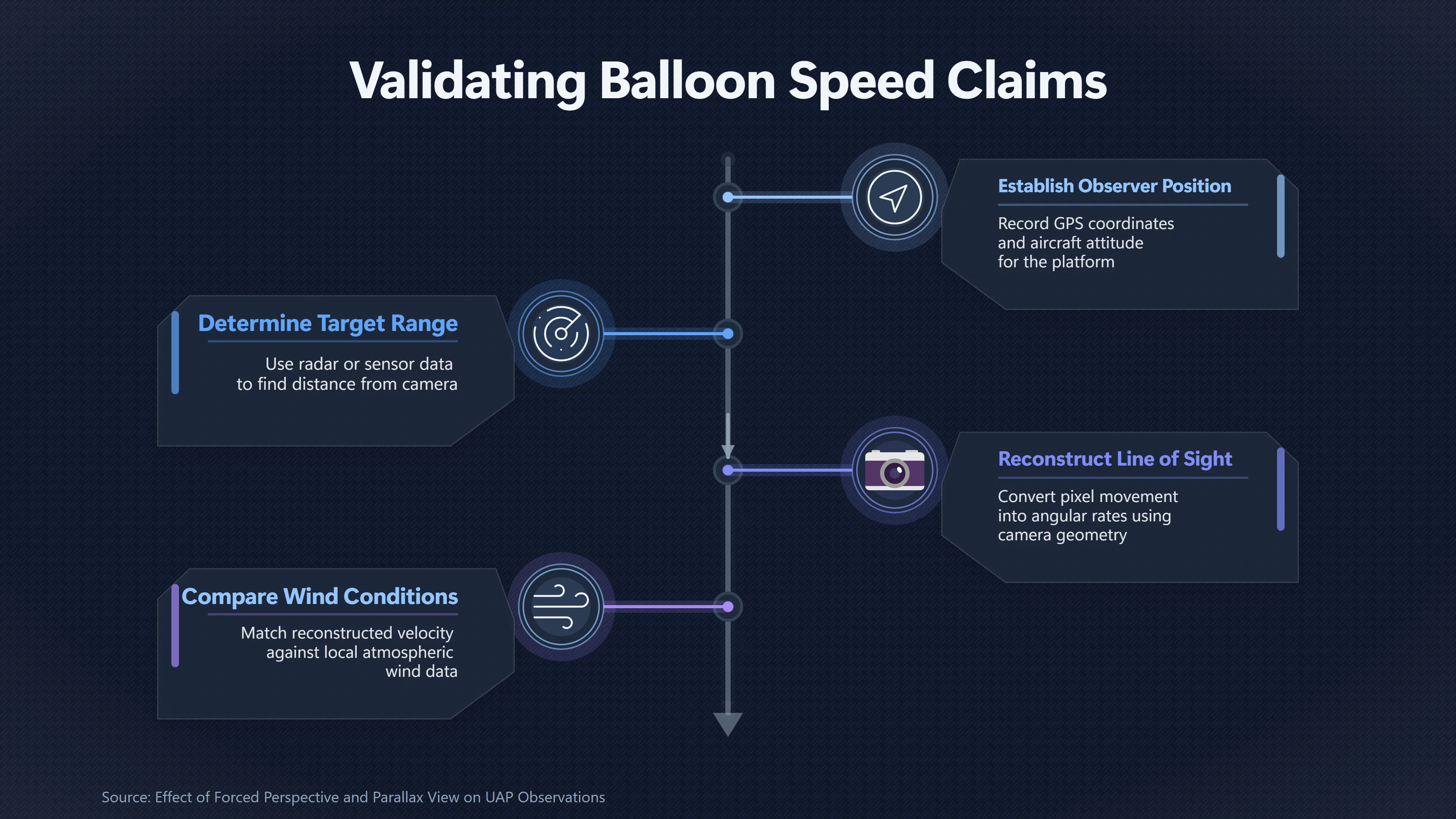
The evidential order consequently matters. First establish the observer’s position and movement. Then determine or constrain the target’s range. Reconstruct the line of sight through time. Compare the resulting velocity with winds at the appropriate altitude. Only after those steps does a claim of exceptional acceleration become physically meaningful.
Without that geometry, saying that a balloon-like object travelled at an “impossible” speed risks converting an unknown distance into an extraordinary conclusion. The camera may have measured the angles accurately; what remains unmeasured is the very quantity needed to turn those angles into speed.
Amazon book picks
Further Reading
Books and field guides related to Can a Balloon Look Impossibly Fast?. Use these as the next step if you want deeper reading beyond the article.
Optics
For courses in Optics A Contemporary Approach to Optics with Practical Applications and New Focused Pedagogy Hecht Optics balances theory...
Visual Perception
First Published in 2001. Routledge is an imprint of Taylor & Francis, an informa company.
Remote Sensing and Image Interpretation
From recent developments in digital image processing to the next generation of satellite systems, this book provides a comprehensive intr...
Multiple View Geometry in Computer Vision
A basic problem in computer vision is to understand the structure of a real world scene given several images of it. Techniques for solvin...
eBay marketplace picks
Marketplace Samples
Live-tested eBay searches with available results related to this page.
Selected fromUFO poster oneBay.co.uk.


Current eBay listing
I Want To Believe UFO Poster Giclée Fine Art Heavyweight Print

Current eBay listing
VINTAGE UFO FLYING SAUCERS COMIC ADVERTISING A2 POSTER PRINT

Endnotes
1.
Source: aaro.mil
Title: Effect of Forced Perspective and Parallax View on UAP Observations
Link:https://www.aaro.mil/Portals/136/PDFs/Information%20Papers/AARO_Effect_of_Forced_Perspective_and_Parallax_View_on_UAP_Observations_2024.pdf
Source snippet
Effect of Forced Perspective and Parallax View on UAP Observations...
2.
Source: aaro.mil
Title: Puerto Rico UAP Case Resolution
Link:https://www.aaro.mil/Portals/136/PDFs/case_resolution_reports/AARO_Puerto_Rico_UAP_Case_Resolution.pdf
Source snippet
AARO Puerto Rico UAP Case ResolutionMarch 19, 2025...
Published: March 19, 2025
3.
Source: aaro.mil
Title: Al Taqaddam Case Resolution
Link:https://www.aaro.mil/Portals/136/PDFs/case_resolution_reports/AARO_Al_Taqaddam_Case_Resolution_Final.pdf
Source snippet
Al Taqaddam Case ResolutionSeptember 18, 2025 — 8 Sept 2025 — AARO assesses with high confidence that the Al Taqaddum object did not...
Published: September 18, 2025
4.
Source: science.nasa.gov
Link:https://science.nasa.gov/wp-content/uploads/2023/09/uap-independent-study-team-final-report.pdf
Source snippet
NASA Science...
5.
Source: aaro.mil
Title: [Go Fast]({{ ‘go-fast/’ | relative_url }}) Case Resolution
Link:https://www.aaro.mil/Portals/136/PDFs/case_resolution_reports/AARO_GoFast_Case_Resolution_Card_Methodology_Final.pdf
Source snippet
AARO GoFast Case Resolution...
6.
Source: weather.gov
Title: National Weather Service Radiosonde Observation
Link:https://www.weather.gov/upperair/factsheet
7.
Source: weather.gov
Link:https://www.weather.gov/rah/virtualtourballoon
8.
Source: aaro.mil
Link:https://www.aaro.mil/Next-AARO-Home-redesign/Next-Parent/Next-AARO-UAP-Imagery-Acc-Table/
9.
Source: aaro.mil
Link:https://www.aaro.mil/Next-AARO-Home-redesign/Next-Parent/Next-UAP-Report-Documents/poster/dividLink/
10.
Source: nasa.gov
Title: 6.0 Natural and Induced Environments
Link:https://www.nasa.gov/reference/6-0-natural-and-induced-environments-vol-2/
11.
Source: science.nasa.gov
Link:https://science.nasa.gov/uap/
12.
Source: aaro.mil
Link:https://www.aaro.mil/Next-AARO-Home-redesign/Next-Parent/Presidential-UAP-Transparency-Initiative/dvpmoduleid/77396/
13.
Source: science.nasa.gov
Link:https://science.nasa.gov/eclips/resources/glossary/
14.
Source: jpl.nasa.gov
Title: modeling additive velocity with spreadsheets
Link:https://www.jpl.nasa.gov/edu/resources/lesson-plan/modeling-additive-velocity-with-spreadsheets/
15.
Source: weather.gov
Title: Upper Air
Link:https://www.weather.gov/epz/upperair
16.
Source: jpl.nasa.gov
Title: may the force mass x acceleration
Link:https://www.jpl.nasa.gov/edu/resources/teachable-moment/may-the-force-mass-x-acceleration/
17.
Source: nasa.gov
Title: UPDAT E: NASA Shares UAP Independent Study Report; Names Director
Link:https://www.nasa.gov/news-release/update-nasa-shares-uap-independent-study-report-names-director/
18.
Source: nasa.gov
Title: NAS A to Release, Discuss Unidentified Anomalous Phenomena Report
Link:https://www.nasa.gov/news-release/nasa-to-release-discuss-unidentified-anomalous-phenomena-report/
19.
Source: space.com
Title: UF Os worth investigating without ‘real evidence,’ Scott Kelly says | Space
Link:https://www.space.com/nasa-astronaut-scott-kelly-ufos-uap-worth-investigating
20.
Source: nasa.gov
Title: NAS A Provides Coverage of Unidentified Anomalous Phenomena Meeting
Link:https://www.nasa.gov/news-release/nasa-provides-coverage-of-unidentified-anomalous-phenomena-meeting/
21.
Source: nasa.gov
Title: NAS A Announces Unidentified Aerial Phenomena Study Team Members
Link:https://www.nasa.gov/general/nasa-announces-unidentified-aerial-phenomena-study-team-members/
22.
Source: nature.com
Link:https://www.nature.com/articles/s41598-018-19237-w
23.
Source: nasa.gov
Title: Apollo 9: Mission Details
Link:https://www.nasa.gov/missions/apollo/apollo-9-mission-details/
24.
Source: pwg.gsfc.nasa.gov
Link:https://pwg.gsfc.nasa.gov/stargaze/Lkepl2nd.htm
25.
Source: ntrs.nasa.gov
Link:https://ntrs.nasa.gov/citations/20030112412
26.
Source: ntrs.nasa.gov
Link:https://ntrs.nasa.gov/citations/20060041337
27.
Source: ntrs.nasa.gov
Link:https://ntrs.nasa.gov/citations/20040173123
28.
Source: ntrs.nasa.gov
Link:https://ntrs.nasa.gov/citations/19920061221
29.
Source: ntrs.nasa.gov
Link:https://ntrs.nasa.gov/citations/19810061557
30.
Source: www1.grc.nasa.gov
Title: motion of free falling object
Link:https://www1.grc.nasa.gov/beginners-guide-to-aeronautics/motion-of-free-falling-object/
31.
Source: smd-cms.nasa.gov
Title: 2020 2024 nasa science plan yr 23 update final
Link:https://smd-cms.nasa.gov/wp-content/uploads/2023/09/2020-2024-nasa-science-plan-yr-23-update-final.pdf
32.
Source: nasa.gov
Title: fy 2025 q3 foia log.xlsx
Link:https://www.nasa.gov/wp-content/uploads/2025/08/fy-2025-q3-foia-log.xlsx?emrc=36f27c
33.
Source: ntrs.nasa.gov
Link:https://ntrs.nasa.gov/api/citations/20000011136/downloads/20000011136.pdf
34.
Source: ntrs.nasa.gov
Link:https://ntrs.nasa.gov/api/citations/19710023849/downloads/19710023849.pdf?attachment=true
35.
Source: science.nasa.gov
Link:https://science.nasa.gov/
36.
Source: ntrs.nasa.gov
Link:https://ntrs.nasa.gov/api/citations/20200002189/downloads/20200002189.pdf
37.
Source: ntrs.nasa.gov
Link:https://ntrs.nasa.gov/api/citations/19690005899/downloads/19690005899.pdf
38.
Source: ntrs.nasa.gov
Link:https://ntrs.nasa.gov/api/citations/20020090931/downloads/20020090931.pdf
39.
Source: ntrs.nasa.gov
Link:https://ntrs.nasa.gov/api/citations/20010038051/downloads/20010038051.pdf?attachment=true
40.
Source: ntrs.nasa.gov
Link:https://ntrs.nasa.gov/api/citations/19690005613/downloads/19690005613.pdf?attachment=true
41.
Source: jpl.nasa.gov
Link:https://www.jpl.nasa.gov/blog/tag/dwarf-planet/page/3
42.
Source: forecast.weather.gov
Link:https://forecast.weather.gov/glossary.php?word=radiosonde
43.
Source: weather.gov
Link:https://www.weather.gov/upperair/Faq
44.
Source: weather.gov
Link:https://www.weather.gov/okx/Tour_Weather_Balloon
45.
Source: forecast.weather.gov
Link:https://forecast.weather.gov/glossary.php?word=RA
46.
Source: weather.gov
Title: NW S Amarillo Upper Air Tour – Balloon Preparation & Launch Image
Link:https://www.weather.gov/ama/upperair2
47.
Source: weather.gov
Link:https://www.weather.gov/tae/tour
48.
Source: weather.gov
Link:https://www.weather.gov/okx/upperair
49.
Source: forecast.weather.gov
Link:https://forecast.weather.gov/glossary.php?word=s
50.
Source: weather.gov
Title: NW S Amarillo Upper Air Tour – Post-Launch
Link:https://www.weather.gov/ama/upperair3
51.
Source: aaro.mil
Link:https://www.aaro.mil/Next-AARO-Home-redesign/Next-Parent/Next-UAP-Case-RR-Data-Table/
52.
Source: aaro.mil
Link:https://www.aaro.mil/Next-AARO-Home-redesign/Next-Parent/AARO-UAP-Case-Resolution-DT/
53.
Source: aaro.mil
Link:https://www.aaro.mil/UAP-Cases/Official-UAP-Imagery/4/
54.
Source: aaro.mil
Link:https://www.aaro.mil/UAP-Cases/Official-UAP-Imagery/ftag/MSF0951a18/
55.
Source: aaro.mil
Link:https://www.aaro.mil/Next-AARO-Home-redesign/Next-Parent/Next-AARO-UAP-Imagery-Fixed-Table/
56.
Source: aaro.mil
Link:https://www.aaro.mil/UAP-Records/-1/
57.
Source: aaro.mil
Title: UAP Imagery* “Go Fast” Object NAVAIR
Link:https://www.aaro.mil/Next-AARO-Home-redesign/Inactive-Parent/Next-UAP-Imagery-dup/
58.
Source: aaro.mil
Title: AAR O UAP Trends All-domain Anomaly Resolution Office UAP REPORTING TRENDS
Link:https://www.aaro.mil/UAP-Cases/UAP-Reporting-Trends/
59.
Source: aaro.mil
Link:https://www.aaro.mil/Resources/Historical-Record-Reports/Volume-II/
60.
Source: aaro.mil
Link:https://www.aaro.mil/Next-AARO-Home-redesign/Next-Parent/Next-AARO-UAP-Trends/
61.
Source: aaro.mil
Link:https://www.aaro.mil/FAQ/
62.
Source: aaro.mil
Link:https://www.aaro.mil/Next-AARO-Home-redesign/Inactive-Parent/AARO-Records-Tabs/
63.
Source: aaro.mil
Link:https://www.aaro.mil/Next-AARO-Home-redesign/Inactive-Parent/FAQ-Datatable/
64.
Source: aaro.mil
Link:https://www.aaro.mil/Next-AARO-Home-redesign/Bruce-working/Next-AARO-UAP-Trends-Charts/
65.
Source: aaro.mil
Title: AAR O UAP Trends All-domain Anomaly Resolution Office UAP REPORTING TRENDS
Link:https://www.aaro.mil/UAP-Cases/UAP-Reporting-Trends/quot/
66.
Source: aaro.mil
Title: UAP Records
Link:https://www.aaro.mil/UAP-Records/
67.
Source: aaro.mil
Link:https://www.aaro.mil/Resources/
68.
Source: astronomy.swin.edu.au
Title: Swinburne Astronomy Transverse velocity | COSMOS
Link:https://astronomy.swin.edu.au/cosmos/%2A/Transverse%2Bvelocity
69.
Source: faa.gov
Link:https://www.faa.gov/air_traffic/technology/asr-11
Source snippet
Federal Aviation AdministrationAirport Surveillance Radar (ASR-11) | Federal Aviation AdministrationSeptember 22, 2025...
Published: September 22, 2025
70.
Source: faa.gov
Title: Federal Aviation Administration Chapter 4. Air Traffic Control
Link:https://www.faa.gov/air_traffic/publications/atpubs/aim_html/chap4_section_5.html
71.
Source: faa.gov
Title: The Mode S Team | Federal Aviation Administration
Link:https://www.faa.gov/about/office_org/headquarters_offices/ato/service_units/techops/safety_ops_support/nas_engineering/modes_digitizers_sbsm/modes
72.
Source: faa.gov
Title: Frequently Asked Questions | Federal Aviation Administration
Link:https://www.faa.gov/air_traffic/technology/equipadsb/resources/faq
73.
Source: faa.gov
Title: Radar Surveillance Terminology | Federal Aviation Administration
Link:https://www.faa.gov/air_traffic/technology/radardivestiture/terminology
74.
Source: faa.gov
Link:https://www.faa.gov/air_traffic/publications/atpubs/AIM/aim0405.html
75.
Source: faa.gov
Link:https://www.faa.gov/air_traffic/publications/ATpubs/ATC/PCG/R.HTM
76.
Source: faa.gov
Title: glossary r
Link:https://www.faa.gov/air_traffic/publications/atpubs/pcg_html/glossary-r.html
77.
Source: faa.gov
Link:https://www.faa.gov/air_traffic/publications/atpubs/aip_html/part2_enr_section_1.1.html
78.
Source: faa.gov
Title: glossary t
Link:https://www.faa.gov/air_traffic/publications/atpubs/pcg_html/glossary-t.html
79.
Source: faa.gov
Link:https://www.faa.gov/air_traffic/publications/atpubs/atc_html/chap5_section_3.html
80.
Source: faa.gov
Link:https://www.faa.gov/air_traffic/publications/atpubs/pcg_html/chap1_section_21.html
81.
Source: astronomy.swinburne.edu.au
Link:https://astronomy.swinburne.edu.au/cosmos/A/Angular%2BVelocity
82.
Source: astronomy.swin.edu.au
Link:https://astronomy.swin.edu.au/cosmos/P/Proper%2Bmotion
Additional References
83.
Source: youtube.com
Title: Congress Fell for a BALLOON? | MICK WEST Breaks Down The Hellfire Missile UFO
Link:https://www.youtube.com/watch?v=FY4aRfx17vQ
Source snippet
Chinese Spy Balloongate And UAPs (w Mick West and Ramsey Faragher)...
84.
Source: youtube.com
Title: GOFAST UFO Analysis (yeah no, probably just a balloon)
Link:https://www.youtube.com/watch?v=-3NYowlCoDc
Source snippet
The SHOCKING Math Error Behind Viral UFO Videos | Mick West...
85.
Source: uap-archive.org
Link:https://uap-archive.org/uap/learn/aaro-case-resolution-reports-overview/
86.
Source: reddit.com
Link:https://www.reddit.com/r/UFOs/comments/1cna8yg/an_aaro_information_paper_effect_of_forced/
87.
Source: es.scribd.com
Link:https://es.scribd.com/document/1035827352/Extraterrestres-Entre-Nosotros-y-Archivos-Clasificados-Evaluacion-Con-Base-en-Material-Desclasifi
88.
Source: liberationtimes.com
Link:https://www.liberationtimes.com/home/nasa-confirms-it-has-no-official-position-on-gofast-ufo-video
89.
Source: defensescoop.com
Link:https://defensescoop.com/2024/11/19/uap-aaro-findings-go-fast-puerto-rico-mt-etna-objects/
90.
Source: vaia.com
Link:https://www.vaia.com/en-us/textbooks/physics/astronomy-a-physical-perspective-2-edition/chapter-13/problem-2-suppose-we-can-detect-proper-motions-down-to-01-ar/
91.
Source: vaia.com
Link:https://www.vaia.com/en-us/textbooks/physics/astronomy-today-8-edition/chapter-23/problem-5-calculate-the-proper-motion-in-arc-seconds-per-yea/
92.
Source: vaia.com
Link:https://www.vaia.com/en-us/textbooks/physics/astronomy-today-7-edition/chapter-23/problem-7-calculate-the-proper-motion-in-arc-seconds-per-yea/