Within Formations
Why Starlink Can Look Like a UFO Formation
Freshly deployed Starlink satellites can cross the sky as an orderly line of separate lights that appears deliberately structured.
On this page
- Why newly deployed satellites form visible trains
- How spacing and shared motion create one pattern
- How satellite paths distinguish the lights from a craft
Page outline Jump by section
Introduction
Freshly deployed Starlink satellites can produce one of the most striking ordinary explanations for an apparent UFO formation: a long, orderly procession of separate lights moving together across the sky. Shortly after a launch, dozens of satellites may still occupy nearly the same orbital track. Seen from the ground while reflecting sunlight, they can resemble a luminous convoy, a precisely spaced formation or even lights belonging to one enormous structured object.
The phenomenon has been documented since Starlink’s first large deployment in May 2019, when observers saw dozens of lights following one another across Europe. It is now sufficiently well understood that the US All-domain Anomaly Resolution Office (AARO) explicitly identifies newly deployed Starlink “trains” as a source of UAP reports. The important distinction is simple: the organisation of the lights is real, but it comes from many independent spacecraft following related orbits, not from a single craft connecting the lights.[Live Science]livescience.comLive ScienceHere's What SpaceX's Starlink Satellites Look Like in the Night Sky | Live ScienceMay 25, 2019…
Why newly deployed satellites form visible trains
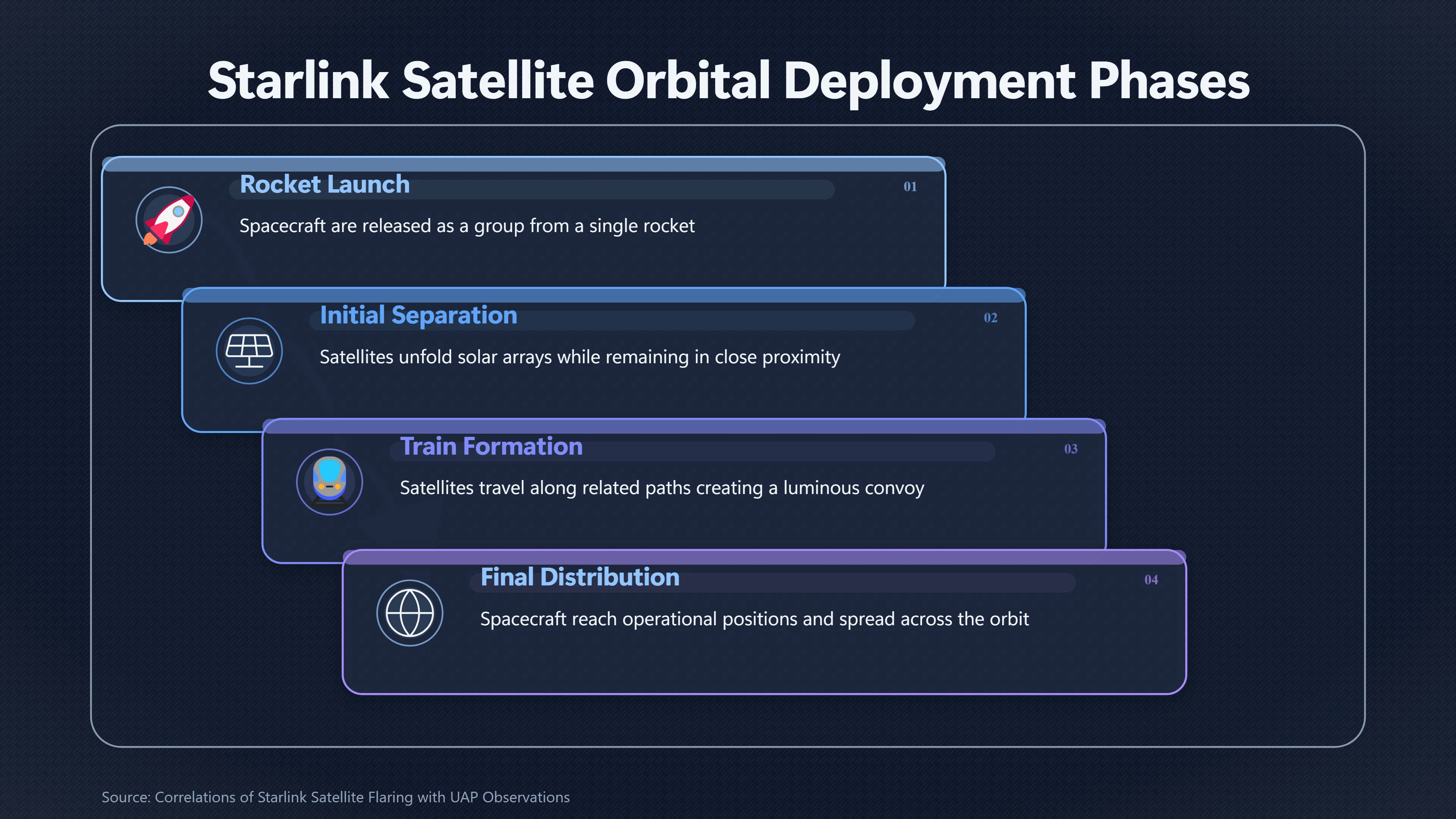
Starlink satellites do not begin their working lives evenly distributed around Earth. SpaceX launches a batch together aboard the same rocket and releases the spacecraft into low Earth orbit as a group. AARO describes three orbital phases during their journey towards operational positions. Immediately after deployment, the satellites separate, unfold their solar arrays and initially remain sufficiently close together to produce the characteristic string or train.[AARO]aaro.milCorrelations of Starlink Satellite Flaring with UAP ObservationsCorrelations of Starlink Satellite Flaring with UAP Observations…
That launch history explains the otherwise surprising geometry. An observer is not seeing dozens of unrelated satellites that have somehow arranged themselves into a line. They have a common origin, were released at roughly the same place and time, and initially travel along closely related orbital paths. The resulting sequence can therefore be far more regular than the random scatter of moving lights that many people associate with satellites.
The historical turning point came on 24 May 2019, less than a day after SpaceX’s first batch of 60 Starlink satellites was launched. Satellite observer Marco Langbroek recorded the group passing over Leiden in the Netherlands and counted at least 56 objects in the procession. Contemporary coverage showed a conspicuous train of individual points extending across the sky — an appearance dramatically different from the familiar sight of a lone satellite.[weforum.org]weforum.orgWorld Economic ForumWatch the launch of Space X's first Starlink satellites | World Economic ForumMay 24, 2019…
The spectacle was also unusually conspicuous because newly launched Starlinks can be brighter than satellites in their established operational configuration. The American Astronomical Society reported from observations of early deployments that Starlinks near their final 550-kilometre orbit were around apparent magnitude 5, while satellites immediately after launch could reach magnitude 0 or brighter. The society noted that reaching their final altitude could take several weeks.[American Astronomical Society]aas.orgOpen source on aas.org.
Visibility is fundamentally an illumination effect. Satellites do not need lamps pointing towards the observer: sunlight reflected from their surfaces makes them visible against a dark ground-level sky. Consequently, the most dramatic appearance depends not only on where the spacecraft are but also on the geometry connecting the Sun, satellites and observer.[AARO]aaro.milCorrelations of Starlink Satellite Flaring with UAP ObservationsCorrelations of Starlink Satellite Flaring with UAP Observations…
How separate spacecraft become one visual pattern
The defining feature of a Starlink train is common motion. Each point advances in the same general direction, along essentially the same apparent path, with neighbouring lights maintaining an orderly sequence. That combination can strongly suggest deliberate formation flight.
Yet nothing visible between the points demonstrates that they are parts of one physical object. The same observation is naturally produced by multiple spacecraft following the orbital track created by a common deployment. In effect, the observer sees the orbital arrangement projected onto the two-dimensional sky.
The pattern also evolves rapidly after launch. Langbroek’s observations provide an unusually useful historical comparison. On the first night after the May 2019 launch, the satellites appeared as a closely packed procession. By 29 May, he reported that the train had stretched so far that the complete sequence took about 30 minutes to pass. Some satellites required binoculars, others remained visible to the naked eye, and neighbouring spacecraft could differ substantially in brightness. He concluded that the original closely grouped linear train was disappearing.[Satellites Above]satobs.orgSatellites AboveStarlink flaring from Marco Langbroek via Seesat-l on 2019-05-28 (SeeSat-L May-19)May 29, 2019…
That evolution is important when assessing UFO reports. There is no single permanent “Starlink look”. A recently released batch can appear remarkably compact; later the same spacecraft spread along their orbital paths. Modern Starlink deployment and constellation management are dynamic rather than static: satellite populations undergo altitude changes, relocations and other orbital adjustments as they progress towards their intended configuration.[arXiv]arxiv.orgarXiv Starlink Constellation: Deployment, Configuration, and DynamicsStarlink Constellation: Deployment, Configuration, and DynamicsMarch 26, 2026…
Brightness can make the apparent formation more complicated still. In May 2019 observers recorded successive satellites briefly brightening as they crossed favourable reflection geometry. Langbroek described roughly 15 objects flaring one after another within one or two minutes. Because the brightening occurred in the same part of the sky, the sequence demonstrated how a collection of independent satellites can produce a visually coordinated display without communicating or manoeuvring as an aerial formation.[Spaceweather.com]spaceweatherarchive.comOpen source on spaceweatherarchive.com.
AARO distinguishes between ordinary diffuse reflection, which can leave a satellite visible for minutes, and narrow specular reflection or “glint”, which can make it brighten dramatically for a much shorter period. These optical effects mean that individual members of a Starlink group need not remain equally bright throughout a sighting. Some can emerge, fade or flash while their orbital motion remains perfectly ordinary.[AARO]aaro.milCorrelations of Starlink Satellite Flaring with UAP ObservationsCorrelations of Starlink Satellite Flaring with UAP Observations…
Why the formation can be reported as a UAP
Starlink trains are particularly convincing as unusual formations because several seemingly significant features occur together: numerous lights, regular spacing, common direction, silent movement and sometimes synchronised-looking changes in brightness. Without knowledge of a recent satellite deployment, that combination can appear engineered in a much more immediate sense — as though the observer is watching a formation of vehicles or illuminated points attached to one vast structure.
This is not merely a hypothetical source of confusion. AARO says the design, launch and operation of Starlink has produced an increase in sightings of satellite-related optical phenomena. Its 2024 information paper specifically notes that immediately after launch, dozens of satellites can form a “distinctive line of bright objects” for several days before becoming less conspicuous as they ascend towards their final orbital positions.[AARO]aaro.milCorrelations of Starlink Satellite Flaring with UAP ObservationsCorrelations of Starlink Satellite Flaring with UAP Observations…
The effect has also reached professional aviation. A 2024 case study examined observations made on 10 August 2022 by five pilots aboard two commercial flights over the Pacific. Investigators combined orbital information for a recently launched Starlink group with Automatic Dependent Surveillance–Broadcast (ADS-B) aircraft-position data and reconstructed what the satellites should have looked like from the cockpit. Their analysis found that the Starlink train launched that day could account for the reported phenomenon, illustrating that even experienced observers can encounter satellite configurations unfamiliar enough to be reported as UAP.[arXiv]arxiv.orgOpen source on arxiv.org.
AARO has independently reported the same broader trend. In its fiscal-year 2024 UAP reporting, the office said it was increasingly receiving cases that could be resolved to Starlink. One commercial pilot reported white flashing lights; investigators correlated the observation with a Starlink launch from Cape Canaveral roughly an hour earlier and found that the sighting occurred along the satellites’ known orbital path.[Astrophysics at Stony Brook University]astro.sunysb.eduFY24 CONSOLIDATED ANNUAL REPORT ON UAP 508FY24 CONSOLIDATED ANNUAL REPORT ON UAP 508
Those cases should not be stretched into the claim that every unusual formation is Starlink. A correlation requires the geometry and timing to work. The useful lesson is narrower: a highly organised formation of multiple lights is no longer, by itself, strong evidence that the lights share one aircraft or extraordinary origin. Large satellite deployments provide a documented mechanism for creating precisely that appearance.
How satellite paths distinguish the lights from a craft
A Starlink explanation becomes much stronger when the reported formation behaves like objects in orbit rather than like a vehicle manoeuvring through the atmosphere. Several characteristics are especially useful when they occur together:
- One common track: the points progress along essentially the same path rather than independently turning around one another.
- Sequential spacing: the lights follow one another rather than maintaining corners or edges of a rigid shape viewed from changing angles.
- Smooth motion: the train crosses the sky continuously, without the abrupt stops or genuine direction changes that would require a different explanation.
- Brightness changes without course changes: satellites may brighten or fade as reflection geometry changes even while their orbital trajectory remains smooth.
- A recent matching launch: a Starlink deployment shortly before the sighting provides a concrete population of spacecraft whose predicted track can be compared with the observation.
- Orbital agreement: the strongest identifications reproduce the sighting using orbital elements, observer location, viewing direction and time rather than relying on visual resemblance alone.[AARO]aaro.milCorrelations of Starlink Satellite Flaring with UAP ObservationsCorrelations of Starlink Satellite Flaring with UAP Observations…
The last point is particularly important. Saying that a video “looks like Starlink” is weaker evidence than demonstrating that the relevant satellites were actually above the observer at the reported time. Modern investigations can use orbital data to calculate where individual spacecraft should have appeared and combine those predictions with an aircraft’s recorded position or a ground observer’s location. The 2022 Pacific case showed how this reconstruction can turn a visually perplexing formation into a testable astronomical identification.[arXiv]arxiv.orgOpen source on arxiv.org.
There is another diagnostic clue in the train itself: it changes with time. A rigid craft would preserve the physical relationship between lights mounted on it. A satellite train progressively stretches as tiny differences in orbital conditions and subsequent manoeuvres distribute its members around their intended orbits. The rapid transformation documented after the first 2019 launch — from a compact procession to a sequence requiring roughly half an hour to pass — is exactly the kind of evolution expected from independent satellites rather than lights fixed to a common structure.[Satellites Above]satobs.orgSatellites AboveStarlink flaring from Marco Langbroek via Seesat-l on 2019-05-28 (SeeSat-L May-19)May 29, 2019…

A formation can be real without being one object
Starlink trains sharpen an important distinction in UFO and UAP interpretation. Calling a pattern an “illusion” can be misleading because the lights really are organised. The satellites genuinely share closely related trajectories, and their orderly procession is a physical consequence of being launched together. What can be mistaken is the level at which that organisation occurs.
A witness may correctly report twenty or thirty lights travelling in a remarkably straight, coordinated formation. What the observation alone does not establish is that the lights are connected, controlled as one aerial vehicle or outlining an unseen solid structure. In the Starlink case, the impressive order comes from orbital mechanics and common deployment history.
The comparison between 2019 and later UAP investigations makes Starlink especially valuable as a modern identification example. Before the first mass deployment, the characteristic luminous “train” was not part of most people’s everyday catalogue of things seen in the night sky. Within a day of that first launch, observers were already recording an unfamiliar procession of more than 50 lights; within days, its spacing and brightness had changed substantially. Years later, AARO and independent researchers were still documenting satellite configurations being reported as anomalous by professional pilots.[livescience.com]livescience.comLive ScienceHere's What SpaceX's Starlink Satellites Look Like in the Night Sky | Live ScienceMay 25, 2019…
For investigations of apparent UFO formations, that history supplies a useful rule: geometry is evidence, but it must be interpreted physically. A straight line, evenly spaced procession or coordinated sequence of lights can tell us that the sources share a trajectory. It does not tell us that they share a hull. With freshly deployed Starlink satellites, many independent spacecraft can create an extraordinarily orderly pattern precisely because they began together and are travelling along nearly the same orbital road.
Amazon book picks
Further Reading
Books and field guides related to Why Starlink Can Look Like a UFO Formation. Use these as the next step if you want deeper reading beyond the article.
NightWatch: A Practical Guide to Viewing the Universe
A practical guide to viewing the universe.
The Backyard Astronomer's Guide
Discusses the practical aspects of stargazing, including how to choose appropriate equipment, contending with light pollution, taking suc...
Turn Left at Orion
With over 100,000 copies sold since first publication, this is one of the most popular astronomy books of all time. It is a unique guideb...
The Stars: A New Way to See Them
Written with the primary purpose of enabling everyone to gain more pleasure from stargazing.
eBay marketplace picks
Marketplace Samples
Live-tested eBay searches with available results related to this page.
Selected fromUFO poster oneBay.co.uk.
Current eBay listing
I Want To Believe UFO Poster Giclée Fine Art Heavyweight Print
Current eBay listing
VINTAGE UFO FLYING SAUCERS COMIC ADVERTISING A2 POSTER PRINT
Endnotes
1.
Source: aaro.mil
Title: Correlations of Starlink Satellite Flaring with UAP Observations
Link:https://www.aaro.mil/Portals/136/PDFs/Information%20Papers/AARO_Satellite_Flaring_Paper.pdf
Source snippet
Correlations of Starlink Satellite Flaring with UAP Observations...
2.
Source: arxiv.org
Title: arXiv Starlink Constellation: Deployment, Configuration, and Dynamics
Link:https://arxiv.org/abs/2603.25835
Source snippet
Starlink Constellation: Deployment, Configuration, and DynamicsMarch 26, 2026...
Published: March 26, 2026
3.
Source: arxiv.org
Link:https://arxiv.org/abs/2403.08155
4.
Source: spacex.com
Title: Space X
Link:https://www.spacex.com/launches/sl
5.
Source: spacex.com
Title: Space X
Link:https://www.spacex.com/launches/sl
6.
Source: spacex.com
Title: Space X
Link:https://www.spacex.com/launches/sl
7.
Source: spacex.com
Title: Space X
Link:https://www.spacex.com/launches/sl
8.
Source: spacex.com
Title: Space X
Link:https://www.spacex.com/launches/sl
9.
Source: aaro.mil
Link:https://www.aaro.mil/Next-AARO-Home-redesign/Next-Parent/Next-UAP-Report-Documents/
10.
Source: aaro.mil
Link:https://www.aaro.mil/Next-AARO-Home-redesign/Next-Parent/Next-AARO-UAP-Imagery-Acc-Table/
11.
Source: aaro.mil
Link:https://www.aaro.mil/Next-AARO-Home-redesign/Next-Parent/Next-UAP-Report-Documents/poster/
12.
Source: aaro.mil
Link:https://www.aaro.mil/Next-AARO-Home-redesign/Next-Parent/Next-UAP-Report-Documents/poster/dividLink/
13.
Source: spacex.com
Title: Space X
Link:https://www.spacex.com/launches/sl
14.
Source: spacex.com
Title: Space X
Link:https://www.spacex.com/launches/sl
15.
Source: spacex.com
Title: Space X
Link:https://www.spacex.com/launches/sl
16.
Source: spacex.com
Title: Space X
Link:https://www.spacex.com/launches/sl
17.
Source: spacex.com
Title: Space X
Link:https://www.spacex.com/launches/sl
18.
Source: spacex.com
Title: Space X
Link:https://www.spacex.com/launches/sl
19.
Source: spacex.com
Title: Space X
Link:https://www.spacex.com/launches/sl
20.
Source: aaro.mil
Link:https://www.aaro.mil/Next-AARO-Home-redesign/Next-Parent/Presidential-UAP-Transparency-Initiative/videoid/1014101/dvpcc/false/
21.
Source: aaro.mil
Link:https://www.aaro.mil/Next-AARO-Home-redesign/Next-Parent/Presidential-UAP-Transparency-Initiative/videoid/1006078/dvpcc/false/
22.
Source: news.sky.com
Title: starlink satellites leads to ufo reports 12297446
Link:https://news.sky.com/video/starlink-satellites-leads-to-ufo-reports-12297446
23.
Source: news.sky.com
Title: share 12297446
Link:https://news.sky.com/video/share-12297446
24.
Source: spacex.com
Title: Space X
Link:https://www.spacex.com/launches/sl-21
25.
Source: spacex.com
Title: Space X
Link:https://www.spacex.com/launches/sl-17
26.
Source: spacex.com
Title: Space X
Link:https://www.spacex.com/launches/sl-16
27.
Source: space-safety.starlink.com
Title: constellation altitudes
Link:https://space-safety.starlink.com/docs/space-safety-articles/constellation_altitudes/
28.
Source: starlink.com
Link:https://starlink.com/updates/starlink-version-3-satellites
29.
Source: starlink.com
Title: Multiple Starlinks
Link:https://starlink.com/as/support/article/b63139bb-11e9-6bb6-f408-4df5f00844b1
30.
Source: space-safety.starlink.com
Title: best practices
Link:https://space-safety.starlink.com/docs/space-safety-articles/best_practices/
31.
Source: aaro.mil
Title: AAR O UAP Trends All-domain Anomaly Resolution Office UAP REPORTING TRENDS
Link:https://www.aaro.mil/UAP-Cases/UAP-Reporting-Trends/
32.
Source: aaro.mil
Title: UAP Records
Link:https://www.aaro.mil/UAP-Records/
33.
Source: aaro.mil
Link:https://www.aaro.mil/Next-AARO-Home-redesign/Inactive-Parent/AARO-Records-Tabs/
34.
Source: aaro.mil
Link:https://www.aaro.mil/Next-AARO-Home-redesign/Next-Parent/Next-AARO-UAP-Trends/
35.
Source: aaro.mil
Link:https://www.aaro.mil/Resources/Historical-Record-Reports/Volume-II/
36.
Source: aaro.mil
Link:https://www.aaro.mil/FAQ/
37.
Source: aaro.mil
Link:https://www.aaro.mil/
38.
Source: aaro.mil
Link:https://www.aaro.mil/Next-AARO-Home-redesign/Inactive-Parent/Next-AARO-UAP-DT-Records/
39.
Source: aaro.mil
Link:https://www.aaro.mil/UAP-Cases/Official-UAP-Imagery/4/
40.
Source: aaro.mil
Link:https://www.aaro.mil/Next-AARO-Home-redesign/Next-Parent/Next-AARO-UAP-Imagery-Fixed-Table/
41.
Source: livescience.com
Link:https://www.livescience.com/65570-spacex-starlink-satellites-spotted-night-sky-video.html
Source snippet
Live ScienceHere's What SpaceX's Starlink Satellites Look Like in the Night Sky | Live ScienceMay 25, 2019...
Published: May 25, 2019
42.
Source: weforum.org
Link:https://www.weforum.org/agenda/2019/05/first-satellites-for-musks-starlink-internet-venture-launched-into-orbit
Source snippet
World Economic ForumWatch the launch of Space X's first Starlink satellites | World Economic ForumMay 24, 2019...
Published: May 24, 2019
43.
Source: space.com
Link:https://www.space.com/spacex-starlink-satellites-spotted-night-sky-video.html
Source snippet
Wow! This Is What SpaceX's Starlink Satellites Look Like in the Night Sky | Space...
44.
Source: aas.org
Link:https://aas.org/form/aas-survey-on-satellite-constell
45.
Source: space.com
Link:https://www.space.com/starlink-satellite-train-how-to-see-and-track-it
Source snippet
These satellites appear as a bright, fast-moving group of lights in the sky shortly after launch, before ascending to a higher operationa...
46.
Source: satobs.org
Link:https://www.satobs.org/seesat/May-2019/0280.html
Source snippet
Satellites AboveStarlink flaring from Marco Langbroek via Seesat-l on 2019-05-28 (SeeSat-L May-19)May 29, 2019...
Published: May 28, 2019
47.
Source: spaceweatherarchive.com
Link:https://spaceweatherarchive.com/2019/05/
48.
Source: astro.sunysb.edu
Title: FY24 CONSOLIDATED ANNUAL REPORT ON UAP 508
Link:https://www.astro.sunysb.edu/fwalter/AST248/UAP/FY24-CONSOLIDATED-ANNUAL-REPORT-ON-UAP-508.PDF
49.
Source: space.com
Title: Starlink satellites: Facts, [tracking]({{ ‘tracking/’ | relative_url }}) and impact on astronomy | Space
Link:https://www.space.com/spacex-starlink-satellites.html
50.
Source: satobs.org
Link:https://www.satobs.org/seesat/Sep-2025/0032.html
51.
Source: baas.aas.org
Link:https://baas.aas.org/pub/2024n6i102p01/release/1
52.
Source: baas.aas.org
Link:https://baas.aas.org/pub/2024n6i102p01
53.
Source: baas.aas.org
Link:https://baas.aas.org/pub/enwrps6k/release/1?from=48753&to=48758
54.
Source: baas.aas.org
Link:https://baas.aas.org/pub/004iuwwu/release/1
55.
Source: baas.aas.org
Link:https://baas.aas.org/pub/2021n1i324p08/release/1
56.
Source: baas.aas.org
Link:https://baas.aas.org/pub/2020i0206/release/1
57.
Source: aas.org
Link:https://aas.org/press/media-advisory-satcon1-workshop-report
58.
Source: satobs.org
Link:https://www.satobs.org/seesat/Jun-2020/0060.html
59.
Source: baas.aas.org
Title: 236 311p07 seitzer
Link:https://baas.aas.org/pub/aas236-311p07-seitzer
60.
Source: satobs.org
Link:https://www.satobs.org/seesat/Mar-2020/0186.html
61.
Source: satobs.org
Link:https://www.satobs.org/seesat/Mar-2020/0160.html
62.
Source: aas.org
Link:https://aas.org/posts/news/2020/02/iau-issues-update-satellite-constellations-potential-impacts-astronomy
63.
Source: satobs.org
Title: See Sat-L Dec-19: by thread
Link:https://www.satobs.org/seesat/Dec-2019/index.html
64.
Source: satobs.org
Title: See Sat-L Sep-19: by date
Link:https://satobs.org/seesat/Sep-2019/date.html
65.
Source: satobs.org
Title: See Sat-L Jul-19: by thread
Link:https://satobs.org/seesat/Jul-2019/index.html
66.
Source: aas.org
Link:https://aas.org/press/aas-issues-position-statement-satellite-constellations
67.
Source: aas.org
Link:https://aas.org/posts/news/2019/06/aas-issues-position-statement-satellite-constellations
68.
Source: satobs.org
Title: See Sat-L May-19: by subject
Link:https://www.satobs.org/seesat/May-2019/subject.html
69.
Source: satobs.org
Title: See Sat-L May-19: by date
Link:https://www.satobs.org/seesat/May-2019/date.html
70.
Source: satobs.org
Title: See Sat-L May-19: by author
Link:https://www.satobs.org/seesat/May-2019/author.html
71.
Source: satobs.org
Link:https://www.satobs.org/seesat/May-2019/0228.html
72.
Source: compasse.aas.org
Title: for professional astronomers
Link:https://compasse.aas.org/get-involved/for-professional-astronomers/
Additional References
73.
Source: youtube.com
Link:https://www.youtube.com/watch?v=cldNfJHdZws
Source snippet
StarLink Satellite seen in Rocky Mountain National Park. Train of lights It's a UFO...
74.
Source: youtube.com
Title: Line of lights in the sky: Starlink satellite train seen over south-central Pa
Link:https://www.youtube.com/watch?v=hZ0qZ5T9bCg
Source snippet
Train of Satellites in the Sky over California | Looks like UFOs | SpaceX Starlink Train 2023...
75.
Source: youtube.com
Link:https://www.youtube.com/watch?v=OJSYBIkDuh8
Source snippet
What caused the string of lights in the sky Wednesday night in Texas?...
76.
Source: researchgate.net
Link:https://www.researchgate.net/publication/368458403_Social_factors_and_UFO_reports_was_the_SARS-CoV-2_pandemic_associated_with_an_increase_in_UFO_reporting
77.
Source: theblackvault.com
Link:https://www.theblackvault.com/documentarchive/aaro-releases-document-and-video-explaining-satellite-flares-as-a-uap-misidentification-source/
78.
Source: noirlab.edu
Link:https://noirlab.edu/public/es/announcements/archive/program/rubin/page/10/?lang=en&nocache=true
79.
Source: skyandtelescope.org
Link:https://skyandtelescope.org/astronomy-news/astronomy-and-society/page/5/
80.
Source: noirlab.edu
Link:https://noirlab.edu/public/about/light-pollution/satellite-constellations/?lang=es
81.
Source: iau.org
Link:https://www.iau.org/CommissionA1/Profile?ID=29394
82.
Source: iau.org
Link:https://www.iau.org/IAU/Shared_Content/Contacts/ContactLayouts/Profile.aspx?ID=29394