Within Helicopters
Can a Helicopter Really Look Motionless at Night?
A real helicopter hover can make a bright night light remain fixed long enough to seem unlike any conventional aircraft.
On this page
- How true helicopter hovering changes a sighting
- Why near head on flight can also look stationary
- Using landmarks to test whether a light actually moved
Page outline Jump by section
Introduction
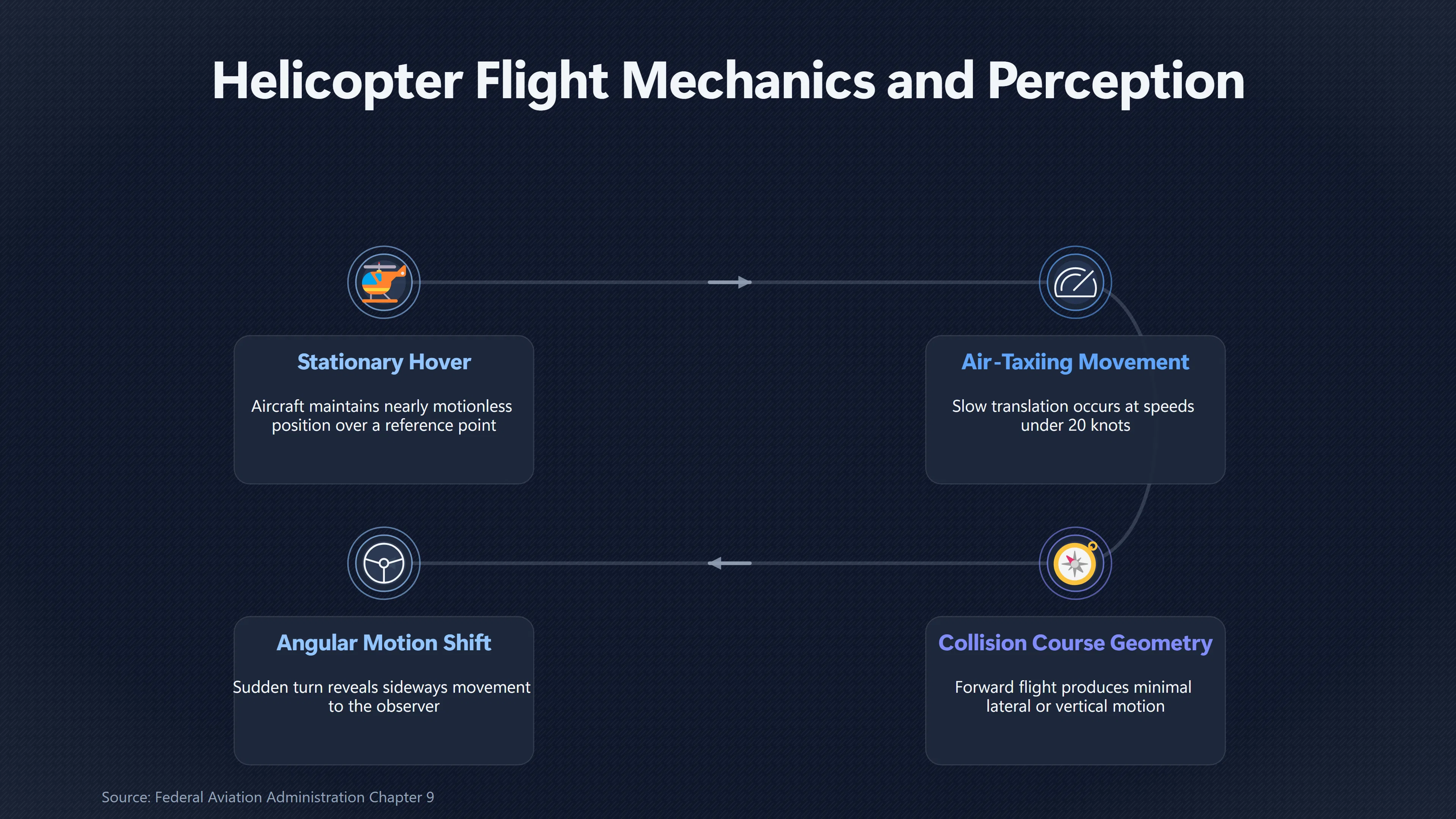
Yes. A helicopter can genuinely look motionless at night, and that makes it an unusually strong conventional match for reports of a bright UFO or UAP that seems to “hover”. Unlike a fixed-wing aeroplane, a helicopter can maintain a real stationary hover over a point on the ground. At sufficient distance, darkness may hide the fuselage and rotor while leaving one or more bright lights conspicuous, so the witness is effectively judging the movement of a luminous point rather than watching a recognisable aircraft. The Federal Aviation Administration (FAA) defines a stationary hover as keeping a helicopter in nearly motionless flight over a reference point at constant altitude and heading.[Federal Aviation Administration]faa.govFederal Aviation Administration Chapter 9Basic Flight Maneuvers Introduction…
There is a second route to the same appearance: a helicopter that is actually travelling towards or away from an observer can remain at nearly the same bearing. Aviation collision-avoidance guidance explicitly warns that an approaching aircraft may show almost no lateral or vertical motion.[Federal Aviation Administration]faa.govFederal Aviation Administration Chapter 8. Medical Facts for PilotsFederal Aviation Administration Chapter 8. Medical Facts for Pilots
The important distinction, therefore, is between motion through space and motion across the observer’s field of view. “The light stayed in the same place” does not by itself rule out an aircraft — and with a helicopter, it may describe exactly what the aircraft was doing.
How true helicopter hovering changes a sighting
A helicopter does not merely have the ability to fly slowly. It can maintain position over a particular location. FAA training material describes a stationary hover as “nearly motionless flight over a reference point”, with the pilot using visual references to detect small changes in altitude and position.[Federal Aviation Administration]faa.govFederal Aviation Administration Chapter 9Basic Flight Maneuvers Introduction… That is fundamentally different from the ordinary forward flight people often expect when they hear the word “aircraft”.
This capability matters disproportionately at night. In daylight, even a hovering helicopter usually supplies several identification cues at once: the body, rotor disc, tail boom, orientation and relationship to the landscape. Darkness can remove much of that information. FAA guidance on helicopter night operations notes that even under otherwise visual flying conditions, the ability to distinguish unlit or low-contrast objects and terrain may be compromised, and that seeing conditions depend heavily on lighting, contrast and surface texture.[Federal Aviation Administration]faa.govJanuary 8, 2015…
From the ground, the corresponding problem is straightforward. The illuminated part of a helicopter can remain conspicuous after the dark airframe has effectively disappeared. If that luminous part stays above the same distant roof, tree line or patch of horizon, the observer has good reason to perceive a hovering light — because there may genuinely be a helicopter hovering there.
The phenomenon need not involve an extended perfectly stationary hover either. Helicopters routinely use very low-speed modes of movement. ICAO terminology cited by SKYbrary describes air-taxiing as helicopter movement above the surface, normally at less than 20 knots, while FAA terminology recognises hover-taxi and air-taxi operations.[Skybrary]skybrary.aeroTaxiing | SKYbrary Aviation SafetyTaxiing | SKYbrary Aviation Safety… From sufficiently far away, a slow translation of this kind can produce only a small change in viewing angle.
That produces a useful rule when assessing UFO reports: hovering is not an aircraft-excluding characteristic. In the case of a helicopter, sustained hovering or very slow movement can actually strengthen the conventional hypothesis if other circumstances — altitude, lights, operating area, eventual departure or recorded aircraft traffic — also fit.
Why near-head-on flight can also look stationary
A light does not have to be physically stationary to remain in almost the same place in the sky. What the eye readily notices is angular motion: movement left, right, up or down relative to the observer. An aircraft travelling substantially along the observer’s line of sight may cover considerable distance without producing much sideways displacement.
Aviation safety guidance treats this geometry as important enough to be a collision warning. The FAA states that an aircraft showing no relative motion and remaining in one scan quadrant is likely to be on a collision course; a target may show no lateral or vertical movement while increasing in apparent size.[Federal Aviation Administration]faa.govFederal Aviation Administration Chapter 8. Medical Facts for PilotsFederal Aviation Administration Chapter 8. Medical Facts for Pilots Research on vision-based aircraft detection likewise describes aircraft on collision-course geometries as effectively “stationary” in an image because they have little or no relative movement against the background.[arXiv]arxiv.orgA Dataset of Stationary, Fixed-wing Aircraft on a Collision Course for Vision-Based Sense and AvoidDecember 6, 2021…
For a UFO witness on the ground, the same geometry has a much less dangerous but potentially confusing consequence. Imagine a helicopter several kilometres away travelling roughly towards the observer. Its range may be shrinking continuously, but its bearing changes very little. If the observer can see mainly a forward-facing bright light, the impression can be:
bright point → apparently stationary point → slowly brightening point → sudden sideways movement.
The final stage can be particularly misleading. Once the helicopter turns or its route takes it across the observer’s line of sight, its sideways angular motion becomes obvious. A witness may consequently describe an object that “hovered for several minutes and then suddenly began moving”, even though the first part of the observation was forward flight rather than a hover.
The FAA’s collision-course rule demonstrates why this is not merely a speculative optical explanation. Lack of apparent sideways movement is a known property of certain real aircraft trajectories.[Federal Aviation Administration]faa.govFederal Aviation Administration Chapter 8. Medical Facts for PilotsFederal Aviation Administration Chapter 8. Medical Facts for Pilots It applies to fixed-wing aircraft too, but helicopters make the interpretation more difficult because they can produce both versions of the observation: genuine stationary flight and apparent stationary flight.
Darkness makes small movements harder to judge
At night, the observer often lacks exactly the references needed to distinguish these possibilities. A light viewed against an otherwise dark sky provides little direct information about its distance. Without a reliable distance, apparent brightness cannot by itself establish whether an aircraft is close and modestly illuminated or distant and carrying a powerful light.
The wider aviation literature treats reduced night-time visual references as a significant source of perceptual error. SKYbrary notes that visual illusions arise when normal visual references are absent or altered, affecting perceptions of height, distance and position. The UK Civil Aviation Authority similarly warns, in its guidance on night drone flying, that reduced light makes distance and direction harder to judge.[Skybrary]skybrary.aeroVisual Illusions | SKYbrary Aviation SafetyVisual Illusions | SKYbrary Aviation Safety
There is also an apparently paradoxical effect. A genuinely stationary light can sometimes seem to move. Autokinesis, or the autokinetic effect, occurs when a small stationary light viewed against a dark or featureless background appears to wander because the visual system lacks a stable reference against which to judge its position. Aviation guidance specifically recognises this illusion.[Skybrary]skybrary.aeroAutokinetic Effect | SKYbrary Aviation SafetyAutokinetic Effect | SKYbrary Aviation Safety
This means witness descriptions such as “it hovered but occasionally drifted”, “it wobbled around the same spot” or “it made tiny movements” require caution unless those movements can be compared with something fixed. They could represent actual helicopter corrections in a hover, slow aircraft movement, observer or camera movement, or apparent movement of an isolated light.
Conversely, the absence of perceived movement is not particularly strong evidence either. Human vision is good at detecting motion when there is a useful frame of reference; a distant luminous point against darkness is a much poorer measuring instrument.
Using landmarks to test whether a light actually moved
The most useful improvement a witness can make is remarkably simple: stop judging the light only against empty sky.
FAA collision-avoidance guidance recommends acquiring distant targets using sizeable reference objects such as prominent landmarks, buildings or other identifiable features.[Federal Aviation Administration]faa.govFederal Aviation Administration ENR 1.15: Medical Facts for PilotsFederal Aviation Administration ENR 1.15: Medical Facts for Pilots The same principle can make a ground-based UFO observation far more informative. Instead of recording that a light “didn’t move”, record where it sits relative to a fixed object.
A useful observation might say that the light was initially one apparent light-width to the left of a chimney, five minutes later directly above it, and another five minutes later noticeably to its right. Even approximate comparisons of this sort preserve evidence of angular movement that memory alone tends to lose.
For a longer sighting, several checks are especially valuable:
- Use two fixed references where possible. A roof edge, mast, tower, tree, hill or other distant feature provides a repeatable bearing reference.
- Keep the camera position fixed. Leaning sideways, walking along a road or moving a handheld phone can change the alignment between a nearby landmark and a distant aircraft through parallax.
- Record continuously rather than only at the dramatic moment. The transition from apparently stationary to clearly moving can reveal an approaching aircraft beginning a turn or a hovering helicopter departing.
- Note changes in brightness separately from changes in position. A light becoming brighter does not necessarily mean it has begun moving vertically; changing range, aircraft attitude or viewing angle can alter how much light reaches the observer.
- Record direction and exact time. Those details allow later comparison with aircraft tracking information, where coverage is available, rather than trying to identify an aircraft from appearance alone.
The value of fixed references is illustrated by the broader technical analysis of UAP imagery. The Pentagon’s All-domain Anomaly Resolution Office (AARO) has repeatedly used reconstructed viewing geometry, observer position, sensor angles and background information to distinguish apparent motion from actual object motion. Its Puerto Rico analysis, for example, found that motion parallax caused slow-moving objects to appear much faster because the observing aircraft itself was moving.[AARO]aaro.milPuerto Rico UAP Case ResolutionPuerto Rico UAP Case Resolution The geometry differs from a person watching a hovering helicopter from the ground, but the investigative lesson is the same: apparent movement becomes much easier to interpret when the observer’s position and stable references are known.
When “stationary” is useful evidence — and when it is not
A stationary-looking light is therefore a clue, but not a conclusion. The strength of a helicopter explanation depends on what “stationary” actually means.
If a witness has a clear landscape reference and the light remains almost exactly aligned with it for an extended period before departing sideways, a true helicopter hover becomes physically plausible. If the light instead grows brighter while retaining approximately the same bearing and then develops obvious lateral movement, near-head-on flight is another strong possibility. If its reported small excursions occurred only against an empty black sky, perceptual effects such as autokinesis become harder to exclude.[Federal Aviation Administration]faa.govFederal Aviation Administration Chapter 9Basic Flight Maneuvers Introduction…
None of these mechanisms proves that an unidentified light was a helicopter. A proper identification requires additional evidence. What they establish is narrower but important: apparent immobility cannot legitimately be used on its own to dismiss the aircraft hypothesis.
That matters in the wider interpretation of UFO and UAP reports because lights and round or orb-like appearances make up a substantial share of reports received by AARO, while some closed cases are ultimately resolved as ordinary aircraft.[AARO]aaro.milUAP TrendsUAP Trends A distant helicopter reduced visually to a light can therefore occupy an awkward middle ground: completely conventional in its flight behaviour, yet difficult to recognise from the information available to a night-time observer.
The key diagnostic question
The strongest question is not simply, “Did it hover?” It is “What evidence shows that its bearing remained fixed?”
A helicopter can truly hover. It can creep slowly enough for its angular movement to be difficult to notice. It can also travel substantially towards or away from an observer while appearing almost stationary. Darkness then removes much of the familiar aircraft shape and many of the visual references that would normally reveal distance and motion.[Federal Aviation Administration]faa.govFederal Aviation Administration Chapter 9Basic Flight Maneuvers Introduction…
For that reason, a bright night light that appears fixed for minutes and later moves away is not behaviour that inherently demands an exotic aircraft. It is one of the situations in which helicopter flight mechanics and viewing geometry provide an especially close conventional match. The decisive evidence is more likely to come from movement against fixed landmarks, the evolution of the light over time and independent aircraft-position information than from the initial impression that the object was hanging motionless in the sky.
Amazon book picks
Further Reading
Books and field guides related to Can a Helicopter Really Look Motionless at Night?. Use these as the next step if you want deeper reading beyond the article.
Helicopter Flying Handbook
Compiled by the Federal Aviation Administration, this handbook is the ultimate technical manual for anyone who flies or wants to learn to...
Pilot's Handbook of Aeronautical Knowledge
Pilot's Handbook of Aeronautical Knowledge, created by the Federal Aviation Administration, is the official reference manual for pilots a...
Principles of Helicopter Aerodynamics
An internationally recognized expert explains the aerodynamic principles of helicopters and other rotating-wing vertical lift aircraft. B...
Helicopter Flight Dynamics: The Theory and Application of Fly...
Good flying qualities are vital for ensuring that mission performance is achievable with safety and, in the first edition of Helicopter F...
eBay marketplace picks
Marketplace Samples
Live-tested eBay searches with available results related to this page.
Selected fromhelicopter model oneBay.co.uk.
Endnotes
1.
Source: faa.gov
Title: Federal Aviation Administration Chapter 9
Link:https://www.faa.gov/sites/faa.gov/files/regulations_policies/handbooks_manuals/aviation/helicopter_flying_handbook/hfh_ch09.pdf
Source snippet
Basic Flight Maneuvers Introduction...
2.
Source: faa.gov
Link:https://www.faa.gov/regulations_policies/handbooks_manuals/aviation/helicopter_flying_handbook
3.
Source: faa.gov
Title: Federal Aviation Administration Chapter 8. Medical Facts for Pilots
Link:https://www.faa.gov/Air_traffic/publications/atpubs/aim_html/chap8_section_1.html
4.
Source: faa.gov
Title: Federal Aviation Administration ENR 1.15: Medical Facts for Pilots
Link:https://www.faa.gov/air_traffic/publications/atpubs/aip_html/part2_enr_section_1.15.html
5.
Source: faa.gov
Title: Federal Aviation Administration
Link:https://www.faa.gov/air_traffic/publications/atpubs/aim/aim1002.html
Source snippet
January 8, 2015...
Published: January 8, 2015
6.
Source: faa.gov
Link:https://www.faa.gov/lessons_learned/rotorcraft/accidents/N828AC
7.
Source: skybrary.aero
Title: Taxiing | SKYbrary Aviation Safety
Link:https://skybrary.aero/index.php/articles/taxiing
Source snippet
Taxiing | SKYbrary Aviation Safety...
8.
Source: faa.gov
Title: Federal Aviation Administration Chapter 4. Air Traffic Control
Link:https://www.faa.gov/Air_traffic/publications/atpubs/aim_html/chap4_section_3.html
9.
Source: arxiv.org
Link:https://arxiv.org/abs/2112.02735
Source snippet
A Dataset of Stationary, Fixed-wing Aircraft on a Collision Course for Vision-Based Sense and AvoidDecember 6, 2021...
Published: December 6, 2021
10.
Source: arxiv.org
Link:https://arxiv.org/abs/1903.03275
11.
Source: skybrary.aero
Title: Visual Illusions | SKYbrary Aviation Safety
Link:https://skybrary.aero/index.php/articles/visual-illusions
12.
Source: skybrary.aero
Title: Autokinetic Effect | SKYbrary Aviation Safety
Link:https://skybrary.aero/index.php/articles/autokinetic-effect
13.
Source: skybrary.aero
Title: General Aviation Night Flying Guidance | SKYbrary Aviation Safety
Link:https://skybrary.aero/index.php/articles/general-aviation-night-flying-guidance
14.
Source: aaro.mil
Title: Puerto Rico UAP Case Resolution
Link:https://www.aaro.mil/Portals/136/PDFs/case_resolution_reports/AARO_Puerto_Rico_UAP_Case_Resolution.pdf
15.
Source: aaro.mil
Title: UAP Trends
Link:https://www.aaro.mil/UAP-Cases/UAP-Reporting-Trends/
16.
Source: faa.gov
Title: St Paul Downtown Airport Holman Field (STP) | Federal Aviation Administration
Link:https://www.faa.gov/flight_deck/stp
17.
Source: aaro.mil
Link:https://www.aaro.mil/Next-AARO-Home-redesign/Next-Parent/Next-AARO-UAP-Imagery-Acc-Table/
18.
Source: aaro.mil
Link:https://www.aaro.mil/Next-AARO-Home-redesign/Next-Parent/Next-UAP-Report-Documents/poster/
19.
Source: aaro.mil
Link:https://www.aaro.mil/Next-AARO-Home-redesign/Next-Parent/Next-UAP-Report-Documents/
20.
Source: aaro.mil
Link:https://www.aaro.mil/Next-AARO-Home-redesign/Next-Parent/Next-UAP-Report-Documents/poster/dividLink/
21.
Source: aaro.mil
Link:https://www.aaro.mil/Next-AARO-Home-redesign/Next-Parent/Presidential-UAP-Transparency-Initiative/
22.
Source: aaro.mil
Link:https://www.aaro.mil/Next-AARO-Home-redesign/Next-Parent/Presidential-UAP-Transparency-Initiative/videoid/1006078/dvpcc/false/
23.
Source: aaro.mil
Link:https://www.aaro.mil/Next-AARO-Home-redesign/Next-Parent/Presidential-UAP-Transparency-Initiative/videoid/1006079/dvpcc/false/
24.
Source: faa.gov
Title: Robinson R44 | Federal Aviation Administration
Link:https://www.faa.gov/lessons_learned/rotorcraft/accidents/N474FA
25.
Source: faa.gov
Title: Operations Over People General Overview | Federal Aviation Administration
Link:https://www.faa.gov/uas/commercial_operators/operations_over_people
26.
Source: faa.gov
Title: Chapter 8. Medical Facts for Pilots
Link:https://www.faa.gov/air_traffic/publications/atpubs/aim/aim0801.html
27.
Source: faa.gov
Title: Chapter 10. Helicopter Operations
Link:https://www.faa.gov/air_traffic/publications/atpubs/aim/aim1001.html
28.
Source: faa.gov
Title: Chapter 4. Air Traffic Control
Link:https://www.faa.gov/air_traffic/publications/ATpubs/AIM/aim0401.html
29.
Source: faa.gov
Link:https://www.faa.gov/air_traffic/publications/ATpubs/ATC/PCG/V.HTM
30.
Source: faa.gov
Link:https://www.faa.gov/air_traffic/publications/ATpubs/ATC/atc0311.html
31.
Source: skybrary.aero
Link:https://skybrary.aero/index.php/accidents-and-incidents/as32-b734-aberdeen-uk-2000
32.
Source: skybrary.aero
Link:https://skybrary.aero/index.php/articles/night-visual-approaches
33.
Source: skybrary.aero
Link:https://skybrary.aero/index.php/articles/empty-field-myopia
34.
Source: skybrary.aero
Link:https://skybrary.aero/index.php/articles/ground-effect
35.
Source: skybrary.aero
Link:https://skybrary.aero/index.php/articles/vortex-ring
36.
Source: skybrary.aero
Link:https://skybrary.aero/index.php/articles/final-approach-and-takeoff-area-fato
37.
Source: skybrary.aero
Link:https://skybrary.aero/index.php/articles/wake-vortex-generation-helicopters
38.
Source: skybrary.aero
Link:https://skybrary.aero/index.php/articles/[radar
39.
Source: skybrary.aero
Link:https://skybrary.aero/index.php/articles/lift
40.
Source: skybrary.aero
Link:https://skybrary.aero/articles/helicopter-emergency-floatation-systems-efs
41.
Source: skybrary.aero
Link:https://skybrary.aero/index.php/articles/weight-wheels-wow-systems
42.
Source: skybrary.aero
Link:https://skybrary.aero/index.php/articles/point-space-pins-helicopter-operations
43.
Source: faa.gov
Link:https://www.faa.gov/faq/beyond-visual-line-sight-bvlos-operations-are-anti-collision-lights-required
44.
Source: faa.gov
Title: Chapter 3. Airport Traffic Control
Link:https://www.faa.gov/air_traffic/publications/atpubs/atc_html/chap3_section_11.html
45.
Source: faa.gov
Link:https://www.faa.gov/data_research/research/med_humanfacs/oamtechreports/1970s/1971/7131
46.
Source: faa.gov
Link:https://www.faa.gov/air_traffic/publications/atpubs/aim_html/chap7_section_6.html
47.
Source: faa.gov
Link:https://www.faa.gov/air_traffic/publications/atpubs/aim_html/chap10_section_1.html
48.
Source: faa.gov
Link:https://www.faa.gov/air_traffic/publications/atpubs/aip_html/chap7_section_6.html
49.
Source: faa.gov
Link:https://www.faa.gov/air_traffic/publications/atpubs/aip_html/part2_enr_section_6.1.html
50.
Source: faa.gov
Link:https://www.faa.gov/air_traffic/publications/atpubs/aim_html/chap4_section_4.html
51.
Source: faa.gov
Link:https://www.faa.gov/Air_traffic/publications/atpubs/aim_html/chap5_section_4.html
52.
Source: faa.gov
Link:https://www.faa.gov/air_traffic/publications/atpubs/aim_html/chap1_section_1.html
53.
Source: faa.gov
Link:https://www.faa.gov/air_traffic/publications/atpubs/aip_html/chap10_section_1.html
54.
Source: faa.gov
Link:https://www.faa.gov/Air_traffic/publications/atpubs/aim_html/chap7_section_4.html
55.
Source: faa.gov
Link:https://www.faa.gov/data_research/research/med_humanfacs/oamtechreports/1970s/1970/7009
56.
Source: faa.gov
Link:https://www.faa.gov/air_traffic/publications/atpubs/atc_html/chap9_section_3.html
57.
Source: faa.gov
Link:https://www.faa.gov/air_traffic/publications/atpubs/aip_html/part2_enr_section_1.1.html
58.
Source: aaro.mil
Link:https://www.aaro.mil/
59.
Source: aaro.mil
Link:https://www.aaro.mil/FAQ/
60.
Source: aaro.mil
Link:https://www.aaro.mil/Next-AARO-Home-redesign/Next-Parent/Next-AARO-UAP-Trends/
61.
Source: aaro.mil
Link:https://www.aaro.mil/Next-AARO-Home-redesign/Next-Parent/Next-AARO-UAP-Imagery-Fixed-Table/
62.
Source: aaro.mil
Link:https://www.aaro.mil/Next-AARO-Home-redesign/Next-Parent/Next-UAP-Case-RR-Data-Table/
63.
Source: aaro.mil
Link:https://www.aaro.mil/UAP-Cases/Official-UAP-Imagery/4/
64.
Source: aaro.mil
Title: UAP Imagery* “[Go Fast]({{ ‘go-fast/’ | relative_url }})” Object NAVAIR
Link:https://www.aaro.mil/Next-AARO-Home-redesign/Inactive-Parent/Next-UAP-Imagery-dup/
65.
Source: aaro.mil
Title: AAR O UAP Trends All-domain Anomaly Resolution Office UAP REPORTING TRENDS
Link:https://www.aaro.mil/UAP-Cases/UAP-Reporting-Trends/quot/
66.
Source: aaro.mil
Link:https://www.aaro.mil/Next-AARO-Home-redesign/Bruce-working/Next-AARO-UAP-Trends-Charts/
67.
Source: nuforc.org
Link:https://nuforc.org/sighting/?id=198435
68.
Source: GOV.UK
Title: www.gov.uk AAI B Report: Guimbal Cabri G2, G-FICH
Link:https://www.gov.uk/government/news/aaib-report-guimbal-cabri-g2-g-fich
69.
Source: GOV.UK
Title: www.gov.uk AAI B investigation to Guimbal Cabri G2, G-FICH
Link:https://www.gov.uk/aaib-reports/aaib-investigation-to-guimbal-cabri-g2-g-fich
70.
Source: nationalarchives.gov.uk
Link:https://www.nationalarchives.gov.uk/about/news/the-national-archives-wins-1-3m-award-to-create-centre-of-excellence-for-heritage-science-and-conservation-research/
71.
Source: atsb.gov.au
Link:https://www.atsb.gov.au/investigations/2022-001
72.
Source: GOV.UK
Link:https://www.gov.uk/government/news/aaib-report-g-bosn-engine-fire-shortly-after-lifted-to-hover-hedsor-buckinghamshire-2-march-2021
Published: march 2021
73.
Source: grc.nasa.gov
Link:https://www.grc.nasa.gov/WWW/K-12/BGP/motion.html
74.
Source: GOV.UK
Link:https://www.gov.uk/aaib-reports/aaib-investigation-to-wingcopter-178-heavylift-uas-registration-n-slash-a
75.
Source: GOV.UK
Title: www.gov.uk AAI B investigation to Guimbal Cabri G2, G-PERH
Link:https://www.gov.uk/aaib-reports/aaib-investigation-to-guimbal-cabri-g2-g-perh
76.
Source: media.nationalarchives.gov.uk
Title: nationalarchives.gov.uk The Cold War and UFOs | The National Archives
Link:https://media.nationalarchives.gov.uk/index.php/cold-war-ufos/
77.
Source: GOV.UK
Title: www.gov.uk AAI B investigation to Aerospatiale SA341G Gazelle, YU-HMC
Link:https://www.gov.uk/aaib-reports/aaib-investigation-to-aerospatiale-sa341g-gazelle-yu-hmc
78.
Source: nuforc.org
Link:https://nuforc.org/sighting/?id=144701
79.
Source: GOV.UK
Title: www.gov.uk AAI B investigation to Rotorway Executive 162F, G-CCMU
Link:https://www.gov.uk/aaib-reports/aaib-investigation-to-rotorway-executive-162f-g-ccmu
80.
Source: media.nationalarchives.gov.uk
Link:https://media.nationalarchives.gov.uk/index.php/ufo-files-national-archives/
81.
Source: GOV.UK
Title: www.gov.uk AAI B investigation to Robinson R44 Raven, G-RFUN
Link:https://www.gov.uk/aaib-reports/aaib-investigation-to-robinson-r44-raven-g-rfun/
82.
Source: GOV.UK
Title: www.gov.uk AAI B investigation to Robinson R44 II Raven, G-HECK
Link:https://www.gov.uk/aaib-reports/aaib-investigation-to-robinson-r44-ii-raven-g-heck
83.
Source: GOV.UK
Title: hiller uh 12 b n38763 4 august 2012
Link:https://www.gov.uk/aaib-reports/hiller-uh-12-b-n38763-4-august-2012
Published: august 2012
84.
Source: GOV.UK
Title: robinson r44 raven ii g lavh 15 may 2008
Link:https://www.gov.uk/aaib-reports/robinson-r44-raven-ii-g-lavh-15-may-2008
Published: may 2008
85.
Source: atsb.gov.au
Title: Avoidable Accidents No. 7
Link:https://www.atsb.gov.au/publications/avoidable-accidents/2013/aviation/avoidable-accidents-no-7-visual-flight-night
86.
Source: nuforc.org
Link:https://nuforc.org/sighting/?id=93667
87.
Source: media.nationalarchives.gov.uk
Link:https://media.nationalarchives.gov.uk/index.php/the-truth-is-in-here-ufos-at-the-national-archives/
88.
Source: discovery.nationalarchives.gov.uk
Link:https://discovery.nationalarchives.gov.uk/details/r/C16460007
89.
Source: atsb.gov.au
Link:https://www.atsb.gov.au/news/2022/nothing-see-night
90.
Source: www2.anac.gov.br
Link:https://www2.anac.gov.br/anacpedia/ing-fra/tr454.htm
91.
Source: www2.anac.gov.br
Link:https://www2.anac.gov.br/anacpedia/ing-esp/tr2178.htm
92.
Source: nationalarchives.gov.uk
Title: UF O reports
Link:https://www.nationalarchives.gov.uk/explore-the-collection/explore-by-time-period/postwar/ufo-reports/
93.
Source: nationalarchives.gov.uk
Title: cas 318549 h8g1b0
Link:https://www.nationalarchives.gov.uk/freedom-of-information/requests/cas-318549-h8g1b0/
94.
Source: nationalarchives.gov.uk
Link:https://www.nationalarchives.gov.uk/help-with-your-research/research-guides/ufos/
95.
Source: nationalarchives.gov.uk
Title: Listen – what’s that sound?
Link:https://www.nationalarchives.gov.uk/education/outreach/my-home/part-1-what-sort-of-building-do-you-live-in/listen-whats-that-sound/
96.
Source: nationalarchives.gov.uk
Link:https://www.nationalarchives.gov.uk/freedom-of-information/requests/
97.
Source: media.nationalarchives.gov.uk
Link:https://media.nationalarchives.gov.uk/index.php/author/dr-david-clarke/
98.
Source: nationalarchives.gov.uk
Link:https://www.nationalarchives.gov.uk/search/results/?_q=ministry+of+defence
Additional References
99.
Source: youtube.com
Link:https://www.youtube.com/watch?v=4PY4J74-SyU
Source snippet
Stock Video: Police Helicopter Hovering with Spotlight on at Night...
100.
Source: youtube.com
Title: Cops vs. Aliens?!? Police Helicopter Chases Down A U.F.O. | Paranormal Witness
Link:https://www.youtube.com/watch?v=lCxdThFvjzY
Source snippet
Chapter 9 Hovering Maneuvers | Helicopter Flying Handbook...
101.
Source: youtube.com
Title: Night Flight Training
Link:https://www.youtube.com/watch?v=71tFfSX3KDk
Source snippet
Cops vs. Aliens?!? Police Helicopter Chases Down A U.F.O. | Paranormal Witness...
102.
Source: defense.gov
Link:https://www.defense.gov/News/News-Stories/Article/Article/631304/campbell-kunduz-hospital-attack-tragic-avoidable-accident/
103.
Source: defense.gov
Link:https://www.defense.gov/News/News-Stories/Article/Article/3965403/dod-examining-unidentified-anomalous-phenomena/
104.
Source: defense.gov
Link:https://www.defense.gov/News/News-Stories/Article/Article/3701297/dod-report-discounts-sightings-of-extraterrestrial-technology/
105.
Source: defense.gov
Link:https://www.defense.gov/News/News-Stories/Article/Article/3575511/dod-unidentified-anomalous-phenomena-office-[launches
106.
Source: defense.gov
Link:https://www.defense.gov/News/News-Stories/Article/article/3368109/dod-working-to-better-understand-resolve-anomalous-phenomena/
107.
Source: defense.gov
Link:https://www.defense.gov/News/Releases/Release/Article/3964824/department-of-defense-releases-the-annual-report-on-unidentified-anomalous-phen/
108.
Source: defense.gov
Link:https://www.defense.gov/News/Releases/Release/Article/2314065/establishment-of-unidentified-aerial-phenomena-task-force/