Within Night Sightings
Why Satellite Flares Can Look Like High UFOs
Satellite reflections can brighten dramatically and fade again, producing isolated night lights that pilots may place at the wrong altitude.
On this page
- How reflected sunlight creates sudden satellite brightening
- Why pilots can misjudge the apparent altitude
- What AARO's resolved flare reports demonstrate
Page outline Jump by section
Introduction
Satellite flares are a particularly instructive cause of night-time UFO and UAP reports because they can turn an ordinary spacecraft hundreds of kilometres above Earth into a startlingly bright, short-lived light. The effect occurs when sunlight reflects from a satellite towards an observer at just the right angle. A satellite that was faint or invisible moments earlier can brighten dramatically, move through a small part of the sky and fade again.
For pilots, the geometry can be especially deceptive. A bright point seen against a dark, largely featureless sky carries almost no direct information about its range. A light that is actually a satellite in low Earth orbit may therefore be interpreted as something much nearer, potentially within or above aviation airspace. Recent research and an All-domain Anomaly Resolution Office (AARO) analysis show that this is not merely hypothetical: satellite reflections have produced UAP reports from experienced commercial pilots.[AARO]aaro.milCorrelations of Starlink Satellite Flaring with UAP ObservationsCorrelations of Starlink Satellite Flaring with UAP Observations…
How reflected sunlight creates sudden satellite brightening
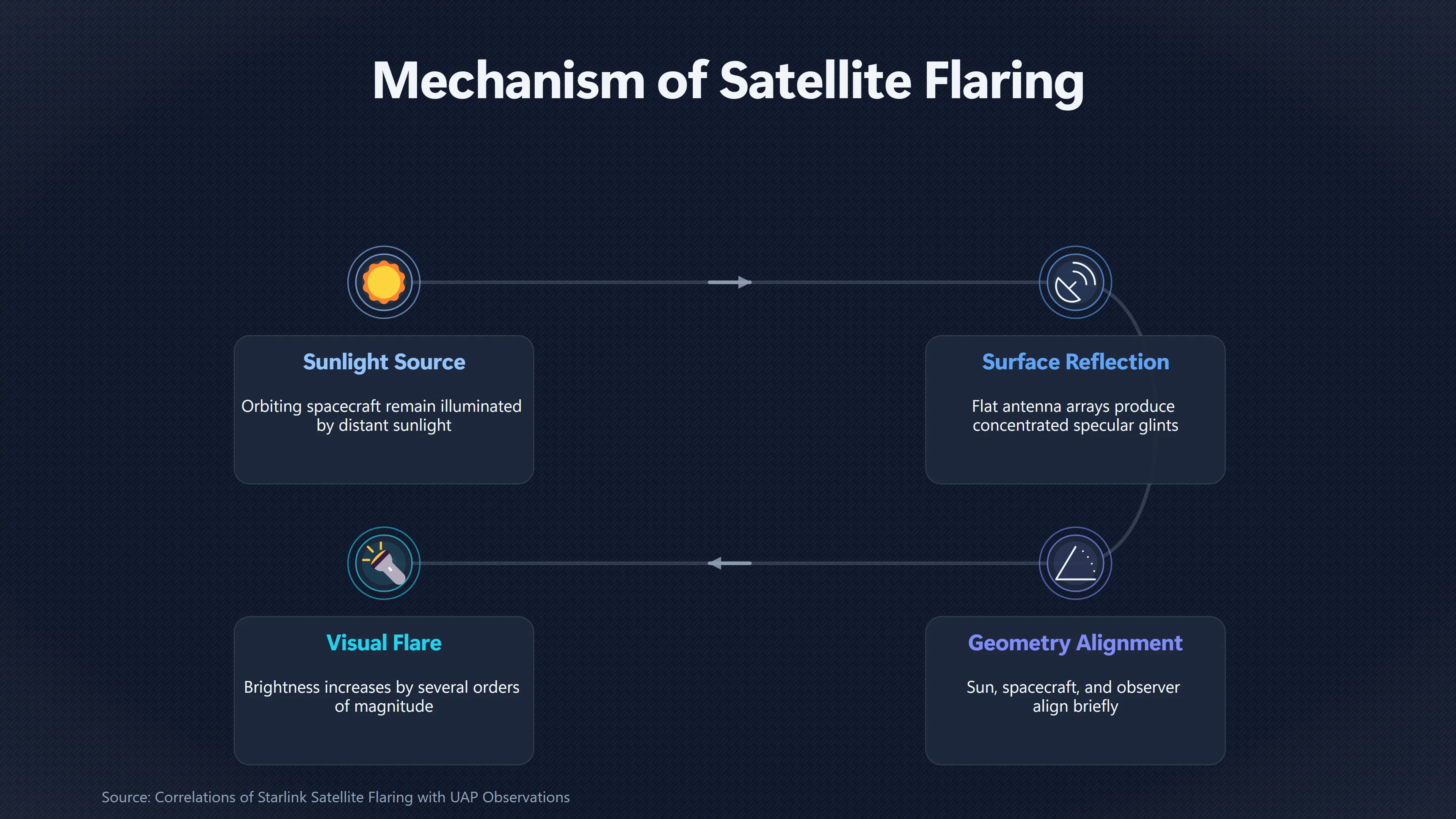
Satellites do not need their own visible lights to become conspicuous at night. While an observer is in darkness, an orbiting spacecraft can remain illuminated by the Sun because of its altitude. Some of that sunlight is then reflected towards Earth.
The crucial distinction is between diffuse reflection and specular reflection. A rough surface scatters incoming light over many directions, producing a relatively broad and weak reflection. A smooth or flat surface can instead concentrate reflected sunlight into a much narrower range of angles. AARO describes this latter effect as specular reflection, or a glint: because the reflected beam is narrow, its apparent brightness can increase by several orders of magnitude, although the observer remains inside that favourable geometry only briefly.[AARO]aaro.milCorrelations of Starlink Satellite Flaring with UAP ObservationsCorrelations of Starlink Satellite Flaring with UAP Observations…
The phenomenon predates modern satellite megaconstellations. NASA documented spectacular flares from the old Iridium communications constellation in the 1990s; typical Iridium flares could last roughly 10–20 seconds, and exceptionally bright examples reached about magnitude –8, brighter than almost anything else in the night sky apart from the Moon. Their timing and direction could be predicted because they arose from known spacecraft geometry rather than unpredictable aerial manoeuvres.[Astronomy Picture of the Day]apod.nasa.govAstronomy Picture of the Day APODAstronomy Picture of the DayAPOD: April 2, 1998 - Iridium FlareApril 2, 1998…
Starlink has made the issue newly relevant. AARO notes that an operational Starlink spacecraft presents flat antenna arrays and reflective surfaces on the Earth-facing satellite bus. When the Sun, spacecraft and observer become suitably aligned, that configuration can produce a strong glint. This is different from the familiar Starlink train seen shortly after launch: operational satellites can be widely separated and individually flare, rather than appearing as a neat procession of lights.[AARO]aaro.milCorrelations of Starlink Satellite Flaring with UAP ObservationsCorrelations of Starlink Satellite Flaring with UAP Observations…
That distinction helps explain why the resulting sighting may not immediately look like a satellite. AARO says several spacecraft can flare simultaneously while travelling in different orbital directions. Because an observer sees them strongly only while each crosses the relatively small “flare window”, lights can appear, brighten and disappear in the same region of sky. The resulting display can resemble glowing orbs, apparently recurring lights or even changing geometric arrangements rather than a conventional satellite train.[AARO]aaro.milCorrelations of Starlink Satellite Flaring with UAP ObservationsCorrelations of Starlink Satellite Flaring with UAP Observations…
The brightness can also be surprisingly high. Astronomers Anthony Mallama and Richard Cole modelled extreme Starlink flaring and found that specular sunlight reflected from the spacecraft could account for very bright observations associated with commercial-pilot UAP reports. Independent observations cited by Sky & Telescope recorded Starlink flares around magnitude –2, while the 2022 aviation case discussed below involved an object measured at roughly magnitude –4 — comparable to Venus.[arXiv]arxiv.orgarXiv Extreme Flaring of Starlink SatellitesExtreme Flaring of Starlink SatellitesMay 21, 2024…
Why pilots can misjudge the apparent altitude
The important perceptual problem is not that a pilot cannot recognise an ordinary satellite moving steadily across a familiar sky. It is that a flare supplies remarkably little information from which to determine distance.
Brightness alone does not establish range. A brilliant light could be a relatively weak source nearby or a much more distant source whose light happens to be directed efficiently towards the observer. If its physical size is unresolved, there is also no useful angular-size cue. Against a dark sky there may be no foreground objects, terrain or visible structure providing parallax or scale. The observer can confidently determine a direction to the light while remaining highly uncertain about how far away it is.
Aviation itself improves the conditions for seeing some satellite flares. AARO explains that an aircraft’s altitude extends its line of sight beyond the horizon available to a ground observer. An aircraft travelling east-to-west after sunset towards the Sun, or west-to-east before sunrise towards it, can also remain within favourable flare geometry for longer.[AARO]aaro.milCorrelations of Starlink Satellite Flaring with UAP ObservationsCorrelations of Starlink Satellite Flaring with UAP Observations…
For the current Starlink configuration analysed by AARO, particularly favourable flares tend to occur close to the horizon. Its model places the best viewing region up to roughly 10° above the horizon under the specified geometry. That is significant for pilots because a low apparent elevation does not mean that the reflecting object itself is low: a satellite hundreds of kilometres above Earth can be far beyond the observer’s local horizon and still appear only a few degrees above it.[AARO]aaro.milCorrelations of Starlink Satellite Flaring with UAP ObservationsCorrelations of Starlink Satellite Flaring with UAP Observations…
This creates a useful distinction between angular position and physical altitude. A pilot may accurately report that a light appeared five degrees above the horizon, yet that measurement by itself does not establish whether the source was tens, hundreds or thousands of kilometres away. Assigning it an altitude requires a range estimate that the isolated light does not provide.
The problem becomes still more counter-intuitive when several satellites pass through the same favourable reflection zone. One light can fade as another appears nearby. Without knowing that separate spacecraft are involved, an observer can perceive continuity between them — as though one object has changed direction, returned to the same location or moved around a looping path. This is one reason some pilot sightings became informally associated with “racetrack” UAPs, even though orbital reconstruction can show separate satellites travelling on ordinary trajectories. Research into commercial-aircrew reports specifically identifies changing specular-reflection angles and unfamiliar satellite configurations as sources of confusion.[arXiv]arxiv.orgEnhancing Space Situational Awareness to Mitigate Risk: A Single-Case Study in the Misidentification of a Recently-Launched Starlink…
A five-pilot sighting shows how convincing the illusion can be
A particularly useful case occurred over the Pacific Ocean on 10 August 2022. Five pilots aboard two commercial aircraft reported bright moving objects as UAP, and the event produced two mobile-phone photographs and a video. This was therefore stronger evidence than an isolated recollection: several experienced aviation observers saw the phenomenon and some imagery survived for later analysis.[arXiv]arxiv.orgEnhancing Space Situational Awareness to Mitigate Risk: A Single-Case Study in the Misidentification of a Recently-Launched Starlink…
Douglas Buettner and colleagues reconstructed the event using the aircraft’s flight information, satellite orbital data and the stars recorded in the photographs. They identified the objects with a closely spaced group of Starlink satellites launched earlier that day. Their reconstruction demonstrated that a mundane orbital source could reproduce an observation that several pilots had independently found anomalous.[arXiv]arxiv.orgEnhancing Space Situational Awareness to Mitigate Risk: A Single-Case Study in the Misidentification of a Recently-Launched Starlink…
The photograph’s brightness was an important part of the puzzle. Using the star Castor as a reference, the researchers measured the elongated satellite feature at approximately apparent magnitude –4, around the brightness of Venus. Such intensity does not resemble many people’s mental picture of a faint artificial satellite creeping through the stars. It is therefore understandable that observers encountering the configuration without orbital information could place the phenomenon much closer than it really was.[Sky & Telescope]skyandtelescope.orgSky & Telescope Starlink Flares Can Fool Anyone — Even Airline PilotsSky & TelescopeStarlink Flares Can Fool Anyone — Even Airline Pilots - Sky & Telescope…
This case also demonstrates why pilot expertise should be treated carefully rather than dismissed or treated as infallible. Pilots have extensive experience recognising aircraft, weather, navigation lights and other features of their normal operating environment. That expertise makes their observations valuable. It does not, however, supply the missing range information contained in an unresolved point of light, nor does it guarantee familiarity with newly common illumination effects involving thousands of orbiting spacecraft.
The practical lesson is therefore not that pilots are unreliable observers. It is that experienced observers remain subject to geometrical ambiguity when the visual scene itself lacks the information needed to determine distance. Buettner and colleagues consequently argued for better space-situational-awareness information that could help aviators distinguish unusual satellite illumination from objects posing an actual aviation hazard.[arXiv]arxiv.orgEnhancing Space Situational Awareness to Mitigate Risk: A Single-Case Study in the Misidentification of a Recently-Launched Starlink…
What AARO’s flare analysis demonstrates
AARO’s December 2024 information paper provides an especially relevant test because it applies flare geometry directly to an aviation UAP report rather than merely describing the phenomenon in general.
The Federal Aviation Administration had supplied AARO with a report from an airline pilot flying eastbound near Gallup, New Mexico, on 9 October 2022. At about 03:50 local time, the aircraft was at 35,000 feet. The pilot reported multiple unidentified lights moving in different directions, located to the left of the constellation Leo. The original report contained no further observational data.[AARO]aaro.milCorrelations of Starlink Satellite Flaring with UAP ObservationsCorrelations of Starlink Satellite Flaring with UAP Observations…
AARO reconstructed the viewing circumstances rather than attempting to infer the objects’ altitude from the witness description. It calculated the geometry appropriate to an airborne observer, estimated the location of the reported lights from Leo and modelled the expected Starlink flare region for that date and time. The estimated sighting was centred at roughly 63.3° azimuth and 5.7° elevation; the Sun’s geometry predicted a flare region at about 65.6° azimuth and roughly 9° elevation.[AARO]aaro.milCorrelations of Starlink Satellite Flaring with UAP ObservationsCorrelations of Starlink Satellite Flaring with UAP Observations…
The reconstruction also showed numerous Starlink satellites in that portion of the sky, with predicted flaring satellites crossing in different directions. That detail directly matched one of the apparently unusual elements of the pilot’s account: the presence of several lights moving differently rather than a single orderly satellite train. AARO concluded that the reported anomalous lights were very likely Starlink and other satellite flares.[AARO]aaro.milCorrelations of Starlink Satellite Flaring with UAP ObservationsCorrelations of Starlink Satellite Flaring with UAP Observations…
This is better understood as a documented explanatory match than as proof that every superficially similar pilot report has the same cause. The Gallup report was sparse, and AARO itself had to estimate the precise sighting direction from the pilot’s reference to Leo. Satellite flaring should therefore be tested against a report’s date, time, observer position, aircraft altitude, viewing direction and satellite ephemerides rather than invoked simply because unexplained lights occurred at night.
AARO’s own field observations strengthen the underlying mechanism independently of that individual case. Its personnel photographed predicted Starlink flares near Sidney, Nebraska, before sunrise on 11 March 2024 and after sunset the previous evening. The observed azimuths fell within the ranges predicted from the Sun-satellite-observer geometry.[AARO]aaro.milCorrelations of Starlink Satellite Flaring with UAP ObservationsCorrelations of Starlink Satellite Flaring with UAP Observations…
The wider significance is narrow but important. Satellite flares provide a documented example in which real objects at orbital altitude can generate extremely bright, transient night lights whose apparent behaviour is easy to interpret within an aviation frame of reference. Once orbital position and illumination geometry are recovered, apparently unusual appearances and disappearances can become predictable consequences of reflected sunlight.
For UFO and UAP investigation, that makes the estimated altitude in a night-time witness account something to test rather than automatically treat as measured fact. A pilot may report the direction and timing of a light accurately while its inferred range is wrong by hundreds or even thousands of kilometres. The satellite has not descended into the atmosphere, accelerated away or switched itself off; only the narrow reflected beam has swept across — and then away from — the observer.[AARO]aaro.milCorrelations of Starlink Satellite Flaring with UAP ObservationsCorrelations of Starlink Satellite Flaring with UAP Observations…
Amazon book picks
Further Reading
Books and field guides related to Why Satellite Flares Can Look Like High UFOs. Use these as the next step if you want deeper reading beyond the article.
NightWatch: A Practical Guide to Viewing the Universe
A practical guide to viewing the universe.
The Backyard Astronomer's Guide
Discusses the practical aspects of stargazing, including how to choose appropriate equipment, contending with light pollution, taking suc...
Turn Left at Orion
With over 100,000 copies sold since first publication, this is one of the most popular astronomy books of all time. It is a unique guideb...
Fundamentals of Astrodynamics
Rating: 4.5/5 from 12 Google Books ratings
Teaching text developed by U.S. Air Force Academy and designed as a first course emphasizes the universal variable formulation. Develops...
eBay marketplace picks
Marketplace Samples
Live-tested eBay searches with available results related to this page.
Selected fromUFO poster oneBay.co.uk.
Current eBay listing
I Want To Believe UFO Poster Giclée Fine Art Heavyweight Print

Current eBay listing
VINTAGE UFO FLYING SAUCERS COMIC ADVERTISING A2 POSTER PRINT

Endnotes
1.
Source: aaro.mil
Title: Correlations of Starlink Satellite Flaring with UAP Observations
Link:https://www.aaro.mil/Portals/136/PDFs/Information%20Papers/AARO_Satellite_Flaring_Paper.pdf
Source snippet
Correlations of Starlink Satellite Flaring with UAP Observations...
2.
Source: arxiv.org
Link:https://arxiv.org/abs/2403.08155
Source snippet
Enhancing Space Situational Awareness to Mitigate Risk: A Single-Case Study in the Misidentification of a Recently-Launched Starlink...
3.
Source: apod.nasa.gov
Title: Astronomy Picture of the Day APOD
Link:https://apod.nasa.gov/rjn/apod/ap980402.html
Source snippet
Astronomy Picture of the DayAPOD: April 2, 1998 - Iridium FlareApril 2, 1998...
Published: April 2, 1998
4.
Source: apod.nasa.gov
Link:https://apod.nasa.gov/apod/ap150902.html
Source snippet
Astronomy Picture of the DayAPOD: 2015 September 2 - The Flare and the Galaxy...
5.
Source: arxiv.org
Title: arXiv Extreme Flaring of Starlink Satellites
Link:https://arxiv.org/abs/2405.13091
Source snippet
Extreme Flaring of Starlink SatellitesMay 21, 2024...
Published: May 21, 2024
6.
Source: space.com
Title: My quiet obsession with satellites — and how they’re ruining everything | Space
Link:https://www.space.com/stargazing/my-quiet-obsession-with-satellites-and-how-theyre-ruining-everything
7.
Source: aaro.mil
Link:https://www.aaro.mil/Next-AARO-Home-redesign/Next-Parent/Next-UAP-Report-Documents/
8.
Source: aaro.mil
Link:https://www.aaro.mil/Next-AARO-Home-redesign/Next-Parent/Next-AARO-UAP-Imagery-Acc-Table/
9.
Source: aaro.mil
Link:https://www.aaro.mil/Next-AARO-Home-redesign/Next-Parent/Next-UAP-Report-Documents/poster/
10.
Source: aaro.mil
Title: AAR O UAP Records
Link:https://www.aaro.mil/UAP-Records/fbclid/IwZXh0bgNhZW0CMTEAAR0F9nbI4TTQyu8d96BuOtBb1uVQuvapZEvLug7mWxQC4ZqlNDrM5_ejMt4_aem_q0czZMebJdVWJ-6XDLdWAA/
11.
Source: aaro.mil
Link:https://www.aaro.mil/Next-AARO-Home-redesign/Next-Parent/Presidential-UAP-Transparency-Initiative/dvpmoduleid/77396/
12.
Source: aaro.mil
Link:https://www.aaro.mil/Next-AARO-Home-redesign/Next-Parent/Presidential-UAP-Transparency-Initiative/videoid/1014101/dvpcc/false/
13.
Source: space.com
Link:https://www.space.com/how-to-tell-difference-between-[meteors
14.
Source: space.com
Title: X launches 52 Starlink satellites, lands rocket at sea | Space
Link:https://www.space.com/spacex-starlink-group-4-26-launch-rocket-landing
15.
Source: space.com
Title: 39130 best space photos of 2017 gallery
Link:https://www.space.com/39130-best-space-photos-of-2017-gallery.html
16.
Source: space.com
Link:https://www.space.com/38995-isaac-newton-telescope-iridium-flare-photo.html
17.
Source: space.com
Title: Have an Awesome Summer Star Party Using Mobile Apps | Space
Link:https://www.space.com/37356-summer-star-party-mobile-apps.html
18.
Source: cneos.jpl.nasa.gov
Link:https://cneos.jpl.nasa.gov/news/news195.html
19.
Source: space.com
Title: Solar Flare Unleashes Violent Plasma ‘Rainstorm’ (Video) | Space
Link:https://www.space.com/33675-solar-flare-unleashes-plasma-rain-video.html
20.
Source: space.com
Title: How to Use Mobile Apps to Spot the Space Station and Iridium Flares | Space
Link:https://www.space.com/32387-satellite-space-station-skywatching-mobile-apps.html
21.
Source: space.com
Title: How to Spot Satellites | Space
Link:https://www.space.com/6870-spot-satellites.html
22.
Source: cneos.jpl.nasa.gov
Link:https://cneos.jpl.nasa.gov/news/news174.html
23.
Source: space.com
Title: Radiation Blast from Big Solar Flare May Threaten Satellites | Space
Link:https://www.space.com/14791-solar-flare-radiation-storm-satellites.html
24.
Source: space.com
Title: Reflections from Space: Spot Iridium Flares | Space
Link:https://www.space.com/6898-reflections-space-spot-iridium-flares.html
25.
Source: cneos.jpl.nasa.gov
Link:https://cneos.jpl.nasa.gov/news/2008tc3.html
26.
Source: space.com
Title: Spot the Space Station | Space
Link:https://www.space.com/5610-spot-space-station.html
27.
Source: space.com
Title: Backyard Astronomers See Bright Space Station Flares | Space
Link:https://www.space.com/3942-backyard-astronomers-bright-space-station-flares.html
28.
Source: apod.nasa.gov
Link:https://apod.nasa.gov/apod/ap000502.html
29.
Source: cneos.jpl.nasa.gov
Link:https://cneos.jpl.nasa.gov/news/news018a.html
30.
Source: aaro.mil
Title: AAR O UAP Trends All-domain Anomaly Resolution Office UAP REPORTING TRENDS
Link:https://www.aaro.mil/UAP-Cases/UAP-Reporting-Trends/
31.
Source: aaro.mil
Link:https://www.aaro.mil/UAP-Cases/Official-UAP-Imagery/4/
32.
Source: aaro.mil
Link:https://www.aaro.mil/Next-AARO-Home-redesign/Next-Parent/Next-AARO-UAP-Trends/
33.
Source: aaro.mil
Title: UAP Records
Link:https://www.aaro.mil/UAP-Records/
34.
Source: aaro.mil
Link:https://www.aaro.mil/Next-AARO-Home-redesign/Inactive-Parent/Next-AARO-UAP-DT-Records/
35.
Source: aaro.mil
Link:https://www.aaro.mil/Resources/Historical-Record-Reports/Volume-II/
36.
Source: aaro.mil
Link:https://www.aaro.mil/FAQ/
37.
Source: aaro.mil
Link:https://www.aaro.mil/
38.
Source: aaro.mil
Link:https://www.aaro.mil/Next-AARO-Home-redesign/Next-Parent/Next-AARO-UAP-Imagery-Fixed-Table/
39.
Source: aaro.mil
Title: UAP Imagery* “[Go Fast]({{ ‘go-fast/’ | relative_url }})” Object NAVAIR
Link:https://www.aaro.mil/Next-AARO-Home-redesign/Inactive-Parent/Next-UAP-Imagery-dup/
40.
Source: aaro.mil
Link:https://www.aaro.mil/Next-AARO-Home-redesign/Inactive-Parent/AARO-Records-Tabs/
41.
Source: cneos.jpl.nasa.gov
Link:https://cneos.jpl.nasa.gov/pi/
42.
Source: cneos.jpl.nasa.gov
Link:https://cneos.jpl.nasa.gov/doc/apophis/
43.
Source: cneos.jpl.nasa.gov
Title: palermo scale
Link:https://cneos.jpl.nasa.gov/sentry/palermo_scale.html
44.
Source: cneos.jpl.nasa.gov
Link:https://cneos.jpl.nasa.gov/fireballs/intro.html
45.
Source: cneos.jpl.nasa.gov
Title: search program
Link:https://cneos.jpl.nasa.gov/about/search_program.html
46.
Source: cneos.jpl.nasa.gov
Link:https://cneos.jpl.nasa.gov/pd/cs/ttx22/
47.
Source: cneos.jpl.nasa.gov
Link:https://cneos.jpl.nasa.gov/glossary/LD.html
48.
Source: cneos.jpl.nasa.gov
Title: ecliptic plane
Link:https://cneos.jpl.nasa.gov/glossary/ecliptic_plane.html
49.
Source: skyandtelescope.org
Title: Sky & Telescope Starlink Flares Can Fool Anyone — Even Airline Pilots
Link:https://skyandtelescope.org/astronomy-news/starlink-flares-can-fool-anyone-even-airline-pilots/
Source snippet
Sky & TelescopeStarlink Flares Can Fool Anyone — Even Airline Pilots - Sky & Telescope...
50.
Source: skyandtelescope.org
Title: Satellite or Meteor? Dissecting Light Trails in Your Sky Photos
Link:https://skyandtelescope.org/astronomy-news/satellite-or-meteor-dissecting-light-trails-in-your-sky-photos/
51.
Source: nuforc.org
Link:https://nuforc.org/sighting/?id=196319
52.
Source: skyandtelescope.org
Title: Magnitude -7 Iridium 64 Flare
Link:https://skyandtelescope.org/online-gallery/magnitude-7-iridium-64-flare/
53.
Source: skyandtelescope.org
Title: Honey, Let’s Start Seeing Other Satellites
Link:https://skyandtelescope.org/stargazing-and-observing/satellites/
54.
Source: skyandtelescope.org
Title: Get Your Iridium Fix Before It’s Too Late!
Link:https://skyandtelescope.org/stargazing-and-observing/get-your-iridium-fix-before-its-too-late/
55.
Source: skyandtelescope.org
Title: Predictive Prowess: See an Iridium Flare
Link:https://skyandtelescope.org/stargazing-and-observing/see-iridium-flare-071720143/
56.
Source: skyandtelescope.org
Title: Cygnus and Iridium flare | Tim S Jones
Link:https://skyandtelescope.org/online-gallery/cygnus-and-iridium-flare/
57.
Source: satobs.org
Title: Iridium Flares
Link:https://www.satobs.org/iridium.html
58.
Source: skyandtelescope.org
Title: Iridium: The Movie
Link:https://skyandtelescope.org/astronomy-blogs/iridium-the-movie/
59.
Source: skyandtelescope.org
Title: Iridium Flare Watch: How to Observe Iridium Flares | Sky & Telescope
Link:https://skyandtelescope.org/stargazing-and-observing/celestial-objects-to-watch/observing-iridium-flares/
60.
Source: skyandtelescope.org
Title: Iridium Flash | Olivier R. Staiger
Link:https://skyandtelescope.org/online-gallery/iridium-flash/
61.
Source: skyandtelescope.org
Title: Take a “Sat-seeing” Tour
Link:https://skyandtelescope.org/stargazing-and-observing/celestial-objects-to-watch/take-a-sat-seeing-tour/
62.
Source: skyandtelescope.org
Title: Have You Been Flashed By Iridium?
Link:https://skyandtelescope.org/stargazing-and-observing/celestial-objects-to-watch/have-you-been-flashed-by-iridium/
63.
Source: skyandtelescope.org
Link:https://skyandtelescope.org/stargazing-and-observing/celestial-objects-to-watch/space-satellites/
64.
Source: skyandtelescope.org
Link:https://skyandtelescope.org/astronomy-news/page/31/
65.
Source: skyandtelescope.org
Link:https://skyandtelescope.org/astronomy-news/page/33/
66.
Source: skyandtelescope.org
Link:https://skyandtelescope.org/astronomy-news/astronomy-and-society/page/2/
67.
Source: skyandtelescope.org
Link:https://skyandtelescope.org/author/tmallamaskyandtelescope-com/
68.
Source: skyandtelescope.org
Link:https://skyandtelescope.org/astronomy-news/page/28/?c=y&id=123828866
69.
Source: cosmosage.online
Link:https://cosmosage.online/arxiv/?pid=2507.00107&rank=pid
70.
Source: cosmosage.online
Link:https://cosmosage.online/arxiv/?pid=2603.07631&rank=pid
Additional References
71.
Source: theufotimes.com
Link:https://theufotimes.com/articles/aaro-virginia-coast-100-uap-fy2025-report
Source snippet
Sunlight reflecting from a satellite can appear as a bright orb that emerges, moves or fades under pa...
72.
Source: watchthestars.co.uk
Title: AARO brought in a new capability during the year that does
Link:https://watchthestars.co.uk/blog/_posts/2026-07-aaro-fy2025-uap-annual-report/
Source snippet
Pentagon UFO Report 2026: AARO's 319 Cases, 191 Unexplained | WatchTheStarsJuly 28, 2026 — SATELLITE FLARES: WHY MOST UFO SIGHTINGS ARE N...
Published: July 28, 2026
73.
Source: youtube.com
Link:https://www.youtube.com/watch?v=mvsU4p0Gsas
Source snippet
The UFO 'cookbook': How the American government investigates the unexplainable...
74.
Source: youtube.com
Link:https://www.youtube.com/watch?v=aWpeN3cU17Q
Source snippet
Curious Pilot: N661LF Oregon UAP / UFO sighting explained, December 7, 2024...
Published: December 7, 2024
75.
Source: youtube.com
Title: The UFO ‘cookbook’: How the American government investigates the unexplainable
Link:https://www.youtube.com/watch?v=6NrAQbco7dQ
Source snippet
SpaceX's Starlink, satellite flares, and spectacular twilight rocket plumes: EXPLAINED...
76.
Source: youtube.com
Title: A Double Iridium Flare
Link:https://www.youtube.com/watch?v=-XE3LuD5htM
Source snippet
Breaking Down UAP Footage with the Head of The Pentagon's UAP Taskforce, Dr. Jon Kosloski This video features the director of AARO explic...
77.
Source: defense.gov
Link:https://www.defense.gov/News/News-Stories/Article/Article/3965403/dod-examining-unidentified-anomalous-phenomena/
78.
Source: defense.gov
Link:https://www.defense.gov/News/Releases/Release/Article/3513171/the-department-of-defense-launches-the-all-domain-anomaly-resolution-office-web/
79.
Source: thedebrief.org
Link:https://thedebrief.org/any-idea-what-they-are-american-pilots-report-multiple-encounters-with-unusual-racetrack-uap-in-recent-weeks/
80.
Source: ufotransparency.com
Link:https://ufotransparency.com/files/2024-02-26-aaro-western-united-states-uap-case-resolution-aaro-western-us-case-resolution