Within Atmosphere
How Cloud Iridescence Creates Object Like Colored Lights
Cloud iridescence can isolate vivid colored spots or borders that look detached from the faint cloud producing them.
On this page
- How diffraction produces colored cloud patches
- Why narrow views can hide the surrounding cloud
- Sun position and cloud texture as diagnostic clues
Page outline Jump by section
Introduction
Cloud iridescence can turn an almost transparent cloud into a vivid patch of green, pink, blue, violet or orange that seems to hang independently in the sky. In a narrow photograph or a brief glance, the faint cloud responsible for the colour may be difficult to see at all, leaving what looks like a luminous disc, oval or irregular object. That makes iridescence a useful atmospheric explanation to consider when assessing some UFO or UAP reports involving bright, multicoloured patches near the Sun.
The effect is produced by sunlight interacting with very small cloud droplets or ice particles. It is especially associated with thin, newly forming or otherwise optically favourable clouds whose particles have similar sizes. Unlike an ordinary rainbow, the colours can follow a cloud edge or appear as isolated, apparently disordered patches. The World Meteorological Organization (WMO) specifically describes iridescence as colours that may be mingled or arranged in bands roughly parallel to cloud margins.[International Cloud Atlas]cloudatlas.wmo.intInternational Cloud Atlas Irisation or Iridescence | International Cloud AtlasInternational Cloud Atlas Irisation or Iridescence | International Cloud Atlas
How diffraction creates a coloured patch
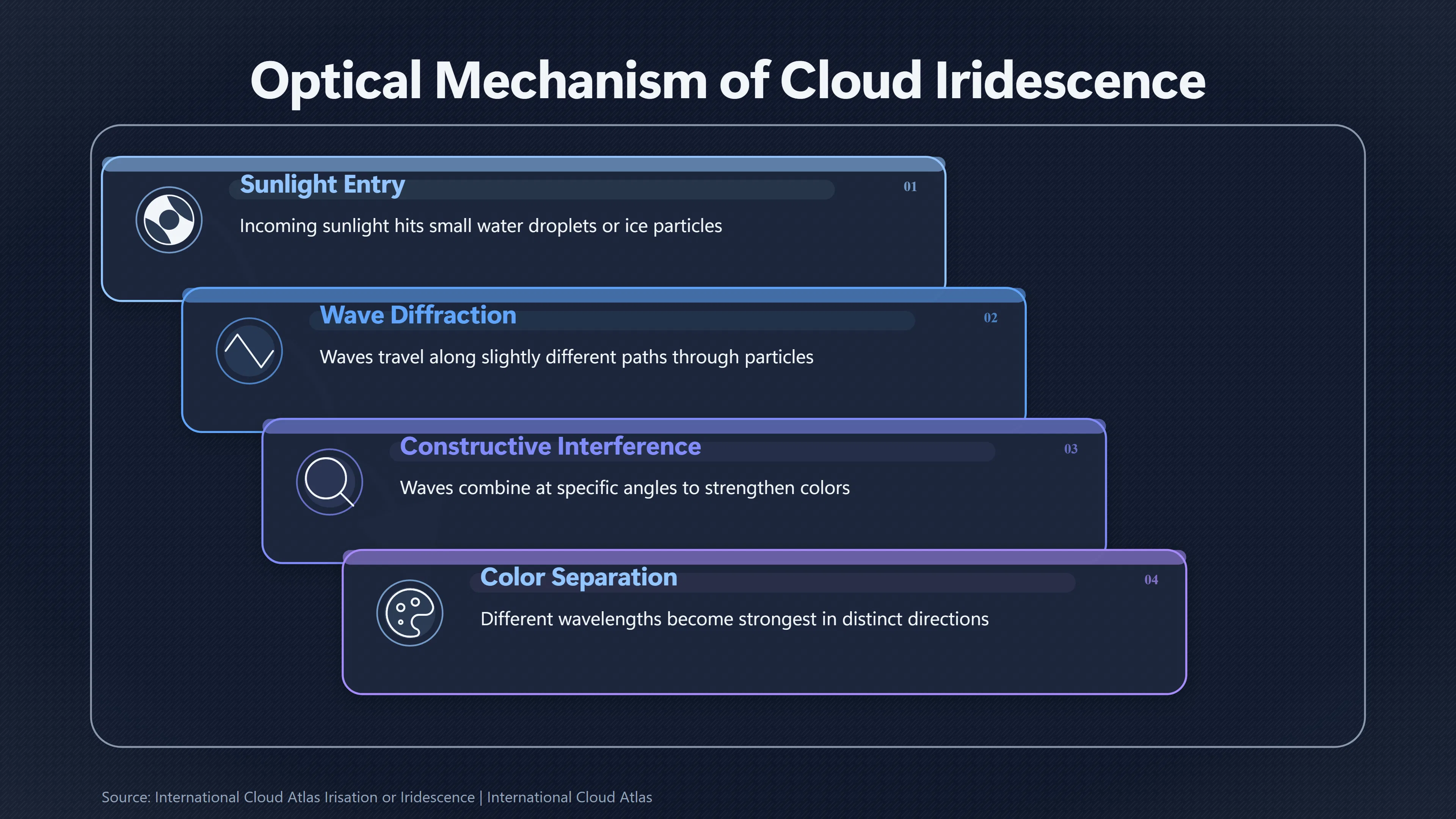
Ordinary clouds usually look white because their numerous water droplets scatter the visible wavelengths of sunlight broadly enough that the colours remain mixed. Iridescence occurs under more selective optical conditions. Small droplets or ice particles scatter incoming sunlight so that waves travelling along slightly different paths combine constructively at some angles and destructively at others. Different wavelengths therefore become strongest in different directions, separating the otherwise white sunlight into visible colours.[Met Office]weather.metoffice.gov.ukMet Office Why are clouds white?Met OfficeWhy are clouds white? - Met Office…
Close to the Sun, diffraction is particularly important. The WMO’s International Cloud Atlas states that within roughly 10 degrees of the Sun, diffraction is the principal cause of cloud iridescence. At greater angular distances, interference generally becomes more important, and iridescent colours can under some circumstances remain visible more than 40 degrees from the Sun. The familiar description of iridescence as simply a “rainbow cloud” therefore hides a more complicated optical phenomenon.[International Cloud Atlas]cloudatlas.wmo.intInternational Cloud Atlas Irisation or Iridescence | International Cloud AtlasInternational Cloud Atlas Irisation or Iridescence | International Cloud Atlas
Particle size is crucial to the appearance. NOAA explains that especially conspicuous iridescence develops when a thin cloud contains many water droplets or ice particles of approximately the same size. Semi-transparent or newly forming clouds are consequently favourable environments.[NOAA Satellite Service]nesdis.noaa.govNOAA Satellite ServiceWhat Are Rainbow Clouds? | NESDIS | National Environmental Satellite, Data, and Information Service… The WMO likewise notes that thin portions of Altocumulus commonly display coronas or iridescence.[International Cloud Atlas]cloudatlas.wmo.intInternational Cloud Atlas Physical constitution | International Cloud AtlasInternational Cloud Atlas Physical constitution | International Cloud Atlas
This relationship with particle size also explains why cloud iridescence and solar coronas are closely related. When cloud droplets are sufficiently uniform across a broad area, their diffraction patterns can produce organised coloured rings around the Sun. When particle sizes vary across the cloud, the result can instead break into less orderly bands and patches. Atmospheric-optics specialist Les Cowley describes these patches as essentially fragments of corona colours, while optical research published in Applied Optics confirms that near-forward scattering produces both coronas and cloud iridescence and that iridescence frequently appears along cloud edges or in apparently random coloured patches.[Atmospheric Optics]atoptics.org.ukAtmospheric Optics OPODAtmospheric OpticsOPOD - Corona & Iridescence…
For UFO identification, that distinction matters. There does not need to be a complete rainbow, halo or circular ring to establish an atmospheric-optical explanation. A small portion of favourable cloud can produce the only conspicuous colour in the scene.
Why the cloud can disappear while the colour remains obvious
The most misleading configuration is a thin cloud whose coloured portion is much more visually conspicuous than the rest of its structure. NOAA lists Altocumulus, Cirrocumulus, lenticular and Cirrus among clouds in which iridescence occurs and stresses that semi-transparent cloud is particularly favourable.[NOAA Satellite Service]nesdis.noaa.govNOAA Satellite ServiceWhat Are Rainbow Clouds? | NESDIS | National Environmental Satellite, Data, and Information Service… The US National Weather Service similarly describes iridescent clouds as brilliant spots, bands or borders, commonly seen in thin Cirrostratus, Cirrocumulus and Altocumulus.[National Weather Service]forecast.weather.govNational Weather Service NOAA's National Weather ServiceNational Weather ServiceNOAA's National Weather Service - Glossary…
This can create an important perceptual imbalance. The observer is not necessarily seeing a brightly coloured cloud-shaped object. They may see a conspicuous coloured portion embedded in cloud that is otherwise pale, translucent and poorly contrasted against the surrounding sky. If the field of view excludes most of the cloud, the coloured area loses the context that identifies it as part of a larger atmospheric structure.
The effect can become still more convincing when only a cloud margin is illuminated strongly enough to display colours. Iridescence commonly forms bands approximately parallel to cloud boundaries, according to the WMO, while the National Weather Service describes colours that contour cloud edges.[International Cloud Atlas]cloudatlas.wmo.intInternational Cloud Atlas Irisation or Iridescence | International Cloud AtlasInternational Cloud Atlas Irisation or Iridescence | International Cloud Atlas An elongated coloured border can therefore resemble the rim of an object rather than the edge of a diffuse cloud.
A historical observation shows how striking this effect can be without modern cameras. A report published in Nature in 1885 described an iridescent formation seen from Derby that developed from an intensely coloured region into a brilliant multicoloured feature surrounded by grey cloud. The observer compared its appearance to a huge coloured eye before the display faded as solar geometry changed.[Nature]nature.comIridescent Clouds | NatureIridescent Clouds | NatureJanuary 1, 1885… The account predates contemporary UFO culture by decades, demonstrating that apparently isolated and strongly structured coloured patches are a longstanding atmospheric observation rather than a phenomenon created by modern imaging.
Photographs can further remove useful context simply through framing. A wide view may reveal that a luminous patch sits along a larger sheet or filament of cloud and close to the Sun; a cropped or zoomed view can show little except the colourful portion. The resulting image is not necessarily false or manipulated. It can be an accurate recording that is nevertheless much harder to interpret because its atmospheric surroundings and solar geometry are missing.
This vulnerability to misidentification is visible in contemporary public reactions. Images of cloud iridescence are routinely described online in terms of spaceships or UFOs when the coloured structure appears isolated. One UAP-identification resource specifically illustrates how partially obscured or irregular iridescent clouds can resemble disc-shaped or unconventional objects, although such specialist identification sites should be treated as secondary evidence rather than authorities on atmospheric physics.[MyUAP Report]myuap.reportMy UAP Report Known Objects: Iridescent CloudsKnown Objects: Iridescent CloudsFebruary 27, 2023…
Sun position is the strongest diagnostic clue
When an apparently anomalous coloured object might be cloud iridescence, the first useful question is not what shape it resembles but where it was relative to the Sun.
The National Weather Service says iridescent bright spots, bands and borders are usually observed within roughly 30 degrees of the Sun.[National Weather Service]forecast.weather.govNational Weather Service NOAA's National Weather ServiceNational Weather ServiceNOAA's National Weather Service - Glossary… The WMO gives a more detailed optical distinction: diffraction dominates within about 10 degrees, while iridescence can occur much farther away under suitable conditions.[International Cloud Atlas]cloudatlas.wmo.intInternational Cloud Atlas Irisation or Iridescence | International Cloud AtlasInternational Cloud Atlas Irisation or Iridescence | International Cloud Atlas NOAA likewise notes that cloud iridescence arises when sunlight is scattered by small droplets or ice particles.[NOAA Satellite Service]nesdis.noaa.govNOAA Satellite ServiceWhat Are Rainbow Clouds? | NESDIS | National Environmental Satellite, Data, and Information Service…
That creates several practical clues for assessing a UFO-like coloured patch:
- Proximity to the Sun: a coloured patch appearing relatively close to the Sun strongly supports an atmospheric-optics check, especially when thin cloud occupies the same region.
- Colours tied to cloud texture: irregular pink, green, blue or violet areas following wisps, edges or changing cloud structure favour iridescence over a discrete luminous object.
- Gradual evolution: the colours can strengthen, shift or disappear as droplet sizes and cloud thickness change. Atmospheric Optics notes that iridescent bands and patches come and go as the cloud evolves.[Atmospheric Optics]atoptics.org.ukAtmospheric Optics Iridescent CloudsAtmospheric Optics Iridescent Clouds
- Partial transparency: visible blue sky or faint background texture through surrounding cloud is compatible with the thin-cloud conditions that favour iridescence.[NOAA Satellite Service]nesdis.noaa.govNOAA Satellite ServiceWhat Are Rainbow Clouds? | NESDIS | National Environmental Satellite, Data, and Information Service…
- Colour without a conventional rainbow arc: cloud iridescence does not require the familiar ordered bow seen opposite the Sun. Its colours may instead be mixed or aligned with cloud margins.[International Cloud Atlas]cloudatlas.wmo.intInternational Cloud Atlas Irisation or Iridescence | International Cloud AtlasInternational Cloud Atlas Irisation or Iridescence | International Cloud Atlas
Cloud type can provide another clue. Thin Altocumulus is a particularly useful candidate because the WMO says coronas and iridescence are often observed in its thinner portions.[International Cloud Atlas]cloudatlas.wmo.intInternational Cloud Atlas Physical constitution | International Cloud AtlasInternational Cloud Atlas Physical constitution | International Cloud Atlas Lenticular clouds can combine two deceptive properties at once: a smooth, apparently object-like outline and iridescent colouring. The International Cloud Atlas describes Altocumulus lenticularis as a lens- or almond-shaped patch with well-defined outlines and notes that iridescence is occasionally visible.[International Cloud Atlas]cloudatlas.wmo.intOpen source on wmo.int.
That combination can produce an unusually convincing UFO-like appearance. The apparent “craft” shape comes from the cloud’s geometry, while the brilliant coloured region comes from its optical properties. Neither feature requires a solid object.
What distinguishes iridescence from a genuinely separate light
The strongest identification does not come from colour alone. It comes from whether the reported light behaves as an optical feature of a cloud.
A candidate becomes more consistent with cloud iridescence when its colour distribution traces visible or faint cloud boundaries, its position is favourable relative to the Sun, and changes in brightness or shape coincide with changes in the cloud. An isolated photograph may preserve only one of these clues, which is why uncropped frames, sequential photographs and video are considerably more informative than a single tight image.
Movement deserves particular care. A witness may report that a luminous patch changed shape, appeared to expand, contracted or faded. Those behaviours do not necessarily imply manoeuvring. Iridescent colours can change as the cloud itself evolves because the relevant droplet sizes, optical thickness and illumination geometry are changing. Atmospheric Optics notes that cloud iridescence commonly appears in patches or bands whose colours change or disappear as the cloud develops.[Atmospheric Optics]atoptics.org.ukAtmospheric Optics Iridescent CloudsAtmospheric Optics Iridescent Clouds
Conversely, an iridescence explanation becomes less persuasive if a well-documented object moves independently across unrelated cloud structures while retaining a fixed shape and brightness, or if accurate geometry places it where the required illumination cannot plausibly operate. Cloud iridescence is a specific optical mechanism, not a catch-all explanation for every coloured UAP report.
There is also a useful distinction from rarer nacreous, or polar stratospheric, clouds. Nacreous clouds can produce extraordinarily vivid iridescence, particularly around twilight, but they form high in the stratosphere under very cold conditions and are geographically and meteorologically much more restricted. The WMO distinguishes their extensive, intense colours from the more localised iridescence commonly seen along the edges of ordinary thin tropospheric clouds.[International Cloud Atlas]cloudatlas.wmo.intInternational Cloud Atlas Nacreous clouds | International Cloud AtlasInternational Cloud Atlas Nacreous clouds | International Cloud Atlas For an everyday bright patch near the daytime Sun, ordinary tropospheric cloud iridescence is therefore the more relevant mechanism to test first.

Why this mechanism matters for UFO and UAP reports
Cloud iridescence illustrates a broader problem in interpreting unusual aerial observations: the brightest visible feature is not necessarily the physical outline of whatever produced it. In this case, a conspicuous coloured “object” can be only the optically favoured portion of a much larger, faint cloud.
That changes how an investigation should treat photographs and witness descriptions. A statement such as “there was a glowing oval in otherwise blue sky” does not by itself establish that the oval was a separate object. The useful evidence is the wider scene: the Sun’s position, faint cloud around the patch, whether colours follow cloud contours, how the feature changes over successive frames, and whether nearby clouds display related optical effects.
Cloud iridescence is particularly diagnostic because these clues arise from the mechanism itself. Thin cloud and suitable particle sizes provide the scattering medium; solar geometry supplies the illumination; diffraction and interference produce the colours; and limited framing can strip away the cloud context that makes the phenomenon recognisable. NOAA, the National Weather Service and the WMO independently document these core characteristics.[noaa.gov]nesdis.noaa.govNOAA Satellite ServiceWhat Are Rainbow Clouds? | NESDIS | National Environmental Satellite, Data, and Information Service…
The resulting patch can look extraordinarily artificial precisely because most of the cloud is visually unremarkable. What appears to be a self-luminous coloured object may therefore be sunlight revealing only one optically special part of an otherwise inconspicuous cloud.
Amazon book picks
Further Reading
Books and field guides related to How Cloud Iridescence Creates Object Like Colored Lights. Use these as the next step if you want deeper reading beyond the article.
Color and Light in Nature
We live in a world of optical marvels - from the commonplace but beautiful rainbow, to the rare and eerie superior mirage. But how many o...
Light and Color in the Outdoors
First published 1993. Subjects: Color, Light, Popular works, Science: General Issues, Photographic equipment & techniques.
The Cloudspotter's Guide
Discusses the history, types, and cultural fascination with clouds and explains what they mean in terms of climate and weather.
A Field Guide to the Atmosphere
More than 400 photographs and line drawings illustrate every kind of atmospheric phenomenon: clouds of every type; storms, from cloudburs...
eBay marketplace picks
Marketplace Samples
Live-tested eBay searches with available results related to this page.
Selected fromUFO patch oneBay.co.uk.

Endnotes
1.
Source: cloudatlas.wmo.int
Title: International Cloud Atlas Irisation or Iridescence | International Cloud Atlas
Link:https://cloudatlas.wmo.int/en/irisation-or-iridescence.html
2.
Source: nesdis.noaa.gov
Link:https://www.nesdis.noaa.gov/about/k-12-education/optical-phenomena/what-are-rainbow-clouds
Source snippet
NOAA Satellite ServiceWhat Are Rainbow Clouds? | NESDIS | National Environmental Satellite, Data, and Information Service...
3.
Source: cloudatlas.wmo.int
Title: International Cloud Atlas Physical constitution | International Cloud Atlas
Link:https://cloudatlas.wmo.int/physical-constitution-altocumulus.html
4.
Source: forecast.weather.gov
Title: National Weather Service NOAA’s National Weather Service
Link:https://forecast.weather.gov/glossary.php?word=C
Source snippet
National Weather ServiceNOAA's National Weather Service - Glossary...
5.
Source: forecast.weather.gov
Title: National Weather Service NOAA’s National Weather Service
Link:https://forecast.weather.gov/glossary.php?letter=i
Source snippet
National Weather ServiceNOAA's National Weather Service - Glossary...
6.
Source: nature.com
Title: Iridescent Clouds | Nature
Link:https://www.nature.com/articles/031193a0
Source snippet
Iridescent Clouds | NatureJanuary 1, 1885...
Published: January 1, 1885
7.
Source: myuap.report
Title: My UAP Report Known Objects: Iridescent Clouds
Link:https://myuap.report/reporting-toolbox/known-objects/iridescent-clouds
Source snippet
Known Objects: Iridescent CloudsFebruary 27, 2023...
Published: February 27, 2023
8.
Source: cloudatlas.wmo.int
Link:https://cloudatlas.wmo.int/en/species-altocumulus-lenticularis-ac-len.html
9.
Source: cloudatlas.wmo.int
Title: International Cloud Atlas Nacreous clouds | International Cloud Atlas
Link:https://cloudatlas.wmo.int/nacreous-clouds.html
10.
Source: goes.noaa.gov
Title: fulldisk band
Link:https://goes.noaa.gov/fulldisk_band.php?band=DayNightCloudMicroCombo&length=12&sat=G16
11.
Source: star.nesdis.noaa.gov
Title: meso band
Link:https://www.star.nesdis.noaa.gov/GOES/meso_band.php?band=DayNightCloudMicroCombo&lat=57N&length=30&lon=135W&sat=G18
12.
Source: star.nesdis.noaa.gov
Title: conus band
Link:https://www.star.nesdis.noaa.gov/GOES/conus_band.php?band=DayNightCloudMicroCombo&dim=1&length=180&sat=G19
13.
Source: star.nesdis.noaa.gov
Title: wfo band
Link:https://www.star.nesdis.noaa.gov/GOES/wfo_band.php?band=DayNightCloudMicroCombo&length=24&wfo=twc
14.
Source: star.nesdis.noaa.gov
Title: wfo band
Link:https://www.star.nesdis.noaa.gov/GOES/wfo_band.php?band=DayNightCloudMicroCombo&length=24&wfo=lmk
15.
Source: star.nesdis.noaa.gov
Title: wfo band
Link:https://www.star.nesdis.noaa.gov/GOES/wfo_band.php?band=DayNightCloudMicroCombo&length=24&wfo=iwx
16.
Source: star.nesdis.noaa.gov
Title: wfo band
Link:https://www.star.nesdis.noaa.gov/GOES/wfo_band.php?band=DayNightCloudMicroCombo&length=24&wfo=bro
17.
Source: star.nesdis.noaa.gov
Title: sector band
Link:https://www.star.nesdis.noaa.gov/goes/sector_band.php?band=DayNightCloudMicroCombo&length=12&sat=G19§or=cgl
18.
Source: nesdis.noaa.gov
Title: what causes rainbow
Link:https://www.nesdis.noaa.gov/about/k-12-education/optical-phenomena/what-causes-rainbow
19.
Source: nesdis.noaa.gov
Title: types of clouds
Link:https://www.nesdis.noaa.gov/about/k-12-education/[atmosphere
20.
Source: nesdis.noaa.gov
Title: how do clouds affect solar energy
Link:https://www.nesdis.noaa.gov/about/k-12-education/atmosphere/how-do-clouds-affect-solar-energy
21.
Source: weather.gov
Link:https://www.weather.gov/buf/totaleclipse
22.
Source: news.sky.com
Title: rare rainbow clouds spotted in uk skies 13035619
Link:https://news.sky.com/story/rare-rainbow-clouds-spotted-in-uk-skies-13035619
23.
Source: nesdis.noaa.gov
Title: earth orbit satellites and solar energy
Link:https://www.nesdis.noaa.gov/news/earth-orbit-satellites-and-solar-energy
24.
Source: nesdis.noaa.gov
Title: maritime stratocumulus provide mesmerizing view
Link:https://www.nesdis.noaa.gov/news/maritime-stratocumulus-provide-mesmerizing-view
25.
Source: nesdis.noaa.gov
Title: cloudy days and solar arrays
Link:https://www.nesdis.noaa.gov/news/cloudy-days-and-solar-arrays
26.
Source: nesdis.noaa.gov
Link:https://www.nesdis.noaa.gov/news/goes-west-shows-stationary-cloud-cover-over-bay-area-causing-strong-sunlight-ground
27.
Source: weather.gov
Link:https://www.weather.gov/boi/eclipse
28.
Source: weather.gov
Link:https://www.weather.gov/cys/eclipse
29.
Source: weather.gov
Title: Solar Eclipse
Link:https://www.weather.gov/sgf/solareclipse
30.
Source: cloudatlas.wmo.int
Link:https://cloudatlas.wmo.int/glory.html
31.
Source: cloudatlas.wmo.int
Link:https://cloudatlas.wmo.int/fr/irisation-or-iridescence.html
32.
Source: cloudatlas.wmo.int
Link:https://cloudatlas.wmo.int/ru/irisation-or-iridescence.html
33.
Source: cloudatlas.wmo.int
Link:https://cloudatlas.wmo.int/en/altocumulus-lenticularis.html
34.
Source: cloudatlas.wmo.int
Link:https://cloudatlas.wmo.int/es/irisation-or-iridescence.html
35.
Source: cloudatlas.wmo.int
Link:https://cloudatlas.wmo.int/en/clouds-species-lenticularis.html
36.
Source: cloudatlas.wmo.int
Title: int Appendix 3
Link:https://cloudatlas.wmo.int/en/appendix-3-history-of-cloud-nomenclature.html
37.
Source: cloudatlas.wmo.int
Link:https://cloudatlas.wmo.int/en/observation-of-clouds-from-aircraft-descriptions-cirrocumulus.html
38.
Source: cloudatlas.wmo.int
Link:https://cloudatlas.wmo.int/fr/clouds-species-lenticularis.html
39.
Source: cloudatlas.wmo.int
Link:https://cloudatlas.wmo.int/species-cirrocumulus-lenticularis-cc-len.html
40.
Source: cloudatlas.wmo.int
Link:https://cloudatlas.wmo.int/zh-hans/irisation-or-iridescence.html
41.
Source: cloudatlas.wmo.int
Link:https://cloudatlas.wmo.int/species-altocumulus-lenticularis-ac-len.html
42.
Source: cloudatlas.wmo.int
Link:https://cloudatlas.wmo.int/en/physical-constitution-cirrocumulus.html
43.
Source: cloudatlas.wmo.int
Link:https://cloudatlas.wmo.int/physical-constitution-cirrocumulus.html
44.
Source: cloudatlas.wmo.int
Link:https://cloudatlas.wmo.int/en/appearance-of-clouds-colour.html
45.
Source: cloudatlas.wmo.int
Link:https://cloudatlas.wmo.int/bishops-ring.html
46.
Source: cloudatlas.wmo.int
Link:https://cloudatlas.wmo.int/en/general-classification-of-[meteors
47.
Source: cloudatlas.wmo.int
Link:https://cloudatlas.wmo.int/corona.html
48.
Source: cloudatlas.wmo.int
Link:https://cloudatlas.wmo.int/fr/nacreous-clouds.html
49.
Source: forecast.weather.gov
Link:https://forecast.weather.gov/glossary.php?word=IR
50.
Source: forecast.weather.gov
Link:https://forecast.weather.gov/glossary.php?word=clouds
51.
Source: marine.weather.gov
Link:https://marine.weather.gov/glossary.php?letter=i
52.
Source: forecast.weather.gov
Link:https://forecast.weather.gov/glossary.php?word=s
53.
Source: forecast.weather.gov
Link:https://forecast.weather.gov/glossary.php?word=CLOUD
54.
Source: forecast.weather.gov
Link:https://forecast.weather.gov/glossary.php?word=cl
55.
Source: forecast.weather.gov
Link:https://forecast.weather.gov/glossary.php?word=CORONA
56.
Source: forecast.weather.gov
Link:https://forecast.weather.gov/glossary.php?word=Cor
57.
Source: forecast.weather.gov
Link:https://forecast.weather.gov/glossary.php?word=glory
58.
Source: preview.weather.gov
Link:https://preview.weather.gov/satellite/
59.
Source: forecast.weather.gov
Link:https://forecast.weather.gov/glossary.php?word=crepuscular+rays
60.
Source: forecast.weather.gov
Link:https://forecast.weather.gov/glossary.php?word=satellite+imagery
61.
Source: weather.gov
Link:https://www.weather.gov/mrx/sattype
62.
Source: forecast.weather.gov
Link:https://forecast.weather.gov/glossary.php?word=n
63.
Source: forecast.weather.gov
Link:https://forecast.weather.gov/glossary.php?word=D
64.
Source: weather.gov
Link:https://www.weather.gov/ggw/GlossaryU
65.
Source: repository.library.noaa.gov
Link:https://repository.library.noaa.gov/view/noaa/47671
66.
Source: psl.noaa.gov
Title: [Radar]({{ ‘radar/’ | relative_url }}) s1
Link:https://psl.noaa.gov/outreach/education/science/convection/Radar_s1.html
67.
Source: nesdis.noaa.gov
Link:https://www.nesdis.noaa.gov/our-environment/solar-phenomena/sunglint
68.
Source: ngdc.noaa.gov
Link:https://www.ngdc.noaa.gov/hazard/stratoguide/helenstory.html
69.
Source: origin-west-www-spc.woc.noaa.gov
Link:https://origin-west-www-spc.woc.noaa.gov/publications/corfidi/sunset.html
70.
Source: nesdis.noaa.gov
Title: marine stratocumulus clouds
Link:https://www.nesdis.noaa.gov/our-environment/clouds/marine-stratocumulus-clouds
71.
Source: psl.noaa.gov
Link:https://psl.noaa.gov/outreach/education/science/convection/Global.html
72.
Source: ufos.wiki
Link:https://ufos.wiki/investigate/
73.
Source: nature.com
Title: Iridescent Clouds | Nature
Link:https://www.nature.com/articles/035581c0
74.
Source: nature.com
Title: Iridescent Clouds | Nature
Link:https://www.nature.com/articles/033220b0
75.
Source: nature.com
Title: Iridescent Clouds | Nature
Link:https://www.nature.com/articles/031193b0
76.
Source: weather.metoffice.gov.uk
Title: Met Office Why are clouds white?
Link:https://weather.metoffice.gov.uk/learn-about/weather/types-of-weather/clouds/why-are-clouds-white
Source snippet
Met OfficeWhy are clouds white? - Met Office...
77.
Source: atoptics.org.uk
Title: Atmospheric Optics OPOD
Link:https://www.atoptics.org.uk/fz746.htm
Source snippet
Atmospheric OpticsOPOD - Corona & Iridescence...
78.
Source: atoptics.org.uk
Title: Atmospheric Optics Iridescent Clouds
Link:https://www.atoptics.org.uk/droplets/irid1.htm
79.
Source: bom.gov.au
Title: iridescent rainbow cloud shines in 2026 australian weather calendar
Link:https://www.bom.gov.au/news-and-media/iridescent-rainbow-cloud-shines-in-2026-australian-weather-calendar
80.
Source: atoptics.co.uk
Title: Cloud Iridescence
Link:https://www.atoptics.co.uk/blog/cloud-iridescence/
81.
Source: greyarro.ws
Title: Iridescent clouds
Link:https://greyarro.ws/t/iridescent-clouds/71440
82.
Source: media.bom.gov.au
Title: bom.gov.au Clouds: your questions answered
Link:https://media.bom.gov.au/social/blog/1344/clouds-your-questions-answered/
83.
Source: epod.usra.edu
Title: iridescent clouds
Link:https://epod.usra.edu/blog/2011/08/iridescent-clouds.html
84.
Source: flickr.com
Title: Cloud iridescence | optical phenomenon: Cloud iridescence: … | Flickr
Link:https://www.flickr.com/photos/thetreatment/5531191140
85.
Source: weather.metoffice.gov.uk
Title: metoffice.gov.uk Unusual cloud [formations]({{ ‘formations/’ | relative_url }})
Link:https://weather.metoffice.gov.uk/learn-about/weather/types-of-weather/clouds/unusual-cloud-formations
86.
Source: weather.metoffice.gov.uk
Title: metoffice.gov.uk Mid-level clouds
Link:https://weather.metoffice.gov.uk/learn-about/weather/types-of-weather/clouds/mid-level-clouds
87.
Source: weather.metoffice.gov.uk
Title: metoffice.gov.uk What are clouds?
Link:https://weather.metoffice.gov.uk/learn-about/met-office-for-schools/other-content/other-resources/what-are-clouds
88.
Source: weather.metoffice.gov.uk
Title: metoffice.gov.uk Optical effects: nature’s light show
Link:https://weather.metoffice.gov.uk/learn-about/weather/optical-effects
89.
Source: weather.metoffice.gov.uk
Title: metoffice.gov.uk High clouds
Link:https://weather.metoffice.gov.uk/learn-about/weather/types-of-weather/clouds/high-clouds
90.
Source: weather.metoffice.gov.uk
Title: metoffice.gov.uk Clouds
Link:https://weather.metoffice.gov.uk/learn-about/weather/types-of-weather/clouds
91.
Source: weather.gov.hk
Link:https://www.weather.gov.hk/en/education/weather/clouds/00467-iridescent-cloud.html
92.
Source: kids.weather.gov.hk
Link:https://kids.weather.gov.hk/eBook/ebook_cloud/m_ebook_cloud10_e.htm
93.
Source: atoptics.org.uk
Title: Corona + Iridescence
Link:https://www.atoptics.org.uk/fza167.htm
94.
Source: atoptics.org.uk
Title: Nacreous clouds
Link:https://www.atoptics.org.uk/highsky/nacr1.htm
95.
Source: atoptics.org.uk
Title: Cloud Iridescence
Link:https://www.atoptics.org.uk/fz1055.htm
96.
Source: atoptics.org.uk
Link:https://www.atoptics.org.uk/fz310.htm
97.
Source: atoptics.org.uk
Link:https://www.atoptics.org.uk/fz503.htm
98.
Source: cloudappreciationsociety.org
Link:https://cloudappreciationsociety.org/cloud-library/iridescence/
99.
Source: sciencedirect.com
Link:https://www.sciencedirect.com/topics/physics-and-astronomy/iridescence
100.
Source: sciencedirect.com
Title: Atmospheric Optics
Link:https://www.sciencedirect.com/topics/physics-and-astronomy/atmospheric-optics
101.
Source: hko.gov.hk
Title: 00467 iridescent cloud
Link:https://www.hko.gov.hk/en/education/weather/meteorology-basics/00467-iridescent-cloud.html
102.
Source: skybrary.aero
Link:https://skybrary.aero/index.php/articles/cloud-iridescence
103.
Source: skybrary.aero
Link:https://skybrary.aero/index.php/articles/cloud
104.
Source: skybrary.aero
Link:https://skybrary.aero/articles/cloud
Additional References
105.
Source: youtube.com
Link:https://www.youtube.com/watch?v=-Qmy_MKpBWY
Source snippet
Cloud iridescence iridescent cloud rainbow cloud explained The Science Behind the Strange Chinese Rainbow Cloud - Pileus Iridescent Cloud...
106.
Source: opg.optica.org
Title: Publishing Group Iridescent clouds and distorted coronas
Link:https://opg.optica.org/ao/abstract.cfm?URI=AO-56-19-G20
Source snippet
Optica Publishing GroupIridescent clouds and distorted coronas...
107.
Source: youtube.com
Title: Have you ever seen what looks like a rainbow on a cloud?
Link:https://www.youtube.com/watch?v=MdYUGUXoCfw
Source snippet
Weather 101: What causes rainbow colors in clouds?...
108.
Source: nasa.gov
Title: NAS A Satellite Reveals Unprecedented View of Mysterious ‘Night-Shining’ Clouds
Link:https://www.nasa.gov/missions/aim/nasa-satellite-reveals-unprecedented-view-of-mysterious-night-shining-clouds/
109.
Source: researchgate.net
Link:https://www.researchgate.net/publication/404390083Rainbow_Clouds_Over_Sentul_A_Scientific[Reconstruction
110.
Source: skybrary.aero
Link:https://skybrary.aero/articles/bishops-ring
111.
Source: skybrary.aero
Link:https://skybrary.aero/index.php/articles/contrail
112.
Source: friendsofnasa.org
Link:https://www.friendsofnasa.org/2026/06/rainbow-cloud-spectacle-over-chinas.html?m=0
113.
Source: skybrary.aero
Link:https://skybrary.aero/index.php/articles/gegenschein
114.
Source: bufog.com
Link:https://www.bufog.com/ifos