Within Autokinesis
Can Autokinesis Mimic a UFO Manoeuvre?
Changes of direction can feel vivid during autokinesis, yet without external reference points they do not establish a matching physical trajectory.
On this page
- Why wandering can look like course changes
- The difference between perceived and measured motion
- Clues that strengthen or weaken a motion claim
Page outline Jump by section
Introduction
A night-time light can appear to make a surprisingly convincing manoeuvre without tracing the same path through physical space. Under autokinesis, an isolated point of light may seem to drift, veer, reverse direction or approach even though the stimulus is stationary. Laboratory work confirms that the perceived path can have direction and structure of its own, while aviation guidance treats the resulting false motion as a genuine operational hazard.[PubMed Central (PMC)]pmc.ncbi.nlm.nih.govPubMed Central (PMC)Autokinesis reveals a threshold for perception of visual motion - PMCApril 5, 2024…
For UFO and UAP reports, the important distinction is therefore between a witnessed manoeuvre and a measured trajectory. A sincere description such as “it moved left, stopped, then changed direction” is evidence about the observer’s visual experience. Without stable reference points, range information, calibrated imagery or another independent measurement, however, it does not by itself demonstrate that the light physically followed that course. NASA makes essentially the same measurement point when assessing claimed exceptional UAP velocities and accelerations: distance must be established before such physical claims can be corroborated.[NASA]nasa.govuap independent study team final report 0UNIDENTIFIED ANOMALOUS PHENOMENA…
Why wandering can look like course changes
Autokinesis is sometimes described too mildly as making a light “drift”. The experimental evidence shows why that wording can understate what an observer may experience.
In a 2024 study, researchers had participants report the apparent paths of a stationary dot viewed in complete darkness. All 12 participants experienced autokinesis during the five-minute stationary-light condition. More importantly, the researchers recorded direction vectors and perceived paths, not merely a vague impression that something had moved. Individual observers showed significantly correlated patterns between repeated blocks, meaning that their illusory motion could display some repeatable directional organisation.[PubMed Central (PMC)]pmc.ncbi.nlm.nih.govPubMed Central (PMC)Autokinesis reveals a threshold for perception of visual motion - PMCApril 5, 2024…
That matters because a path made from successive perceived directions naturally contains what an eyewitness may describe as manoeuvres. If a light seems to move one way and its apparent direction subsequently shifts, the observer experiences something functionally similar to a turn. If its perceived displacement changes back towards an earlier position, that may be described as a reversal. The language of “course change” can therefore be perfectly faithful to the experience without establishing an equivalent course change by the source.
The illusion is not merely a semantic curiosity. Functional brain imaging has found increased activity in motion-sensitive visual area MT/V5 when autokinesis becomes more pronounced during prolonged viewing of an unchanged stationary light. In that experiment, the physical stimulus remained the same while the subjective impression of motion increased.[PubMed]pubmed.ncbi.nlm.nih.govPub Med Imaging the visual autokinetic illusion with f MRIImaging the visual autokinetic illusion with fMRI - PubMedAugust 1, 2005…
This helps explain an important feature of some night-time UFO accounts: vividness is not a measurement of displacement. A movement can look compelling because the visual system is genuinely processing an experience of motion. Knowing about the illusion does not require dismissing the witness as careless, dishonest or merely “imagining things”.
Perceived motion is not measured motion
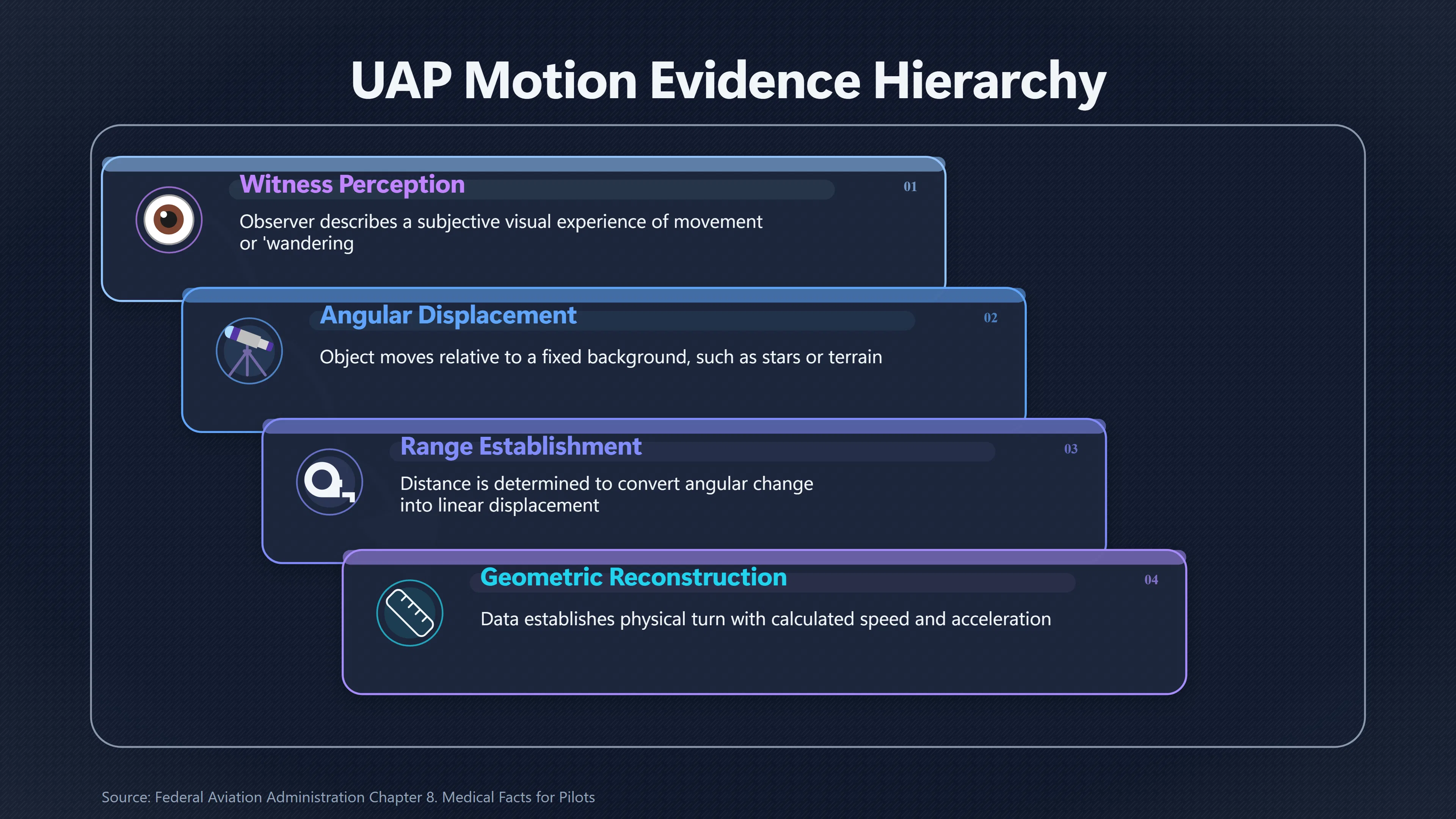
The central evidential problem is the absence of a stable coordinate system.
In ordinary viewing, a moving object changes position relative to other visible features. An aircraft can be watched crossing stars, cloud edges, buildings or a horizon; video frames can preserve those relationships. An isolated light in a dark field removes precisely the contextual information needed to make that comparison. SKYbrary’s aviation guidance describes autokinesis as arising when a stationary point is seen in a dark or featureless environment where there is no useful reference against which its movement can be defined.[Skybrary]skybrary.aeroAutokinetic Effect | SKYbrary Aviation SafetyAutokinetic Effect | SKYbrary Aviation Safety…
This distinction becomes particularly important when a UFO report escalates from direction to speed or acceleration. Suppose an observer says that a light suddenly moved several “object widths” sideways and then snapped back. If the source is unresolved, its apparent width may be glare rather than its physical dimensions. If its range is unknown, an angular displacement cannot straightforwardly establish a linear distance travelled. Consequently, a dramatic-looking angular change does not automatically provide a physical speed, acceleration or turning radius.
NASA’s UAP Independent Study Team explicitly highlighted this problem. It concluded that clearly determining distance is essential when attempting to corroborate claims of anomalously high velocity or acceleration. The report also called for calibrated instruments and accompanying metadata rather than relying on poorly constrained observations.[NASA]nasa.govuap independent study team final report 0UNIDENTIFIED ANOMALOUS PHENOMENA…
The All-domain Anomaly Resolution Office (AARO) likewise distinguishes apparent motion from physical motion in UAP analysis. Its public guidance notes that motion parallax can make stationary or slowly moving objects appear to move rapidly and asks for such supporting information as image metadata, locations and timestamps. Parallax is a different mechanism from autokinesis, but the methodological lesson is the same: motion in the visual field is not automatically motion of the target through three-dimensional space.[AARO]aaro.milAARO FAQ…
For an autokinesis candidate, investigators should therefore separate three increasingly strong propositions:
- “The witness saw the light change direction.” This is a report of perception.
- “The light changed angular position relative to a fixed background.” This requires an external visual or instrumental reference.
- “The object executed a physical turn with a particular speed and acceleration.” This additionally requires enough information about geometry, timing and normally range to reconstruct the motion.
Confusing the first proposition with the third is how an apparent manoeuvre can acquire physical characteristics that were never actually measured.
A stationary light can even seem to approach
The ambiguity is not confined to sideways wandering. FAA safety material warns that a bright stationary light against a black background — potentially a star, planet or another light source — may appear to move towards an aircraft. The agency explains the problem in terms of motion perception lacking fixed reference points and advises pilots not to fixate continuously on a single light.[FAASafety]faasafety.govYour Senses In The ShadowsYour Senses in the Shadows. Nighttime Visual Illusions and Spatial… | by FAA Safety Briefing Magazine | Jan, 2025 | MediumJanuar…
That is especially relevant to UFO narratives involving an apparent reaction to the observer: a light that seems initially stationary may subsequently appear to approach, retreat or alter course. Such an experience can feel more significant than simple wandering because it suggests purposeful behaviour.
Yet apparent approach is not, by itself, evidence of closing range. To demonstrate approach physically, an investigation needs an independent cue: increasing angular size from a resolved object, stereoscopic or multi-station geometry, reliable ranging, radar, or another calibrated measurement capable of establishing changing distance. For an unresolved point of light against an empty sky, the observer lacks much of that information.
Aviation’s response is instructive. The FAA does not advise pilots to estimate the mysterious light’s trajectory more carefully while continuing to stare at it. It warns that the static light itself can appear to move and emphasises visual scanning instead. Other FAA training material says the illusion can be reduced by scanning, increasing the number of visible lights or otherwise restoring visual references.[Federal Aviation Administration]faa.govFederal Aviation Administration Chapter 8. Medical Facts for PilotsFederal Aviation Administration Chapter 8. Medical Facts for Pilots
The practical lesson for UAP assessment is similar: restore reference information before interpreting the apparent manoeuvre.
Slow real motion can be distorted too
Autokinesis does not create a simple choice between “completely stationary” and “really moving”. The more difficult case is a light that actually moves slowly while being viewed under conditions favourable to the illusion.
The 2024 experiment directly tested this situation. Participants viewed dots that really moved at different speeds. In normal illumination their reported directions tracked the physical direction accurately. In darkness, however, accuracy became very poor at the lowest tested speeds, and reported movement was more strongly aligned with the observer’s autokinetic tendency. As physical speed increased, judgements in darkness became better aligned with the target’s real direction.[PubMed Central (PMC)]pmc.ncbi.nlm.nih.govPubMed Central (PMC)Autokinesis reveals a threshold for perception of visual motion - PMCApril 5, 2024…
This result has an important consequence for UFO reports. Autokinesis need not manufacture an entire sighting from a perfectly fixed star or ground light. It can potentially contaminate the perceived path of a genuinely slow-moving light.
An observer might therefore be broadly correct that something is travelling across the sky while being less reliable about small zigzags, temporary reversals or deviations superimposed on that movement. The relevant investigative question is not simply “did it move?” but “which components of the reported motion are independently recoverable?”
This is one reason that a reported straight transit and a reported series of small manoeuvres should not automatically receive the same evidential weight. A stable movement across a recognisable star field recorded by a fixed camera has an external reference. Small excursions seen only by an observer fixating on the light may not.
Why eye movement alone is too simple an explanation
It is tempting to explain false manoeuvres by saying that the witness’s eyes moved and therefore the light appeared to move in the opposite direction. Research indicates that the situation is more complicated.
Human eyes do make small movements during fixation, but apparent autokinetic displacement can greatly exceed those involuntary movements. A historical review of visual motion illusions concluded that autokinetic apparent motion is much larger than the corresponding involuntary eye movement, although some relationship may exist.[PubMed]pubmed.ncbi.nlm.nih.govPub Med Visual motion illusions, eye movements, and the search for objectivityPub Med Visual motion illusions, eye movements, and the search for objectivity
Earlier experimental work also found that fixation did not simply reproduce the perceived trajectory: during autokinesis, measured fixation lagged behind the apparent movement.[ScienceDirect]sciencedirect.comOpen source on sciencedirect.com.
That distinction matters when assessing testimony. An investigator does not need to demonstrate an eye twitch matching every reported turn. Autokinesis is a perceptual stability problem occurring when the visual system lacks the external structure normally used to determine what is stationary. The resulting perceived trajectory is not expected to be a literal recording of eyeball motion.
This is also why autokinesis should not be invoked indiscriminately. A clear object crossing a structured landscape, repeatedly passing in front of identifiable stars, or producing independently recorded positional changes presents a different evidential situation from a solitary unresolved light against darkness.
What strengthens or weakens a manoeuvre claim
A useful assessment asks whether the alleged turn exists outside the witness’s unaided perception. No single clue is decisive, but several can substantially change the strength of the motion evidence.
Factors that make autokinesis more plausible include:
- a small or unresolved light against a largely featureless dark sky;
- prolonged fixation on that light;
- no visible horizon, terrain, cloud structure or neighbouring reference points;
- apparent wandering or small irregular changes that are not preserved against an external background;
- motion that changes or disappears when the observer looks away, scans the scene or introduces stable references.
These conditions closely match those described in aviation guidance for producing or mitigating autokinesis.[Skybrary]skybrary.aeroAutokinetic Effect | SKYbrary Aviation SafetyAutokinetic Effect | SKYbrary Aviation Safety…
Factors that strengthen a claim of genuine physical manoeuvring include:
- a trajectory visibly changing relative to fixed stars, terrain or another stable reference;
- fixed-camera footage preserving that reference frame;
- independent observations from separated locations that permit geometric comparison;
- radar, ranging or other calibrated sensor data consistent with the visual motion;
- sufficient timing and positional information to reconstruct the path;
- agreement between multiple independent measurement systems rather than merely multiple people sharing the same visually impoverished viewpoint.
The last distinction is particularly important. Several witnesses agreeing that a light appeared to turn can strengthen confidence that something striking was perceived, but it is not equivalent to several independent instruments measuring the same trajectory. AARO emphasises metadata and recorded sensor information as particularly useful for analysing UAP reports, while NASA has stressed calibrated observations and distance determination for evaluating extraordinary velocity or acceleration claims.[AARO]aaro.milAARO FAQ…

What a “sharp turn” actually proves
Descriptions such as “instant acceleration”, “90-degree turn” or “impossible manoeuvre” sound quantitative, but eyewitness wording can exceed the quantitative information contained in the observation.
For a genuinely measured 90-degree turn, two physical or angular trajectory segments must be established well enough to calculate the angle between them. For acceleration, velocity must change over a measured interval. For linear velocity, angular displacement normally has to be combined with reliable distance or geometry. An isolated point of light viewed without those constraints does not automatically provide any of them.
The correct conclusion is not that every spectacular night-time manoeuvre report is autokinesis. Some observations contain reference objects, imagery, multiple sensors or other evidence that must be analysed on its own merits. Autokinesis has a narrower but important role: it shows that the subjective appearance of directional manoeuvring is possible even when the external stimulus does not perform that manoeuvre at all.[PubMed Central (PMC)]pmc.ncbi.nlm.nih.govPubMed Central (PMC)Autokinesis reveals a threshold for perception of visual motion - PMCApril 5, 2024…
That changes the evidential threshold. A report that a light “zigzagged” or “turned towards us” is valuable testimony about what was seen, but the manoeuvre becomes a physical claim only when something outside the perceptual experience establishes the corresponding displacement.
The key distinction for UFO investigation
Autokinesis is most useful in UFO analysis not as a universal explanation but as a warning about what cannot safely be inferred from an isolated night light.
The perceptual event can be real and vivid. Experimental subjects report directional movement from stationary targets; motion-sensitive visual areas respond as the illusion develops; pilots are explicitly trained that stationary lights can appear to move.[nih.gov]pmc.ncbi.nlm.nih.govPubMed Central (PMC)Autokinesis reveals a threshold for perception of visual motion - PMCApril 5, 2024… None of this implies that witnesses who report turns or approaches are fabricating their experiences.
But it does mean that the wording of an eyewitness account cannot substitute for trajectory data. When the only evidence for a dramatic manoeuvre is the apparent wandering of an unresolved light in darkness, the safest description is perceived motion of uncertain physical origin. When the change of course persists against stable references or is independently recorded and geometrically constrained, the evidential situation becomes substantially stronger.
That boundary — between “I saw it turn” and “we measured it turning” — is the central reason autokinesis matters when evaluating apparently manoeuvring UFOs and UAPs.
Amazon book picks
Further Reading
Books and field guides related to Can Autokinesis Mimic a UFO Manoeuvre?. Use these as the next step if you want deeper reading beyond the article.
Sensation and Perception
. Bruce Goldstein's SENSATION AND PERCEPTION, the best-seller which has helped over 150,000 students understand the ties between how we s...
Visual Perception: Physiology, Psychology, and Ecology
This edition contains over 460 additional references and the treatment of visual psychology in the early chapters has been extensively re...
Vision Science: Photons to Phenomenology
This textbook on vision reflects the integrated computational approach of modern research scientists, combining psychological, computatio...
Seeing Motion: A History of Visual Perception in Art and Science
The central focus of this publication is the synthesis of science and art in the field of visual perception, in particular how early 19th...
eBay marketplace picks
Marketplace Samples
Live-tested eBay searches with available results related to this page.
Selected fromUFO poster oneBay.co.uk.


Current eBay listing
VINTAGE UFO FLYING SAUCERS COMIC ADVERTISING A2 POSTER PRINT

Current eBay listing
I Want To Believe UFO Poster Giclée Fine Art Heavyweight Print

Endnotes
1.
Source: faa.gov
Title: Federal Aviation Administration Chapter 8. Medical Facts for Pilots
Link:https://www.faa.gov/Air_traffic/publications/atpubs/aim_html/chap8_section_1.html
2.
Source: nasa.gov
Title: uap independent study team final report 0
Link:https://www.nasa.gov/wp-content/uploads/2023/09/uap-independent-study-team-final-report-0.pdf?emrc=68f088cf18427
Source snippet
UNIDENTIFIED ANOMALOUS PHENOMENA...
3.
Source: sciencedirect.com
Title: ScienceDirect Autokinesis Reveals a Threshold for Perception of Visual Motion
Link:https://www.sciencedirect.com/science/article/pii/S0306452224000514
Source snippet
Autokinesis Reveals a Threshold for Perception of Visual Motion - ScienceDirect...
4.
Source: skybrary.aero
Title: Autokinetic Effect | SKYbrary Aviation Safety
Link:https://skybrary.aero/index.php/articles/autokinetic-effect
Source snippet
Autokinetic Effect | SKYbrary Aviation Safety...
5.
Source: aaro.mil
Link:https://www.aaro.mil/FAQ/
Source snippet
AARO FAQ...
6.
Source: faasafety.gov
Title: Your Senses In The Shadows
Link:https://www.faasafety.gov/files/events/SO/SO15/2024/SO15134204/YourSensesInTheShadows.pdf
Source snippet
Your Senses in the Shadows. Nighttime Visual Illusions and Spatial… | by FAA Safety Briefing Magazine | Jan, 2025 | MediumJanuar...
7.
Source: faa.gov
Link:https://www.faa.gov/sites/faa.gov/files/regulations_policies/handbooks_manuals/aviation/FAA-H-8083-4.pdf
Source snippet
Federal Aviation AdministrationFAA-H-8083-4Helicopter Instructor's...
8.
Source: sciencedirect.com
Link:https://www.sciencedirect.com/science/article/pii/0042698969900339
9.
Source: faa.gov
Title: LE D Approach Lighting System Installations | Federal Aviation Administration
Link:https://www.faa.gov/about/office_org/headquarters_offices/avs/offices/afx/afs/afs400/afs410/efvs/LED_Approach_Lighting_System_Installations
10.
Source: aaro.mil
Link:https://www.aaro.mil/Next-AARO-Home-redesign/Next-Parent/Next-UAP-Report-Documents/poster/dividLink/
11.
Source: aaro.mil
Link:https://www.aaro.mil/Next-AARO-Home-redesign/Next-Parent/Next-AARO-UAP-Imagery-Acc-Table/
12.
Source: science.nasa.gov
Link:https://science.nasa.gov/uap/faqs/
13.
Source: science.nasa.gov
Link:https://science.nasa.gov/uap/
14.
Source: aaro.mil
Link:https://www.aaro.mil/Next-AARO-Home-redesign/Next-Parent/Presidential-UAP-Transparency-Initiative/dvpmoduleid/77396/
15.
Source: aaro.mil
Link:https://www.aaro.mil/Next-AARO-Home-redesign/Next-Parent/Presidential-UAP-Transparency-Initiative/
16.
Source: jpl.nasa.gov
Title: modeling additive velocity with spreadsheets
Link:https://www.jpl.nasa.gov/edu/resources/lesson-plan/modeling-additive-velocity-with-spreadsheets/
17.
Source: faa.gov
Title: FA A [Launches]({{ ‘launches/’ | relative_url }}) Improved Runway Safety Tool | Federal Aviation Administration
Link:https://www.faa.gov/blog/clearedfortakeoff/faa-launches-improved-runway-safety-tool
18.
Source: sciencedirect.com
Link:https://www.sciencedirect.com/science/article/pii/S0167945724000794
19.
Source: sciencedirect.com
Link:https://www.sciencedirect.com/science/article/pii/S0028393224000988
20.
Source: nasa.gov
Title: UPDAT E: NASA Shares UAP Independent Study Report; Names Director
Link:https://www.nasa.gov/news-release/update-nasa-shares-uap-independent-study-report-names-director/
21.
Source: faa.gov
Title: Mc Donnell Douglas DC-10 | Federal Aviation Administration
Link:https://www.faa.gov/lessons_learned/transport_airplane/accidents/TC-JAV
22.
Source: ntrs.nasa.gov
Link:https://ntrs.nasa.gov/archive/nasa/casi.ntrs.nasa.gov/20170011048.pdf
23.
Source: ntrs.nasa.gov
Link:https://ntrs.nasa.gov/citations/20170004692
24.
Source: faa.gov
Title: Chapter 8. Medical Facts for Pilots
Link:https://www.faa.gov/air_traffic/publications/atpubs/aim/aim0801.html
25.
Source: faa.gov
Link:https://www.faa.gov/air_traffic/publications/ATpubs/ATC/atc0302.html
26.
Source: pds.nasa.gov
Title: view Profile.jsp
Link:https://pds.nasa.gov/ds-view/pds/viewProfile.jsp?dsid=PHX-M-ASE-5-EDL-RDR-V1.0
27.
Source: sciencedirect.com
Title: Imaging the visual autokinetic illusion with f MRI
Link:https://www.sciencedirect.com/science/article/pii/S1053811905002168
28.
Source: ntrs.nasa.gov
Link:https://ntrs.nasa.gov/citations/20030112412
29.
Source: ntrs.nasa.gov
Link:https://ntrs.nasa.gov/citations/19980000737
30.
Source: ntrs.nasa.gov
Link:https://ntrs.nasa.gov/citations/20040173123
31.
Source: ntrs.nasa.gov
Link:https://ntrs.nasa.gov/citations/19920013262
32.
Source: skybrary.aero
Link:https://skybrary.aero/bookshelf/aac-no-91-61-hazard-aerobatics-effect-g-forces-pilots
33.
Source: ntrs.nasa.gov
Link:https://ntrs.nasa.gov/citations/19790011017
34.
Source: ntrs.nasa.gov
Link:https://ntrs.nasa.gov/citations/19760015130
35.
Source: ntrs.nasa.gov
Link:https://ntrs.nasa.gov/citations/19750008518
36.
Source: ntrs.nasa.gov
Link:https://ntrs.nasa.gov/citations/19740014365
37.
Source: faa.gov
Link:https://www.faa.gov/air_traffic/publications/atpubs/aim_html/chap7_section_6.html
38.
Source: faa.gov
Link:https://www.faa.gov/data_research/research/med_humanfacs/oamtechreports/1960s/1969/196923
39.
Source: faa.gov
Link:https://www.faa.gov/air_traffic/publications/atpubs/aip_html/part2_enr_section_1.1.html
40.
Source: faa.gov
Title: Chapter 3. Airport Traffic Control
Link:https://www.faa.gov/air_traffic/publications/atpubs/atc_html/chap3_section_2.html
41.
Source: faa.gov
Link:https://www.faa.gov/data_research/research/med_humanfacs/oamtechreports/1970s/1970/7002
42.
Source: faa.gov
Link:https://www.faa.gov/data_research/research/med_humanfacs/oamtechreports/1960s/1967/196712
43.
Source: faa.gov
Link:https://www.faa.gov/air_traffic/publications/atpubs/so_html/chap4_section_1.html
44.
Source: sciencedirect.com
Link:https://www.sciencedirect.com/science/article/abs/pii/S0149763415301317
45.
Source: sciencedirect.com
Title: Proprioceptive information about target location suppresses autokinesis
Link:https://www.sciencedirect.com/science/article/pii/0042698977901584
46.
Source: sciencedirect.com
Title: Proprioceptive information about target location suppresses autokinesis
Link:https://www.sciencedirect.com/science/article/abs/pii/0042698977901584
47.
Source: sciencedirect.com
Title: Is there a constancy for velocity?
Link:https://www.sciencedirect.com/science/article/pii/0042698989900424
48.
Source: skybrary.aero
Link:https://skybrary.aero/index.php/articles/visual-illusions
49.
Source: skybrary.aero
Link:https://skybrary.aero/index.php/articles/general-aviation-night-flying-guidance
50.
Source: skybrary.aero
Link:https://skybrary.aero/index.php/articles/somatogravic-and-somatogyral-illusions
51.
Source: skybrary.aero
Link:https://skybrary.aero/articles/evoked-potential
52.
Source: skybrary.aero
Link:https://skybrary.aero/index.php/articles/automaticity
53.
Source: skybrary.aero
Link:https://skybrary.aero/index.php/articles/bank-angle-awareness
54.
Source: skybrary.aero
Link:https://skybrary.aero/index.php/articles/vestibular-system-and-illusions-oghfa-bn
55.
Source: skybrary.aero
Link:https://skybrary.aero/index.php/articles/spatial-disorientation
56.
Source: skybrary.aero
Link:https://skybrary.aero/index.php/Startle_Effect
57.
Source: skybrary.aero
Link:https://skybrary.aero/articles/acceleration-effects
58.
Source: aaro.mil
Link:https://www.aaro.mil/Next-AARO-Home-redesign/Next-Parent/Next-AARO-UAP-Imagery-Fixed-Table/
59.
Source: aaro.mil
Link:https://www.aaro.mil/Next-AARO-Home-redesign/Inactive-Parent/FAQ-Datatable/
60.
Source: aaro.mil
Title: AAR O UAP Trends All-domain Anomaly Resolution Office UAP REPORTING TRENDS
Link:https://www.aaro.mil/UAP-Cases/UAP-Reporting-Trends/
61.
Source: aaro.mil
Link:https://www.aaro.mil/Next-AARO-Home-redesign/Next-Parent/Next-AARO-UAP-Trends/
62.
Source: aaro.mil
Link:https://www.aaro.mil/Next-AARO-Home-redesign/Bruce-working/Next-AARO-UAP-Trends-Charts/
63.
Source: aaro.mil
Link:https://www.aaro.mil/About/Mission-Vision/
64.
Source: aaro.mil
Link:https://www.aaro.mil/UAP-Cases/Official-UAP-Imagery/4/
65.
Source: aaro.mil
Title: AAR O UAP Trends All-domain Anomaly Resolution Office UAP REPORTING TRENDS
Link:https://www.aaro.mil/UAP-Cases/UAP-Reporting-Trends/quot/
66.
Source: aaro.mil
Link:https://www.aaro.mil/EFOIA-Reading-Room/
67.
Source: aaro.mil
Link:https://www.aaro.mil/Next-AARO-Home-redesign/Inactive-Parent/AARO-Records-Tabs/
68.
Source: faasafety.gov
Link:https://www.faasafety.gov/gslac/ALC/libview_chapter.aspx?chapter=Illusions+-+Have+I+Considered+Them%3F&id=6580
69.
Source: www1.grc.nasa.gov
Title: motion of free falling object
Link:https://www1.grc.nasa.gov/beginners-guide-to-aeronautics/motion-of-free-falling-object/
70.
Source: grc.nasa.gov
Link:https://www.grc.nasa.gov/WWW/k-12/VirtualAero/BottleRocket/airplane/mofall508.html
71.
Source: ntrs.nasa.gov
Link:https://ntrs.nasa.gov/search?linkId=167810033&q=Pioneer
72.
Source: ufos.wiki
Title: Autokinetic effect
Link:https://ufos.wiki/investigation/autokinetic-effect/
73.
Source: ntrs.nasa.gov
Link:https://ntrs.nasa.gov/search.jsp?R=19680007625
74.
Source: pmc.ncbi.nlm.nih.gov
Link:https://pmc.ncbi.nlm.nih.gov/articles/PMC10965040/
Source snippet
PubMed Central (PMC)Autokinesis reveals a threshold for perception of visual motion - PMCApril 5, 2024...
Published: April 5, 2024
75.
Source: pubmed.ncbi.nlm.nih.gov
Title: Pub Med Imaging the visual autokinetic illusion with f MRI
Link:https://pubmed.ncbi.nlm.nih.gov/15878673/
Source snippet
Imaging the visual autokinetic illusion with fMRI - PubMedAugust 1, 2005...
Published: August 1, 2005
76.
Source: pubmed.ncbi.nlm.nih.gov
Title: Pub Med Visual motion illusions, eye movements, and the search for objectivity
Link:https://pubmed.ncbi.nlm.nih.gov/15069868/
77.
Source: encyclopedia.arabpsychology.com
Link:https://encyclopedia.arabpsychology.com/autokinesis/
78.
Source: pubmed.ncbi.nlm.nih.gov
Link:https://pubmed.ncbi.nlm.nih.gov/39292248/
79.
Source: pubmed.ncbi.nlm.nih.gov
Link:https://pubmed.ncbi.nlm.nih.gov/38432549/
80.
Source: pmc.ncbi.nlm.nih.gov
Link:https://pmc.ncbi.nlm.nih.gov/articles/PMC5777566/
81.
Source: pmc.ncbi.nlm.nih.gov
Link:https://pmc.ncbi.nlm.nih.gov/articles/PMC5332863/
82.
Source: pubmed.ncbi.nlm.nih.gov
Link:https://pubmed.ncbi.nlm.nih.gov/1236562/
83.
Source: pubmed.ncbi.nlm.nih.gov
Link:https://pubmed.ncbi.nlm.nih.gov/5325293/
84.
Source: pubmed.ncbi.nlm.nih.gov
Link:https://pubmed.ncbi.nlm.nih.gov/4566651/
85.
Source: pubmed.ncbi.nlm.nih.gov
Link:https://pubmed.ncbi.nlm.nih.gov/5906738/
86.
Source: pubmed.ncbi.nlm.nih.gov
Link:https://pubmed.ncbi.nlm.nih.gov/660168/
87.
Source: pubmed.ncbi.nlm.nih.gov
Link:https://pubmed.ncbi.nlm.nih.gov/1852560/
88.
Source: pubmed.ncbi.nlm.nih.gov
Link:https://pubmed.ncbi.nlm.nih.gov/14075726/
Additional References
89.
Source: youtube.com
Title: Quantum physicists analyze pentagon US navy UFO video footage
Link:https://www.youtube.com/watch?v=cwACSrLEPeM
Source snippet
This selection of videos explains how apparent maneuvers and rapid flight paths in UAP reports often stem from optical illusions, visual...
90.
Source: youtube.com
Title: Raytheon ATFLIR expert discusses Navy gimbal UFO/UAP video with Mick West
Link:https://www.youtube.com/watch?v=FGHeu5GeR-0
Source snippet
Quantum physicists analyze pentagon US navy UFO video footage...
91.
Source: nature.com
Link:https://www.nature.com/articles/nrn1348
92.
Source: youtube.com
Title: The SHOCKING Math Error Behind Viral UFO Videos | Mick West
Link:https://www.youtube.com/watch?v=ypfbhfEXnBo
Source snippet
CHRIS LEHTO DEBUNKS MICK WEST'S UFO DEBUNKINGS | Gimbal, Flir, & GoFast...
93.
Source: youtube.com
Title: CHRIS LEHTO DEBUNKS MICK WEST’S UFO DEBUNKINGS | Gimbal, Flir, & [Go Fast]({{ ‘go-fast/’ | relative_url }})
Link:https://www.youtube.com/watch?v=PC81Gqz3K9U
Source snippet
UFO Videos Explained: Mick West's Expert Analysis...
94.
Source: defense.gov
Link:https://www.defense.gov/News/News-Stories/Article/Article/3701297/dod-report-discounts-sightings-of-extraterrestrial-technology/
95.
Source: defense.gov
Link:https://www.defense.gov/News/News-Stories/Article/article/3368109/dod-working-to-better-understand-resolve-anomalous-phenomena/
96.
Source: youtube.com
Title: UFO Videos Explained: Mick West’s Expert Analysis
Link:https://www.youtube.com/watch?v=-_4QF__92q0
Source snippet
Raytheon ATFLIR expert discusses Navy gimbal UFO/UAP video with Mick West...
97.
Source: nature.com
Title: Direction of [self-motion]({{ ‘self-motion/’ | relative_url }}) is perceived from optical flow | Nature
Link:https://www.nature.com/articles/336162a0
98.
Source: uap-archive.org
Link:https://uap-archive.org/uap/learn/aaro-case-resolution-reports-overview/