Within Haze
Why a Head On Aircraft Can Look Stationary
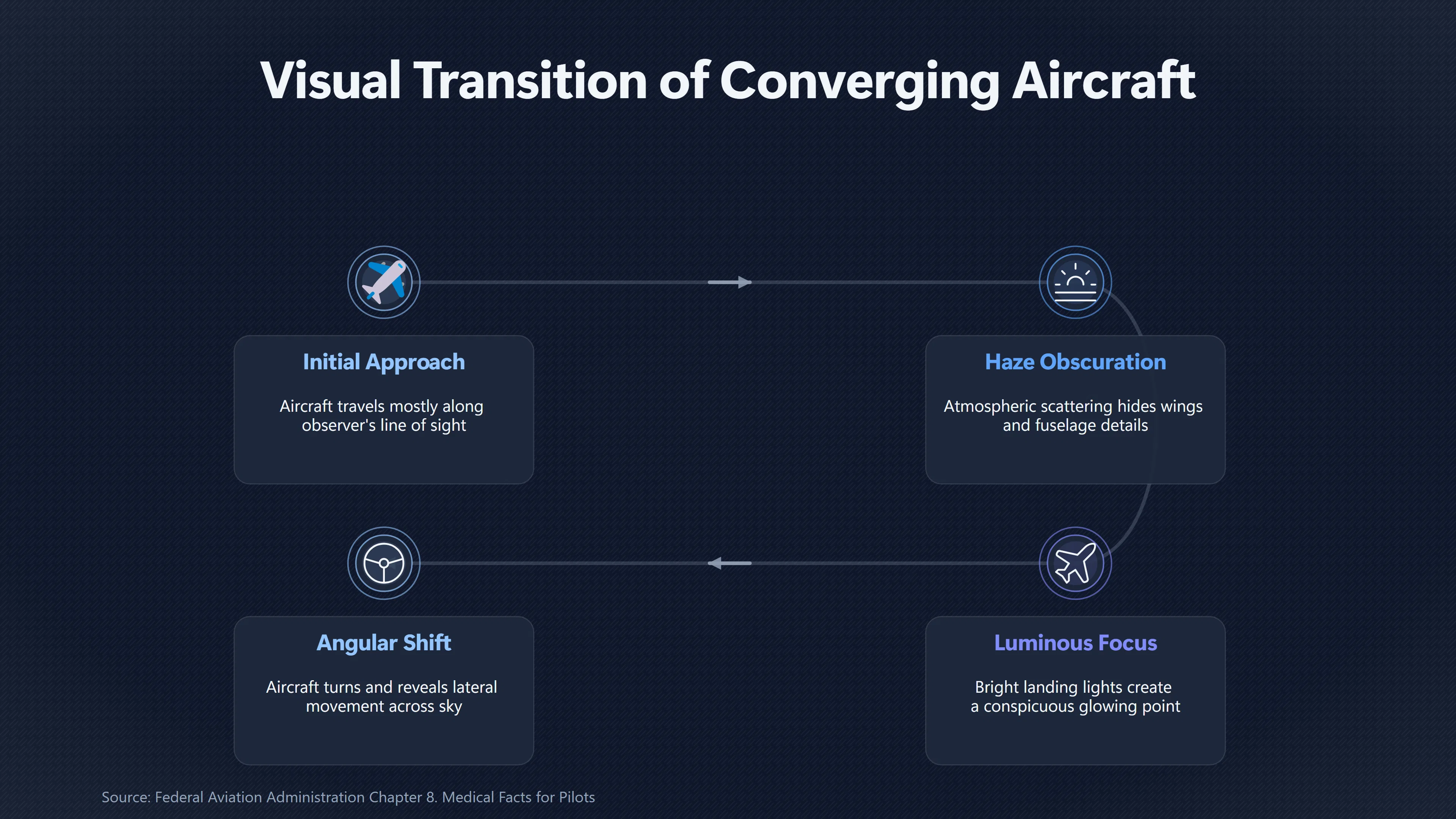
An aircraft flying almost directly toward an observer may stay near one bearing, making a bright light seem stationary until its course changes.
On this page
- Why head on motion produces little sideways movement
- How haze hides the airframe around the light
- What changes when the aircraft turns
Page outline Jump by section
Introduction
A conventional aircraft flying almost directly towards an observer can appear to hover in one part of the sky, even while closing the distance at normal flying speed. The key is geometry: most of the aircraft’s movement is towards the observer rather than across their field of view, so its bearing changes very little. Aviation safety guidance treats this lack of apparent sideways or vertical motion as an important warning sign for converging aircraft.[Federal Aviation Administration]faa.govFederal Aviation Administration Chapter 8. Medical Facts for PilotsFederal Aviation Administration Chapter 8. Medical Facts for Pilots
Haze can make the effect much more convincing. Atmospheric scattering reduces visibility and contrast, while a powerful forward-facing landing light can remain conspicuous. The observer may therefore see a bright point or diffuse glow without enough airframe detail to recognise an aeroplane.[wmo.int]cloudatlas.wmo.intInternational Cloud Atlas Haze Aloft | International Cloud AtlasInternational Cloud Atlas Haze Aloft | International Cloud Atlas
For UFO or UAP assessment, the important point is that apparent hovering alone is weak evidence that an object is physically stationary. A light that seems fixed for several minutes and then suddenly reveals ordinary aircraft motion can be exactly what head-on approach geometry predicts.
Why head-on motion produces little sideways movement
Human observers normally recognise movement across the sky from angular motion: an object shifts relative to a building, star, cloud or another point in the visual field. But an aircraft approaching nearly along the observer’s line of sight has relatively little angular movement. Its distance may be changing substantially while its direction from the observer changes only slightly.
A simple terrestrial analogy is a vehicle approaching along a long, straight road. Seen from well off to the side, it obviously travels across the scene. Seen from a position close to the road’s extended centreline, however, it stays near the same direction and mainly becomes larger as it approaches.
Aviation uses essentially the same geometry when discussing collision hazards. The US Federal Aviation Administration (FAA) warns pilots that an aircraft showing no relative movement and remaining in one part of their visual scan may be on a collision course. If it has no lateral or vertical apparent motion but increases in size, evasive action is advised.[Federal Aviation Administration]faa.govFederal Aviation Administration Chapter 8. Medical Facts for PilotsFederal Aviation Administration Chapter 8. Medical Facts for Pilots An Australian Transport Safety Bureau safety publication likewise explains that two aircraft on converging trajectories can maintain a constant relative bearing, leaving the other aircraft apparently fixed at the same point on the windscreen despite the rapidly decreasing separation.[ATSB]atsb.gov.auEditorial 3 Editorial 4 Weather-rela…
A European aviation-safety treatment of mid-air collisions describes the same phenomenon as convergence at a constant bearing. With converging trajectories, the other aircraft can look motionless to the pilot; that visual immobility is itself a detection problem because movement is an important cue for attracting human attention.[Skybrary]skybrary.aeroMid-Air CollisionsMid-Air CollisionsNovember 1, 2025…
The situation seen from the ground need not be a literal collision course. An aircraft merely has to be travelling roughly towards the observer for its sideways angular movement to become small. A jet descending along an extended runway centreline, for example, can remain within a surprisingly small patch of sky from the viewpoint of somebody living near that approach path.
This distinction is crucial:
Nearly stationary bearing does not mean nearly stationary aircraft.
It means that much of the object’s velocity is directed along the observer’s line of sight rather than across it.
How haze hides the aircraft around the light
Head-on geometry becomes particularly deceptive when combined with reduced visibility. Haze consists of very small atmospheric particles that scatter light; the World Meteorological Organization notes that increasing concentrations produce increasing scattering and a gradual reduction in visibility for an observer within a haze layer.[International Cloud Atlas]cloudatlas.wmo.intInternational Cloud Atlas Haze Aloft | International Cloud AtlasInternational Cloud Atlas Haze Aloft | International Cloud Atlas
The FAA similarly identifies smoke, haze, dust and rain as conditions that can greatly reduce the ability to detect aircraft. At the same time, it notes that exterior aircraft lighting can substantially increase an aircraft’s conspicuity.[Federal Aviation Administration]faa.govFederal Aviation Administration Chapter 8. Medical Facts for PilotsFederal Aviation Administration Chapter 8. Medical Facts for Pilots These two effects can operate together: the aircraft becomes harder to recognise as a physical structure while its lights remain noticeable.
That matters especially for an approaching aircraft because landing lights are designed to be conspicuous. FAA guidance encourages pilots to use them below 10,000 feet, particularly within 10 miles of an airport and in reduced visibility. Its Airplane Flying Handbook states that landing lights provide a means for aircraft to be seen by others at night as well as serving their obvious take-off and landing functions.[Federal Aviation Administration]faa.govFederal Aviation Administration Chapter 4. Air Traffic ControlFederal Aviation Administration Chapter 4. Air Traffic Control
Consequently, an observer can receive an unusually stripped-down visual impression:
- the aircraft is moving mostly towards them, so there is little sideways motion;
- haze reduces the contrast needed to distinguish wings and fuselage;
- the forward-facing light remains conspicuous;
- scattering can spread a bright source into a glow rather than a sharply defined point;
- distance makes changes in the aircraft’s apparent size initially difficult to judge.
Night-time haze adds another complication. Research on imaging through haze identifies glow around bright light sources as a specific problem in night scenes, produced by atmospheric scattering and capable of obscuring surrounding edges and textures.[arXiv]arxiv.orgOpen source on arxiv.org. An aircraft’s landing light can therefore look larger and less neatly bounded than the lamp itself.
Real aviation investigations demonstrate how strongly reduced visibility and bright lights can alter visual interpretation. In its investigation of a Gulfstream III incident at Biggin Hill, the UK’s Air Accidents Investigation Branch discussed how fog attenuates distant lights and how halos from stronger lights can make weaker visual cues still harder to detect. In that case the issue involved runway and taxiway lights rather than an aircraft mistaken for a UFO, but the underlying perceptual lesson is relevant: reduced visibility does not simply dim everything uniformly; it can radically change which visual cues dominate the scene.[GOV.UK]GOV.UKaaib investigation to gulfstream iii g 1159a n103cdAAIB investigation to Gulfstream III (G-1159A), N103CD - GOV.UKDecember 10, 2015…
That combination explains why witnesses can sincerely describe something much stranger than “an aeroplane”. At sufficient distance they may genuinely have no visible wings, fuselage or recognisable aircraft motion — only an intense, apparently stationary light.
Why the illusion can persist for minutes
A common objection is that an aeroplane should obviously move if watched for more than a few seconds. That would be true for an aircraft crossing the observer’s line of sight, but not necessarily for one travelling substantially along it.
Suppose an aircraft is several miles away on a long, fairly straight approach. During the next minute it may travel several miles closer while remaining close to the same bearing. Its angular size is increasing throughout that period, but a distant aircraft begins as such a small visual target that this “looming” cue can be far less obvious than sideways displacement would have been.
Haze weakens the cue further because the observer may not actually be seeing the dimensions of the aircraft. If all that remains conspicuous is an unresolved landing light and its surrounding glow, there may be no clearly visible wingspan or fuselage against which to notice gradual enlargement. The most informative geometric cue — increasing apparent size — has effectively been replaced by an indistinct patch of light.
The result can be counter-intuitive: an aircraft travelling at hundreds of kilometres per hour may produce less obvious motion across the sky than a much more distant aircraft travelling across the observer’s line of sight.
This is why duration by itself is not a reliable discriminator. “It stayed in approximately the same place for several minutes” does not establish hovering unless there is enough information to show that its bearing and distance actually remained constant.
What changes when the aircraft turns
The most revealing moment often comes when the aircraft stops flying approximately towards the observer.
A turn converts some of its motion from radial motion — towards or away from the observer — into transverse motion across the observer’s field of view. The previously tiny change in bearing can therefore become much easier to see. Something that appeared to hover may suddenly begin travelling sideways.
The lighting can change at roughly the same time. Aircraft carry directionally useful position lights, and FAA material describes the conventional red and green lighting arrangement used to help observers determine orientation.[Federal Aviation Administration]faa.gov12 afh ch11Federal Aviation AdministrationAirplane Flying Handbook (FAA-H-8083-3C)… A powerful landing light viewed close to its forward direction can dominate the visual impression at long range; after the aircraft turns, the viewing geometry changes and other lights or the aircraft’s structure may become easier to distinguish.
That sequence can produce a striking transformation:
bright stationary-looking light → slight drift → turn → recognisable moving aircraft.
The transition may be misremembered as the object suddenly beginning to move, when the more precise interpretation is that its angular motion suddenly became perceptible.
The same principle applies if the aircraft passes sufficiently far to one side rather than making a deliberate turn. As the line-of-sight geometry changes, its angular speed across the observer’s view increases. Haze may also become less effective at concealing the airframe as the range decreases. What initially appeared to be a solitary light can therefore acquire navigation lights, strobes, a silhouette and finally the unmistakable appearance of an aircraft.
Why apparent hovering is easy to overinterpret
The perceptual problem is not that observers fail to understand that aeroplanes move. It is that unaided vision provides poor information about distance and radial speed when a distant target lacks a recognisable shape.
A featureless light offers no obvious wingspan, fuselage length or other known dimension from which to estimate range. Without reliable distance, the observer also cannot readily infer physical speed. A light apparently shifting by only a small angle might be a nearby slow object or a distant fast aircraft travelling mainly towards the observer.
Haze makes those judgements still less secure. FAA weather guidance explicitly treats haze as an obscuration associated with reduced visibility, while aviation safety material recognises that haze degrades target detection.[Federal Aviation Administration]faa.govFederal Aviation Administration Chapter 7. Safety of FlightFederal Aviation Administration Chapter 7. Safety of Flight
There is therefore a risk in reasoning backwards from appearance:
It looked stationary, therefore it could not have been an aircraft.
The first part may be an accurate description of the witness’s visual experience. The inference does not follow. Constant or nearly constant bearing is a well-established property of converging motion, not evidence that the object itself lacked forward speed.[faa.gov]faa.govFederal Aviation Administration Chapter 8. Medical Facts for PilotsFederal Aviation Administration Chapter 8. Medical Facts for Pilots
Equally, this explanation should not be applied automatically to every apparently hovering light. A genuinely stationary source, helicopter, distant celestial object or another cause can produce different versions of the same broad description. The aircraft hypothesis becomes persuasive when the sequence fits: sustained near-constant bearing, increasing brightness or apparent size, location near plausible air traffic, followed by lateral motion or the emergence of recognisable aircraft lighting.
The strongest clues in a UAP report
For investigations of UFO or UAP reports, “it hovered” should therefore be broken into more precise observations. Did the light remain on exactly the same bearing, or merely within a small part of the sky? Did it become brighter or larger? Did its apparent sideways speed increase later? Did red, green or flashing white lights emerge after a change of direction? Was the observer looking towards an airport approach?
The last question is particularly useful because aircraft lighting is deliberately made conspicuous around airports. FAA guidance specifically encourages landing-light use within ten miles of airports and during reduced visibility.[Federal Aviation Administration]faa.govFederal Aviation Administration Chapter 4. Air Traffic ControlFederal Aviation Administration Chapter 4. Air Traffic Control A bright light aligned with a known approach corridor therefore deserves an aircraft check even when the witness initially reports no visible movement.
Flight records can strengthen or weaken that explanation, but the visual geometry should be reconstructed rather than judged from a single frame. A video showing an apparently motionless point of light contains very little range information. The useful evidence is often the object’s behaviour over time and its relationship to the observer’s location and viewing direction.
The most diagnostic observation may be what happens after the apparent hovering ends. If the light begins drifting when the aircraft turns, develops ordinary navigation-light geometry as its aspect changes, or eventually resolves into an airframe, the earlier stationary appearance is no mystery requiring the aircraft itself to have stopped. It is the expected consequence of viewing substantial forward motion almost end-on.
The practical takeaway
A head-on aircraft in haze combines two ordinary effects that reinforce each other. Approach geometry suppresses apparent sideways movement, while atmospheric scattering suppresses the visual details that would identify the source as an aircraft. Bright forward lighting can survive both limitations well enough to leave an isolated luminous target.[wmo.int]cloudatlas.wmo.intInternational Cloud Atlas Haze Aloft | International Cloud AtlasInternational Cloud Atlas Haze Aloft | International Cloud Atlas
That makes the “hovering light” description entirely compatible with some conventional aircraft encounters. Aviation’s own collision-avoidance literature provides particularly strong confirmation of the underlying geometry: a converging aircraft can remain at essentially constant bearing despite rapidly decreasing range.[faa.gov]faa.govFederal Aviation Administration Chapter 8. Medical Facts for PilotsFederal Aviation Administration Chapter 8. Medical Facts for Pilots
For UFO and UAP analysis, the decisive question is therefore not simply “Did it look stationary?” It is “Was it stationary in space, or was an approaching aircraft staying almost stationary in angle?” Haze can make those two very different situations look remarkably alike.
Amazon book picks
Further Reading
Books and field guides related to Why a Head On Aircraft Can Look Stationary. Use these as the next step if you want deeper reading beyond the article.
Sensation and Perception
. Bruce Goldstein's SENSATION AND PERCEPTION, the best-seller which has helped over 150,000 students understand the ties between how we s...
Human Factors in Aviation
Since the 1950s, a number of specialized books dealing with human factors has been published, but very little in aviation. Human Factors...
The UFO Handbook: A Guide to Investigating, Evaluating, and R...
An explanation of the usual reasons for confusing IFOs (identified flying objects) with UFOs and a survey of the tools used to investigat...
Visual Intelligence: How We Create What We See
A unique, illustrated popular study reveals the way the human eye acts on the visual world not just to represent but to create the things...
eBay marketplace picks
Marketplace Samples
Live-tested eBay searches with available results related to this page.
Selected fromaircraft wall art oneBay.co.uk.

Endnotes
1.
Source: faa.gov
Title: Federal Aviation Administration Chapter 8. Medical Facts for Pilots
Link:https://www.faa.gov/Air_traffic/publications/atpubs/aim_html/chap8_section_1.html
2.
Source: atsb.gov.au
Link:https://www.atsb.gov.au/sites/default/files/media/5774849/special_vf_86.pdf
Source snippet
Editorial 3 Editorial 4 Weather-rela...
3.
Source: arxiv.org
Link:https://arxiv.org/abs/2308.01738
4.
Source: skybrary.aero
Title: Mid-Air Collisions
Link:https://skybrary.aero/sites/default/files/bookshelf/771.pdf
Source snippet
Mid-Air CollisionsNovember 1, 2025...
Published: November 1, 2025
5.
Source: faa.gov
Title: Federal Aviation Administration Chapter 4. Air Traffic Control
Link:https://www.faa.gov/Air_traffic/publications/atpubs/aim_html/chap4_section_3.html
6.
Source: faa.gov
Title: 12 afh ch11
Link:https://www.faa.gov/sites/faa.gov/files/regulations_policies/handbooks_manuals/aviation/airplane_handbook/12_afh_ch11.pdf
Source snippet
Federal Aviation AdministrationAirplane Flying Handbook (FAA-H-8083-3C)...
7.
Source: GOV.UK
Title: aaib investigation to gulfstream iii g 1159a n103cd
Link:https://www.gov.uk/aaib-reports/aaib-investigation-to-gulfstream-iii-g-1159a-n103cd
Source snippet
AAIB investigation to Gulfstream III (G-1159A), N103CD - GOV.UKDecember 10, 2015...
Published: December 10, 2015
8.
Source: assets.publishing.service.gov.uk
Title: UKAAI B Bulletin
Link:https://assets.publishing.service.gov.uk/government/uploads/system/uploads/attachment_data/file/482335/AAIB_Bulletin_12-2015.pdf
Source snippet
Bulletin...
9.
Source: faa.gov
Title: Federal Aviation Administration Letter
Link:https://www.faa.gov/media/116066
10.
Source: faa.gov
Title: Federal Aviation Administration Chapter 7. Safety of Flight
Link:https://www.faa.gov/air_traffic/publications/atpubs/aim_html/chap7_section_1.html
11.
Source: atsb.gov.au
Link:https://www.atsb.gov.au/taxonomy/term/330
12.
Source: faa.gov
Title: Airfield Drivers Best Practices for Safety | Federal Aviation Administration
Link:https://www.faa.gov/airports/runway_safety/airfield_drivers/best_practices
13.
Source: faa.gov
Title: Airborne Collision Avoidance System (ACAS) | Federal Aviation Administration
Link:https://www.faa.gov/about/office_org/headquarters_offices/avs/offices/afx/afs/afs400/afs410/airborne-collision-avoidance-system-acas
14.
Source: skybrary.aero
Title: ACA S Guide
Link:https://skybrary.aero/bookshelf/acas-guide-airborne-collision-avoidance
15.
Source: GOV.UK
Title: www.gov.uk AAI B investigation to Sikorsky S-92A, G-LAWX
Link:https://www.gov.uk/aaib-reports/aaib-investigation-to-sikorsky-s-92a-g-lawx
16.
Source: faa.gov
Link:https://www.faa.gov/lessonslearned/smallairplane/accidents/N952DB
17.
Source: GOV.UK
Title: www.gov.uk AAI B investigation to Piper PA-24-250 Comanche, G-TALF
Link:https://www.gov.uk/aaib-reports/aaib-investigation-to-piper-pa-24-250-comanche-g-talf
18.
Source: atsb.gov.au
Link:https://www.atsb.gov.au/investigations/ao
19.
Source: GOV.UK
Title: regulatory article ra 3535 helicopter landing site lights
Link:https://www.gov.uk/government/publications/regulatory-article-ra-3535-helicopter-landing-site-lights
20.
Source: GOV.UK
Title: www.gov.uk AAI B investigation to Piper PA-32R-300 Cherokee Lance, G-BDWP
Link:https://www.gov.uk/aaib-reports/aaib-investigation-to-piper-pa-32r-300-cherokee-lance-g-bdwp
21.
Source: GOV.UK
Link:https://www.gov.uk/aaib-reports/aaib-investigation-to-piper-pa-28rt-201t-turbo-cherokee-arrow-iv-g-lzzy
22.
Source: skybrary.aero
Title: f50 p28t vicinity friedrichshafen germany 2016
Link:https://skybrary.aero/index.php/accidents-and-incidents/f50-p28t-vicinity-friedrichshafen-germany-2016
23.
Source: GOV.UK
Title: www.gov.uk AAI B investigation to Piper PA-38-112 Tomahawk, G-BWNU
Link:https://www.gov.uk/aaib-reports/aaib-investigation-to-piper-pa-38-112-tomahawk-g-bwnu/
24.
Source: GOV.UK
Title: www.gov.uk AAI B investigation to Cessna 172M Skyhawk, G-BIHI
Link:https://www.gov.uk/aaib-reports/aaib-investigation-to-cessna-172m-skyhawk-g-bihi
25.
Source: GOV.UK
Title: regulatory article ra 3274 low visibility procedures lvp
Link:https://www.gov.uk/government/publications/regulatory-article-ra-3274-low-visibility-procedures-lvp
26.
Source: GOV.UK
Title: regulatory article ra 3267 aerodrome vehicle marking and lighting requirements
Link:https://www.gov.uk/government/publications/regulatory-article-ra-3267-aerodrome-vehicle-marking-and-lighting-requirements
27.
Source: faa.gov
Title: Chapter 2. Aeronautical Lighting and Other Airport Visual Aids
Link:https://www.faa.gov/air_traffic/publications/atpubs/AIM/aim0201.html
28.
Source: faa.gov
Link:https://www.faa.gov/air_traffic/publications/atpubs/aim/TOC.html
29.
Source: faa.gov
Title: Chapter 7. Safety of Flight
Link:https://www.faa.gov/air_traffic/publications/atpubs/aim/aim0701.html
30.
Source: faa.gov
Link:https://www.faa.gov/air_traffic/publications/ATpubs/AIM/aim0403.html
31.
Source: faa.gov
Link:https://www.faa.gov/air_traffic/publications/ATpubs/ATC/PCG/H.HTM
32.
Source: faa.gov
Link:https://www.faa.gov/air_traffic/publications/atpubs/aim/aim1002.html
33.
Source: GOV.UK
Title: cessna 172c g aryk 4 november 2004
Link:https://www.gov.uk/aaib-reports/cessna-172c-g-aryk-4-november-2004
Published: november 2004
34.
Source: GOV.UK
Title: www.gov.uk Use of pilot controlled lighting at licensed aerodromes
Link:https://www.gov.uk/government/consultations/use-of-pilot-controlled-lighting-at-licensed-aerodromes
35.
Source: atsb.gov.au
Title: keeping your distance
Link:https://www.atsb.gov.au/publications/educational-fact-sheet/2022/aviation/keeping-your-distance
36.
Source: faa.gov
Title: Notice to Pilots and Interested Personnel in North
Link:https://www.faa.gov/air_traffic/publications/domesticnotices/dom21017_mil.html
37.
Source: faa.gov
Title: Oregon/Washington. Lights Out Military Helicopter Operations
Link:https://www.faa.gov/air_traffic/publications/atpubs/ntap/MIL00003.html
38.
Source: faa.gov
Title: A C 20-30B
Link:https://www.faa.gov/airports/resources/advisory_circulars/index.cfm/go/document.information/documentNumber/20-30B
39.
Source: faa.gov
Link:https://www.faa.gov/Air_traffic/publications/atpubs/aim_html/chap2_section_2.html
40.
Source: faa.gov
Link:https://www.faa.gov/Air_traffic/publications/atpubs/aim_html/chap2_section_1.html
41.
Source: faa.gov
Link:https://www.faa.gov/air_traffic/publications/atpubs/aim_html/chap1_section_1.html
42.
Source: faa.gov
Link:https://www.faa.gov/air_traffic/publications/atpubs/fs_html/chap9_section_1.html
43.
Source: faa.gov
Link:https://www.faa.gov/air_traffic/publications/atpubs/aip_html/chap2_section_1.html
44.
Source: faa.gov
Link:https://www.faa.gov/air_traffic/publications/atpubs/aip_html/part3_ad_1.1.html
45.
Source: faa.gov
Link:https://www.faa.gov/air_traffic/publications/atpubs/aim_html/chap4_section_5.html
46.
Source: faa.gov
Link:https://www.faa.gov/Air_traffic/publications/atpubs/aim_html/chap4_section_4.html
47.
Source: faa.gov
Link:https://www.faa.gov/air_traffic/publications/atpubs/aip_html/part2_enr_section_1.1.html
48.
Source: faa.gov
Link:https://www.faa.gov/air_traffic/publications/atpubs/aip_html/part2_enr_section_1.12.html
49.
Source: faa.gov
Link:https://www.faa.gov/air_traffic/publications/atpubs/aip_html/chap7_section_1.html
50.
Source: faa.gov
Link:https://www.faa.gov/air_traffic/publications/atpubs/aip_html/part1_gen_section_1.7.html
51.
Source: faa.gov
Link:https://www.faa.gov/air_traffic/publications/ATpubs/AIM_html/chap5_section_6.html
52.
Source: faa.gov
Link:https://www.faa.gov/air_traffic/publications/atpubs/pcg_html/chap1_section_9.html
53.
Source: faa.gov
Link:https://www.faa.gov/air_traffic/publications/atpubs/so_html/chap7_section_1.html
54.
Source: faa.gov
Link:https://www.faa.gov/Air_traffic/publications/atpubs/aim_html/chap_7.html
55.
Source: faa.gov
Link:https://www.faa.gov/air_traffic/publications/atpubs/aip_html/chap10_section_2.html
56.
Source: faa.gov
Link:https://www.faa.gov/regulations_policies/advisory_circulars/index.cfm/go/document.list/?appliedFacets=7B2266696C746572223A22746F7069633A464143455428416972706F72747329222C22636F756E74223A32312C2276616C7565223A22416972706F727473227D%2C7B2266696C746572223A226F66666963656E756D6265723A4641434554285C224141532D3130305C2229222C22636F756E74223A322C2276616C7565223A224141532D313030227D%2C7B2266696C746572223A22746F7069633A4641434554285C2244657369676E2C20436F6E737472756374696F6E2C20616E64204D61696E74656E616E6365202D2047656E6572616C5C2229222C22636F756E74223A332C2276616C7565223A2244657369676E2C20436F6E737472756374696F6E2C20616E64204D61696E74656E616E6365202D2047656E6572616C227D%2C7B2266696C746572223A227375626A656374636C6173733A4641434554285C223135302F353231305C2229222C22636F756E74223A322C2276616C7565223A223135302F35323130227D%2C7B2266696C746572223A22746F7069633A4641434554285C2241697263726166742052657363756520616E642046697265204669676874696E67202841524646295C2229222C22636F756E74223A312C2276616C7565223A2241697263726166742052657363756520616E642046697265204669676874696E6720284152464629227D&display=current&q=&startAt=0
57.
Source: faa.gov
Title: parent Topic ID
Link:https://www.faa.gov/regulations_policies/advisory_circulars/index.cfm/go/document.list/parentTopicID/97
58.
Source: nationalarchives.gov.uk
Title: UF O reports
Link:https://www.nationalarchives.gov.uk/explore-the-collection/explore-by-time-period/postwar/ufo-reports/
59.
Source: atsb.gov.au
Link:https://www.atsb.gov.au/taxonomy/term/374
60.
Source: atsb.gov.au
Link:https://www.atsb.gov.au/taxonomy/term/302
61.
Source: atsb.gov.au
Link:https://www.atsb.gov.au/taxonomy/term/307?page=0
62.
Source: skybrary.aero
Title: f50 p28t vicinity friedrichshafen germany 2016
Link:https://skybrary.aero/accidents-and-incidents/f50-p28t-vicinity-friedrichshafen-germany-2016
63.
Source: skybrary.aero
Link:https://skybrary.aero/index.php/articles/visual-scanning-technique
64.
Source: skybrary.aero
Link:https://skybrary.aero/index.php/articles/flarm-flight-alarm
65.
Source: skybrary.aero
Link:https://skybrary.aero/index.php/articles/empty-field-myopia
66.
Source: skybrary.aero
Link:https://skybrary.aero/index.php/articles/collision-avoidance
67.
Source: skybrary.aero
Link:https://skybrary.aero/index.php/ACAS%3A_Guidance_for_Controllers
68.
Source: skybrary.aero
Link:https://skybrary.aero/index.php/articles/vision-oghfa-bn
69.
Source: skybrary.aero
Link:https://skybrary.aero/index.php/articles/somatogravic-and-somatogyral-illusions
70.
Source: skybrary.aero
Link:https://skybrary.aero/index.php/articles/incorrect-use-tcas-traffic-display
71.
Source: skybrary.aero
Link:https://skybrary.aero/index.php/articles/gyroscopic-flight-instruments
72.
Source: assets.publishing.service.gov.uk
Title: ufo report 1997
Link:https://assets.publishing.service.gov.uk/media/5a758d2fe5274a6faebebd11/ufo_report_1997.pdf
73.
Source: airporttech.tc.faa.gov
Title: retro reflective markers as taxiway visual aids
Link:https://www.airporttech.tc.faa.gov/Products/Airport-Safety-Papers-Publications/Airport-Safety-Detail/retro-reflective-markers-as-taxiway-visual-aids
74.
Source: cloudatlas.wmo.int
Title: International Cloud Atlas Haze Aloft | International Cloud Atlas
Link:https://cloudatlas.wmo.int/en/haze-as-seen-from-aircraft.html
75.
Source: epa.gov
Link:https://www.epa.gov/visibility
76.
Source: aaro.mil
Link:https://www.aaro.mil/Next-AARO-Home-redesign/Next-Parent/Next-UAP-Report-Documents/poster/
77.
Source: aaro.mil
Link:https://www.aaro.mil/Next-AARO-Home-redesign/Next-Parent/Next-UAP-Report-Documents/
78.
Source: sciencedirect.com
Link:https://www.sciencedirect.com/book/9780128044506/visibility
79.
Source: mpaviation.com
Link:https://www.mpaviation.com/night.htm
80.
Source: brainly.com
Link:https://brainly.com/question/47626122
81.
Source: tarmacview.com
Link:https://www.tarmacview.com/glossary/relative-bearing/
Additional References
82.
Source: cia.gov
Link:https://www.cia.gov/readingroom/document/cia-rdp81r00560r000100010001-0
83.
Source: youtube.com
Title: 3 Ways your BRAIN Tricks You into Thinking AIRPLANES HOVER!
Link:https://www.youtube.com/watch?v=3osSwf7dgUI
Source snippet
Plane Appears to Pause Mid-Air in Viral Optical Illusion...
84.
Source: youtube.com
Title: The STRANGE Airplane [Parallax]({{ ‘parallax/’ | relative_url }}) Effect
Link:https://www.youtube.com/watch?v=b9vpvnSU6E4
Source snippet
Plane appears to hover optical illusion parallax The STRANGE Airplane Parallax Effect😱...
85.
Source: youtube.com
Title: Plane appears to pause mid-air in optical illusion
Link:https://www.youtube.com/watch?v=zuq_s3jtBeM
Source snippet
Why Planes Appear Stuck in Midair – The Parallax Effect Explained...
86.
Source: youtube.com
Title: Plane Appears to Pause Mid-Air in Viral Optical Illusion
Link:https://www.youtube.com/watch?v=sfs3j8y104s
Source snippet
Plane appears to pause mid-air in optical illusion...
87.
Source: researchgate.net
Link:https://www.researchgate.net/publication/307523999_A_Terminal_Guidance_Law_Based_on_Motion_Camouflage_Strategy_of_Air-to-Ground_Missiles
88.
Source: researchgate.net
Link:https://www.researchgate.net/publication/277741284_FAA_Air_Traffic_Control_Tower_Cab_Glass_Evaluation_Specification_and_Assessment_with_Respect_to_Optical-Visual_Characteristics
89.
Source: researchgate.net
Link:https://www.researchgate.net/publication/6647114_Ultraviolet_light_propagation_under_low_visibility_atmospheric_conditions_and_its_application_to_aircraft_landing_aid
90.
Source: instagram.com
Link:https://www.instagram.com/p/DQcYhylk5OS/
91.
Source: visualexpert.com
Link:https://www.visualexpert.com/Resources/crashcourse.html