Within Missing Data
Why One Camera Is Often Not Enough
A second camera, radar or calibrated sensor can confirm that a feature exists outside one instrument and provide measurements a lone image cannot.
On this page
- What a second independent observation adds
- How triangulation and radar can constrain distance
- Why calibrated sensors help expose instrument artefacts
Page outline Jump by section
Introduction
A second independent sensor can change a UFO or UAP sighting from an ambiguous picture into a measurement problem. One camera may establish that something appeared in a particular direction, but without reliable distance it usually cannot determine the object’s true size, speed or three-dimensional path. A second camera at a known position can provide another line of sight; radar can supply range and radial velocity; and a sensor operating in another wavelength can test whether a feature seen in visible or infrared imagery is actually associated with the object. NASA’s UAP study therefore highlighted the lack of multiple measurements, calibration and sensor metadata as central weaknesses in existing UAP evidence.[NASA Science]smd-cms.nasa.govScience NASAUNIDENTIFIED ANOMALOUS PHENOMENA…
The important point is not that multiple sensors automatically make a sighting extraordinary. Often they do the opposite: independent measurements expose parallax, distant aircraft, balloons or imaging artefacts. Their value is that they replace assumptions with constraints.
What a second independent observation adds
A photograph is essentially a two-dimensional projection of a three-dimensional scene. If an unresolved object occupies a few pixels, the image records its angular position and apparent size, but those quantities can correspond to very different physical situations. A centimetre-scale object close to the camera and a large object kilometres away can look remarkably similar.
That uncertainty propagates into claims about performance. Apparent movement across an image gives an angular rate, not necessarily a physical velocity. To convert that movement into metres per second, investigators normally need distance or enough information to reconstruct it. This is why parallax — apparent movement caused by the observer’s own changing viewpoint — is particularly important in UAP analysis. AARO notes that forced perspective and parallax can produce apparently excessive sizes and speeds, especially when a fast-moving observer views a relatively slow object whose range is uncertain.[AARO]aaro.milEffect of Forced Perspective and Parallax View on UAP ObservationsEffect of Forced Perspective and Parallax View on UAP ObservationsMay 8, 2024…
An independent observation can break some of these ambiguities. The strongest combinations do not merely provide two copies of the same image; they measure different aspects of the event.
- Two separated cameras can potentially triangulate position and distance.
- Radar plus imagery can associate a visible or infrared target with independently measured range and motion.
- Visible and infrared cameras can test whether the same feature persists in different wavelength bands.
- Environmental measurements, such as wind, can test whether a measured trajectory fits a balloon or other windborne object.
- Air-traffic tracking data can independently identify aircraft whose distant appearance is ambiguous in imagery.
This is the logic behind proposed purpose-built UAP observatories. Researchers with the Galileo Project have described a multimodal system combining wide-field and narrow-field cameras, passive radar, radio receivers, microphones and environmental sensors. The intention is to derive quantities such as position and kinematics while using different sensing methods to corroborate detections and identify artefacts.[arXiv]arxiv.orgThe Scientific Investigation of Unidentified Aerial Phenomena (UAP) Using Multimodal Ground-Based ObservatoriesMay 29, 2023…
Independence matters. Two cameras sharing the same processing pipeline might reproduce the same software error. Two sensors mounted almost together may provide little useful geometric separation. Conversely, instruments separated in space or operating through fundamentally different physical mechanisms provide stronger checks because the same failure is less likely to affect both in the same way.
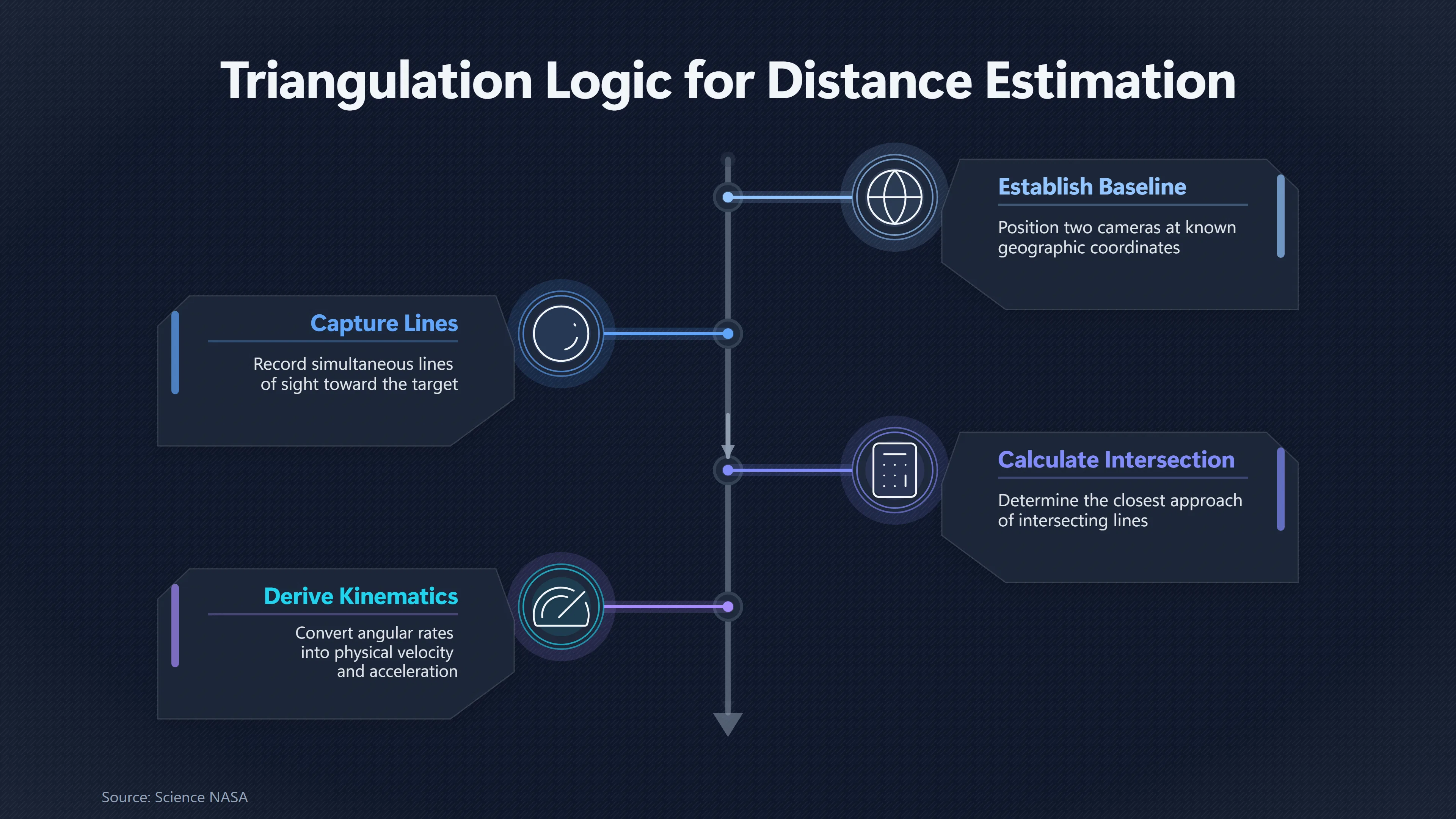
How triangulation turns an image into distance
The simplest example is two cameras observing the same target from different known locations. Each camera defines a line of sight towards the object. If their positions, orientations and timestamps are accurately known, the intersection — or closest approach — of those lines can be used to estimate the object’s three-dimensional location.
The principle is familiar from human depth perception. Your eyes see an object from slightly different positions; nearby objects shift more between the two views than distant ones. In an instrument network, the separation between cameras acts as a much larger baseline.
Once distance is constrained, several quantities that were previously ambiguous become calculable. If the image gives the object’s angular size, range permits an estimate of physical dimensions. Repeating the position measurement through time can produce a trajectory, from which velocity and acceleration can be estimated together with uncertainties.
The geometry also explains why merely having “two videos” is insufficient. Useful triangulation requires accurately known sensor locations and pointing directions, synchronised observations and confidence that both sensors really detected the same object. The baseline must also be suitable for the target’s distance. Two cameras almost on top of each other will see a distant target from nearly identical angles and provide weak depth information.
The Galileo Project’s proposed observational architecture explicitly uses wide-field cameras to derive positions and kinematics through triangulation. Its separate SkyWatch concept uses geographically distributed passive-radar receivers to estimate three-dimensional position and velocity from signal delay and Doppler information.[arXiv]arxiv.orgThe Scientific Investigation of Unidentified Aerial Phenomena (UAP) Using Multimodal Ground-Based ObservatoriesMay 29, 2023…
That distinction is crucial when investigating reports of apparently exceptional motion. A rapidly moving spot on a screen is not equivalent to an independently measured object accelerating rapidly through three-dimensional space. The latter requires the geometry to be solved.
Radar supplies the missing range dimension
Radar can be especially useful because it measures properties that ordinary imagery often does not. Depending on the system, radar observations can constrain range, direction and the component of velocity towards or away from the radar through Doppler shift.
Combining radar with optical or infrared imagery therefore creates a much richer record. If an infrared camera appears to show an object racing past the background while radar places it far away and moving slowly, the apparent speed may be an effect of geometry. If, by contrast, independently calibrated radar and imagery both reconstruct the same unusual trajectory, the case becomes substantially harder to dismiss as a single-camera illusion.
NASA’s independent study specifically discussed radar resources in this context. It identified the US NEXRAD Doppler weather-radar network as potentially useful for distinguishing interesting objects from airborne clutter and noted that synthetic aperture radar could provide independent validation when assessing claims of unusual acceleration or manoeuvring.[NASA Science]smd-cms.nasa.govScience NASAUNIDENTIFIED ANOMALOUS PHENOMENA…
AARO’s Western United States case provides a practical example of corroborating information resolving ambiguous imagery. Infrared footage contained distant dots that could not be confidently identified from their appearance alone. When investigators examined the full-motion video together with commercial flight information, radar tracks for three commercial aircraft aligned with the observed objects. AARO consequently assessed them as distant aircraft rather than anomalous vehicles.[AARO]aaro.milNext - AARO UAP Imagery Acc Table…
The lesson is broader than that individual case: an independent sensor does not need to produce a spectacular second image to be valuable. A radar track that establishes where an ordinary aircraft actually was can be more diagnostically useful than a much sharper photograph lacking range information.
Multiple viewpoints can overturn apparent extraordinary motion
The 2013 Puerto Rico UAP recording illustrates how strongly viewing geometry can affect interpretation. An infrared sensor aboard a US Customs and Border Protection aircraft recorded objects near Rafael Hernández Airport. In the imagery, the target appeared to move rapidly, seemed at one point to split, and appeared to pass into or through water — features that could suggest highly unusual performance if the video were interpreted literally.[AARO]aaro.milAARO Open Hearing Case Slides: Senate Armed Services Subcommittee on Emerging Threats and CapabilitiesNovember 20, 2024…
AARO’s later reconstruction combined the aircraft’s position with sensor parameters including elevation, azimuth and slant angle. It concluded that the apparent rapid motion resulted from motion parallax and estimated that the objects moved at roughly 3.6 metres per second, or 8 mph, close to the recorded wind speed. The reconstruction also placed them over land throughout the observation rather than entering the sea.[AARO]aaro.milPuerto Rico UAP Case ResolutionPuerto Rico UAP Case Resolution
Investigators further concluded that the apparent splitting represented two nearby objects whose visibility changed as the aircraft’s viewing angle changed. In other words, properties that looked intrinsic to the UAP in the raw video were instead strongly dependent on the sensor-observer geometry.[AARO]aaro.milAARO Open Hearing Case Slides: Senate Armed Services Subcommittee on Emerging Threats and CapabilitiesNovember 20, 2024…
This is precisely why range, platform position and pointing information matter. Without them, an observer may be forced to assume where the object is in three-dimensional space. Once those assumptions are replaced by measurements, estimates of speed and trajectory can change dramatically.
The “Go Fast” footage presents a related warning. AARO’s analysis concluded with high confidence that the target did not exhibit anomalous or exceptional behaviour, although the available information was still insufficient to determine a unique location, speed and heading. Its modelling showed how the motion of the observing F/A-18, wind and parallax could amplify the target’s apparent speed.[AARO]aaro.milGo Fast Case Resolution Card Methodology FinalGo Fast Case Resolution Card Methodology Final
Independent measurements are therefore valuable even when they do not completely identify an object: they can establish that a dramatic visual impression does not require dramatic physical performance.
Why calibrated sensors expose artefacts
Multiple sensors also help answer a different question: is the unusual feature outside the instrument at all?
Digital imaging systems do not passively reproduce reality. Lenses introduce optical effects; infrared systems translate radiation into displayed brightness or colour; autofocus and stabilisation move optical components; compression algorithms discard information; sharpening alters edges; and sensor noise can create or modify small features. When the target itself occupies only a handful of pixels, processing effects may represent a substantial fraction of what the viewer sees.
NASA’s UAP study emphasised calibration because investigators need to understand both the target and the measuring device. Relevant metadata can include the sensor model, sensitivity, noise characteristics, acquisition time, exposure settings, data bit depth and environmental conditions. NASA noted that apparent UAP have been shown to be sensor artefacts when appropriate calibration and metadata analysis were applied.[NASA Science]smd-cms.nasa.govScience NASAUNIDENTIFIED ANOMALOUS PHENOMENA…
AARO’s South Asian “atmospheric wake” imagery offers a concrete example. Infrared footage appeared to show an object with a conspicuous trailing feature. Analysis incorporated additional footage taken at a longer focal length as well as commercial flight information. AARO assessed the object as probably a commercial aircraft and the apparent trail as a video-compression artefact rather than a physical wake associated with an unusual craft.[AARO]aaro.milNext - AARO UAP Imagery Acc Table…
This is where different sensor modalities become particularly powerful. Suppose an apparent halo expands around an object in one infrared camera. If a separately calibrated infrared camera shows the same spatially resolved halo, confidence that it is external to the first instrument increases. If visible imagery, radar and other sensors detect the object but none detects anything corresponding to the halo, an instrument-specific explanation becomes more plausible.
The reasoning works both ways. Independent sensors are not simply tools for debunking sightings. If a feature repeatedly appears at the same physical position and time across independent instruments whose error mechanisms are different, explanations based on one camera’s internal optics or processing become harder to sustain.
Calibration matters as much as sensor count
Adding instruments does not automatically create good evidence. Ten poorly characterised cameras can still produce ten ambiguous recordings.
For quantitative analysis, investigators need to know how measured sensor values correspond to the physical world. Camera calibration establishes parameters such as lens distortion, focal geometry and pointing. Timing calibration determines whether observations recorded by different instruments really occurred simultaneously. Radiometric calibration relates measured brightness to incoming radiation. Radar systems have their own uncertainties in range, angle and velocity.
Purpose-built systems can test those quantities against objects whose locations are already known. A 2024 Galileo Project paper on an all-sky infrared camera array, for example, described using aircraft positions reported through Automatic Dependent Surveillance-Broadcast (ADS-B) data as part of the cameras’ calibration and performance testing. During commissioning, the researchers reconstructed roughly 500,000 aerial-object trajectories. Their initial outlier search still left 144 trajectories ambiguous after manual review; the authors said those were probably mundane but could not yet be resolved without distance and kinematic estimates or other sensor modalities.[arXiv]arxiv.orgOpen source on arxiv.org.
That result illustrates an important difference between collecting more images and collecting the missing measurements. Even a systematic camera network can encounter objects it cannot classify if it lacks sufficient range or complementary sensing.
Calibration also makes disagreements informative. If two calibrated instruments disagree beyond their known uncertainties, investigators have something specific to investigate: synchronisation, alignment, atmospheric propagation, target association or an unrecognised sensor effect. With an undocumented camera, the same discrepancy may be impossible to diagnose.
The strongest evidence is a chain of compatible measurements
For UAP investigations, the ideal observation is therefore not simply the clearest photograph. It is a set of measurements that constrain one another.
Imagine two synchronised cameras several kilometres apart recording the same object. Their geometry yields a range and altitude. Radar independently detects a target at the same position and measures its radial velocity. Successive triangulated positions give a compatible three-dimensional speed. Visible and infrared cameras record the target simultaneously, while meteorological sensors establish wind conditions and air-traffic data rule known aircraft in or out.
At that point, an investigator can ask much sharper questions. Does the object’s trajectory match the wind? Does its measured speed fit an aircraft, bird or balloon? Is an apparent acceleration present in physical coordinates or only in one image? Does an infrared feature correspond to something visible from another position? Are all observations consistent with one target?
None of those measurements guarantees an exotic answer. Their purpose is to make the answer testable.
That is why NASA’s recommendation for UAP research centred on systematic calibration, multiple measurements and complete sensor metadata rather than simply acquiring more dramatic footage.[NASA]nasa.govUPDATE: NASA Shares UAP Independent Study Report; Names DirectorUPDATE: NASA Shares UAP Independent Study Report; Names Director - NASA… A single recording can leave distance, size and velocity entangled in assumptions. Independent instruments can progressively remove those assumptions.
Why one camera is often not enough
The most important distinction is between corroboration of a sighting and corroboration of a claimed property. Two witnesses saying they saw the same light strengthens the case that something was visible. Two cameras detecting it independently strengthens that further. But neither alone proves that the object was ten metres wide, travelling at Mach 5 or performing an extraordinary acceleration.
Those stronger claims require measurements capable of establishing distance and motion.
This is where a second sensor can fundamentally change the evidential value of a UFO sighting. Triangulation can turn angular position into three-dimensional location. Radar can add range and velocity. Different wavelength bands can separate physical features from instrument-dependent ones. Calibration supplies the uncertainties needed to know how much confidence to place in the resulting numbers.
In many cases those extra measurements will reveal an ordinary cause. That is a scientific success, not a failure: AARO’s resolved imagery demonstrates how flight tracks, viewing geometry and sensor analysis can transform apparently unusual motion or structure into testable conventional explanations.[AARO]aaro.milUAP ImageryAARO UAP Imagery…
If a genuinely unusual aerial event were ever to resist those tests, the same principle would become even more important. A feature reproduced by independent, calibrated instruments — with measured range, trajectory and uncertainty — would constitute much stronger evidence than even a visually impressive lone video. The crucial step is not getting another picture of the mystery. It is obtaining another measurement that the first instrument could not provide.
Amazon book picks
Further Reading
Books and field guides related to Why One Camera Is Often Not Enough. Use these as the next step if you want deeper reading beyond the article.
The UFO Handbook: A Guide to Investigating, Evaluating, and R...
An explanation of the usual reasons for confusing IFOs (identified flying objects) with UFOs and a survey of the tools used to investigat...

Fundamentals of Radar Signal Processing
Fully updated and expanded, Fundamentals of Radar Signal Processing, Second Edition, offers comprehensive coverage of the basic digital s...
The UFO Experience: A Scientific Inquiry
The author belives that a number of UFO siting are still to be explained.

eBay marketplace picks
Marketplace Samples
Live-tested eBay searches with available results related to this page.
Selected fromUFO poster oneBay.co.uk.



Current eBay listing
I Want To Believe UFO Poster Giclée Fine Art Heavyweight Print

Current eBay listing
VINTAGE UFO FLYING SAUCERS COMIC ADVERTISING A2 POSTER PRINT
Endnotes
1.
Source: smd-cms.nasa.gov
Title: Science NASA
Link:https://smd-cms.nasa.gov/wp-content/uploads/2023/09/uap-independent-study-team-final-report.pdf
Source snippet
UNIDENTIFIED ANOMALOUS PHENOMENA...
2.
Source: nasa.gov
Title: UPDATE: NASA Shares UAP Independent Study Report; Names Director
Link:https://www.nasa.gov/news-release/update-nasa-shares-uap-independent-study-report-names-director/
Source snippet
UPDATE: NASA Shares UAP Independent Study Report; Names Director - NASA...
3.
Source: aaro.mil
Title: Effect of Forced Perspective and Parallax View on UAP Observations
Link:https://www.aaro.mil/Portals/136/PDFs/Information%20Papers/AARO_Effect_of_Forced_Perspective_and_Parallax_View_on_UAP_Observations_2024.pdf?ver=WTwJtQaCvC3BkRlBJCGLzg%3D%3D
Source snippet
Effect of Forced Perspective and Parallax View on UAP ObservationsMay 8, 2024...
Published: May 8, 2024
4.
Source: arxiv.org
Link:https://arxiv.org/abs/2305.18566
Source snippet
The Scientific Investigation of Unidentified Aerial Phenomena (UAP) Using Multimodal Ground-Based ObservatoriesMay 29, 2023...
Published: May 29, 2023
5.
Source: arxiv.org
Link:https://arxiv.org/abs/2305.18562
6.
Source: aaro.mil
Link:https://www.aaro.mil/Next-AARO-Home-redesign/Next-Parent/Next-AARO-UAP-Imagery-Fixed-Table/
Source snippet
Next - AARO UAP Imagery Acc Table...
7.
Source: aaro.mil
Title: UAP Imagery
Link:https://www.aaro.mil/UAP-Cases/Official-UAP-Imagery/ftag/MSF0951a18/
Source snippet
AARO UAP Imagery...
8.
Source: aaro.mil
Link:https://www.aaro.mil/Portals/136/PDFs/SASC_AARO_Open_Hearing_Case_Slides_19Nov2024.pdf?ver=Hec1SwKwP-4zSRJwIEIlJw%3D%3D
Source snippet
AARO Open Hearing Case Slides: Senate Armed Services Subcommittee on Emerging Threats and CapabilitiesNovember 20, 2024...
Published: November 20, 2024
9.
Source: aaro.mil
Title: Puerto Rico UAP Case Resolution
Link:https://www.aaro.mil/Portals/136/PDFs/case_resolution_reports/AARO_Puerto_Rico_UAP_Case_Resolution.pdf
10.
Source: aaro.mil
Title: Go Fast Case Resolution Card Methodology Final
Link:https://www.aaro.mil/Portals/136/PDFs/case_resolution_reports/AARO_GoFast_Case_Resolution_Card_Methodology_Final.pdf?ver=qXvjrruO_0MgtnTsfYnCEQ%3D%3D
11.
Source: aaro.mil
Title: UAP Imagery
Link:https://www.aaro.mil/UAP-Cases/Official-UAP-Imagery/4/
12.
Source: arxiv.org
Link:https://arxiv.org/abs/2411.07956
13.
Source: science.nasa.gov
Link:https://science.nasa.gov/science-research/earth-science/principal-investigator-and-quality-assessment-reports-evaluate-umbra-synthetic-aperture-radar-data/
14.
Source: science.nasa.gov
Title: get to know sar
Link:https://science.nasa.gov/mission/nisar/get-to-know-sar/
15.
Source: ntrs.nasa.gov
Link:https://ntrs.nasa.gov/citations/20260004654
16.
Source: science.nasa.gov
Link:https://science.nasa.gov/uap/faqs/
17.
Source: aaro.mil
Link:https://www.aaro.mil/Next-AARO-Home-redesign/Next-Parent/Next-UAP-Report-Documents/poster/dividLink/
18.
Source: aaro.mil
Link:https://www.aaro.mil/Next-AARO-Home-redesign/Next-Parent/Next-AARO-UAP-Imagery-Acc-Table/
19.
Source: science.nasa.gov
Link:https://science.nasa.gov/uap/
20.
Source: aaro.mil
Link:https://www.aaro.mil/Next-AARO-Home-redesign/Next-Parent/Presidential-UAP-Transparency-Initiative/
21.
Source: aaro.mil
Link:https://www.aaro.mil/Next-AARO-Home-redesign/Next-Parent/Presidential-UAP-Transparency-Initiative/dvpmoduleid/77396/
22.
Source: ntrs.nasa.gov
Link:https://ntrs.nasa.gov/citations/20250009218
23.
Source: nasa.gov
Title: How New NASA, India Earth Satellite NISAR Will See Earth
Link:https://www.nasa.gov/missions/nisar/how-new-nasa-india-earth-satellite-nisar-will-see-earth/
24.
Source: ntrs.nasa.gov
Link:https://ntrs.nasa.gov/citations/20240007942
25.
Source: ntrs.nasa.gov
Link:https://ntrs.nasa.gov/citations/20230018164
26.
Source: ntrs.nasa.gov
Link:https://ntrs.nasa.gov/citations/20230017968
27.
Source: nasa.gov
Title: NAS A to Release, Discuss Unidentified Anomalous Phenomena Report
Link:https://www.nasa.gov/news-release/nasa-to-release-discuss-unidentified-anomalous-phenomena-report/
28.
Source: aaro.mil
Link:https://www.aaro.mil/Next-AARO-Home-redesign/Next-Parent/Presidential-UAP-Transparency-Initiative/videoid/1007707/dvpcc/false/
29.
Source: ntrs.nasa.gov
Link:https://ntrs.nasa.gov/citations/20210014151
30.
Source: nasa.gov
Title: NIS T in Space: Better Remote Sensors for Better Science
Link:https://www.nasa.gov/directorates/stmd/niac/niac-studies/nist-in-space-better-remote-sensors-for-better-science/
31.
Source: nasa.gov
Title: NAS A Evaluates Compact Synthetic Aperture Radar
Link:https://www.nasa.gov/news-release/nasa-evaluates-compact-synthetic-aperture-radar/
32.
Source: ntrs.nasa.gov
Link:https://ntrs.nasa.gov/citations/20060019122
33.
Source: ntrs.nasa.gov
Link:https://ntrs.nasa.gov/citations/20040000525
34.
Source: ntrs.nasa.gov
Link:https://ntrs.nasa.gov/citations/19920000353
35.
Source: ntrs.nasa.gov
Link:https://ntrs.nasa.gov/citations/19890020095
36.
Source: ai.jpl.nasa.gov
Link:https://ai.jpl.nasa.gov/public/projects/uavsar/
37.
Source: jpl.nasa.gov
Title: uninhabited aerial vehicle synthetic aperture radar uavsar
Link:https://www.jpl.nasa.gov/missions/uninhabited-aerial-vehicle-synthetic-aperture-radar-uavsar/
38.
Source: airsar.jpl.nasa.gov
Link:https://airsar.jpl.nasa.gov/documents/genairsar/radar.html
39.
Source: aaro.mil
Title: AAR O UAP Trends All-domain Anomaly Resolution Office UAP REPORTING TRENDS
Link:https://www.aaro.mil/UAP-Cases/UAP-Reporting-Trends/
40.
Source: aaro.mil
Link:https://www.aaro.mil/Next-AARO-Home-redesign/Next-Parent/Next-AARO-UAP-Trends/
41.
Source: aaro.mil
Link:https://www.aaro.mil/Next-AARO-Home-redesign/Next-Parent/Next-UAP-Case-RR-Data-Table/
42.
Source: aaro.mil
Title: Next UAP Imagery dup
Link:https://www.aaro.mil/Next-AARO-Home-redesign/Inactive-Parent/Next-UAP-Imagery-dup/
43.
Source: aaro.mil
Link:https://www.aaro.mil/Next-AARO-Home-redesign/Inactive-Parent/Next-AARO-UAP-DT-Records/
44.
Source: aaro.mil
Link:https://www.aaro.mil/Next-AARO-Home-redesign/Next-Parent/AARO-UAP-Case-Resolution-DT/
45.
Source: aaro.mil
Link:https://www.aaro.mil/
46.
Source: aaro.mil
Link:https://www.aaro.mil/UAP-Records/-1/
47.
Source: aaro.mil
Link:https://www.aaro.mil/Next-AARO-Home-redesign/Inactive-Parent/AARO-Records-Tabs/
48.
Source: aaro.mil
Link:https://www.aaro.mil/Resources/Historical-Record-Reports/Volume-II/
49.
Source: aaro.mil
Link:https://www.aaro.mil/FAQ/
50.
Source: aaro.mil
Link:https://www.aaro.mil/Next-AARO-Home-redesign/Next-Parent/AARO-UAP-Case-DT/
51.
Source: ntrs.nasa.gov
Link:https://ntrs.nasa.gov/citations/19700018925
52.
Source: ntrs.nasa.gov
Link:https://ntrs.nasa.gov/citations/19660006779
53.
Source: ntrs.nasa.gov
Link:https://ntrs.nasa.gov/citations/19660009122
54.
Source: pubs.usgs.gov
Link:https://pubs.usgs.gov/publication/ofr20231033/full
Additional References
55.
Source: wired.com
Link:https://www.wired.com/story/nasa-ufos-aliens-report-2023
Source snippet
The agency stressed the need to shift the conversation from sensationalism to science and eliminate the stigma associated with reporting...
56.
Source: youtube.com
Title: Public Meeting on Unidentified Anomalous Phenomena (Official NASA Broadcast)
Link:https://www.youtube.com/watch?v=bQo08JRY0iM
Source snippet
Unidentified Anomalous Phenomena Independent Study Report...
57.
Source: youtube.com
Title: Replay! NASA’s Release of the Unidentified Anomalous Phenomena Report
Link:https://www.youtube.com/watch?v=nuBMnluJfs0
Source snippet
High-Resolution Spectroscopy of UAP | Massimo Teodorani...
58.
Source: youtube.com
Title: Unidentified Anomalous Phenomena Independent Study Report
Link:https://www.youtube.com/watch?v=TQcqOW39ksk
Source snippet
Replay! NASA's Release of the Unidentified Anomalous Phenomena Report...
59.
Source: youtube.com
Title: High-Resolution Spectroscopy of UAP | Massimo Teodorani
Link:https://www.youtube.com/watch?v=Pu-60A6m7g4
Source snippet
Pentagon UFO Footage Looks Impossible. Here's the Catch...
60.
Source: ufopress.com
Link:https://www.ufopress.com/articles/aaro-releases-four-information-papers-on-uap-classification-satellite-flaring-se/
61.
Source: t.co
Link:https://t.co/4M3L5Trglk
62.
Source: hp.com
Link:https://www.hp.com/gb-en/shop/products/desktops/hp-elitebook-x-g2i-14-inch-notebook-next-gen-ai-pc-wolf-pro-security-edition-e15n3ea-abu
63.
Source: uapexpedition.org
Link:https://www.uapexpedition.org/methodology
64.
Source: scribd.com
Link:https://www.scribd.com/document/671256731/UAP-Independent-Study-Team-Final-Report