Within Reflections
How Reflections Can Fake Impossible UFO Manoeuvres
Camera, observer or vehicle movement can sweep a nearby reflection across the view and make it seem to accelerate or change direction.
On this page
- Why reflected motion follows viewing geometry
- Angular movement versus real airborne speed
- Tests that reveal camera linked or observer linked motion
Page outline Jump by section
Introduction
Some of the most dramatic UFO and UAP reports involve a light that seems to shoot sideways, reverse direction, pace a vehicle or accelerate so abruptly that an ordinary aircraft appears incapable of matching it. Yet when the visible feature is a reflection tied to a window, windscreen, camera lens or other nearby optical surface, the apparent manoeuvre may not represent flight at all. A small change in camera position, viewing angle or vehicle attitude can move the reflected image rapidly against the distant landscape.
The central mistake is to treat motion across an image as motion through the atmosphere. Those are not equivalent. The All-domain Anomaly Resolution Office (AARO) explicitly warns that observer motion and parallax can make stationary or slow objects appear to move rapidly, distorting estimates of speed and direction.[AARO]aaro.milOpen source on aaro.mil. A moving reflection adds an even more fundamental problem: the luminous feature may not occupy the distant scene in the first place.
Why reflected motion follows viewing geometry
A photograph or video made through glass can contain two superimposed scenes. The transmission layer is the world beyond the glass; the reflection layer contains light originating on the camera’s side and redirected towards it by the glass. Computer-vision researchers treat this two-layer structure as a genuine imaging problem rather than a visual curiosity. Research published at the IEEE/CVF Conference on Computer Vision and Pattern Recognition (CVPR), for example, separates reflections from backgrounds precisely by exploiting the fact that the two layers can exhibit different motion when the camera moves.[CVF Open Access]thecvf.comOpen source on thecvf.com.
That distinction is crucial for UFO footage. Imagine filming a dark sky through a car side-window. A small illuminated dashboard control, phone screen or other interior light is reflected in the glass and appears visually superimposed over a distant hillside. The recording contains no depth label telling the viewer that one feature belongs to the interior reflection layer while the hill belongs to the exterior scene.
Now move the phone.
The apparent alignment changes. The reflected point can slide across the hill or sky even though the light source inside the vehicle has barely moved. If the camera rotates, the vehicle turns, the passenger shifts position or the glass changes angle relative to the observer, the reflected image can acquire a new apparent trajectory.
This differential movement is sufficiently predictable that reflection-removal algorithms use it as information. A 2020 CVPR study described recovering a background and obstructing layer from sequences taken with a moving camera by estimating the different optical-flow fields of those layers. Another video-reflection study similarly describes footage through reflective glass as a combination of background and reflection layers and uses motion cues to separate them.[CVF Open Access]thecvf.comOpen source on thecvf.com.
For UAP analysis, the important implication is simple: a light can move differently from the landscape because it belongs to a different optical layer, not because it is an independently manoeuvring craft.
A nearby reflection can seem to cross kilometres of sky
The spectacular impression arises when angular displacement is unconsciously converted into physical distance.
Suppose a luminous feature moves ten degrees across a recording in one second. That angular movement can be measured from the footage. But it does not tell investigators how many metres or kilometres the supposed object travelled unless its range is also known.
If a real aircraft several kilometres away changes its bearing by ten degrees in one second, considerable physical motion may indeed be involved. But if the luminous feature is a reflection associated with glass centimetres from the camera, applying the distant-aircraft geometry is invalid. What changed was the line of sight through an optical system.
This is closely related to the broader problem of parallax. AARO explains that as an observer moves, the projected position of an object against its background changes. From a fast-moving airborne sensor, a stationary or slow object can consequently appear to travel rapidly. AARO specifically cautions that these effects can produce inaccurate estimates of a UAP’s size, speed and direction.[AARO]aaro.milOpen source on aaro.mil.
A reflection is not simply another nearby physical target, so ordinary parallax and reflected motion should not be treated as identical mechanisms. But they share an important analytical lesson: angular motion cannot safely be converted into extraordinary physical velocity until the geometry and range have been established.
This makes statements such as “it crossed half the sky in two seconds” much weaker than they initially sound. The statement describes an angular change as seen by an observer. It does not establish how far anything travelled.
Why an apparent instant acceleration proves little by itself
A reflection can also imitate one of the most striking claimed UAP characteristics: abrupt acceleration.
Physical aircraft have inertia. If a material object changes its velocity enormously in a fraction of a second, the resulting acceleration has physical consequences. A reflected image has no corresponding requirement. Its position is determined by rays of light and viewing geometry, so it can change position as rapidly as that geometry changes.
A quick wrist movement can rotate a phone through several degrees. A car can hit a bump. An aircraft can bank. A passenger can lean towards a window. A camera operator can abruptly pan towards a light. Each action can change where a reflected image is projected against the distant scene.
Consequently, a trajectory containing sharp corners or sudden reversals does not automatically make reflection less plausible. Under the right circumstances, the lack of an inertial-looking trajectory may actually be a clue that investigators should test for an observer-linked optical effect.
There is an important limit to this argument. It would be poor analysis to label every apparently abrupt UAP movement a reflection merely because reflections can move abruptly. A reflection hypothesis needs supporting geometry. The relevant question is whether the anomalous movement correlates with camera motion, changes in the reflecting surface, a bright source or other evidence of an optical layer.
The distinction is between a possible mechanism and a demonstrated explanation.
Lens ghosts can perform their own false manoeuvres
The reflecting surface need not be a window. A camera itself contains multiple optical surfaces capable of generating secondary images.
Canon describes lens ghosting as an artefact produced when a strong light source undergoes repeated reflections within the optical system. A characteristic ghost can appear approximately symmetrically opposite the source in the image. Canon’s illustrated example places the Sun in the upper-right portion of the picture and shows the resulting ghost in the lower-left.[Canon Snapshot]asia.canonOpen source on asia.canon.
That geometrical relationship has direct relevance to moving UFO-like lights.
If the camera rotates relative to a bright street lamp, aircraft light, the Moon or another strong source, the source moves through the camera’s coordinate system. Its ghost moves too. A viewer concentrating on the ghost may perceive a glowing object crossing the sky, while the actual cause is the changing relationship between the camera’s optical axis and the bright source.
The effect becomes particularly deceptive when the source itself is near the edge of the frame or outside the cropped area. The viewer sees the moving artefact but lacks the most obvious clue to its origin.
This also explains why apparently independent movement is not necessarily independent. A lens ghost does not have to sit directly on top of its source. Its displaced position is part of the optical phenomenon. As the camera pans, the artefact may therefore move in a direction or at a rate that looks surprisingly unlike the distant scenery.
Manufacturer guidance provides a useful practical test: Canon notes that changing the shooting position or blocking the offending bright light can suppress ghosting.[Canon Snapshot]asia.canonOpen source on asia.canon. If a supposed UAP appears, changes position or disappears systematically as the camera’s relationship to a bright source changes, that behaviour deserves close examination before physical flight characteristics are inferred.
Glass can produce more than one phantom image
Real window reflections are also more complicated than the simplified picture of one light producing one reflected dot.
Research by YiChang Shih, Dilip Krishnan, Frédo Durand and William Freeman at CVPR demonstrated that glass commonly produces shifted double reflections. In double-pane windows, separate panes can return displaced and attenuated copies of the reflected scene. Even a single pane can generate ghosting through reflections from its near and far surfaces.[CVF Open Access]thecvf.comOpen source on thecvf.com.
The researchers calculated that, with typical 3–10 mm single-pane glass, an SLR with a 50 mm lens positioned within roughly 30 cm of the window could produce more than four pixels of visible ghost separation under specified oblique viewing conditions.[CV Foundation]cv-foundation.orgOpen source on cv-foundation.org.
For UAP interpretation, this matters because an interior light need not produce a perfectly clean duplicate. It can appear as a pair of lights, an elongated patch or overlapping luminous shapes. As camera angle changes, the visibility and separation of these components can change.
A viewer may consequently describe an object as “splitting”, “forming another orb” or altering shape when the recording is actually revealing multiple reflected light paths. That possibility should be investigated from the original footage rather than inferred from a compressed social-media copy, because faint secondary reflections are among the first details likely to disappear after compression, noise reduction or aggressive exposure adjustment.

Moving vehicles create especially persuasive false motion
Cars, trains and aircraft combine several ingredients that make moving reflections difficult to interpret.
First, the observer is moving. Second, the camera may be handheld. Third, the reflecting window is moving with the observer. Fourth, the exterior background may sweep rapidly past. Finally, at night the vehicle interior contains potential reflection sources while the outside sky provides relatively few depth cues.
The result can be counter-intuitive. A reflected feature associated with the observer may appear comparatively stable while the outside world streams behind it, creating the impression of a distant object “keeping pace” with the vehicle. Alternatively, a slight change in camera or window geometry can send the reflected feature across the view, creating the impression that the object suddenly accelerated away.
This is not merely a hypothetical difficulty with glass photography. Research into removing reflections from moving-camera footage relies specifically on motion differences between the reflected and transmitted layers.[CVF Open Access]thecvf.comOpen source on thecvf.com.
Aviation practice also recognises the broader importance of controlling light and visibility inside the cockpit. The US Federal Aviation Administration advises pilots to keep interior lights low at night and notes the importance of maintaining clear windscreens and managing visual obstructions.[Federal Aviation Administration]faa.govFederal Aviation Administration Chapter 8. Medical Facts for PilotsFederal Aviation Administration Chapter 8. Medical Facts for Pilots Those recommendations are not UFO guidance, but they confirm the operational reality underlying this mechanism: the visual environment inside a vehicle can interfere with perception of the exterior scene.
Darkness removes the depth cues that would expose the illusion
A reflection becomes much easier to recognise when it overlaps a richly detailed daytime scene. At night, the same reflected dot may appear to hang in empty black sky.
That removes a crucial piece of information: range.
A point of light contains little inherent information about its physical size. A one-centimetre source nearby and a much larger light far away can occupy similar angular sizes. If there are no clouds, terrain features or other reliable depth references, observers may unconsciously assign the light a distance and then interpret its movement at that assumed range.
The FAA documents a related night-vision illusion called autokinesis. When a person stares at a stationary light against a dark background, the light can appear to move. FAA guidance warns pilots about precisely this effect.[Federal Aviation Administration]faa.govFederal Aviation Administration Chapter 8. Medical Facts for PilotsFederal Aviation Administration Chapter 8. Medical Facts for Pilots
Autokinesis is not reflection, and it should not be offered as though the terms were interchangeable. The significance here is that a reflected light can occur in exactly the kind of sparse night-time scene in which human motion judgement is already vulnerable. A genuine optical movement of the reflection can therefore be combined with uncertain human estimates of its direction, distance and speed.
This can make a modest image displacement feel like a dramatic aerial manoeuvre.
GoFast illustrates the broader speed-estimation trap
The well-known US Navy “GoFast” footage is not being cited here as an example of a window reflection. It is useful for a narrower reason: it demonstrates how strongly apparent speed can differ from reconstructed physical motion.
AARO explains generally that motion parallax can cause a stationary or slow-moving object to appear very fast when observed from a rapidly moving platform. Its public FAQ states that observer speed, field of view and the moving background can all contribute to this impression.[AARO]aaro.milOpen source on aaro.mil.
That lesson transfers directly to reflection cases while keeping the mechanisms distinct. If even a genuine external target can appear much faster because the sensor platform is moving, then a luminous feature that is itself generated within an observer-linked optical system requires still greater caution before speed is inferred.
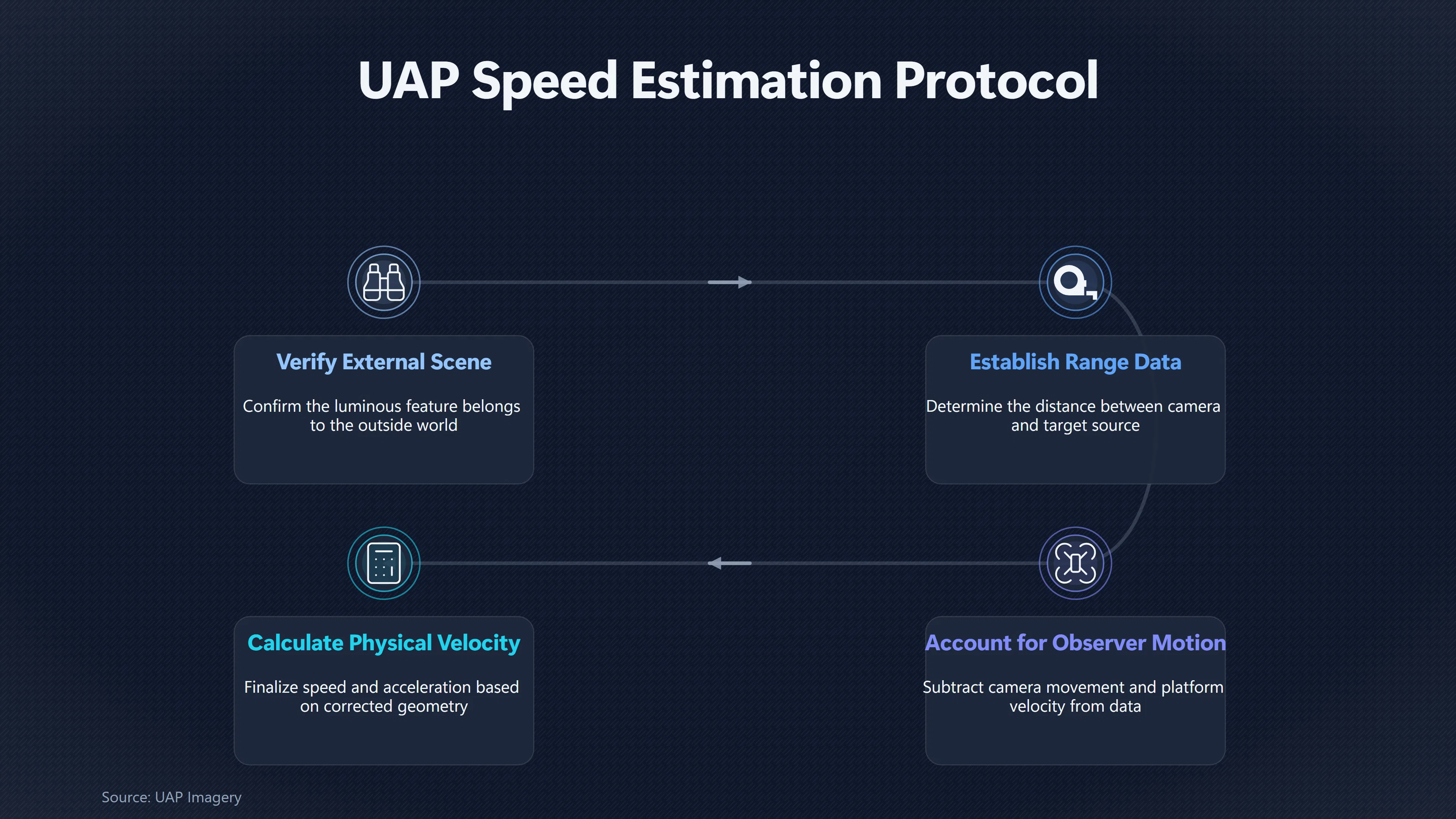
The proper sequence is therefore:
- establish that the luminous feature represents something in the external scene;
- determine or constrain its range;
- account for observer and camera movement;
- only then estimate physical velocity or acceleration.
Reversing that order — beginning with an assumed distant range and calculating an astonishing speed — can turn an optical artefact into an apparently extraordinary aircraft by arithmetic alone.
Tests that expose camera-linked or observer-linked motion
A convincing investigation should attempt to falsify the reflection explanation rather than simply asserting it. Several tests are particularly useful.
Stabilise the exterior background. Track stars, buildings, terrain or other distant features and compensate for camera shake. Once the transmitted scene is stabilised, examine how the suspect light moves. Reflection-removal research shows why this works: reflected and transmitted layers can possess measurably different motion fields.[CVF Open Access]thecvf.comOpen source on thecvf.com.
Compare manoeuvres with camera motion. Look frame by frame for pans, tilts, bumps, zooms and changes of orientation. If every spectacular acceleration coincides with a camera movement, the supposed object’s performance should not be interpreted independently until that correlation is explained.
Search for the generating light. Inspect the entire uncropped frame for bright sources, particularly when a suspect feature resembles lens ghosting. Canon notes the characteristic approximately opposite placement of some ghosts relative to their source.[Canon Snapshot]asia.canonOpen source on asia.canon. Cropped video should therefore be treated cautiously because cropping may remove the source needed to recognise the relationship.
Look for doubled reflection structure. A faint duplicate displaced from the main light can be valuable evidence. Research on window photography demonstrates that shifted double reflections arise naturally from the surfaces of single and double glazing.[CVF Open Access]thecvf.comOpen source on thecvf.com.
Inspect the environment around the camera. Establish whether the recording was made through a windscreen, passenger window, aircraft canopy or building glass. Identify illuminated controls, displays, cabin lights and other possible sources. Without that information, analysis of the sky alone may omit half of the optical scene.
Preserve original metadata and full-resolution footage. AARO specifically identifies original imagery, metadata, location information and higher-resolution video as valuable for UAP analysis.[AARO]aaro.milOpen source on aaro.mil. Re-encoded social-media clips can remove precisely the subtle features needed to diagnose a reflection.
Seek independent viewpoints. A reflection tied to one camera-window system should not normally triangulate to the same distant position from another separated camera. Independent observations with known locations can therefore transform the evidential situation.
What would genuinely weaken the reflection explanation?
The existence of this mechanism does not mean that every fast-moving light should be dismissed as reflected illumination. Strong evidence can make the hypothesis progressively less plausible.
Synchronous recordings from geographically separated observers would be important if they show a feature at geometrically consistent bearings. Reliable range measurements would be stronger still. Radar, lidar or another independent sensor tracking the same trajectory could demonstrate that physical motion occurred in external space rather than merely across an image.
Likewise, if investigators reconstruct the camera movement, identify all bright sources and reflective surfaces, model the relevant optics and still cannot reproduce or account for the observed trajectory, a simple reflection explanation becomes weaker.
This evidential standard is important because UFO investigation has a long history of both genuine unresolved reports and mundane identifications. AARO’s historical review of Project Blue Book notes that the US Air Force used categories including astronomical objects, balloons, aircraft, searchlights, false radar indications and reflections when resolving reports. Project Blue Book recorded 12,618 sightings, of which 701 remained categorised as unidentified.[GovInfo]govinfo.govOpen source on govinfo.gov. The existence of unresolved cases therefore does not justify treating every apparent anomaly as an artefact, just as the existence of ordinary explanations does not make every unresolved observation extraordinary.
The appropriate question for this particular mechanism is narrower: has the apparent manoeuvre been shown to belong to a distant physical object rather than to the viewing system?
The decisive distinction is image motion versus flight
Moving reflections can imitate unusually persuasive UFO behaviour because they exploit an assumption viewers rarely notice themselves making. We see a luminous feature against the sky and instinctively place it in the sky.
Once that assumed distance is accepted, everything that follows can become misleading. Angular displacement becomes kilometres travelled. Camera shake becomes acceleration. A change in reflection geometry becomes a right-angle turn. A feature tied to a vehicle can appear to pace it. A lens ghost responding to a pan can seem to shoot away. Multiple reflections from glass can even produce apparently changing or multiplying lights.
Optical and computer-vision research establishes that reflected and transmitted scenes really can behave as distinct moving layers, while camera manufacturers document internally reflected ghost images produced by strong lights.[CVF Open Access]thecvf.comOpen source on thecvf.com. AARO’s work on parallax separately demonstrates the broader danger of interpreting apparent image velocity as physical target velocity without reconstructing the observation geometry.[AARO]aaro.milOpen source on aaro.mil.
That is why an apparently “impossible” manoeuvre is not, on its own, evidence of impossible flight. The extraordinary quantity — speed, acceleration or change of direction — exists physically only after investigators establish that a real external object occupied the inferred position and followed the inferred path.
Until then, the safest description is the literal one: a luminous feature moved across the observer’s view. In reflection cases, that statement can be entirely true even when nothing in the distant sky performed the manoeuvre at all.
Amazon book picks
Further Reading
Books and field guides related to How Reflections Can Fake Impossible UFO Manoeuvres. Use these as the next step if you want deeper reading beyond the article.
Optics
For courses in Optics A Contemporary Approach to Optics with Practical Applications and New Focused Pedagogy Hecht Optics balances theory...
Applied Photographic Optics
Selected by the American Library Association's 'Choice' magazine as "best technical book", the first edition of this book soon establishe...
Understanding Exposure
Rating: 4.5/5 from 19 Google Books ratings
Provides detailed lessons on the elements of exposure and how each relates to depth of field, freezing and blurring action, and shooting...
The Science of Imaging
A genuine introduction to the subject, The Science of Imaging: An Introduction keeps the mathematics to a minimum and is copiously litter...
eBay marketplace picks
Marketplace Samples
Live-tested eBay searches with available results related to this page.
Selected fromUFO model oneBay.co.uk.
Endnotes
1.
Source: aaro.mil
Title: UAP Imagery
Link:https://www.aaro.mil/UAP-Cases/Official-UAP-Imagery/ftag/MSF0951a18/
Source snippet
AARO UAP Imagery...
2.
Source: faa.gov
Title: Federal Aviation Administration Chapter 8. Medical Facts for Pilots
Link:https://www.faa.gov/Air_traffic/publications/atpubs/aim_html/chap8_section_1.html
3.
Source: aaro.mil
Title: UAP Imagery
Link:https://www.aaro.mil/UAP-Cases/Official-UAP-Imagery/4/
4.
Source: aaro.mil
Link:https://www.aaro.mil/Next-AARO-Home-redesign/Next-Parent/Next-UAP-Report-Documents/poster/dividLink/
5.
Source: aaro.mil
Link:https://www.aaro.mil/Next-AARO-Home-redesign/Next-Parent/Next-AARO-UAP-Imagery-Acc-Table/
6.
Source: aaro.mil
Link:https://www.aaro.mil/Next-AARO-Home-redesign/Next-Parent/Presidential-UAP-Transparency-Initiative/dvpmoduleid/77396/
7.
Source: aaro.mil
Link:https://www.aaro.mil/Next-AARO-Home-redesign/Next-Parent/Presidential-UAP-Transparency-Initiative/videoid/1006159/dvpcc/false/
8.
Source: faa.gov
Title: Airman Education Programs | Federal Aviation Administration
Link:https://www.faa.gov/pilots/training/airman_education/topics_of_interest/spatial_disorientation
9.
Source: aaro.mil
Link:https://www.aaro.mil/Next-AARO-Home-redesign/Next-Parent/Presidential-UAP-Transparency-Initiative/videoid/1006078/dvpcc/false/
10.
Source: aaro.mil
Link:https://www.aaro.mil/Next-AARO-Home-redesign/Next-Parent/Presidential-UAP-Transparency-Initiative/videoid/1006079/dvpcc/false/
11.
Source: aaro.mil
Link:https://www.aaro.mil/Next-AARO-Home-redesign/Next-Parent/Presidential-UAP-Transparency-Initiative/videoid/1014097/dvpcc/false/
12.
Source: aaro.mil
Link:https://www.aaro.mil/Next-AARO-Home-redesign/Next-Parent/Presidential-UAP-Transparency-Initiative/videoid/1006106/dvpcc/false/
13.
Source: aaro.mil
Link:https://www.aaro.mil/Next-AARO-Home-redesign/Next-Parent/Presidential-UAP-Transparency-Initiative/videoid/1014099/dvpcc/false/
14.
Source: aaro.mil
Link:https://www.aaro.mil/Next-AARO-Home-redesign/Next-Parent/Presidential-UAP-Transparency-Initiative/videoid/1006067/dvpmoduleid/77396/
15.
Source: faa.gov
Title: Robinson R44 | Federal Aviation Administration
Link:https://www.faa.gov/lessons_learned/rotorcraft/accidents/N474FA
16.
Source: faa.gov
Link:https://www.faa.gov/lessons_learned/transport_airplane/accidents/N310EA
17.
Source: aaro.mil
Link:https://www.aaro.mil/Next-AARO-Home-redesign/Next-Parent/Presidential-UAP-Transparency-Initiative/videoid/1007740/dvpcc/false/
18.
Source: aaro.mil
Link:https://www.aaro.mil/Next-AARO-Home-redesign/Next-Parent/Presidential-UAP-Transparency-Initiative/videoid/1007707/dvpcc/false/
19.
Source: aaro.mil
Link:https://www.aaro.mil/Next-AARO-Home-redesign/Next-Parent/Presidential-UAP-Transparency-Initiative/videoid/1006105/dvpmoduleid/77396/
20.
Source: faa.gov
Title: Chapter 8. Medical Facts for Pilots
Link:https://www.faa.gov/air_traffic/publications/atpubs/aim/aim0801.html
21.
Source: faa.gov
Title: Bell 206B-3 Jet Ranger III | Federal Aviation Administration
Link:https://www.faa.gov/lessons_learned/rotorcraft/accidents/N828AC
22.
Source: airporttech.tc.faa.gov
Title: evaluation of wind driven retroreflective taxiway edge markers 1
Link:https://www.airporttech.tc.faa.gov/Products/Airport-Safety-Papers-Publications/Airport-Safety-Detail/evaluation-of-wind-driven-retroreflective-taxiway-edge-markers-1
23.
Source: faa.gov
Title: Office of Aerospace Medicine Technical Reports | Federal Aviation Administration
Link:https://www.faa.gov/data_research/research/med_humanfacs/oamtechreports/1970s/1978/197815
24.
Source: faa.gov
Title: Office of Aerospace Medicine Technical Reports | Federal Aviation Administration
Link:https://www.faa.gov/data_research/research/med_humanfacs/oamtechreports/1970s/1971/7134
25.
Source: aaro.mil
Link:https://www.aaro.mil/FAQ/
26.
Source: aaro.mil
Link:https://www.aaro.mil/Next-AARO-Home-redesign/Inactive-Parent/Next-AARO-UAP-DT-Records/
27.
Source: aaro.mil
Title: UAP Imagery UAP Video
Link:https://www.aaro.mil/Next-AARO-Home-redesign/Inactive-Parent/Next-UAP-Imagery-dup/
28.
Source: aaro.mil
Link:https://www.aaro.mil/UAP-Records/-1/
29.
Source: aaro.mil
Link:https://www.aaro.mil/Next-AARO-Home-redesign/Inactive-Parent/FAQ-Datatable/
30.
Source: aaro.mil
Link:https://www.aaro.mil/Next-AARO-Home-redesign/Next-Parent/Next-AARO-UAP-Imagery-Fixed-Table/
31.
Source: aaro.mil
Title: AAR O UAP Trends All-domain Anomaly Resolution Office UAP REPORTING TRENDS
Link:https://www.aaro.mil/UAP-Cases/UAP-Reporting-Trends/
32.
Source: aaro.mil
Link:https://www.aaro.mil/Next-AARO-Home-redesign/Next-Parent/Next-UAP-Case-RR-Data-Table/
33.
Source: aaro.mil
Link:https://www.aaro.mil/Next-AARO-Home-redesign/Next-Parent/AARO-UAP-Case-Resolution-DT/
34.
Source: aaro.mil
Link:https://www.aaro.mil/Next-AARO-Home-redesign/Next-Parent/Next-AARO-UAP-Trends/
35.
Source: aaro.mil
Link:https://www.aaro.mil/Resources/Historical-Record-Reports/Volume-II/
36.
Source: aaro.mil
Link:https://www.aaro.mil/Next-AARO-Home-redesign/Inactive-Parent/AARO-Records-Tabs/
37.
Source: aaro.mil
Link:https://www.aaro.mil/Next-AARO-Home-redesign/Bruce-working/Next-AARO-UAP-Trends-Charts/
38.
Source: faa.gov
Link:https://www.faa.gov/data_research/research/med_humanfacs/oamtechreports/1970s/1977/197712
39.
Source: faa.gov
Link:https://www.faa.gov/data_research/research/med_humanfacs/oamtechreports/1970s/1970/7009
40.
Source: faa.gov
Link:https://www.faa.gov/data_research/research/med_humanfacs/oamtechreports/2000s/2006/200628
41.
Source: faa.gov
Link:https://www.faa.gov/data_research/research/med_humanfacs/oamtechreports/1970s/1979/197904
42.
Source: faa.gov
Link:https://www.faa.gov/data_research/research/med_humanfacs/oamtechreports/1960s/1967/196716
43.
Source: faa.gov
Link:https://www.faa.gov/data_research/research/med_humanfacs/oamtechreports/1960s/1969/196923
44.
Source: faa.gov
Link:https://www.faa.gov/data_research/research/med_humanfacs/oamtechreports/1970s/1970/7002
45.
Source: faa.gov
Link:https://www.faa.gov/data_research/research/med_humanfacs/oamtechreports/1970s/1979/197926
46.
Source: faa.gov
Link:https://www.faa.gov/air_traffic/publications/atpubs/aip_html/part2_enr_section_5.3.html
47.
Source: faa.gov
Link:https://www.faa.gov/air_traffic/publications/atpubs/aim_html/chap7_section_6.html
48.
Source: snapshot.asia.canon
Title: Canon Snapshot Lens FAQ #4: What is “ghosting” and “flaring”?
Link:https://snapshot.asia.canon/in/en/article/lens-faq-4-what-is-ghosting-and-flaring
49.
Source: snapshot.canon-asia.com
Title: lens faq 4 what is ghosting and flaring
Link:https://snapshot.canon-asia.com/article/eng/lens-faq-4-what-is-ghosting-and-flaring
50.
Source: imagine.gsfc.nasa.gov
Link:https://imagine.gsfc.nasa.gov/descriptions/parallax.html
51.
Source: starchild.gsfc.nasa.gov
Link:https://starchild.gsfc.nasa.gov/docs/StarChild/questions/parallax.html
52.
Source: openaccess.thecvf.com
Link:https://openaccess.thecvf.com/content/CVPR2026/html/Lee_ReflexSplit_Single_Image_Reflection_Separation_via_Layer_Fusion-Separation_CVPR_2026_paper.html
Additional References
53.
Source: av.jpn.support.panasonic.com
Link:https://av.jpn.support.panasonic.com/support/global/cs/dsc/knowhow/knowhow15.html
Source snippet
Panasonic SupportLens Characteristics: Flare, Ghosting and Aberration | Digital Camera Know-Hows | Digital Camera | Digital AV | Support...
54.
Source: sony.com
Link:https://www.sony.com/electronics/support/articles/00344523
Source snippet
The photographs I take with my Xperia have circular lights or appear whitish (Flare, Ghost) | Sony USA...
55.
Source: astrobiology.nasa.gov
Title: Astrobiology Know Thy Star, Know Thy Planet | News | Astrobiology
Link:https://astrobiology.nasa.gov/news/know-thy-star-know-thy-planet/
Source snippet
NASA AstrobiologyKnow Thy Star, Know Thy Planet | News | Astrobiology...
56.
Source: researchgate.net
Title: 319439526 Reflection Removal Under Fast Forward Camera Motion
Link:https://www.researchgate.net/publication/319439526_Reflection_Removal_Under_Fast_Forward_Camera_Motion
Source snippet
Reflection Removal Under Fast Forward Camera Motion | Request PDFSeptember 1, 2017...
Published: September 1, 2017
57.
Source: arxiv.org
Title: arXiv Learning to See Through Obstructions
Link:https://arxiv.org/abs/2004.01180
Source snippet
Learning to See Through ObstructionsApril 2, 2020...
Published: April 2, 2020
58.
Source: youtube.com
Title: Explained: “[Go Fast]({{ ‘go-fast/’ | relative_url }})” UFO Video
Link:https://www.youtube.com/watch?v=PLyEO0jNt6M
Source snippet
Mick west reflection ufo motion movement camera Gimbal UFO - A New Analysis...
59.
Source: defense.gov
Link:https://www.defense.gov/News/News-Stories/Article/Article/3965403/dod-examining-unidentified-anomalous-phenomena/
60.
Source: defense.gov
Link:https://www.defense.gov/News/News-Stories/Article/Article/3701297/dod-report-discounts-sightings-of-extraterrestrial-technology/
61.
Source: defense.gov
Link:https://www.defense.gov/News/News-Stories/Article/article/3368109/dod-working-to-better-understand-resolve-anomalous-phenomena/
62.
Source: defense.gov
Link:https://www.defense.gov/News/Releases/Release/article/2853121/dod-announces-the-establishment-of-the-airborne-object-identification-and-manag/