Within Bright Stars
Why Can a Stationary Star Suddenly Seem to Move?
A lone star in a featureless dark sky can appear to drift, jump or zigzag even though its position has not physically changed.
On this page
- What the autokinetic illusion looks like
- Why darkness and prolonged fixation encourage false motion
- Ways to test whether apparent movement is real
Page outline Jump by section
Introduction
A stationary star can genuinely seem to dart, drift, zigzag or “correct” its position when it is watched against a dark, nearly featureless sky. The effect is called autokinesis, or the autokinetic illusion. It does not require the star to move unusually: the apparent motion is generated by the observer’s visual system when it has too little surrounding information with which to judge where the light really is. Aviation authorities treat the effect seriously because pilots can mistake a fixed light, including a star or planet, for another aircraft that is moving.[Federal Aviation Administration]faa.govA stationary star can genuinely seem to dart, drift, zigzag or “correct” its position when it is watched against a dark, nearly featurele…
For UFO or UAP reports, autokinesis matters most in a very specific situation: a witness watches an isolated point-like light for several seconds or longer, particularly in a dark part of the sky, and reports that it began moving after initially appearing stationary. That pattern is compatible with a well-established perceptual illusion. It is not, however, a universal explanation for every unusual movement reported in the night sky.
What the autokinetic illusion looks like
Autokinesis is deceptively convincing because the observer does not normally experience it as an obvious disturbance of their eyesight. The light itself appears to move. A stationary point may seem to wander slowly, make short excursions in different directions, jump sideways or trace an irregular path before apparently returning towards its original position. The University of Richmond’s account describes an isolated light as appearing to wander in unpredictable directions and at variable speeds, while aviation guidance simply warns that a static light can appear to “move about” after prolonged observation.[UR Scholarship Repository]scholarship.richmond.eduAutokinesis is deceptively convincing because the observer does not normally experience it as an obvious disturbance of their eyesight. T…
That makes the illusion particularly relevant to reports in which a bright “star” seems to become active only after somebody starts watching it closely. A person might initially notice an ordinary-looking stationary light, continue staring to determine what it is, and then perceive the very motion that makes the object seem extraordinary. In other words, closer visual attention can sometimes make the observation less reliable rather than more reliable.
The effect is not merely an anecdote from stargazing. It can be produced under controlled conditions by placing a small stationary light in darkness. In a 2005 brain-imaging experiment, 11 healthy participants fixated a stationary dim LED in complete darkness for 35 seconds. The perceived autokinetic movement became stronger during the latter half of the fixation period, despite the physical stimulus remaining unchanged. Activity also increased in the motion-sensitive visual region MT/V5, supporting the conclusion that observers were experiencing a genuine perception of motion rather than simply deciding or imagining that the light had moved.[PubMed]pubmed.ncbi.nlm.nih.govPub MedThe effect is not merely an anecdote from stargazing. It can be produced under controlled conditions by placing a small stationary light…
More recent experimental work reinforces the point. A 2024 study placed observers in a specially designed dark room and measured their reports of apparent motion. All 12 participants experienced autokinesis during five minutes of viewing a stationary dot. When the researchers introduced actual slow movement, perceived direction could still be influenced strongly by autokinesis; at higher physical speeds, perception became better aligned with the object’s real direction of travel.[ScienceDirect]sciencedirect.comMore recent experimental work reinforces the point. A 2024 study placed observers in a specially designed dark room and measured their re…
This distinction is important when assessing unusual-light reports. Autokinesis is capable of producing perceived motion, but that does not mean any arbitrarily large or well-referenced trajectory can simply be labelled autokinetic.
Why darkness and prolonged fixation encourage false motion
Human vision normally has abundant information for deciding whether something has moved. A lamp can be judged against a building; an aircraft against the horizon; a person against the pavement and surrounding objects. Even while the eyes, head and body move, the brain integrates visual and non-visual information to maintain a remarkably stable representation of the outside world.[ScienceDirect]sciencedirect.comMore recent experimental work reinforces the point. A 2024 study placed observers in a specially designed dark room and measured their re…
An isolated star in a black sky is an unusually poor stimulus for that system. There may be no visible horizon, building, cloud edge or nearby star bright enough to provide a dependable reference. The observer sees a point but has little information defining exactly where that point belongs within the surrounding scene. Aviation safety material therefore describes the lack of fixed visual references as central to the conditions in which autokinesis develops.[Skybrary]skybrary.aeroautokinetic effectAn isolated star in a black sky is an unusually poor stimulus for that system. There may be no visible horizon, building, cloud edge or n…
The eyes themselves are not perfectly motionless during fixation either. Tiny movements are part of normal vision, and researchers have long investigated how eye-position signals, fixation behaviour and the brain’s compensation for those movements contribute to autokinesis. A 1966 experiment found that experimentally manipulated compensatory eye movements significantly influenced reported autokinetic motion. Earlier work by psychologists Richard Gregory and Oliver Zangwill found that deliberately fatiguing the eye muscles by holding the eyes in an extreme position could produce an immediate and pronounced autokinetic effect afterwards.[Sage Journals]journals.sagepub.comThe eyes themselves are not perfectly motionless during fixation either. Tiny movements are part of normal vision, and researchers have l…
Yet the familiar shorthand that autokinesis is simply “your eyeballs twitching” is too crude. Experiments have produced results that cannot easily be explained by a simple one-to-one relationship between eye movement and perceived light movement. For example, research reported in 2018 found that two visible dots could sometimes appear to move independently of one another. If every apparent movement were merely the direct perceptual consequence of the same movement of the observer’s eyes, both dots should behave together. The researchers argued that such findings point towards higher-level visual processing as part of the phenomenon.[PubMed Central (PMC)]pmc.ncbi.nlm.nih.govPub Med Central (PMCYet the familiar shorthand that autokinesis is simply “your eyeballs twitching” is too crude. Experiments have produced results that cann…
The safest description, therefore, is that autokinesis emerges from the visual system’s attempt to establish stable position and motion when the available sensory information is unusually impoverished. Eye movements and signals about eye position contribute, but the detailed mechanism has been debated experimentally for decades. The illusion is well established even though reducing it to a single cause would overstate what the research demonstrates.[go.jp]jstage.jst.go.jpThe safest description, therefore, is that autokinesis emerges from the visual system's attempt to establish stable position and motion w…
Why staring can make it worse
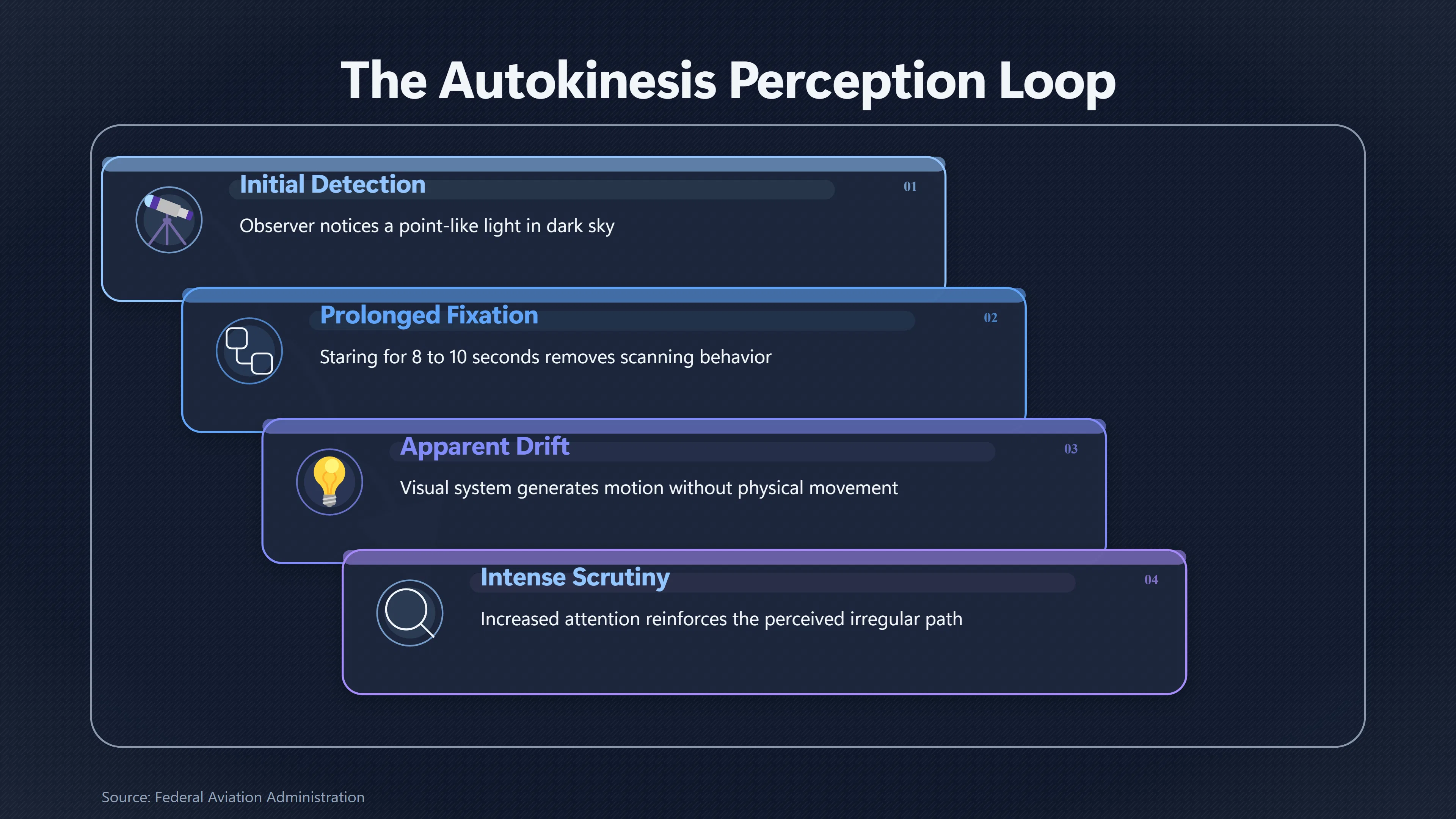
Time is another useful clue. Autokinesis generally develops during sustained fixation rather than requiring the light to look mobile immediately. The 2005 imaging experiment found that the illusion strengthened as fixation continued. FAA training material likewise describes apparent movement beginning after roughly 8–10 seconds under suitable conditions and recommends avoiding prolonged fixation.[PubMed]pubmed.ncbi.nlm.nih.govPub MedThe effect is not merely an anecdote from stargazing. It can be produced under controlled conditions by placing a small stationary light…
That creates a potential feedback loop during a UFO observation. Someone notices an ambiguous light and stares harder to decide whether it is moving. The longer fixation removes the normal scanning behaviour that might otherwise refresh positional references. Apparent movement then develops, encouraging still more concentrated observation.
The resulting sequence can be striking: stationary light → prolonged scrutiny → apparent drift → intense scrutiny → increasingly convincing movement. Nothing in that sequence requires dishonesty, poor eyesight or fabrication. The percept itself can be vivid.
Why a star can seem to make “impossible” manoeuvres
Autokinesis is especially important when a report describes motion that is irregular rather than a steady journey across the sky. A genuine satellite, aircraft or other moving object normally establishes a track relative to background stars or terrestrial landmarks. Autokinetic movement can instead appear directionally unstable because the perceived position itself lacks a dependable reference.
This can produce descriptions such as hovering, swaying, darting sideways or changing direction. The subjective path need not resemble the smooth apparent motion expected from an astronomical object. Indeed, the strangeness of the perceived movement can be what persuades an observer that the light cannot be a star.
That is precisely why aviation medicine treats autokinesis as more than a curiosity. The US Federal Aviation Administration warns that a pilot staring at a static light in darkness can perceive it moving and then respond to that false motion. FAA safety guidance gives stars, planets and other aircraft lights as examples of stationary or effectively fixed points capable of triggering the illusion.[Federal Aviation Administration]faa.govA stationary star can genuinely seem to dart, drift, zigzag or “correct” its position when it is watched against a dark, nearly featurele…
The connection with UFO investigation is also longstanding. The psychological section of the University of Colorado’s 1968 Condon Report on UFOs explicitly cited the autokinetic effect as an example of a normal perceptual distortion: a stationary light in darkness can appear to move. Its relevance is narrow but significant. When the disputed feature of a report is specifically the unexplained movement of an otherwise point-like nocturnal light, perception itself becomes one of the hypotheses that has to be tested.[NCAS Files]files.ncas.orgThe connection with UFO investigation is also longstanding. The psychological section of the University of Colorado's 1968 Condon Report…
Crucially, that reasoning works in only one direction. Showing that autokinesis could produce a reported motion does not establish that it did. Investigators still need to determine what the underlying light was and whether independent evidence shows physical displacement.
Ways to test whether apparent movement is real
The strongest way to distinguish autokinesis from genuine movement is to restore the reference information that darkness has removed. Simply continuing to stare at the light is a poor test because it preserves the conditions that favour the illusion.
Break fixation. Look elsewhere briefly and return to the object rather than staring continuously. Aviation guidance recommends a normal visual scanning pattern and avoiding prolonged fixation on a single light. If the apparent darting repeatedly emerges during sustained staring and diminishes after scanning resumes, autokinesis becomes more plausible.[Skybrary]skybrary.aeroautokinetic effectAn isolated star in a black sky is an unusually poor stimulus for that system. There may be no visible horizon, building, cloud edge or n…
Put a fixed reference beside the light. Observe its position relative to a roofline, chimney, pole, tree branch or other stationary foreground feature where practical. Alternatively, compare it carefully with nearby stars. The key question is not whether the light feels as though it moved, but whether its angular separation from identifiable reference points changes consistently.
Use a supported camera. A fixed camera provides an independent coordinate frame. If a witness perceives dramatic zigzags while a stationary recording shows the point maintaining the same position relative to background stars, that is strong evidence against corresponding physical motion. Conversely, reproducible displacement against the star field cannot be dismissed as the observer’s autokinetic perception.
Check the sky position. If the supposedly hovering object remains in the expected position of a known bright star or planet over time, astronomical identification becomes testable rather than speculative. The important comparison is with the surrounding sky and the predicted position, not merely with how unusual the light looked to the naked eye.
Ask whether several references moved together. If nearby stars seem to shift along with the target, observer or camera movement becomes a stronger possibility. If one object demonstrably changes position against several fixed stars, genuine angular movement has been recorded and autokinesis alone is inadequate.
These tests reflect the same principle found in experimental research. Supplying additional positional information can reduce the ambiguity responsible for autokinetic perception. One laboratory study, for example, found that providing observers with physical positional information about the target delayed the onset of autokinesis and reduced its magnitude and duration.[ScienceDirect]sciencedirect.comThese tests reflect the same principle found in experimental research. Supplying additional positional information can reduce the ambigui…

Where autokinesis is a strong explanation — and where it is not
Autokinesis should be treated as a specific diagnostic possibility, not as a catch-all dismissal of unusual aerial observations. It fits best when several features occur together: the source is effectively point-like; the surrounding field is dark and poor in reference points; the observer fixates on it; the reported movement is irregular; and there is no independent recording or reference showing corresponding physical displacement. Those are substantially the same conditions under which experimental observers and pilots experience the illusion.[ScienceDirect]sciencedirect.comMore recent experimental work reinforces the point. A 2024 study placed observers in a specially designed dark room and measured their re…
Its explanatory value falls sharply when the movement can be measured against stable references. A light that crosses a known star pattern, passes behind foreground objects, changes angular separation from several stars in a reproducible way, or follows the same trajectory on a fixed recording is supplying evidence of real image displacement. Autokinesis cannot by itself explain such observations.
Nor does autokinesis identify the underlying light. If a stationary point appears to dart, the illusion explains the darting, not why the point is present. The source might independently be identified as a star, planet or another light. This separation prevents circular reasoning: investigators should establish the object’s identity and assess the claimed movement as related but distinct questions.
There is also good reason not to demand that every witness experience exactly the same apparent path. Modern experiments show substantial perceptual complexity, while the 2024 study found repeatable patterns within individual observers rather than establishing one universal autokinetic trajectory.[PubMed Central (PMC)]pmc.ncbi.nlm.nih.govPub Med Central (PMCYet the familiar shorthand that autokinesis is simply “your eyeballs twitching” is too crude. Experiments have produced results that cann…
For reports of bright stars mistaken for hovering aerial objects, this is the main lesson. A star need not physically race sideways for a sincere observer to see it do so. Under a dark, reference-poor sky, the human visual system can supply apparent motion of its own. But autokinesis becomes a persuasive explanation only when the circumstances fit and objective positional checks fail to reproduce the reported movement.
Amazon book picks
Further Reading
Books and field guides related to Why Can a Stationary Star Suddenly Seem to Move?. Use these as the next step if you want deeper reading beyond the article.
The Invisible Gorilla: How Our Intuitions Deceive Us
NEW YORK TIMES BESTSELLER • Our minds don’t work the way we think they do. Two renowned psychologists explain how and why our intuitions...
Visual Intelligence: Sharpen Your Perception, Change Your Life
An engrossing guide to seeing—and communicating—more clearly from the groundbreaking course that helps FBI agents, cops, CEOs, ER docs, a...
Sleights of Mind: What the Neuroscience of Magic Reveals Abou...
What can magic tell us about ourselves and our daily lives? If you subtly change the subject during an uncomfortable conversation, did yo...
NightWatch: A Practical Guide to Viewing the Universe
A practical guide to viewing the universe.
eBay marketplace picks
Marketplace Samples
Live-tested eBay searches with available results related to this page.
Selected fromUFO poster oneBay.co.uk.

Current eBay listing
I Want To Believe UFO Poster Giclée Fine Art Heavyweight Print


Current eBay listing
VINTAGE UFO FLYING SAUCERS COMIC ADVERTISING A2 POSTER PRINT
Endnotes
1.
Source: faa.gov
Title: Federal Aviation Administration
Link:https://www.faa.gov/air_traffic/publications/atpubs/aim/aim0801.html
Source snippet
A stationary star can genuinely seem to dart, drift, zigzag or “correct” its position when it is watched against a dark, nearly featurele...
2.
Source: scholarship.richmond.edu
Title: UR Scholarship Repository
Link:https://scholarship.richmond.edu/jepson-faculty-publications/162/
Source snippet
Autokinesis is deceptively convincing because the observer does not normally experience it as an obvious disturbance of their eyesight. T...
3.
Source: pubmed.ncbi.nlm.nih.gov
Title: Pub Med
Link:https://pubmed.ncbi.nlm.nih.gov/15878673/
Source snippet
The effect is not merely an anecdote from stargazing. It can be produced under controlled conditions by placing a small stationary light...
4.
Source: sciencedirect.com
Link:https://www.sciencedirect.com/science/article/pii/S0306452224000514
Source snippet
More recent experimental work reinforces the point. A 2024 study placed observers in a specially designed dark room and measured their re...
5.
Source: skybrary.aero
Title: autokinetic effect
Link:https://skybrary.aero/index.php/articles/autokinetic-effect
Source snippet
An isolated star in a black sky is an unusually poor stimulus for that system. There may be no visible horizon, building, cloud edge or n...
6.
Source: journals.sagepub.com
Title: Sage Journals
Link:https://journals.sagepub.com/doi/10.2466/pms.1966.22.1.319
Source snippet
The eyes themselves are not perfectly motionless during fixation either. Tiny movements are part of normal vision, and researchers have l...
7.
Source: pmc.ncbi.nlm.nih.gov
Title: Pub Med Central (PMC)
Link:https://pmc.ncbi.nlm.nih.gov/articles/PMC5777566/
Source snippet
Yet the familiar shorthand that autokinesis is simply “your eyeballs twitching” is too crude. Experiments have produced results that cann...
8.
Source: jstage.jst.go.jp
Title: J-STAGE+2Sage Journals
Link:https://www.jstage.jst.go.jp/article/jjpsy1926/23/3/23_3_153/_article/-char/en
Source snippet
The safest description, therefore, is that autokinesis emerges from the visual system's attempt to establish stable position and motion w...
9.
Source: files.ncas.org
Link:https://files.ncas.org/condon/text/s6chap03.htm
Source snippet
The connection with UFO investigation is also longstanding. The psychological section of the University of Colorado's 1968 Condon Report...
10.
Source: sciencedirect.com
Link:https://www.sciencedirect.com/science/article/pii/0042698977901584
Source snippet
These tests reflect the same principle found in experimental research. Supplying additional positional information can reduce the ambigui...
Additional References
11.
Source: youtube.com
Title: Chapter 17 Aeromedical Factors | PHAK
Link:https://www.youtube.com/watch?v=n1UYc615ZTQ
Source snippet
This video on Aviation Visual Illusions explains autokinesis and other night perception illusions experienced by pilots...
12.
Source: youtube.com
Title: Aviation Visual Illusions
Link:https://www.youtube.com/watch?v=zZOhH07h4Iw
Source snippet
Night Flying Ground Lesson for Private Pilot: Logging, Illusions and 3 Types of Night...
13.
Source: youtube.com
Link:https://www.youtube.com/watch?v=zsZHfZz4Vr8
Source snippet
Part 107 Night Training...
14.
Source: youtube.com
Title: PPGS Lesson 14.2 | Aeromedical: Illusions
Link:https://www.youtube.com/watch?v=ZBPmFaqECdM
Source snippet
Aviation Visual Illusions...
15.
Source: youtube.com
Title: Part 107 Night Training
Link:https://www.youtube.com/watch?v=f_YfFRxOr9o
Source snippet
Chapter 17 Aeromedical Factors | PHAK...