Within Radar
Can Birds and Insects Look Like UFOs on Radar?
Birds and insects can produce genuine radar echoes, showing that a real detection does not by itself establish an unknown craft.
On this page
- Why biological targets reflect radar energy
- How weather radars identify birds and insects
- What biological echoes mean for UAP claims
Page outline Jump by section
Introduction
Birds and insects can produce genuine radar echoes. That simple fact matters when radar detections are discussed as evidence for UFOs or unidentified anomalous phenomena (UAP): a real radar return proves that electromagnetic energy was reflected back to the sensor, but it does not by itself establish that the reflector was an aircraft or other technological craft. Modern weather-radar networks routinely detect migrating birds, departing bird roosts and mass insect movements strongly enough for scientists to use those echoes as ecological data.[USGS]usgs.govRadar analysis of fall bird migration stopover sites in the Northeastern U.S. | U.S. Geological SurveyJune 30, 2012…
This is not merely a theoretical source of radar clutter. Mysterious echoes noticed during the early development of radar were eventually linked in part to birds, while later observations demonstrated that insects could also generate detectable returns. Today, dual-polarisation radar and specialised processing make biological echoes easier to recognise, but distinguishing birds, insects and other targets can still require several radar variables, contextual information and sometimes independent observations.[nih.gov]pubmed.ncbi.nlm.nih.govDetection of bird migration by centimetric radar; a cause of radar angels - PubMedDecember 24, 1958…
Why birds and insects reflect radar energy
Radar does not inherently recognise an object as an aeroplane, bird, insect or raindrop. It transmits radio waves and measures returned energy. Anything capable of scattering enough of that energy towards the receiver can contribute to a detectable echo.
Birds and insects are therefore physical radar targets rather than imaginary signals. A long-standing technical literature contains measurements of their radar cross-section — roughly, how strongly a target reflects radar energy back towards the radar under specified conditions. A review preserved by NASA’s Technical Reports Server found that both birds and insects have measurable radar cross-sections and discussed them collectively as a source of local radar clutter. It also showed why crude assumptions based simply on an animal’s weight can be misleading: body shape, orientation, wavelength and polarisation affect the strength of the reflection.[NASA Technical Reports Server]ntrs.nasa.govTechnical Reports Server Birds and insects as radar targetsNASA Technical Reports ServerBirds and insects as radar targets - A review - NASA Technical Reports Server (NTRS)…
Size still matters. A single small insect generally produces a much weaker echo than a large aircraft, but radar sensitivity and numbers change the practical picture. Huge numbers of insects occupying the radar sampling volume can create substantial biological backscatter. Similarly, migrating birds do not have to form a visually tight flock to create a broad radar signature: large numbers can be dispersed through the lower atmosphere while collectively producing an extensive region of reflectivity. US Geological Survey research, for example, has used NEXRAD reflectivity to estimate the density and distribution of nocturnally migrating landbirds.[USGS]usgs.govRadar analysis of fall bird migration stopover sites in the Northeastern U.S. | U.S. Geological SurveyJune 30, 2012…
That distinction is particularly important when interpreting an unusual radar display. An echo can be authentic without representing one object. Weather-surveillance radar commonly measures a volume containing numerous scatterers, so an area of biological reflectivity may represent many birds or insects rather than a single target with the dimensions implied by the displayed patch. The USGS notes that although the US weather-radar network readily detects birds, bats and insects, its normal measurements do not allow an individual object within those echoes to be followed as though every return were a discrete tracked aircraft.[USGS]usgs.govNew Wildlife Tag Enabling Animal Tracking Using Weather Radar | U.S. Geological SurveyUSGSNew Wildlife Tag Enabling Animal Tracking Using Weather Radar | U.S. Geological SurveyApril 1, 2022
From mysterious “angels” to known biological echoes
The history of radar provides a useful warning against treating an unexplained return as an unexplained craft. Biological echoes were once genuinely mysterious.
Bird migration became an established explanation for at least some so-called radar angels, unexplained echoes that attracted attention during the early decades of radar. The connection became a subject of formal scientific research: W. G. Harper’s 1958 Royal Society paper was explicitly titled Detection of bird migration by centimetric radar; a cause of radar angels.[PubMed]pubmed.ncbi.nlm.nih.govDetection of bird migration by centimetric radar; a cause of radar angels - PubMedDecember 24, 1958…
The important lesson is not that every historical “angel” was a bird. Radar angels have encompassed different phenomena, and biological echoes should not be used as a catch-all explanation for every anomalous radar observation. Rather, the episode demonstrated experimentally that apparently puzzling radar returns could originate from commonplace airborne organisms.
That conclusion became useful enough to create an entirely new scientific application of radar. Weather-surveillance systems are now deliberately mined for information that earlier operators might have regarded simply as clutter. The USGS describes NEXRAD as a remote-sensing tool for studying migrating birds and has used radar to map their departures from stopover habitats. Radar aeroecology also examines bats and insects, turning non-weather echoes into measurements of animal movement through the atmosphere.[USGS]usgs.govRadar analysis of fall bird migration stopover sites in the Northeastern U.S. | U.S. Geological SurveyJune 30, 2012…
Birds can produce particularly conspicuous patterns. When large numbers leave a communal roost near dawn, their expanding movement can appear as a ring or spreading region on weather radar. At continental scales, nocturnal migration can become extensive enough for radar networks to reveal broad layers of birds moving across large areas. Cornell’s bird-migration work uses weather radar precisely because these movements are repeatedly detectable rather than exceptional sensor accidents.[All About Birds]allaboutbirds.orgOpen source on allaboutbirds.org.
Insects can be equally striking under the right conditions. Modern reviews describe weather radar as a viable instrument for observing aerial insect abundance and movement, particularly after the introduction of dual-polarisation measurements. Insects are therefore not merely hypothetical weak reflectors at the margins of radar sensitivity; biological researchers actively extract information about them from operational radar data.[PubMed Central (PMC)]pmc.ncbi.nlm.nih.govPub Med Central (PMC)Monitoring aerial insect biodiversity: a radar perspectivePubMed Central (PMC)Monitoring aerial insect biodiversity: a radar perspective - PMC…
How weather radars identify biological targets
The fact that radar detects wildlife does not mean every biological return is hopelessly ambiguous. Modern systems provide considerably more information than a simple bright dot.
A conventional reflectivity measurement principally tells the operator how much returned energy was detected. Doppler velocity adds information about motion towards or away from the radar. Modern dual-polarisation weather radars go further by transmitting and receiving energy in horizontal and vertical orientations. Comparing those returns provides information related to the shape, orientation and mixture of scatterers inside a radar sampling volume. The US National Weather Service specifically lists birds among the non-meteorological echoes that dual-polarisation helps forecasters distinguish from precipitation.[National Weather Service]weather.govNational Weather Service What is Dual-Pol?National Weather Service What is Dual-Pol?
For biological targets, several measurements can be combined:
- Reflectivity indicates the strength of the returned signal and can help estimate how much biological material occupies the sampled airspace.
- Radial velocity measures movement towards or away from the radar. The resulting motion can be compared with winds and with expected migration behaviour.
- Differential reflectivity compares horizontal and vertical returned power. Elongated, oriented organisms can produce different horizontal and vertical responses.
- Correlation coefficient describes how similar the horizontal and vertical radar returns are within the sampled volume. Biological scatterers often behave differently from relatively uniform populations of raindrops.
- Spatial and temporal patterns provide another clue. A biological echo that suddenly expands from a known bird roost around dawn, for example, has a very different context from an isolated high-speed target.
These quantities are sufficiently informative that researchers use dual-polarisation radar to study birds and insects separately. A major review of dual-polarisation products for biological applications found characteristic polarimetric behaviour associated with birds and insects, although it also stressed variability between locations and observations.[NOAA Institutional Repository]repository.library.noaa.govOpen source on noaa.gov.
The UK’s Met Office makes the operational point more simply: birds and insects can interfere with weather-radar measurements, while dual-polarisation helps distinguish flying creatures and other clutter from precipitation by providing additional information about the objects producing the echoes.[Met Office]metoffice.gov.ukMet Office Raindrops and radarMet Office Raindrops and radar
Birds and insects can still be difficult to separate
Recognising that an echo is biological is not necessarily the same as determining what produced it. Birds and insects may occupy the same volume of air, and both have irregular, non-spherical shapes whose radar response varies with orientation.
This remains an active classification problem. A 2021 study in the Journal of Atmospheric and Oceanic Technology developed a machine-learning method specifically to classify bird and insect echoes using S-band dual-polarisation weather radar. The researchers noted both that the WSR-88D radar is sensitive to these biological scatterers and that their non-spherical shapes and frequent co-location complicate identification.[American Meteorological Society Journals]journals.ametsoc.orgAmerican Meteorological Society JournalsA Machine Learning Approach for Classifying Bird and Insect Radar Echoes with S-Band Polarimetric…
Research on insect monitoring reaches a similar conclusion. Dual-polarisation measurements substantially improve the ability to recognise mass insect movements because elongated insects interact differently with horizontally and vertically polarised signals. Yet radar classification does not automatically identify an insect to species, or even always cleanly separate all biological categories. A 2022 study of nocturnal insects found that radar could distinguish meteorological from non-meteorological phenomena effectively, while finer biological classification remained more limited.[PubMed Central (PMC)]pmc.ncbi.nlm.nih.govPub Med Central (PMC)Monitoring aerial insect biodiversity: a radar perspectivePubMed Central (PMC)Monitoring aerial insect biodiversity: a radar perspective - PMC…
Even sophisticated bird-migration products therefore depend on modelling and assumptions rather than a radar somehow “seeing” individual birds in the optical sense. Cornell’s BirdCast guidance explicitly cautions that radar itself cannot identify the bird species responsible for a migration signal; species estimates require information from other datasets.[All About Birds]allaboutbirds.orgOpen source on allaboutbirds.org.
This illustrates an important hierarchy of interpretation:
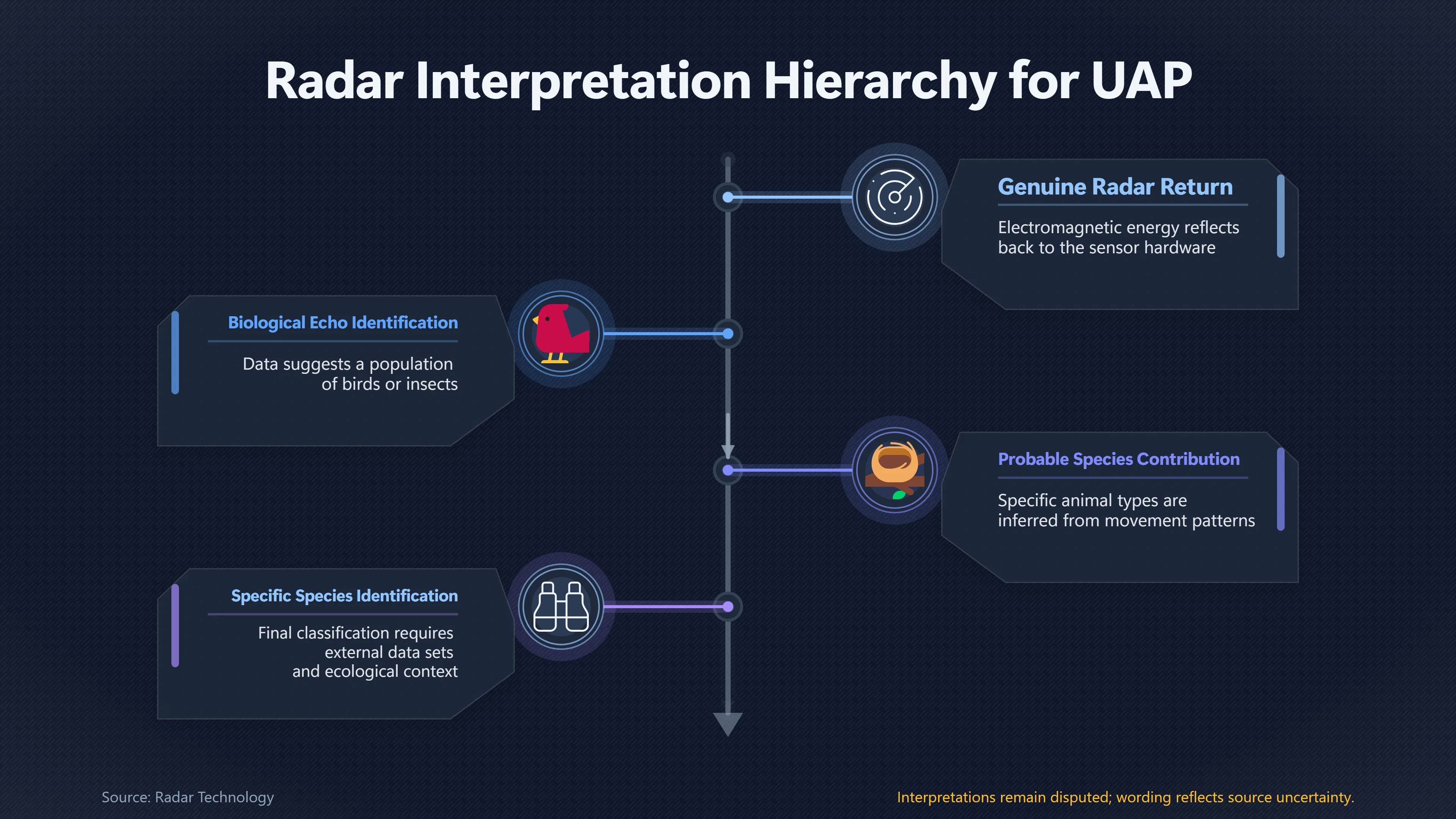
Radar return → likely biological echo → probable bird or insect contribution → particular species
Each step requires more evidence than the one before it. Reversing that logic — treating an unidentified return immediately as a specific kind of craft — makes the same inferential mistake in the opposite direction.
Movement alone does not make an echo an aircraft
Doppler radar can make biological echoes appear especially persuasive because they have measurable motion. Birds genuinely fly under their own power, while insects may combine active flight with transport by the surrounding wind. Their radar velocities are therefore real measurements rather than display noise.
But a measured radial velocity still requires interpretation. Weather radar measures only the component of motion towards or away from the sensor, and a radar sampling volume can contain large numbers of organisms with somewhat different headings and speeds. The apparent movement of an echo pattern can consequently describe a population rather than a single compact body.
This is why radar ecologists can infer migration direction, intensity and flight behaviour from biological echoes. Purdue University’s radar-aeroecology programme notes that NEXRAD data are used to study migration intensity and track, while dual-polarisation measurements have added information about the orientation of airborne migrants. In other words, biological returns can possess organised motion and directional structure — characteristics that, without context, might make an unidentified radar feature seem more aircraft-like than random clutter.[Purdue AeroEco Lab]aeroecolab.comOpen source on aeroecolab.com.
There is also a useful distinction between airspeed and ground movement. Insects transported by strong winds may travel rapidly relative to the ground even though their own flight speed is modest. Birds likewise exploit or compensate for winds during migration. Consequently, a velocity inferred from radar cannot safely be converted into assumptions about propulsion or vehicle performance until wind, geometry and target classification have been considered.
What biological echoes mean for UAP claims
Birds and insects offer a particularly instructive counterexample to the idea that a “confirmed radar return” necessarily strengthens a UAP case towards an exotic interpretation. Unlike electronic noise, these organisms are physically present in the atmosphere. The radar can be operating correctly and the detection can be completely genuine while the interpretation of the target is wrong.
For an unusual radar target, biological contamination becomes more plausible when several features occur together: the return is concentrated at altitudes and times associated with migration or insect activity; many weak targets or broad areas of reflectivity appear rather than a stable aircraft-like track; velocities are broadly compatible with winds or animal movement; polarimetric variables indicate non-meteorological, non-aircraft scatterers; or the pattern develops around sunset, sunrise, a known roost or a migration corridor. Weather-radar research shows that these are measurable population phenomena, not speculative explanations invented specifically for UFO reports.[USGS]usgs.govRadar analysis of fall bird migration stopover sites in the Northeastern U.S. | U.S. Geological SurveyJune 30, 2012…
Conversely, simply saying “birds” is not enough to explain every unexplained radar target. A credible biological explanation should fit the radar frequency and sensitivity, altitude, signal strength, velocity, spatial distribution, season, time of day and local ecology. A well-resolved target maintaining aircraft-like behaviour across independent radar systems may require a different explanation. The scientific value of biological echoes lies precisely in being a testable alternative hypothesis, not a universal dismissal.
The strongest investigations therefore combine radar information with independent evidence. Optical or infrared observations, other radars, weather data, known bird-migration activity, wind profiles and the detailed characteristics of the radar return can all help determine what was actually present. The history of radar ornithology itself was built by comparing unusual echoes with observations and biological behaviour rather than identifying targets from an isolated blip alone.[PubMed]pubmed.ncbi.nlm.nih.govDetection of bird migration by centimetric radar; a cause of radar angels - PubMedDecember 24, 1958…
The key distinction: real echo, uncertain identity
Bird and insect echoes show why “real” and “unidentified” are not synonyms for “technological”. Radar is sufficiently sensitive to wildlife that scientists now use operational weather networks to map bird migration, locate stopover habitat and investigate airborne insect populations. What once appeared as unwanted or mysterious clutter has become useful ecological information.[USGS]usgs.govRadar TechnologyRadar Technology - A Tool for Understanding Migratory Aerofauna | U.S. Geological Survey…
For UAP analysis, the practical rule is straightforward: establishing that a radar return was genuine answers only the first question. Investigators must still determine whether the reflector was one aircraft, several objects, a population of birds or insects, precipitation, another source of clutter, or something genuinely unresolved. Biological echoes demonstrate especially clearly that a radar system can faithfully detect something in the sky while a human observer can still be mistaken about what that something is.
Amazon book picks
Further Reading
Books and field guides related to Can Birds and Insects Look Like UFOs on Radar?. Use these as the next step if you want deeper reading beyond the article.
Doppler Radar and Weather Observations
Doppler Radar and Weather Observations deals with the use of Doppler radar to make observations of a variety of weather phenomena such as...
Radar Entomology: Observing Insect Flight and Migration
This book (10 chapters) covers radar entomology and its application in the study and monitoring of insect flight and migration. Chapter 1...
Introduction to Radar Systems
Since the publication of the second edition of "Introduction to Radar Systems," there has been continual development of new radar capabil...
eBay marketplace picks
Marketplace Samples
Live-tested eBay searches with available results related to this page.
Selected fromUFO poster oneBay.co.uk.

Current eBay listing
VINTAGE UFO FLYING SAUCERS COMIC ADVERTISING A2 POSTER PRINT


Current eBay listing
I Want To Believe UFO Poster Giclée Fine Art Heavyweight Print
Endnotes
1.
Source: usgs.gov
Link:https://www.usgs.gov/publications/radar-analysis-fall-bird-migration-stopover-sites-northeastern-us-0
Source snippet
Radar analysis of fall bird migration stopover sites in the Northeastern U.S. | U.S. Geological SurveyJune 30, 2012...
Published: June 30, 2012
2.
Source: usgs.gov
Title: Radar Technology
Link:https://www.usgs.gov/centers/norock/science/radar-technology-tool-understanding-migratory-aerofauna
Source snippet
Radar Technology - A Tool for Understanding Migratory Aerofauna | U.S. Geological Survey...
3.
Source: ntrs.nasa.gov
Title: Technical Reports Server Birds and insects as radar targets
Link:https://ntrs.nasa.gov/citations/19850045677
Source snippet
NASA Technical Reports ServerBirds and insects as radar targets - A review - NASA Technical Reports Server (NTRS)...
4.
Source: usgs.gov
Link:https://www.usgs.gov/centers/national-innovation-center/science/new-wildlife-tag-enabling-animal-[tracking
Source snippet
New Wildlife Tag Enabling Animal Tracking Using Weather Radar | U.S. Geological SurveyApril 1, 2022...
Published: April 1, 2022
5.
Source: weather.gov
Title: National Weather Service What is Dual-Pol?
Link:https://www.weather.gov/jan/dualpolupgrade-about
6.
Source: weather.gov
Title: National Weather Service Dual Polarization Technology
Link:https://www.weather.gov/hun/radar_dual_pole
7.
Source: repository.library.noaa.gov
Link:https://repository.library.noaa.gov/view/noaa/32181
8.
Source: repository.library.noaa.gov
Link:https://repository.library.noaa.gov/view/noaa/34122
9.
Source: preview.weather.gov
Link:https://preview.weather.gov/ewx/radar
10.
Source: usgs.gov
Link:https://www.usgs.gov/centers/wetland-and-aquatic-research-center/science/western-us-using-networked-weather-radar-and
11.
Source: weather.gov
Link:https://www.weather.gov/zse/OLv6?artcc=1&colorfill=1&ln=-120.5<=44.8&namr=1&obs=15&otherkml=zse&priority=8&zm=6
12.
Source: preview.weather.gov
Link:https://preview.weather.gov/zse/WeatherLoop
13.
Source: weather.gov
Title: ZS E Weather Loop
Link:https://www.weather.gov/zse/WeatherLoop
14.
Source: forecast.weather.gov
Link:https://forecast.weather.gov/product.php?format=CI&glossary=0&issuedby=OHX&product=AFD&site=BIS&version=20
15.
Source: forecast.weather.gov
Link:https://forecast.weather.gov/product.php?format=CI&glossary=1&issuedby=OHX&product=AFD&site=LWX&version=19
16.
Source: marine.weather.gov
Link:https://marine.weather.gov/product.php?format=CI&glossary=1&issuedby=OHX&product=AFD&site=JAX&version=11
17.
Source: marine.weather.gov
Link:https://marine.weather.gov/product.php?format=CI&glossary=1&issuedby=OHX&product=AFD&site=JAX&version=10
18.
Source: forecast.weather.gov
Link:https://forecast.weather.gov/product.php?format=CI&glossary=0&issuedby=RNK&product=PNS&site=NWS&version=6
19.
Source: forecast.weather.gov
Link:https://forecast.weather.gov/product.php?format=CI&glossary=1&issuedby=RNK&product=PNS&site=PPG&version=6
20.
Source: sanctuaries.noaa.gov
Title: osprey banding at mallow bay
Link:https://sanctuaries.noaa.gov/notes/2025/osprey-banding-at-mallow-bay.html
21.
Source: birdcast.info
Title: research what did birds insects do during the 2017 solar eclipse
Link:https://birdcast.info/news/research-what-did-birds-insects-do-during-the-2017-solar-eclipse/
22.
Source: repository.library.noaa.gov
Link:https://repository.library.noaa.gov/view/noaa/61003
23.
Source: weather.gov
Title: New Radar Webpage (RIDGE2) Frequently Asked Questions
Link:https://www.weather.gov/radarfaq
24.
Source: weather.gov
Title: Tracking Mayflies
Link:https://www.weather.gov/arx/mayfly_tracking?platform=hootsuite
25.
Source: preview.weather.gov
Title: mayfly tracking
Link:https://preview.weather.gov/arx/mayfly_tracking
26.
Source: fisheries.noaa.gov
Title: animated visualizations salmon smolt behavior aid recovery
Link:https://www.fisheries.noaa.gov/new-england-mid-atlantic/science-data/animated-visualizations-salmon-smolt-behavior-aid-recovery
27.
Source: birdcast.info
Title: Weather radars’ role in biodiversity monitoring
Link:https://birdcast.info/news/weather-radars-role-in-biodiversity-monitoring/
28.
Source: repository.library.noaa.gov
Link:https://repository.library.noaa.gov/view/noaa/67663
29.
Source: birdcast.info
Title: Laura: a dangerous major hurricane
Link:https://birdcast.info/news/laura-to-become-a-major-hurricane/
30.
Source: restoreactscienceprogram.noaa.gov
Title: partly cloudy with a chance of migrating birds
Link:https://restoreactscienceprogram.noaa.gov/living-coastal-and-marine-resources/partly-cloudy-with-a-chance-of-migrating-birds
31.
Source: fisheries.noaa.gov
Link:https://www.fisheries.noaa.gov/inport/item/54278
32.
Source: fisheries.noaa.gov
Link:https://www.fisheries.noaa.gov/inport/item/43933
33.
Source: birdcast.info
Link:https://birdcast.info/news/research-seasonal-abundance-and-survival-of-north-americas-migratory-avifauna-determined-by-weather-radar/
34.
Source: birdcast.info
Title: Weather surveillance radar: beyond meteorology
Link:https://birdcast.info/news/weather-surveillance-radar-beyond-meteorology/
35.
Source: birdcast.info
Title: traffic report northeastern us 13 20 october 2016
Link:https://birdcast.info/news/traffic-report-northeastern-us-13-20-october-2016/
Published: october 2016
36.
Source: usgs.gov
Link:https://www.usgs.gov/centers/eesc/science/radar-analysis-fall-migration-stopover-sites-northeastern-us
37.
Source: usgs.gov
Title: Nex Rad Composite.jpg | U.S. Geological Survey
Link:https://www.usgs.gov/media/images/nexradcompositejpg
38.
Source: usgs.gov
Title: Realizing the biological potential of weather radar | U.S. Geological Survey
Link:https://www.usgs.gov/centers/norock/science/realizing-biological-potential-weather-radar
39.
Source: usgs.gov
Link:https://www.usgs.gov/centers/norock/science/ecology-behavior-and-conservation-migratory-birds
40.
Source: birdcast.info
Title: traffic report northeastern us 3 23 september 2015
Link:https://birdcast.info/news/traffic-report-northeastern-us-3-23-september-2015/
Published: september 2015
41.
Source: usgs.gov
Link:https://www.usgs.gov/publications/radar-analysis-fall-bird-migration-stopover-sites-northeastern-us
42.
Source: inside.nssl.noaa.gov
Title: user defined resolution in w2birddensity
Link:https://inside.nssl.noaa.gov/wdssii/2014/03/user-defined-resolution-in-w2birddensity/
43.
Source: weather.gov
Title: Life-saving technology upgrade coming to a Doppler radar near you
Link:https://www.weather.gov/news/080212-dual
44.
Source: birdcast.info
Title: migration report 16 22 march 2012
Link:https://birdcast.info/news/migration-report-16-22-march-2012/
Published: march 2012
45.
Source: birdcast.info
Title: Understanding Radar and Birds: Part 1
Link:https://birdcast.info/news/understanding-radar-and-birds-part-1/
46.
Source: usgs.gov
Link:https://www.usgs.gov/publications/partly-cloudy-a-chance-migration-weather-radars-and-aeroecology
47.
Source: usgs.gov
Link:https://www.usgs.gov/publications/potential-use-weather-radar-study-movements-wintering-waterfowl
48.
Source: weather.gov
Title: 081110 roostring
Link:https://www.weather.gov/grb/081110_roostring
49.
Source: usgs.gov
Link:https://www.usgs.gov/publications/new-software-methods-radar-ornithology-using-wsr-88d-weather-data-and-potential
50.
Source: weather.gov
Link:https://www.weather.gov/abr/nwsdopplerradardetectsgeesemigration
51.
Source: usgs.gov
Link:https://www.usgs.gov/publications/management-and-research-applications-long-range-surveillance-radar-data-birds-bats-and
52.
Source: weather.gov
Title: 081006 roostring
Link:https://www.weather.gov/grb/081006_roostring
53.
Source: ncei.noaa.gov
Link:https://www.ncei.noaa.gov/access/metadata/landing-page/bin/iso?id=gov.noaa.ncdc%3AC00708
54.
Source: pubs.usgs.gov
Link:https://pubs.usgs.gov/publication/70202107
55.
Source: pubs.usgs.gov
Link:https://pubs.usgs.gov/publication/70043805
56.
Source: nssl.noaa.gov
Link:https://www.nssl.noaa.gov/tools/radar/dualpol/
57.
Source: ncei.noaa.gov
Link:https://www.ncei.noaa.gov/access/metadata/landing-page/bin/iso?id=gov.noaa.ncdc%3AC00345
58.
Source: restoreactscienceprogram.noaa.gov
Title: migratory birds
Link:https://restoreactscienceprogram.noaa.gov/projects/migratory-birds
59.
Source: ncei.noaa.gov
Link:https://www.ncei.noaa.gov/products/radar
60.
Source: inside.nssl.noaa.gov
Title: benjamin herzog
Link:https://inside.nssl.noaa.gov/wdssii/author/benjamin-herzog/
61.
Source: prod-01-asg-www-climate.woc.noaa.gov
Title: radar maps and animations map viewer
Link:https://prod-01-asg-www-climate.woc.noaa.gov/maps-data/dataset/radar-maps-and-animations-map-viewer
62.
Source: ncei.noaa.gov
Title: next generation weather radar
Link:https://www.ncei.noaa.gov/index.php/products/radar/next-generation-weather-radar
63.
Source: ncei.noaa.gov
Title: interactive map tool
Link:https://www.ncei.noaa.gov/products/radar/interactive-map-tool
64.
Source: repository.library.noaa.gov
Link:https://repository.library.noaa.gov/view/noaa/25696
65.
Source: repository.library.noaa.gov
Link:https://repository.library.noaa.gov/view/noaa/6942
66.
Source: inside.nssl.noaa.gov
Link:https://inside.nssl.noaa.gov/wdssii/topic/tips/
67.
Source: weather.gov
Link:https://www.weather.gov/mlb/Doppler_Dual_Pol_Weather_Radar
68.
Source: weather.gov
Link:https://www.weather.gov/hun/dualpol
69.
Source: weather.gov
Link:https://www.weather.gov/iln/birds
70.
Source: weather.gov
Link:https://www.weather.gov/iwx/wsr_88d
71.
Source: weather.gov
Link:https://www.weather.gov/okx/tour_doppler_radar
72.
Source: weather.gov
Title: Tampa Bay Office Tour Radar
Link:https://www.weather.gov/tbw/tampabayofficetourradar
73.
Source: weather.gov
Link:https://www.weather.gov/rah/virtualtourradar
74.
Source: weather.gov
Link:https://www.weather.gov/cle/area_radars
75.
Source: weather.gov
Link:https://www.weather.gov/grb/radar_birds
76.
Source: weather.gov
Link:https://www.weather.gov/bgm/researchRadarandBirds1997
77.
Source: forecast.weather.gov
Link:https://forecast.weather.gov/glossary.php?word=reflectivity
78.
Source: forecast.weather.gov
Link:https://forecast.weather.gov/glossary.php?word=a
79.
Source: forecast.weather.gov
Link:https://forecast.weather.gov/glossary.php?word=RADAR
80.
Source: weather.gov
Title: National Weather Service Glossary ‘A’ALF
Link:https://www.weather.gov/ggw/GlossaryA
81.
Source: forecast.weather.gov
Link:https://forecast.weather.gov/glossary.php?word=s
82.
Source: forecast.weather.gov
Link:https://forecast.weather.gov/glossary.php?letter=a
83.
Source: forecast.weather.gov
Link:https://forecast.weather.gov/glossary.php?word=n
84.
Source: weather.gov
Link:https://www.weather.gov/jan/dualpol
85.
Source: weather.gov
Link:https://www.weather.gov/jan/dualpolupgrade-products
86.
Source: weather.gov
Title: Dual Pol KNQANATIONAL WEATHER SERVICE
Link:https://www.weather.gov/meg/dualpol
87.
Source: weather.gov
Link:https://www.weather.gov/wrn/current-ambassadors
88.
Source: training.weather.gov
Title: Section1 2
Link:https://training.weather.gov/nwstc/NEXRAD/RADAR/Section1-2.html
89.
Source: training.weather.gov
Link:https://training.weather.gov/wdtd/buildTraining/build21/index.php
90.
Source: training.weather.gov
Link:https://training.weather.gov/wdtd/buildTraining/build18/index.php
91.
Source: weather.gov
Link:https://www.weather.gov/bmx/radar_aboutnwsradar_howdoesitwork
92.
Source: birdcast.org
Link:https://birdcast.org/frequently-asked-questions/
93.
Source: birdcast.info
Title: Products, Data, and Interpretation
Link:https://birdcast.info/about/review/
94.
Source: birdcast.info
Title: A primer for using weather surveillance radar to study bird migration
Link:https://birdcast.info/category/resources/
95.
Source: birdcast.info
Title: A primer for using weather surveillance radar to study bird migration
Link:https://birdcast.info/category/migration/
96.
Source: pmc.ncbi.nlm.nih.gov
Title: Pub Med Central (PMC)Monitoring aerial insect biodiversity: a radar perspective
Link:https://pmc.ncbi.nlm.nih.gov/articles/PMC11070259/
Source snippet
PubMed Central (PMC)Monitoring aerial insect biodiversity: a radar perspective - PMC...
97.
Source: pubmed.ncbi.nlm.nih.gov
Link:https://pubmed.ncbi.nlm.nih.gov/13623800/
Source snippet
Detection of bird migration by centimetric radar; a cause of radar angels - PubMedDecember 24, 1958...
Published: December 24, 1958
98.
Source: journals.ametsoc.org
Link:https://journals.ametsoc.org/view/journals/atot/aop/JTECH-D-20-0180.1/JTECH-D-20-0180.1.xml
Source snippet
American Meteorological Society JournalsA Machine Learning Approach for Classifying Bird and Insect Radar Echoes with S-Band Polarimetric...
99.
Source: allaboutbirds.org
Link:https://www.allaboutbirds.org/news/can-you-really-use-weather-radar-to-see-migrating-birds/
100.
Source: allaboutbirds.org
Link:https://www.allaboutbirds.org/news/heres-how-to-use-the-new-migration-forecast-tools-from-birdcast/
101.
Source: pmc.ncbi.nlm.nih.gov
Link:https://pmc.ncbi.nlm.nih.gov/articles/PMC9790603/
102.
Source: metoffice.gov.uk
Title: Met Office Raindrops and radar
Link:https://www.metoffice.gov.uk/research/weather/observations-research/raindrops-and-radar
103.
Source: aeroecolab.com
Link:https://aeroecolab.com/radar-aeroecology
104.
Source: weather.metoffice.gov.uk
Title: metoffice.gov.uk U K rainfall radar map
Link:https://weather.metoffice.gov.uk/maps-and-charts/rainfall-radar-forecast-map?viewClass=Print
105.
Source: weather.metoffice.gov.uk
Title: metoffice.gov.uk U K rainfall radar map
Link:https://weather.metoffice.gov.uk/maps-and-charts/rainfall-radar-forecast-map
106.
Source: weather.metoffice.gov.uk
Title: metoffice.gov.uk U K rainfall radar map with accessible colours
Link:https://weather.metoffice.gov.uk/maps-and-charts/rainfall-radar-forecast-accessible-colours-map
107.
Source: weather.metoffice.gov.uk
Title: metoffice.gov.uk U K rainfall radar map
Link:https://weather.metoffice.gov.uk/maps-and-charts/rainfall-radar-forecast-map?s=cl
108.
Source: aeroecolab.com
Title: Purdue Aero Eco Lab
Link:https://aeroecolab.com/
109.
Source: allaboutbirds.org
Title: The Basics of Bird Migration: How, Why, When, and Where | All About Birds
Link:https://www.allaboutbirds.org/news/the-basics-how-why-and-where-of-bird-migration/
110.
Source: allaboutbirds.org
Title: Birding with Insight: Cornell Lab Tools for Better Birding | All About Birds
Link:https://www.allaboutbirds.org/news/insight-better-birding-tools/
111.
Source: pmc.ncbi.nlm.nih.gov
Link:https://pmc.ncbi.nlm.nih.gov/articles/PMC12625803/
112.
Source: metoffice.gov.uk
Link:https://www.metoffice.gov.uk/blog/2025/how-does-the-met-office-use-radar-for-weather-forecasts
113.
Source: metoffice.gov.uk
Title: Met Office Deep Dive: Record heat, flying ants, and a changeable outlook
Link:https://www.metoffice.gov.uk/blog/2025/met-office-deep-dive-record-heat-flying-ants-and-a-changeable-outlook
114.
Source: allaboutbirds.org
Link:https://www.allaboutbirds.org/news/when-will-spring-bird-migration-hit-its-peak-birdcast-has-answers/
115.
Source: pmc.ncbi.nlm.nih.gov
Link:https://pmc.ncbi.nlm.nih.gov/articles/PMC11070261/
116.
Source: metoffice.gov.uk
Title: Fourth Calibration and Monitoring Workshop Programme
Link:https://www.metoffice.gov.uk/research/approach/collaboration/wxrcalmon-2023-programme
117.
Source: allaboutbirds.org
Link:https://www.allaboutbirds.org/news/bright-lights-and-big-data-radar-ornithology-and-the-rise-of-birdcast/
118.
Source: allaboutbirds.org
Link:https://www.allaboutbirds.org/news/im-getting-a-little-tired-of-winter-what-are-some-of-the-first-spring-birds-to-arrive-and-when-will-they-get-here/
119.
Source: allaboutbirds.org
Link:https://www.allaboutbirds.org/news/new-birdcast-dashboard-spotlights-the-hottest-states-and-counties-for-bird-migration/
120.
Source: pmc.ncbi.nlm.nih.gov
Link:https://pmc.ncbi.nlm.nih.gov/articles/PMC9339755/
121.
Source: academy.allaboutbirds.org
Link:https://academy.allaboutbirds.org/live-event/the-birdcast-dashboard-live-radar-tracking-of-bird-migration-in-your-county-and-state/
122.
Source: allaboutbirds.org
Link:https://www.allaboutbirds.org/news/new-birdcast-analysis-shows-how-high-migrating-birds-fly/
123.
Source: journals.ametsoc.org
Link:https://journals.ametsoc.org/abstract/journals/atot/38/10/JTECH-D-20-0180.1.xml
124.
Source: pmc.ncbi.nlm.nih.gov
Link:https://pmc.ncbi.nlm.nih.gov/articles/PMC7923785/
125.
Source: academy.allaboutbirds.org
Title: birdcast learn when and where birds migrate
Link:https://academy.allaboutbirds.org/live-event/birdcast-learn-when-and-where-birds-migrate/
126.
Source: metoffice.gov.uk
Title: An improved picture for weather radar
Link:https://www.metoffice.gov.uk/about-us/news-and-media/media-centre/weather-and-climate-news/2018/an-improved-picture-for-weather-radar
127.
Source: journals.ametsoc.org
Link:https://journals.ametsoc.org/abstract/journals/amsm/59/1/amsmonographs-d-18-0006.1.xml
128.
Source: journals.ametsoc.org
Link:https://journals.ametsoc.org/view/journals/atot/32/4/jtech-d-13-00247_1.xml
129.
Source: allaboutbirds.org
Link:https://www.allaboutbirds.org/news/eight-intriguing-migration-mysteries-solved-with-birdcast-and-ebird/
130.
Source: pmc.ncbi.nlm.nih.gov
Link:https://pmc.ncbi.nlm.nih.gov/articles/PMC3024816/
131.
Source: pubmed.ncbi.nlm.nih.gov
Link:https://pubmed.ncbi.nlm.nih.gov/21669769/
132.
Source: journals.ametsoc.org
Title: jtech2038 1.xml
Link:https://journals.ametsoc.org/view/journals/atot/24/7/jtech2038_1.xml
133.
Source: journals.ametsoc.org
Title: 1520 0426 1997 014 0538 aiapso 2 0 co 2.xml
Link:https://journals.ametsoc.org/view/journals/atot/14/3/1520-0426_1997_014_0538_aiapso_2_0_co_2.xml
134.
Source: journals.ametsoc.org
Title: 1520 0426 1985 002 0049 ioudpr 2 0 co 2.xml
Link:https://journals.ametsoc.org/view/journals/atot/2/1/1520-0426_1985_002_0049_ioudpr_2_0_co_2.xml
135.
Source: journals.ametsoc.org
Link:https://journals.ametsoc.org/collection/atot?access=all&page=55&pageSize=10&print=&sort=datedescending&t_0=hans-ertel
136.
Source: glossary.ametsoc.org
Link:https://glossary.ametsoc.org/wiki/angel/
137.
Source: library.metoffice.gov.uk
Link:https://library.metoffice.gov.uk/portal/Default/en-GB/RecordView/Index/218986
138.
Source: metoffice.gov.uk
Title: Biodiversity at the Met Office
Link:https://www.metoffice.gov.uk/about-us/who-we-are/our-values/sustainability/biodiversity
139.
Source: library.metoffice.gov.uk
Title: Record View
Link:https://library.metoffice.gov.uk/portal/Default/en-GB/RecordView/Index/416274
140.
Source: library.metoffice.gov.uk
Link:https://library.metoffice.gov.uk/Portal/recordview/index/633814
141.
Source: library.metoffice.gov.uk
Link:https://library.metoffice.gov.uk/Portal/Default/RecordView/Index/153544
142.
Source: library.metoffice.gov.uk
Link:https://library.metoffice.gov.uk/Portal/Default/en-GB/RecordView/Index/169073
143.
Source: library.metoffice.gov.uk
Title: Record View
Link:https://library.metoffice.gov.uk/portal/Default/en-GB/RecordView/Index/235888
144.
Source: library.metoffice.gov.uk
Link:https://library.metoffice.gov.uk/Portal/Default/en-GB/recordview/index/633104
145.
Source: library.metoffice.gov.uk
Link:https://library.metoffice.gov.uk/portal/Default/en-GB/RecordView/Index/336784
146.
Source: library.metoffice.gov.uk
Link:https://library.metoffice.gov.uk/Portal/Default/en-GB/recordview/index/633193
147.
Source: metoffice.gov.uk
Title: East Anglian radar project
Link:https://www.metoffice.gov.uk/research/weather/observations-research/east-anglian-radar-project
148.
Source: metoffice.gov.uk
Title: New radar noise level estimator
Link:https://www.metoffice.gov.uk/research/news/2019/new-radar-noise-level-estimator
149.
Source: weather.metoffice.gov.uk
Title: metoffice.gov.uk Latest weather observations guide
Link:https://weather.metoffice.gov.uk/guides/observations/latest-weather-observations-guide
150.
Source: weather.metoffice.gov.uk
Title: metoffice.gov.uk U K rainfall radar map
Link:https://weather.metoffice.gov.uk/maps-and-charts/rainfall-radar-forecast-map?fs=e
151.
Source: metoffice.gov.uk
Title: Weather radar network renewal
Link:https://www.metoffice.gov.uk/services/business-industry/water/radar-improvements
152.
Source: metoffice.gov.uk
Title: Radar systems
Link:https://www.metoffice.gov.uk/research/weather/observations-research/radar-systems
153.
Source: weather.metoffice.gov.uk
Title: metoffice.gov.uk Met Office app FAQs
Link:https://weather.metoffice.gov.uk/weather-app/faqs
154.
Source: weather.metoffice.gov.uk
Title: metoffice.gov.uk How do we measure the weather?
Link:https://weather.metoffice.gov.uk/learn-about/met-office-for-schools/other-content/other-resources/how-to-measure-the-weather
155.
Source: weather.metoffice.gov.uk
Title: metoffice.gov.uk U K rainfall radar map
Link:https://weather.metoffice.gov.uk/maps-and-charts/rainfall-radar-forecast-map?em_x=22
Additional References
156.
Source: youtube.com
Title: Ep 44 Birds, Storms and Wind Farms: The Science of Aeroecology
Link:https://www.youtube.com/watch?v=V9Cilf2Zz5A
Source snippet
This video explains how early radar operators misidentified bird flocks as unknown targets ("angels") and details how radar ornithology d...
157.
Source: science.gov
Link:https://www.science.gov/topicpages/r/radar%2Bcross-section%2Brcs
158.
Source: youtube.com
Title: Flight Paths: How Scientists Solved the Mystery of Bird Migration
Link:https://www.youtube.com/watch?v=dRnFsGN0dZo
Source snippet
How Does Weather Radar Track Bird Migration?...
159.
Source: youtube.com
Title: Taking Radar Aeroecology into the 21st Century
Link:https://www.youtube.com/watch?v=uwvXKmOViws
Source snippet
Ep 44 Birds, Storms and Wind Farms: The Science of Aeroecology...
160.
Source: growkudos.com
Link:https://www.growkudos.com/publications/10.1002%25252Fecs2.70419/reader
161.
Source: doi.org
Link:https://doi.org/10.1002/rse2.101
162.
Source: eurekamag.com
Link:https://eurekamag.com/research/083/199/083199767.php
163.
Source: lgl.com
Link:https://lgl.com/publications-birds/
164.
Source: lulu.com
Link:https://www.lulu.com/shop/t-s-roelofs-and-alfred-steber/unseen-encounters-angels-phantoms-and-ufos-on-us-radars-characteristics-of-trackable-radar-angels/paperback/product-p67yv68.html
165.
Source: royalsocietypublishing.org
Link:https://royalsocietypublishing.org/doi/10.1098/rspa.2019.0777