Within Parallax
Why the Go Fast UFO Looked So Fast
The GoFast footage looked extraordinarily fast, but reconstructed geometry showed that aircraft motion and range could explain the effect.
On this page
- What the sensor display actually measured
- How aircraft motion changed the viewing geometry
- Why reconstructed speeds were not extraordinary
Page outline Jump by section
Introduction
The 2015 “GoFast” video is memorable because it seems to show a small object racing just above the Atlantic at extraordinary speed. Yet the numbers recorded on the targeting-pod display tell a much less dramatic story. They place the object at roughly 13,000 feet (4,000 metres), not just above the sea, while the observing F/A-18F was itself moving rapidly at about 25,000 feet. That geometry creates strong motion parallax: as the aircraft changes position, a comparatively slow object appears to sweep across the much more distant ocean background.[Metabunk]metabunk.orgOpen source on metabunk.org.
NASA’s 2023 UAP study used the displayed geometry to estimate an average target speed of about 40 mph (64 km/h), while acknowledging important uncertainties. AARO subsequently performed a more extensive reconstruction and concluded with high confidence that GoFast showed no anomalous speed or other exceptional performance. The object’s precise identity remains uncertain, but the feature that gave the video its name — apparently tremendous speed — does not survive geometric reconstruction.[UFO Transparency]ufotransparency.comOpen source on ufotransparency.com.
What the sensor display actually measured
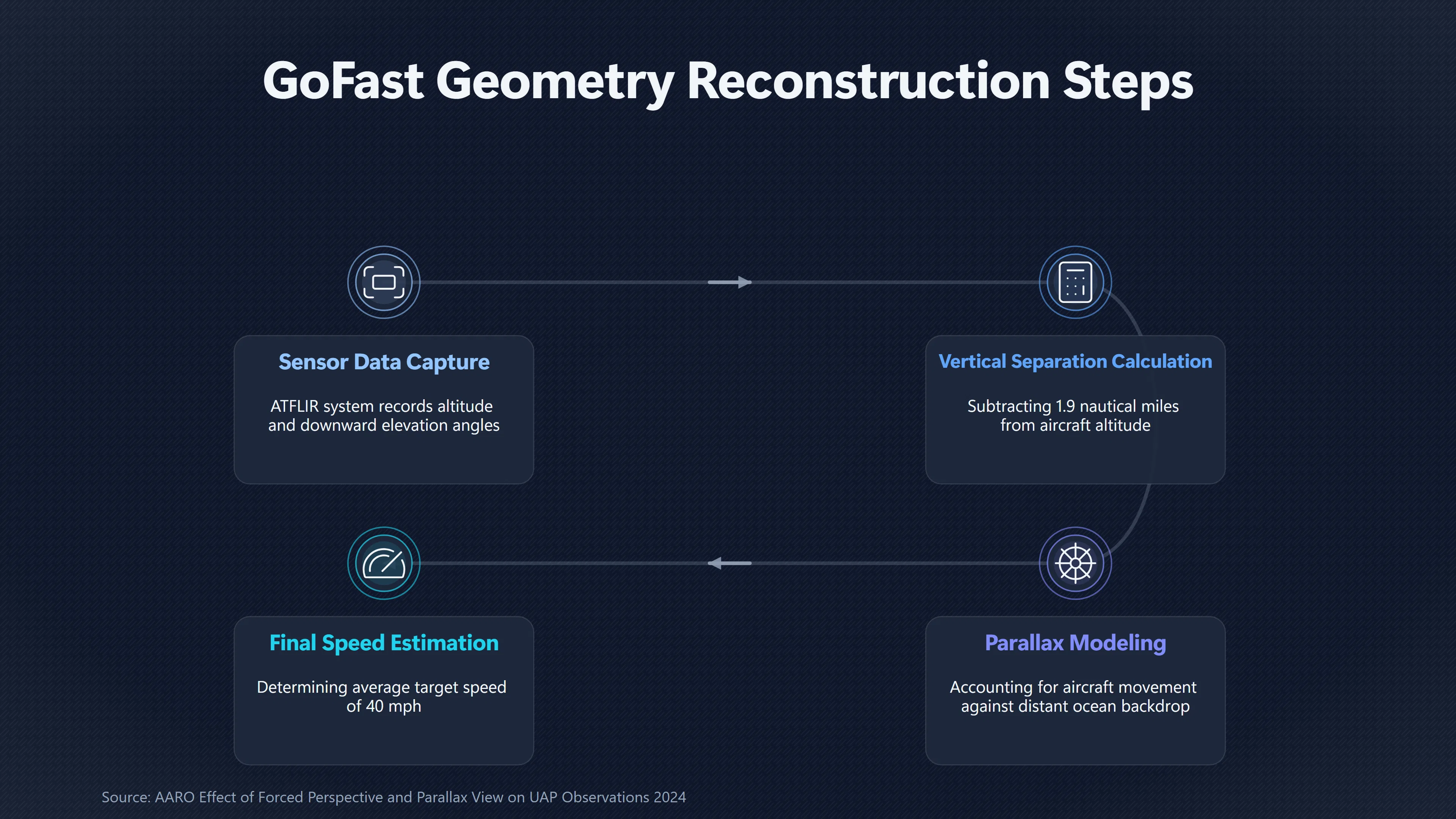
GoFast was recorded in January 2015 by a US Navy F/A-18F operating off the eastern coast of Florida. The 34-second public video came from an infrared targeting system, commonly described as ATFLIR, rather than an ordinary handheld camera. Alongside the small tracked object, the display recorded numerical information about the aircraft and sensor geometry.[AARO]aaro.milOpen source on aaro.mil.
Those numbers are crucial because the eye alone provides almost no useful scale. There are no nearby buildings, vehicles or other familiar objects against which to judge the target’s size, height or speed. The ocean is effectively a distant textured backdrop.
The display includes the aircraft’s altitude and airspeed, the camera’s azimuth and downward elevation angle, and a range to the tracked object. Around the time tracking begins, the aircraft is at roughly 25,000 feet, the target range reads about 4.4 nautical miles, and the sensor is looking approximately 26 degrees downwards. As the encounter progresses, the range falls and the viewing angle becomes steeper.[Metabunk]metabunk.orgOpen source on metabunk.org.
That combination immediately challenges the impression that the target is skimming the waves. If the line-of-sight range is about 4.4 nautical miles and the sensor is looking down by roughly 26 degrees, the vertical separation between aircraft and target is only about 1.9 nautical miles. Subtracting that separation from the aircraft’s altitude puts the target at approximately 13,000 feet above sea level. Later measurements give a similar result.[Metabunk]metabunk.orgOpen source on metabunk.org.
AARO’s later geospatial reconstruction independently arrived at essentially the same altitude. Its February 2025 case-resolution report assessed that the object was approximately 13,000 feet above the ocean. AARO also reported that pixel analysis by an Intelligence Community partner suggested the object was roughly one metre or less in size, although the low-resolution footage was insufficient to determine its identity.[AARO]aaro.milOpen source on aaro.mil.
The distinction between range and speed is important here. A range reading tells investigators where the target lies relative to the aircraft; it does not mean that the object’s spectacular-looking movement against the water is its actual velocity. The geometry still has to be reconstructed.
How aircraft motion created the speed illusion
The counter-intuitive feature of GoFast is that much of the movement visible in the video belongs to the observer, not necessarily to the object.
Imagine looking sideways from a fast train at a bird suspended in the air between the train and a distant hillside. The bird will appear to sweep rapidly across the hillside even if it is moving slowly. The apparent displacement results from the train carrying the observer past the bird. GoFast reproduces that geometry on a much larger scale.
The F/A-18F was travelling at several hundred miles per hour. The target was substantially below it, while the ocean was another 13,000 feet or so beneath the target. As the aircraft moved, the camera continuously viewed the target against different patches of distant water. The infrared tracking system meanwhile kept the small object close to the centre of the image. The result is perceptually compelling: the target stays comparatively fixed while the ocean races behind it, encouraging the viewer to interpret the background movement as evidence that the object itself is racing forwards.[UFO Transparency]ufotransparency.comOpen source on ufotransparency.com.
This is why the object’s altitude matters so much. If it really were a few metres above the waves, its rapid movement across the ocean background could imply a high physical speed. At roughly 13,000 feet, however, there is enormous separation between target and background. The aircraft’s own movement can therefore generate substantial apparent motion through parallax.
The narrow view of a targeting camera strengthens the impression. There is little surrounding scenery to reveal the overall geometry, and the tracking system largely removes the ordinary visual cue of the target moving through the camera’s field of view. What remains is a small, stabilised object with the ocean apparently rushing past it.
That is the central GoFast illusion: the video vividly records angular movement, but angular movement against a distant background is not the same thing as extraordinary target speed.
Why reconstructed speeds were not extraordinary
NASA made GoFast a worked example in its 2023 independent UAP study. Using the telemetry visible in the public video, the study calculated the target’s altitude at about 13,000 feet and reconstructed an overhead view of the encounter. The aircraft was banking left by roughly 15 degrees, corresponding to a turning radius of about 16 kilometres. From the changing range and bearing, NASA’s analysis estimated that the object travelled approximately 390 metres during 22 seconds — an average of about 40 mph.[UFO Transparency]ufotransparency.comOpen source on ufotransparency.com.
That figure should not be treated as a precision measurement. NASA explicitly said its calculation neglected wind effects on the aircraft and therefore contained uncertainty. The important conclusion was narrower: the observations did not require an extraordinarily fast object. A speed of roughly 40 mph was compatible with ordinary atmospheric movement at the estimated altitude.[UFO Transparency]ufotransparency.comOpen source on ufotransparency.com.
AARO later attempted a more detailed reconstruction. Its analysis used the publicly available 34-second video because, according to the agency, the original file and associated metadata were no longer available. Another limitation was that the F/A-18F’s exact geographical position and compass heading were unknown. AARO therefore could not derive one unique target trajectory. Instead, it modelled the possible geometry across the full range of aircraft headings.[AARO]aaro.milOpen source on aaro.mil.
This matters because wind was significant. AARO used historical atmospheric information indicating winds of about 69 mph at 13,000 feet and substantially stronger winds at the aircraft’s altitude. Depending on the unknown heading of the aircraft relative to that wind, the calculated target movement changed. The resulting scenarios nevertheless remained within conventional ranges rather than requiring extreme performance. AARO’s modelling found circumstances in which the object’s motion was close to the prevailing wind, while its wider range of possible motion still produced no anomalous flight characteristics.[AARO]aaro.milOpen source on aaro.mil.
The newer analysis therefore refines rather than overturns NASA’s basic finding. “40 mph” is not a uniquely established speed for the object; it was a useful simplified reconstruction. The stronger conclusion shared by the analyses is that the apparent high velocity in the footage greatly exaggerates what the geometry requires.[UFO Transparency]ufotransparency.comOpen source on ufotransparency.com.
What GoFast does — and does not — resolve
There is an important difference between explaining the apparent speed and identifying the object.
AARO states that it cannot definitively identify the GoFast target. The public footage is low-resolution, and investigators lack some of the information that would be needed for a unique reconstruction, including the aircraft’s precise location and heading. AARO also reported that it sought but was unable to obtain accounts from the F/A-18F aircrew for its published analysis.[AARO]aaro.milOpen source on aaro.mil.
Those limitations leave legitimate uncertainty about what the small object was. They do not restore the original claim that it must have been travelling at an extraordinary velocity. AARO concluded with high confidence that the target exhibited neither anomalous nor exceptional behaviour, and its detailed modelling found the striking visual speed to be explicable through parallax.[AARO]aaro.milOpen source on aaro.mil.
NASA was similarly cautious about identification. Its report noted that the infrared image provided no evidence of a hot propulsion source and suggested that drifting with the wind was plausible, while stressing that additional data would be required for a firmer conclusion about the object’s nature.[UFO Transparency]ufotransparency.comOpen source on ufotransparency.com.
That distinction is useful when assessing UFO footage generally. “Unidentified” describes a failure to establish an object’s identity; it does not automatically validate every apparent characteristic attributed to it. In GoFast, investigators may not be able to say with confidence whether the tiny infrared target was a balloon, bird, drone or something else. They can nevertheless test the much more specific proposition that it was travelling extraordinarily fast.
On that question, the telemetry is unusually informative.
Why GoFast is such a useful parallax case
GoFast became famous largely because the visual impression is so persuasive. The target appears low, the water appears close behind it, and the background races past. Even the aircrew’s audible reaction reinforces the sense that something remarkable has been captured.
Yet the same recording contains much of the information needed to challenge that impression. The displayed range, altitude and viewing angles place the target thousands of feet above the water. Once the aircraft’s own high speed and changing viewing geometry are incorporated, the apparent dash across the ocean becomes compatible with an object moving at an ordinary speed. NASA demonstrated the basic calculation publicly in 2023; AARO’s more elaborate reconstruction subsequently reached the same central conclusion.[ufotransparency.com]ufotransparency.comOpen source on ufotransparency.com.
GoFast therefore illustrates a particularly important cause of apparently extraordinary UFO or UAP performance: a camera can faithfully record what it sees while the viewer misinterprets what the image means geometrically. Nothing has to be fabricated, and the witnesses need not be careless. A fast-moving observing aircraft, an uncertain three-dimensional scene and a distant background are enough to produce a striking speed illusion.
The unresolved part of GoFast is the object’s identity. The supposedly impossible speed is not.
Amazon book picks
Further Reading
Books and field guides related to Why the Go Fast UFO Looked So Fast. Use these as the next step if you want deeper reading beyond the article.
UFOs: Generals, Pilots, and Government Officials Go on the Re...
NEW YORK TIMES BESTSELLER • Impeccably researched, this riveting journalistic investigation separates fact from fiction, and documents th...
Fundamentals of Astrodynamics
Rating: 4.5/5 from 12 Google Books ratings
Teaching text developed by U.S. Air Force Academy and designed as a first course emphasizes the universal variable formulation. Develops...
Sensation and Perception
. Bruce Goldstein's SENSATION AND PERCEPTION, the best-seller which has helped over 150,000 students understand the ties between how we s...
Optics
For courses in Optics A Contemporary Approach to Optics with Practical Applications and New Focused Pedagogy Hecht Optics balances theory...
eBay marketplace picks
Marketplace Samples
Live-tested eBay searches with available results related to this page.
Selected fromnaval aviation poster oneBay.co.uk.




Endnotes
1.
Source: aaro.mil
Title: AARO Effect of Forced Perspective and Parallax View on UAP Observations 2024
Link:https://www.aaro.mil/Portals/136/PDFs/Information%20Papers/AARO_Effect_of_Forced_Perspective_and_Parallax_View_on_UAP_Observations_2024.pdf
2.
Source: aaro.mil
Link:https://www.aaro.mil/FAQ/
Additional References
3.
Source: youtube.com
Link:https://www.youtube.com/watch?v=fh3znHctOkA
Source snippet
This video provides an expert analysis of the "GoFast" footage, detailing how motion parallax and on-screen targeting sensor geometry dem...
4.
Source: youtube.com
Link:https://www.youtube.com/watch?v=mvsU4p0Gsas
Source snippet
Pentagon claims to debunk famous 'GOFAST' UFO [radar]({{ 'radar/' | relative_url }}) video, but still has not ID'd mysterious object...
5.
Source: youtube.com
Title: Quantum physicists analyze pentagon US navy UFO video footage
Link:https://www.youtube.com/watch?v=cwACSrLEPeM
Source snippet
Breaking Down UAP Footage with the Head of The Pentagon's UAP Taskforce, Dr. Jon Kosloski...
6.
Source: youtube.com
Title: Breakdown of the Pentagon UFO videos with Mick West
Link:https://www.youtube.com/watch?v=Le7Fqbsrrm8
Source snippet
Quantum physicists analyze pentagon US navy UFO video footage...
7.
Source: youtube.com
Title: Explained: New Navy UFO Videos
Link:https://www.youtube.com/watch?v=Q7jcBGLIpus
Source snippet
Breakdown of the Pentagon UFO videos with Mick West...