Within UFO Identifications
How Infrared Glare Turns Shapes Into Orbs
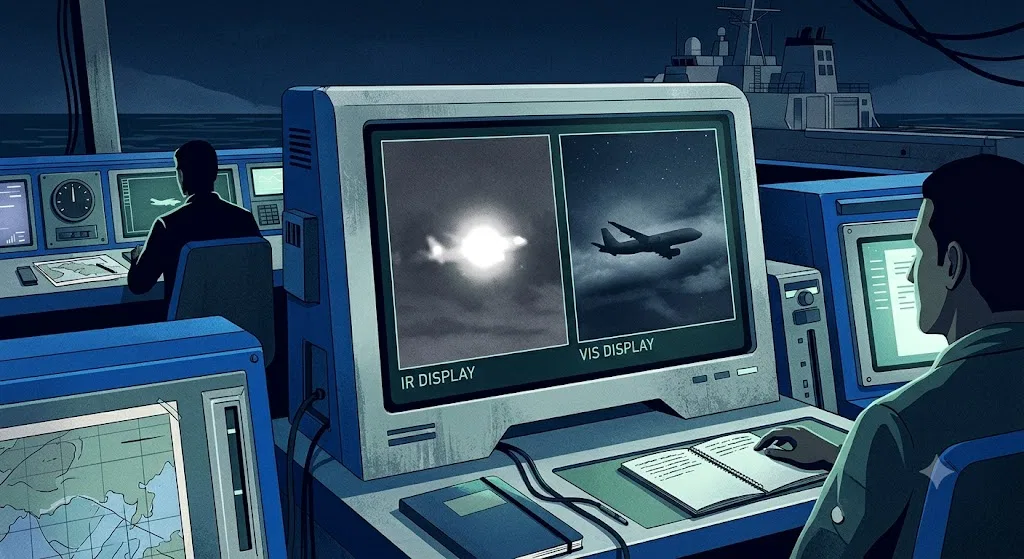
Bright infrared sources can bloom beyond their true outlines, turning structured aircraft or birds into smooth luminous blobs.
On this page
- Why bright targets bloom on infrared sensors
- How glare changes apparent size and outline
- Comparing infrared imagery with other sensor views
Page outline Jump by section
Introduction
Infrared imagery can make an ordinary aircraft, bird or other warm target look far less structured than it really is. The reason is not that infrared cameras literally photograph an object’s physical outline. They record radiation passing through optics, falling across detector pixels and then being processed into a display image. When a source is bright, distant or only marginally resolved, its energy can spread beyond the pixels corresponding to its true silhouette. The result may be a smooth white or black blob, oval or “orb” that is noticeably larger than the underlying target.
This is an important identification risk in UFO and UAP footage. A featureless infrared shape is therefore weak evidence that the physical object itself was featureless. Real optical spreading, limited resolution, saturation, sharpening and display processing can all conceal wings, tails and other identifying structure.[nist.gov]nist.govOpen source on nist.gov.
Why bright targets bloom on infrared sensors
Every imaging system has finite spatial resolution. Even an ideal point source is not reproduced as a perfect geometrical point: the camera’s optics spread its energy into a small pattern described by the point-spread function, or PSF. NIST’s work on infrared imaging explains the principle simply: if perfect optics would place a point of light into one detector pixel, real optics distribute some of that signal over neighbouring pixels. Longer infrared wavelengths also impose poorer diffraction-limited resolution than shorter visible wavelengths when other factors are equal.[NIST Publications]nist.govOpen source on nist.gov.
That distinction becomes especially important with distant aircraft. Suppose an aeroplane is so far away that its fuselage, wings and tail occupy only a handful of independent resolution elements. Its shape is already difficult to recover. If its engines or another part of the target produce a much stronger infrared signal than the airframe, the brightest component can dominate the image and the weaker structural information can effectively disappear.
Brightness can compound the problem. Infrared detectors have finite measurement ranges, and sufficiently strong radiation can exceed the operating range for which an imager is configured. Teledyne FLIR, for example, recommends attenuating exceptionally intense signals with filters when radiation would otherwise exceed a camera’s usable measurement range.[FLIR Customer Support]custhelp.comOpen source on custhelp.com. Saturation is not identical to optical glare, but the effects can reinforce one another: the camera may accurately tell the operator that a powerful source is present while no longer preserving a trustworthy representation of its boundary.
Image formation also continues after radiation reaches the detector. Thermal-camera signals are corrected, digitised, contrast-adjusted and rendered for a human viewer. Research on thermal imagery has shown that image quality and recognisability depend on spatial resolution, contrast, brightness and noise, rather than merely on whether a target was detected at all.[NIST Publications]nist.govOpen source on nist.gov. A target may consequently be conspicuous enough to track while still being too poorly resolved to identify from its displayed silhouette.
This produces a useful distinction for UAP analysis: detection is not the same thing as shape measurement. Seeing a strong infrared return proves that the sensor received contrasting radiation from that direction. It does not automatically establish that the bright region’s displayed edge corresponds to the physical edge of an object.
How glare changes apparent size and outline
The most counter-intuitive consequence is that a bright target can appear larger than the object producing the signal. The wings of a point-spread function become visible farther from its centre as a source grows brighter, while saturation or display clipping can flatten detail near the core. Thermal-imaging research similarly treats blur and the PSF as important limitations on spatial resolution and has demonstrated that deconvolution can recover detail lost through optical spreading.[PubMed Central (PMC)]nih.govOpen source on nih.gov.
For a distant aeroplane, that means the displayed infrared blob can be dominated by thermal radiation from an engine or exhaust region rather than by the visible-light silhouette of the whole aircraft. A recognisable aeroplane viewed optically may therefore become an oval or roughly circular patch in another spectral band. The reverse can also happen: parts of an object that stand out visually may have little thermal contrast and disappear from the infrared image.
Distance makes the ambiguity worse. AARO’s published UAP material includes western-US recordings in which infrared targets appeared only as small dots because they were extremely distant. When analysts combined the full-motion video with commercial flight information, the objects aligned with three separate conventional aircraft.[AARO]aaro.milOpen source on aaro.mil. The example is valuable because it demonstrates that an infrared dot does not imply a physically dot-shaped object: the sensor simply lacked enough angular detail to reproduce the aircraft’s familiar morphology.
AARO’s “Atmospheric Wakes” investigation provides another useful warning about taking infrared morphology literally. Several recordings appeared to show objects with unusual trails or propulsion effects. AARO’s analysis concluded that the supposed wakes were sensor artefacts; one case was associated with an identified commercial Airbus A380, another with a military aircraft, and another object was assessed as probably a conventional aircraft. The office also reported that camera aberration made one object appear oblong.[AARO]aaro.milOpen source on aaro.mil.
These examples involve more than glare alone, but they illustrate the larger interpretive problem: the shape visible on a processed infrared display can contain characteristics produced by the imaging chain rather than by the target.
Brightness also makes pixel counting hazardous. If a luminous patch is several pixels wider than the true unresolved source, treating those bright pixels as the object’s physical diameter will overestimate its size. The problem becomes circular if the estimated size is then used as evidence that the target cannot be an aircraft, bird or other conventional object. Without knowing the sensor’s angular resolution, focus, range, processing mode and response to intense sources, the outer boundary of a glare patch is not a reliable ruler.
When a smooth “orb” may conceal a structured object
The glare explanation is strongest when several features occur together rather than when an image merely looks round.
A distant target is particularly vulnerable when:
- its angular size is close to or below the system’s effective spatial resolution;
- one component, such as an engine or hot exhaust, greatly outshines the rest of the target in the infrared band;
- the object’s apparent diameter changes as brightness, contrast settings or imaging mode change;
- edges remain soft while the central signal is strongly clipped or saturated;
- greater optical resolution reveals previously invisible structure;
- a second sensor, radar track or flight database independently places an ordinary aircraft in the same direction and at the relevant time.
The opposite evidence also matters. If a target remains sharply resolved, retains the same physical-looking boundary under substantial changes of gain and exposure, and shows matching morphology on independent sensors, glare becomes a less satisfactory explanation. A glare hypothesis should therefore be tested rather than applied as a generic dismissal.
The well-known 2015 Navy “Gimbal” footage illustrates why that distinction matters. One proposed interpretation is that the prominent dark infrared form is largely glare associated with a distant aircraft and that apparent rotation is connected with the behaviour of the gimbal-mounted optical system. That interpretation has been developed in open-source technical analyses.[Metabunk]metabunk.orgOpen source on metabunk.org.
It is not, however, an uncontested identification. An AIAA conference paper by Yannick Peings and Marik von Rennenkampff discusses the distant-aircraft/glare hypothesis but argues that other reconstructed trajectories are compatible with aviators’ accounts of unusual motion.[arXiv]arxiv.orgOpen source on arxiv.org. The appropriate lesson is therefore narrower than “Gimbal was proved to be glare”. It is that the video’s apparent silhouette cannot safely be treated as an unprocessed photograph of an object’s physical outline. Establishing the object’s identity requires geometry, sensor behaviour and corroborating observations as well.

Comparing infrared imagery with other sensor views
The most powerful test for glare is comparison. If an infrared camera shows a smooth blob while a simultaneous visible-light camera resolves wings and a fuselage, the discrepancy immediately demonstrates that the infrared outline is not the object’s geometric silhouette. Conversely, if several independently calibrated sensors reproduce the same unusual structure, an artefact confined to one imaging chain becomes less plausible.
AARO’s recent published material contains examples of precisely why modality changes matter. In one 2024 observation, a target reported as “diamond-shaped” appeared in short-wave infrared but was lost when the operator switched to the visible spectrum. That fact alone does not identify the target: differing spectral contrast can make an object conspicuous in one band and practically invisible in another.[AARO]aaro.milOpen source on aaro.mil.
AARO’s Puerto Rico investigation offers another illustration. The 2013 infrared footage seemed at first glance to show extraordinary behaviour, including an apparent division of one target into two and apparent interaction with the sea. AARO’s later geometric reconstruction instead concluded that two objects had been travelling close together and that neither entered the water; the office assessed them with moderate confidence as sky lanterns. It also noted that their infrared signatures lost distinctiveness when thermal contrast against the background became weak.[AARO]aaro.milOpen source on aaro.mil.
The lesson for glare analysis is that infrared appearance should be compared with information that does not depend on the same pixels. Useful corroboration includes radar-derived range and velocity, aircraft transponder information, simultaneous visible imagery, a second infrared wavelength, independent viewing angles and accurate sensor pointing metadata.
This is also the reasoning behind scientific proposals for purpose-built UAP observation systems. The Galileo Project’s instrumentation paper advocates multiple spectral bands and independent sensor types, including wide- and narrow-field cameras, radar, radio, acoustic and environmental measurements, specifically so that detections can be corroborated and sensor artefacts recognised.[arXiv]arxiv.orgOpen source on arxiv.org. NASA’s independent UAP study likewise centres the problem on obtaining better-characterised observations rather than attempting to extract certainty from isolated imagery.[NASA Science]nasa.govOpen source on nasa.gov.
What investigators should infer from a glowing infrared blob
Infrared glare does not prove that every apparently spherical UAP is an aircraft, nor does the existence of sensor artefacts make an unidentified observation automatically mundane. Its importance is evidential: a smooth infrared outline carries much less information about physical shape than it appears to carry.
Before treating an infrared blob as evidence for an object without wings, a fuselage, propulsion surfaces or other conventional structure, investigators need to establish that those features should actually have been resolvable. That requires the original-resolution data where possible, target range, field of view, optical zoom, spectral band, detector characteristics, focus and relevant image-processing settings. Changes in apparent size should also be compared with changes in signal strength or camera mode. If the “object” grows as it becomes brighter while its central structure remains unresolved, optical spreading or glare deserves particular attention.
Likewise, an apparently clean edge should not automatically be read as a physical boundary. Contrast enhancement, clipping and sharpening can convert gradual intensity gradients into visually persuasive outlines. A display optimised to help an operator detect and track a target is not necessarily optimised for reconstructing its engineering shape. NIST’s work on thermal imagers makes this broader point directly: the image delivered to the viewer results from the complete chain from lens and detector through electronics and display, and the observer’s ability to identify objects depends on that entire chain.[NIST Publications]nist.govOpen source on nist.gov.
For UFO and UAP investigation, the practical consequence is straightforward. Infrared footage can be excellent evidence that something was present, where it was relative to the sensor and how its signal changed over time. But when the target is distant, bright and poorly resolved, the glowing patch may tell investigators more about the camera’s response to the source than about the object’s true outline. Until independent information restores the missing spatial detail, an apparent infrared “orb” can still conceal something as conventionally shaped as an aircraft.

Amazon book picks
Further Reading
Books and field guides related to How Infrared Glare Turns Shapes Into Orbs. Use these as the next step if you want deeper reading beyond the article.
Infrared Thermal Imaging: Fundamentals, Research and Applicat...
This richly illustrated hands-on guide is designed for researchers, teachers and practitioners. The huge selection of examples taken from...
Introduction to Infrared and Electro-Optical Systems
This newly revised and updated edition offers a current and complete introduction to the analysis and design of Electro-Optical (EO) imag...
Infrared Detectors and Systems
Infrared Detectors and Systems offers a deep and detailed examination of the optical detection process and the electronics of mimicking t...
eBay marketplace picks
Marketplace Samples
Live-tested eBay searches with available results related to this page.
Selected fromUFO poster oneBay.co.uk.



Current eBay listing
I Want To Believe UFO Poster Giclée Fine Art Heavyweight Print

Current eBay listing
VINTAGE UFO FLYING SAUCERS COMIC ADVERTISING A2 POSTER PRINT
Endnotes
1.
Source: aaro.mil
Link:https://www.aaro.mil/UAP-Cases/Official-UAP-Imagery/4/
Additional References
2.
Source: youtube.com
Title: Can We Explain The GIMBAL UAP Video With Science And Tech?
Link:https://www.youtube.com/watch?v=WVrlG8RhIGU
Source snippet
Gimbal UFO - A New Analysis Mick West · 206k views Explained: New Navy UFO Videos...
3.
Source: youtube.com
Title: “Gimbal” UFO 3D Reconstruction (likely a private jet)
Link:https://www.youtube.com/watch?v=rGzJ9dx3n4o
Source snippet
Can We Explain The GIMBAL UAP Video With Science And Tech?...
4.
Source: cia.gov
Link:https://www.cia.gov/stories/story/how-to-investigate-a-flying-saucer/
5.
Source: media.defense.gov
Title: FY24 CONSOLIDATED ANNUAL REPORT ON UAP 508
Link:https://media.defense.gov/2024/Nov/14/2003583603/-1/-1/0/FY24-CONSOLIDATED-ANNUAL-REPORT-ON-UAP-508.PDF
6.
Source: youtube.com
Title: My UFO Mistake
Link:https://www.youtube.com/watch?v=_YIS16GfzfQ
Source snippet
“Gimbal” UFO 3D Reconstruction (likely a private jet)...
7.
Source: youtube.com
Title: Gimbal UFO
Link:https://www.youtube.com/watch?v=qsEjV8DdSbs
Source snippet
Explained: New Navy UFO Videos...
8.
Source: youtube.com
Title: Explained: New Navy UFO Videos
Link:https://www.youtube.com/watch?v=Q7jcBGLIpus
Source snippet
My UFO Mistake...