Within Atmosphere
Can Noctilucent Clouds Look Like Lights in the Sky?
Noctilucent clouds can shine silver-blue against a dark sky because their extreme altitude still exposes them to sunlight.
On this page
- Why mesospheric clouds remain sunlit after dusk
- How silver blue structures can seem independently luminous
- Twilight timing and sky position as identification clues
Page outline Jump by section
Introduction
Yes. Noctilucent clouds can look remarkably like lights in the sky because they remain illuminated by the Sun after the observer and ordinary weather clouds below them have entered darkness. They are not self-luminous: tiny ice particles in the mesosphere scatter sunlight from beyond the local horizon. From the ground, however, the result can be a silver, bluish-white or electric-blue structure apparently glowing on its own against a dark twilight sky.[International Cloud Atlas]cloudatlas.wmo.intInternational Cloud Atlas Appearance | International Cloud AtlasInternational Cloud Atlas Appearance | International Cloud Atlas
That appearance has long been relevant to UFO identification. Historical US investigations explicitly included noctilucent clouds among natural phenomena that observers should learn to recognise, and a US Air Force teaching text used the example of someone encountering their first noctilucent cloud at twilight to illustrate how an unfamiliar aerial phenomenon could initially qualify as a UFO.[CIA]cia.govHow To Investigate a Flying SaucerHow To Investigate a Flying Saucer - CIAJanuary 21, 2016… The important identification clues are therefore not merely that a cloud “glows”, but when it appears, where it sits relative to twilight and how its structure behaves.
Why the clouds remain sunlit after dusk
Noctilucent clouds occupy an atmospheric region far above normal weather. The World Meteorological Organization (WMO) places them in the mesosphere, while modern observations commonly put the layer near 80–85 kilometres above Earth. NASA describes the corresponding polar mesospheric clouds as forming roughly 50 miles above the surface. At such heights, their illumination geometry is radically different from that of the observer standing on the ground.[International Cloud Atlas]cloudatlas.wmo.intInternational Cloud Atlas Appearance | International Cloud AtlasInternational Cloud Atlas Appearance | International Cloud Atlas
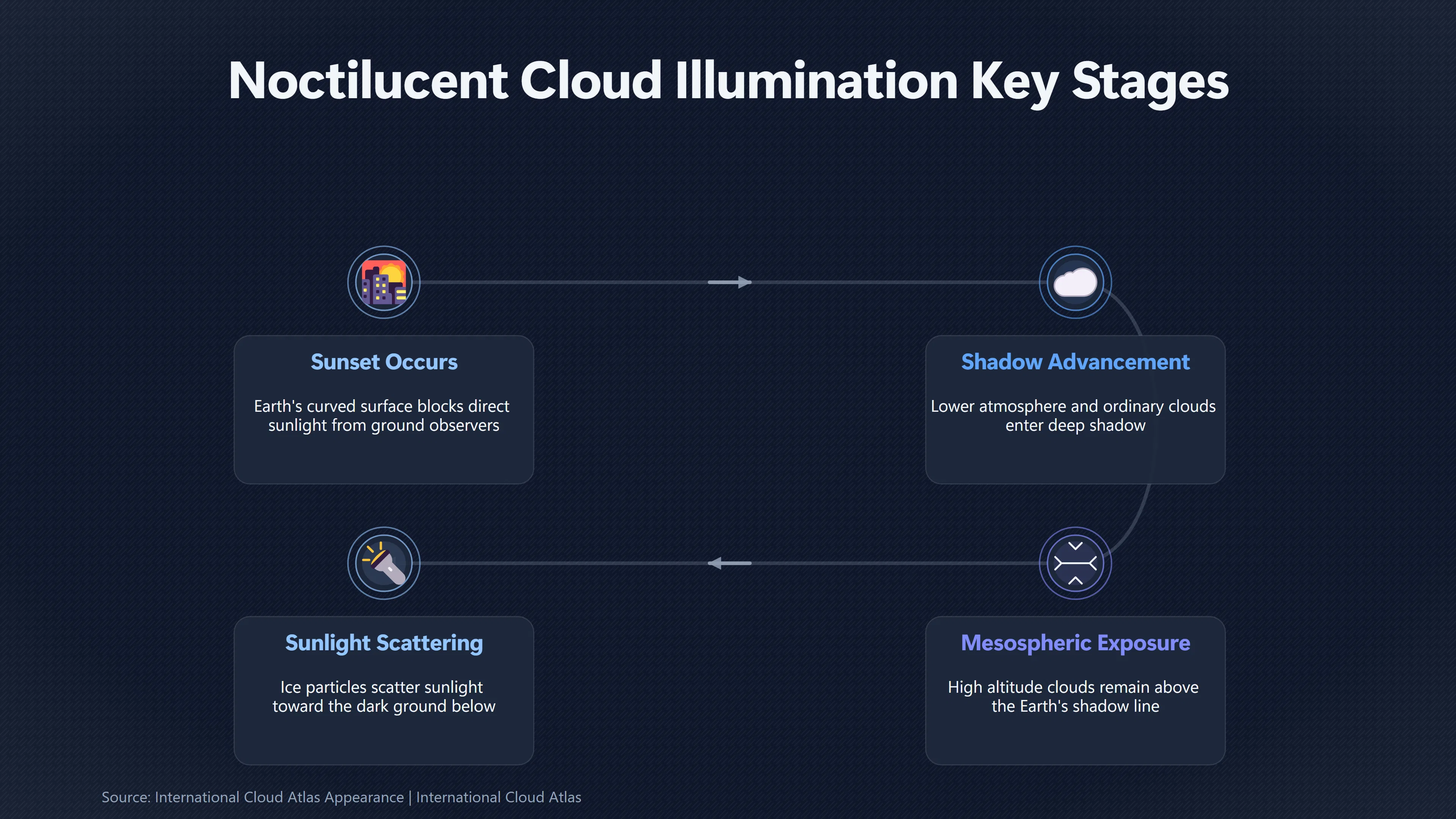
After sunset, Earth’s curved surface blocks direct sunlight from the observer and progressively casts the lower atmosphere into shadow. A sufficiently high cloud layer can still project above that shadow and receive direct sunlight. Its ice particles then scatter some of that light towards the observer. This is why the phenomenon seems paradoxical: the landscape may be dark, stars may already be visible and ordinary clouds may appear as dark silhouettes, while the much more distant mesospheric cloud remains brightly illuminated. The Met Office accordingly describes noctilucent clouds as becoming conspicuous around the time the brightest stars appear and remaining visible because their great altitude still exposes them to sunlight.[Met Office]weather.metoffice.gov.ukMet Office Unusual cloud formationsMet OfficeUnusual cloud formations - Met Office…
The WMO gives a particularly useful numerical identification test. Noctilucent clouds are generally observed when the Sun is 6° to 16° below the observer’s horizon, with visibility often best around a solar depression of 10°. Earlier in twilight, the background sky is usually too bright for a moderate display to stand out strongly. Once the Sun is more than roughly 16° below the horizon, sunlight no longer reaches the normal noctilucent-cloud layer and the display disappears.[International Cloud Atlas]cloudatlas.wmo.intInternational Cloud Atlas Appearance | International Cloud AtlasInternational Cloud Atlas Appearance | International Cloud Atlas
This creates a characteristic observing window rather than unrestricted “night-time” luminosity. A mysterious glow that becomes conspicuous as twilight darkens, remains visible for a period and then fades as Earth’s shadow reaches higher altitude has a straightforward illumination mechanism. The changing brightness is itself evidence about the phenomenon’s height.
Why silver-blue structures can seem independently luminous
The deceptive feature is contrast. Noctilucent clouds are intrinsically faint enough that they are difficult or impossible to see against a bright daytime sky, yet at twilight their illuminated ice particles can be viewed against a much darker background. The Met Office describes them as pearly or silvery, generally with blue coloration, while the WMO notes that genuine noctilucent clouds appear brighter than the surrounding twilight sky.[Met Office]metoffice.gov.ukMet Office CloudsNational Meteorological Library and Archive…
That reversal of normal cloud appearance matters for UFO or UAP reports. Most people intuitively expect a cloud seen after sunset either to become dark or to take on familiar sunset colours. A blue-white structure remaining bright after lower cloud has turned black can therefore look less like reflected sunlight and more like an independent light source. NASA has itself described the clouds as appearing to give off their own glowing light, although their illumination is reflected or scattered sunlight.[NASA]nasa.govAppearance of Night-Shining Clouds Has IncreasedAppearance of Night-Shining Clouds Has Increased - NASA…
Their geometry can strengthen that impression. Noctilucent clouds are not necessarily featureless hazes. The WMO classification includes veils, bands, billows and whirls; complex displays can contain intersecting bands, bright knots and net-like structures. Some whirls form partial or even complete rings with darker centres, while small curved features can resemble bright ripples.[International Cloud Atlas]cloudatlas.wmo.intInternational Cloud Atlas Type IV Whirls | International Cloud AtlasInternational Cloud Atlas Type IV Whirls | International Cloud Atlas
Consequently, a display seen briefly or photographed with limited context need not immediately register as “a cloud”. Individual bright knots may look like separate lights; curved bands can suggest outlines; overlapping wave systems can create apparently organised patterns. NASA describes noctilucent clouds as showing electric-blue ripples and pale tendrils, an appearance sufficiently unfamiliar that its own account remarked on their distinctly “alien” visual character.[NASA]nasa.govMeteor Smoke Makes Strange CloudsMeteor Smoke Makes Strange Clouds - NASAAugust 8, 2012…
There is nevertheless an important limit to this explanation. Noctilucent clouds are much better candidates for reports involving extended luminous patches, bands, filaments, ripples or apparently glowing formations than for a sharply defined point source performing rapid independent manoeuvres. An atmospheric explanation should match the reported morphology and behaviour rather than simply being invoked because a sighting occurred after sunset.

Twilight timing and sky position are strong identification clues
The strongest diagnosis comes from combining appearance with geometry. A suspected noctilucent display should behave like a very high layer illuminated by a Sun already below the observer’s horizon.
Several clues are particularly useful:
- Twilight rather than deep night: the classic viewing interval is when the Sun is roughly 6°–16° below the horizon.[International Cloud Atlas]cloudatlas.wmo.intInternational Cloud Atlas Appearance | International Cloud AtlasInternational Cloud Atlas Appearance | International Cloud Atlas
- Brighter than the surrounding sky: a dark cloud silhouette is not a noctilucent cloud.[International Cloud Atlas]cloudatlas.wmo.intInternational Cloud Atlas Appearance | International Cloud AtlasInternational Cloud Atlas Appearance | International Cloud Atlas
- Bluish-white or silvery colour: ordinary cirrus catching low sunlight is more commonly yellow, orange or pink, while moonlit or artificially illuminated lower cloud tends towards a different milky-white appearance.[International Cloud Atlas]cloudatlas.wmo.intInternational Cloud Atlas Appearance | International Cloud AtlasInternational Cloud Atlas Appearance | International Cloud Atlas
- Fine organised structure: bands, waves, billows, knots and whirls are characteristic, and binoculars can reveal sharply resolved fine detail that ordinary cirrus often lacks.[International Cloud Atlas]cloudatlas.wmo.intInternational Cloud Atlas Appearance | International Cloud AtlasInternational Cloud Atlas Appearance | International Cloud Atlas
- Season and latitude: natural displays are especially associated with high-latitude summer conditions. NASA’s AIM observations show the strong seasonal and polar character of the phenomenon, while the Met Office gives the principal ground-viewing latitude range as roughly 45°–80° in each hemisphere.[NASA Science]science.nasa.govScience AIMScience AIM
Direction also changes through twilight. After sunset, observers commonly begin looking towards the part of the sky geometrically favourable for illumination, while before sunrise the sequence is reversed. The crucial point is that the illuminated region should make sense relative to the hidden Sun and Earth’s advancing or retreating shadow. A report containing an accurate time, location and viewing direction can therefore be tested rather than judged solely from how strange a photograph looks.
There is another useful discriminator: ordinary low and middle clouds may drift across or obscure the bright noctilucent layer. Because the luminous material is vastly higher, seeing dark foreground cloud pass in front of a silver-blue pattern immediately establishes that the two features occupy very different atmospheric levels. Conversely, poor visibility and intervening tropospheric cloud can make faint noctilucent displays harder to identify, a difficulty explicitly recognised by the WMO.[International Cloud Atlas]cloudatlas.wmo.intInternational Cloud Atlas Appearance | International Cloud AtlasInternational Cloud Atlas Appearance | International Cloud Atlas
From an 1880s mystery to a recognised UFO look-alike
The phenomenon itself has an instructive history because its first well-known observations were genuinely puzzling. Noctilucent clouds attracted scientific attention in 1885, shortly after the 1883 Krakatoa eruption had produced extraordinary sunsets and encouraged systematic twilight observing. Early researchers eventually established through observations including triangulation that the luminous material was extraordinarily high, around 82 kilometres — explaining how it could remain sunlit after darkness had reached the ground.[ScienceDirect]sciencedirect.comScienceDirect Noctilucent CloudsScienceDirect Noctilucent Clouds
The original association with Krakatoa did not become a complete explanation for the phenomenon. Noctilucent clouds continued to occur after the obvious volcanic effects had subsided, and subsequent research established them as ice clouds of the upper mesosphere. NASA’s AIM mission, launched in 2007 specifically to investigate these clouds, subsequently mapped their occurrence and structure from orbit.[NASA Science]science.nasa.govScience Night-Shining CloudsScience Night-Shining Clouds
The historical connection with UFO investigation is unusually explicit. In discussing the Cold War-era Robertson Panel, the CIA notes that investigators recommended teaching military personnel and researchers to recognise natural phenomena commonly mistaken for UFOs, specifically including noctilucent “night” clouds alongside meteors, fireballs and mirages. The objective was not to assume that every unusual report had such an explanation, but to remove identifiable false positives before devoting attention to sightings that remained unexplained.[CIA]cia.govHow To Investigate a Flying SaucerHow To Investigate a Flying Saucer - CIAJanuary 21, 2016…
An Air Force educational treatment from the late 1960s made essentially the same perceptual point: under the broad contemporary definition of an unidentified flying object, someone seeing a noctilucent cloud at twilight for the first time could legitimately report something unidentified because it was unknown to that observer. Identification comes afterwards, when the sighting’s characteristics are compared with known phenomena.[Biblioteca Pleyades]bibliotecapleyades.netBiblioteca Pleyades Unidentified Flying ObjectsBiblioteca PleyadesUnidentified Flying Objects - Introductory Space Science - Department of Physics - USAF…
That distinction remains useful. Calling an observation a UFO or UAP describes an initial failure to identify it; recognising the characteristic twilight geometry of noctilucent clouds can resolve a subset of those observations without implying that the witness invented what they saw.
The most useful test is whether the “light” follows the Sun
For this particular atmospheric mimic, illumination is more diagnostic than apparent strangeness. A silver-blue structure seen after sunset may look as though it is generating light, but noctilucent clouds predict a specific sequence: the lower atmosphere darkens first, the extremely high cloud remains sunlit, contrast increases as the twilight background fades, and eventually the cloud itself loses direct sunlight as Earth’s shadow rises through the mesosphere.[International Cloud Atlas]cloudatlas.wmo.intInternational Cloud Atlas Appearance | International Cloud AtlasInternational Cloud Atlas Appearance | International Cloud Atlas
That sequence separates a physically testable atmospheric explanation from the vague proposition that an unusual object merely “looked cloud-like”. Given a sufficiently precise UFO/UAP report, investigators can reconstruct the Sun’s depression below the horizon, viewing direction, season and latitude and compare them with photographs or independent observations. A display appearing within the characteristic twilight window and showing silvery-blue waves or filaments has several mutually reinforcing signatures of noctilucent cloud.
The result is one of the clearest examples of how atmospheric perspective can produce an apparently luminous aerial anomaly without an actual luminous object. The witness really can be looking at something unusually bright in a dark sky. What is misleading is not necessarily the observation itself, but the intuitive assumption that darkness at ground level means darkness throughout the atmosphere above it.
Amazon book picks
Further Reading
Books and field guides related to Can Noctilucent Clouds Look Like Lights in the Sky?. Use these as the next step if you want deeper reading beyond the article.
The Cloudspotter's Guide
Discusses the history, types, and cultural fascination with clouds and explains what they mean in terms of climate and weather.
A Field Guide to the Atmosphere
More than 400 photographs and line drawings illustrate every kind of atmospheric phenomenon: clouds of every type; storms, from cloudburs...
Color and Light in Nature
We live in a world of optical marvels - from the commonplace but beautiful rainbow, to the rare and eerie superior mirage. But how many o...
Light and Color in the Outdoors
First published 1993. Subjects: Color, Light, Popular works, Science: General Issues, Photographic equipment & techniques.
eBay marketplace picks
Marketplace Samples
Live-tested eBay searches with available results related to this page.
Selected fromtwilight sky poster oneBay.co.uk.
Endnotes
1.
Source: cloudatlas.wmo.int
Title: International Cloud Atlas Appearance | International Cloud Atlas
Link:https://cloudatlas.wmo.int/en/noctilucent-clouds-appearance-a.html
2.
Source: nasa.gov
Title: Appearance of Night-Shining Clouds Has Increased
Link:https://www.nasa.gov/missions/aim/appearance-of-night-shining-clouds-has-increased/
Source snippet
Appearance of Night-Shining Clouds Has Increased - NASA...
3.
Source: cia.gov
Title: How To Investigate a Flying Saucer
Link:https://www.cia.gov/stories/story/how-to-investigate-a-flying-saucer/
Source snippet
How To Investigate a Flying Saucer - CIAJanuary 21, 2016...
Published: January 21, 2016
4.
Source: nasa.gov
Title: Satellite Captures First View of ‘Night-Shining’ Clouds
Link:https://www.nasa.gov/news-release/nasa-satellite-captures-first-view-of-night-shining-clouds/
Source snippet
NASA Satellite Captures First View of 'Night-Shining' Clouds - NASA...
5.
Source: cloudatlas.wmo.int
Title: International Cloud Atlas Type IV Whirls | International Cloud Atlas
Link:https://cloudatlas.wmo.int/noctilucent-clouds-type-IV-whirls.html
6.
Source: cloudatlas.wmo.int
Title: International Cloud Atlas Complex structures | International Cloud Atlas
Link:https://cloudatlas.wmo.int/en/noctilucent-clouds-complex-structures.html
7.
Source: nasa.gov
Title: Meteor Smoke Makes Strange Clouds
Link:https://www.nasa.gov/missions/aim/meteor-smoke-makes-strange-clouds/
Source snippet
Meteor Smoke Makes Strange Clouds - NASAAugust 8, 2012...
Published: August 8, 2012
8.
Source: science.nasa.gov
Title: Science AIM
Link:https://science.nasa.gov/mission/aim
9.
Source: sciencedirect.com
Title: ScienceDirect Noctilucent Clouds
Link:https://www.sciencedirect.com/topics/physics-and-astronomy/noctilucent-clouds
10.
Source: svs.gsfc.nasa.gov
Link:https://svs.gsfc.nasa.gov/3484/
11.
Source: science.nasa.gov
Title: Science Night-Shining Clouds
Link:https://science.nasa.gov/earth/earth-observatory/night-shining-clouds-86036/
12.
Source: news.sky.com
Title: what are the ufo clouds seen hanging over uk skies 13291303
Link:https://news.sky.com/story/what-are-the-ufo-clouds-seen-hanging-over-uk-skies-13291303
13.
Source: nasa.gov
Link:https://www.nasa.gov/missions/aim/rocket-[launches
14.
Source: science.nasa.gov
Title: high dry and rare in the sky 148502
Link:https://science.nasa.gov/earth/earth-observatory/high-dry-and-rare-in-the-sky-148502/
15.
Source: nasa.gov
Title: NAS A’s AIM Sees First Night-Shining Clouds of Antarctic Summer
Link:https://www.nasa.gov/missions/aim/nasas-aim-sees-first-night-shining-clouds-of-antarctic-summer/
16.
Source: nasa.gov
Title: NAS A’s AIM Spots First Arctic Noctilucent Clouds of the Season
Link:https://www.nasa.gov/solar-system/nasas-aim-spots-first-arctic-noctilucent-clouds-of-the-season/
17.
Source: science.nasa.gov
Title: clouds light the night 145202
Link:https://science.nasa.gov/earth/earth-observatory/clouds-light-the-night-145202/
18.
Source: sciencedirect.com
Title: Long-term variations of noctilucent clouds at ALOMAR
Link:https://www.sciencedirect.com/science/article/pii/S1364682616302024
19.
Source: nasa.gov
Title: Taking AIM at Night-Shining Clouds: 10 Years, 10 Science Highlights
Link:https://www.nasa.gov/solar-system/taking-aim-at-night-shining-clouds-10-years-10-science-highlights/
20.
Source: nasa.gov
Title: Space Station View of Noctilucent Clouds
Link:https://www.nasa.gov/image-article/space-station-view-of-noctilucent-clouds/
21.
Source: nasa.gov
Title: Night-Shining Clouds
Link:https://www.nasa.gov/image-article/night-shining-clouds/
22.
Source: nasa.gov
Title: first night shining clouds of 2015 arctic season
Link:https://www.nasa.gov/image-article/first-night-shining-clouds-of-2015-arctic-season/
23.
Source: sciencedirect.com
Title: Morphology of polar mesospheric clouds as seen from space
Link:https://www.sciencedirect.com/science/article/pii/S1364682612002301
24.
Source: weather.gov
Link:https://www.weather.gov/ama/noctilucentclouds
25.
Source: science.nasa.gov
Title: early start for noctilucent clouds 81446
Link:https://science.nasa.gov/earth/earth-observatory/early-start-for-noctilucent-clouds-81446/
26.
Source: science.nasa.gov
Title: nocturnal wonders
Link:https://science.nasa.gov/resource/nocturnal-wonders/
27.
Source: science.nasa.gov
Title: polar mesospheric clouds south pacific ocean 80217
Link:https://science.nasa.gov/earth/earth-observatory/polar-mesospheric-clouds-south-pacific-ocean-80217/
28.
Source: science.nasa.gov
Title: polar mesospheric clouds northern hemisphere 78346
Link:https://science.nasa.gov/earth/earth-observatory/polar-mesospheric-clouds-northern-hemisphere-78346/
29.
Source: sciencedirect.com
Title: Analysis of gravity waves structures visible in noctilucent cloud images
Link:https://www.sciencedirect.com/science/article/pii/S136468261000177X
30.
Source: nasa.gov
Title: Sunrise Noctilucent Clouds
Link:https://www.nasa.gov/image-article/sunrise-noctilucent-clouds/
31.
Source: science.nasa.gov
Title: polar mesospheric clouds illuminated by orbital sunrise 44488
Link:https://science.nasa.gov/earth/earth-observatory/polar-mesospheric-clouds-illuminated-by-orbital-sunrise-44488/
32.
Source: eol.jsc.nasa.gov
Title: Polar Mesospheric Clouds Southern Hemisphere
Link:https://eol.jsc.nasa.gov/Collections/EarthObservatory/articles/PolarMesosphericCloudsSouthernHemisphere.htm
33.
Source: nasa.gov
Link:https://www.nasa.gov/missions/aim/nasas-aim-satellite-and-models-are-unlocking-the-secrets-of-mysterious-night-shining-clouds/
34.
Source: science.nasa.gov
Title: noctilucent clouds
Link:https://science.nasa.gov/missions/aim/nasa-noctilucent-clouds/
35.
Source: science.nasa.gov
Title: noctilucent clouds 8366
Link:https://science.nasa.gov/earth/earth-observatory/noctilucent-clouds-8366/
36.
Source: nasa.gov
Title: NAS A Satellite Reveals Unprecedented View of Mysterious ‘Night-Shining’ Clouds
Link:https://www.nasa.gov/missions/aim/nasa-satellite-reveals-unprecedented-view-of-mysterious-night-shining-clouds/
37.
Source: science.nasa.gov
Title: noctilucent clouds 3695
Link:https://science.nasa.gov/earth/earth-observatory/noctilucent-clouds-3695/
38.
Source: science.gsfc.nasa.gov
Link:https://science.gsfc.nasa.gov/earth/gmao/projects/14
39.
Source: cloudatlas.wmo.int
Link:https://cloudatlas.wmo.int/es/noctilucent-clouds-appearance-a.html
40.
Source: cloudatlas.wmo.int
Link:https://cloudatlas.wmo.int/en/noctilucent-clouds-type-II-bands.html
41.
Source: cloudatlas.wmo.int
Link:https://cloudatlas.wmo.int/en/observation-of-upper-atmospheric-clouds.html
42.
Source: cloudatlas.wmo.int
Title: int Appendix 3
Link:https://cloudatlas.wmo.int/en/appendix-3-history-of-cloud-nomenclature.html
43.
Source: cloudatlas.wmo.int
Link:https://cloudatlas.wmo.int/en/noctilucent-clouds-type-I-veils.html
44.
Source: cloudatlas.wmo.int
Link:https://cloudatlas.wmo.int/noctilucent-clouds.html
45.
Source: cloudatlas.wmo.int
Link:https://cloudatlas.wmo.int/es/noctilucent-clouds-type-II-bands.html
46.
Source: cloudatlas.wmo.int
Title: int Appendix 4
Link:https://cloudatlas.wmo.int/appendix-4-lists-of-tables-figures-and-acronyms.html
47.
Source: cloudatlas.wmo.int
Link:https://cloudatlas.wmo.int/ru/noctilucent-clouds-type-III-billows.html
48.
Source: cloudatlas.wmo.int
Link:https://cloudatlas.wmo.int/es/noctilucent-clouds-type-III-billows.html
49.
Source: cloudatlas.wmo.int
Title: int Apéndice 3
Link:https://cloudatlas.wmo.int/es/appendix-3-history-of-cloud-nomenclature.html
50.
Source: cloudatlas.wmo.int
Title: intالملحق 3
Link:https://cloudatlas.wmo.int/ar/appendix-3-history-of-cloud-nomenclature.html
51.
Source: cloudatlas.wmo.int
Link:https://cloudatlas.wmo.int/en/polar-aurora-forms.html
52.
Source: cloudatlas.wmo.int
Link:https://cloudatlas.wmo.int/es/noctilucent-clouds-complex-structures.html
53.
Source: cloudatlas.wmo.int
Title: appendix 3 history of cloud nomenclature
Link:https://cloudatlas.wmo.int/ru/appendix-3-history-of-cloud-nomenclature.html
54.
Source: cloudatlas.wmo.int
Link:https://cloudatlas.wmo.int/en/noctilucent-clouds-brightness-scale.html
55.
Source: cloudatlas.wmo.int
Link:https://cloudatlas.wmo.int/en/upper-atmospheric-clouds.html
56.
Source: cloudatlas.wmo.int
Title: int Annexe 3
Link:https://cloudatlas.wmo.int/fr/appendix-3-history-of-cloud-nomenclature.html
57.
Source: cloudatlas.wmo.int
Title: appendix 3 history of cloud nomenclature
Link:https://cloudatlas.wmo.int/zh-hans/appendix-3-history-of-cloud-nomenclature.html
58.
Source: sciencedirect.com
Title: Microphysical and optical properties of noctilucent clouds
Link:https://www.sciencedirect.com/science/article/pii/S0012825205000243
59.
Source: sciencedirect.com
Link:https://www.sciencedirect.com/science/article/abs/pii/S1364682625000756
60.
Source: sciencedirect.com
Link:https://www.sciencedirect.com/science/article/pii/S1364682608002745
61.
Source: sciencedirect.com
Title: Morphology of polar mesospheric clouds as seen from space
Link:https://www.sciencedirect.com/science/article/abs/pii/S1364682612002301
62.
Source: forecast.weather.gov
Link:https://forecast.weather.gov/glossary.php?word=clouds
63.
Source: forecast.weather.gov
Link:https://forecast.weather.gov/glossary.php?word=CLOUD
64.
Source: forecast.weather.gov
Link:https://forecast.weather.gov/glossary.php?word=CI
65.
Source: forecast.weather.gov
Link:https://forecast.weather.gov/glossary.php?letter=c
66.
Source: forecast.weather.gov
Link:https://forecast.weather.gov/glossary.php?word=CL
67.
Source: forecast.weather.gov
Link:https://forecast.weather.gov/glossary.php?letter=n
68.
Source: weather.gov
Link:https://www.weather.gov/lmk/twilight-types?lv=true
69.
Source: weather.gov
Link:https://www.weather.gov/ggw/GlossaryN
70.
Source: weather.gov
Link:https://www.weather.gov/mtr/noctilucent_clouds
71.
Source: forecast.weather.gov
Link:https://forecast.weather.gov/glossary.php?word=dusk
72.
Source: forecast.weather.gov
Link:https://forecast.weather.gov/glossary.php?word=T
73.
Source: forecast.weather.gov
Link:https://forecast.weather.gov/glossary.php?word=n
74.
Source: forecast.weather.gov
Link:https://forecast.weather.gov/glossary.php?word=C
75.
Source: forecast.weather.gov
Link:https://forecast.weather.gov/glossary.php?word=cond
76.
Source: weather.gov
Link:https://www.weather.gov/fsd/twilight
77.
Source: cia.gov
Link:https://www.cia.gov/readingroom/document/cia-rdp82-00141r000200290001-1
78.
Source: bibliotecapleyades.net
Title: Biblioteca Pleyades Unidentified Flying Objects
Link:https://www.bibliotecapleyades.net/ciencia/ciencia_flyingobjects02.htm
Source snippet
Biblioteca PleyadesUnidentified Flying Objects - Introductory Space Science - Department of Physics - USAF...
79.
Source: weather.metoffice.gov.uk
Title: Met Office Unusual cloud formations
Link:https://weather.metoffice.gov.uk/learn-about/weather/types-of-weather/clouds/unusual-cloud-formations
Source snippet
Met OfficeUnusual cloud formations - Met Office...
80.
Source: metoffice.gov.uk
Title: Met Office Clouds
Link:https://www.metoffice.gov.uk/binaries/content/assets/metofficegovuk/pdf/research/library-and-archive/library/publications/factsheets/factsheet_1-clouds_2023.pdf
Source snippet
National Meteorological Library and Archive...
81.
Source: metoffice.gov.uk
Link:https://www.metoffice.gov.uk/blog/2025/how-does-the-met-office-measure-sunshine-visibility-pressure-and-radiation
82.
Source: antarctica.gov.au
Title: Noctilucent clouds – Australian Antarctic Program
Link:https://www.antarctica.gov.au/about-antarctica/ice-and-atmosphere/atmosphere/clouds-and-radiation/noctilucent-clouds/
83.
Source: cambridge.org
Title: Noctilucent clouds | Polar Record | Cambridge Core
Link:https://www.cambridge.org/core/journals/polar-record/article/noctilucent-clouds/329FC9B8D1E7C6C3081090F125C55ACA
84.
Source: books.google.com
Title: Noctilucent Clouds
Link:https://books.google.com/books/about/Noctilucent_Clouds.html?id=1px6AAAAIAAJ
85.
Source: books.google.com
Title: Noctilucent Clouds
Link:https://books.google.com/books/about/Noctilucent_Clouds.html?hl=en&id=1px6AAAAIAAJ&output=html_text
86.
Source: nature.com
Title: Noctilucent clouds | Nature
Link:https://www.nature.com/articles/265280b0
87.
Source: weather.metoffice.gov.uk
Title: metoffice.gov.uk7 facts about clouds
Link:https://weather.metoffice.gov.uk/learn-about/weather/types-of-weather/clouds/facts-about-clouds
88.
Source: weather.metoffice.gov.uk
Title: metoffice.gov.uk Earth’s atmosphere
Link:https://weather.metoffice.gov.uk/climate/climate-explained/earths-atmosphere
89.
Source: weather.metoffice.gov.uk
Title: metoffice.gov.uk What are clouds?
Link:https://weather.metoffice.gov.uk/learn-about/met-office-for-schools/other-content/other-resources/what-are-clouds
90.
Source: library.metoffice.gov.uk
Link:https://library.metoffice.gov.uk/portal/Default/en-GB/RecordView/Index/258329
91.
Source: library.metoffice.gov.uk
Link:https://library.metoffice.gov.uk/portal/Default/en-GB/RecordView/Index/260596
92.
Source: weather.metoffice.gov.uk
Title: metoffice.gov.uk Mid-level clouds
Link:https://weather.metoffice.gov.uk/learn-about/weather/types-of-weather/clouds/mid-level-clouds
93.
Source: metoffice.gov.uk
Title: Clouds and microphysics
Link:https://www.metoffice.gov.uk/research/foundation/parametrizations/clouds-and-microphysics
94.
Source: weather.metoffice.gov.uk
Title: metoffice.gov.uk Clouds
Link:https://weather.metoffice.gov.uk/learn-about/weather/types-of-weather/clouds
95.
Source: weather.metoffice.gov.uk
Title: metoffice.gov.uk Low level clouds
Link:https://weather.metoffice.gov.uk/learn-about/weather/types-of-weather/clouds/low-level-clouds
96.
Source: weather.metoffice.gov.uk
Title: metoffice.gov.uk Why are clouds white?
Link:https://weather.metoffice.gov.uk/learn-about/weather/types-of-weather/clouds/why-are-clouds-white
97.
Source: the-demonic-paradise.fandom.com
Title: Unidentified Flying Object
Link:https://the-demonic-paradise.fandom.com/wiki/Unidentified_Flying_Object
Additional References
98.
Source: youtube.com
Title: Science Casts: Meteor Smoke Makes Strange Clouds
Link:https://www.youtube.com/watch?v=Qzs9ZOsjF-c
Source snippet
Noctilucent clouds night shining clouds mesosphere Noctilucent Clouds explained...
99.
Source: youtube.com
Title: What are noctilucent clouds and how can you see them?
Link:https://www.youtube.com/watch?v=Eefr-pcFUoQ
Source snippet
ScienceCasts: Unexpected Teleconnections in Noctilucent Clouds...
100.
Source: youtube.com
Title: Science Casts: Unexpected Teleconnections in Noctilucent Clouds
Link:https://www.youtube.com/watch?v=7d3t1_l4bcw
Source snippet
ScienceCasts: Meteor Smoke Makes Strange Clouds...
101.
Source: youtube.com
Title: Science Casts: An Early Start for Noctilucent Clouds
Link:https://www.youtube.com/watch?v=5EhsIN6BMyk
Source snippet
What are noctilucent clouds and how can you see them?...
102.
Source: researchgate.net
Link:https://www.researchgate.net/publication/253875215Height_determination_of_noctilucent_clouds-_100_years
103.
Source: researchgate.net
Link:https://www.researchgate.net/publication/258648041_Notes_on_historical_aspects_on_the_earliest_known_observations_of_noctilucent_clouds
104.
Source: rmets.org
Link:https://www.rmets.org/event/2nd-annual-photo-competition-and-talk-about-norfolk-skies
105.
Source: rmets.org
Link:https://www.rmets.org/weather-photographer-of-the-year/photos/1097904
106.
Source: ebrary.net
Link:https://ebrary.net/5745/education/terms_describing_clouds
107.
Source: rmets.org
Link:https://www.rmets.org/cloud-identification