Within Reconstruction
Can Weather Records Explain a UFO Sighting?
Archived winds, cloud layers and visibility can reveal whether a reported UFO moved or disappeared exactly as ordinary atmospheric conditions predict.
On this page
- Matching winds to drifting object hypotheses
- Using cloud and visibility records to test disappearances
- Why local historical conditions beat generic assumptions
Page outline Jump by section
Introduction
Once investigators know when and where a UFO or UAP sighting occurred, historical weather records can turn a vague atmospheric explanation into a testable one. A proposed balloon should drift broadly with the wind at its actual altitude. A reported object that “vanished” may have reached a cloud layer or entered haze at the recorded time. Conversely, if the winds run the wrong way or the sky was demonstrably clear, those explanations become harder to sustain.
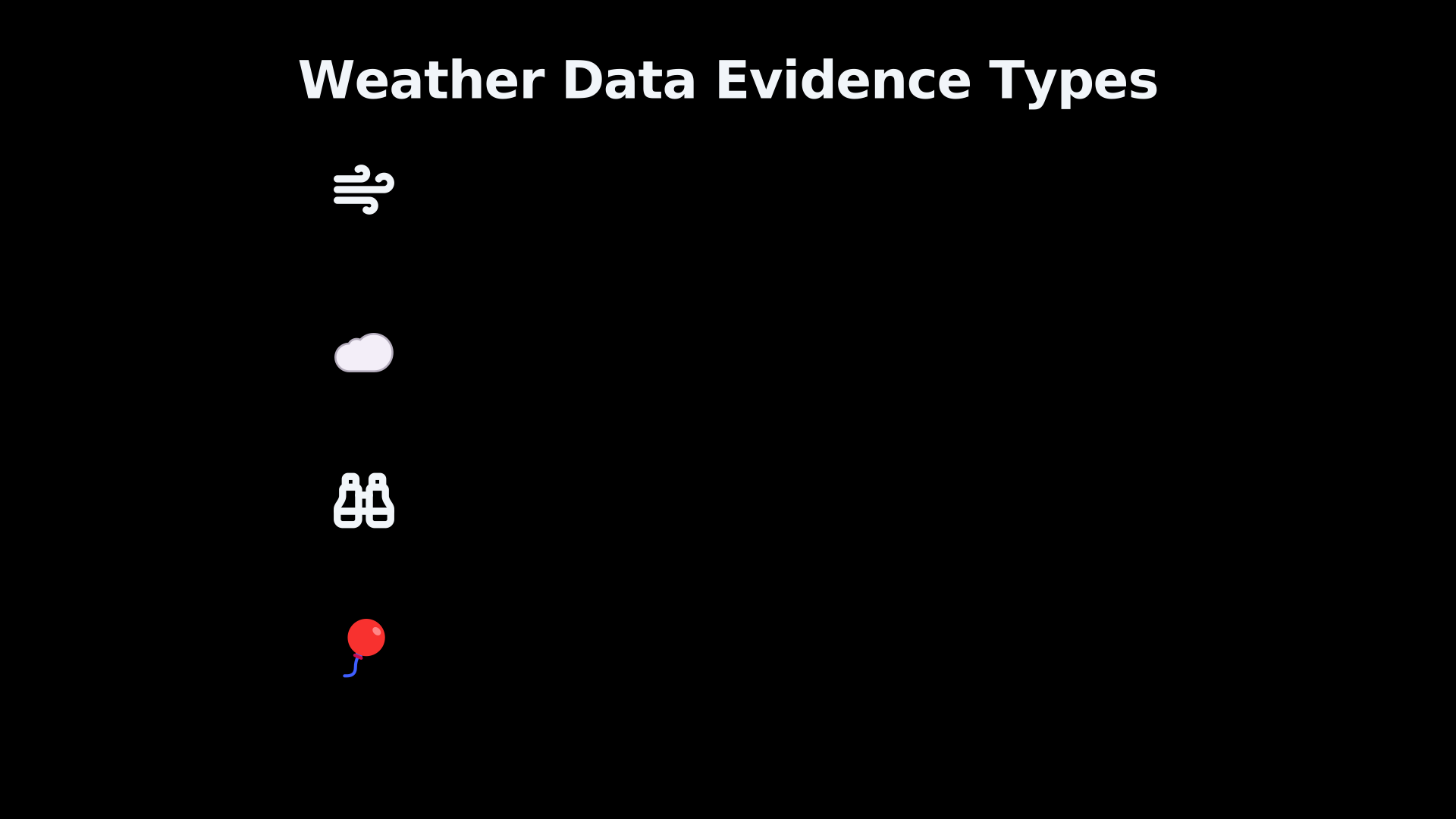
The important distinction is between weather as a generic possibility and weather as event-specific evidence. Archives preserve wind direction and speed, cloud amount and height, visibility and upper-air measurements for particular places and times. NOAA’s global datasets contain both surface observations and vertical atmospheric profiles, while the Met Office maintains UK records extending deep into the historical UFO era.[NCEI]noaa.govOpen source on noaa.gov. Used carefully, those records let investigators ask a much stronger question than “could it have been a balloon?”: would a balloon or cloud explanation actually behave as the sighting did under the weather conditions that existed?
Matching winds to a drifting-object hypothesis
A balloon explanation makes a prediction. A freely drifting balloon has little independent horizontal propulsion, so its movement should be strongly governed by the surrounding air. Radiosondes make this especially clear: the US National Weather Service derives winds aloft by tracking a radiosonde’s changing position as its balloon ascends. NOAA notes that radiosondes provide vertical profiles including wind speed and direction, while ordinary sounding balloons can travel well over 100 kilometres horizontally during a flight.[weather.gov]weather.govOpen source on weather.gov.
That means investigators should not simply look up the wind reported at ground level. Wind can change substantially with altitude. A balloon hundreds of metres or several kilometres above the witness may encounter a different speed and direction from the breeze measured at the nearest airport. NOAA’s Integrated Global Radiosonde Archive (IGRA) is particularly valuable here: it contains radiosonde and pilot-balloon observations from more than 2,800 stations, with records extending back to 1905 and measurements at multiple pressure or height levels.[NCEI]noaa.govOpen source on noaa.gov.
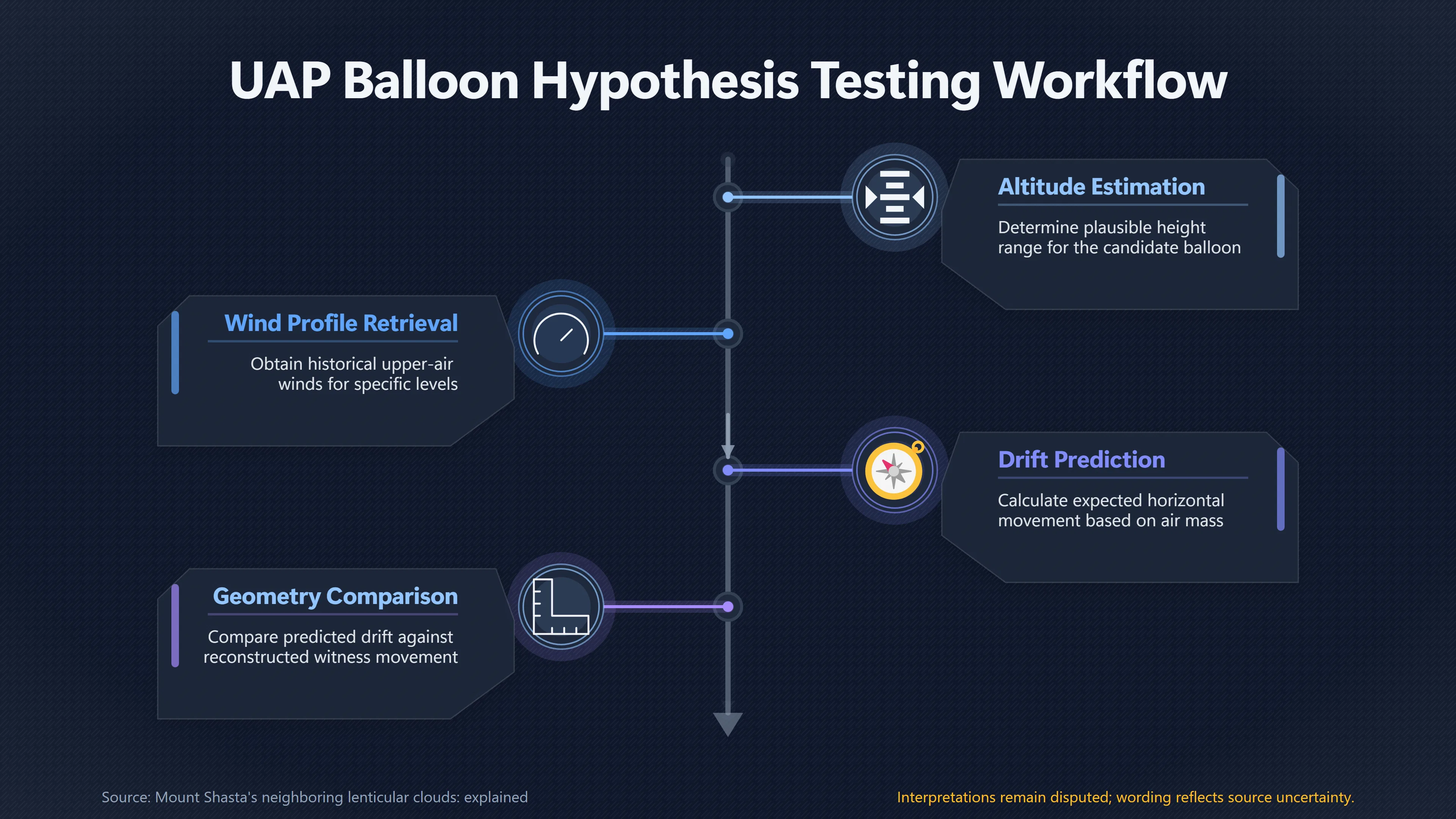
The basic test is therefore three-dimensional. Investigators estimate a plausible altitude range for the candidate balloon, obtain winds for those levels and compare the predicted drift with the object’s reconstructed movement across the sky. A close match does not prove that the object was a balloon — other objects can travel with the wind — but a strong mismatch can count against a particular balloon hypothesis.
A historical example appears in Case 41 of the University of Colorado UFO study, commonly known as the Condon Report. Witnesses in 1967 watched a bright object move about 30 degrees across the sky before apparently separating into several pieces. Investigators identified a Weather Bureau radiosonde balloon launched roughly 45 miles west of the observation. They compared the reported angular movement with winds aloft and calculated that, if the object was around 100,000 feet high, the implied speed was about 20 mph, comparable with measured winds at similar levels. The balloon’s eventual break-up and parachute deployment also offered an explanation for the reported fragmentation.[Project 1947]project1947.comOpen source on project1947.com.
The case is useful not because every balloon hypothesis can be handled so neatly, but because it demonstrates the evidential logic: launch information, upper-air winds, viewing geometry and reported motion are compared rather than merely asserted to be compatible.
Modern UAP cases show why altitude matters
The same approach appears in contemporary UAP analysis. In its reconstruction of the well-known “GoFast” infrared video, the US All-domain Anomaly Resolution Office (AARO) incorporated historical atmospheric conditions rather than treating the wind as a single surface value. Its methodology records winds near the event of about 30.9 metres per second at 13,000 feet and 52 metres per second at 25,000 feet, with somewhat different directions at the two levels. Because the aircraft’s exact compass heading was unavailable, AARO modelled the possible effects across the full range of wind directions rather than selecting one convenient geometry.[AARO]aaro.milOpen source on aaro.mil.
That illustrates an important safeguard. If the altitude of a reported UFO is poorly constrained, investigators should not select whichever wind level happens to make a balloon explanation work. They need to test the range of plausible heights and uncertainties. A match that survives those variations is more persuasive than one dependent on a single assumed altitude.
AARO has used comparable reasoning in other cases. Its published summary of the Mt Etna footage says analysts assessed with moderate confidence that the object was a balloon roughly 170 kilometres from the volcano’s caldera, travelling at the speed and direction of the wind. In the 2013 Puerto Rico case, AARO says reconstruction showed two nearby objects following a straight path at wind speed rather than one extraordinary object splitting apart and entering the sea.[AARO]aaro.milOpen source on aaro.mil.
These cases also demonstrate a limitation: wind agreement is generally supporting evidence, not unique identification. A lightweight balloon, lantern or other passive airborne object may all drift with an air mass. Weather data become strongest when combined with independent constraints such as launch records, imagery, altitude estimates, trajectories and known balloon behaviour.
Cloud records can test a reported disappearance
Weather archives can also investigate one of the most dramatic phrases in UFO reports: “it suddenly disappeared.” Disappearance does not necessarily mean that an object accelerated away, ceased to exist or performed an unusual manoeuvre. An otherwise ordinary object can simply pass behind cloud or become impossible to distinguish as atmospheric visibility deteriorates.
Historical observations often contain precisely the variables needed to test that possibility. NOAA’s Integrated Surface Database includes cloud information, visibility, present weather and wind alongside other meteorological measurements, drawing on observations from more than 20,000 stations. Some of its source material reaches back through records entered from paper forms from the 1950s to the 1970s.[NCEI]noaa.govOpen source on noaa.gov.
British records can be remarkably detailed as well. Met Office daily registers typically record wind direction and force, cloud type, cloud height and amount, visibility and weather. Its Daily Weather Reports for 1961–70 — a period encompassing many well-known historical UFO reports — contain observations at 0000, 0600, 1200 and 1800 including wind, visibility and cloud.[Met Office]metoffice.gov.ukOpen source on metoffice.gov.uk.
Those measurements allow several specific checks. If a witness says an object disappeared at a particular bearing, investigators can ask whether cloud existed at an appropriate level and whether the object’s reconstructed path would have carried it towards that cloud. If the report describes an object repeatedly appearing and disappearing, broken or layered cloud may be relevant. Conversely, a well-supported observation of an entirely clear sky makes cloud obscuration a weaker explanation.
Visibility deserves separate attention. Meteorological visibility records can help establish whether haze, mist, precipitation or other atmospheric conditions limited how far a small or low-contrast object could realistically remain visible. The Met Office’s current observing network, for example, routinely reports visibility alongside wind and weather, illustrating that these are standard measured quantities rather than subjective additions made specifically for UAP analysis.[Met Office]metoffice.gov.ukOpen source on metoffice.gov.uk.
The strongest analysis therefore goes beyond finding that “there were clouds that day”. It asks whether the right obscuring conditions existed at approximately the right time, direction and altitude to reproduce the reported loss of visibility.
Historical archives can reach surprisingly far back
Weather reconstruction is not limited to modern sightings with digital meteorological files. In Britain, the Met Office’s Daily Weather Summary series runs from September 1860 onwards. Depending on the period, it includes synoptic charts and station observations for variables such as wind, visibility and weather. The Met Office also preserves original meteorological observations and charts through its National Meteorological Archive.[Met Office]metoffice.gov.ukOpen source on metoffice.gov.uk.
The contents become particularly useful during the twentieth century. Daily Weather Reports from 1921–30 already included wind, humidity, visibility and cloud observations; equivalent records from the 1940s and 1950s retained those variables. International supplements add observations from stations outside Britain, and the 1951–60 overseas series includes radio soundings and upper-wind information for selected stations.[Met Office Library]metoffice.gov.ukOpen source on metoffice.gov.uk.
NOAA offers a complementary global resource. Besides IGRA’s upper-air archive, its historical surface datasets preserve wind, sky cover, clouds and visibility. The Global Synoptic Surface Observations collection, for example, contains three-hourly observations from 1967 onwards including sky cover, wind direction and speed, visibility, weather and clouds.[NCEI]noaa.govOpen source on noaa.gov.
This matters for older UFO cases because the atmospheric record may be more durable than the sighting record. A witness’s precise recollection of cloud height decades later is inherently difficult to verify, but a surviving observation made by a trained meteorological observer on the same day is independent contemporary evidence.
Why local historical conditions beat generic assumptions
Statements such as “balloons drift slowly”, “the wind was blowing east” or “there were clouds in the area” are too crude for serious reconstruction. The atmosphere varies both horizontally and vertically, and observations from the wrong hour, the wrong station or the wrong altitude can create an apparently convincing match that never existed.
Three distinctions are especially important.
- Surface wind is not necessarily upper-level wind. Radiosonde records show how wind direction and speed change through the atmosphere. A balloon can therefore move differently from leaves, flags or low cloud visible to a witness.[National Weather Service]weather.govOpen source on weather.gov.
- A regional weather summary is not a local observation. The nearest useful station may report substantially different visibility or cloud from conditions at the actual sighting location, particularly around fronts, showers, hills or coastal areas.
- A daily value is not necessarily the weather at the sighting time. Hourly or synoptic observations are preferable where available. NOAA’s ISD provides hourly and synoptic surface observations, while historical Met Office series often preserve measurements at fixed times through the day.[NCEI]noaa.govOpen source on noaa.gov.
There is another caution with archival evidence: records themselves have limits. The Met Office notes that its historical Daily Weather Summaries were generally produced before later quality-control work, so values in the original publication can differ from subsequently corrected datasets.[Met Office]metoffice.gov.ukOpen source on metoffice.gov.uk. A station can also be many kilometres from the witness, while a radiosonde may have been launched hours before the event. Investigators therefore need to preserve uncertainty rather than turning the nearest available measurement into an exact description of the atmosphere above the witness.

When the weather test is genuinely persuasive
Weather records are most powerful when a proposed explanation makes several independent predictions and the historical conditions satisfy them together. A convincing balloon reconstruction might show that an appropriate balloon was actually launched, that winds at its likely altitude carried it towards the witness, that its predicted angular motion resembles the reported movement and that its later ascent, burst or descent explains changes in appearance.
Likewise, a cloud-obscuration explanation becomes substantially stronger if contemporaneous observations establish cloud at an appropriate height while the reconstructed object path places it behind that layer at approximately the reported disappearance time. Merely finding a weather report saying “partly cloudy” is much weaker.
The reverse tests are equally valuable. If reliable upper-air observations show winds consistently carrying passive objects opposite to the reported trajectory, a particular balloon hypothesis may fail. If multiple nearby observations establish excellent visibility and negligible cloud at the relevant time, “it disappeared into cloud” loses evidential support. Weather data therefore should not function as an automatic debunking tool; they are a way to expose ordinary explanations to conditions that can confirm, weaken or sometimes rule them out.
That is why historical weather records occupy a useful place in reconstructing UFO sightings. They transform atmospheric explanations from retrospective stories into predictions that can be checked against independent data. The decisive question is not whether balloons, clouds or poor visibility can explain UFO reports in general. It is whether they explain this observation, at this place, at this time, under the atmosphere that was actually there.
Amazon book picks
Further Reading
Books and field guides related to Can Weather Records Explain a UFO Sighting?. Use these as the next step if you want deeper reading beyond the article.
Weather Flying
Weather Flying is regarded in the industry as the bible of weather flying. Robert Buck, a general aviation and commercial pilot with tens...
Weather: A Very Short Introduction
From deciding the best day for a picnic, to the devastating effects of hurricanes and typhoons, the weather impacts our lives on a daily...
The Weather Book: Why It Happens and Where It Comes From
The Nature Book is your one-stop guide to reconnecting and appreciating nature once more.
eBay marketplace picks
Marketplace Samples
Live-tested eBay searches with available results related to this page.
Selected fromUFO poster oneBay.co.uk.



Current eBay listing
VINTAGE UFO FLYING SAUCERS COMIC ADVERTISING A2 POSTER PRINT

Current eBay listing
I Want To Believe UFO Poster Giclée Fine Art Heavyweight Print
Endnotes
1.
Source: aaro.mil
Link:https://www.aaro.mil/Portals/136/PDFs/case_resolution_reports/AARO_Puerto_Rico_UAP_Case_Resolution.pdf
2.
Source: aaro.mil
Link:https://www.aaro.mil/UAP-Records/
Additional References
3.
Source: youtube.com
Title: Mount Shasta’s neighboring [lenticular clouds]({{ ‘lenticular-clouds/’ | relative_url }}): explained
Link:https://www.youtube.com/watch?v=oyX2o2nF9UA
Source snippet
Tracking A Weather Balloon And Decoding Its Telemetry With An Airspy R2 And RS41Tracker...
4.
Source: youtube.com
Title: How weather balloons are tracked across the U.S
Link:https://www.youtube.com/watch?v=CefVqSl20FA
Source snippet
Mount Shasta's neighboring lenticular clouds: explained...
5.
Source: youtube.com
Title: Lenticular Clouds
Link:https://www.youtube.com/watch?v=KgO7Kyq3q-U
Source snippet
This video on tracking weather balloons across the US is directly relevant because it explains how meteorological stations routinely rele...
6.
Source: youtube.com
Title: The “Windfarm UFO”
Link:https://www.youtube.com/watch?v=xkgTajUDORs
Source snippet
Lenticular Clouds...
7.
Source: geipan.fr
Link:https://www.geipan.fr/en/what-did-i-see/step-1