Within Haze
How a Turn Can Reveal an Aircraft's Identity
A bright white aircraft light may dominate in haze until a turn exposes the weaker red and green position lights that reveal conventional flight.
On this page
- Why forward white lights dominate at long range
- How red and green position lights encode direction
- Why a turn can transform a mysterious light
Page outline Jump by section
Introduction
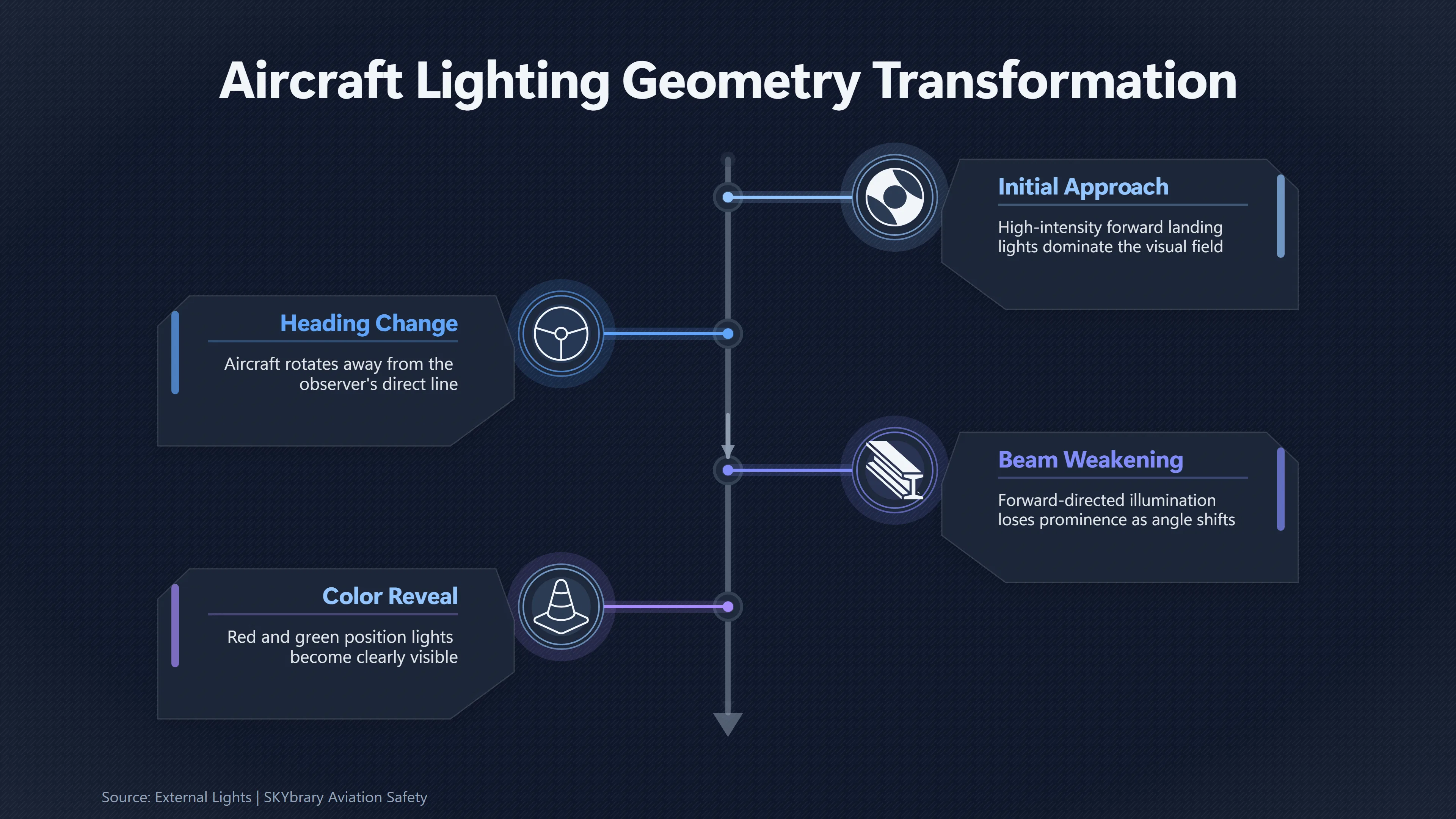
A distant aircraft can look like a single brilliant white light and then, after apparently changing direction, suddenly acquire a red light on one side and a green light on the other. That transformation can seem dramatic in a UFO or UAP sighting, but it follows directly from the way aircraft lighting is designed. Landing lights are powerful forward-facing lights, while navigation or position lights use red on the aircraft’s left side, green on its right and white towards the rear.[Skybrary]skybrary.aeroExternal Lights | SKYbrary Aviation SafetyExternal Lights | SKYbrary Aviation Safety…
The crucial clue is the turn. When an approaching aircraft is nearly head-on, its intense landing lights can dominate what an observer sees, particularly through haze. As the aircraft turns, the observer moves away from the strongest part of that forward illumination while the viewing geometry of the red or green position light changes. A previously featureless white point can therefore resolve into an unmistakably conventional lighting pattern without any lights actually changing colour.
Why the forward white light can dominate
Landing lights and position lights perform different jobs. Position lights communicate the aircraft’s orientation to other traffic. Landing lights primarily illuminate the runway but also make an aircraft conspicuous to others. SKYbrary describes landing lights as high-intensity lights that can be mounted on the wings, landing-gear structure or fuselage, while the standard navigation arrangement consists of red on the left, green on the right and white aft.[Skybrary]skybrary.aeroExternal Lights | SKYbrary Aviation SafetyExternal Lights | SKYbrary Aviation Safety…
That difference matters enormously to a distant observer. A landing light is not simply another white marker of comparable prominence to the coloured navigation lights. Its useful output is concentrated towards the direction in which the aircraft is travelling. A practical aviation explainer describes landing lights as narrow, spotlight-like beams rather than broad floodlights.[AeroSavvy]aerosavvy.comAero Savvy Savvy Passenger Guide to Airplane LightsSavvy Passenger Guide to Airplane Lights - AeroSavvyDecember 4, 2017…
FAA operating guidance reinforces why approaching aircraft are commonly conspicuous this way. It recommends exterior lighting to increase aircraft visibility and calls for landing lights to be illuminated for take-off; landing lights are also routinely used during arrival and approach.[Federal Aviation Administration]faa.govFederal Aviation Administration ENR 1.1: General RulesFederal Aviation Administration ENR 1.1: General Rules
For someone on the ground near the extended approach path, the geometry can therefore be unusually favourable for seeing the landing lights. The aircraft may be several miles away, with its fuselage and wings already difficult to distinguish, yet its concentrated forward illumination remains obvious. Haze strengthens the perceptual imbalance described on the parent page: subtle structural contrast is lost while a powerful compact source remains visible.
The important point is that “I could see only a white light” does not mean that only a white light was present. Red and green position lights can be operating normally while being far less conspicuous than the dominant white source.
Red and green lights encode direction
Aircraft position lights are deliberately directional. In US certification requirements for transport-category aeroplanes, the forward lights are red on the left and green on the right. The required coverage is divided into defined angular sectors rather than requiring each coloured lamp to look equally bright from every possible direction.[Legal Information Institute]law.cornell.eduLegal Information Institute14 CFR § 25.1389 - Position light distribution and intensities. | Electronic Code of Federal Regulations (e-CF…
The geometry is quite specific. The left and right sectors each extend from the aircraft’s forward longitudinal direction through 110 degrees on their respective sides. The aft white-light sector covers the rear portion.[Legal Information Institute]law.cornell.eduLegal Information Institute14 CFR § 25.1387 - Position light system dihedral angles. | Electronic Code of Federal Regulations (e-CFR) | U… This is why the colours carry useful directional information rather than merely decorating the aircraft.
The required intensity also varies with angle. For comparable US aircraft-lighting requirements, forward red and green position lights have substantially greater specified minimum intensity close to dead ahead than towards the outer edge of their sectors: the published values are 40 candela from 0–10 degrees, 30 from 10–20 degrees and 5 from 20–110 degrees.[Legal Information Institute]law.cornell.eduLegal Information Institute14 CFR § 29.1391 - Minimum intensities in the horizontal plane of forward and rear position lights. | Electron… The precise installation and apparent brightness vary between aircraft, but the underlying lesson is robust: what an observer sees depends strongly on viewing angle.
A useful interpretation is therefore:
- Red visible: the observer has a view into the sector illuminated by the aircraft’s left-side position light.
- Green visible: the observer has a view into the corresponding right-side sector.
- Red and green together: the geometry can be consistent with a broadly frontal view, although other lights may still dominate.
- Predominantly white aft position lighting: this can indicate a substantially rearward aspect rather than an approaching aircraft.
These are orientation clues, not an infallible identification algorithm. Anti-collision strobes, beacons, landing lights, atmospheric conditions and the aircraft’s exact lighting installation can all complicate the appearance. SKYbrary, for example, distinguishes steady navigation lights from high-intensity white strobes and red flashing or rotating beacons.[Skybrary]skybrary.aeroExternal Lights | SKYbrary Aviation SafetyExternal Lights | SKYbrary Aviation Safety…

Why a turn can transform a mysterious light
The most revealing moment can occur when the aircraft changes heading relative to the witness. Imagine an aircraft approaching from several miles away with its landing lights pointed approximately towards the observer. The visible scene may contain little more than one brilliant white point.
Now suppose the aircraft begins a turn towards its final approach course or another leg of the traffic pattern. Three things can happen almost together.
The dominant white light weakens. As the aircraft’s nose rotates away from the observer, the observer moves farther from the strongest part of the forward landing-light beam. Because landing lights are directional, even a modest angular change can substantially alter their apparent prominence.[AeroSavvy]aerosavvy.comAero Savvy Savvy Passenger Guide to Airplane LightsSavvy Passenger Guide to Airplane Lights - AeroSavvyDecember 4, 2017…
A coloured position light becomes easier to distinguish. The turn changes which part of the red or green light’s designed field of coverage faces the observer. Position-light regulations explicitly define these angular sectors, so their visibility is inherently dependent on relative bearing.[Legal Information Institute]law.cornell.eduLegal Information Institute14 CFR § 25.1387 - Position light system dihedral angles. | Electronic Code of Federal Regulations (e-CFR) | U…
The lights become spatially separable. As the aircraft closes the distance or presents more of its side, lights mounted far apart on the airframe may cease to merge perceptually into the same unresolved luminous point. US rules explicitly call for the red and green position lights to be spaced laterally as far apart as practicable.[FAR/AIM]faraim.orgsection 23.2530FAR/AIM§ 23.2530 External and cockpit lighting. | 14 CFR Part 23 | FAR/AIM.org…
The combined effect can be surprisingly abrupt to the eye. Before the turn, the witness reports “a bright white object”. During the turn, the white light fades or shifts in prominence. Seconds later, a red or green point appears, perhaps accompanied by a white strobe. What seemed to be an object changing its luminous properties may instead be an aircraft revealing different components of a lighting system as its orientation changes.
There is even an everyday observational counterpart to this sequence. In an aviation discussion prompted by exactly this appearance — aircraft looking like single bright lights on approach and later becoming dimmer, blinking lights — pilots identified the initially dominant source as the directional landing light and the later lights as the aircraft’s other exterior lighting once the forward beam no longer faced the observer. This is anecdotal rather than regulatory evidence, but it illustrates the perceptual sequence described by the technical sources.[Reddit]reddit.comDumb question about blinky lightsDumb question about blinky lightsJanuary 24, 2023…
The turn is more informative than the colour alone
For UAP assessment, the strongest evidence is not simply that a red or green light appears. Many objects can produce coloured lights, and cameras can reproduce colours poorly. What is more diagnostic is a coherent sequence tied to apparent heading.
Consider an observation in which a brilliant white point approaches slowly, seems almost stationary for a period, then begins moving sideways. As it does so, the white light diminishes and a steady red or green light becomes visible at approximately the same location, with periodic white flashes perhaps appearing as well. That sequence fits ordinary aircraft lighting particularly well because several independent observations change in the direction predicted by a turn:
- the forward-directed landing light becomes less prominent;
- the aspect-dependent position lighting becomes clearer;
- lateral motion becomes easier to recognise as the aircraft ceases flying approximately along the observer’s line of sight; and
- decreasing distance may make previously unresolved lights separable.
The FAA’s own human-factors research describes the functions involved in essentially these terms: navigation lighting indicates an aircraft’s direction of movement, using green on the right wingtip, red on the left and white at the tail, whereas landing lights are white lights used to illuminate the runway.[Federal Aviation Administration]faa.govFederal Aviation AdministrationAn Investigation of Lighting Schemes to Improve sUAS ConspicuityJuly 20, 2022…
This makes a turn particularly valuable when reconstructing a puzzling sighting. A single photograph of the initial white point preserves almost none of the useful geometry. A continuous video showing what happens before, during and after the turn can preserve far more information.
Why the reveal is not always clean
A real aircraft does not necessarily transform into a textbook red-green-white diagram. Distance may still leave the lights unresolved. Haze can reduce colour saturation and contrast. A bank can move one wingtip into a more favourable line of sight while making the other harder to see. Different aircraft also have different combinations and placements of landing, taxi, runway-turnoff, beacon and strobe lights. SKYbrary notes this substantial variation in exterior-light installations.[Skybrary]skybrary.aeroExternal Lights | SKYbrary Aviation SafetyExternal Lights | SKYbrary Aviation Safety…
High-intensity anti-collision lights can further complicate the view. FAA research distinguishes the steady red/green/white position-light system from flashing or rotating anti-collision lighting, while certification standards separately regulate position-light intensity and angular coverage.[Federal Aviation Administration]faa.govFederal Aviation AdministrationAn Investigation of Lighting Schemes to Improve sUAS ConspicuityJuly 20, 2022… A short phone video may therefore capture a white strobe at one instant, a red position light at another and an overexposed landing light at another without faithfully showing all of them simultaneously.
Nor should the disappearance of the bright white light automatically be interpreted as the pilot switching it off. Switching is certainly possible, but geometry alone can produce a large apparent change because landing lights project their useful illumination forward.[Skybrary]skybrary.aeroExternal Lights | SKYbrary Aviation SafetyExternal Lights | SKYbrary Aviation Safety… If the brightness change coincides precisely with a visible change in trajectory, changing aspect should be considered before assuming that the lighting system itself changed state.
What makes a turn reveal persuasive
The strongest aircraft interpretation comes from several clues occurring together rather than from any single colour. A turn is especially revealing when a previously dominant white source fades as lateral motion develops and conventional red, green or flashing aircraft lights become distinguishable. That is the expected direction of change for an aircraft whose forward lighting had initially been aimed towards the witness.
The red and green lights are particularly useful because their placement is not arbitrary. Certification rules deliberately put red on the aircraft’s left and green on its right and specify angular coverage so that other observers can infer orientation.[FAR/AIM]faraim.orgsection 23.2530FAR/AIM§ 23.2530 External and cockpit lighting. | 14 CFR Part 23 | FAR/AIM.org… In other words, the lights that suddenly appear during a turn can supply information that the original featureless white light could not: which way the object is facing.
That does not prove that every distant white light which later shows colour is an aeroplane. Identification still benefits from trajectory, timing, airport location and flight-tracking information. But within the specific problem of haze making aircraft appear featureless, a turn provides an unusually strong natural test. If changing orientation causes the brilliant frontal light to recede and exposes the familiar red-left, green-right or white-aft pattern, the apparently anomalous light has begun to reveal the lighting geometry of a conventional aircraft.
Amazon book picks
Further Reading
Books and field guides related to How a Turn Can Reveal an Aircraft's Identity. Use these as the next step if you want deeper reading beyond the article.
Human Factors in Aviation
Since the 1950s, a number of specialized books dealing with human factors has been published, but very little in aviation. Human Factors...
Sensation and Perception
. Bruce Goldstein's SENSATION AND PERCEPTION, the best-seller which has helped over 150,000 students understand the ties between how we s...
The UFO Handbook: A Guide to Investigating, Evaluating, and R...
An explanation of the usual reasons for confusing IFOs (identified flying objects) with UFOs and a survey of the tools used to investigat...
Visual Intelligence: How We Create What We See
A unique, illustrated popular study reveals the way the human eye acts on the visual world not just to represent but to create the things...
eBay marketplace picks
Marketplace Samples
Live-tested eBay searches with available results related to this page.
Selected fromaircraft model lights oneBay.co.uk.



Endnotes
1.
Source: skybrary.aero
Title: External Lights | SKYbrary Aviation Safety
Link:https://skybrary.aero/index.php/articles/external-lights
Source snippet
External Lights | SKYbrary Aviation Safety...
2.
Source: aerosavvy.com
Title: Aero Savvy Savvy Passenger Guide to Airplane Lights
Link:https://aerosavvy.com/airplane-lights/
Source snippet
Savvy Passenger Guide to Airplane Lights - AeroSavvyDecember 4, 2017...
Published: December 4, 2017
3.
Source: faa.gov
Title: Federal Aviation Administration ENR 1.1: General Rules
Link:https://www.faa.gov/air_traffic/publications/atpubs/aip_html/part2_enr_section_1.1.html
4.
Source: reddit.com
Title: Dumb question about blinky lights
Link:https://www.reddit.com/r/aviation/comments/10jyao8
Source snippet
Dumb question about blinky lightsJanuary 24, 2023...
Published: January 24, 2023
5.
Source: faa.gov
Link:https://www.faa.gov/data_research/research/med_humanfacs/oamtechreports/media/Investigation%20of%20Lighting%20Schemes%20to%20Improve%20sUAS%20Conspicuity%20.pdf
Source snippet
Federal Aviation AdministrationAn Investigation of Lighting Schemes to Improve sUAS ConspicuityJuly 20, 2022...
Published: July 20, 2022
6.
Source: faa.gov
Title: Runway Status Lights | Federal Aviation Administration
Link:https://www.faa.gov/air_traffic/technology/rwsl
7.
Source: skybrary.aero
Title: a321 en route near luton uk 2023
Link:https://skybrary.aero/index.php/accidents-and-incidents/a321-en-route-near-luton-uk-2023
8.
Source: skybrary.aero
Title: e145 presque isle me usa 2019
Link:https://skybrary.aero/index.php/accidents-and-incidents/e145-presque-isle-me-usa-2019
9.
Source: faa.gov
Link:https://www.faa.gov/lessonslearned/smallairplane/accidents/N952DB
10.
Source: skybrary.aero
Title: aaib bulletin 122015 n103cd ewc20141001 glf3 biggin hill uk 2014
Link:https://skybrary.aero/bookshelf/aaib-bulletin-122015-n103cd-ewc20141001-glf3-biggin-hill-uk-2014
11.
Source: faa.gov
Title: Chapter 2. Aeronautical Lighting and Other Airport Visual Aids
Link:https://www.faa.gov/air_traffic/publications/atpubs/AIM/aim0201.html
12.
Source: faa.gov
Link:https://www.faa.gov/air_traffic/publications/ATpubs/AIM/aim0202.html
13.
Source: faa.gov
Link:https://www.faa.gov/air_traffic/publications/atpubs/aim/aim0403.html
14.
Source: faa.gov
Link:https://www.faa.gov/air_traffic/publications/ATpubs/ATC/PCG/A.HTM
15.
Source: faa.gov
Title: Index Basic
Link:https://www.faa.gov/air_traffic/publications/atpubs/aim/Index-Basic.html
16.
Source: faa.gov
Link:https://www.faa.gov/air_traffic/publications/atpubs/AIM/TOC.html
17.
Source: faa.gov
Link:https://www.faa.gov/air_traffic/publications/ATpubs/ATC/atc0302.html
18.
Source: faa.gov
Title: Chapter 19. Temporary Flight Restrictions
Link:https://www.faa.gov/air_traffic/publications/atpubs/fac/1907.html
19.
Source: skybrary.aero
Title: a343 auckland new zealand 2013
Link:https://skybrary.aero/index.php/accidents-and-incidents/a343-auckland-new-zealand-2013
20.
Source: skybrary.aero
Title: b752 newark nj usa 2006
Link:https://skybrary.aero/index.php/accidents-and-incidents/b752-newark-nj-usa-2006
21.
Source: faa.gov
Title: A C 20-74
Link:https://www.faa.gov/regulations_policies/advisory_circulars/index.cfm/go/document.information/documentID/22032
22.
Source: faa.gov
Link:https://www.faa.gov/Air_traffic/publications/atpubs/aim_html/chap2_section_1.html
23.
Source: faa.gov
Link:https://www.faa.gov/Air_traffic/publications/atpubs/aim_html/chap2_section_2.html
24.
Source: faa.gov
Link:https://www.faa.gov/air_traffic/publications/atpubs/aip_html/chap2_section_1.html
25.
Source: faa.gov
Title: Chapter 3. Airport Traffic Control
Link:https://www.faa.gov/air_traffic/publications/atpubs/atc_html/chap3_section_4.html
26.
Source: faa.gov
Link:https://www.faa.gov/Air_traffic/publications/atpubs/aim_html/chap4_section_3.html
27.
Source: faa.gov
Link:https://www.faa.gov/air_traffic/publications/atpubs/aip_html/chap2_section_2.html
28.
Source: faa.gov
Link:https://www.faa.gov/air_traffic/publications/atpubs/fs_html/chap9_section_1.html
29.
Source: faa.gov
Link:https://www.faa.gov/air_traffic/publications/atpubs/pcg_html/glossary-a.html
30.
Source: faa.gov
Title: Chapter 3. Airport Traffic Control
Link:https://www.faa.gov/air_traffic/publications/atpubs/atc_html/chap3_section_2.html
31.
Source: faa.gov
Link:https://www.faa.gov/air_traffic/publications/atpubs/pcg_html/chap1_section_2.html
32.
Source: faa.gov
Link:https://www.faa.gov/air_traffic/publications/atpubs/aim_html/chap2_section_3.html
33.
Source: faa.gov
Link:https://www.faa.gov/air_traffic/publications/atpubs/aip_html/part1_gen_section_1.7.html
34.
Source: faa.gov
Link:https://www.faa.gov/air_traffic/publications/ATpubs/AIM_html/chap_4.html
35.
Source: skybrary.aero
Link:https://skybrary.aero/index.php/articles/aerodrome-lighting
36.
Source: skybrary.aero
Link:https://skybrary.aero/index.php/articles/runway-lighting
37.
Source: skybrary.aero
Link:https://skybrary.aero/index.php/articles/approach-lighting
38.
Source: skybrary.aero
Link:https://skybrary.aero/index.php/articles/active-ground-lighting-control
39.
Source: skybrary.aero
Link:https://skybrary.aero/index.php/articles/taxiway-lighting
40.
Source: skybrary.aero
Link:https://skybrary.aero/index.php/articles/medium-intensity-approach-light-system-runway-alignment-indicator-lights-malsr
41.
Source: skybrary.aero
Link:https://skybrary.aero/index.php/articles/instrument-landing-system-ils
42.
Source: skybrary.aero
Title: at72 dresden germany 2002
Link:https://skybrary.aero/index.php/accidents-and-incidents/at72-dresden-germany-2002
43.
Source: skybrary.aero
Link:https://skybrary.aero/index.php/articles/laser-interference-aviation
44.
Source: skybrary.aero
Link:https://skybrary.aero/index.php/articles/localiser-loc-and-localiser-type-directional-aid-lda-approaches
45.
Source: faraim.org
Title: section 23.2530
Link:https://www.faraim.org/faa/far/cfr/title-14/part-23/section-23.2530.html
Source snippet
FAR/AIM§ 23.2530 External and cockpit lighting. | 14 CFR Part 23 | FAR/AIM.org...
46.
Source: law.cornell.edu
Link:https://www.law.cornell.edu/cfr/text/14/25.1389
Source snippet
Legal Information Institute14 CFR § 25.1389 - Position light distribution and intensities. | Electronic Code of Federal Regulations (e-CF...
47.
Source: law.cornell.edu
Link:https://www.law.cornell.edu/cfr/text/14/25.1387
Source snippet
Legal Information Institute14 CFR § 25.1387 - Position light system dihedral angles. | Electronic Code of Federal Regulations (e-CFR) | U...
48.
Source: law.cornell.edu
Link:https://www.law.cornell.edu/cfr/text/14/29.1391
Source snippet
Legal Information Institute14 CFR § 29.1391 - Minimum intensities in the horizontal plane of forward and rear position lights. | Electron...
49.
Source: GOV.UK
Title: overarching national policy statement for energy en 1 2025 accessible webpage
Link:https://www.gov.uk/government/publications/overarching-national-policy-statement-for-energy-en-1-2025/overarching-national-policy-statement-for-energy-en-1-2025-accessible-webpage
50.
Source: GOV.UK
Title: www.gov.uk Airspace modernisation
Link:https://www.gov.uk/government/publications/airspace-modernisation/airspace-modernisation
51.
Source: GOV.UK
Title: aaib report airbus a321 253nx g oatw on 4 october 2023
Link:https://www.gov.uk/government/news/aaib-report-airbus-a321-253nx-g-oatw-on-4-october-2023
Published: october 2023
52.
Source: environment.data.gov.uk
Title: data.gov.uk Navigation Light | Data Requirements Library
Link:https://environment.data.gov.uk/data-requirements-library/revision/current/categories/AidsToNavigation/asset-types/Signal/elements/Signal-navigation-light
53.
Source: GOV.UK
Title: the thames navigation licensing and general byelaws 1993
Link:https://www.gov.uk/government/publications/river-thames-navigation-licensing-and-general-byelaws-1993/the-thames-navigation-licensing-and-general-byelaws-1993
54.
Source: environment.data.gov.uk
Title: data.gov.uk Navigation Light
Link:https://environment.data.gov.uk/asset-management/drl-app/revision/current/categories/AidsToNavigation/asset-types/Signal/elements/Signal-navigation-light
55.
Source: GOV.UK
Title: www.gov.uk AAI B investigation to Reims Cessna F172M, G-MOFO
Link:https://www.gov.uk/aaib-reports/aaib-investigation-to-reims-cessna-f172m-g-mofo
56.
Source: GOV.UK
Title: www.gov.uk AAI B investigation to Reims Cessna F172N Skyhawk, G-BGSV
Link:https://www.gov.uk/aaib-reports/aaib-investigation-to-reims-cessna-f172n-skyhawk-g-bgsv
57.
Source: GOV.UK
Title: bn2t islander g bswr 13 july 2011
Link:https://www.gov.uk/aaib-reports/bn2t-islander-g-bswr-13-july-2011
Published: july 2011
58.
Source: GOV.UK
Title: eads socata tbm 700c1 n700gy 27 march 2008
Link:https://www.gov.uk/aaib-reports/eads-socata-tbm-700c1-n700gy-27-march-2008
Published: march 2008
59.
Source: GOV.UK
Link:https://www.gov.uk/government/news/leave-the-landing-light-on–2
60.
Source: law.cornell.edu
Title: edu14 CFR § 91.209
Link:https://www.law.cornell.edu/cfr/text/14/91.209
61.
Source: law.cornell.edu
Link:https://www.law.cornell.edu/cfr/text/14/23.2530
62.
Source: law.cornell.edu
Link:https://www.law.cornell.edu/cfr/text/14/29.1389
63.
Source: law.cornell.edu
Link:https://www.law.cornell.edu/cfr/text/14/27.1389
64.
Source: law.cornell.edu
Link:https://www.law.cornell.edu/cfr/text/14/25.1391
65.
Source: law.cornell.edu
Link:https://www.law.cornell.edu/cfr/text/14/27.1385
66.
Source: law.cornell.edu
Link:https://www.law.cornell.edu/cfr/text/14/25.1395
67.
Source: law.cornell.edu
Link:https://www.law.cornell.edu/cfr/text/14/29.1395
68.
Source: faraim.org
Link:https://faraim.org/faa/aim/chapter-4/section-4-3-24.html
69.
Source: faraim.org
Link:https://faraim.org/faa/aim/chapter-2/section-2-1-4.html
70.
Source: faraim.org
Link:https://faraim.org/faa/aim/chapter-4/section-4-3-13.html
71.
Source: faraim.org
Link:https://www.faraim.org/faa/aim/chapter-2/section-2-1-5.html
72.
Source: faraim.org
Title: section 27.1385
Link:https://www.faraim.org/faa/far/cfr/title-14/part-27/section-27.1385.html
74.
Source: faraim.org
Title: Part 91
Link:https://faraim.org/faa/far/cfr/title-14/part-91/index-all.html
76.
Source: faraim.org
Title: section 25.1391
Link:https://www.faraim.org/faa/far/cfr/title-14/part-25/section-25.1391.html
77.
Source: tarmacview.com
Link:https://www.tarmacview.com/glossary/landing-lights/
78.
Source: metoffice.gov.uk
Title: Aerodrome Weather Warnings
Link:https://www.metoffice.gov.uk/services/transport/aviation/regulated/training-resources-for-aviation/aerodrome-warnings
79.
Source: wiki.flightgear.org
Title: Aircraft lighting
Link:https://wiki.flightgear.org/Aircraft_lighting
80.
Source: law.cornell.edu
Link:https://www.law.cornell.edu/cfr/text/14/25.1385
81.
Source: law.cornell.edu
Link:https://www.law.cornell.edu/cfr/text/14/29.1387
82.
Source: faraim.org
Title: section 29.1387
Link:https://www.faraim.org/faa/far/cfr/title-14/part-29/section-29.1387.html
Additional References
83.
Source: youtube.com
Title: Why Do Airplane Wings Have Different Colored Lights?
Link:https://www.youtube.com/watch?v=o8E4Mrpl2kk
Source snippet
Aircraft Lights: Red and Green Airplane Light Meaning Aircraft Lights: Red and Green Airplane Light Meaning...
84.
Source: youtube.com
Title: Every Light on an Airplane EXPLAINED (And Why Pilots Use Them!) Part 1
Link:https://www.youtube.com/watch?v=qelNrU4I3MY
Source snippet
Airplane Lights Explained - Navigation Light VS Anti-Collision Lights...
85.
Source: youtube.com
Title: Airplane Lights Explained
Link:https://www.youtube.com/watch?v=DZbasN6Ik5Q
Source snippet
LIGHTS on Airplanes explained by "CAPTAIN"Joe...
86.
Source: youtube.com
Title: Aircraft Lights: Red and Green Airplane Light Meaning
Link:https://www.youtube.com/watch?v=3yfEYmyH-Ro
Source snippet
Every Light on an Airplane EXPLAINED (And Why Pilots Use Them!) Part 1...
87.
Source: a1cr.net
Link:https://a1cr.net/aircraft_12.html
88.
Source: aircraftsystemstech.com
Link:https://www.aircraftsystemstech.com/2017/04/aircraft-lighting-systems.html
89.
Source: caa.co.uk
Link:https://www.caa.co.uk/general-aviation/ga-airspace/airspace-notification-of-kites/
90.
Source: caa.co.uk
Link:https://www.caa.co.uk/data-and-publications/publications/documents/content/cap-523/
91.
Source: caa.co.uk
Link:https://www.caa.co.uk/commercial-industry/airspace/event-and-obstacle-notification/crane-notification/
92.
Source: caa.co.uk
Link:https://www.caa.co.uk/General-aviation/Aircraft-ownership-and-maintenance/Electronic-Conspicuity-devices/