Within Blue Book
What Blue Book's Biggest Statistical Study Found
Special Report No.
On this page
- How Special Report No. 14 classified sightings
- Why all, unit and object sightings differed
- What the object sighting totals revealed
Page outline Jump by section
Introduction
Project Blue Book Special Report No. 14 did more than count UFO reports. The 1955 Battelle Memorial Institute study tried to determine whether Blue Book’s identification categories behaved consistently when thousands of reports were reorganised in different ways. Its central methodological problem was simple but important: a report, a sighting and an apparent object were not necessarily the same statistical unit.
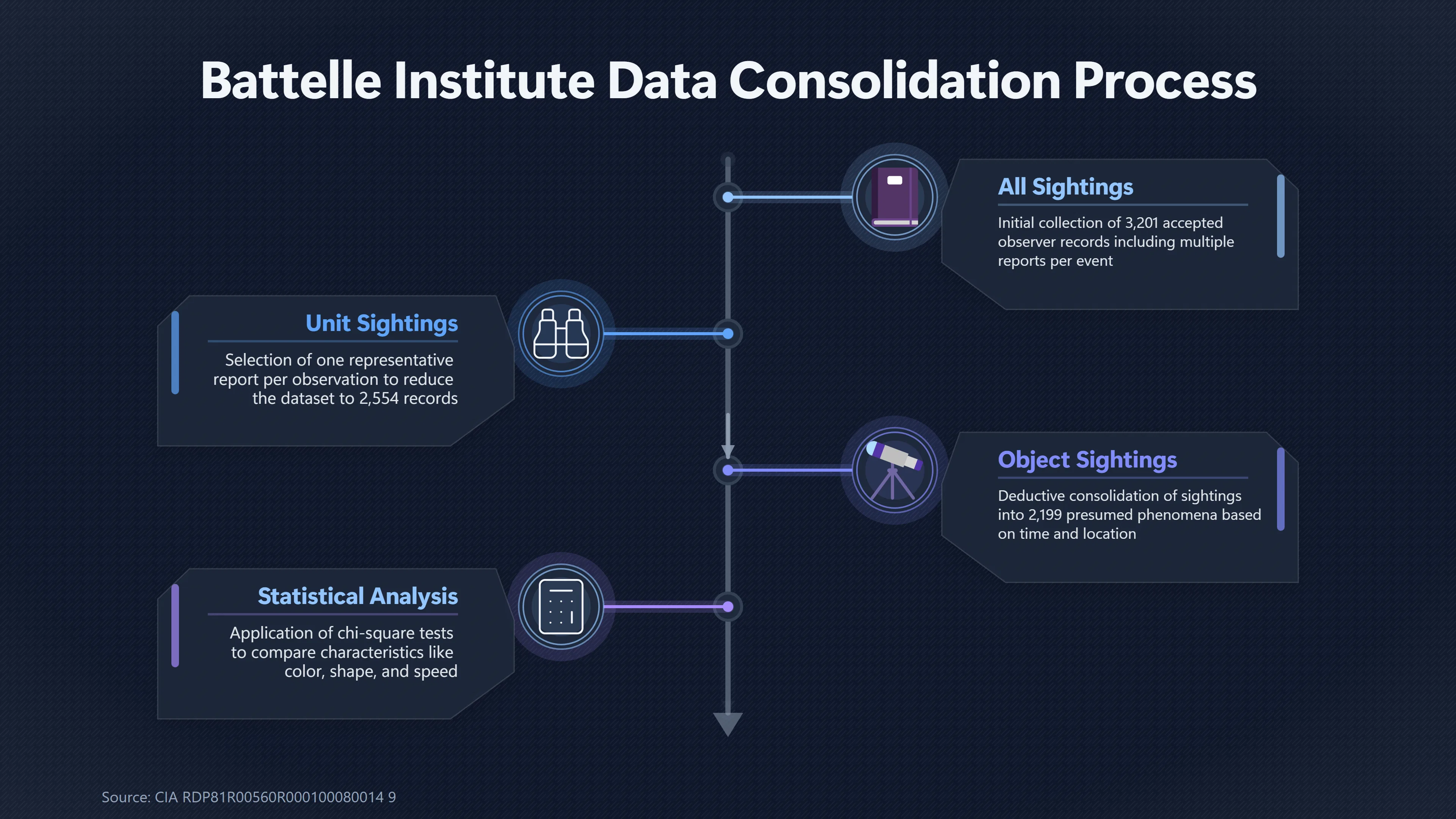
The study therefore analysed the material as All Sightings, Unit Sightings and Object Sightings. That distinction reduced 3,201 accepted observer reports to 2,554 distinct sightings and, after probable duplicate events were consolidated, to an estimated 2,199 separate phenomena. On that last and arguably most useful basis, 434 — 19.7% — remained classified as unknown.[UFO Transparency]ufotransparency.comdecade 1970s project blue book special report 14 1955 pbbsr14UFO TransparencyProject Blue Book Special Report 14, 1955, U.S. Air Force / Battelle Memorial Institute · 1976 · UFO TransparencyMay 5, 1955…
This makes Special Report 14 especially useful for understanding Blue Book’s identified UFO categories. It tested whether familiar explanations — particularly astronomical objects, aircraft and balloons — were merely labels attached to individual reports, or whether their statistical patterns survived attempts to correct for multiple witnesses and multiple reports of the same event. The results were more complicated than either “Blue Book explained everything” or “the unknowns proved extraordinary craft”.
How Special Report No. 14 classified sightings
Battelle’s starting material consisted of Air Force reports from June 1947 through December 1952. The researchers converted report characteristics into coded data suitable for IBM punched-card tabulation and examined variables including date, location, duration, reported colour, shape, number of objects, speed and brightness. The resulting appendix alone contained 240 statistical tables covering different combinations of variables and sampling bases.[UFO Transparency]ufotransparency.comdecade 1970s project blue book special report 14 1955 pbbsr14UFO TransparencyProject Blue Book Special Report 14, 1955, U.S. Air Force / Battelle Memorial Institute · 1976 · UFO TransparencyMay 5, 1955…
The evaluation system separated reports into recognisable Blue Book explanation classes. Among the 3,201 All Sightings, the distribution was:
EvaluationReportsShareAstronomical81725.5%Aircraft642about 20.1%Balloon45014.0%Miscellaneous/other2578.0%Psychological manifestations481.5%Insufficient information2989.3%Unknown68921.5%Total3,201100%
These figures show why the categories matter to any study of causes of UFO reports. Astronomical objects, aircraft and balloons alone accounted for nearly 60% of the raw reports. Psychological explanations were comparatively rare. Most importantly, “unknown” and “insufficient information” were separate outcomes: a report was not supposed to become unknown merely because investigators lacked enough information to identify it.[Noufors]noufors.comUFOs…
That distinction is easy to lose when later summaries quote only an overall unexplained percentage. In Special Report 14’s classification logic, insufficient information represented a data problem. An unknown represented a different problem: the available description had survived the attempted correlation with recognised objects or phenomena. A later official Air Force description likewise defined an unknown as a report containing the pertinent information normally needed to formulate an explanation, but whose reported object and manoeuvres could not be correlated with a known phenomenon.[CIA]cia.govCIA RDP81R00560R000100080014 9Approved For Release 2001/04/02: CIA-RDP81R00560R000100080014-91 4 5Dr. Lloyd V. BerknerMarch 26, 2026…
There was another layer of uncertainty inside the identified categories. Identifications could be judged certain or doubtful. Consequently, “identified” should not be read as meaning that investigators had independently proved the cause of every case. Some were strong correlations; others were the explanation considered most plausible from imperfect witness reports. Overall, roughly 69% of the 3,201 reports were classified as known, but only about 38% of the whole dataset were considered certainly identified, with roughly 31% receiving doubtful identifications.[The Black Vault]theblackvault.comThe Black Vault Project Blue Book Special Report #14 –The Black VaultProject Blue Book Special Report #14 – May 5, 1955 - The Black Vault…
This is one of the report’s most important cautions for interpreting Blue Book’s cause categories: a statistical label recorded an investigative judgement, not necessarily a demonstrated physical identification.
Why all, unit and object sightings differed
The most distinctive feature of Special Report 14 was its attempt to prevent heavily reported incidents from distorting the statistics.
Suppose ten people independently reported the same luminous phenomenon. Counting ten questionnaires as ten separate UFO events could make whatever characteristics that event possessed appear ten times more common than they really were. Battelle therefore created three principal ways of counting the material.[UFO Transparency]ufotransparency.comdecade 1970s project blue book special report 14 1955 pbbsr14UFO TransparencyProject Blue Book Special Report 14, 1955, U.S. Air Force / Battelle Memorial Institute · 1976 · UFO TransparencyMay 5, 1955…
All Sightings meant all accepted observer reports. This was the largest dataset, containing 3,201 records. Multiple observers of the same event could therefore contribute multiple entries.
Unit Sightings attempted to count actual sightings rather than every report. For a multiple-observer incident, the researchers selected one representative report. That reduced the dataset to 2,554 records.
Object Sightings went further. Separate sightings judged likely to represent the same underlying phenomenon were consolidated into one presumed event. This produced 2,199 records. In the report’s own shorthand, All Sightings represented reports, Unit Sightings represented sightings, and Object Sightings represented the estimated number of phenomena.[UFO Transparency]ufotransparency.comdecade 1970s project blue book special report 14 1955 pbbsr14UFO TransparencyProject Blue Book Special Report 14, 1955, U.S. Air Force / Battelle Memorial Institute · 1976 · UFO TransparencyMay 5, 1955…
The distinction was methodologically sensible but also introduced a new source of judgement. Identifying Unit Sightings was relatively direct because investigators were grouping reports known to describe the same observation. Constructing Object Sightings was deductive: analysts had to infer whether observations at different locations or times represented the same physical phenomenon.
They used date and time, observers’ locations, duration, range, bearing, direction of travel and the proposed identification to make those decisions. The report says it adopted a conservative approach: when several Unit Sightings might have represented one phenomenon but the evidence was inconclusive, investigators did not automatically combine them.[UFO Transparency]ufotransparency.comdecade 1970s project blue book special report 14 1955 pbbsr14UFO TransparencyProject Blue Book Special Report 14, 1955, U.S. Air Force / Battelle Memorial Institute · 1976 · UFO TransparencyMay 5, 1955…
That matters because the 2,199 figure is not equivalent to saying Blue Book documented exactly 2,199 independent physical objects. It is an analytical estimate produced by record linkage. An aircraft crossing a region could generate reports from several communities; a conspicuous astronomical event might generate numerous observations; conversely, apparently similar reports might genuinely describe different things.
For that reason, the Object Sightings dataset is better treated as an attempt to control duplicate reporting than as a literal census of objects in the sky.
The reassuring finding for Battelle was that switching among the three principal bases did not radically alter the distributions. After examining All, Unit and Object Sightings, the researchers reported no apparent major change in the distribution of variables and no marked pattern that appeared only because one counting method had been chosen.[UFO Transparency]ufotransparency.comdecade 1970s project blue book special report 14 1955 pbbsr14UFO TransparencyProject Blue Book Special Report 14, 1955, U.S. Air Force / Battelle Memorial Institute · 1976 · UFO TransparencyMay 5, 1955…
That result strengthens one limited conclusion: Blue Book’s broad category patterns were not simply an artefact of a few spectacular incidents generating unusually large numbers of witness reports.
What the object-sighting totals revealed
The Object Sightings sample is particularly valuable because it comes closest to answering the question readers usually think a UFO statistic answers: how many apparently separate phenomena fell into each explanation category?
After consolidation, Special Report 14 counted 2,199 Object Sightings. Of those, 434 were unknown, or 19.7%. The remaining sample was distributed among astronomical, aircraft, balloon, other and insufficient-information classifications.[UFO Transparency]ufotransparency.comdecade 1970s project blue book special report 14 1955 pbbsr14UFO TransparencyProject Blue Book Special Report 14, 1955, U.S. Air Force / Battelle Memorial Institute · 1976 · UFO TransparencyMay 5, 1955…
That 19.7% is lower than the 21.5% unknown rate among the 3,201 All Sightings. The difference shows that some unknown reports belonged to multiply reported incidents. But it also demonstrates that correcting for duplicate observations did not make the unknown category disappear. Hundreds of inferred phenomena remained in it.
More revealingly, Special Report 14 compared the characteristics of the 434 unknown Object Sightings against 1,765 known Object Sightings. It used chi-square tests — a statistical technique for asking whether two observed distributions differ more than random variation would ordinarily suggest — across six reported characteristics: colour, number of objects, shape, duration, speed and brightness.[UFO Transparency]ufotransparency.comdecade 1970s project blue book special report 14 1955 pbbsr14UFO TransparencyProject Blue Book Special Report 14, 1955, U.S. Air Force / Battelle Memorial Institute · 1976 · UFO TransparencyMay 5, 1955…
In five of those six initial comparisons, the report found less than a 1% probability that the known and unknown distributions were the same. Brightness was the exception, and the researchers regarded that measurement as too subjective to carry much weight.[UFO Transparency]ufotransparency.comdecade 1970s project blue book special report 14 1955 pbbsr14UFO TransparencyProject Blue Book Special Report 14, 1955, U.S. Air Force / Battelle Memorial Institute · 1976 · UFO TransparencyMay 5, 1955…
At first sight, that sounds like powerful evidence that the unknowns constituted a fundamentally different phenomenon. The report itself warned against that interpretation.
One important confounder was the astronomical category. Astronomical sightings had distinctive characteristics and were often relatively easy to identify, so their presence could make the entire “known” population statistically unlike the unknowns. Battelle therefore removed the astronomical sightings from the known sample and repeated the tests. The fit improved. Some differences persisted, but the researchers described the revised results as inconclusive rather than evidence that the unknowns represented a separate class of objects.[UFO Transparency]ufotransparency.comdecade 1970s project blue book special report 14 1955 pbbsr14UFO TransparencyProject Blue Book Special Report 14, 1955, U.S. Air Force / Battelle Memorial Institute · 1976 · UFO TransparencyMay 5, 1955…
The exercise illustrates both the value and the weakness of Blue Book’s categories. “Known” was not a homogeneous physical population. It combined aeroplanes, balloons, astronomical bodies and miscellaneous phenomena whose observable characteristics naturally differed. Comparing that mixture with unknowns could therefore produce statistical differences even if the unknown population itself consisted entirely of conventional things in different proportions.
Special Report 14 explicitly recognised this possibility. Unknowns might simply contain a larger proportion of difficult-to-recognise aircraft, for example, than the already identified population. The report declined to keep mathematically adjusting the mixture until the two populations matched because the underlying eyewitness estimates were too inaccurate for such an exercise to remain meaningful.[UFO Transparency]ufotransparency.comdecade 1970s project blue book special report 14 1955 pbbsr14UFO TransparencyProject Blue Book Special Report 14, 1955, U.S. Air Force / Battelle Memorial Institute · 1976 · UFO TransparencyMay 5, 1955…
That restraint is significant. The study’s statistics showed that the initial known and unknown categories behaved differently, but they did not establish why.
Better reports created an awkward result
One of Special Report 14’s most discussed findings concerns report quality. If unidentified cases existed mainly because witnesses supplied poor information, one might expect the unknown percentage to fall as report quality improved.
The Object Sightings tables did not behave that way.
Battelle divided sightings into four reliability groups. Its distributions showed that unknowns were proportionally prominent among the better-rated reports rather than being concentrated simply among the weakest material. Contemporary summaries of the study note that roughly a third of the highest-quality cases remained unknown, while the proportion was substantially lower among poorer reports.[UFO Transparency]ufotransparency.comdecade 1970s project blue book special report 14 1955 pbbsr14UFO TransparencyProject Blue Book Special Report 14, 1955, U.S. Air Force / Battelle Memorial Institute · 1976 · UFO TransparencyMay 5, 1955…
This does not prove that the better cases involved exotic objects. Reliability ratings were themselves constructed from characteristics of reports and witnesses, and the entire analysis depended on retrospective eyewitness descriptions. A detailed but mistaken observation can still receive a comparatively good data-quality rating.
But it does weaken a simpler explanation: that the unknown category was merely a dumping ground for reports too vague to analyse. Special Report 14 already had an Insufficient Information category for that purpose. The unknown category survived even among comparatively information-rich reports.[Noufors]noufors.comUFOs…
This distinction became particularly important because later public discussion could blur different denominators and different periods. A later official document described an unknown rate of about 3% at the time Special Report 14 was released, whereas the historical dataset analysed inside the report contained 689 unknown All Sightings, 21.5% of its 3,201 reports, and 434 unknown Object Sightings, 19.7% of its 2,199 inferred phenomena. Those figures refer to different statistical contexts and should not be treated as interchangeable.[CIA]cia.govCIA RDP81R00560R000100080014 9Approved For Release 2001/04/02: CIA-RDP81R00560R000100080014-91 4 5Dr. Lloyd V. BerknerMarch 26, 2026…
The categories could not prove what the unknowns were
Special Report 14’s strongest negative finding was not that every unknown had been explained. It was that the researchers could not turn the unknown category into a coherent physical model.
After the statistical comparison, Battelle examined the unknowns more closely, asking whether their reported characteristics could define one or more consistent classes of “flying saucer”. The study concluded that reported manoeuvres and missing corroborating information — such as aircraft flight plans or balloon-launch records — probably accounted for the failure to identify many cases. Yet it also acknowledged that its statistical procedure had not demonstrated this explanation conclusively.[UFO Transparency]ufotransparency.comdecade 1970s project blue book special report 14 1955 pbbsr14UFO TransparencyProject Blue Book Special Report 14, 1955, U.S. Air Force / Battelle Memorial Institute · 1976 · UFO TransparencyMay 5, 1955…
The investigators then searched the better-described unknown reports for consistent physical characteristics. Only a small subset was considered detailed enough for the modelling exercise, and the reports did not yield a stable common configuration. Battelle therefore concluded that the available data could not produce a verified example or reliable model of a new class of craft. It also emphasised the absence of physical material establishing such an interpretation.[UFO Transparency]ufotransparency.comdecade 1970s project blue book special report 14 1955 pbbsr14UFO TransparencyProject Blue Book Special Report 14, 1955, U.S. Air Force / Battelle Memorial Institute · 1976 · UFO TransparencyMay 5, 1955…
That conclusion and the statistical differences are not actually contradictory once their limits are separated.
The chi-square tests asked whether reported characteristics of knowns and unknowns followed the same distributions. In several comparisons they did not. The modelling exercise asked a much stronger question: whether the unknown reports supplied consistent evidence from which a novel physical object could be characterised. They did not.
Neither result automatically answers what caused each individual unknown.
What Report 14 actually established about Blue Book’s categories
Special Report 14 is most useful when treated as a test of classification rather than as a referendum on whether extraordinary UFOs existed.
It demonstrated first that conventional causes dominated Blue Book’s reports. Astronomical objects, aircraft and balloons accounted for most identified cases, giving quantitative support to the idea that unfamiliar viewing conditions routinely turned ordinary objects and phenomena into UFO reports.[The Black Vault]theblackvault.comThe Black Vault Project Blue Book Special Report #14 –The Black VaultProject Blue Book Special Report #14 – May 5, 1955 - The Black Vault…
Second, it showed that counting methodology mattered. 3,201 reports did not represent 3,201 independent phenomena. Collapsing multiple reports into sightings and then probable phenomena reduced the sample to 2,199 Object Sightings. That is a basic lesson for interpreting any modern UAP database in which one conspicuous event can produce many submissions.[UFO Transparency]ufotransparency.comdecade 1970s project blue book special report 14 1955 pbbsr14UFO TransparencyProject Blue Book Special Report 14, 1955, U.S. Air Force / Battelle Memorial Institute · 1976 · UFO TransparencyMay 5, 1955…
Third, the exercise showed that “identified” was not synonymous with certainty. Blue Book’s known population included both certain and doubtful identifications, while insufficient information and unknown were conceptually distinct classifications. Treating every known as proven, every unknown as extraordinary, or every insufficient case as an unknown would each distort what the dataset actually recorded.[The Black Vault]theblackvault.comThe Black Vault Project Blue Book Special Report #14 –The Black VaultProject Blue Book Special Report #14 – May 5, 1955 - The Black Vault…
Finally, the 434 unknown Object Sightings remain the study’s most interesting unresolved result. Their reported characteristics differed statistically from the initial known population, yet those differences weakened when obvious confounding categories such as astronomical sightings were removed. Battelle could neither reduce the entire unknown population to demonstrated conventional causes nor extract from it a reproducible model of an unfamiliar technology.[UFO Transparency]ufotransparency.comdecade 1970s project blue book special report 14 1955 pbbsr14UFO TransparencyProject Blue Book Special Report 14, 1955, U.S. Air Force / Battelle Memorial Institute · 1976 · UFO TransparencyMay 5, 1955…
For the history of UFO identification, that is the enduring value of Special Report No. 14. Its categories showed that most reports could be associated with familiar causes, but the residual category could not be interpreted simply from its percentage. The result depended on what was counted, how confidently explanations were assigned, which known categories were used for comparison, and how much trustworthy information each report contained. Blue Book’s largest statistical study therefore left a more useful legacy than a single “explained versus unexplained” number: it exposed how difficult it is to turn eyewitness reports into reliable evidence about the things that actually produced them.
Amazon book picks
Further Reading
Books and field guides related to What Blue Book's Biggest Statistical Study Found. Use these as the next step if you want deeper reading beyond the article.
The UFO Experience: A Scientific Inquiry
Cited by the New York Review of Books as "the best brief for visitation," this classic study presents an analysis of UFO reports and conc...
The Report on Unidentified Flying Objects
Edward J. Ruppelt's "The Report on Unidentified Flying Objects" serves as a pivotal text in the study of UFO phenomena, blending personal...
UFOs and Government: A Historical Inquiry
Governments around the world have had to deal with the UFO phenomenon for a good part of a century. How and why they did so is the subjec...
How to Lie with Statistics
'A great introduction to a crucial topic' Bill Gates 'Perhaps the most popular book on statistics ever published ... It's a marvel ... ga...
eBay marketplace picks
Marketplace Samples
Live-tested eBay searches with available results related to this page.
Selected fromUFO poster oneBay.co.uk.
Current eBay listing
I Want To Believe UFO Poster Giclée Fine Art Heavyweight Print
Current eBay listing
VINTAGE UFO FLYING SAUCERS COMIC ADVERTISING A2 POSTER PRINT


Endnotes
1.
Source: noufors.com
Link:https://noufors.com/ufos.html
Source snippet
UFOs...
2.
Source: cia.gov
Title: CIA RDP81R00560R000100080014 9
Link:https://www.cia.gov/readingroom/docs/CIA-RDP81R00560R000100080014-9.pdf
Source snippet
Approved For Release 2001/04/02: CIA-RDP81R00560R000100080014-91 4 5Dr. Lloyd V. BerknerMarch 26, 2026...
Published: March 26, 2026
3.
Source: noufors.com
Link:https://noufors.com/Documents/Books%2C%20Manuals%20and%20Published%20Papers/Specialty%20UFO%20Publications/NICAP%20UFO%20Investigator/003%20JANUARY%201958.pdf
Source snippet
Noufors*'U.F.O.Investigato...
4.
Source: cia.gov
Link:https://www.cia.gov/readingroom/docs/CIA-RDP81R00560R000100060001-5.pdf
5.
Source: cia.gov
Link:https://www.cia.gov/readingroom/document/cia-rdp79b00752a000300100010-4
6.
Source: noufors.com
Link:https://noufors.com/Encyclopedia_of_Terminology_and_Abbreviations.html
7.
Source: ufotransparency.com
Title: decade 1970s project blue book special report 14 1955 pbbsr14
Link:https://ufotransparency.com/files/decade-1970s-project-blue-book-special-report-14-1955-pbbsr14
Source snippet
UFO TransparencyProject Blue Book Special Report 14, 1955, U.S. Air Force / Battelle Memorial Institute · 1976 · UFO TransparencyMay 5, 1955...
Published: May 5, 1955
8.
Source: theblackvault.com
Title: The Black Vault Project Blue Book Special Report #14 –
Link:https://www.theblackvault.com/documentarchive/project-blue-book-special-report-14-may-5-1955/
Source snippet
The Black VaultProject Blue Book Special Report #14 – May 5, 1955 - The Black Vault...
Published: May 5, 1955
9.
Source: en.ikwipedia.org
Title: Project Blue Book
Link:https://en.ikwipedia.org/wiki/Project_Blue_Book
Source snippet
14 [edit | edit source] In late December 1951, Ruppelt met with members of the Battelle Memorial Institute, a think tank based in Columbu...
Published: December 1951
10.
Source: timecyclopedia.com
Title: project blue book special report 14
Link:https://timecyclopedia.com/entry/project-blue-book-special-report-14
11.
Source: theblackvault.com
Title: The Vault Files: The “Tic-Tac” Incident,
Link:https://www.theblackvault.com/casefiles/the-vault-files-the-tic-tac-incident-november-14-2004/amp/
12.
Source: theblackvault.com
Title: Government UFO Lies
Link:https://www.theblackvault.com/casefiles/government-ufo-lies/
13.
Source: creativespirits.net
Title: Project Blue Book | Creativespirits.net
Link:https://www.creativespirits.net/project-blue-book/
14.
Source: cufos.org
Title: Project Blue Book
Link:https://cufos.org/resources/project-blue-book/
15.
Source: academia.edu
Title: Project Blue Book Special Report 14
Link:https://www.academia.edu/49680297/Project_Blue_Book_Special_Report_14
16.
Source: military-history.fandom.com
Title: Project Blue Book
Link:https://military-history.fandom.com/wiki/Project_Blue_Book
17.
Source: internationalflyingsaucerbureau.com
Title: Project Blue Book
Link:https://www.internationalflyingsaucerbureau.com/project-blue-book/
18.
Source: Wikipedia
Title: Project Blue Book
Link:https://en.wikipedia.org/wiki/Project_Blue_Book
19.
Source: archives.gov
Title: Project BLUE BOOK
Link:https://www.archives.gov/research/military/air-force/ufos
20.
Source: ufotransparency.com
Link:https://ufotransparency.com/takeaways/all
21.
Source: disclosdex.com
Title: Project Blue Book Special Report No. 14 | Disclosdex
Link:https://disclosdex.com/events/1955-project-blue-book-special-report-14
Additional References
22.
Source: treygoff.com
Link:https://www.treygoff.com/writing/ufo-claims-ledger
Source snippet
The Claims Ledger: What Survived Contact With the Record — TreyJuly 25, 2026 — PRESS RELEASE: MORE INFO WOULD EXPLAIN THEM The press rele...
Published: July 25, 2026
23.
Source: youtube.com
Link:https://www.youtube.com/watch?v=j0tkeeIOFMc
Source snippet
Ep. 6: Blue Book: The Rise | Ruppelt, Battelle, and the Washington UFO Wave of 1952...
24.
Source: youtube.com
Title: Stanton Friedman On UFOs
Link:https://www.youtube.com/watch?v=q5FBXPRLPjg
Source snippet
Project Blue Book Special Report 14 Battelle Memorial Institute Ep. 6: Blue Book: The Rise | Ruppelt, Battelle, and the Washington UFO Wa...
25.
Source: youtube.com
Title: UFO Education
Link:https://www.youtube.com/watch?v=kTzrmEQc69I
Source snippet
The Air Force Found 1 in 5 UFOs Unexplained — Then Told the Public 3% | Declassified Blue Book 14...
26.
Source: war.gov
Link:https://www.war.gov/medialink/ufo/061226/release_03/documents/CIA-UAP-015-Project_Blue_Book_Special_Report_No_14.pdf
27.
Source: warufo.com
Link:https://warufo.com/archive
28.
Source: enigmalabs.io
Link:https://enigmalabs.io/library/3396bbf7-0cae-47c5-8f58-607063dc01c8
29.
Source: facebook.com
Link:https://www.facebook.com/HISTORY/posts/during-the-cold-war-as-project-blue-book-investigated-potential-ufo-threats-a-sh/1473622884330683/
31.
Source: archive.org
Link:https://archive.org/stream/ProjectBlueBookSpecialReport14/pbbsr14_djvu.txt