Within Aircraft
Why a Fast Aircraft Can Look Motionless
An aircraft moving rapidly toward an observer can stay at nearly the same bearing, creating a convincing impression of hovering.
On this page
- How constant bearing geometry creates a static looking target
- Why radial speed can hide hundreds of kilometres per hour
- When small bearing changes finally become noticeable
Page outline Jump by section
Introduction
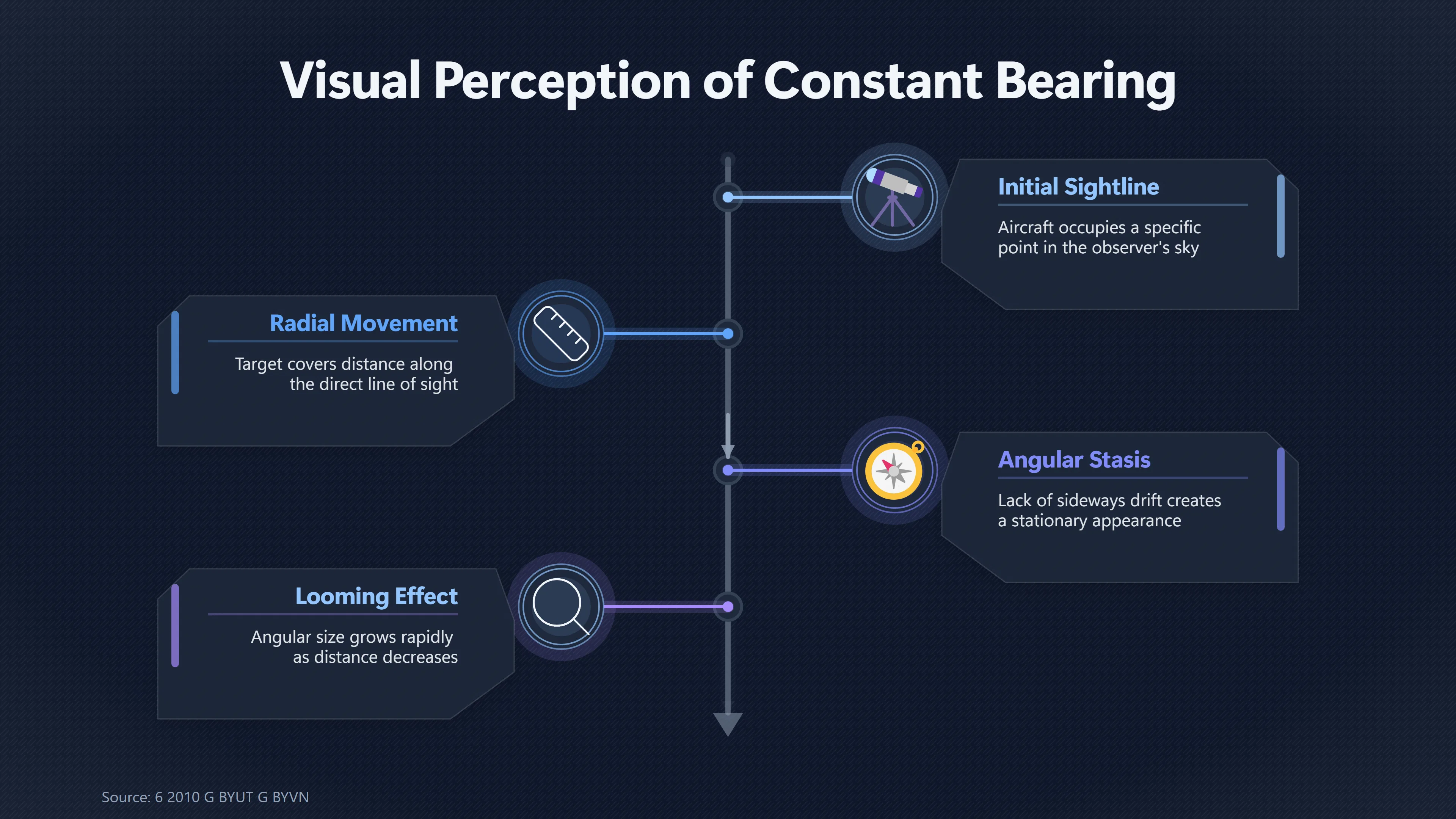
A fast aircraft can look almost motionless when it is travelling nearly along the observer’s line of sight. The reason is simple but counter-intuitive: the eye sees direction, not distance directly. If an aircraft is rapidly getting closer while remaining at nearly the same bearing — the same direction in the sky — it produces little sideways movement for the observer to notice. In aviation, the exact version of this geometry is familiar as constant relative bearing and is a recognised collision hazard because another aircraft on a collision course can appear stationary in the pilot’s visual field.[TSB]tsb.gc.caAviation Investigation Report A99P016820 Nov 1999 — When two aircraft are on a collision course with constant headings and constant sp…
For UFO or UAP reports, the important consequence is narrower. A witness who says that a light “hovered” or “stayed in exactly the same place” may be accurately describing its apparent angular position, without establishing that it was physically stationary. An approaching aeroplane can cover kilometres during that apparently motionless interval.
How constant-bearing geometry creates a static-looking target
Imagine an observer looking towards a distant aircraft. At one moment the aircraft is 15 kilometres away. A little later it is 12 kilometres away, then 9 kilometres away. If its flight path runs almost directly towards the observer, those three positions can lie on nearly the same sightline. Its geographical position has changed enormously, but its position against the observer’s sky has hardly shifted.
The exact collision-course case demonstrates the geometry particularly clearly. The Transportation Safety Board of Canada states that when two aircraft maintain constant headings and speeds on a collision course, their relative bearing remains constant. Each aircraft, if detected, therefore appears motionless to the pilot of the other. The board specifically notes that this apparent lack of movement makes visual acquisition more difficult.[tsb-bst.gc.ca]tsb-bst.gc.caAviation Investigation Report A99P0168 - Transportation Safety Board of CanadaJuly 3, 2001…
The same principle appears repeatedly in aviation safety guidance. A UK Air Accidents Investigation Branch report explains that two aircraft on a collision course maintain a constant relative bearing until impact and that, because the other aircraft has no relative movement, it may fail to attract peripheral vision. UK Civil Aviation Authority guidance similarly warns pilots about “constant angle” encounters in which another aircraft initially appears motionless.[GOV.UK]assets.publishing.service.gov.uk6 2010 G BYUT G BYVNaccident report 6/2010Two aircraft on a collision course maintain a constant relative bearing to each other until the moment of impact. A…
An observer on the ground does not need to be standing precisely on an aircraft’s eventual flight path for the effect to matter. A near-constant bearing is enough to produce the perceptual impression. If the aircraft has only a small sideways component relative to its distance, its bearing changes slowly. During a short observation, that drift can be difficult to see, especially when the target is a small point of light without useful foreground references.
This distinction is central:
Low angular speed is not the same thing as low physical speed.
The observer may see almost no movement across the sky while the aircraft has considerable velocity along the sightline. Aviation researchers therefore treat bearing rate — how quickly the observed direction changes — as information distinct from range and range rate. Modern collision-detection research likewise uses bearing rate alongside distance and closing-rate information when assessing aerial conflicts.[MDPI]mdpi.comVisual Flight Rules-Based Collision Avoidance Systems for UAV Flying in Civil AerospaceFebruary 25, 2020…
Why radial speed can hide hundreds of kilometres per hour
The effect becomes clearer with a simple numerical example. Suppose an aircraft is approaching at 400 kilometres per hour, about 111 metres per second. In one minute it travels roughly 6.7 kilometres. Yet if most of those 6.7 kilometres are directed towards the observer, rather than across the observer’s sightline, the aircraft can remain in roughly the same patch of sky.
That is why judging an unknown object’s speed from its apparent sideways movement alone can be profoundly misleading. “It did not move” may really mean “I could not detect a change in bearing”.
The aviation literature shows how serious that perceptual limitation can be. A peer-reviewed review of the see-and-avoid principle notes that an unobstructed converging aircraft can remain small, motionless and inconspicuous until shortly before impact. An experimental study of visual collision perception likewise describes a collision trajectory as one in which an approaching object expands while maintaining a constant bearing; changes in bearing rate provide important information for distinguishing objects that will pass by from those continuing towards the observer.[PubMed]pubmed.ncbi.nlm.nih.govlimitations of the see-and-avoid concept in civil aviationby CC Morris · 2005 · Cited by 57 — Even if a converging aircraft is unob…
This also explains why constant-bearing geometry can be particularly persuasive in a UAP observation. Normal intuition tends to associate rapid aircraft with obvious movement across the sky. But that expectation mainly fits crossing traffic. A jet flying across the observer’s view has a large transverse component and can sweep visibly from one landmark or star to another. The same jet pointed nearly towards the observer converts much more of its velocity into changing range rather than changing bearing.
At night the effect can become more striking because the observer may initially see little more than a bright light. Aircraft routinely use powerful exterior lights to improve conspicuity; FAA guidance, for example, encourages landing-light use below 10,000 feet, particularly near airports, while European aviation rules explicitly recognise landing lights as a means of increasing aircraft conspicuity.[Federal Aviation Administration]faa.govFederal Aviation Administration ENR 1.1: General RulesFederal Aviation Administration ENR 1.1: General Rules A distant aircraft approaching close to the direction in which those lights are aimed can therefore present a conspicuous light while its airframe remains much harder to resolve.
The resulting visual description — a bright object that remained in one place but became brighter or larger — is entirely compatible with an aircraft whose range is shrinking rapidly.
When small bearing changes finally become noticeable
The illusion cannot normally remain unchanged forever. As the aircraft gets closer, two things increasingly expose its motion.
First, angular size grows. An aircraft of fixed physical dimensions occupies a larger angle in the observer’s visual field as its distance decreases. This expansion is called looming. At long range the change can initially be very small, but it accelerates dramatically near the observer.
Australian Transport Safety Bureau (ATSB) modelling of a mid-air collision illustrates just how late that change can become visually striking. With a closing speed of 245 knots, the study calculated target-aircraft angular sizes of only about 0.4–0.5 degrees roughly 10–12 seconds before collision. In one reconstructed view, angular size increased from about 0.39 degrees at 12.5 seconds before impact to 1 degree approximately five seconds before impact and 7.5 degrees during the final second.[ATSB]atsb.gov.auOpen source on atsb.gov.au.
This is not a model for an ordinary ground-based UFO sighting — where the aircraft generally passes safely elsewhere — but it demonstrates an important feature of the geometry. Closing distance does not necessarily produce an immediately obvious visual expansion. Much of the dramatic apparent growth can be concentrated late in the approach.
Second, almost any departure from a perfect sightline becomes easier to detect at closer range. Suppose an aircraft is not actually headed at the observer but will pass several kilometres to one side. When it is very distant, that offset represents only a small angle. As it approaches, the same lateral separation corresponds to an increasingly large angular difference. The apparently fixed light therefore begins to drift sideways more noticeably.
This transition can make an observation seem stranger rather than more ordinary at first: a light may appear to “hover” for some time and then suddenly begin moving. No stop-and-start manoeuvre is required. The aircraft may have maintained an essentially ordinary flight path throughout; what changed was the observer’s viewing angle as range decreased.
RAF safety material describes an analogous late-stage effect as “ballooning”: traffic held on a constant sightline can remain exceptionally difficult to spot until its apparent size grows rapidly in the canopy.[Royal Air Force]raf.mod.ukair clues safety magazine 40air clues safety magazine 40 European aviation safety material similarly warns that a distant aircraft on a steady collision course can appear motionless and remain seemingly stationary without initially appearing to grow appreciably.[Hellenic Civil Aviation Authority]hcaa.gov.grHellenic Civil Aviation AuthorityegastHellenic Civil Aviation Authorityegast
What “it hovered” actually establishes
For assessing an aircraft-like UFO or UAP report, constant-bearing geometry suggests a useful distinction between observation and inference.
A witness may be entirely correct that a light remained beside the same star, building or patch of sky for an extended interval. That is observational evidence about its bearing. Concluding that the source itself was stationary is an additional inference requiring information about distance and trajectory.
Several features make a constant-bearing aircraft explanation more plausible: the object is initially point-like; its bearing changes little while its brightness or apparent size increases; it lies in the general direction of an airport approach or known traffic flow; and obvious sideways movement develops later as the geometry changes. None is conclusive by itself. The strongest assessment comes from reconstructing the observer’s position, viewing direction and time and comparing those with available aircraft tracks.
The collision-safety literature is especially valuable here because it establishes the mechanism independently of UFO interpretation. Aviation authorities have documented real cases in which aircraft converging at constant relative bearing were genuinely difficult for pilots to detect precisely because the traffic produced little or no apparent movement. In one Canadian investigation, radar data showed two aircraft remaining on constant-relative-bearing geometry until about ten seconds before their geometry began to change.[TSB]tsb.gc.caOpen source on gc.ca.
The practical lesson is therefore precise rather than dismissive: apparent hovering does not, by itself, demonstrate actual hovering. When an unidentified light is distant, its bearing can remain nearly fixed even while an aircraft is closing the range at normal aviation speeds. Only when the viewing geometry changes — through lateral displacement, a turn, a close approach or increasing angular size — may the hidden motion become visually obvious.
Amazon book picks
Further Reading
Books and field guides related to Why a Fast Aircraft Can Look Motionless. Use these as the next step if you want deeper reading beyond the article.
The Pilot's Handbook of Aeronautical Knowledge
Pilot's Handbook of Aeronautical Knowledge, an official Federal Aviation Administration (FAA) Handbook; provides basic knowledge that is...
Stick and Rudder: An Explanation of the Art of Flying
In the early 1940's, Wolfgang Langewiesche wrote a series of articles in Air Facts analyzing the various aspects of piloting techniques....
Human Factors in Aviation
Fully updated and expanded, the second edition of Human Factors in Aviation serves the needs of the widespread aviation community - stude...
Flight Theory and Aerodynamics: A Practical Guide for Operati...
The pilot's guide to aeronautics and the complex forces of flight Flight Theory and Aerodynamics is the essential pilot's guide to the ph...
eBay marketplace picks
Marketplace Samples
Live-tested eBay searches with available results related to this page.
Selected fromaircraft wall art oneBay.co.uk.
Endnotes
1.
Source: tsb.gc.ca
Link:https://www.tsb.gc.ca/eng/rapports-reports/aviation/1999/a99p0168/a99p0168.html
Source snippet
Aviation Investigation Report A99P016820 Nov 1999 — When two aircraft are on a collision course with constant headings and constant sp...
2.
Source: assets.publishing.service.gov.uk
Title: 6 2010 G BYUT G BYVN
Link:https://assets.publishing.service.gov.uk/media/542301c9e5274a1314000acb/6-2010_G-BYUT_G-BYVN.pdf
Source snippet
accident report 6/2010Two aircraft on a collision course maintain a constant relative bearing to each other until the moment of impact. A...
3.
Source: tsb-bst.gc.ca
Link:https://www.tsb-bst.gc.ca/eng/rapports-reports/aviation/1999/a99p0168/a99p0168.html
Source snippet
Aviation Investigation Report A99P0168 - Transportation Safety Board of CanadaJuly 3, 2001...
Published: July 3, 2001
4.
Source: tsb.gc.ca
Link:https://www.tsb.gc.ca/eng/rapports-reports/aviation/1999/a99p0108/a99p0108.html
Source snippet
Aviation Investigation Report A99P010820 Aug 1999 — When two aircraft are on a collision course and neither is turning, each has a con...
5.
Source: mdpi.com
Link:https://www.mdpi.com/2218-6581/9/1/9/htm
Source snippet
Visual Flight Rules-Based Collision Avoidance Systems for UAV Flying in Civil AerospaceFebruary 25, 2020...
Published: February 25, 2020
6.
Source: faa.gov
Title: Federal Aviation Administration ENR 1.1: General Rules
Link:https://www.faa.gov/air_traffic/publications/atpubs/aip_html/part2_enr_section_1.1.html
7.
Source: atsb.gov.au
Link:https://www.atsb.gov.au/sites/default/files/investigation-reports/as-2022-001-final.pdf
8.
Source: atsb.gov.au
Link:https://www.atsb.gov.au/investigations/2022-001
9.
Source: hcaa.gov.gr
Title: Hellenic Civil Aviation Authorityegast
Link:https://hcaa.gov.gr/sites/default/files/documents/egast_ga1_collision-avoidance.pdf
10.
Source: tsb.gc.ca
Link:https://www.tsb.gc.ca/eng/rapports-reports/aviation/2001/a01p0171/a01p0171.html
11.
Source: mdpi.com
Link:https://www.mdpi.com/2077-1312/12/11/2058
12.
Source: mdpi.com
Title: An Angular Acceleration Based Looming Detector for Moving UAVs
Link:https://www.mdpi.com/2624390
13.
Source: atsb.gov.au
Link:https://www.atsb.gov.au/investigations/197102540
14.
Source: faa.gov
Link:https://www.faa.gov/Air_traffic/publications/atpubs/aim_html/chap7_section_6.html
15.
Source: faa.gov
Title: AM70 09
Link:https://www.faa.gov/sites/faa.gov/files/data_research/research/med_humanfacs/oamtechreports/AM70-09.pdf
16.
Source: faa.gov
Link:https://www.faa.gov/sites/faa.gov/files/2022-11/AAR87-07.pdf
17.
Source: faa.gov
Link:https://www.faa.gov/documentLibrary/media/Advisory_Circular/AC_90-120.pdf
18.
Source: faa.gov
Title: CAB accident report
Link:https://www.faa.gov/sites/faa.gov/files/2022-11/CAB_accident_report.pdf
19.
Source: faa.gov
Link:https://www.faa.gov/air_traffic/publications/atpubs/pcg_html/glossary-a.html
20.
Source: faa.gov
Link:https://www.faa.gov/air_traffic/publications/atpubs/aim_html/chap4_section_5.html
21.
Source: faa.gov
Link:https://www.faa.gov/air_traffic/publications/atpubs/ATC/PCG/A.HTM
22.
Source: faa.gov
Title: 2019 11 07 ACS WG Interim Recommendation Report Powered Lift Handbook
Link:https://www.faa.gov/regulations_policies/rulemaking/committees/documents/media/2019-11-07%20ACS%20WG%20Interim%20Recommendation%20Report%20-%20Powered-Lift%20Handbook.pdf
23.
Source: atsb.gov.au
Link:https://www.atsb.gov.au/safetywatch/ga-pilots
24.
Source: atsb.gov.au
Link:https://www.atsb.gov.au/sites/default/files/media/4050593/see_and_avoid_report_print.pdf
25.
Source: atsb.gov.au
Link:https://www.atsb.gov.au/investigations/2023-001
26.
Source: atsb.gov.au
Title: Special edition
Link:https://www.atsb.gov.au/sites/default/files/media/5774849/special_vf_86.pdf
27.
Source: atsb.gov.au
Link:https://www.atsb.gov.au/sites/default/files/2024-02/AO-2023-024%20Final.pdf
28.
Source: atsb.gov.au
Title: Midair collision
Link:https://www.atsb.gov.au/sites/default/files/investigation-reports/ao2008081.pdf
29.
Source: atsb.gov.au
Title: aair200203449 001
Link:https://www.atsb.gov.au/sites/default/files/investigation-reports/aair200203449_001.pdf
30.
Source: atsb.gov.au
Link:https://www.atsb.gov.au/sites/default/files/investigation-reports/197401423.pdf
31.
Source: atsb.gov.au
Link:https://www.atsb.gov.au/sites/default/files/investigation-reports/197603014.pdf
32.
Source: atsb.gov.au
Link:https://www.atsb.gov.au/sites/default/files/media/5774705/asd_08_dec_56.pdf
33.
Source: atsb.gov.au
Link:https://www.atsb.gov.au/investigations/ao
34.
Source: assets.publishing.service.gov.uk
Link:https://assets.publishing.service.gov.uk/media/5e18b047ed915d3b0d1b767b/Volume_06_Aviation_Medicine.pdf
35.
Source: assets.publishing.service.gov.uk
Title: 8 2010 G BOLZ G EYES
Link:https://assets.publishing.service.gov.uk/media/5422f6dd40f0b613420005b1/8-2010_G-BOLZ_G-EYES.pdf
36.
Source: pubmed.ncbi.nlm.nih.gov
Link:https://pubmed.ncbi.nlm.nih.gov/15828635/
Source snippet
limitations of the see-and-avoid concept in civil aviationby CC Morris · 2005 · Cited by 57 — Even if a converging aircraft is unob...
37.
Source: pmc.ncbi.nlm.nih.gov
Link:https://pmc.ncbi.nlm.nih.gov/articles/PMC5393792/
38.
Source: raf.mod.uk
Title: air clues safety magazine 40
Link:https://www.raf.mod.uk/our-organisation/units/raf-safety-centre/air-clues/raf-safety-centre-documents/air-clues-safety-magazine-40/
39.
Source: nuforc.org
Link:https://nuforc.org/sighting/?id=199107
40.
Source: metabunk.org
Title: UAP Report
Link:https://www.metabunk.org/threads/uap-report-aurora-ontario-canada.14364/
41.
Source: pmc.ncbi.nlm.nih.gov
Link:https://pmc.ncbi.nlm.nih.gov/articles/PMC11154257/
42.
Source: pubmed.ncbi.nlm.nih.gov
Link:https://pubmed.ncbi.nlm.nih.gov/38248596/
43.
Source: nuforc.org
Link:https://nuforc.org/sighting/?id=179097
44.
Source: pmc.ncbi.nlm.nih.gov
Link:https://pmc.ncbi.nlm.nih.gov/articles/PMC10595048/
45.
Source: tsb.gc.ca
Link:https://www.tsb.gc.ca/eng/rapports-reports/aviation/2021/a21p0111/a21p0111.html
46.
Source: pmc.ncbi.nlm.nih.gov
Link:https://pmc.ncbi.nlm.nih.gov/articles/PMC8481591/
47.
Source: pmc.ncbi.nlm.nih.gov
Link:https://pmc.ncbi.nlm.nih.gov/articles/PMC6163552/
48.
Source: pmc.ncbi.nlm.nih.gov
Link:https://pmc.ncbi.nlm.nih.gov/articles/PMC3513526/
49.
Source: tsb.gc.ca
Link:https://www.tsb.gc.ca/eng/rapports-reports/aviation/2013/a13p0127/a13p0127.html
50.
Source: pubmed.ncbi.nlm.nih.gov
Link:https://pubmed.ncbi.nlm.nih.gov/23364572/
51.
Source: pmc.ncbi.nlm.nih.gov
Link:https://pmc.ncbi.nlm.nih.gov/articles/PMC2650431/
52.
Source: pmc.ncbi.nlm.nih.gov
Link:https://pmc.ncbi.nlm.nih.gov/articles/PMC2081158/
53.
Source: tsb.gc.ca
Link:https://www.tsb.gc.ca/eng/rapports-reports/aviation/1999/a99p0136/a99p0136.html
54.
Source: tsb.gc.ca
Link:https://www.tsb.gc.ca/eng/rapports-reports/aviation/2011/a11p0027/a11p0027.html
55.
Source: tsb.gc.ca
Link:https://www.tsb.gc.ca/fra/rapports-reports/aviation/1999/a99p0168/a99p0168.html
56.
Source: tsb.gc.ca
Link:https://www.tsb.gc.ca/eng/rapports-reports/aviation/2006/a06o0206/a06o0206.html
57.
Source: pmc.ncbi.nlm.nih.gov
Link:https://pmc.ncbi.nlm.nih.gov/articles/PMC7695743/
Additional References
58.
Source: youtube.com
Title: How Modern Missile Defense Actually Works (And Why It’s So Hard)
Link:https://www.youtube.com/watch?v=ortGuPJaMnw
Source snippet
COLREGs Rule 2 Explained | Responsibility, Good Seamanship & Collision Avoidance...
59.
Source: youtube.com
Title: UBOAT Intercept Vectors
Link:https://www.youtube.com/watch?v=gj0t0lJ4ci0
Source snippet
Mentour Pilot's analysis of airplane optical illusions explains the visual mechanisms that cause approaching aircraft to look stationary...
60.
Source: arxiv.org
Link:https://arxiv.org/abs/2502.08089
61.
Source: youtube.com
Title: A Black Hawk Crossed the 737’s Final Approach… Then TCAS Screamed
Link:https://www.youtube.com/watch?v=W-xB6MlVDtA
Source snippet
How Modern Missile Defense Actually Works (And Why It's So Hard)...
62.
Source: youtube.com
Title: 3 Ways your BRAIN Tricks You into Thinking AIRPLANES HOVER!
Link:https://www.youtube.com/watch?v=3osSwf7dgUI
Source snippet
A Black Hawk Crossed the 737's Final Approach… Then TCAS Screamed...
63.
Source: caa.co.uk
Link:https://www.caa.co.uk/media/xmocy0uu/20130121ssl13.pdf
Source snippet
Civil Aviation AuthoritySafetySense Leaflet 131 Jan 2013 — Be aware that constant angle collisions often occur when the other aircraft in...
64.
Source: researchgate.net
Link:https://www.researchgate.net/publication/356817165_A_Dataset_of_Stationary_Fixed-wing_Aircraft_on_a_Collision_Course_for_Vision-Based_Sense_and_Avoid
65.
Source: researchgate.net
Link:https://www.researchgate.net/publication/335197986_Below_Horizon_Aircraft_Detection_Using_Deep_Learning_for_Vision-Based_Sense_and_Avoid
66.
Source: researchgate.net
Link:https://www.researchgate.net/publication/284591881_Temporal_Characteristics_in_Detecting_Imminent_Collision_Events_on_Linear_Trajectories
67.
Source: researchgate.net
Link:https://www.researchgate.net/publication/315456434_Vision-Based_Estimation_of_Airborne_Target_Pseudobearing_Rate_using_Hidden_Markov_Model_Filters