Within UFO Identifications
Why Moving Lights on Clouds Become UFOs
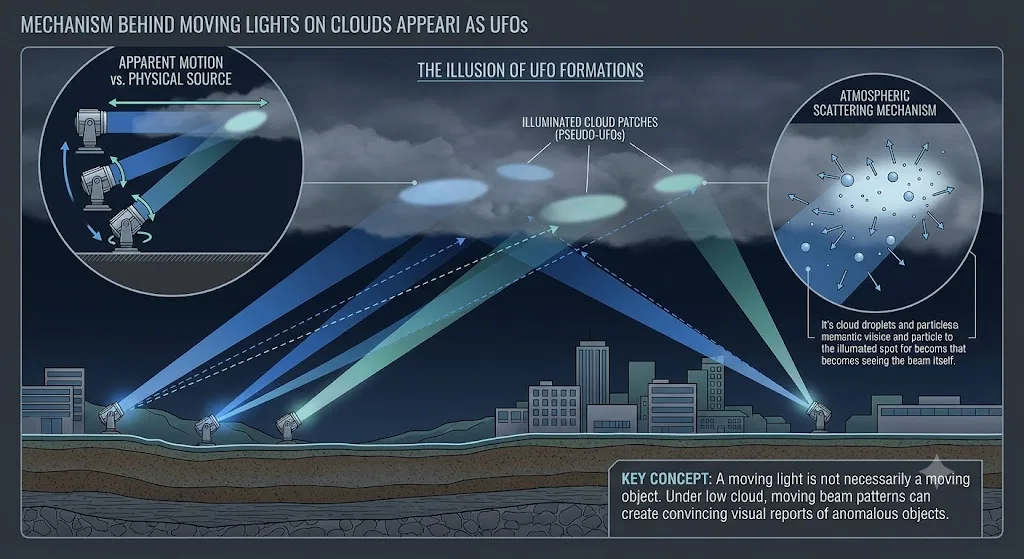
Powerful beams striking clouds can form bright moving patches whose source is hidden below the observer's line of sight.
On this page
- How beams illuminate low cloud layers
- Why the source may remain invisible
- Recognizing synchronized or sweeping light patterns
Page outline Jump by section
Introduction
Powerful searchlights can create convincing apparent “objects” in the night sky when their beams strike a low cloud deck. What the witness sees may be only the bright patch where a moving beam illuminates the underside of the cloud, not a physical object travelling through the air. The effect is particularly deceptive when the projector itself is kilometres away, hidden by buildings or terrain, or when the beam between the ground and cloud is too faint to see clearly.
This is a recognised source of UFO reports rather than a speculative explanation. The US Air Force’s Project Blue Book included searchlights among phenomena that resolved UFO cases, and modern atmospheric instrumentation demonstrates the same basic optical principle: a directed light can form a distinct illuminated spot on a cloud base.[AARO]aaro.milOpen source on aaro.mil. The most useful clues are therefore not exotic shapes but patterns — repeated sweeps, synchronised lights, abrupt disappearance at cloud edges and movement consistent with a ground-mounted lighting system.
How beams illuminate low clouds
A cloud is an unusually effective screen for a powerful light source. Cloud droplets scatter incoming light in many directions, allowing observers well away from the beam axis to see the illuminated area. The US National Weather Service defines atmospheric scattering as the diffusion or deflection of a light beam by suspended particles and notes that the scattering associated with cloud droplets is responsible for their bright appearance.[National Weather Service]weather.govOpen source on weather.gov.
The principle is practical enough to have been used in meteorology. An older form of optical ceilometer, an instrument for measuring cloud-base height, projected a spot of light onto the underside of a cloud and determined its altitude by triangulation. Modern laser ceilometers instead measure the travel time of light scattered back from the cloud.[National Weather Service]weather.govOpen source on weather.gov. In other words, a bright point apparently “in the clouds” can quite literally be nothing more than a patch of cloud being illuminated from below.
Entertainment searchlights exploit the same geometry on a much larger and more conspicuous scale. A motorised fixture can rotate or tilt its narrow beam rapidly. The illuminated patch then races across a cloud layer even though nothing is travelling along that path. A small change in the projector’s angle can shift the intersection point a large distance across a high cloud base, so the apparent light may seem to accelerate, reverse direction or cross a substantial piece of sky in seconds. That apparent speed is the speed of an illumination pattern, not the speed of a material craft — much as a torch spot can cross a distant wall far faster than the torch itself moves. This follows directly from the projected-spot geometry documented for optical cloud-height measurement.[National Weather Service]weather.govOpen source on weather.gov.
Cloud structure adds another layer of strangeness. A beam can brighten as it encounters thicker cloud, weaken over a thinner patch and disappear completely where there is a hole in the layer. Multiple fixtures can produce several luminous discs at once; overlapping beams can make patches merge, separate or brighten suddenly. Atmospheric scattering also varies with the amount and nature of droplets, haze and precipitation in the beam’s path.[National Weather Service]weather.govOpen source on weather.gov. These changes can make an otherwise regular lighting programme look less mechanical than it really is.
Why the source may remain invisible
The strongest reason searchlights become UFO reports is the separation between effect and source. Seeing a glowing patch on cloud does not guarantee that the observer will see a luminous column connecting it to the ground.
A searchlight beam becomes visible from the side only because some of its light is scattered towards the observer by particles in the intervening atmosphere. The cloud itself contains an abundance of droplets and can scatter strongly, while comparatively clear air beneath it may reveal little of the beam. It is therefore entirely possible for the endpoint to look brilliant while much of the path leading to it is inconspicuous. That conclusion follows from the National Weather Service’s description of scattering by suspended particles and of cloud-droplet scattering.[National Weather Service]weather.govOpen source on weather.gov.
Geometry can hide the projector as well. A commercial display may be operating beyond a row of buildings, behind a hill or simply outside the witness’s normal field of view. The visible cloud patch can also lie well away from the ground installation because the beam is angled rather than vertical. A witness who searches directly beneath the apparent “object” may consequently find no obvious source.
This becomes particularly misleading when several projectors are programmed together. The observer may see two, four or more luminous spots keeping formation, rotating around one another or converging on the same point. Because every spot appears to move coherently, the display can suggest a structured object with several lights attached to it. In reality, the apparent “formation” exists only on the cloud surface.
The phenomenon is sufficiently familiar in aviation regulation that the UK Civil Aviation Authority treats searchlights as intense directional light sources requiring attention because they can distract or dazzle flight crews. Its guidance explicitly groups lasers and searchlights as directed-light displays and recommends advance co-ordination where aviation could be affected.[Civil Aviation Authority]caa.co.ukOpen source on caa.co.uk. The same guidance notes that searchlights and related lighting have legitimate uses ranging from commercial displays to meteorological and aerodrome activities.[Civil Aviation Authority]caa.co.ukOpen source on caa.co.uk.
Patterns that point to searchlights
No single visual feature proves that mysterious lights are searchlights, but the explanation becomes substantially stronger when several characteristic behaviours occur together.
Repeated sweeping arcs are one of the clearest clues. A programmed fixture normally follows a limited range of pan-and-tilt movements. Consequently, a light may cross the same part of the sky repeatedly, disappear, then return on approximately the same trajectory. A freely moving aircraft, balloon or astronomical source would not ordinarily reproduce a tightly repeated scan pattern.
Several lights may move in synchrony. Event-lighting rigs commonly contain multiple independently steerable fixtures under computer control. If two or more bright spots repeatedly maintain fixed spacing, mirror one another or converge and diverge on cue, investigators should consider coordinated ground lighting before assuming a formation of separate airborne objects. This is a diagnostic inference from the known use of multiple directional searchlights rather than proof by itself. The CAA’s regulatory treatment of temporary light displays confirms that organised, powerful searchlight installations operating into airspace are a normal real-world activity.[Civil Aviation Authority]caa.co.ukOpen source on caa.co.uk.
Cloud dependence is especially revealing. A light that exists only on a cloud layer, fades at its edge or vanishes when the sky clears is behaving like projected illumination. The comparison with an optical ceilometer is useful here: its projected spot exists visually because a cloud surface is available to scatter the light.[National Weather Service]weather.govOpen source on weather.gov. If an apparent UFO repeatedly disappears at gaps in cloud yet reappears on the next section of cloud along the same sweep, that is difficult to reconcile with a self-luminous solid object but straightforward for a moving beam.
Extreme apparent acceleration need not indicate extreme physical acceleration. Because the light patch is an intersection point between a beam and a remote cloud surface, it has no mass that must be accelerated. A motor merely changes the beam direction. This can create the visual impression of a luminous object making exceptionally fast turns or reversals without requiring any vehicle to perform those manoeuvres.
A local event can close the case. A practical investigation should compare the sighting time and bearing with concerts, fairs, nightclubs, casinos, sporting events, openings, promotional installations or rehearsals. A 2026 episode near Darwin in Australia’s Northern Territory illustrates the point: conspicuous rotating lights prompted UFO speculation before they were traced to powerful searchlights being tested for a wedding display.[NT News]com.auOpen source on com.au. A similar pattern occurred around Edinburgh before Hogmanay celebrations, when conspicuous beams seen from Fife were reported as mysterious lights but were associated with testing for the event.[The Scottish Sun]thescottishsun.co.ukOpen source on thescottishsun.co.uk.

Why investigators have treated searchlights as an IFO cause
Searchlights occupy a modest but longstanding place in UFO investigation because they can reproduce several characteristics witnesses understandably associate with unusual craft: bright circular “objects”, rapid motion, repeated manoeuvres, multiple lights and sudden disappearance.
The US government’s 2024 historical review of unidentified anomalous phenomena revisited Project Blue Book, the Air Force investigation that ran from 1952 to 1969. In summarising Blue Book’s identified cases, the All-domain Anomaly Resolution Office listed searchlights alongside such causes as reflections, satellites, missiles, birds, fireworks and flares.[AARO]aaro.milOpen source on aaro.mil. That historical classification is important because it shows that searchlight confusion was encountered in actual UFO casework, rather than being invented later as a generic sceptical possibility.
At the same time, “it looks like searchlights” is not a sufficient resolution. A sound identification should connect the reported geometry and timing to a plausible source. Useful evidence can include repeated movement cycles in video, weather observations confirming a suitable cloud ceiling, witness bearings, the location of a lighting installation and records of an event or rehearsal. The absence of a visible beam by itself weighs little against the explanation because beam visibility depends strongly on atmospheric scattering and viewing geometry.[National Weather Service]weather.govOpen source on weather.gov.
Regulation can provide an identification trail
Searchlight cases have an advantage over many other UFO explanations: large organised displays may leave an administrative footprint.
In England, government planning guidance specifically states that illuminated advertisements projected onto clouds by lasers, searchlights or other beams can require express consent from the local planning authority. The wording is unusually relevant to UFO investigation because it formally recognises cloud projection as an intended use of such lighting.[GOV.UK]gov.ukOpen source on gov.uk.
Aviation authorities provide another potential trail. Current UK Civil Aviation Authority guidance says outdoor activities involving lasers and searchlights can distract or confuse aircrew and directs organisers towards procedures for notification and safety assessment.[Civil Aviation Authority]caa.co.ukOpen source on caa.co.uk. CAA safeguarding guidance likewise says temporary outdoor displays involving searchlights near an aerodrome should be assessed so that they cannot be confused with aeronautical lighting, create glare or dazzle pilots, and should be notified to the CAA and affected aerodrome where appropriate.[Civil Aviation Authority]caa.co.ukOpen source on caa.co.uk.
Those requirements matter beyond aviation safety. For an investigator confronting reports of mysterious repeating lights over a town, checks with event organisers, venues, local planning authorities and nearby aerodromes can sometimes establish whether powerful directed lighting was operating at the relevant time. The governance record can therefore turn an apparently distant aerial mystery into a testable ground-source hypothesis.

The key distinction: a moving light is not necessarily a moving object
Searchlight-generated UFO reports illustrate one of the most important principles in identifying unusual aerial phenomena: apparent motion does not necessarily represent the motion of a physical object.
A beam projected onto cloud creates a luminous location that can move, stop, split between different beams, reverse direction and disappear almost instantaneously. The observer correctly sees something bright moving across the sky; the error arises only when that changing patch of illumination is interpreted as a self-contained craft.
The strongest searchlight identification is therefore a combination of mechanism and corroboration. Low cloud supplies the projection surface; atmospheric scattering makes the patch visible; motorised fixtures explain sweeping or synchronised motion; and event, planning or aviation records may identify the source. Project Blue Book’s historical experience, meteorological use of projected cloud spots and contemporary regulation of high-powered skyward lighting all support the same conclusion: under the right conditions, an apparently agile luminous “object” in the clouds may be no object at all.[aaro.mil]aaro.milOpen source on aaro.mil.
Amazon book picks
Further Reading
Books and field guides related to Why Moving Lights on Clouds Become UFOs. Use these as the next step if you want deeper reading beyond the article.
The Cloudspotter's Guide
Discusses the history, types, and cultural fascination with clouds and explains what they mean in terms of climate and weather.
Light and Color in the Outdoors
All of science springs from the observation of nature. In this classic book, the late Professor Minnaert accompanies the reader on a tour...
Color and Light in Nature
We live in a world of optical marvels - from the commonplace but beautiful rainbow, to the rare and eerie superior mirage. But how many o...
Meteorology Today
METEOROLOGY TODAY has for many years been one of the most widely used and authoritative texts for the introductory meteorology course. Ea...
eBay marketplace picks
Marketplace Samples
Live-tested eBay searches with available results related to this page.
Selected fromUFO poster oneBay.co.uk.

Current eBay listing
I Want To Believe UFO Poster Giclée Fine Art Heavyweight Print


Current eBay listing
VINTAGE UFO FLYING SAUCERS COMIC ADVERTISING A2 POSTER PRINT
Endnotes
1.
Source: aaro.mil
Link:https://www.aaro.mil/UAP-Cases/Official-UAP-Imagery/4/
Additional References
2.
Source: youtube.com
Link:https://www.youtube.com/watch?v=0_Y9tYksutA
Source snippet
A Comparative Study between Laser Beam Ceilometer and Algorithm for Continuous Evaluation...
3.
Source: youtube.com
Title: Visualize the Mixing Layer Height with Ceilometers and BL-VIEW Software
Link:https://www.youtube.com/watch?v=agykSUq6fKE
Source snippet
PROBE introductory lecture: Instruments for profiling the atmospheric boundary layer...
4.
Source: youtube.com
Link:https://www.youtube.com/watch?v=6EKyFc3dbgo
Source snippet
This video on Cloud Base Height directly explains how a vertical cloud searchlight projects a bright spot of light onto a cloud deck to m...
5.
Source: youtube.com
Link:https://www.youtube.com/watch?v=Ixy1yVAvDvk
Source snippet
RAYMETRICS - HEA 2016 Winner...
6.
Source: cia.gov
Link:https://www.cia.gov/stories/story/how-to-investigate-a-flying-saucer/
7.
Source: media.defense.gov
Title: FY24 CONSOLIDATED ANNUAL REPORT ON UAP 508
Link:https://media.defense.gov/2024/Nov/14/2003583603/-1/-1/0/FY24-CONSOLIDATED-ANNUAL-REPORT-ON-UAP-508.PDF
8.
Source: youtube.com
Title: Cloud Base Height
Link:https://www.youtube.com/watch?v=6ca36mpXxAk
Source snippet
Visualize the Mixing Layer Height with Ceilometers and BL-VIEW Software...