Within UFO Identifications
Why Space Debris Can Look Like a Formation
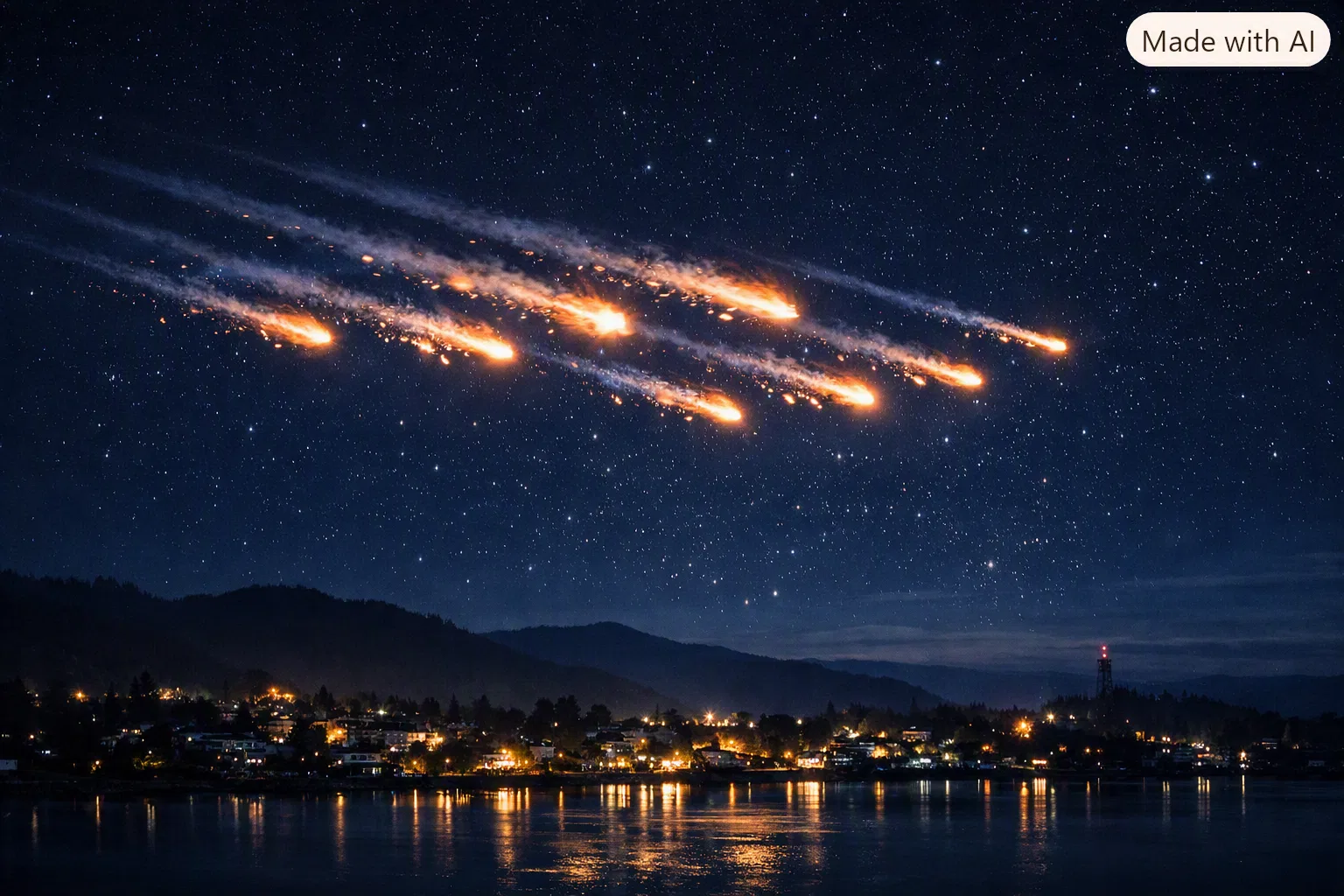
Reentering spacecraft and debris can fragment into bright formations that appear coordinated despite following a shared trajectory.
On this page
- How reentry fragments produce multiple lights
- Why parallel motion suggests false structure
- Confirming events with orbital reentry records
Page outline Jump by section
Introduction
Atmospheric reentries can produce one of the most persuasive kinds of mistaken “structured craft” sighting: several bright objects moving together across the sky, maintaining roughly parallel tracks while shedding sparks or smaller lights. To an observer without range information, the fragments may look like fixed lights on a single large vehicle rather than separate pieces of a spacecraft or rocket stage breaking apart tens of kilometres overhead.
The effect is not hypothetical. Instrumented reentries and well-documented historical events show that large artificial objects commonly fragment under aerodynamic and thermal loads, after which the pieces continue along closely related trajectories. Reentries are also unusually slow and long-lived compared with ordinary meteors, sometimes remaining visible for tens of seconds or even minutes. Those characteristics give observers time to perceive — and sometimes mentally complete — a coherent shape around the lights.[nasa.gov]ares.jsc.nasa.govyakima wa debris de orbitMeteorite Falls | Yakima, WA Debris De-Orbit26 Mar 2021 — This event is not a. It is a re-entry of a SpaceX Falcon 9 upper stage … oc…
For UFO or UAP investigation, the decisive evidence is often temporal rather than visual: a spectacular formation can become straightforward once its date, time and direction are compared with records of a known satellite or rocket-body reentry.
How reentry fragments produce multiple lights
An ageing satellite, rocket stage or spacecraft approaching Earth does not normally descend intact like an aircraft. At orbital speed it encounters progressively denser atmosphere, producing intense heating and rapidly increasing aerodynamic forces. Large structures can tumble, deform and break apart; individual components then heat, ablate and sometimes fragment again. ESA describes most spacecraft as undergoing breakup under aerothermal and mechanical loads during reentry, although sufficiently robust pieces can survive to the surface.[reentry.esoc.esa.int]reentry.esoc.esa.intESA's re-entry predictionsWhen spacecraft re-enter into the Earth's atmosphere, most of it will break up due to aerothermal. Nonetheless…
From the ground, that process can become a procession of luminous points. Researchers analysing a Long March 3B rocket-stage reentry observed from Hawaii note that breakup releases fragments which travel along similar apparent trajectories. The recorded event lasted more than 50 seconds, far longer than the fleeting streak many people associate with a meteor.[ESA Proceedings Database]conference.sdo.esoc.esa.intESA Proceedings DatabaseAnalysis of re-entry event of CZ-3B R/B observed by all-sky…These events are usually accompanied with the brea…
NASA documented an especially clear modern example over the US Pacific Northwest on 25 March 2021. A Falcon 9 upper stage reentered at about 21:00 local time, producing what NASA described as a long-lasting, slow-moving cascade of many fragments. Further pieces visibly separated as it crossed the sky. Reports arrived from California, Montana, Oregon and Washington, and some witnesses heard sonic booms. NASA identified its slow speed, shallow trajectory and extended fragmentation as characteristic of space debris rather than an ordinary meteor.[ARES]ares.jsc.nasa.govyakima wa debris de orbitMeteorite Falls | Yakima, WA Debris De-Orbit26 Mar 2021 — This event is not a. It is a re-entry of a SpaceX Falcon 9 upper stage … oc…
That distinction matters because an artificial reentry can occupy a large portion of the sky while visibly evolving. The Aerospace Corporation’s Center for Orbital and Reentry Debris Studies similarly advises that human-made reentries tend to appear slower than meteors and may break into numerous objects travelling together. Its reentry database records spacecraft and rocket bodies returning to Earth, providing a practical comparison source when a sighting date is known.[The Aerospace Corporation]aerospace.orgOpen source on aerospace.org.
The luminous points are not necessarily identical. Different components have different masses, shapes and materials, so they heat and decelerate differently. Some flare briefly; others remain bright; still others separate into smaller fragments. Scientific observation campaigns therefore use imaging, trajectory reconstruction and spectroscopy to determine when breakup occurs and which materials or components may be producing particular luminous features.[ESA Proceedings Database]conference.sdo.esoc.esa.intOpen source on esa.int.
The resulting display can look highly organised even though no fragment is actively maintaining formation.
Why parallel motion suggests false structure
The most important perceptual trap is simple: common motion does not require a common visible body.
Immediately after breakup, the pieces of a spacecraft inherit almost the same velocity and direction as their parent object. Their individual trajectories begin to diverge, but from a distant observer’s viewpoint they can remain grouped for a substantial period. ESA-linked analysis of reentry observations explicitly describes breakup fragments travelling on similar paths across the sky.[ESA Proceedings Database]conference.sdo.esoc.esa.intESA Proceedings DatabaseAnalysis of re-entry event of CZ-3B R/B observed by all-sky…These events are usually accompanied with the brea…
The eye then faces an ambiguity. A row or triangle of bright points could mean several independent objects, or it could be interpreted as lights attached to one dark object whose surface cannot be seen. At night there is usually no illuminated hull or background detail to settle the question. If three bright fragments appear at the corners of an apparent triangle, observers can perceive a triangular craft even though the space between them contains nothing.
A remarkable historical demonstration came from Zond 4, an uncrewed Soviet spacecraft that returned towards Earth in March 1968. NASA’s historical account confirms that Zond 4 was a high-speed reentry test mission whose flight ended unsuccessfully.[NASA]nasa.gov50 Years Ago: Zond 4 launched successfully50 Years Ago: Zond 4 launched successfully The subsequent reentry became important to UFO researchers because observers knew what they had seen but frequently misjudged its distance, altitude and structure.
The University of Colorado’s Air Force-sponsored UFO study, commonly called the Condon Report, used the Zond 4 event specifically to examine perception. Witnesses described the known reentry in dramatically different terms. Some interpreted multiple lights as objects pursuing one another; others placed what they were seeing at only a few thousand feet despite the phenomenon occurring high in the atmosphere. The report treated the case as an unusually useful controlled example because the physical source was independently known.[files.ncas.org]files.ncas.orgOpen source on ncas.org.
That case exposes several mechanisms relevant to apparent craft:
- Grouping: lights travelling at the same apparent speed are naturally treated as belonging together.
- Contour completion: the observer may perceive an implied triangle, rectangle or fuselage between separated luminous points.
- Distance compression: without familiar reference objects, something tens of kilometres away can seem much nearer.
- Size inflation: once the lights are interpreted as parts of one nearby object, their angular separation implies an enormous vehicle.
- Apparent manoeuvring: fragmentation, differential deceleration or fading can make one point appear to accelerate relative to another, despite every piece remaining on a ballistic path.
Zond 4 is particularly valuable because it removes the question of whether witnesses were merely inventing unusual details. They were watching a real, extraordinary event. Their descriptions nevertheless transformed one known reentry into reports involving seemingly low-flying, structured or interacting objects.[files.ncas.org]files.ncas.orgOpen source on ncas.org.
Skylab showed how a single object becomes a fleet
The uncontrolled return of Skylab in July 1979 provides a larger-scale comparison. NASA records the space station’s reentry and impact over Western Australia on 11 July 1979 UTC.[NASA Technical Reports Server]ntrs.nasa.govOpen source on nasa.gov. As the 77-tonne station disintegrated, observers saw not one continuous vehicle but separated luminous pieces spread along its flight path.
Contemporary recollections preserved in later historical accounts describe several large glowing objects moving horizontally across the sky before breaking into many smaller points. One Western Australian witness recalled five prominent lights spread across a considerable angular distance and visible for roughly two minutes, followed by further fragmentation.[NSS]nss.orgSpace in the Seventies: Skylab's Final Moments, Part TwoSpace in the Seventies: Skylab's Final Moments, Part Two
The importance of Skylab for UFO interpretation is not that its identity was mysterious — its fall was internationally anticipated — but precisely the opposite. It demonstrates what a known spacecraft breakup can look like when viewed without the explanatory label attached.
Seen unexpectedly, a similar display could be reported as a row of craft, a huge object carrying several lights, an escort formation or a procession of glowing vehicles. Yet all of those impressions can arise from one structure disintegrating while its fragments retain the forward velocity they shared moments earlier.
Modern controlled observations reinforce the same physics. ESA has repeatedly organised airborne campaigns specifically to watch spacecraft destruction during atmospheric entry because the fragmentation process is complicated enough that numerical models require observational validation. The 2024 reentry of ESA’s Salsa satellite was successfully observed from an aircraft over the South Pacific as part of this continuing effort to understand when spacecraft break apart and how their fragments disperse.[European Space Agency]esa.intCluster mission set to end with reentry over South PacificCluster mission set to end with reentry over South Pacific
In other words, the “formation” appearance is not an oddity confined to anecdotal UFO cases. Fragment trains are an expected and measurable phase of destructive reentry.

The time window is often more useful than the photograph
Reentry identifications become strongest when investigators move beyond resemblance. A photograph of several parallel lights may be compatible with space debris, but visual similarity alone cannot prove the source. The more discriminating test is whether a catalogued orbital object was actually returning through the relevant region at the relevant time.
This makes an accurate event time window unusually important. Useful witness information includes the nearest reliable time, observing location, direction of travel, approximate duration and whether the lights fragmented or maintained a common track.
Investigators can then compare those details with orbital-reentry records. The Aerospace Corporation maintains a database of payload and rocket-body reentries since 2000, while ESA publishes reentry predictions and information concerning spacecraft breakup and recovered debris.[The Aerospace Corporation]aerospace.orgOpen source on aerospace.org.
The sequence usually works better in this order:
- Establish the observation time as precisely as possible from photographs, phone metadata, doorbell cameras or multiple witnesses.
- Determine the direction and approximate path independently rather than relying on descriptions such as “came towards us”.
- Check whether a tracked spacecraft or rocket body had a predicted decay window overlapping the event.
- Compare the reported direction of motion with the object’s expected ground track.
- Look for the characteristic slow, extended fragmentation pattern across independent videos from different locations.
Precise prediction has limits. Uncontrolled reentries are affected strongly by atmospheric drag, so their exact location can remain uncertain until shortly before atmospheric entry. A broad forecast therefore should not be treated as proof that a particular object crossed a particular town. The identification becomes substantially stronger when observed timing, trajectory and fragmentation all agree. The existence of scientific programmes devoted to improving reentry prediction reflects these real uncertainties.[ESA Proceedings Database]conference.sdo.esoc.esa.intOpen source on esa.int.
Multi-station imagery can go further. Researchers can triangulate fragment paths from cameras at different locations and reconstruct the trajectory rather than relying on apparent motion from a single viewpoint. The Long March 3B study, for example, used observations from multiple stations to estimate individual fragment trajectories, while fireball networks have also demonstrated that artificial reentry events can be identified and reconstructed from ground-based video.[ESA Proceedings Database]conference.sdo.esoc.esa.intESA Proceedings DatabaseAnalysis of re-entry event of CZ-3B R/B observed by all-sky…These events are usually accompanied with the brea…
Reentry clues that matter most in a UAP report
No single visual characteristic is decisive, but several features together make atmospheric reentry a particularly strong candidate.
A long duration is important. Ordinary meteors are generally rapid events. Orbital debris is travelling fast in everyday terms, but substantially more slowly than many natural meteoroids and often enters at a shallow angle. A train that crosses a large section of sky over tens of seconds strongly favours investigation of an artificial reentry. NASA specifically highlighted prolonged duration, slow apparent movement and a flatter path in its identification of the 2021 Falcon 9 event.[ARES]ares.jsc.nasa.govyakima wa debris de orbitMeteorite Falls | Yakima, WA Debris De-Orbit26 Mar 2021 — This event is not a. It is a re-entry of a SpaceX Falcon 9 upper stage … oc…
Repeated fragmentation is even more diagnostic. Instead of one light merely fading, a reentry may split into several bright pieces, each of which can brighten, dim or fragment again. This cascading appearance is a natural consequence of the parent spacecraft undergoing progressive structural failure.[ARES]ares.jsc.nasa.govyakima wa debris de orbitMeteorite Falls | Yakima, WA Debris De-Orbit26 Mar 2021 — This event is not a. It is a re-entry of a SpaceX Falcon 9 upper stage … oc…
Parallel tracks favour common origin over coordinated control. When newly separated fragments continue in almost the same direction, their alignment is a consequence of shared momentum. Maintaining a visually stable arrangement for part of the event therefore does not demonstrate aerodynamic formation flying.[ESA Proceedings Database]conference.sdo.esoc.esa.intESA Proceedings DatabaseAnalysis of re-entry event of CZ-3B R/B observed by all-sky…These events are usually accompanied with the brea…
A broad geographic footprint is expected. A high-altitude luminous train can be visible from multiple regions simultaneously. The 2021 Pacific Northwest reentry generated reports across four US states, illustrating why witnesses many hundreds of kilometres apart may apparently describe the same “formation”.[ARES]ares.jsc.nasa.govyakima wa debris de orbitMeteorite Falls | Yakima, WA Debris De-Orbit26 Mar 2021 — This event is not a. It is a re-entry of a SpaceX Falcon 9 upper stage … oc…
Independent orbital agreement is the strongest clue of all. If a tracked rocket body was expected to reenter in the correct time interval and its trajectory matches the sighting, the explanation rests on external data rather than resemblance.
Conversely, a reentry explanation weakens when the observation lasts far longer than a plausible atmospheric passage, repeatedly reverses direction, remains stationary against the stars, or occurs when a well-constrained candidate object’s trajectory is incompatible with the sighting. Those discrepancies should be tested rather than explained away.
What these cases teach about “structured craft”
Atmospheric reentries occupy an especially useful place in the study of UFO and UAP misidentification because they can reproduce several features that witnesses reasonably associate with vehicles at once: multiple bright lights, apparent geometric organisation, sustained common motion, colour changes, fragments apparently separating from a larger source and an impressive apparent size.
The historical evidence also shows why a witness description should not be treated as a literal engineering drawing. During the known Zond 4 reentry, observers converted distant luminous fragments into very different estimates of altitude, speed and object configuration.[files.ncas.org]files.ncas.orgOpen source on ncas.org. Skylab demonstrated that one large artificial body can become a widely spaced procession of glowing objects during breakup, while the 2021 Falcon 9 event supplied modern imagery of the same basic phenomenon.[NASA Technical Reports Server]ntrs.nasa.govOpen source on nasa.gov.
None of this means that every triangular or formation-like UAP is space debris. It establishes a narrower and more useful point: several lights moving together do not, by themselves, establish several controlled vehicles or one solid craft connecting the lights. Reentry physics supplies a well-observed mechanism that can generate exactly that appearance.
The practical dividing line is therefore not how extraordinary a formation looks, but whether its event time, duration, direction and fragmentation behaviour can be matched to an independently recorded orbital return. When they can, an apparently organised craft can resolve into something more prosaic but visually spectacular: the final minutes of a human-made object breaking apart on a shared path through the atmosphere.
Amazon book picks
Further Reading
Books and field guides related to Why Space Debris Can Look Like a Formation. Use these as the next step if you want deeper reading beyond the article.
Space Junk: The Dangers of Polluting Earth's Orbit
Scientists have identified at least 100 million pieces of space debris—from paint chips to nonoperational zombie satellites—floating in E...
Reentry: SpaceX, Elon Musk, and the Reusable Rockets that Lau...
Featured in The Economist’s Best Books of 2024 USA Today Bestseller How did a shaky startup defy expectations and become the world’s lead...
Orbital Debris: A Technical Assessment
Since the beginning of space flight, the collision hazard in Earth orbit has increased as the number of artificial objects orbiting the E...
Space Debris: Models and Risk Analysis
In Space Debris Models and Risk Analysis the authors will provide the reader with a comprehensive background to understand the various so...
eBay marketplace picks
Marketplace Samples
Live-tested eBay searches with available results related to this page.
Selected fromspacecraft display model oneBay.co.uk.

Endnotes
1.
Source: ares.jsc.nasa.gov
Title: yakima wa debris de orbit
Link:https://ares.jsc.nasa.gov/meteorite-falls/events/yakima-wa-debris-de-orbit
Source snippet
Meteorite Falls | Yakima, WA Debris De-Orbit26 Mar 2021 — This event is not a. It is a re-entry of a SpaceX Falcon 9 upper stage … oc...
2.
Source: conference.sdo.esoc.esa.int
Link:https://conference.sdo.esoc.esa.int/proceedings/neosst2/paper/19
Source snippet
ESA Proceedings DatabaseAnalysis of re-entry event of CZ-3B R/B observed by all-sky...These events are usually accompanied with the brea...
3.
Source: aerospace.org
Link:https://aerospace.org/article/what-does-reentry-look-like
4.
Source: reentry.esoc.esa.int
Link:https://reentry.esoc.esa.int/
Source snippet
ESA's re-entry predictionsWhen spacecraft re-enter into the Earth's atmosphere, most of it will break up due to aerothermal. Nonetheless...
5.
Source: conference.sdo.esoc.esa.int
Link:https://conference.sdo.esoc.esa.int/proceedings/sdc6/paper/147
Source snippet
ESA Proceedings DatabaseEquivalent Re-Entry Breakup Altitude and Fragment ListThis paper describes the development of the concept of equi...
6.
Source: aerospace.org
Link:https://aerospace.org/reentries
7.
Source: conference.sdo.esoc.esa.int
Link:https://conference.sdo.esoc.esa.int/proceedings/sdc7/paper/410
8.
Source: conference.sdo.esoc.esa.int
Link:https://conference.sdo.esoc.esa.int/proceedings/sdc7/paper/410/SDC7-paper410.pdf
9.
Source: nasa.gov
Title: 50 Years Ago: Zond 4 launched successfully
Link:https://www.nasa.gov/history/50-years-ago-zond-4-launched-successfully/
10.
Source: files.ncas.org
Link:https://files.ncas.org/condon/text/s6chap02.htm
11.
Source: files.ncas.org
Link:https://files.ncas.org/condon/text/s6chap01.htm
12.
Source: ntrs.nasa.gov
Link:https://ntrs.nasa.gov/citations/19800012907
13.
Source: nss.org
Title: Space in the Seventies: Skylab’s Final Moments, Part Two
Link:https://nss.org/space-in-the-seventies-skylabs-final-moments-part-two/
14.
Source: esa.int
Title: Cluster mission set to end with reentry over South Pacific
Link:https://www.esa.int/Science_Exploration/Space_Science/Cluster/Cluster_mission_set_to_end_with_reentry_over_South_Pacific
15.
Source: indico.esa.int
Link:https://indico.esa.int/event/516/timetable/?view=standard
16.
Source: conference.sdo.esoc.esa.int
Link:https://conference.sdo.esoc.esa.int/proceedings/sdc9/paper/106/SDC9-paper106.pdf
17.
Source: space.com
Title: A I is ready to run spacecraft. Is the space industry ready for it? (op-ed)
Link:https://www.space.com/space-exploration/[satellites
18.
Source: ntrs.nasa.gov
Link:https://ntrs.nasa.gov/api/citations/19990041784/downloads/19990041784.pdf
19.
Source: cneos.jpl.nasa.gov
Link:https://cneos.jpl.nasa.gov/fireballs/intro.html
20.
Source: ntrs.nasa.gov
Link:https://ntrs.nasa.gov/api/citations/19940020171/downloads/19940020171.pdf
21.
Source: ares.jsc.nasa.gov
Link:https://ares.jsc.nasa.gov/meteorite-falls/events/
22.
Source: nasa.gov
Title: van allen probe a to re enter atmosphere
Link:https://www.nasa.gov/missions/van-allen-probes/nasa-van-allen-probe-a-to-re-enter-atmosphere/
23.
Source: nasa.gov
Title: its fireball season answering your meteor questions
Link:https://www.nasa.gov/blogs/watch-the-skies/2026/03/26/its-fireball-season-answering-your-meteor-questions/
24.
Source: ntrs.nasa.gov
Link:https://ntrs.nasa.gov/api/citations/19940020171/downloads/19940020171.pdf?attachment=true
25.
Source: science.nasa.gov
Title: great balls of fire
Link:https://science.nasa.gov/earth/earth-observatory/great-balls-of-fire/
26.
Source: jpl.nasa.gov
Title: instruments image fireball over bering sea
Link:https://www.jpl.nasa.gov/news/nasa-instruments-image-fireball-over-bering-sea/
27.
Source: ntrs.nasa.gov
Link:https://ntrs.nasa.gov/api/citations/20200000049/downloads/20200000049.pdf
28.
Source: orbitaldebris.jsc.nasa.gov
Link:https://orbitaldebris.jsc.nasa.gov/reentry/
29.
Source: ntrs.nasa.gov
Link:https://ntrs.nasa.gov/api/citations/20150002597/downloads/20150002597.pdf
30.
Source: nasa.gov
Title: 65 years ago sputnik ushers in the space age
Link:https://www.nasa.gov/history/65-years-ago-sputnik-ushers-in-the-space-age/
31.
Source: cneos.jpl.nasa.gov
Link:https://cneos.jpl.nasa.gov/fireballs/
32.
Source: science.nasa.gov
Link:https://science.nasa.gov/solar-system/meteors-meteorites/facts/
33.
Source: ntrs.nasa.gov
Link:https://ntrs.nasa.gov/api/citations/19730002972/downloads/19730002972.pdf
34.
Source: nasa.gov
Title: re entry of jules verne
Link:https://www.nasa.gov/image-article/re-entry-of-jules-verne/
35.
Source: ntrs.nasa.gov
Link:https://ntrs.nasa.gov/api/citations/19730002976/downloads/19730002976.pdf
36.
Source: ntrs.nasa.gov
Link:https://ntrs.nasa.gov/api/citations/19730002974/downloads/19730002974.pdf
37.
Source: nasa.gov
Title: core area of expertise entry systems
Link:https://www.nasa.gov/ames/core-area-of-expertise-entry-systems/
38.
Source: ntrs.nasa.gov
Link:https://ntrs.nasa.gov/api/citations/19820016261/downloads/19820016261.pdf
39.
Source: nasa.gov
Link:https://www.nasa.gov/wp-content/uploads/2023/01/FY19-Presidents-Report_508.pdf
40.
Source: orbitaldebris.jsc.nasa.gov
Link:https://www.orbitaldebris.jsc.nasa.gov/quarterly-news/pdfs/odqnv10i2.pdf
41.
Source: orbitaldebris.jsc.nasa.gov
Link:https://orbitaldebris.jsc.nasa.gov/quarterly-news/pdfs/ODQNv8i1.pdf
42.
Source: nasa.gov
Link:https://www.nasa.gov/wp-content/uploads/2023/01/presrep2007.pdf
43.
Source: ntrs.nasa.gov
Link:https://ntrs.nasa.gov/api/citations/20110023479/downloads/20110023479.pdf?attachment=true
44.
Source: nasa.gov
Link:https://www.nasa.gov/wp-content/uploads/2015/01/178101main_rtfip_final_200705.pdf
45.
Source: nasa.gov
Link:https://www.nasa.gov/wp-content/uploads/2023/01/presrep2009.pdf
46.
Source: ntrs.nasa.gov
Link:https://ntrs.nasa.gov/api/citations/19810013465/downloads/19810013465.pdf?attachment=true
47.
Source: ntrs.nasa.gov
Link:https://ntrs.nasa.gov/api/citations/19760023158/downloads/19760023158.pdf
48.
Source: nasa.gov
Link:https://www.nasa.gov/wp-content/uploads/2024/01/presrep1988.pdf?emrc=6814e862607f0
49.
Source: esa.int
Link:https://www.esa.int/Space_Safety/Clean_Space/%28archive%29/0
50.
Source: esa.int
Title: Watching Salsa s reentry live from the sky
Link:https://www.esa.int/Space_Safety/Watching_Salsa_s_reentry_live_from_the_sky
51.
Source: conference.sdo.esoc.esa.int
Title: SDC4 paper44
Link:https://conference.sdo.esoc.esa.int/proceedings/sdc4/paper/44/SDC4-paper44.pdf
52.
Source: blogs.esa.int
Title: reentry prediction soviet era venera venus lander cosmos 482 descent craft
Link:https://blogs.esa.int/rocketscience/2025/05/07/reentry-prediction-soviet-era-venera-venus-lander-cosmos-482-descent-craft/
53.
Source: esa.int
Title: ESA Space Environment Report 2025
Link:https://www.esa.int/Space_Safety/Space_Debris/ESA_Space_Environment_Report_2025
54.
Source: esa.int
Link:https://www.esa.int/Space_Safety/%28archive%29/100
55.
Source: esa.int
Link:https://www.esa.int/Space_Safety/Space_Debris/Reentry_and_collision_avoidance
56.
Source: blogs.esa.int
Title: int Aeolus reentry: live – Rocket Science
Link:https://blogs.esa.int/rocketscience/2023/07/24/aeolus-reentry-live/
57.
Source: esa.int
Link:https://www.esa.int/Enabling_Support/Space_Engineering_Technology/Forging_the_future
58.
Source: blogs.esa.int
Title: int Black box set to record ATV’s fiery death
Link:https://blogs.esa.int/orion/2011/06/21/black-box-set-to-record-atvs-fiery-death/
59.
Source: conference.sdo.esoc.esa.int
Title: SDC9 paper135
Link:https://conference.sdo.esoc.esa.int/proceedings/sdc9/paper/135/SDC9-paper135.pdf
60.
Source: conference.sdo.esoc.esa.int
Link:https://conference.sdo.esoc.esa.int/proceedings/sdc6/paper/147/SDC6-paper147.pdf
61.
Source: conference.sdo.esoc.esa.int
Title: SDC7 paper658
Link:https://conference.sdo.esoc.esa.int/proceedings/sdc7/paper/658/SDC7-paper658.pdf
62.
Source: conference.sdo.esoc.esa.int
Link:https://conference.sdo.esoc.esa.int/proceedings/sdc7/paper/647/SDC7-paper647.pdf
63.
Source: reentry.esoc.esa.int
Link:https://reentry.esoc.esa.int/home/blog/observing-break-ups
64.
Source: ideas.esa.int
Link:https://ideas.esa.int/core/servlet/hype/IMT?documentId=f3364026f28b55504cf90d8c08c00eca&documentTableId=7803042287531010827&templateName=&userAction=Browse
65.
Source: blogs.esa.int
Link:https://blogs.esa.int/rocketscience/category/space-debris/feed/
66.
Source: conference.sdo.esoc.esa.int
Link:https://conference.sdo.esoc.esa.int/proceedings/archive?page=17%2C
67.
Source: indico.esa.int
Link:https://indico.esa.int/event/579/timetable/?print=1&view=standard
68.
Source: indico.esa.int
Link:https://indico.esa.int/event/516/contributions/
69.
Source: files.ncas.org
Link:https://files.ncas.org/condon/text/s3chap06.htm
70.
Source: aerospace.org
Link:https://aerospace.org/article/space-debris-101
71.
Source: space.com
Title: fallen space junk help fight orbital debris
Link:https://www.space.com/fallen-space-junk-help-fight-orbital-debris
72.
Source: space.com
Title: 7589 case finally closed 1965 pennsylvania ufo mystery
Link:https://www.space.com/7589-case-finally-closed-1965-pennsylvania-ufo-mystery.html
73.
Source: news.sky.com
Link:https://news.sky.com/story/ufo-files-latest-new-release-in-us-reveals-reports-of-unexplained-green-orbs-discs-and-fireballs-13543508
74.
Source: Wikipedia
Title: Atmospheric entry
Link:https://en.wikipedia.org/wiki/Atmospheric_entry
75.
Source: reentrygame.com
Link:https://reentrygame.com/
76.
Source: history.com
Title: [Project Blue Book]({{ ‘blue-book/’ | relative_url }})
Link:https://www.history.com/articles/project-blue-book
77.
Source: history.com
Link:https://www.history.com/articles/the-day-skylab-crashed-to-earth-facts-about-the-first-u-s-space-stations-re-entry
78.
Source: spectrum.ieee.org
Link:https://spectrum.ieee.org/skylab
79.
Source: youtube.com
Link:https://www.youtube.com/ReentryAnOrbitalSimulator
80.
Source: youtube.com
Link:https://www.youtube.com/watch?v=zoVXuKQ__0s
81.
Source: youtube.com
Link:https://www.youtube.com/watch?v=_W7SqS6UhE4
82.
Source: instagram.com
Link:https://www.instagram.com/p/Da9pCmDkR2D/
83.
Source: wordreference.com
Link:https://www.wordreference.com/enit/reentry
84.
Source: reentryjourney.org
Title: Re Entry
Link:https://reentryjourney.org/
Additional References
85.
Source: arxiv.org
Link:https://arxiv.org/abs/2109.01004
86.
Source: youtube.com
Title: Fireball over Michigan likely dead Russian satellite reentry
Link:https://www.youtube.com/watch?v=KD-3ga6vRiU
Source snippet
Space debris burns up over US, likely reentering Starlink satellite...
87.
Source: youtube.com
Title: Rocket re-entering atmosphere results in impressive light show
Link:https://www.youtube.com/watch?v=XrITRQc9tJg
Source snippet
[Tracking]({{ 'tracking/' | relative_url }}) the burning spacecraft that made sonic booms over LA...
88.
Source: war.gov
Link:https://www.war.gov/medialink/ufo/061226/release_03/documents/CIA-UAP-016-Sightings_of_Unidentified_Flying_Ojbects_in_Ladakh_Nepal_Sikkim_and_Bhutan.pdf
89.
Source: youtube.com
Title: Tracking the burning spacecraft that made sonic booms over LA
Link:https://www.youtube.com/watch?v=bzOOfkc0TTU
Source snippet
Streak of light in the sky puzzled California residents...
90.
Source: youtube.com
Title: Streak of light in the sky puzzled California residents
Link:https://www.youtube.com/watch?v=qahL2QP8pLY
Source snippet
Fireball over Michigan likely dead Russian satellite reentry...
91.
Source: facebook.com
Link:https://www.facebook.com/globaltimesnews/posts/a-mysterious-glowing-object-streaked-across-xinjiangs-night-sky-on-tuesday-spark/1577913544380847/
92.
Source: governmentattic.org
Link:https://www.governmentattic.org/13docs/UFOsRelatedSubjBiblio_Catoe_1969.pdf
93.
Source: spaceacademy.net.au
Link:https://www.spaceacademy.net.au/watch/debris/reentryhaz.htm
94.
Source: slideshare.net
Link:https://www.slideshare.net/slideshow/project-blue-book-140388203/140388203