Within Starlink
Can Satellite Spacing Date a Starlink UFO Sighting?
A tightly packed chain fits a recent deployment far better than an older Starlink group that has already dispersed.
On this page
- How spacing evolves after deployment
- Matching train compactness to launch age
- When spacing weakens a Starlink identification
Page outline Jump by section
Introduction
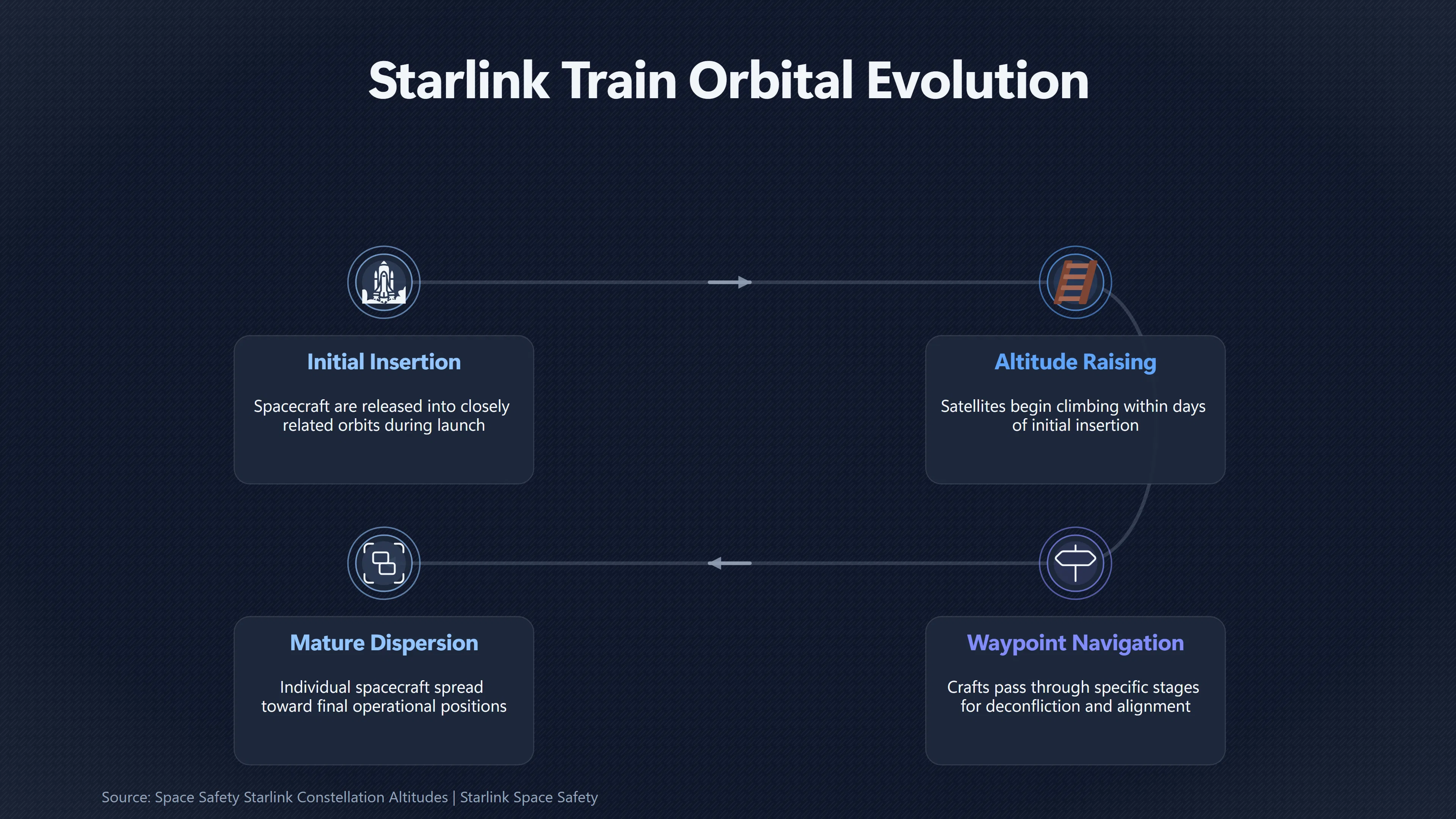
The spacing of a suspected Starlink “train” can do more than make a UFO or UAP sighting look familiar. It can help test whether a specific Starlink launch was young enough to produce the reported formation. Starlink spacecraft are deployed together, but the launch cohort does not remain a permanently compact string. After insertion, satellites begin manoeuvring, raising altitude, passing through orbital waypoints and spreading towards operational positions. Starlink itself says orbit raising begins within days of insertion, while observational research shows that individual spacecraft can follow different parking and raising schedules.[Space Safety]space-safety.starlink.comSpace Safety Starlink Constellation Altitudes | Starlink Space SafetySpace Safety Starlink Constellation Altitudes | Starlink Space Safety
That gives investigators a useful chronological constraint. A very dense, orderly chain is much more naturally associated with a recent deployment than with a mature group that has already dispersed. Conversely, if a proposed Starlink batch was launched long before the sighting and its actual orbital positions show widely separated spacecraft, “it was Starlink” becomes harder to sustain.
Spacing is not an exact clock. Perspective can compress a train, only some satellites may be illuminated, and Starlink deployment procedures have changed. The strongest method therefore combines launch age, actual orbital positions, apparent spacing and illumination geometry, rather than relying on visual resemblance alone.
How spacing evolves after deployment
A Starlink train begins with an unusually concentrated population because a launch places many spacecraft into closely related orbits during the same deployment event. Current CelesTrak supplemental data illustrates just how precisely that starting point can sometimes be known: its Starlink datasets can include SpaceX-provided pre-launch and post-deployment state vectors, with predicted launch and deployment times. CelesTrak also derives supplemental orbital data from SpaceX’s public ephemeris repository.[CelesTrak]celestrak.orgCelesTrak: Current Supplemental GP Element SetsJuly 16, 2026…
This matters because the train is a deployment state, not the permanent architecture of the constellation. Starlink’s own space-safety documentation says that satellites begin raising altitude within days of insertion. During the climb they can use multiple altitude waypoints, both for deconfliction with crewed spacecraft and to align themselves with their intended orbital shells. The timing and rate of that climb depend partly on atmospheric density.[Space Safety]space-safety.starlink.comSpace Safety Starlink Constellation Altitudes | Starlink Space SafetySpace Safety Starlink Constellation Altitudes | Starlink Space Safety
Detailed orbital research confirms that the process is more complicated than every satellite simply climbing together at the same rate. A 2025 study of continuously manoeuvring Starlink satellites examined 22 spacecraft from a 24 January 2024 launch. Eighteen passed through parking stages around 350 km and 430 km before reaching operational altitude near 480 km, while four followed different sequences, including waypoints around 430 km and 450 km and destinations near 480 or 550 km. The duration of parking stages also varied between satellites.[PubMed Central (PMC)]pmc.ncbi.nlm.nih.govPubMed Central (PMC)Orbit Determination for Continuously Maneuvering Starlink Satellites Based on an Unscented Batch Filtering Method - PMC…
That is precisely why a Starlink train stretches and evolves rather than behaving as a rigid formation. Small differences in orbital period, altitude and manoeuvring accumulate into changes in along-track separation. Some spacecraft move onwards while others remain at waypoints. A group that initially resembles closely spaced beads can consequently become a longer chain, break into subgroups and eventually cease to look like a launch-sized train at all.
Research covering the constellation from 2019 to 2025 reinforces this distinction between deployment and mature operation. A 2026 empirical analysis found Starlink to be highly dynamic, with continuing altitude adjustments and intra-orbital relocations. Nevertheless, most operational spacecraft form a comparatively stable structure with near-uniform spacing; the authors also found smaller two- or three-satellite clusters used as in-orbit backups. That mature topology is quite different from dozens of objects packed into the recognisable procession associated with a fresh launch.[arXiv]arxiv.orgarXiv Starlink Constellation: Deployment, Configuration, and DynamicsStarlink Constellation: Deployment, Configuration, and DynamicsMarch 26, 2026…
For UFO identification, the practical implication is simple: the tighter and more launch-like the reported procession, the more important it becomes to find a suitably recent deployment.
How well can compactness date a train?
There is no defensible universal conversion such as “this spacing means the launch occurred exactly three days ago”. Starlink missions have used different satellite designs, insertion altitudes, operational shells and deployment strategies, while atmospheric drag and spacecraft manoeuvres affect how individual groups evolve. Starlink explicitly notes that orbit-raising timing and rate depend heavily on atmospheric density.[Space Safety]space-safety.starlink.comSpace Safety Starlink Constellation Altitudes | Starlink Space SafetySpace Safety Starlink Constellation Altitudes | Starlink Space Safety
Nevertheless, age supplies a strong relative test.
A sighting within hours or a few days of a launch has an obvious mechanism for producing a dense train: many spacecraft were only recently released into closely related trajectories. Popular observing guidance consequently notes that Starlink trains are easiest to see shortly after launch, before the satellites climb and disperse. Space.com’s observing guide, for example, describes them as easiest to see a day or two after launch and progressively harder to observe as they ascend and spread out.[Space]space.comStarlink satellites: Facts, tracking and impact on astronomy | SpaceStarlink satellites: Facts, tracking and impact on astronomy | SpaceJune 1, 2026…
Historical observations demonstrate how striking that earliest stage can be. Following the first 60-satellite Starlink launch in May 2019, observers in Europe saw a conspicuous train less than a day after launch, with the spacecraft still moving close together. The unusual sight immediately generated UFO reports, illustrating why the compact phase has such identification value.[Reddit]reddit.comSpace X Starlink SatellitesSpaceX Starlink SatellitesMay 25, 2019…
The important distinction, however, is between visibility age and spacing age. Satellites may remain observable after a train has noticeably stretched, and a spacecraft can become faint even while it remains relatively close to its launch companions. Brightness therefore cannot be treated as a simple proxy for separation.
That distinction is supported by photometric measurements of Starlink V2 Mini satellites during orbit raising. Researchers found a substantial brightness change near 357 km altitude: the mean apparent magnitude below that level was 2.68, compared with 6.46 above it. After adjusting observations to a common 1,000 km distance, the authors estimated that the change represented about a 93 per cent reduction in brightness.[arXiv]arxiv.orgarXiv The Brightness of Starlink Mini Satellites During Orbit-RaisingarXiv The Brightness of Starlink Mini Satellites During Orbit-Raising
Earlier work likewise found that changes in spacecraft orientation could make orbit-raising Starlinks dramatically fainter. A study of roll-angle adjustments measured roughly a 90 per cent average reduction after the operational change.[arXiv]arxiv.orgarXiv Roll Angle Adjustment Dims Starlink SatellitesarXiv Roll Angle Adjustment Dims Starlink Satellites
A train can therefore evolve in two ways at once: its physical spacing changes, while the set of members visible to the human eye changes too. Investigators should not infer that a photograph showing eight lights means only eight satellites occupied that section of orbit.
Matching a UFO report to the right launch
A good spacing test works backwards from the observation. Suppose a witness reports 25 lights moving in single file across a short angular span of sky. It is not enough to discover that several Starlink satellites were above the horizon. The more useful questions are:
- Was there a recent Starlink deployment capable of supplying dozens of closely related spacecraft?
- Where were the individual members of that batch at the sighting time?
- How far apart should they have appeared from the witness’s position?
- Which of them were sunlit and potentially visible?
- Does the predicted train length resemble the photographed or reported one?
Modern orbital datasets make these questions increasingly testable. CelesTrak’s Supplemental General Perturbations, or SupGP, service publishes Starlink data derived from SpaceX ephemerides. It can also group objects by launch using their International Designator, while current datasets may include pre-launch stack vectors and post-deployment information supplied by SpaceX.[CelesTrak]celestrak.orgOpen source on celestrak.org.
This is especially valuable immediately after launch. A fresh satellite train is moving and manoeuvring during precisely the period when ordinary catalogue-based predictions can be most challenging. Supplemental operator ephemerides can therefore provide a better starting point than assuming a train will follow an unchanged orbit for days.
The observer’s location is equally important because apparent compactness is a projection. Imagine a long line of satellites viewed broadside: their angular separation may be obvious. View substantially along the direction of the train, however, and the same physical distribution can appear compressed. Distance also changes angular separation. A photograph that looks “too tight” in two dimensions cannot safely be converted into a physical separation without reconstructing the viewing geometry.
This creates an important safeguard against overconfidence. Launch age is a filter; propagated geometry is the actual test.
The August 2022 pilot case shows the method
A well-documented commercial-aviation incident demonstrates what a strong Starlink identification looks like. On 10 August 2022, five pilots aboard two commercial aircraft over the Pacific reported unusual lights. The incident produced two mobile-phone photographs and a video, providing more evidence than a purely verbal sighting.[arXiv]arxiv.orgOpen source on arxiv.org.
Researchers led by Douglas Buettner reconstructed the observation using supplemental two-line orbital elements for a Starlink train launched that same day, together with Automatic Dependent Surveillance–Broadcast (ADS-B) position data for the aircraft carrying the observers. Their reconstruction reproduced the view of the satellites from the cockpit at the relevant time and place.[arXiv]arxiv.orgOpen source on arxiv.org.
Sky & Telescope’s account of the research emphasised the key chronological fact: the objects were identified with a closely spaced Starlink train launched earlier that day.[Sky & Telescope]skyandtelescope.orgSky & Telescope Starlink Flares Can Fool Anyone — Even Airline PilotsSky & Telescope Starlink Flares Can Fool Anyone — Even Airline Pilots
That makes the case particularly relevant to the spacing test. The investigators did not start with an arbitrary collection of Starlink satellites already scattered through the constellation. They had a specific, extremely young launch cohort whose compact state made physical sense at the time of observation. They then checked the geometry using independent aircraft and satellite data.
This is considerably stronger than saying that a row of UFOs “looks like Starlink”. It connects four independent elements:
a recent launch → a still-compact cohort → a predicted position → the witness’s actual line of sight.
The authors also stress why the task is not always trivial: Starlink has employed multiple deployment and orbital-evolution strategies, while changing solar reflection angles can produce unfamiliar appearances.[arXiv]arxiv.orgOpen source on arxiv.org. That complexity argues for reconstruction rather than for abandoning the spacing test.
Why brightness can make spacing deceptive
A witness does not see the orbital distribution directly. They see the subset of spacecraft that happen to reflect enough sunlight towards them.
Starlink satellites are visible primarily through reflected sunlight, and their brightness depends strongly on Sun–satellite–observer geometry. Modelling of Starlink’s flat-panel spacecraft has shown that apparent brightness can vary markedly with solar elevation and viewing angle; under some geometries, sunlight illuminates surfaces in a way that makes the satellite effectively invisible to an observer below.[arXiv]arxiv.orgOpen source on arxiv.org.
More recent work on Starlink Mini satellites likewise finds that brightness varies across the sky and with solar angle, with twilight particularly favourable for visible satellites and occasional brightness surges or flares.[arXiv]arxiv.orgarXiv Starlink Mini Satellite Brightness Distributions Across the SkyarXiv Starlink Mini Satellite Brightness Distributions Across the Sky
This produces several potential illusions. A physically continuous train might appear to contain gaps because intermediate spacecraft are too faint. A longer dispersed group could appear as a smaller cluster if only neighbouring satellites happen to be bright. Individual lights may brighten and fade rather than remaining uniform throughout a pass.
Accordingly, investigators should distinguish between orbital spacing and visible-light spacing. Photographs establish the latter. Ephemerides allow the former to be calculated. A credible Starlink reconstruction should explain why the two are compatible instead of silently assuming they are identical.
When spacing weakens a Starlink explanation
The greatest evidential value of spacing may come when it contradicts the proposed identification.
Starlink has become so numerous that the statement “Starlink satellites were in the sky” is increasingly weak by itself. A mature constellation contains thousands of spacecraft distributed across multiple shells and orbital planes. Finding some Starlinks near a general direction does not demonstrate that those spacecraft produced a particular dense procession.
A strong mismatch occurs when a report describes a tightly packed, launch-like chain but the proposed satellites are from a substantially older cohort whose propagated positions are already widely distributed. The older objects do not cease to be Starlinks, but they may no longer possess the geometry needed to explain that observation.
The 2026 constellation study is relevant here because it shows that mature Starlink architecture is neither one permanent train nor perfectly static. Most spacecraft settle into relatively stable, near-uniform spacing, while some twins and triads remain clustered and individual satellites continue manoeuvring.[arXiv]arxiv.orgarXiv Starlink Constellation: Deployment, Configuration, and DynamicsStarlink Constellation: Deployment, Configuration, and DynamicsMarch 26, 2026… Thus, two or three neighbouring points should not automatically be rejected merely because the satellites are old. But dozens of tightly ordered lights demand a different explanation and make launch chronology much more discriminating.
There is another warning against simplistic age rules. The February 2022 geomagnetic-storm incident showed that environmental conditions can disrupt normal post-launch evolution. SpaceX launched 49 satellites on 3 February; increased atmospheric drag prevented many from leaving safe mode and beginning normal orbit raising, and up to 40 subsequently re-entered.[UK Space Agency Blog]space.blog.gov.ukOpen source on blog.gov.uk. A fixed timetable applied blindly across every Starlink mission would miss such exceptional behaviour.
The correct question is therefore not “Is this launch older than X days?” but “Where should this particular launch cohort actually have been at the observation time?”

A practical hierarchy of evidence
Spacing is most powerful when used as part of a sequence of increasingly demanding checks.
First comes chronology. Search for launches recent enough to plausibly retain the reported compactness. A spectacularly dense train should direct attention towards recent deployments before older operational satellites.
Second comes orbital reconstruction. Obtain orbital elements or operator-derived ephemerides and calculate where the candidate spacecraft were at the sighting time. CelesTrak’s supplemental Starlink service is particularly useful because its current data are derived from SpaceX’s public ephemerides and can include deployment-specific information.[CelesTrak]celestrak.orgCelesTrak: Current Supplemental GP Element SetsJuly 16, 2026…
Third comes observer geometry. Calculate azimuth, elevation, range and projected along-track distribution from the witness’s location rather than viewing the constellation from an abstract Earth-centred perspective.
Fourth comes illumination. Determine whether the candidate spacecraft were sunlit and whether their orientation and phase geometry make the reported brightness plausible. Photometric research shows that Starlink brightness can change by several magnitudes during orbit raising and can depend strongly on viewing geometry.[arXiv]arxiv.orgarXiv The Brightness of Starlink Mini Satellites During Orbit-RaisingarXiv The Brightness of Starlink Mini Satellites During Orbit-Raising
Finally comes morphological comparison: does the reconstructed pattern have approximately the same number of visible objects, angular length, direction of travel and spacing behaviour as the report?
The further an identification progresses through those tests, the less it depends on subjective resemblance.
Spacing makes “Starlink” a falsifiable explanation
The broader value of launch-age analysis is that it prevents Starlink from becoming a catch-all explanation for every orderly group of lights. A useful identified-flying-object explanation should make predictions that could have failed.
A proposed recent Starlink train predicts that a known launch cohort existed; that its members occupied particular orbital positions; that their projected spacing from the witness’s location had a particular structure; and that at least some of them were illuminated strongly enough to be seen. Those predictions can be compared with independent records.
The August 2022 aviation reconstruction demonstrates the positive case: a same-day launch supplied a closely spaced train, satellite ephemerides placed it correctly, and aircraft tracking allowed the researchers to reconstruct what the pilots should have seen.[arXiv]arxiv.orgOpen source on arxiv.org.
The inverse is equally important. If a claimed Starlink explanation requires an old batch to remain densely packed when orbital records show it had already dispersed, or places the candidate satellites in the wrong part of the sky, the hypothesis should lose credibility. A different recent launch might still work, but “Starlink” in the abstract does not rescue a failed candidate.
That is why launch age and spacing are unusually useful within investigations of modern UFO and UAP reports. The familiar string of lights is temporary, and temporary phenomena carry a timeline. A tightly packed Starlink train should have a deployment history capable of producing that compactness. When the launch date, orbital evolution, projected spacing and illumination all agree, the identification can be strong. When they do not, spacing provides a concrete reason to keep looking rather than accepting a superficial visual match.
Amazon book picks
Further Reading
Books and field guides related to Can Satellite Spacing Date a Starlink UFO Sighting?. Use these as the next step if you want deeper reading beyond the article.
Orbital Mechanics for Engineering Students
Orbital Mechanics for Engineering Students, Second Edition, provides an introduction to the basic concepts of space mechanics. These incl...
Fundamentals of Astrodynamics
Rating: 4.5/5 from 12 Google Books ratings
Teaching text developed by U.S. Air Force Academy and designed as a first course emphasizes the universal variable formulation. Develops...
Satellite Orbits: Models, Methods and Applications
Satellite Orbits -Models, Methods, and Applications has been written as a compre hensive textbook that guides the reader through the theo...
Celestial Objects for Modern Telescopes
Based on field notes made by the author during his own career as an amateur astronomer, this unique guide covers both the traditional and...
eBay marketplace picks
Marketplace Samples
Live-tested eBay searches with available results related to this page.
Selected fromStarlink satellite model oneBay.co.uk.

Endnotes
1.
Source: space-safety.starlink.com
Title: Space Safety Starlink Constellation Altitudes | Starlink Space Safety
Link:https://space-safety.starlink.com/docs/space-safety-articles/constellation_altitudes/
2.
Source: celestrak.org
Link:https://celestrak.org/NORAD/elements/supplemental/index.php?FORMAT=json
Source snippet
CelesTrak: Current Supplemental GP Element SetsJuly 16, 2026...
Published: July 16, 2026
3.
Source: celestrak.org
Link:https://celestrak.org/NORAD/elements/supplemental/
4.
Source: celestrak.org
Link:https://celestrak.org/NORAD/elements/supplemental/index.php?FORMAT=csv
5.
Source: arxiv.org
Title: arXiv Starlink Constellation: Deployment, Configuration, and Dynamics
Link:https://arxiv.org/abs/2603.25835
Source snippet
Starlink Constellation: Deployment, Configuration, and DynamicsMarch 26, 2026...
Published: March 26, 2026
6.
Source: space.com
Title: Starlink satellites: Facts, tracking and impact on astronomy | Space
Link:https://www.space.com/spacex-starlink-satellites.html
Source snippet
Starlink satellites: Facts, tracking and impact on astronomy | SpaceJune 1, 2026...
Published: June 1, 2026
7.
Source: space.com
Link:https://www.space.com/starlink-satellite-train-how-to-see-and-track-it
Source snippet
These satellites appear as a bright, fast-moving group of lights in the sky shortly after launch, before ascending to a higher operationa...
8.
Source: reddit.com
Title: Space X Starlink Satellites
Link:https://www.reddit.com/r/gifs/comments/bss8wa
Source snippet
SpaceX Starlink SatellitesMay 25, 2019...
Published: May 25, 2019
9.
Source: arxiv.org
Title: arXiv The Brightness of Starlink Mini Satellites During Orbit-Raising
Link:https://arxiv.org/abs/2405.12007
10.
Source: arxiv.org
Title: arXiv Roll Angle Adjustment Dims Starlink Satellites
Link:https://arxiv.org/abs/2303.01431
11.
Source: celestrak.org
Link:https://celestrak.org/NORAD/documentation/sup-gp-queries.php
12.
Source: arxiv.org
Link:https://arxiv.org/abs/2403.08155
13.
Source: arxiv.org
Link:https://arxiv.org/abs/2003.07805
14.
Source: arxiv.org
Title: arXiv Starlink Mini Satellite Brightness Distributions Across the Sky
Link:https://arxiv.org/abs/2401.01546
15.
Source: celestrak.org
Title: Celes Trak: Current GP Element Sets
Link:https://celestrak.org/NORAD/elements/
16.
Source: celestrak.org
Title: Celes Trak: Current Supplemental GP Element Sets
Link:https://celestrak.org/NORAD/elements/supplemental/?FORMAT=csv
17.
Source: celestrak.org
Title: Celes Trak: Current Supplemental GP Element Sets
Link:https://www.celestrak.org/NORAD/elements/supplemental/index.php?FORMAT=kvn
18.
Source: celestrak.org
Title: Celes Trak: Current Supplemental GP Element Sets
Link:https://celestrak.org/NORAD/elements/supplemental/index.php?FORMAT=2le
19.
Source: celestrak.org
Title: Celes Trak: Current GP Element Sets
Link:https://celestrak.org/NORAD/elements/?FORMAT=json
22.
Source: celestrak.org
Title: Celes Trak: Current Supplemental GP Element Sets
Link:https://www.celestrak.org/NORAD/elements/supplemental/index.php?FORMAT=json-pretty
23.
Source: celestrak.org
Title: Celes Trak: Current Supplemental GP Element Sets
Link:https://celestrak.org/NORAD/elements/supplemental/index.php?FORMAT=xml
27.
Source: space.com
Link:https://www.space.com/space-exploration/launches-spacecraft/spacex-starlink-17-54-b1093-vsfb-ocisly
28.
Source: space.com
Link:https://www.space.com/space-exploration/launches-spacecraft/spacex-starlink-10-53-1085-ccsfs-asog
29.
Source: celestrak.org
Title: Celes Trak: Current Supplemental GP Element Sets
Link:https://celestrak.org/NORAD/elements/supplemental/index.php?FORMAT=tle
30.
Source: space.com
Title: Watch Space X Starlink train circle Earth in amazing satellite video | Space
Link:https://www.space.com/space-exploration/launches-spacecraft/watch-spacex-starlink-train-circle-earth-in-amazing-satellite-video
31.
Source: space.com
Title: X launches 10,000th active Starlink satellite in low Earth orbit | Space
Link:https://www.space.com/space-exploration/launches-spacecraft/spacex-launches-10-000th-active-starlink-satellite-into-low-earth-orbit
32.
Source: celestrak.org
Title: Celes Trak: Starlink G6-104 Pre-Launch
Link:https://celestrak.org/norad/elements/supplemental/table.php?FILE=starlink-g6-104&FORMAT=2le
33.
Source: celestrak.org
Title: Celes Trak: Starlink G17-19 Pre-Launch
Link:https://celestrak.org/norad/elements/supplemental/table.php?FILE=starlink-g17-19&FORMAT=csv
34.
Source: space.com
Title: spacex starlink 6 88 b1101 ccsfs jrti
Link:https://www.space.com/space-exploration/launches-spacecraft/spacex-starlink-6-88-b1101-ccsfs-jrti
35.
Source: space.com
Title: X lowering orbits of 4,400 Starlink satellites for safety’s sake | Space
Link:https://www.space.com/space-exploration/satellites/spacex-lowering-orbits-of-4-400-starlink-satellites-for-safetys-sake
36.
Source: space.com
Link:https://www.space.com/space-exploration/launches-spacecraft/spacex-starlink-10-14-b1077-ccsfs-jrti
37.
Source: in-the-sky.org
Link:https://in-the-sky.org/spacecraft.php?id=53797
38.
Source: space.com
Title: X launches 52 Starlink satellites, lands rocket at sea | Space
Link:https://www.space.com/spacex-starlink-group-4-26-launch-rocket-landing
39.
Source: space.com
Title: NAS A is joining the hunt for ‘unidentified aerial phenomena’ | Space
Link:https://www.space.com/nasa-unidentified-aerial-phenomena-science-panel
40.
Source: space.com
Link:https://www.space.com/spacex-starlink-satellites-spotted-night-sky-video.html
41.
Source: spacex.com
Title: Space X
Link:https://www.spacex.com/launches/?os=___
42.
Source: spacex.com
Title: Space X
Link:https://www.spacex.com/launches/mission/?missionId=oneweblaunch20
43.
Source: spacex.com
Title: Space X
Link:https://www.spacex.com/launches/mission/?missionId=sl
44.
Source: spacex.com
Title: Space X
Link:https://www.spacex.com/launches/[falcon-9
45.
Source: starlink.com
Title: Multiple Starlinks
Link:https://starlink.com/as/support/article/b63139bb-11e9-6bb6-f408-4df5f00844b1
46.
Source: starlink.com
Link:https://starlink.com/updates/starlink-version-3-satellites
47.
Source: youtube.com
Title: Passage of Starlink Satellites (
Link:https://www.youtube.com/watch?v=jts_BVIEgbc
Source snippet
SpaceX Starlink satellite train over the UK...
Published: November 9, 2023
48.
Source: youtube.com
Title: Space X Starlink satellite train over the UK
Link:https://www.youtube.com/watch?v=cR5Z3xssIG0
Source snippet
This video is relevant because it demonstrates how a Starlink satellite train slowly disperses and fades over time following deployment...
49.
Source: pmc.ncbi.nlm.nih.gov
Link:https://pmc.ncbi.nlm.nih.gov/articles/PMC12252113/
Source snippet
PubMed Central (PMC)Orbit Determination for Continuously Maneuvering Starlink Satellites Based on an Unscented Batch Filtering Method - PMC...
50.
Source: skyandtelescope.org
Title: Sky & Telescope Starlink Flares Can Fool Anyone — Even Airline Pilots
Link:https://skyandtelescope.org/astronomy-news/starlink-flares-can-fool-anyone-even-airline-pilots/
51.
Source: space.blog.gov.uk
Link:https://space.blog.gov.uk/2022/02/09/recently-launched-starlink-satellites-hit-by-geomagnetic-storm/
52.
Source: spaceinformer.com
Title: How to See Starlink Satellites Tonight
Link:https://spaceinformer.com/how-to-see-starlink-satellites-tonight/
53.
Source: spaceflightnow.com
Link:https://spaceflightnow.com/2026/05/20/live-coverage-spacex-to-launch-29-starlink-satellites-on-falcon-9-rocket-from-cape-canaveral-13/
54.
Source: thedebrief.org
Link:https://thedebrief.org/spacex-starlink-extreme-flaring-increases-reported-uap-sightings-and-poses-aviation-risks-new-research-finds/
55.
Source: nuforc.org
Link:https://nuforc.org/sighting/?id=171341
56.
Source: bleepingcomputer.com
Title: Space X Starlink ‘train’ of satellites illuminates Northwest skies
Link:https://www.bleepingcomputer.com/news/technology/spacex-starlink-train-of-satellites-illuminates-northwest-skies/
57.
Source: spaceflightnow.com
Link:https://spaceflightnow.com/2022/08/10/falcon-9-rocket-deploys-spacexs-3000th-starlink-internet-satellite/
58.
Source: tech.hindustantimes.com
Link:https://tech.hindustantimes.com/tech/news/spacex-successfully-launches-52-starlink-satellites-what-is-elon-musk-up-to-now-71660120476322.html
59.
Source: nexthorizonsspaceflight.com
Title: Space X launches Starlink 4-26 – Next Horizons Spaceflight
Link:https://nexthorizonsspaceflight.com/2022/08/10/spacex-launches-starlink-4-26/
60.
Source: spaceflightnow.com
Link:https://spaceflightnow.com/2022/08/09/falcon-9-starlink-4-26-live-coverage/
61.
Source: spaceflightnow.com
Link:https://spaceflightnow.com/2022/08/09/spacex-rolls-out-falcon-9-rocket-as-starship-work-continues-at-pad-39a/
62.
Source: sciencetimes.com
Link:https://www.sciencetimes.com/articles/39277/20220809/spacex-falcon-9-rocket-launching-52-starlink-satellites-kennedy-space.htm
63.
Source: skyandtelescope.org
Title: Starlink Satellites Are Fainter Now — But Still Visible
Link:https://skyandtelescope.org/astronomy-news/starlink-satellites-fainter-but-still-visible/
64.
Source: skyandtelescope.org
Title: top 10 astronomy news stories 2019
Link:https://skyandtelescope.org/astronomy-news/top-10-astronomy-news-stories-2019/
65.
Source: skyandtelescope.org
Title: The Starlink Situation
Link:https://skyandtelescope.org/astronomy-news/starlink-satellites-astronomy/
66.
Source: spaceflightnow.com
Link:https://spaceflightnow.com/2019/11/11/successful-launch-continues-deployment-of-spacexs-starlink-network/
67.
Source: skyandtelescope.org
Title: Space X Launches First Volley of Starlink Satellites
Link:https://skyandtelescope.org/astronomy-news/observing-news/spacex-launches-starlink-satellites/
68.
Source: theguardian.com
Link:https://www.theguardian.com/technology/2019/may/28/spacex-satellites-could-blight-the-night-sky-warn-astronomers
69.
Source: spaceflightnow.com
Link:https://spaceflightnow.com/2019/05/24/spacexs-first-60-starlink-broadband-satellites-deployed-in-orbit/
70.
Source: arstechnica.com
Title: Space X launches Starlink mission, deploys 60 satellites [Updated]
Link:https://arstechnica.com/science/2019/05/spacex-returns-its-falcon-9-to-the-pad-for-another-starlink-launch-attempt/
71.
Source: spaceflightnow.com
Title: Falcon 9 rocket rolled out for first dedicated Starlink launch – Spaceflight Now
Link:https://spaceflightnow.com/2019/05/13/falcon-9-rocket-rolled-out-for-first-dedicated-starlink-launch/
72.
Source: spaceatlas.tech
Link:https://www.spaceatlas.tech/see-starlink
73.
Source: spaceflightnow.com
Title: launch log 2021 2022
Link:https://spaceflightnow.com/launch-log-2021-2022/
74.
Source: spaceweatherarchive.com
Link:https://spaceweatherarchive.com/2019/05/
75.
Source: cosmosage.online
Link:https://cosmosage.online/arxiv/?pid=2506.13034&rank=pid
76.
Source: orbitalfocus.uk
Link:https://www.orbitalfocus.uk/Diaries/Launches/Launches.php?year=2022
77.
Source: spaceline.news
Link:https://www.spaceline.news/archives/2022-08.html
78.
Source: spaceline.org
Title: launches 2020 to present
Link:https://www.spaceline.org/cape-canaveral-launch-chronology/launches-2020-to-present/
79.
Source: spacex-one.vercel.app
Title: All Launches | Space XSTARLINK 4-9 (V1.5) Date
Link:https://spacex-one.vercel.app/launches/all
Additional References
80.
Source: youtube.com
Title: How Do Starlink Satellites Navigate To Their Final Operational Orbits
Link:https://www.youtube.com/watch?v=VIQr1UyhwWk
Source snippet
Starlink satellites DOUBLE train realtime video april 24th 2020...
81.
Source: youtube.com
Link:https://www.youtube.com/watch?v=FsySNQ8j2Tg
Source snippet
4K Starlink group 5-5 satellite train 4 days after launch...
82.
Source: war.gov
Link:https://www.war.gov/News/Transcripts/Transcript/Article/3965734/dr-jon-kosloski-director-aaro-media-roundtable-on-the-fy24-consolidated-annual/
83.
Source: faa.gov
Link:https://www.faa.gov/newsroom/faa-proposes-175000-fine-against-spacex-not-submitting-required-pre-launch-data
84.
Source: nature.com
Title: Satellite megaconstellations will threaten space-based astronomy | Nature
Link:https://www.nature.com/articles/s41586-025-09759-5
85.
Source: youtube.com
Title: 4K Starlink group 5-5 satellite train 4 days after launch
Link:https://www.youtube.com/watch?v=ERPsbkay0Hs
Source snippet
Passage of Starlink Satellites (November 9, 2023)...
Published: November 9, 2023
86.
Source: thedebrief.org
Link:https://thedebrief.org/any-idea-what-they-are-american-pilots-report-multiple-encounters-with-unusual-racetrack-uap-in-recent-weeks/
87.
Source: linkedin.com
Link:https://www.linkedin.com/posts/navarino-technology_navarinonews-starlink-satelliteconnectivity-activity-7453089317607944192-rPQ1
88.
Source: researchgate.net
Link:https://www.researchgate.net/publication/393207767_Orbit_Determination_for_Continuously_Maneuvering_Starlink_Satellites_Based_on_an_Unscented_Batch_Filtering_Method
89.
Source: researchgate.net
Link:https://www.researchgate.net/publication/371870994_Propulsion-Free_Cross-Track_Control_of_a_LEO_Small-Satellite_Constellation_with_Differential_Drag