Within Mirages
When a Star Stops Looking Like a Star
Stars seen through strong inversion layers can scintillate, change color and spread into ovals or short bars that resemble structured lights.
On this page
- Why low angle starlight is unusually vulnerable to refraction
- Color fringes, scintillation and stretched apparent shapes
- What the Condon cases reveal about mistaken aerial objects
Page outline Jump by section
Introduction
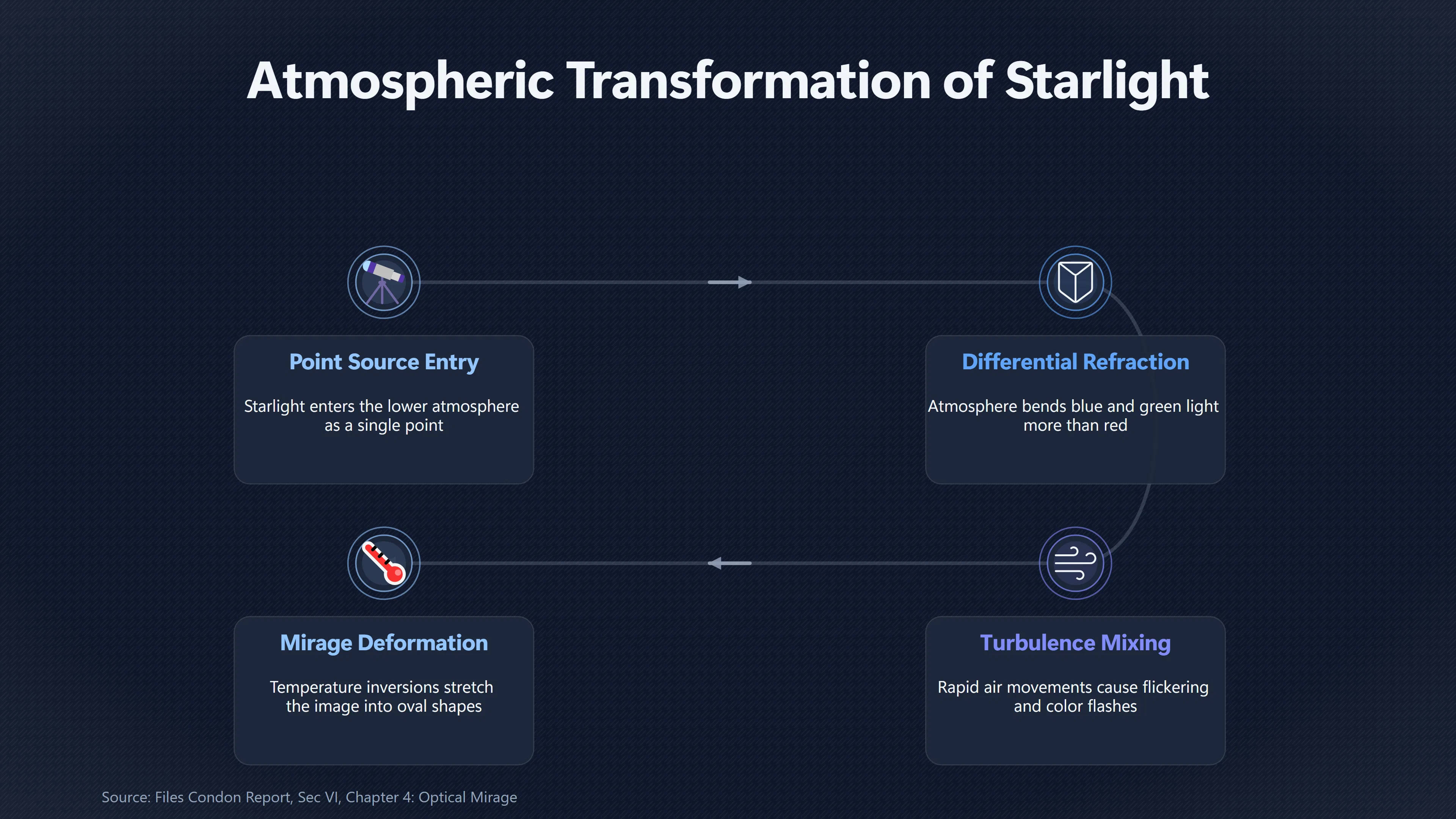
A bright star low on the horizon can look surprisingly unlike a star. Instead of a steady white point, it may flash red, green and blue, jump or shimmer, and under unusually strong refraction become oval, vertically stretched or fringed with colour. In the right circumstances, that combination can resemble a compact aerial object carrying coloured lights rather than an astronomical source.
The effect is strongest near the horizon because the starlight reaches the observer along a much longer path through the lower atmosphere. Turbulence produces rapid scintillation, while larger and more persistent temperature gradients — including inversion layers — can systematically refract and distort the image. The two processes can occur together. The World Meteorological Organization notes that scintillation changes the apparent brightness, colour and position of stars and becomes more pronounced towards the horizon; the Condon UFO study went further, documenting cases in which low astronomical sources acquired coloured fringes and visibly elongated shapes.[International Cloud Atlas]cloudatlas.wmo.intInternational Cloud Atlas Scintillation | International Cloud AtlasInternational Cloud Atlas Scintillation | International Cloud Atlas
Why low-angle starlight is unusually vulnerable
Stars are effectively point sources to the unaided eye. That makes their appearance particularly sensitive to small disturbances in the wavefront of their light. As starlight crosses turbulent regions with slightly different temperatures and densities, variations in refractive index continually redirect and focus or defocus parts of the incoming light. The result is atmospheric scintillation: the familiar twinkling of a star, but potentially much stronger near the horizon. The World Meteorological Organization defines the phenomenon as rapid variations in light and specifically says that a star’s apparent brilliance, colour and position can all vary.[International Cloud Atlas]cloudatlas.wmo.intInternational Cloud Atlas Scintillation | International Cloud AtlasInternational Cloud Atlas Scintillation | International Cloud Atlas
Viewing angle matters enormously. A star overhead is observed through a comparatively short atmospheric path. Near the horizon, its light crosses much more air and encounters more opportunities for turbulence and refractive gradients to alter what reaches the observer. That is why a conspicuous star such as Sirius can sparkle violently when low but become substantially steadier and whiter as it climbs. Sirius is especially noticeable because it is the brightest star in the night sky; observers commonly report its low-altitude scintillation as flashes of different colours.[EarthSky]earthsky.orgEarth Sky Is Sirius the most luminous star in the sky?Is Sirius the most luminous star in the sky?March 4, 2026…
The Condon study made an important distinction between random refraction, caused by relatively small and rapidly changing atmospheric irregularities, and systematic refraction, produced by larger temperature structures persisting over much greater distances and times. Ordinary stellar scintillation belongs mainly to the first category; mirage-like displacement and deformation belong to the second. A low star viewed through an inversion can be affected by both simultaneously, so a slowly distorted underlying image may also flicker, wander and change colour from moment to moment.[NCAS Files]files.ncas.orgFiles Condon Report, Sec VI, Chapter 4: Optical MirageNCAS FilesCondon Report, Sec VI, Chapter 4: Optical Mirage…
That combination is more relevant to UFO identification than ordinary twinkling alone. The Condon analysis concluded that the most spectacular naked-eye scintillation effects occur for objects close to the horizon, and that they can become particularly conspicuous when superimposed on an image already modified by systematic atmospheric refraction.[NCAS Files]files.ncas.orgFiles Condon Report, Sec VI, Chapter 4: Optical MirageNCAS FilesCondon Report, Sec VI, Chapter 4: Optical Mirage…
How a white point becomes a coloured oval
Colour changes do not require the star itself to vary. Earth’s atmosphere is dispersive: its refractive index depends slightly on wavelength, so blue and green light are bent more strongly than red light. Atmospheric Optics describes the same effect for low Venus, where differently coloured components become displaced relative to one another, and notes that stars are subject to the same wavelength-dependent refraction.[Atoptics]atoptics.co.ukAtoptics Goodbye HesperusGoodbye HesperusDecember 16, 2024…
For a star high in the sky, the separation is normally too small to notice with the unaided eye. Towards the horizon, differential refraction grows. The Condon study’s optical treatment described red as being refracted less than green and blue-violet and found that visible colour separation is especially favoured for tiny bright sources close to the horizon.[NCAS Files]files.ncas.orgFiles Condon Report, Sec VI, Chapter 4: Optical MirageNCAS FilesCondon Report, Sec VI, Chapter 4: Optical Mirage…
Turbulence then makes the effect dynamic. Different packets of air continually change the path and focusing of the light, producing momentary red, green, blue or white flashes. Photographs of low Sirius demonstrate how conspicuous this can become, while astronomical research confirms that atmospheric dispersion contributes to colour-dependent scintillation away from the zenith.[EarthSky]earthsky.orgEarth Sky Sirius in many colors | Astronomy Essentials | Earth SkySirius in many colors | Astronomy Essentials | EarthSkyDecember 15, 2017…
A strong inversion can add something more unusual: shape. If the refractive gradient changes sharply with altitude, rays arriving from slightly different directions are displaced by different amounts. Mirage images can therefore be stretched vertically or horizontally, compressed, duplicated or otherwise distorted. For a point-like astronomical source, the perceptual result need not resemble a textbook star at all. The Condon atmospheric-optics chapter specifically records apparent stretching as a normal characteristic of mirage images and notes that small bright images affected by scintillation can appear to blink, oscillate and change colour.[NCAS Files]files.ncas.orgFiles Condon Report, Sec VI, Chapter 4: Optical MirageNCAS FilesCondon Report, Sec VI, Chapter 4: Optical Mirage…
This helps explain why eyewitness language such as “oval”, “elliptical”, “flashing red and green” or “coloured underneath” does not by itself establish that the source possessed a physical structure. Under strong low-angle refraction, apparent shape and colour can be properties of the optical path rather than of the distant object.
There is also an important limit to the explanation. A temperature inversion is not a universal mechanism for turning any star anywhere in the sky into a large object. The geometry strongly favours shallow viewing angles. An astronomical object tens of degrees above the horizon is a much poorer candidate for severe inversion-related deformation than a bright source only a few degrees above it.[NCAS Files]files.ncas.orgFiles Condon Report, Sec VI, Chapter 4: Optical MirageNCAS FilesCondon Report, Sec VI, Chapter 4: Optical Mirage…

The Condon case with an oval star and red fringe
One of the clearest historical examples appears in Gordon Thayer’s optical and radar analysis for the University of Colorado’s Condon study. In the relevant case, investigators considered an astronomical source close to the horizon while meteorological evidence indicated an elevated warm layer and cooler, moister air associated with Lake Superior. That arrangement could strengthen an inversion and the accompanying refractive gradient.[NCAS Files]files.ncas.orgFiles Condon Report, Sec III, Chapter 5: Optical & Radar AnalysisNCAS FilesCondon Report, Sec III, Chapter 5: Optical & Radar Analysis…
What makes the case particularly valuable is the reported appearance. Observers did not merely describe conventional twinkling. The Condon analysis recorded strong red-green scintillation, an apparent stretching of the light into a somewhat oval shape, and a red fringe along its lower edge. Thayer concluded that these details could have resulted from strong, irregular refraction in one or more inversion layers.[NCAS Files]files.ncas.orgFiles Condon Report, Sec III, Chapter 5: Optical & Radar AnalysisNCAS FilesCondon Report, Sec III, Chapter 5: Optical & Radar Analysis…
The candidate astronomical source was Lambda Scorpii. Its calculated position and setting time were compatible with the reported direction, allowing for an obstructed local horizon. The investigators therefore had more than a generic claim that “an inversion existed”: they could compare the sighting direction with an actual celestial source and then ask whether the reported distortions were consistent with the atmospheric conditions.[NCAS Files]files.ncas.orgFiles Condon Report, Sec III, Chapter 5: Optical & Radar AnalysisNCAS FilesCondon Report, Sec III, Chapter 5: Optical & Radar Analysis…
The report ultimately characterised the incident as a combination of an unusually scintillating star and anomalous radar propagation associated with a strong elevated atmospheric layer. The radar component belongs to a broader discussion, but the visual evidence is useful here because it preserves exactly the transformation relevant to low-star UFO reports: a stellar source acquiring rapid colour changes, a coloured edge and enough elongation to look less like a point and more like a small luminous object.[NCAS Files]files.ncas.orgFiles Condon Report, Sec III, Chapter 5: Optical & Radar AnalysisNCAS FilesCondon Report, Sec III, Chapter 5: Optical & Radar Analysis…
Other Condon material reinforces the more general identification problem. In a separate multiple-witness school sighting, several observers described oval or star-like lights that flashed and changed colour. Investigators found that the principal object’s direction closely matched Jupiter and attributed its colour changes to scintillation, although they explicitly did not claim that this accounted for every reported aspect of the incident.[NCAS Files]files.ncas.orgFiles Condon Report, Case 6: UFO Sighting Over a SchoolFiles Condon Report, Case 6: UFO Sighting Over a School
That distinction is important. Atmospheric optics can explain particular observed characteristics without automatically explaining an entire complicated UFO narrative.
When the “structured lights” interpretation becomes misleading
Human observers naturally interpret colour and shape as properties of an object. A red patch below a green or white patch can therefore suggest separate lamps; an elongated luminous area can suggest a fuselage or disc; brightness pulsations can suggest intentional flashing. But a refracted point source breaks that everyday assumption because the atmosphere itself can spatially separate colours and continually reshape their apparent distribution.
The Condon study noted that scintillation of a small bright source can produce apparent flashing, side-to-side oscillation and even an impression of motion towards or away from the observer. Its technical analysis placed the strongest naked-eye manifestations close to the horizon, roughly within the lowest part of the sky.[NCAS Files]files.ncas.orgFiles Condon Report, Sec VI, Chapter 4: Optical MirageNCAS FilesCondon Report, Sec VI, Chapter 4: Optical Mirage…
That does not mean every multicoloured stationary UFO is Sirius, Venus or another astronomical object. The more useful lesson is narrower: colour, flicker and modest apparent extension cease to be reliable evidence of physical structure when a brilliant source is being observed at low elevation through strongly refracting air.
Several clues make the stellar interpretation substantially stronger:
- the light remains in approximately the same celestial direction for an extended period;
- its long-term movement is compatible with the normal rising or setting motion of the sky;
- the colour changes are rapid and irregular rather than following a consistent navigation-light sequence;
- the apparent distortion becomes stronger as the source approaches the horizon;
- a bright star or planet occupies the reported direction and elevation at the recorded time; and
- nearby astronomical sources seen higher in the sky appear steadier, because their light traverses a shorter atmospheric path.
Sirius provides an accessible modern demonstration. When low, it can flash conspicuously through several colours; as it rises, the same source becomes less colourful and steadier. Photographic sequences have captured this atmospheric colour variation without requiring any intrinsic change in Sirius itself.[EarthSky]earthsky.orgEarth Sky Is Sirius the most luminous star in the sky?Is Sirius the most luminous star in the sky?March 4, 2026…
What the cases actually establish
The strongest evidence is not that inversion layers can arbitrarily manufacture elaborate aerial craft. It is that a much smaller transformation is physically well established and sometimes sufficient to produce a misleading observation: a distant point of light can cease to look point-like, white and stationary.
Atmospheric scintillation demonstrably changes stellar brightness, colour and apparent position, with stronger effects towards the horizon. Atmospheric dispersion separates colours because different wavelengths refract by different amounts. Larger refractive gradients can deform an image, while turbulence superimposed on that deformation makes it fluctuate. Observations of setting stars from Cerro Tololo likewise show changing atmospheric refraction shifting and distorting their otherwise regular apparent paths close to the horizon.[wmo.int]cloudatlas.wmo.intInternational Cloud Atlas Scintillation | International Cloud AtlasInternational Cloud Atlas Scintillation | International Cloud Atlas
The historical UFO cases add the identification lesson. The Condon material documents exactly the characteristics that can otherwise sound surprisingly object-like: red-green flashing, an oval appearance and a coloured lower fringe. It also shows why a credible identification requires more than recognising those symptoms. Investigators need the object’s azimuth and elevation, observation time, celestial positions and atmospheric conditions. When those independent pieces converge on a low astronomical source, “structured coloured lights” can turn out to be the atmosphere continually redrawing a star.[NCAS Files]files.ncas.orgFiles Condon Report, Sec III, Chapter 5: Optical & Radar AnalysisNCAS FilesCondon Report, Sec III, Chapter 5: Optical & Radar Analysis…
Amazon book picks
Further Reading
Books and field guides related to When a Star Stops Looking Like a Star. Use these as the next step if you want deeper reading beyond the article.
Light and Color in the Outdoors
All of science springs from the observation of nature. In this classic book, the late Professor Minnaert accompanies the reader on a tour...
Color and Light in Nature
We live in a world of optical marvels - from the commonplace but beautiful rainbow, to the rare and eerie superior mirage. But how many o...
NightWatch: A Practical Guide to Viewing the Universe
A practical guide to viewing the universe.
The Backyard Astronomer's Guide
Discusses the practical aspects of stargazing, including how to choose appropriate equipment, contending with light pollution, taking suc...
eBay marketplace picks
Marketplace Samples
Live-tested eBay searches with available results related to this page.
Selected fromUFO poster oneBay.co.uk.
Current eBay listing
I Want To Believe UFO Poster Giclée Fine Art Heavyweight Print
Current eBay listing
VINTAGE UFO FLYING SAUCERS COMIC ADVERTISING A2 POSTER PRINT
Endnotes
1.
Source: files.ncas.org
Title: Files Condon Report, Sec VI, Chapter 4: Optical Mirage
Link:https://files.ncas.org/condon/text/s6chap04.htm
Source snippet
NCAS FilesCondon Report, Sec VI, Chapter 4: Optical Mirage...
2.
Source: earthsky.org
Title: Earth Sky Is Sirius the most luminous star in the sky?
Link:https://earthsky.org/astronomy-essentials/is-sirius-the-most-luminous-star-in-the-sky/
Source snippet
Is Sirius the most luminous star in the sky?March 4, 2026...
Published: March 4, 2026
3.
Source: earthsky.org
Link:https://earthsky.org/tonight/brightest-stars-midnight-culmination-new-years-eve/
4.
Source: earthsky.org
Title: Earth Sky Sirius in many colors | Astronomy Essentials | Earth Sky
Link:https://earthsky.org/todays-image/photo-sirius-in-many-colors/
Source snippet
Sirius in many colors | Astronomy Essentials | EarthSkyDecember 15, 2017...
Published: December 15, 2017
5.
Source: files.ncas.org
Title: Files Condon Report, Sec III, Chapter 5: Optical & Radar Analysis
Link:https://files.ncas.org/condon/text/s3chap05.htm
Source snippet
NCAS FilesCondon Report, Sec III, Chapter 5: Optical & Radar Analysis...
6.
Source: files.ncas.org
Title: Files Condon Report, Case 6: UFO Sighting Over a School
Link:https://files.ncas.org/condon/text/case06.htm
7.
Source: earthsky.org
Title: Look for the colors of the stars in the night sky
Link:https://earthsky.org/tonight/can-you-see-the-different-colors-of-the-stars/
8.
Source: earthsky.org
Title: See Sirius, the brightest star in the night sky
Link:https://earthsky.org/brightest-stars/sirius-the-brightest-star/
9.
Source: earthsky.org
Title: See brightest star, Sirius, in your morning sky
Link:https://earthsky.org/tonight/the-skys-brightest-star-sirius-before-dawn/
10.
Source: earthsky.org
Title: The return of Sirius in the morning signals seasonal change
Link:https://earthsky.org/tonight/orion-heralds-return-of-sirius/
12.
Source: earthsky.org
Title: Flashing star in autumn? Here are 3 candidates
Link:https://earthsky.org/astronomy-essentials/flashing-star-autumn-capella-arcturus-sirius/
13.
Source: earthsky.org
Title: Colors of Betelgeuse in a star collage
Link:https://earthsky.org/todays-image/colors-of-betelgeuse/
14.
Source: earthsky.org
Title: The colors of stars | Today’s Image | Earth Sky
Link:https://earthsky.org/todays-image/colors-of-stars-rigel-betelgeuse-sirius-photo/
15.
Source: earthsky.org
Title: Moon, Jupiter on evening February 23 | Sky Archive | Earth Sky
Link:https://earthsky.org/tonight/moon-and-king-planet-jupiter-at-early-evening/
16.
Source: files.ncas.org
Link:https://files.ncas.org/condon/text/case35.htm
17.
Source: files.ncas.org
Link:https://files.ncas.org/condon/text/contents.htm
18.
Source: files.ncas.org
Link:https://files.ncas.org/condon/text/case09.htm
19.
Source: files.ncas.org
Link:https://files.ncas.org/condon/text/s6chap01.htm
20.
Source: files.ncas.org
Link:https://files.ncas.org/condon/text/s3chap01.htm
21.
Source: condon.ncas.org
Link:https://condon.ncas.org/text/intro.htm
22.
Source: files.ncas.org
Link:https://files.ncas.org/condon/text/case53.htm
23.
Source: earthsky.org
Link:https://earthsky.org/search/orions%2Bbelt
24.
Source: files.ncas.org
Link:https://files.ncas.org/condon
25.
Source: files.ncas.org
Title: appndx b
Link:https://files.ncas.org/condon/text/appndx-b.htm
26.
Source: files.ncas.org
Link:https://files.ncas.org/condon/text/case52.htm
27.
Source: files.ncas.org
Link:https://files.ncas.org/condon/text/case51.htm
28.
Source: files.ncas.org
Link:https://files.ncas.org/condon/text/case46.htm
29.
Source: cloudatlas.wmo.int
Title: International Cloud Atlas Scintillation | International Cloud Atlas
Link:https://cloudatlas.wmo.int/scintillation.html
30.
Source: atoptics.co.uk
Title: Atoptics Goodbye Hesperus
Link:https://atoptics.co.uk/blog/goodbye-hesperus/
Source snippet
Goodbye HesperusDecember 16, 2024...
Published: December 16, 2024
31.
Source: astronomy.com
Title: Why do some stars appear to twinkle while others don’t?
Link:https://www.astronomy.com/observing/why-do-some-stars-appear-to-twinkle-while-others-dont/
32.
Source: atoptics.co.uk
Link:https://atoptics.co.uk/blog/opod-many-coloured-venus/
33.
Source: atoptics.co.uk
Link:https://www.atoptics.co.uk/blog/opod-twinkling/
34.
Source: atoptics.co.uk
Link:https://atoptics.co.uk/blog/opod-moon-illusion/
35.
Source: atoptics.co.uk
Title: Chromatic Glitter
Link:https://atoptics.co.uk/blog/chromatic-glitter/
36.
Source: atoptics.co.uk
Title: Green Flash….Up Close
Link:https://atoptics.co.uk/blog/green-flash-up-close-opod/
37.
Source: atoptics.co.uk
Title: Green Rim
Link:https://www.atoptics.co.uk/blog/green-rim/
38.
Source: atoptics.co.uk
Title: Vocanic ash and sunsets
Link:https://atoptics.co.uk/blog/vocanic-ash-and-sunsets/
39.
Source: atoptics.co.uk
Title: Why is the Sky Blue?
Link:https://www.atoptics.co.uk/blog/why-is-the-sky-blue/
40.
Source: atoptics.co.uk
Link:https://atoptics.co.uk/fz807.htm
41.
Source: atoptics.co.uk
Title: Flattened Suns
Link:https://atoptics.co.uk/blog/flattened-suns/
42.
Source: atoptics.co.uk
Title: loured Lamps?
Link:https://atoptics.co.uk/blog/coloured-lamps/
43.
Source: astronomy.com
Title: Simply Scintillating | Astronomy.com
Link:https://www.astronomy.com/science/simply-scintillating/
44.
Source: nuforc.org
Link:https://nuforc.org/sighting/?id=69187
45.
Source: cloudatlas.wmo.int
Link:https://cloudatlas.wmo.int/en/scintillation.html
46.
Source: gb.nrao.edu
Link:https://www.gb.nrao.edu/GBTopsdocs/primer/scintillation.htm
47.
Source: new.expo.uw.edu
Link:https://new.expo.uw.edu/expo/apply/736/proceedings/result?mentor_name=Hope+M+Sisley
Additional References
48.
Source: ufotransparency.com
Title: decade 1960s condon report 1968 ad0680975
Link:https://ufotransparency.com/files/decade-1960s-condon-report-1968-ad0680975
Source snippet
UFO TransparencyThe Condon Report (DTIC AD0680975), University of Colorado / U.S. Air Force (sponsor) · 1969 · UFO Transparency...
49.
Source: weather.gov
Link:https://www.weather.gov/fgz/Rainbow
50.
Source: weather.gov
Link:https://www.weather.gov/owlie/weird-weather
51.
Source: weather.gov
Link:https://www.weather.gov/lmk/twilight-types?lv=true
52.
Source: weather.gov
Link:https://www.weather.gov/arx/why_halos_sundogs_pillars
53.
Source: weather.gov
Link:https://www.weather.gov/fgz/SkyBlue
54.
Source: science.gov
Link:https://www.science.gov/topicpages/m/magnetized%2Bstrange%2Bstar
55.
Source: science.gov
Link:https://www.science.gov/topicpages/w/water%2Bcolumn%2Bdensity
56.
Source: science.gov
Link:https://www.science.gov/topicpages/w/water%2Bcolumn%2Bstructure
57.
Source: science.gov
Link:https://www.science.gov/topicpages/z/zodiac%2Btessellation%2Bimproved