Within Searchlights
Why You May Never See the Searchlight
A cloud patch may glow brilliantly even when the beam beneath it and the distant ground projector remain nearly invisible.
On this page
- Why clouds scatter more light than clear air
- How terrain and buildings conceal the projector
- Why the bright spot can appear far from its source
Page outline Jump by section
Introduction
A bright patch on a cloud can be conspicuous even when the searchlight producing it is effectively invisible. That apparent contradiction is one of the reasons searchlight displays can generate UFO or UAP reports: the observer sees the effect — a brilliant disc, oval or fuzzy patch apparently moving across the clouds — without seeing a luminous column leading back to a recognisable lamp on the ground. BBC Sky at Night describes precisely this failure mode: searchlights viewed from miles away can leave only bright white spots visible while the intervening beam is too weak to notice.[Sky at Night Magazine]skyatnightmagazine.comMay 11, 2026…
There is no optical requirement for the whole path of a light beam to be visible. The beam must scatter sufficient light towards the observer’s eyes. A cloud supplies an enormous concentration of water droplets that can do this efficiently, whereas relatively clear air below may scatter far less light. Buildings, hills, trees and the horizon can then hide the ground installation altogether. The result is a luminous cloud patch that appears to have no source — and may consequently look much more like an independent aerial object than a projected spot.
Why clouds reveal light that clear air does not
The crucial distinction is between light travelling through the air and light scattered towards an observer. A person standing to one side of a searchlight does not see most of the light travelling along the beam because it is moving in another direction. The beam becomes conspicuous from the side only when molecules, aerosols, dust, smoke or water droplets redirect some of that light towards the observer. This is why theatrical light beams are deliberately used with haze or smoke, and why a laser or torch beam can be difficult to see sideways in clean air while its spot on a wall remains obvious. An explanation from West Texas A&M University makes the underlying point explicitly: a beam viewed from the side becomes visible because matter in its path scatters light towards the eye.[West Texas A&M University]wtamu.eduWest Texas A&M UniversityHow bright is a laser beam when viewed from the side? | Science Questions with Surprising AnswersFebruary 14, 2013…
Clouds provide a much better scattering target. The US National Weather Service defines atmospheric scattering as the diffusion or deflection of a light beam by suspended particles and identifies the scattering associated with relatively large particles as the process responsible for the familiar white appearance of clouds.[National Weather Service]forecast.weather.govNational Weather Service NOAA's National Weather ServiceNational Weather ServiceNOAA's National Weather Service - Glossary… The Met Office similarly explains that the millions of water droplets in a cloud scatter visible wavelengths efficiently.[Met Office]weather.metoffice.gov.ukMet Office Why are clouds white?Met OfficeWhy are clouds white? - Met Office…
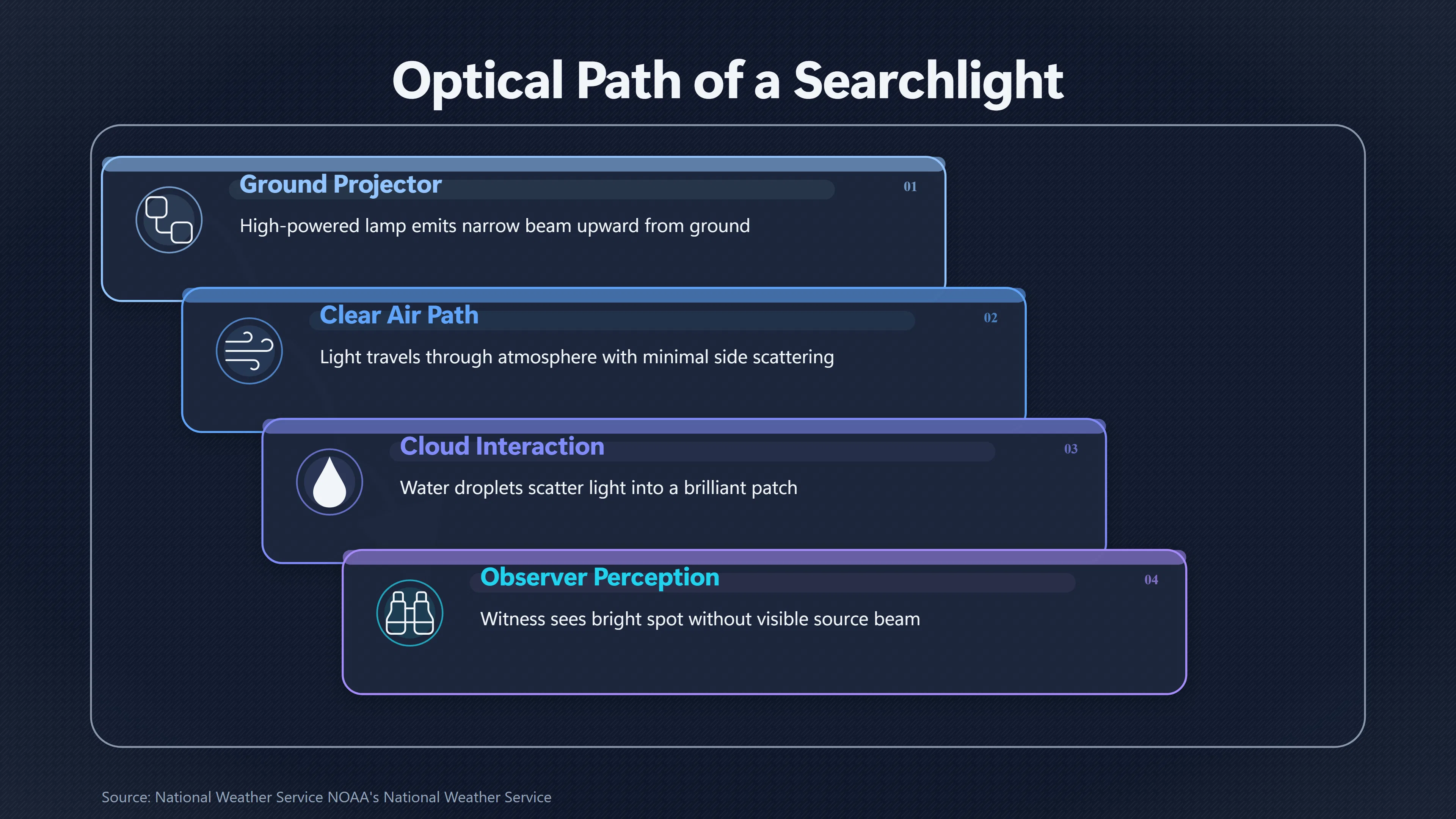
That produces an important visual imbalance. The lower atmosphere between projector and cloud may contain enough particles to make a faint beam detectable under favourable conditions, but the dense collection of droplets at the cloud base can produce a much brighter endpoint. An observer may therefore perceive something like this:
invisible projector → barely visible or invisible beam → brilliant cloud patch
This is not merely a theoretical possibility. Before laser instruments became standard, meteorologists deliberately exploited it. A device known as a ceiling light or ceiling projector used a searchlight to project a narrow beam upwards, forming an illuminated spot on the cloud base. An observer at a known distance measured the angle to that spot and calculated the cloud height by triangulation. The American Meteorological Society describes exactly this arrangement.[Glossary of Meteorology]glossary.ametsoc.orgGlossary of Meteorologyceiling lightGlossary of Meteorology… A 1939 paper in the Journal of the Optical Society of America even analysed the apparent brightness of the projected cloud spot under different atmospheric conditions.[Optica Publishing Group]opg.optica.orgPublishing Group On the Theory of the Ceiling Projector*Optica Publishing GroupOn the Theory of the Ceiling Projector*August 1, 1939…
In other words, the seemingly peculiar UFO scenario — a bright light apparently sitting on or in a cloud while its origin remains unclear — is closely related to a once-routine meteorological measurement technique.
Clouds can also amplify artificial illumination much more generally. Measurements in and around Berlin found that cloud cover increased night-sky luminance by a factor of 10.1 at one urban location and 2.8 at a site 32 kilometres from the city centre.[PubMed Central (PMC)]pmc.ncbi.nlm.nih.govPubMed Central (PMC)Cloud Coverage Acts as an Amplifier for Ecological Light Pollution in Urban Ecosystems - PMCMarch 2, 2011… Other research likewise describes clouds as particularly effective at scattering artificial light from the ground and finds that cloud-base height and cloud properties materially affect night-sky brightness.[ScienceDirect]sciencedirect.comScienceDirect The impact of clouds on the brightness of the night skyScienceDirect The impact of clouds on the brightness of the night sky These studies concern diffuse skyglow rather than a narrow searchlight spot, but they demonstrate the same important principle: clouds can make upward-directed artificial light dramatically more conspicuous than it would be in clear conditions.
How the projector disappears from view
Even if an observer correctly suspects a searchlight, looking beneath the luminous patch may reveal no obvious lamp. That absence is weak evidence against the searchlight explanation because the cloud and projector occupy very different lines of sight.
A ground projector can be hidden by ordinary obstacles: buildings, woodland, ridges, embankments or intervening urban development. The beam, however, rises above those obstructions and can strike a cloud that remains plainly visible to the observer. This is the same elementary line-of-sight principle that allows someone to see the upper portion of a distant tower while its base is concealed.
Distance makes the separation more pronounced. For an observer with eyes about 1.7 metres above level ground, the purely geometric horizon is only about 4.7 kilometres away; elevated terrain changes that figure, and atmospheric refraction modifies it somewhat.[Pearson]pearson.comEarth Curvature Calculator | Drop, Hidden Height & Horizon DistanceEarth Curvature Calculator | Drop, Hidden Height & Horizon Distance A powerful light installation can therefore be below, behind or among foreground obstructions while its illumination reaches a cloud layer hundreds or thousands of metres above the ground.
Real searchlight displays need not be immediately local. BBC Sky at Night notes that searchlights associated with clubs, theme parks and festivals can resemble mysterious moving objects when viewed from several miles away.[Sky at Night Magazine]skyatnightmagazine.comMay 11, 2026… A specialist catalogue of artificial light phenomena similarly notes that powerful xenon searchlight displays have been visible from substantial distances and specifically identifies clear air beneath clouds as a circumstance in which the beam itself may disappear from view while cloud spots remain visible.[Caelestia]caelestia.beSearchlights, light shows and laser beamsSearchlights, light shows and laser beams
This creates a common investigative trap: “I looked underneath the lights and there was nothing there.” That test assumes the projector should be directly beneath the apparent patch from the witness’s viewpoint. It often is not.
Why the bright spot can appear far from its source
A searchlight aimed vertically produces a cloud spot roughly above the projector. Tilt the beam, however, and the illuminated point moves sideways across the cloud base. The ground source and apparent aerial light can then be separated by a considerable horizontal distance.
The old cloud-height instruments demonstrate the geometry particularly clearly. Their operation depended on the fact that the projector, observer and illuminated cloud spot formed a triangle.[Glossary of Meteorology]glossary.ametsoc.orgGlossary of Meteorologyceiling lightGlossary of Meteorology… For an entertainment searchlight the same geometry works in reverse: instead of calculating the cloud height from the projected spot, the changing beam angle determines where the spot appears.
A simple example shows why this matters. Suppose a roughly level cloud base is 1,000 metres above a projector. Ignoring terrain and Earth curvature over such a short distance, a beam tilted 45 degrees from vertical meets that cloud approximately 1,000 metres horizontally from the lamp. At 60 degrees from vertical, the intersection is roughly 1.7 kilometres away. With higher clouds, the displacement grows proportionally.
That means searching the ground directly beneath the observed glow can lead investigators to the wrong neighbourhood entirely. Perspective makes the problem harder because a distant witness normally does not know the cloud’s exact altitude, slope or distance. The luminous patch supplies few reliable depth cues, so a light projected onto a cloud several kilometres away may simply look like a self-luminous object somewhere in the sky.
The geometry also explains why the apparent object can move so dramatically without the source moving at all. Only the direction of the beam needs to change. A modest rotation of a motorised fixture can sweep its intersection point rapidly across a distant cloud surface. Nothing physical has to travel between the two positions.
Why “there was no beam” is a poor exclusion test
For UFO identification, the most important lesson is that beam visibility is conditional rather than compulsory. The absence of an obvious shaft of light does not establish that the cloud patch is self-luminous.
Atmospheric conditions can change the appearance even during one observation. More haze, mist or aerosol beneath the cloud makes side-scattering stronger and may reveal part of the beam; cleaner air can make the same path much less conspicuous. Meanwhile the cloud remains an efficient scattering surface. Experimental demonstrations of light scattering routinely add fog or dust specifically to make beams visible from the side.[Instructional Resources]instructional-resources.physics.uiowa.eduInstructional Resources8B30.95Instructional Resources8B30.95
This also explains why witness descriptions can differ. Someone closer to the projector, or viewing the beam from a more favourable angle, may report obvious searchlights. Another observer several kilometres away may see only luminous discs on the clouds. Neither description has to be inaccurate: they are viewing different parts of the same optical system through different atmospheric paths.
Cloud thickness further complicates matters. A projected spot can intensify where the beam encounters optically thicker cloud, fade on thinner material and vanish at a break in the deck. Research into artificial night lighting confirms that cloud optical properties and cloud-base height materially alter how ground light is redistributed.[ScienceDirect]sciencedirect.comScienceDirect The impact of clouds on the brightness of the night skyScienceDirect The impact of clouds on the brightness of the night sky To a witness who cannot see the projector, those changes can look as though an aerial light is brightening, dimming or disappearing under its own control.
The hidden-source illusion in UFO reports
Searchlights have a documented place among conventional causes considered in UFO investigations. A US National Archives account of Project Blue Book records lists searchlights among the human-created phenomena responsible for identified reports, alongside aircraft, balloons, satellites and flares.[Pieces of History]prologue.blogs.archives.govPieces of History UFOs: Natural Explanations – Pieces of HistoryPieces of History UFOs: Natural Explanations – Pieces of History The US Air Force records that Project Blue Book investigated 12,618 sightings between 1947 and 1969, of which 701 ultimately remained classified as unidentified; the existence of that residual category does not alter the fact that many other reports received conventional explanations.[Secrets Declassified]secretsdeclassified.af.milOpen source on af.mil.
Modern examples show that the confusion has not disappeared with familiarity. In April 2026, high-powered searchlights being tested for a wedding near Darwin, Australia, generated widespread UFO speculation and reports to police. The lighting operator said people were seeing the display from communities kilometres from the installation.[The Courier-Mail]couriermail.com.auOpen source on com.au. The episode illustrates the broader identification problem: witnesses can encounter the remote optical effect without knowing that an event or lighting installation exists at its actual source.
A useful diagnostic approach therefore does not ask only, “Can I see a beam?” It asks whether the complete behaviour is compatible with projected illumination. Particularly relevant clues include repeated sweeps over the same part of the sky, several spots maintaining coordinated patterns, instantaneous-looking reversals, brightness tied to cloud structure, disappearance at gaps or cloud edges, and recurrence over the same general area.
None of those signs proves a searchlight explanation by itself. Conversely, a vague resemblance to a spotlight should not be used to dismiss a report without checking time, direction, cloud conditions and possible sources. The critical point is narrower: an invisible projector and an invisible beam are entirely compatible with a very visible cloud spot.
That separation between cause and appearance is what makes the phenomenon deceptive. The eye is presented with a compact luminous feature against the sky and naturally treats that feature as the object of interest. In reality, the “object” may be only the one place in a much larger optical arrangement where enough light is being scattered towards the observer to become obvious. The lamp can be kilometres away, screened by ordinary landscape or buildings; the beam can cross comparatively clear air almost unnoticed; and the cloud alone can reveal where that otherwise hidden light finally lands.
Amazon book picks
Further Reading
Books and field guides related to Why You May Never See the Searchlight. Use these as the next step if you want deeper reading beyond the article.
Light and Color in the Outdoors
First published 1993. Subjects: Color, Light, Popular works, Science: General Issues, Photographic equipment & techniques.
Color and Light in Nature
We live in a world of optical marvels - from the commonplace but beautiful rainbow, to the rare and eerie superior mirage. But how many o...
The Cloudspotter's Guide
Discusses the history, types, and cultural fascination with clouds and explains what they mean in terms of climate and weather.
Seeing the Light: Optics in Nature, Photography, Color, Visio...
The clearest and most complete non-mathematical study of light available—with updated material and a new chapter on digital photography....
eBay marketplace picks
Marketplace Samples
Live-tested eBay searches with available results related to this page.
Selected fromUFO poster oneBay.co.uk.
Current eBay listing
VINTAGE UFO FLYING SAUCERS COMIC ADVERTISING A2 POSTER PRINT
Current eBay listing
I Want To Believe UFO Poster Giclée Fine Art Heavyweight Print
Endnotes
1.
Source: forecast.weather.gov
Title: National Weather Service NOAA’s National Weather Service
Link:https://forecast.weather.gov/glossary.php?word=SCATTERING
Source snippet
National Weather ServiceNOAA's National Weather Service - Glossary...
2.
Source: opg.optica.org
Title: Publishing Group On the Theory of the Ceiling Projector*
Link:https://opg.optica.org/josa/abstract.cfm?uri=josa
Source snippet
Optica Publishing GroupOn the Theory of the Ceiling Projector*August 1, 1939...
Published: August 1, 1939
3.
Source: sciencedirect.com
Title: ScienceDirect The impact of clouds on the brightness of the night sky
Link:https://www.sciencedirect.com/science/article/pii/S0022407319308726
4.
Source: sciencedirect.com
Link:https://www.sciencedirect.com/science/article/abs/pii/S002240732300081X
5.
Source: pearson.com
Title: Earth Curvature Calculator | Drop, Hidden Height & Horizon Distance
Link:https://www.pearson.com/channels/calculators/earth-curvature-calculator
6.
Source: caelestia.be
Title: Searchlights, light shows and laser beams
Link:https://www.caelestia.be/lightbeams.html
7.
Source: prologue.blogs.archives.gov
Title: Pieces of History UFOs: Natural Explanations – Pieces of History
Link:https://prologue.blogs.archives.gov/2018/04/16/ufos-natural-explanations/
8.
Source: news.sky.com
Link:https://news.sky.com/story/classified-ufo-files-from-fbi-cia-and-pentagon-released-including-reports-of-glowing-red-orbs-13553433
9.
Source: news.sky.com
Title: bluesky 13553433
Link:https://news.sky.com/story/bluesky-13553433
10.
Source: news.sky.com
Title: what are the ufo clouds seen hanging over uk skies 13291303
Link:https://news.sky.com/story/what-are-the-ufo-clouds-seen-hanging-over-uk-skies-13291303
11.
Source: sciencedirect.com
Link:https://www.sciencedirect.com/science/article/pii/S0022407319309392
12.
Source: sciencedirect.com
Title: Cloud base height estimates from sky imagery and a network of pyranometers
Link:https://www.sciencedirect.com/science/article/pii/S0038092X19303305
13.
Source: opg.optica.org
Link:https://opg.optica.org/ao/abstract.cfm?uri=ao
14.
Source: history.com
Title: Project Blue Book
Link:https://www.history.com/articles/project-blue-book
15.
Source: opg.optica.org
Link:https://opg.optica.org/ao/abstract.cfm?URI=AO-47-34-H39
16.
Source: opg.optica.org
Link:https://opg.optica.org/ao/abstract.cfm?uri=ao
17.
Source: opg.optica.org
Link:https://opg.optica.org/ao/abstract.cfm?uri=ao
18.
Source: sciencedirect.com
Title: Mie Scattering
Link:https://www.sciencedirect.com/topics/earth-and-planetary-sciences/mie-scattering
19.
Source: sciencedirect.com
Title: Atmospheric Optics
Link:https://www.sciencedirect.com/topics/physics-and-astronomy/atmospheric-optics
20.
Source: opg.optica.org
Link:https://opg.optica.org/abstract.cfm?uri=josa
21.
Source: weather.gov
Link:https://www.weather.gov/source/zhu/ZHU_Training_Page/clouds/cloud_development/clouds.htm
22.
Source: forecast.weather.gov
Link:https://forecast.weather.gov/glossary.php?word=s
23.
Source: weather.gov
Link:https://www.weather.gov/owlie/weird-weather
24.
Source: forecast.weather.gov
Link:https://forecast.weather.gov/glossary.php?word=C
25.
Source: forecast.weather.gov
Link:https://forecast.weather.gov/glossary.php?word=CLOUD
26.
Source: forecast.weather.gov
Link:https://forecast.weather.gov/glossary.php?word=clouds
27.
Source: forecast.weather.gov
Link:https://forecast.weather.gov/glossary.php?word=bright+band
28.
Source: weather.gov
Link:https://www.weather.gov/jkl/education
29.
Source: weather.gov
Link:https://www.weather.gov/arx/clouds
30.
Source: forecast.weather.gov
Link:https://forecast.weather.gov/glossary.php?word=r
31.
Source: weather.gov
Link:https://www.weather.gov/fgz/SkyBlue
32.
Source: weather.gov
Link:https://www.weather.gov/ggw/GlossaryM
33.
Source: forecast.weather.gov
Link:https://forecast.weather.gov/glossary.php?word=n
34.
Source: forecast.weather.gov
Link:https://forecast.weather.gov/glossary.php?word=h
35.
Source: weather.gov
Link:https://www.weather.gov/crp/weather_education
36.
Source: forecast.weather.gov
Link:https://forecast.weather.gov/glossary.php?word=a
37.
Source: opg.optica.org
Link:https://opg.optica.org/abstract.cfm?uri=josa
38.
Source: opg.optica.org
Link:https://opg.optica.org/josa/abstract.cfm?uri=josa
39.
Source: skyatnightmagazine.com
Link:https://www.skyatnightmagazine.com/space-science/things-mistaken-for-ufos
Source snippet
May 11, 2026...
Published: May 11, 2026
40.
Source: wtamu.edu
Link:https://www.wtamu.edu/~cbaird/sq/2013/02/14/how-bright-is-a-laser-beam-when-viewed-from-the-side/
Source snippet
West Texas A&M UniversityHow bright is a laser beam when viewed from the side? | Science Questions with Surprising AnswersFebruary 14, 2013...
Published: February 14, 2013
41.
Source: weather.metoffice.gov.uk
Title: Met Office Why are clouds white?
Link:https://weather.metoffice.gov.uk/learn-about/weather/types-of-weather/clouds/why-are-clouds-white
Source snippet
Met OfficeWhy are clouds white? - Met Office...
42.
Source: glossary.ametsoc.org
Title: Glossary of Meteorologyceiling light
Link:https://glossary.ametsoc.org/wiki/ceiling-light/
Source snippet
Glossary of Meteorology...
43.
Source: glossary.ametsoc.org
Title: Glossary of Meteorologycloud-height indicator
Link:https://glossary.ametsoc.org/wiki/cloud-height-indicator/
Source snippet
Glossary of Meteorology...
44.
Source: pmc.ncbi.nlm.nih.gov
Link:https://pmc.ncbi.nlm.nih.gov/articles/PMC3047560/
Source snippet
PubMed Central (PMC)Cloud Coverage Acts as an Amplifier for Ecological Light Pollution in Urban Ecosystems - PMCMarch 2, 2011...
Published: March 2, 2011
45.
Source: pubmed.ncbi.nlm.nih.gov
Link:https://pubmed.ncbi.nlm.nih.gov/21399694/
Source snippet
Cloud coverage acts as an amplifier for ecological light pollution in urban ecosystems - PubMed...
46.
Source: instructional-resources.physics.uiowa.edu
Title: Instructional Resources8B30.95
Link:https://instructional-resources.physics.uiowa.edu/8b3095-forward-backward-and-side-scattering-zodiacal-light
47.
Source: secretsdeclassified.af.mil
Link:https://www.secretsdeclassified.af.mil/Fact-Sheets/Display/Article/459832/project-blue-book/
48.
Source: couriermail.com.au
Link:https://www.couriermail.com.au/news/northern-territory/rural-area-family-wedding-preparations-prompt-ufo-and-alien-fears/news-story/f035279d2574934001e84b4e7e1cbda4
49.
Source: calculator.academy
Title: Horizon Distance Calculator
Link:https://calculator.academy/horizon-distance-calculator/
50.
Source: cal3.calculator.city
Title: city Line Of Site Calculator – Calculator City
Link:https://cal3.calculator.city/line-of-site-calculator/
51.
Source: pubmed.ncbi.nlm.nih.gov
Link:https://pubmed.ncbi.nlm.nih.gov/41171848/
52.
Source: pmc.ncbi.nlm.nih.gov
Link:https://pmc.ncbi.nlm.nih.gov/articles/PMC6361923/
53.
Source: pubmed.ncbi.nlm.nih.gov
Link:https://pubmed.ncbi.nlm.nih.gov/28751661/
54.
Source: pmc.ncbi.nlm.nih.gov
Link:https://pmc.ncbi.nlm.nih.gov/articles/PMC5532222/
55.
Source: science.nasa.gov
Link:https://science.nasa.gov/earth/earth-observatory/aerosols/
56.
Source: pubmed.ncbi.nlm.nih.gov
Link:https://pubmed.ncbi.nlm.nih.gov/19037349/
57.
Source: dictionary.cambridge.org
Link:https://dictionary.cambridge.org/us/dictionary/english/searchlight
58.
Source: dictionary.cambridge.org
Link:https://dictionary.cambridge.org/dictionary/english/searchlight
59.
Source: weather.metoffice.gov.uk
Title: metoffice.gov.uk What are clouds?
Link:https://weather.metoffice.gov.uk/learn-about/met-office-for-schools/other-content/other-resources/what-are-clouds
60.
Source: weather.metoffice.gov.uk
Title: metoffice.gov.uk7 facts about clouds
Link:https://weather.metoffice.gov.uk/learn-about/weather/types-of-weather/clouds/facts-about-clouds
61.
Source: weather.metoffice.gov.uk
Title: metoffice.gov.uk Clouds
Link:https://weather.metoffice.gov.uk/learn-about/weather/types-of-weather/clouds
62.
Source: weather.metoffice.gov.uk
Title: metoffice.gov.uk Optical effects: nature’s light show
Link:https://weather.metoffice.gov.uk/learn-about/weather/optical-effects
63.
Source: weather.metoffice.gov.uk
Title: metoffice.gov.uk Unusual cloud [formations]({{ ‘formations/’ | relative_url }})
Link:https://weather.metoffice.gov.uk/learn-about/weather/types-of-weather/clouds/unusual-cloud-formations
64.
Source: weather.metoffice.gov.uk
Title: metoffice.gov.uk Make a cloud in a glass
Link:https://weather.metoffice.gov.uk/learn-about/met-office-for-schools/other-content/other-resources/experiments/cloud
65.
Source: weather.metoffice.gov.uk
Title: metoffice.gov.uk Low level clouds
Link:https://weather.metoffice.gov.uk/learn-about/weather/types-of-weather/clouds/low-level-clouds
66.
Source: metoffice.gov.uk
Title: Raindrops and [radar]({{ ‘radar/’ | relative_url }})
Link:https://www.metoffice.gov.uk/research/weather/observations-research/raindrops-and-radar
67.
Source: weather.metoffice.gov.uk
Title: metoffice.gov.uk Why the sky is blue and sunsets red
Link:https://weather.metoffice.gov.uk/learn-about/weather/optical-effects/why-is-the-sky-blue
68.
Source: weather.metoffice.gov.uk
Title: metoffice.gov.uk Thunder and lightning
Link:https://weather.metoffice.gov.uk/learn-about/weather/types-of-weather/thunder-and-lightning
69.
Source: weather.metoffice.gov.uk
Title: metoffice.gov.uk Understanding weather
Link:https://weather.metoffice.gov.uk/learn-about/met-office-for-schools/other-content/other-resources/understanding-weather
70.
Source: weather.metoffice.gov.uk
Title: metoffice.gov.uk How we measure visibility
Link:https://weather.metoffice.gov.uk/guides/observations/how-we-measure-visibility
71.
Source: psl.noaa.gov
Title: light beams
Link:https://psl.noaa.gov/outreach/education/activities/light_beams.html
72.
Source: cufos.org
Title: Project Blue Book
Link:https://cufos.org/resources/project-blue-book/
73.
Source: weather.gov.hk
Link:https://www.weather.gov.hk/en/education/earth-science/optical-phenomena/00349-colours-of-clouds.html
74.
Source: ufos.wiki
Title: Crown flash
Link:https://ufos.wiki/investigation/crown-flash/
75.
Source: laserhire.co.uk
Link:https://www.laserhire.co.uk/searchlights.html
Additional References
76.
Source: nature.com
Link:https://www.nature.com/articles/s41598-021-02772-4
77.
Source: nature.com
Link:https://www.nature.com/nature-index/topics/l4/optical-properties-and-light-scattering-of-atmospheric-aerosols
78.
Source: youtube.com
Title: Mr. Kirkman Demonstrates the Tyndall Effect
Link:https://www.youtube.com/watch?v=sZ0iFoJP4mo
Source snippet
A Comparative Study between Laser Beam Ceilometer and Algorithm for Continuous Evaluation...
79.
Source: nist.gov
Link:https://www.nist.gov/publications/amplification-optical-absorption-cross-section-aerosols-soot-nonabsorbing-coating
80.
Source: nist.gov
Link:https://www.nist.gov/publications/measured-wavelength-dependent-absorption-enhancement-internally-mixed-black-carbon
81.
Source: nist.gov
Link:https://www.nist.gov/publications/measurement-gas-and-aerosol-phase-absorption-spectra-across-visible-and-near-ir-using
82.
Source: nist.gov
Link:https://www.nist.gov/publications/large-and-small-scale-structures-and-their-interactions-axisymmetric-jet-nistir-6393
83.
Source: nist.gov
Title: methods and standards measurement atmospheric aerosol radiative properties
Link:https://www.nist.gov/programs-projects/methods-and-standards-measurement-atmospheric-aerosol-radiative-properties
84.
Source: aaro.mil
Link:https://www.aaro.mil/EFOIA-Reading-Room/
85.
Source: aaro.mil
Link:https://www.aaro.mil/Resources/Historical-Record-Reports/Volume-II/